

Key takeaways
- Most of the 10 club ideas use cheap materials: paper, tape, foil, string, straws and cardboard.
- Most end with a number kids can measure, such as height, coins held or seconds of fall.
- Run every session as hook, build, test and share, in about 60 minutes.
- Mixed ages work when older children get a harder target on the same task.
- Celebrate the fix. A tower that falls and gets rebuilt taller is the best moment of the session.
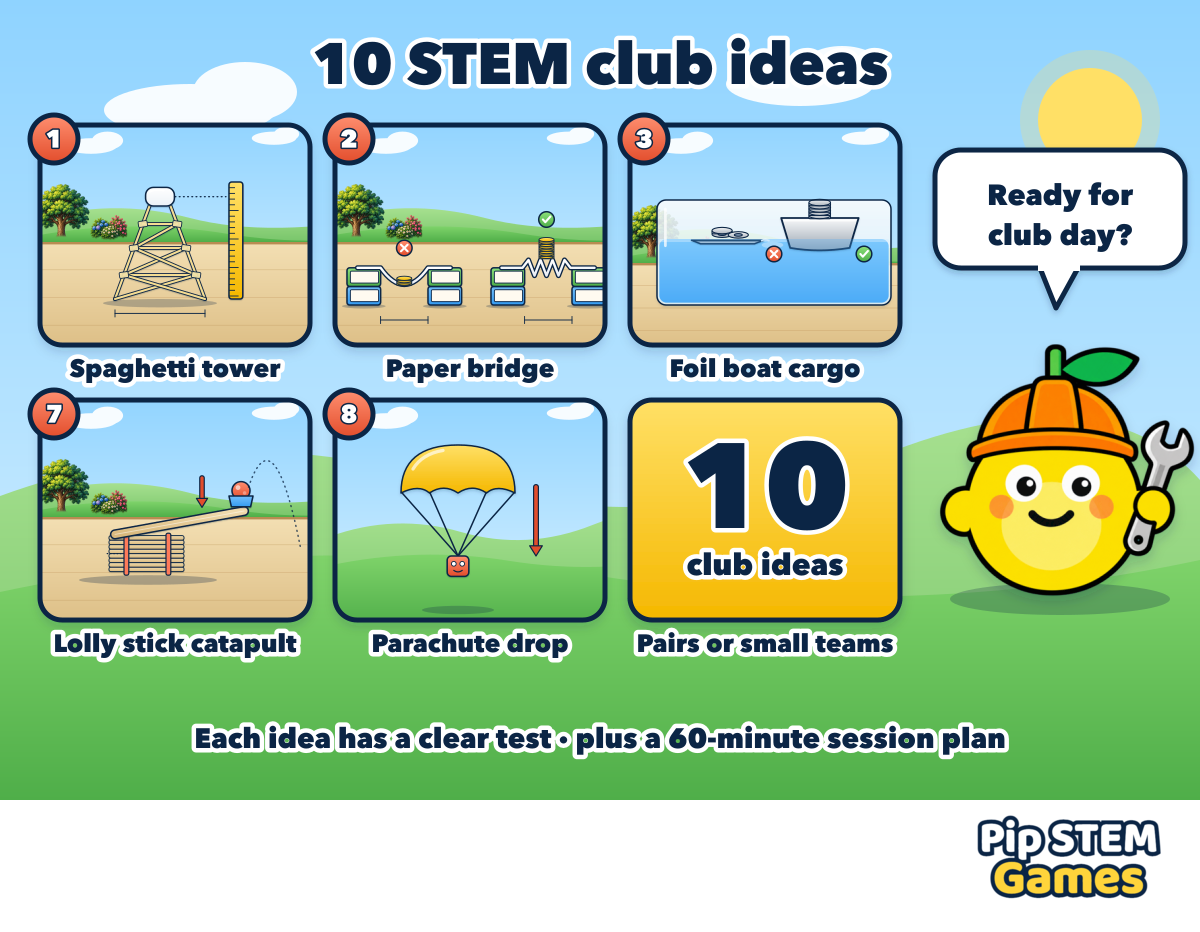
These are 10 STEM club ideas for kids aged 5 to 12, each with a clear test, plus a 60-minute session plan at the end.
1. Spaghetti tower
Ages 5–12 · 45 minutes · teams of 2–3. Teams build the tallest free-standing tower from dry spaghetti, tape and a marshmallow.
You need:
- 10 strands of dry spaghetti per team
- A short length of masking tape per team
- 1 marshmallow per team (check for allergies)
- A ruler
How to do it:
- Give each team the same kit and 20 minutes.
- Teams build a wide base, then bring the strands together as it rises.
- Place the marshmallow on top. The tower must stand alone for 10 seconds.
- Measure each tower, write the height on the board, then run a 10-minute second round.
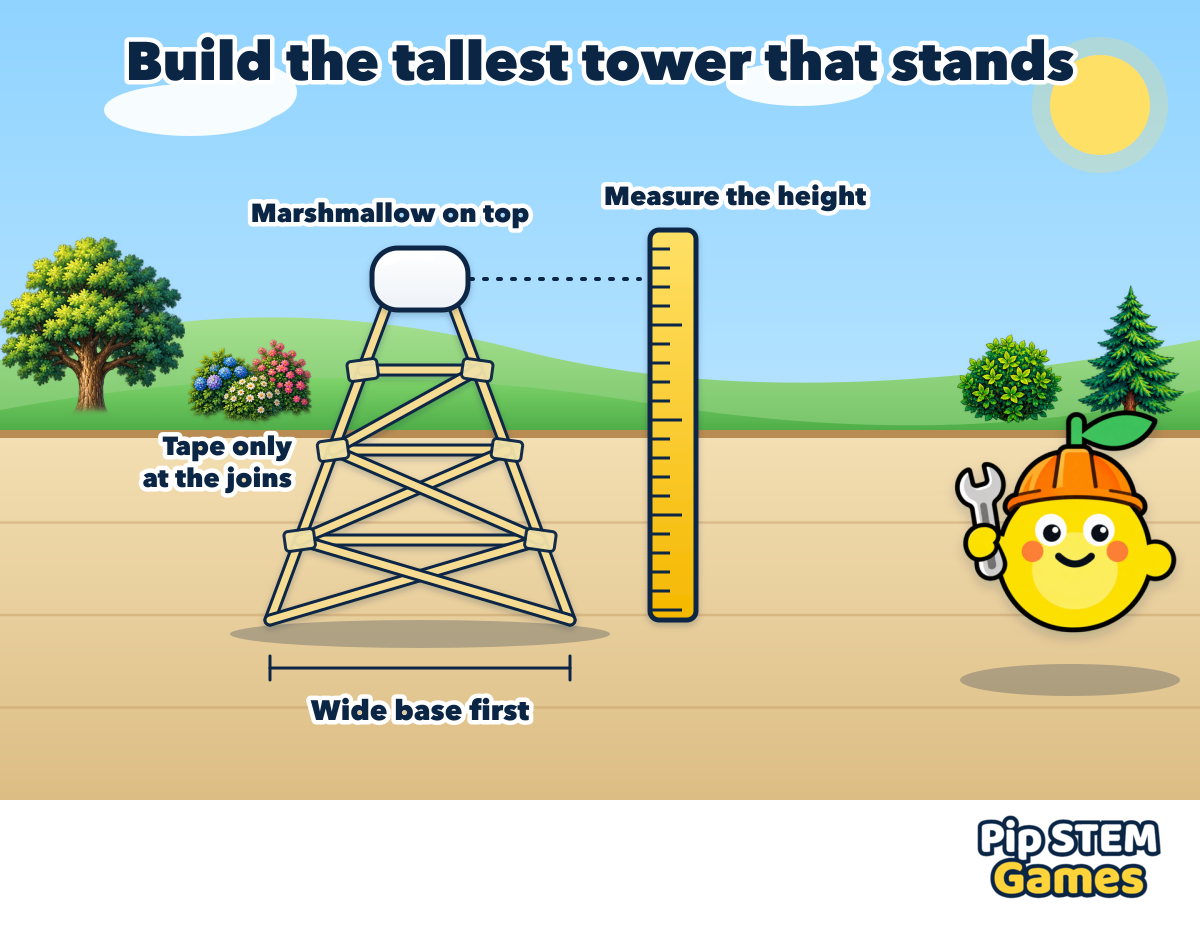
Best first session: it is cheap, quick and everyone gets a number to beat. Younger children can aim for "stands up", older ones for a target height. Rules in the 10 spaghetti tower challenge.
2. One-sheet paper bridge
Ages 5–12 · 30 minutes · pairs. Pairs fold one sheet of paper into a bridge and load it with coins.
You need:
- 1 sheet of paper per pair
- 2 books of the same height per pair
- 20 or more coins per pair (not for under-6s to hold alone)
How to do it:
- Set the books about 10 cm apart, the same for every team.
- Test the sheet flat, adding coins one at a time.
- Fold the sheet into an accordion and test it again.
- Record the count for each design.
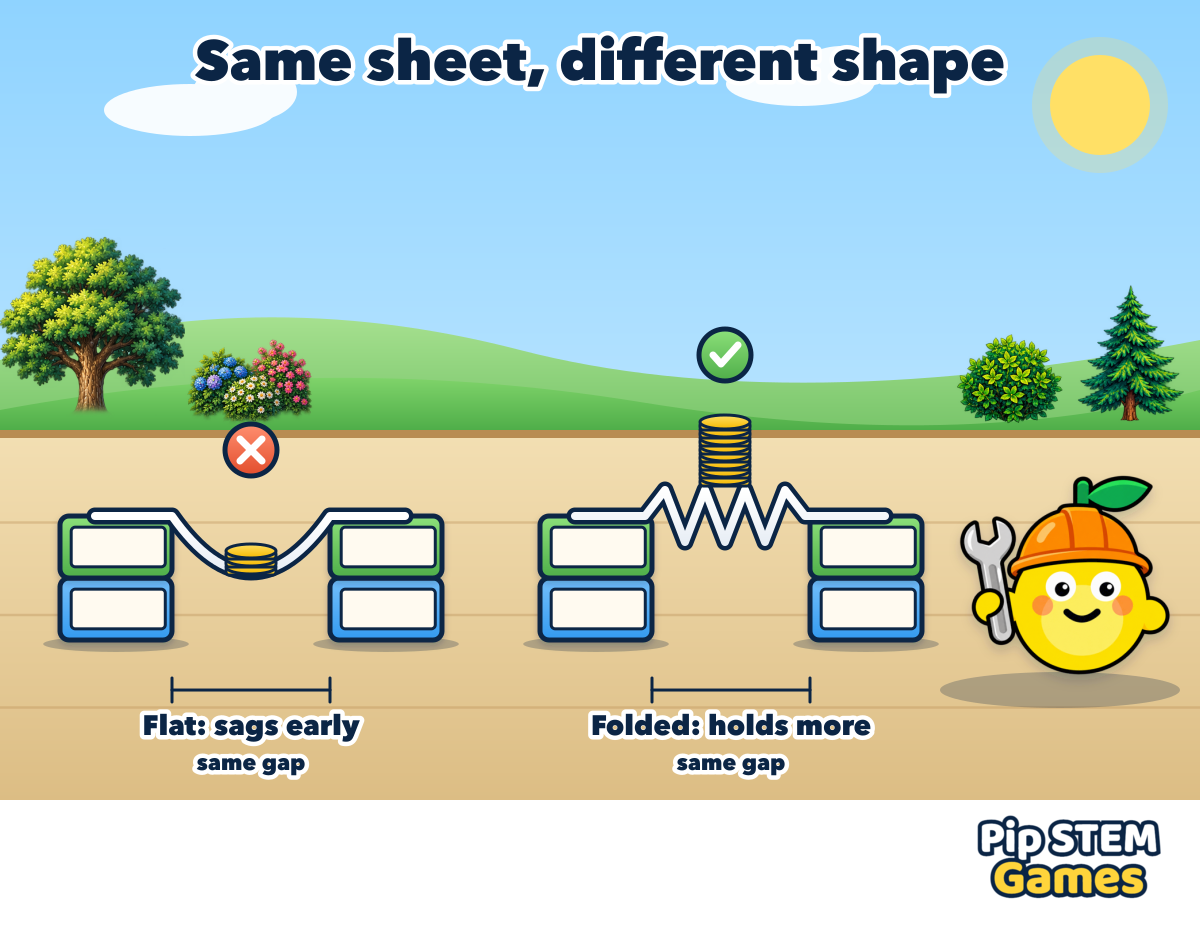
Keep the gap the same for every team so the results are fair. Full steps in can one sheet of paper hold 20 coins.
3. Foil boat cargo
Ages 5–12 · 30 minutes · pairs. Teams fold foil into the boat that carries the most cargo.
You need:
- A shallow basin of water per table, on a stable surface
- Foil squares, all the same size
- Identical washers as cargo
- Towels
How to do it:
- Each pair folds two different boat shapes.
- Float one boat and add washers gently, one at a time.
- Count how many it holds when water first comes in.
- Swap designs and see if another team can beat the count.
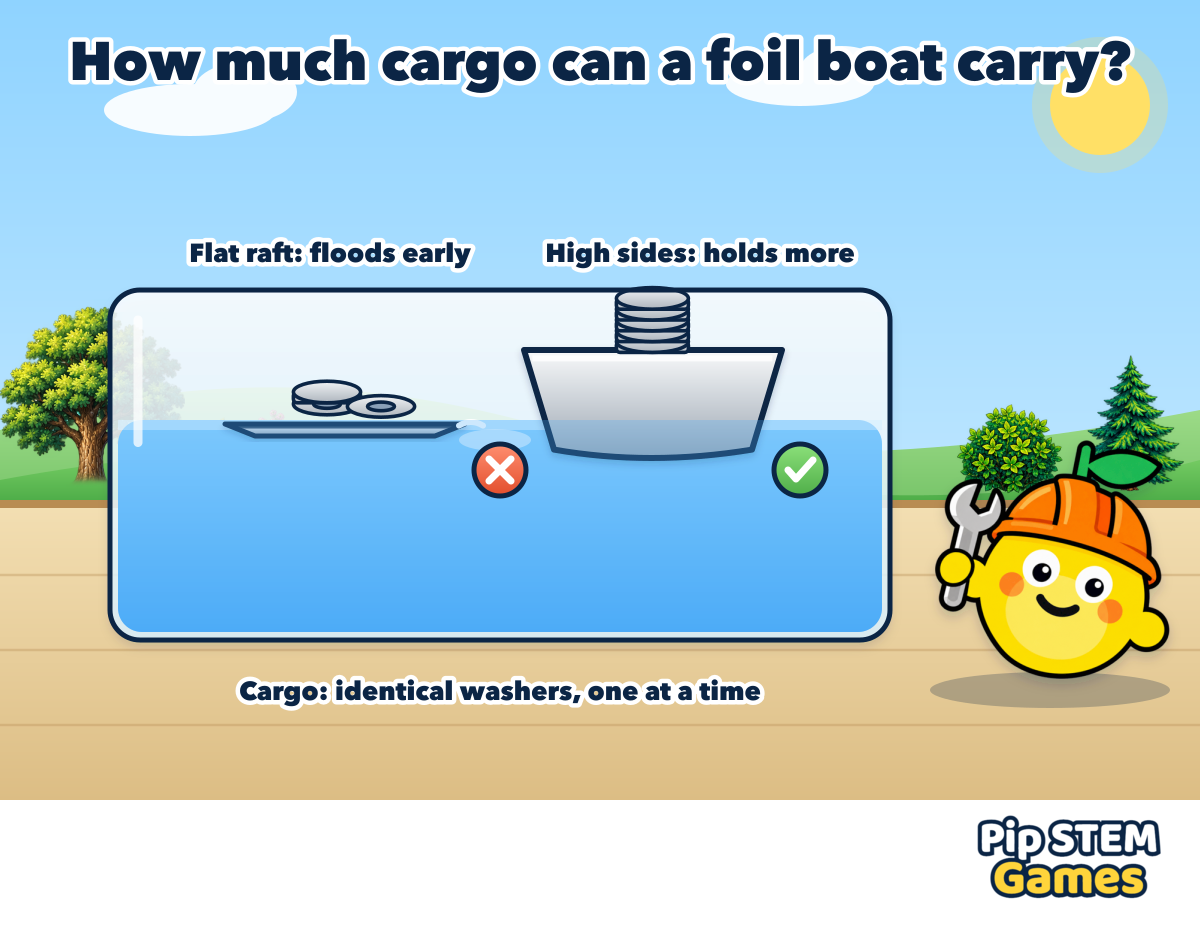
Put towels down first and mop up as you go. Never leave water or small weights unattended. See how to build a boat that actually floats.
4. Balloon car race
Ages 6–12 · 60 minutes · teams of 2–3. Teams build balloon cars and race them along a taped track.
You need:
- Cardboard, 2 straws and 2 blunt axles per team
- 4 bottle tops for wheels
- A balloon, a drinking straw and tape
- A tape measure for the track
How to do it:
- Teams build the car body, axles and wheels.
- Push a drinking straw into the balloon's neck and tape it, then tape the balloon and straw on the car, straw pointing backwards.
- Inflate through the straw, pinch it, and release on a flat floor.
- Measure each run and let teams change one thing before the final race.

Adults inflate balloons for under-8s and keep balloon pieces away from young children. Steps in make a balloon-powered car at home.
5. Pulley lift
Ages 8–12 · 45 minutes · pairs. Pairs fix a pulley and test how smoothly it lifts a load.
You need:
- A small grooved pulley or spool per pair
- String and a very light load
- A sturdy low support fixed by an adult
How to do it:
- An adult fixes each pulley to a sturdy support.
- Thread the string and tie on the load.
- Pull down gently to raise it.
- Add a slightly heavier load and write down whether the pull changes.

Good for ages 8 to 12 who like machines. Never lift people or heavy things. See build a simple pulley with household items.
6. Cardboard marble run
Ages 6–12 · 60 minutes · teams of 2–3. Teams tape a sloped track that guides a marble into a tray.
You need:
- Scrap cardboard and tubes
- Masking tape
- A shallow tray and 1 large marble per team
How to do it:
- Plan a track on paper.
- Tape the sloped track to a box or board.
- Add a turn and a catch tray.
- Test, find where the marble stalls and change one thing.

A calm session that suits mixed ages. Keep marbles large and counted, and pick them all up at the end. See our marble run guide.
7. Lolly stick catapult
Ages 7–12 · 45 minutes · pairs. Pairs build a mini catapult and launch a pom-pom as far as possible.
You need:
- 8 lolly sticks and 4 rubber bands per pair
- A bottle cap and tape
- A pom-pom or paper ball
- A tape measure
How to do it:
- Stack 6 sticks and wrap a rubber band tightly around each end.
- Band 2 sticks together at one end, then spread the other ends into a V.
- Slide the stack between the arm sticks so they cross, then band the crossing point.
- Tape the cap to the arm, add a pom-pom, press down, release and measure. Change one thing and test again.
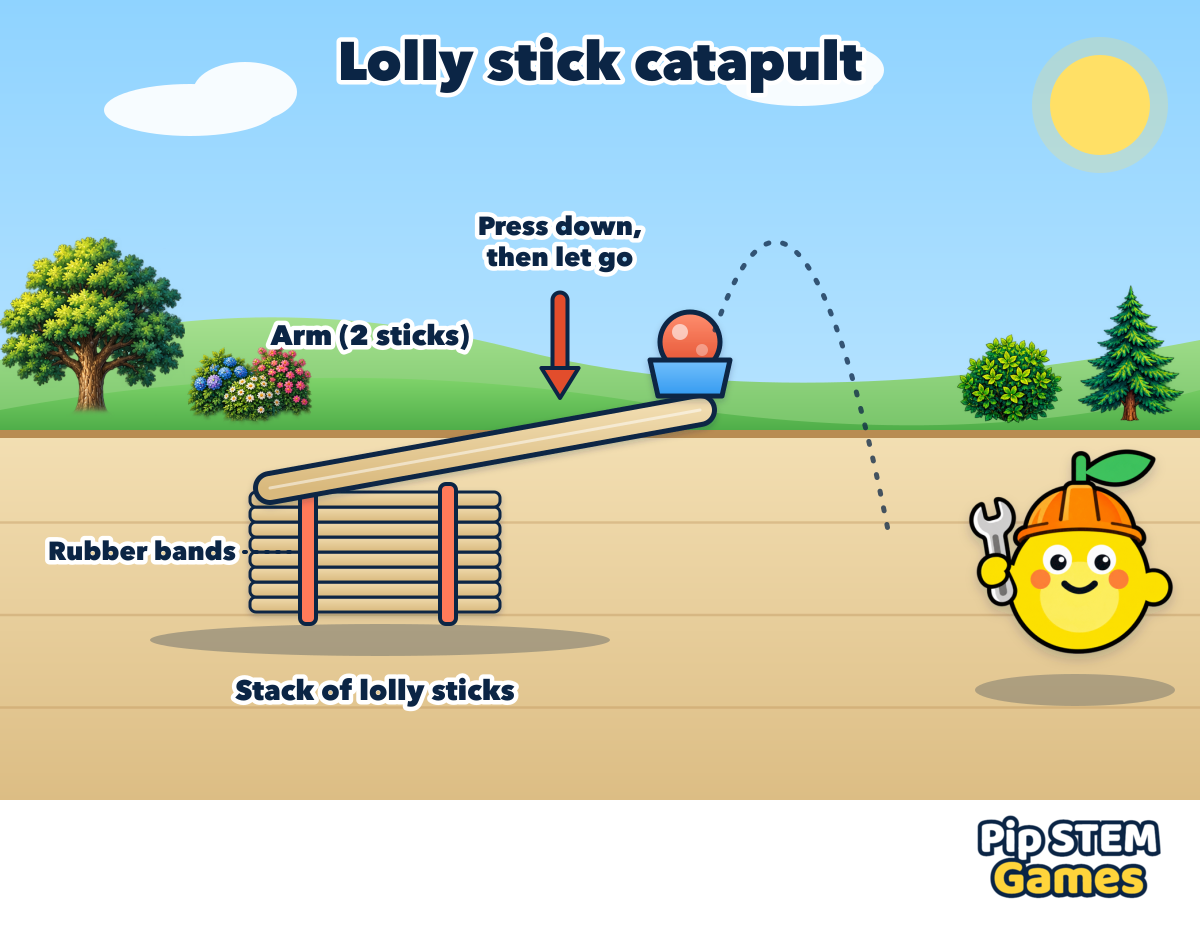
Set a firing line and a no-go zone. Never aim at faces or other children, and keep an adult nearby for rubber bands.
8. Parachute drop
Ages 6–12 · 45 minutes · pairs. Pairs make a parachute that brings a small toy down as slowly as possible.
You need:
- A plastic bag or light fabric, about 30 cm across to start
- 4 pieces of string, all the same length
- A small toy or 2 washers
- A phone stopwatch
How to do it:
- An adult cuts the bag into squares.
- Tie a string to each corner and join them to the load.
- An adult holds each parachute as high as they can reach and drops it.
- Time each fall. Change the canopy size and drop again.
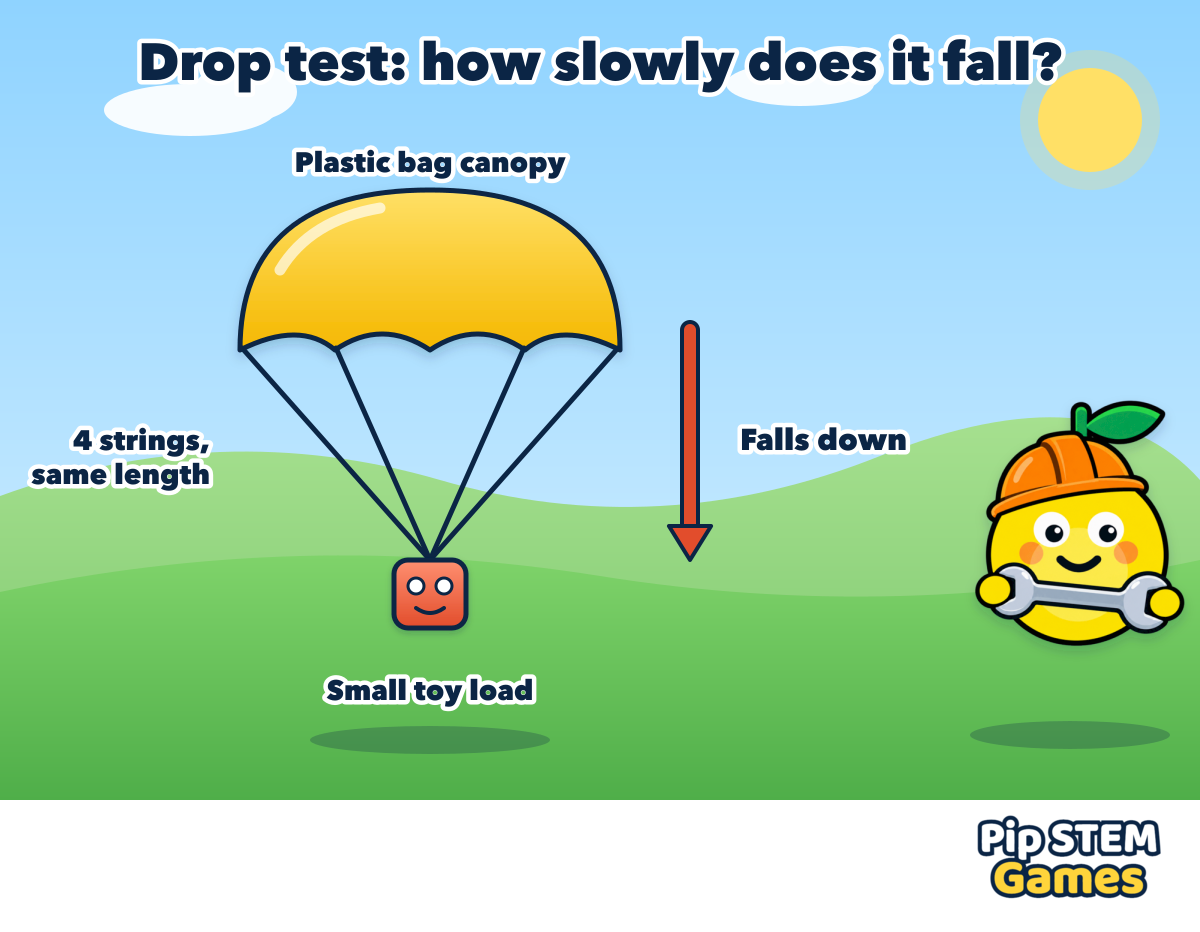
Drop from the same height every time, with feet on the floor. Never drop from a window, stairs or a balcony. Plastic bags are a suffocation risk, so an adult cuts them and keeps them away from under-6s.
9. Wind turbine spin test
Ages 8–12 · 45 minutes · pairs. Pairs compare pinwheels with 4 and 6 blades in front of a fan.
You need:
- Paper squares and a pencil
- A straw and split pins (adult handles)
- A desk fan on low and a phone stopwatch
How to do it:
- Each pair makes a 4-blade and a 6-blade pinwheel.
- An adult sets the fan on low and marks the spots.
- Count the turns in 10 seconds, three times each.
- Find the average and decide which design wins.

Good practice for fair testing and averages. Keep fingers clear of the fan. See make a wind turbine spin faster.
10. Gear direction puzzle
Ages 8–12 · 20 minutes · pairs. Pairs predict which way the last gear in a row turns.
You need:
- Paper and pencils
- Optional cardboard gears and push pins (adult prepares)
How to do it:
- Draw four touching gears labelled A to D.
- Gear A turns clockwise. Draw its arrow.
- Draw each touching gear turning the opposite way.
- Try five gears and write the rule for odd and even.

A quiet warm-up that needs no kit. Try it in the four gear direction challenge.
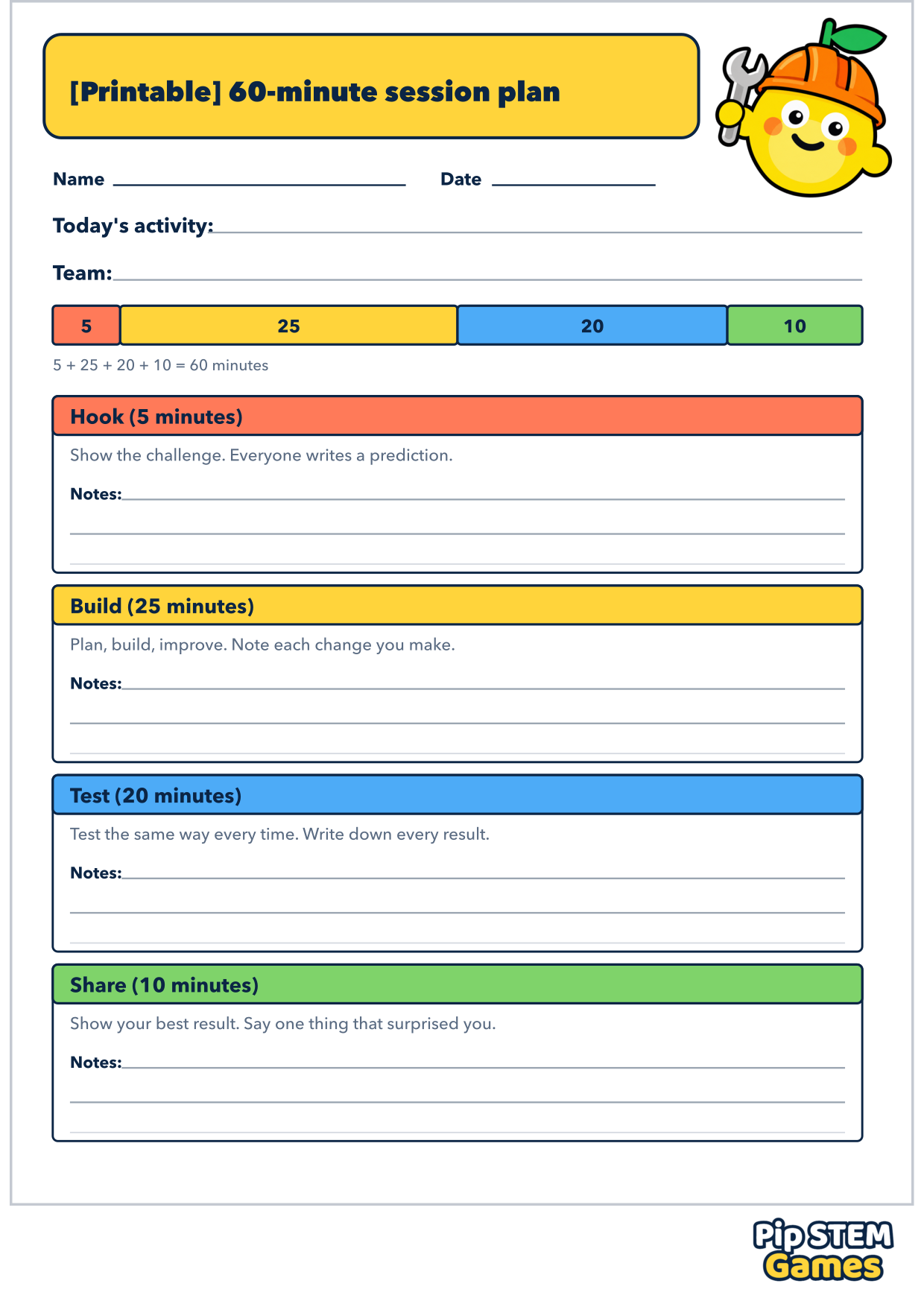
A simple 60-minute session plan
Use the same four parts every week: hook, build, test, share.
- Hook (5 minutes). Show the challenge and one rule.
- Build (25 minutes). Teams of two or three plan and build. Ask questions, not answers.
- Test (20 minutes). Test in turn, measure, and write results on a board.
- Share (10 minutes). Each team names one thing that failed and one change they would make.
For mixed ages, give everyone the same task with harder targets for older children, and pair older and younger kids as planner and builder. Run a six-week programme in this order: spaghetti tower, balloon car, paper bridge, pulley lift, foil boat, then a showcase where teams improve their favourite.
Do a short risk check each week and follow your school or venue supervision rules. Keep coins, marbles, beads and balloon pieces away from under-6s, check for allergies before using marshmallows, and use safety scissors for ages 5 to 7. Early finishers can try the Tower Stack game. The Junior Engineers workbook (ages 5 to 7) and Senior Engineers workbook (ages 8 to 12) have record pages.
Print one plan per team and fill in the notes as you go.
Questions parents ask
What are good STEM club ideas for kids?
Spaghetti towers, balloon cars, foil boats, pulley lifts and paper bridges are common choices. They use cheap materials and give a clear result to measure.
How long should a STEM club session be?
A 60-minute session with four parts works well: 5 to introduce, 25 to build, 20 to test and 10 to share. Younger groups may prefer 45 minutes.
How do I start an after-school STEM club?
Agree a space and a day, collect cheap materials, plan a six-week programme and start with an easy challenge. Ask the school or a parent group about funding for supplies.
How many children should be in a STEM club?
There is no fixed number. Keep groups small enough for one adult to see every team, and follow your school or venue's supervision rules.
How do I run a STEM club for mixed ages?
Use the same challenge but set harder targets for older children and pair older and younger kids as a team.
Do STEM clubs need expensive equipment?
No. Paper, tape, cups, straws, string and cardboard cover most sessions.
Where can UK clubs find help and activity ideas?
STEM Learning runs the STEM Clubs programme and the STEM Ambassadors scheme at stem.org.uk, which brings local engineers and scientists into schools. The British Science Association runs CREST Awards for ages 3 to 19.
Great STEM activities to try next...
 The 10-Spaghetti Tower ChallengeActivity
 Which Shape Makes the Strongest Tower?Activity
 Build a Simple Pulley With Household ItemsActivity
More to try: 4-Week STEM Learning Plan for Kids at Home · 7 Days of STEM Activities for the School Holidays · STEM Activities for Small Spaces: 3 Desk-Sized Challenges

Pip STEM Games
We make engineering games and workbooks for kids aged 5 to 12. Every activity here is one we'd happily run at the kitchen table: test it, watch it fail, fix it, try again.




