

Key takeaways
- A flat foil sheet and a foil ball sink, but the same foil folded into a tray floats.
- A boat floats when the water it pushes aside weighs as much as the boat and its load.
- Add coins one at a time, in the middle, and stop when water first comes over the side.
- Wide bases and tall sides usually carry the most, but testing beats guessing.
- Keep an adult within arm's reach, use about 5 cm of water and empty the basin after.
To build a boat that floats, fold a square of kitchen foil into a tray with a flat base and straight sides, then float it in a shallow basin. Add coins one at a time to see how much it carries, then change one thing and test again. This guide gives you the folds, the science, the safety rules and a printable test sheet.
How do you build a foil boat that floats?
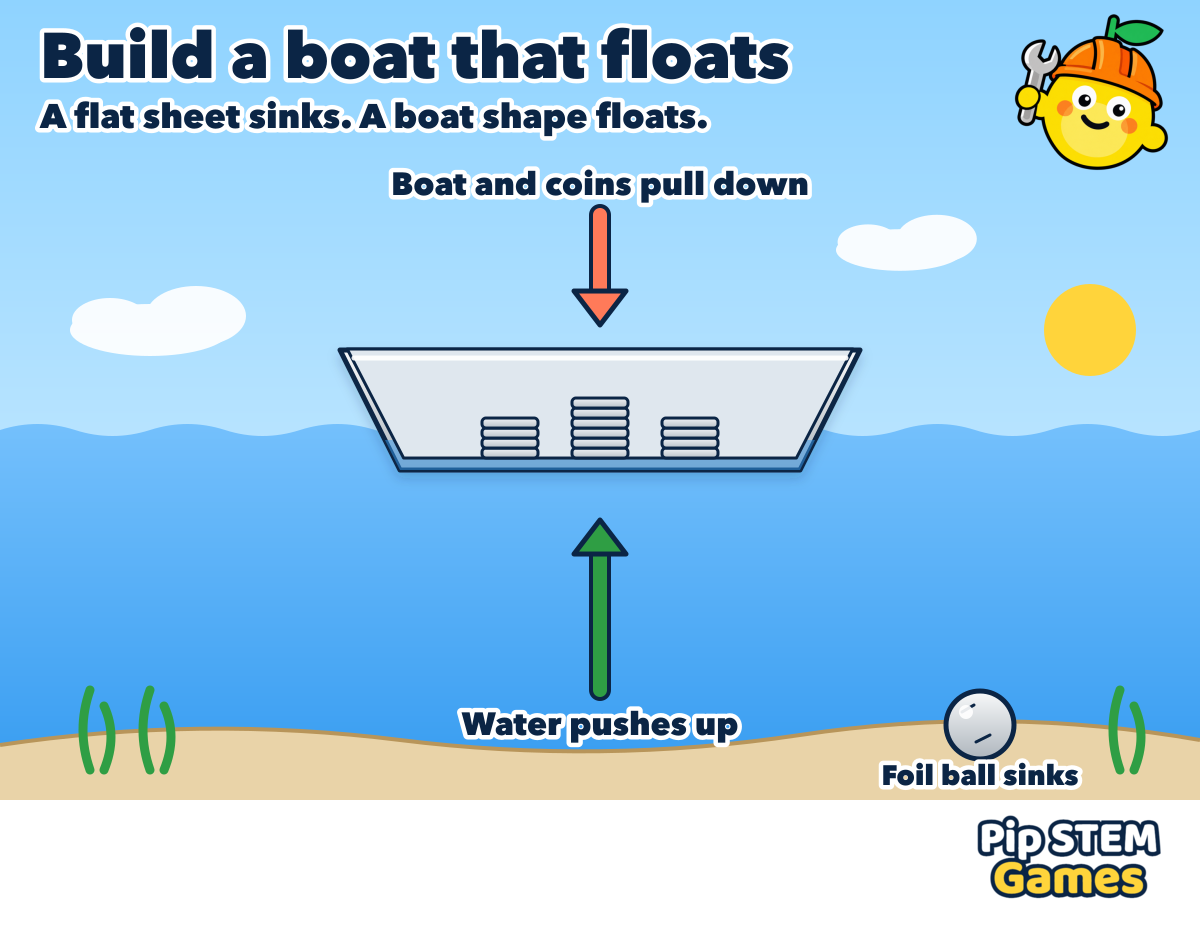
Fold a square of kitchen foil into a tray with straight sides and a flat base, and it floats. It takes about 20 minutes, and the whole point is to test it with coins and fix what goes wrong. This page is for ages 5 to 12, with an adult close by.
You need:
- Kitchen foil, torn into squares about 20 cm each way (two or three, so you can try more than one design)
- A shallow basin or washing-up bowl with about 5 cm of cool water
- About 40 UK 10p coins, or washers, for cargo
- A towel for spills, and paper and a pencil for tallies
Make the boat:
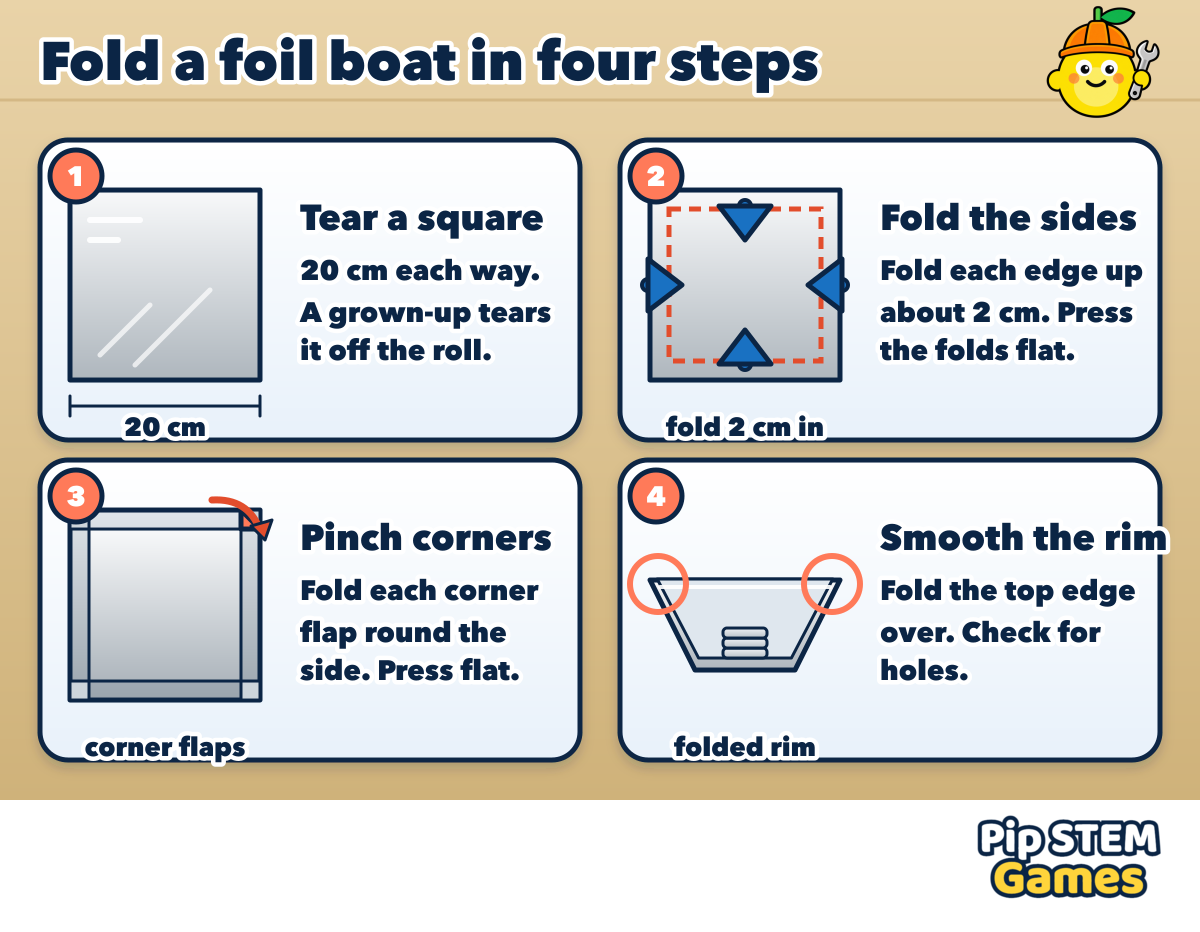
- A grown-up tears off a square of foil about 20 cm each way. Torn foil edges are sharp, so children shouldn't handle the roll's cutting edge.
- Fold each edge up about 2 cm to make four low walls. Press the folds flat with your thumb.
- Pinch each corner and fold the flap round the side so the corners stay closed.
- Fold the top edge of each wall over a little. That makes it smooth to touch and a bit stiffer.
- Run a finger round the outside and check there are no holes or tears.
Now put it on the water. If it floats, you've built a boat. The next sections show how to test it, why it works and what to do when it doesn't.
How do you keep water play safe?
A grown-up should stay within arm's reach of the water the whole time. Children can drown in just a few centimetres of water, so this activity needs an adult who is watching, not just nearby in the house.
- Use a shallow basin with about 5 cm of water, set on a steady table or on the floor away from stairs.
- Empty the basin as soon as you finish. Tip it down the sink or onto the garden, and never leave it standing.
- Coins are a choking risk for children under 3, so keep younger brothers and sisters away from them. Children who still put things in their mouths should use big washers or large bath toys as cargo, with an adult counting.
- Fold the foil's torn edges over. Fresh edges can scratch fingers.
- Keep plugs, chargers and other mains electrical items well away from the water. Wipe up spills so nobody slips.
How do you test which boat carries more?
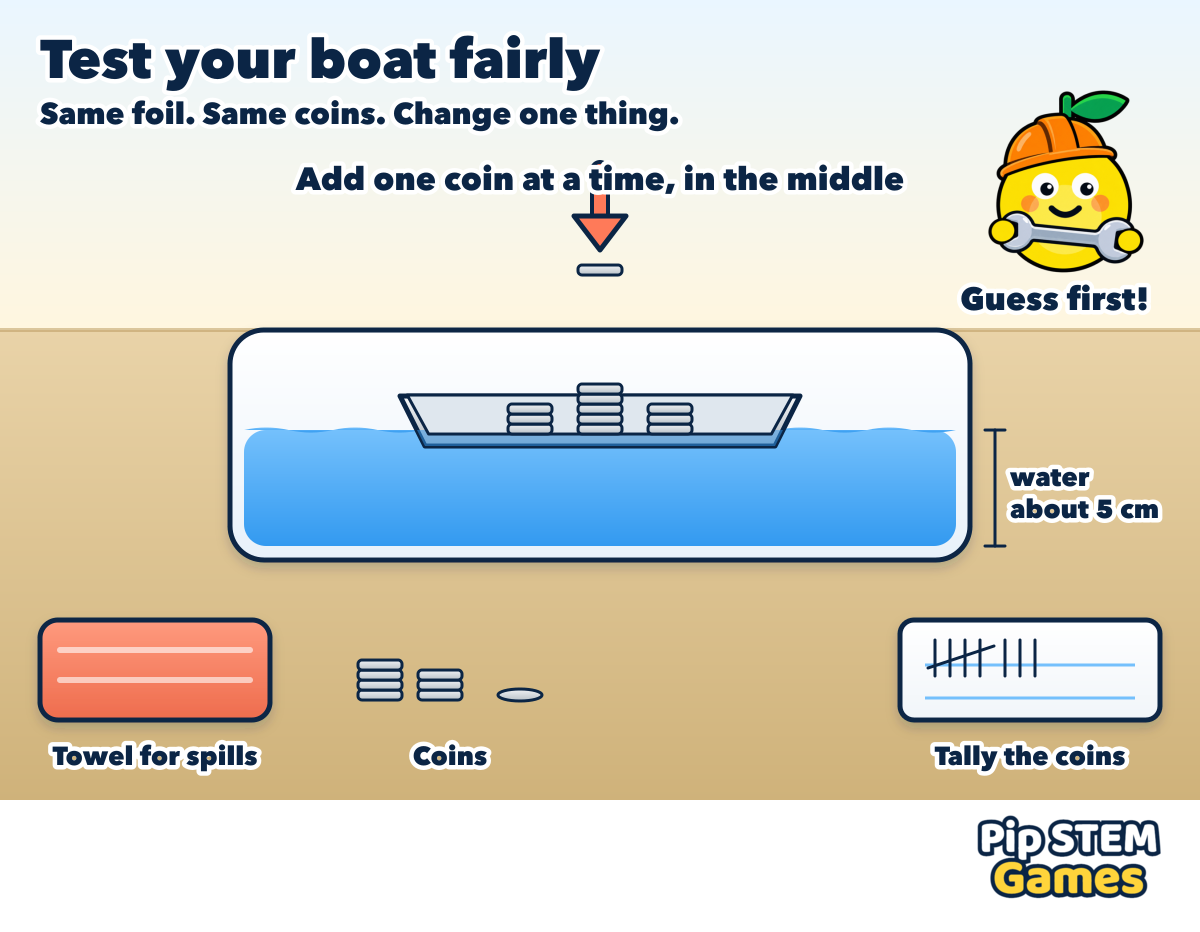
Add coins one at a time, in the middle of the boat, and stop the moment water first comes over the side. Count the coins, write the number down, then try a second design. That's a fair test.
- Float the first boat in the basin and let it settle.
- Guess how many coins it will carry and write your guess down.
- Add one coin at a time, in the middle. Keep your hand steady so you don't make waves.
- Stop when water comes over the rim or the boat tips. Count the coins and note what happened: floated, tipped or leaked.
- Dry the foil boat or fold a fresh one, then test the next design in exactly the same way.
Use the same size of foil and the same coins for every boat. Change only one thing between tests, such as the height of the sides. If you change two things, you won't know which one made the difference.
Here's a record sheet to print and fill in. Right-click to save it.
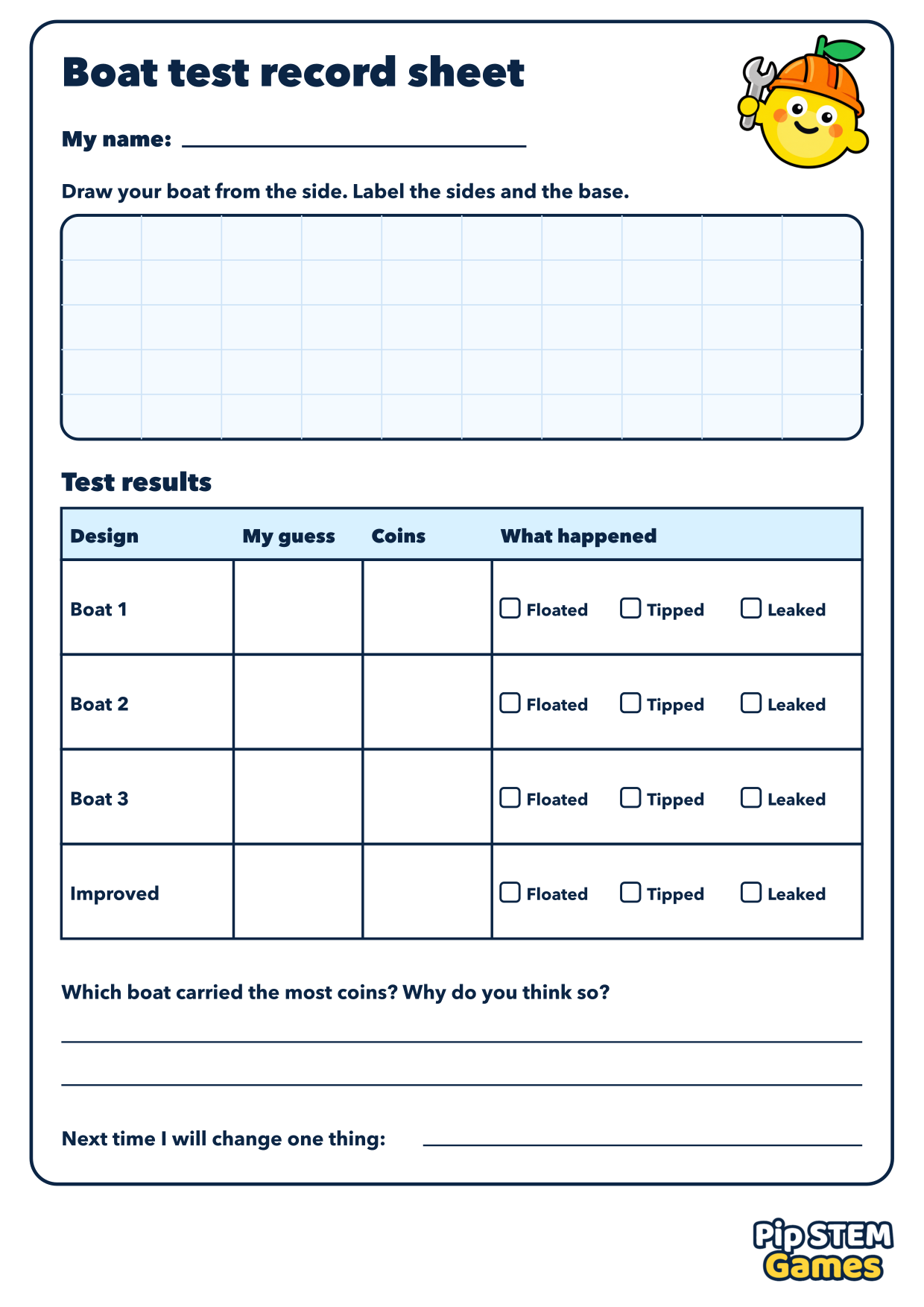
For a simple game after your boat tests, try the Leak Hunt game, where you find and fix leaks before the water wins. The test-and-fix loop is the same one we describe in the engineering design process.
Why does a foil boat float when a foil ball sinks?
A boat floats when the water it pushes aside weighs as much as the boat and its load. The foil is the same in the ball and the boat. The only difference is shape.
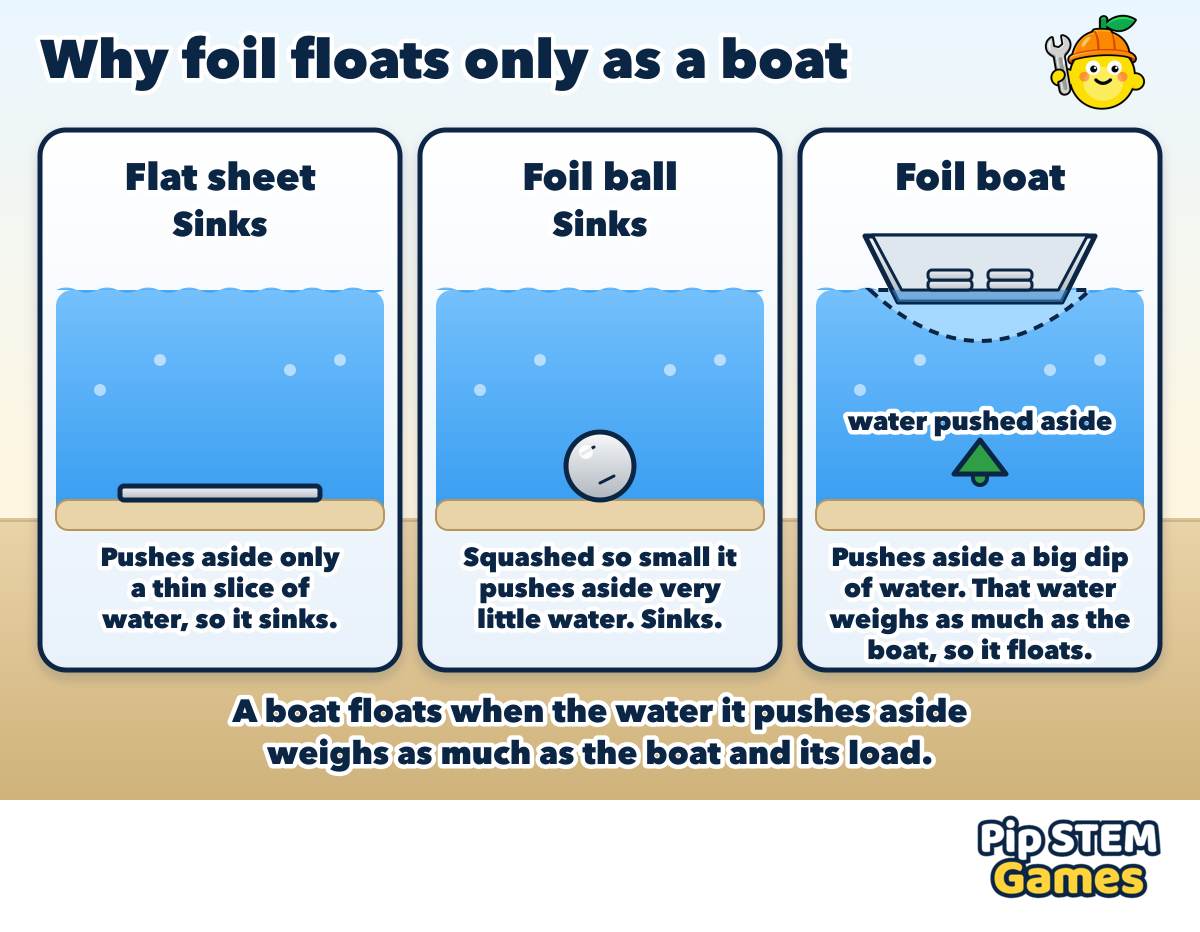
Foil is aluminium, which is denser than water. A solid lump of it sinks. When you fold it into a tray, the tray holds a lot of air. The boat now takes up much more room in the water while weighing the same.
Water doesn't like being pushed aside. It pushes back up, and the more water the boat moves out of the way, the harder the push. The push is called buoyancy. The boat sinks lower into the water until the push up matches the pull of its weight down, and then it sits still.
Here's a number to check yourself with. One cubic centimetre of water weighs about 1 gram. A tray with a base of 16 cm by 16 cm and sides 2 cm tall has room for roughly 500 cubic centimetres, so in theory it could hold about 500 grams before water reaches the rim. Real boats carry less, because they tip and flood at the lowest corner. That gap between the maths and the real result is the interesting bit to talk about.
What if your boat sinks or tips?
Check for holes first, then look at where the coins sit, then at the height of the sides. Most boats that fail have one of three problems, and each has a quick fix.
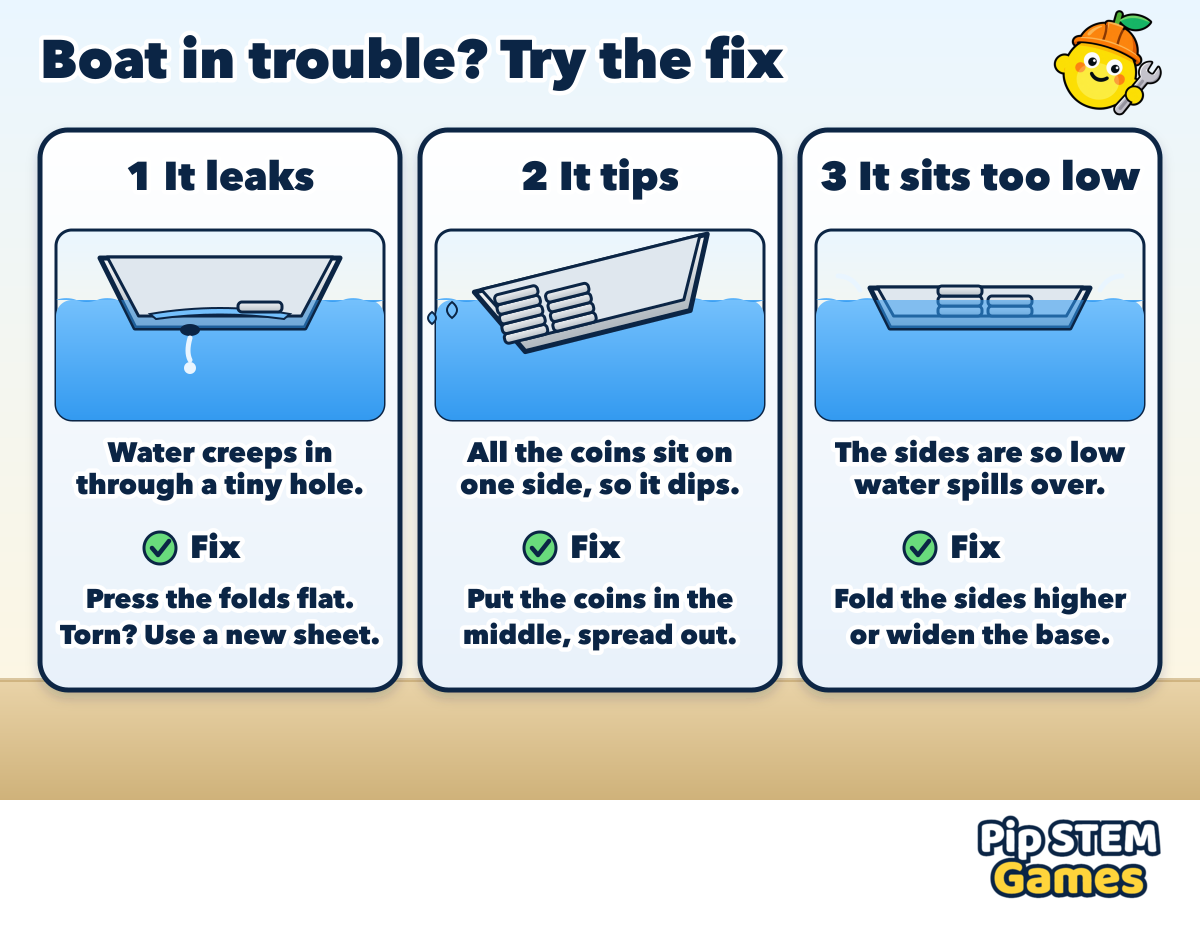
- Leaks: press the folds flat and look for a tiny tear. A torn sheet can't be mended with a dab of anything, so fold a fresh one.
- Tips: put every coin in the middle and spread them out. If the boat is narrow, make the base wider.
- Sits too low: fold the sides higher, or widen the base so the weight spreads over more water.
Frankly, a boat that fails is the best bit. You learn more from a boat that tips than from one that floats first time. Ask your child, "What do you think happened, and what could we change?"
What shape makes the best foil boat?
A wide, flat base with straight, tall sides usually carries the most. The base spreads the weight over more water, and the tall sides give the boat more room to sink down before water pours in.
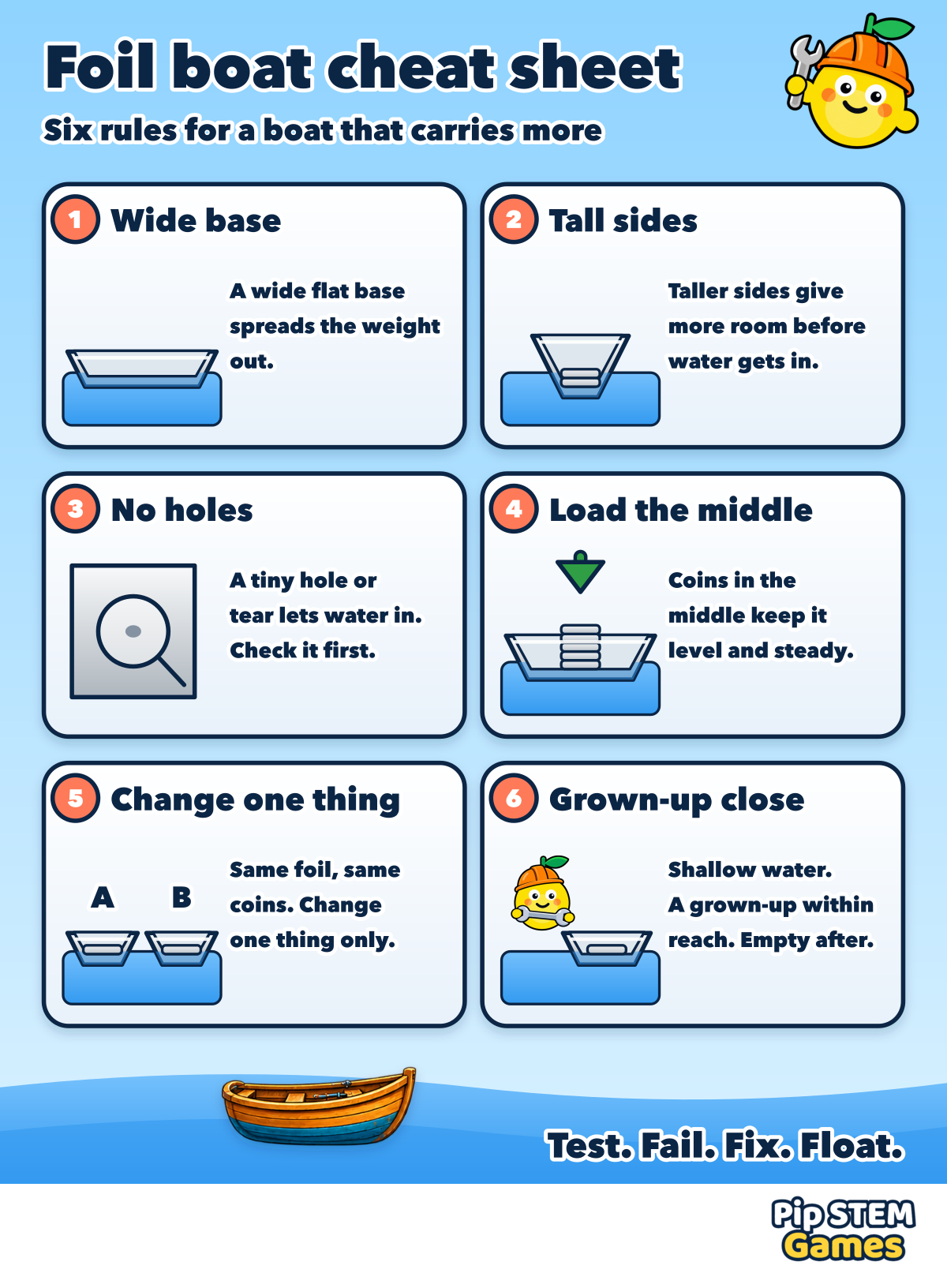
Test our rules instead of taking our word for them. Try three shapes: a wide, low tray, a narrower, taller tray, and a long, thin boat. Your coin counts will tell you which wins with your foil, and you may find a shape we didn't think of.
Pro tips:
- Fold the rim over double. It makes the walls stiffer, so they don't crumple when the coins go in.
- Add a foil divider across the middle of the boat. It stops all the coins sliding to one end.
- Drop coins in the middle from just above the boat. A splash from a high drop can flood a boat that would have floated.
- Predict first. Children who guess before they test remember the result better.
Want a similar test with paper and weight? Try the paper bridge challenge, where shape also makes weak paper strong.
How do you change the boat challenge for each age?
Match the task to the child. The same boat and basin work for everyone from 5 to 12.
- Ages 5 to 7 (easier): an adult tears the foil and does the first folds with the child. Test one flat sheet and one boat shape, and use large washers or big bath toys as cargo. Ask, "Which one floats, and why do you think so?" Our Junior Engineers workbook has lots of test-and-fix pages like this.
- Ages 8 to 10: build three designs and fill in the record sheet. Guess first, then count. Work out which design carried the most.
- Ages 10 to 12 (harder): set a rule, such as one 20 cm square and no tape, and try to beat a target of coins. Weigh the cargo on kitchen scales and compare it with the theory above. Our Senior Engineers workbook has harder design challenges for this age.
The aim isn't to build the best boat on the first go. It's to try, watch it fail, and fix it. That's how real boat designers work too. For more ideas when it's raining, see our rainy day STEM activities.
Questions parents ask
Why does a foil boat float but a ball of foil sinks?
The foil is the same, but the boat is open and holds air, so it pushes aside a lot more water. A boat floats when the water it pushes aside weighs as much as the boat. A tight ball moves very little water, so it sinks.
How many coins should a foil boat hold?
It depends on the size of the foil, the shape and the coins you use. Many children are surprised by how many a wide, tall-sided boat carries, so test and count your own. Stop at 40 coins if you want to keep it simple.
What size foil should we use?
A square about 20 cm each way works well and folds easily. Whatever size you pick, use the same size for every boat so the test is fair.
Is it safe for young children?
It is with an adult within arm's reach of the water at all times. Use only about 5 cm of water, empty the basin afterwards, and keep coins away from children under 3.
What can we use instead of coins?
Washers, large metal nuts, marbles, or dry pasta shells all work. For young children, use large washers or big bath toys that can't be swallowed. Use the same cargo for every test.
Why does my boat tip over?
Usually the weight sits on one side, or the base is too narrow. Put the coins in the middle, spread them out, and try a wider base.
Can we use a different material?
Yes. Try a small plastic tub, a clay boat or a piece of card covered in tape. Clay is a good one: a ball of it sinks, but a thin bowl of it floats, just like foil.
Great STEM activities to try next...
 5 Low-Mess STEM Activities for Your Kitchen TableActivity roundup
 Paper Bridge Challenge: Build a Bridge From One Sheet of Paper [Printable]Build challenge
 Rainy Day STEM Activities for Ages 6 to 10Build challenge
More to try: Build Order Challenge: What to Repair First

Pip STEM Games
We make engineering games and workbooks for kids aged 5 to 12. Every activity here is one we'd happily run at the kitchen table: test it, watch it fail, fix it, try again.




