

Key takeaways
- Repair order: generator first, pump second, lighthouse third.
- A dependency is a job that can't work until another job is done.
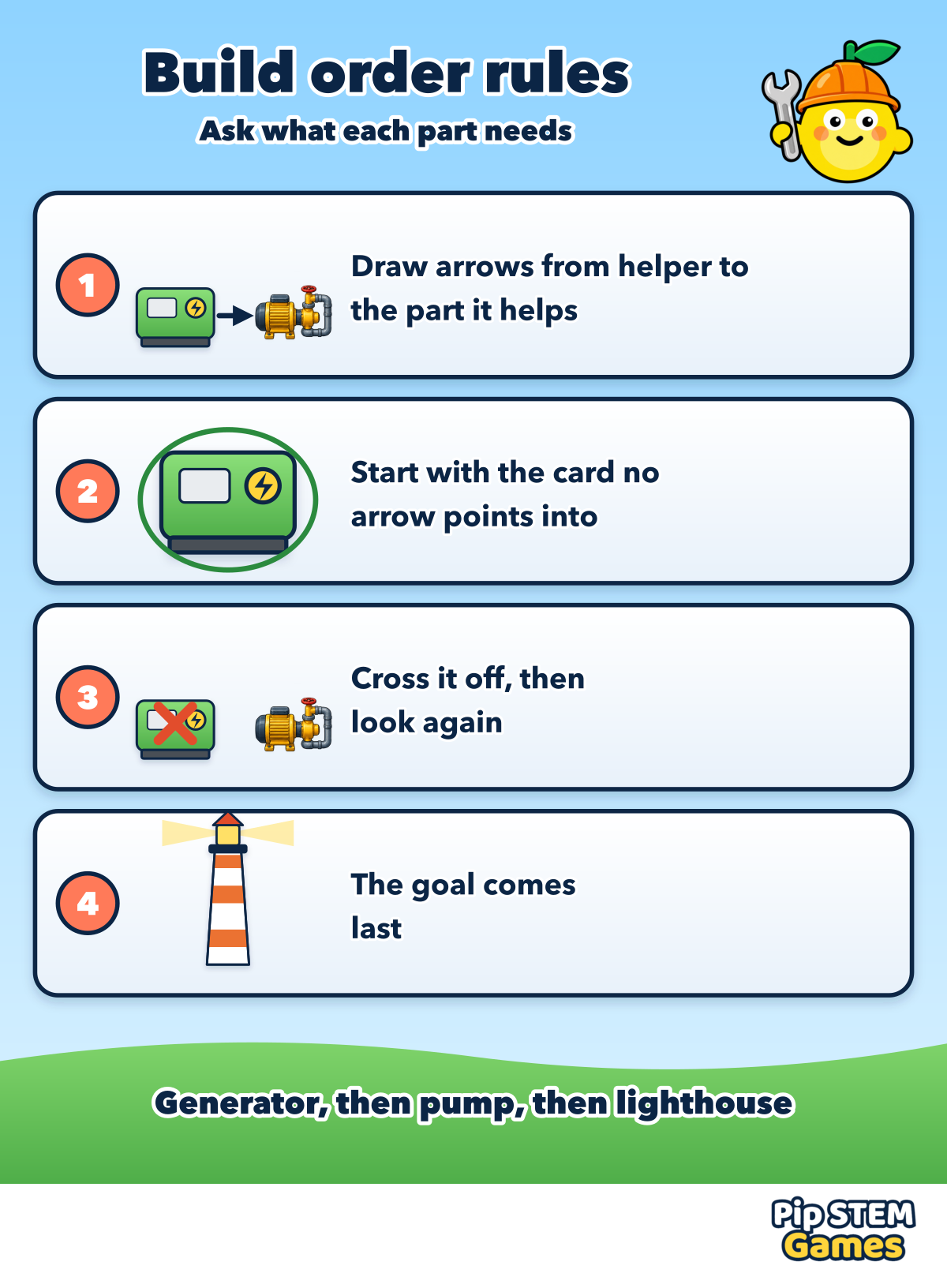
- Draw arrows from each helper to the part it helps.
- Start with the card that has no arrow pointing into it.
- Jobs that share a start but don't need each other can happen together.
This build order challenge has three broken parts on a small island: a generator, a water pump and a dark lighthouse. Which should you repair first? The answer teaches one of the most useful ideas in engineering, and you can test it at the kitchen table with three paper cards.
What should you repair first?
Generate power first, start the pump second and fix the lighthouse third. Each repair needs the one before it. On our game island, the generator powers the pump, the pump lifts water up to the lighthouse, and the lighthouse can't work until both are running.
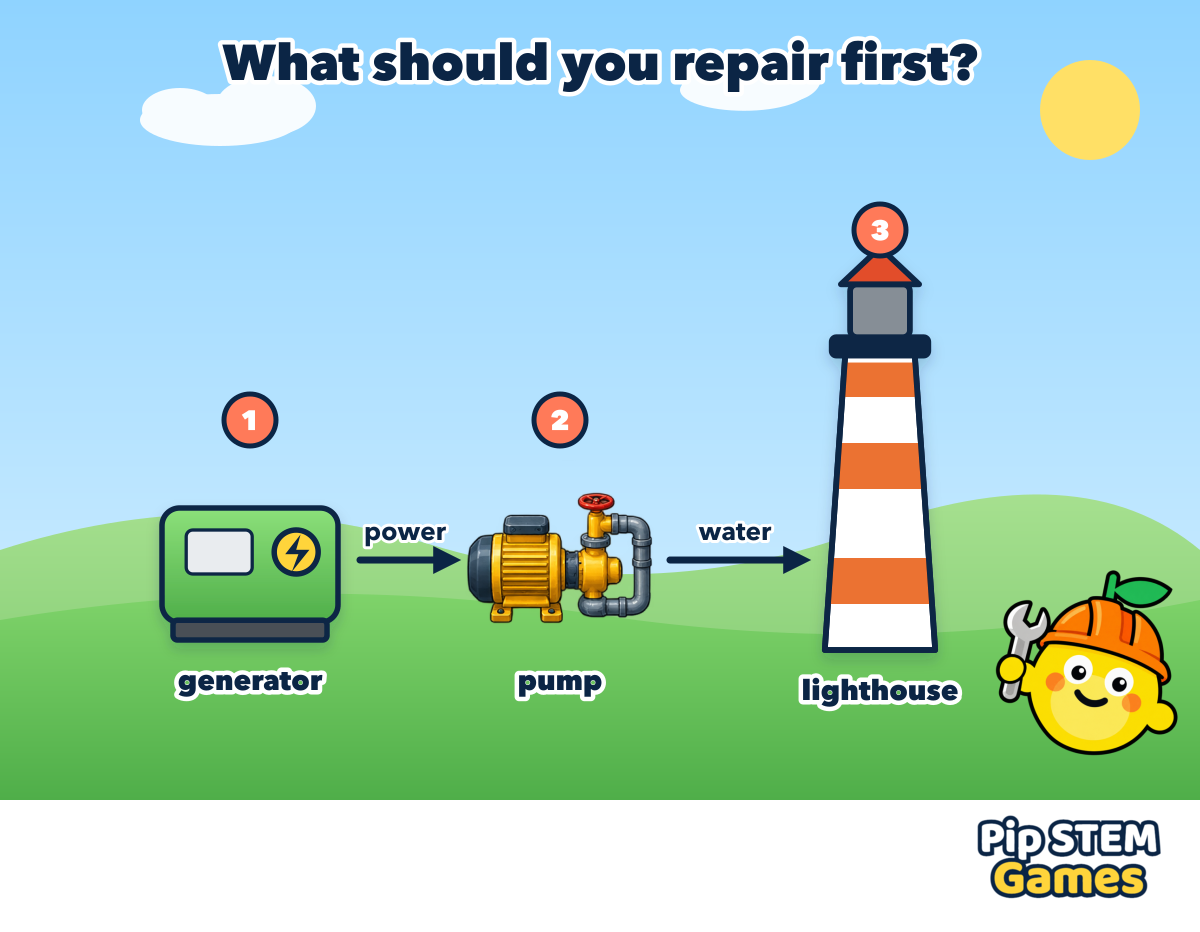
This puzzle comes from an island we drew for a game idea. It's a picture, not a real island and not a game you can play yet. Use it as a thinking puzzle at the kitchen table, then turn it into a hands-on card test.
What is a dependency?
A dependency is a job that can't work until another job is done. A kettle depends on electricity. A tap depends on a water supply. On the island, the lighthouse depends on the pump and the pump depends on power.
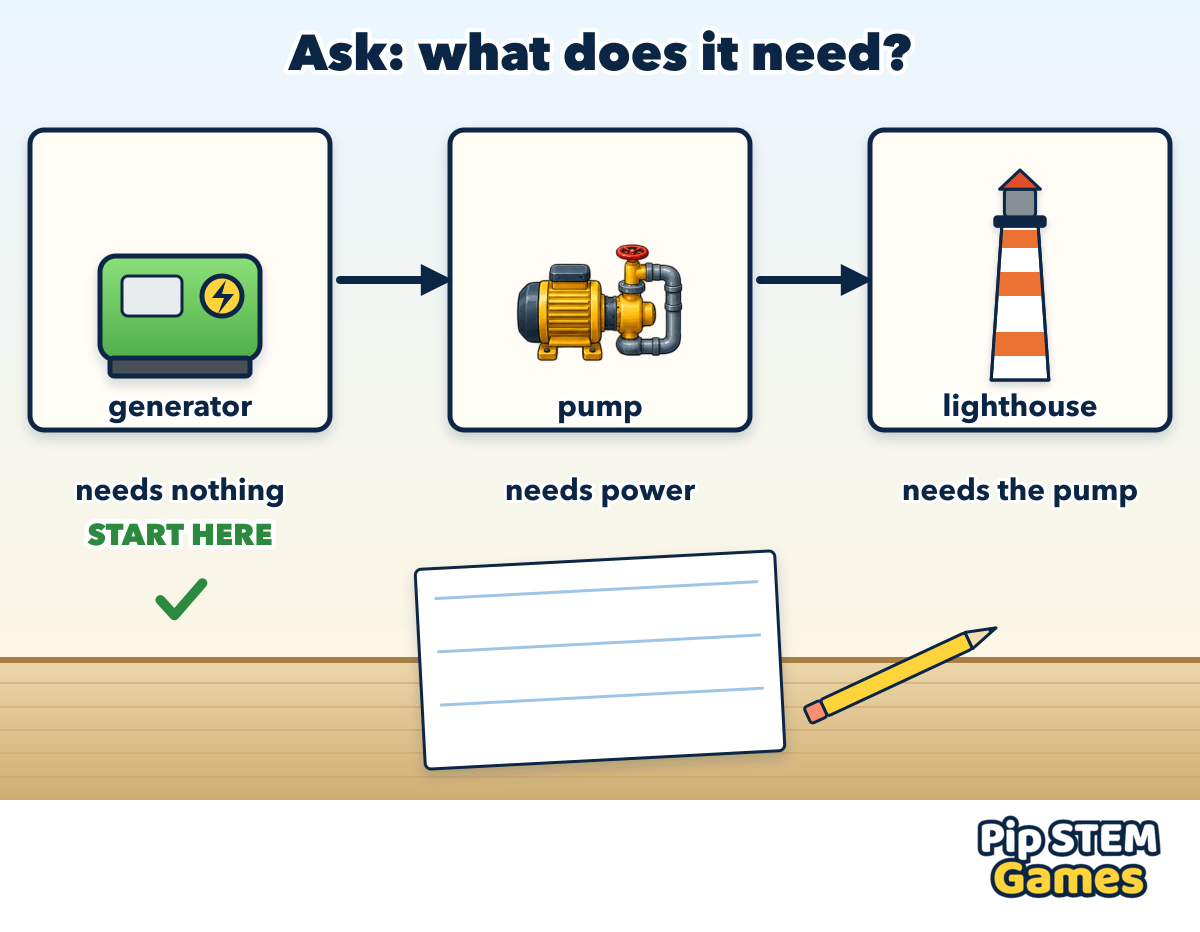
Engineers draw these links as arrows so a team knows what to build first. The list they make is called a build order. The arrows go from the helper to the thing it helps. If you want more island fixes, try which machine should we repair first.
Why does power come first?
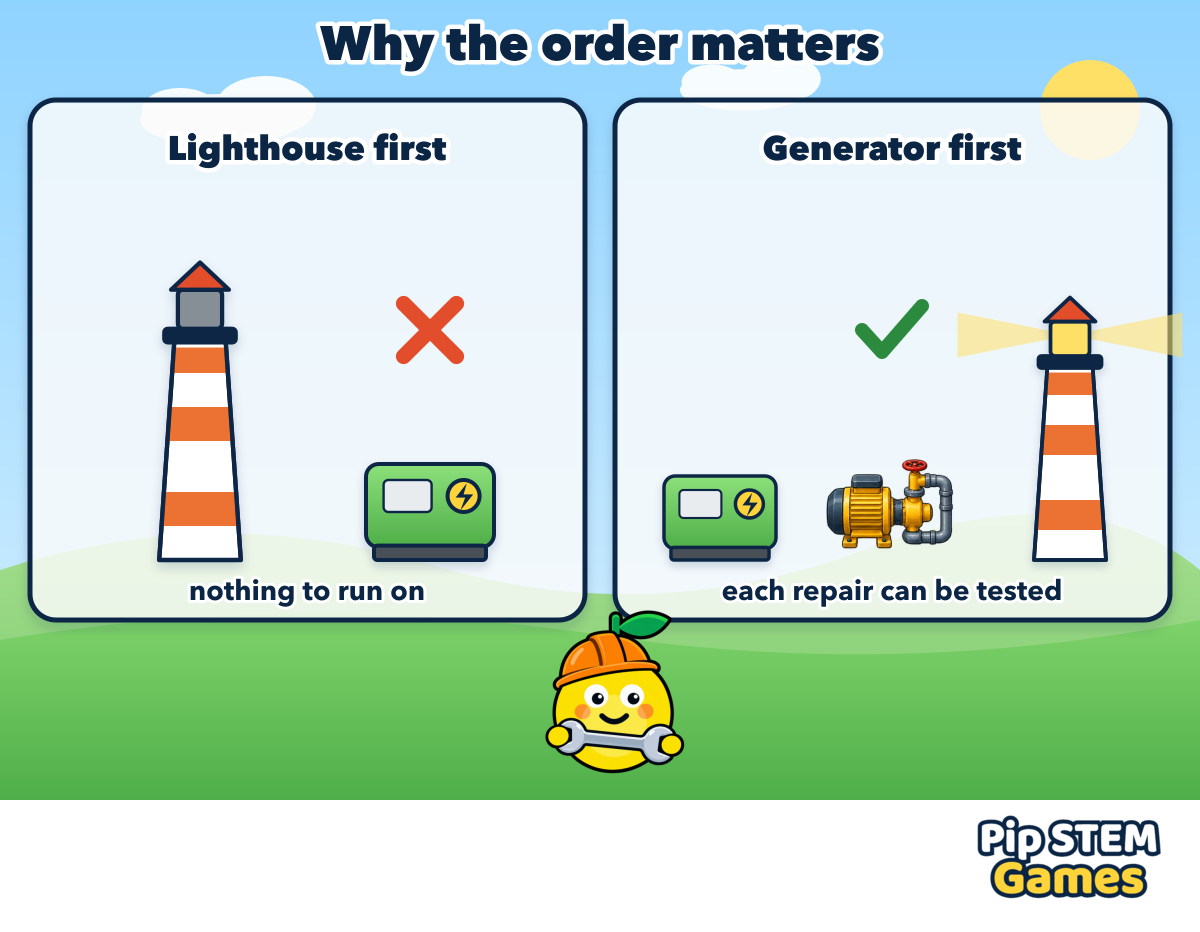
Power is at the start of the chain because nothing else on the island can run without it. If you fix the lighthouse first, it has nothing to run on. You couldn't even test whether your repair worked.
Here's a rule children can use anywhere: ask what does this need before it can work? Keep asking until you reach something that needs nothing. That's where you start.
How do you trace the order?
- Predict. Look at the three broken parts and guess the order. Say it out loud.
- Draw arrows. Draw an arrow from each helper to the part it helps.
- Find the start. Look for the card with no arrow pointing into it. That's step one.
- Remove and repeat. Take that card away and look again. Keep going until every card has a place.
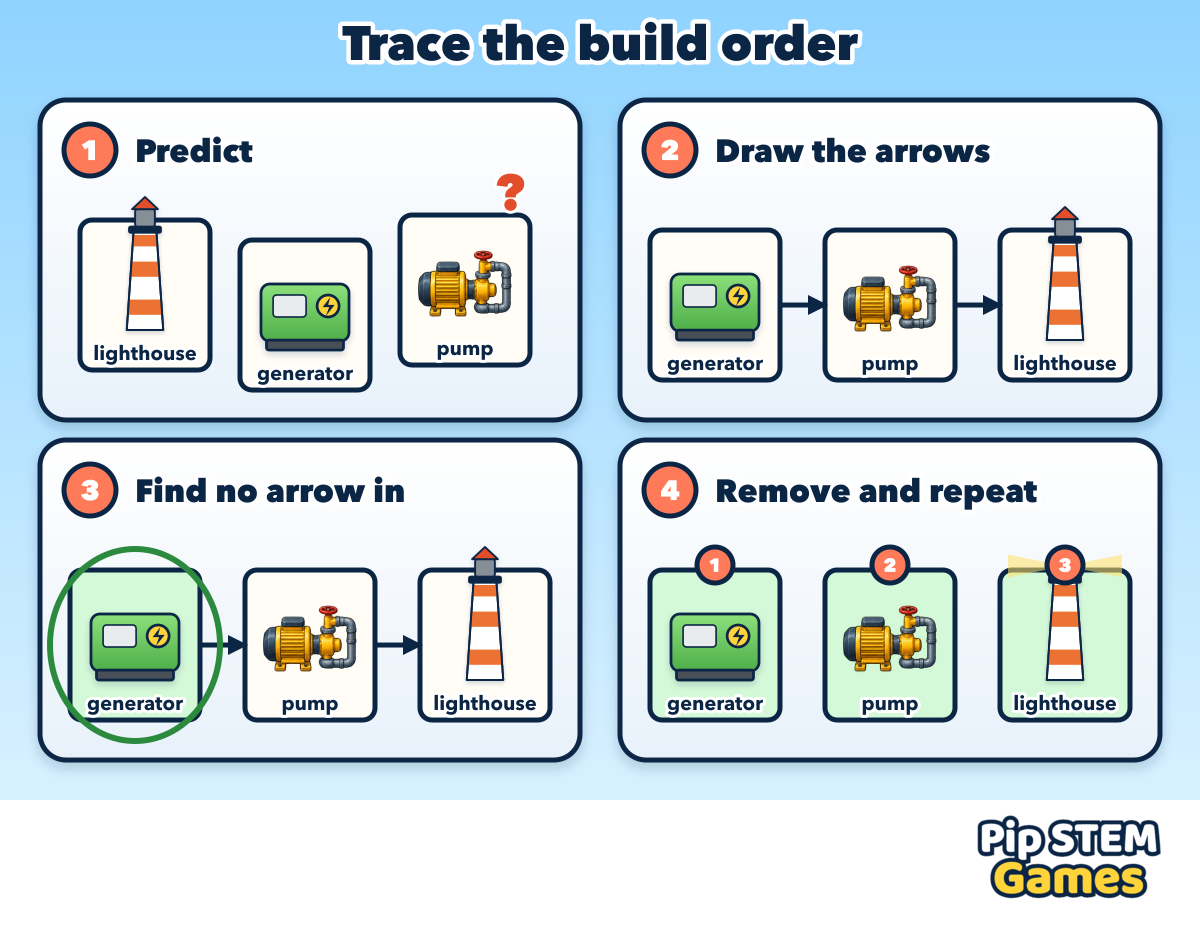
The worked answer is generator, then pump, then lighthouse. Computer scientists use the same idea to sort jobs that depend on each other. They call it a topological sort, and the remove-and-repeat method is very close to one called Kahn's algorithm. Big building projects use a related planning method called the critical path method, which engineers at DuPont and Remington Rand worked out in the late 1950s.
What do you need for the paper version?
- Plain paper and a pencil
- Three sticky notes or small paper cards
- Round-ended scissors, with an adult helping younger children
- A few buttons or coins to use as markers
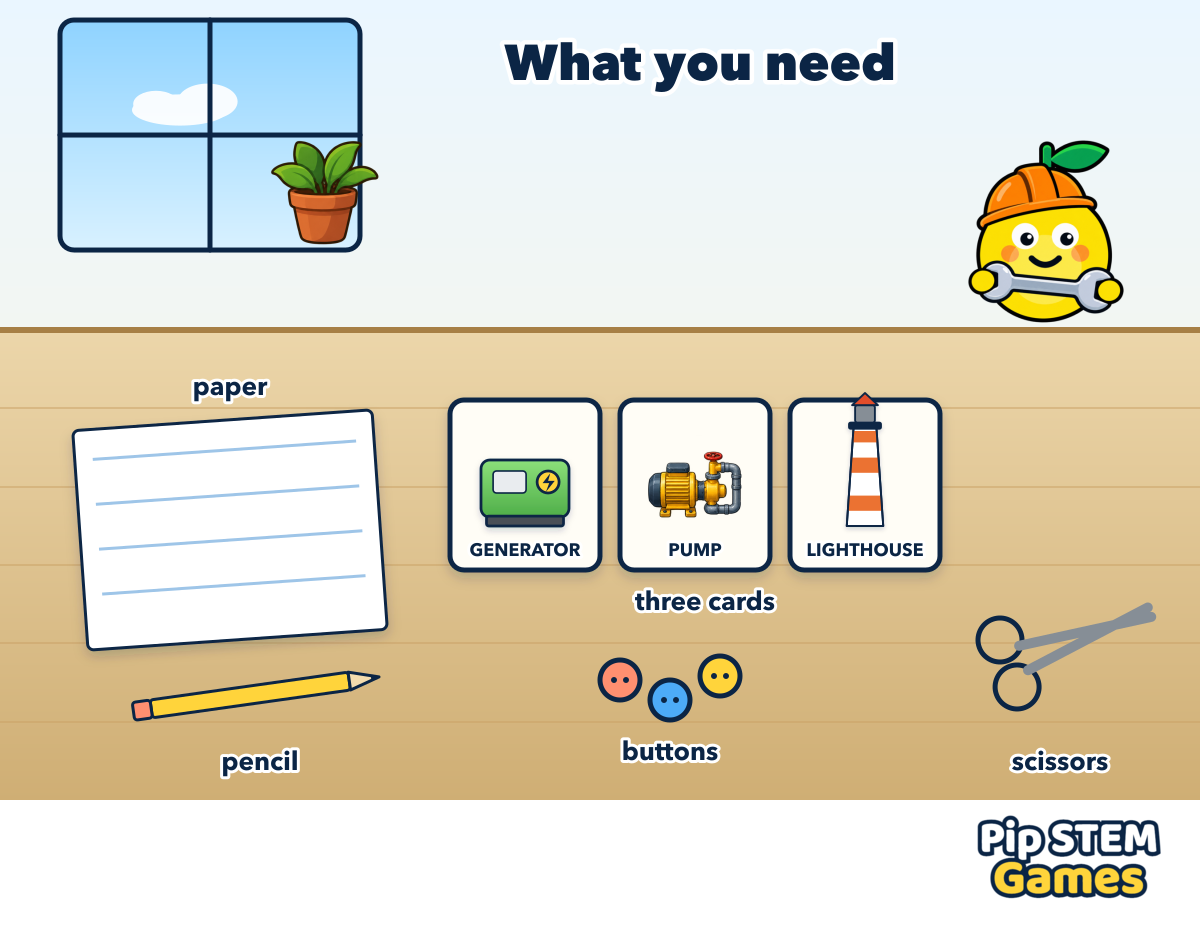
Safety: buttons and coins are small parts, so keep them away from children under 5 and supervise. No batteries, water or mains electricity are needed. It's a pencil and paper activity only.
How do you play it at home?
- Write GENERATOR, PUMP and LIGHTHOUSE on three cards, or use our printable cards below.
- Mix them up. Ask your child to predict the repair order and write the guess down.
- Lay the cards out. Draw arrows on paper between them, from each helper to the part it helps.
- Ask: which card has no arrow pointing into it? Put it first and put a button on it.
- Move the other cards into order. Compare the result with the prediction.
- Talk about what would happen if the order changed.
Children who like puzzles on a screen can try the Pipe Connect game next. Water only reaches the end when every pipe before it is in place, which is the same idea.
What if your child gets stuck?
- They put the lighthouse first because it's the goal: explain that the goal comes last, because it needs everything else.
- The arrows point the wrong way: say the arrow goes from the helper to the thing it helps.
- They say the order doesn't matter: ask them to pretend to fix the lighthouse first and tell you what they could test.
Being stuck is part of it. Our engineer's five-step fix-it checklist gives children a calm way to work through a problem.
How do you make it a fair test?
Change only one thing at a time. Keep the same three cards, the same words and the same question each round, and only swap the order. Ask your child to say out loud what stops working. Write down each try as "worked" or "got stuck", and where.
This is a thinking test, so record what your child really says rather than steering them to the answer. Getting stuck on the way is useful evidence.
What is the next challenge?
Add a fourth card: a radio mast that needs power but doesn't need the pump. Ask: must the mast come after the pump, or could it be fixed at the same time?
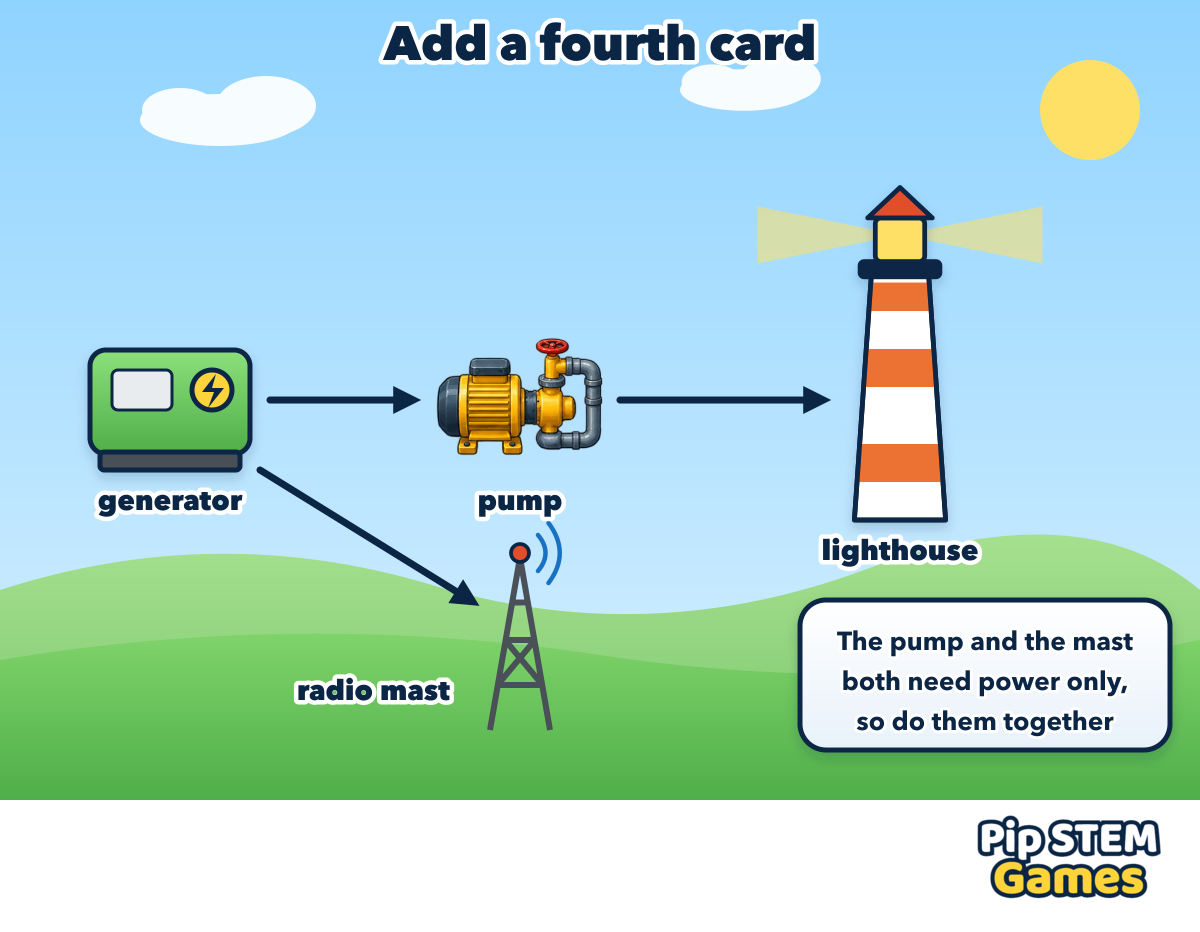
Some jobs depend on the same start but not on each other. Real project teams use that to save time, because two groups can work at once. For a bigger island problem, try one broken turbine, three problems across the island.
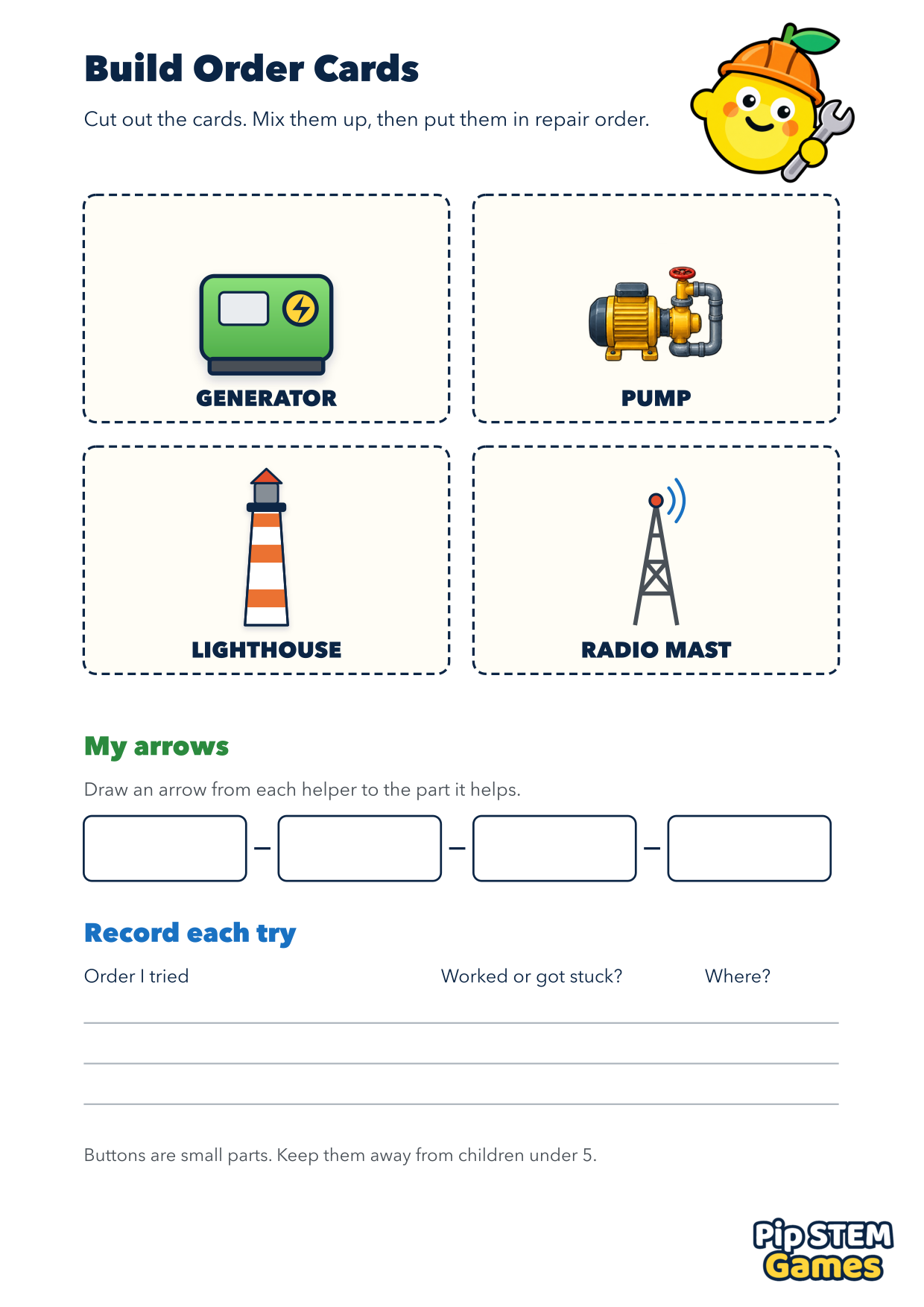
Different ages: ages 5 to 6 can use two cards, power and lamp, and talk about which comes first. Ages 7 to 9 can use the three-card version and draw the arrows themselves. Ages 10 to 12 can add the radio mast, write an explanation and design their own island with five parts. The island is a simple model for learning about dependencies, not a picture of how real power and water systems are built.
Questions parents ask
What is a build order?
A list of jobs in the order they must be done, because some jobs need others to be finished first.
Why can't you fix the lighthouse first?
It needs the pump, and the pump needs power. Fixed first, it would have nothing to run on, and you couldn't test the repair.
What is a dependency in engineering?
A link where one part or job can't work until another is ready. Engineers draw dependencies as arrows to plan the work.
How do you find the first job?
Draw arrows from each helper to the part it helps. The first job is the one with no arrow pointing into it.
Can two jobs happen at the same time?
Yes, if they share a start but don't need each other. A radio mast and a pump that both only need power can be fixed together.
What age is this build order challenge for?
Ages 5 to 12. Younger children use two cards; older children add more parts and design their own island.
Great STEM activities to try next...
 Which Machine Should We Repair First?Systems thinking
 The Engineer’s Five-Step Fix-It Checklist for KidsBuild challenge
 One Broken Turbine. Three Problems Across the Island. [Printable]Build challenge
More to try:

Pip STEM Games
We make engineering games and workbooks for kids aged 5 to 12. Every activity here is one we'd happily run at the kitchen table: test it, watch it fail, fix it, try again.




