 Pip


Business Course for Kids
Learn how the world around you works. A town is preparing for a huge festival, and a small team decides to start a business for it, with limited money, limited time and plenty of ideas. Follow them for 12 animated lessons while you build your own small, tested business project alongside them.
- £29.99, one-off
- 12 animated lessons
- Ages 9–13
- Project workbook + final challenge
What is a business course for kids?
It is where children find out how the world around them pays for itself: why things cost what they do, how people earn a living, why some shops thrive and others close, and how to decide when you cannot have everything. This one is built around a story. A town is preparing for a festival, a small team starts a business for it, and your child makes the decisions with them, then tries each idea on their own project.
- Story firstEvery lesson opens with a problem the festival team must solve.
- Learn by doingA game in every lesson, with live meters and real trade-offs.
- Finish with something realA small, tested business project in their own workbook.
What's in the course
Twelve lessons in three stages. Every lesson starts with a problem the festival team has to solve, follows what happens through the town, then gives your child a decision to make and a step for their own project.
Understand money, choices and useful work
- Lesson 1The Mystery of Money
A traveller arrives with something valuable, but nobody will accept it as payment. The investigation opens doors into different places and periods.
You learnWhat money helps people do: exchange things, compare prices and keep money for later. Why acceptance and trust matter.
- Lesson 2The Festival That Couldn’t Have Everything
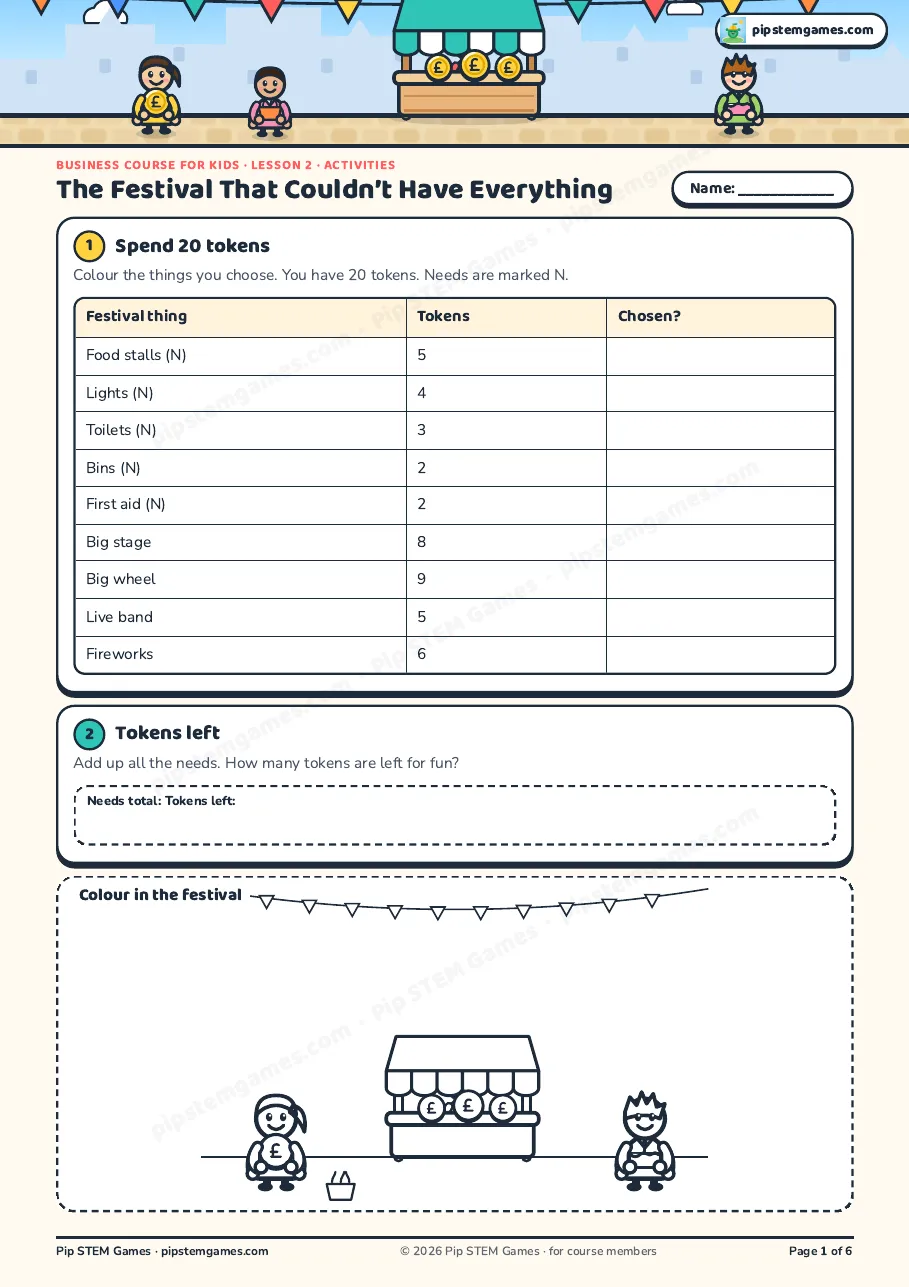
The team designs an enormous festival, then discovers they have used the same money, land and time several times over.
You learnScarcity, budgets and trade-offs. Choosing one thing means giving up another possibility.
- Lesson 3The Town That Stopped Working
The festival is ready to open, but the food has not arrived, the signs are missing and the broken equipment is still broken.
You learnHow useful work connects an economy: products, services, jobs, wages and business income.
- Lesson 4The Brilliant Invention Nobody Bought
A spectacular invention solves a problem nobody actually has. Talking to customers changes the design.
You learnCustomers, needs and evidence. Liking something yourself does not tell you whether other people will buy it.
Build something that can work
- Lesson 5The Shop That Sold Out and Lost Money
A mountain of coins, then the bills arrive for materials, packaging and equipment. The mountain disappears.
You learnRevenue, costs and profit. Selling lots does not automatically mean a business has made money.
- Lesson 6The Great Stall Showdown
Two neighbouring stalls change their prices, improve their products and compete for customers. Then a shortage changes everything.
You learnPricing, supply, demand and competition. Customers have alternatives and limits on what they will pay.
- Lesson 7The Factory Stopped by One Tiny Part
Everything is ready except one missing component. When it arrives, the packing table cannot keep up.
You learnMaterials, suppliers, production, quality and bottlenecks. A business must deliver what it promises.
- Lesson 8The Advert That Promised Too Much
An exaggerated advert brings a queue of excited customers. The product cannot do what the advert claims.
You learnMarketing, persuasion and trust. How to spot a misleading promise, from adverts to influencer posts.
Make decisions, handle change and test the business
- Lesson 9The Oven They Couldn’t Yet Afford
A neighbouring business wants better equipment. The story splits into three futures: save and wait, start smaller, or borrow and repay.
You learnSaving, borrowing, interest and commitments. Getting something sooner can create costs later.
- Lesson 10The Festival With No Lights
Every stall is ready, but nobody has arranged the lighting, waste collection or shared facilities.
You learnShared services, taxes and collective decisions. Communities need resources for things many people use.
- Lesson 11The Perfect Plan Meets a Rain Cloud
Bad weather changes attendance. A supplier raises a price. A customer pays late. The team must adapt.
You learnRisk, cash flow and changing conditions. Money arriving later cannot pay a bill due today.
- Lesson 12Opening Day
The festival opens. Every decision meets real customer choices, limited time and unexpected events.
You learnPutting it all together: sales, profit, customer satisfaction and what to change for a second attempt.
Play it: a game in every lesson
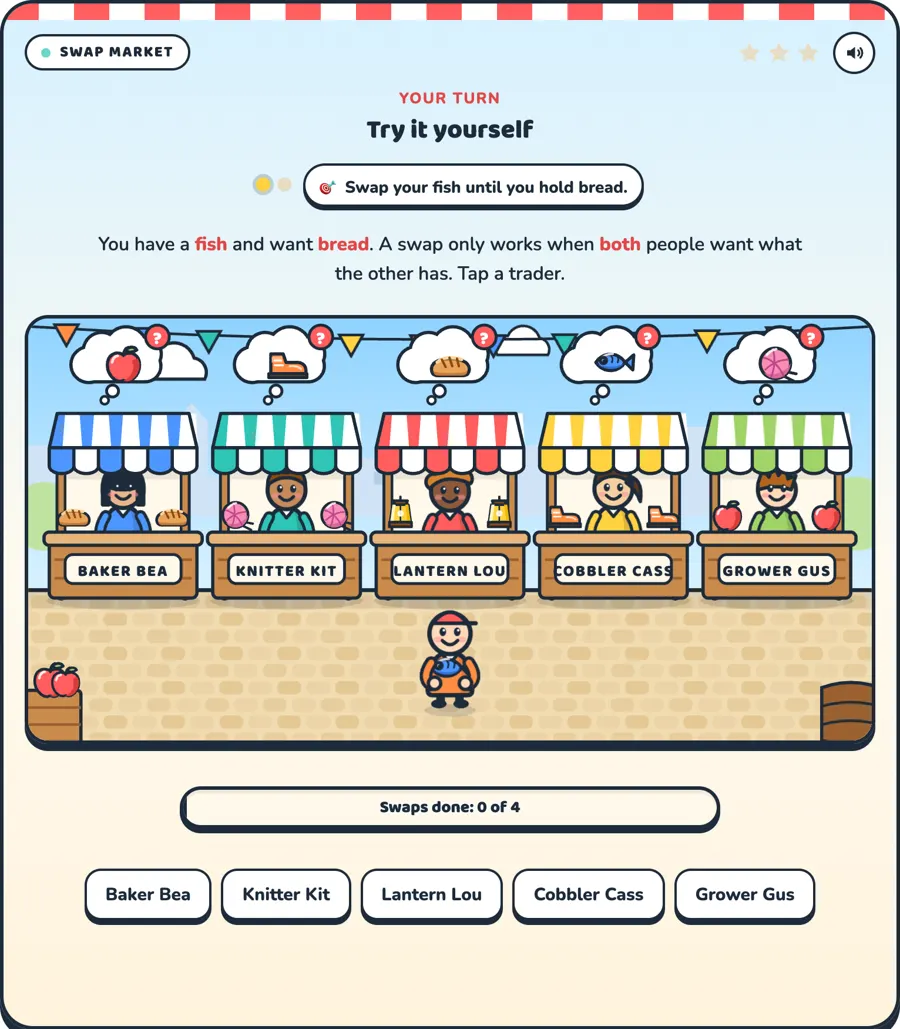
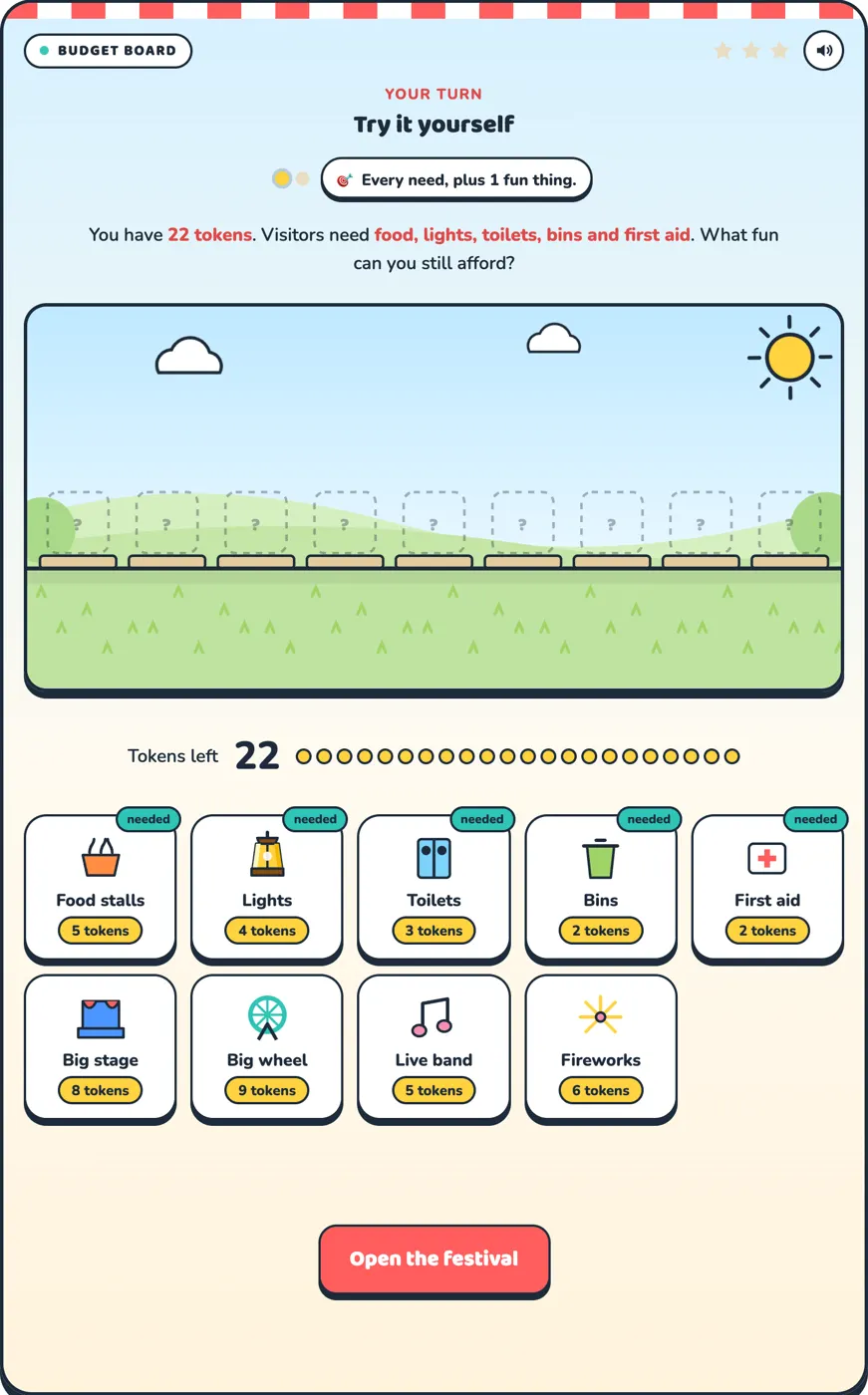
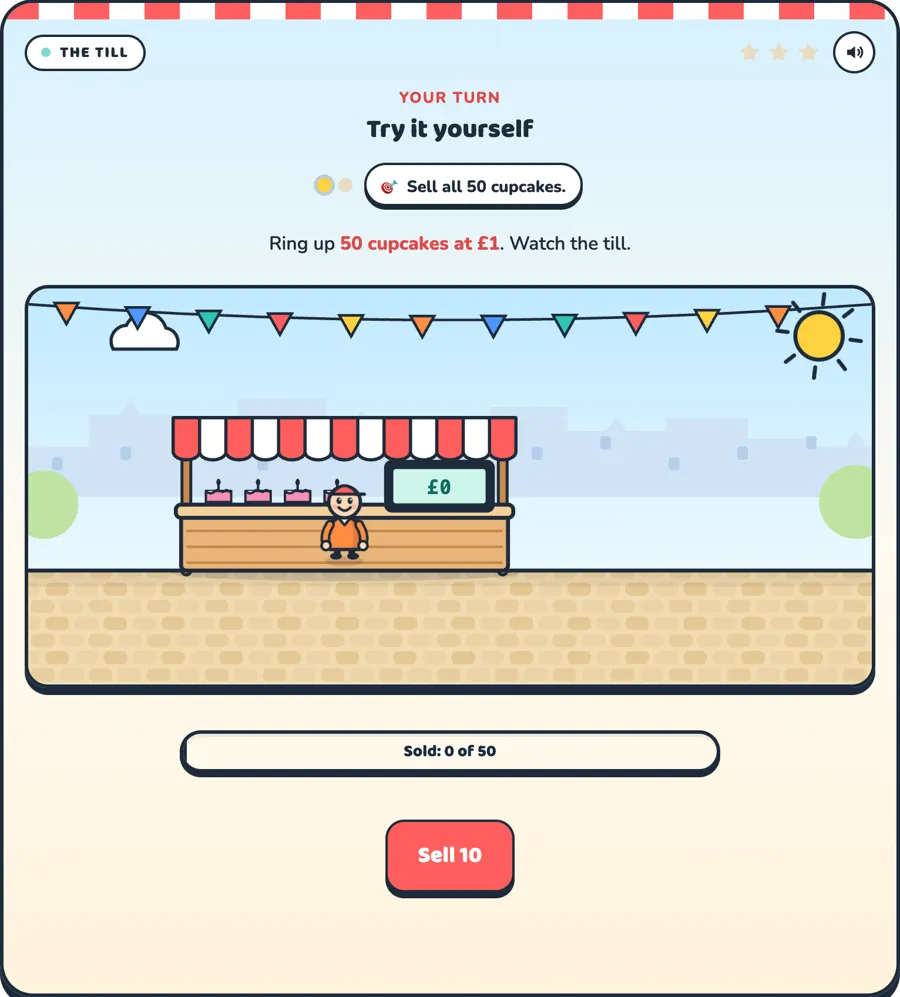
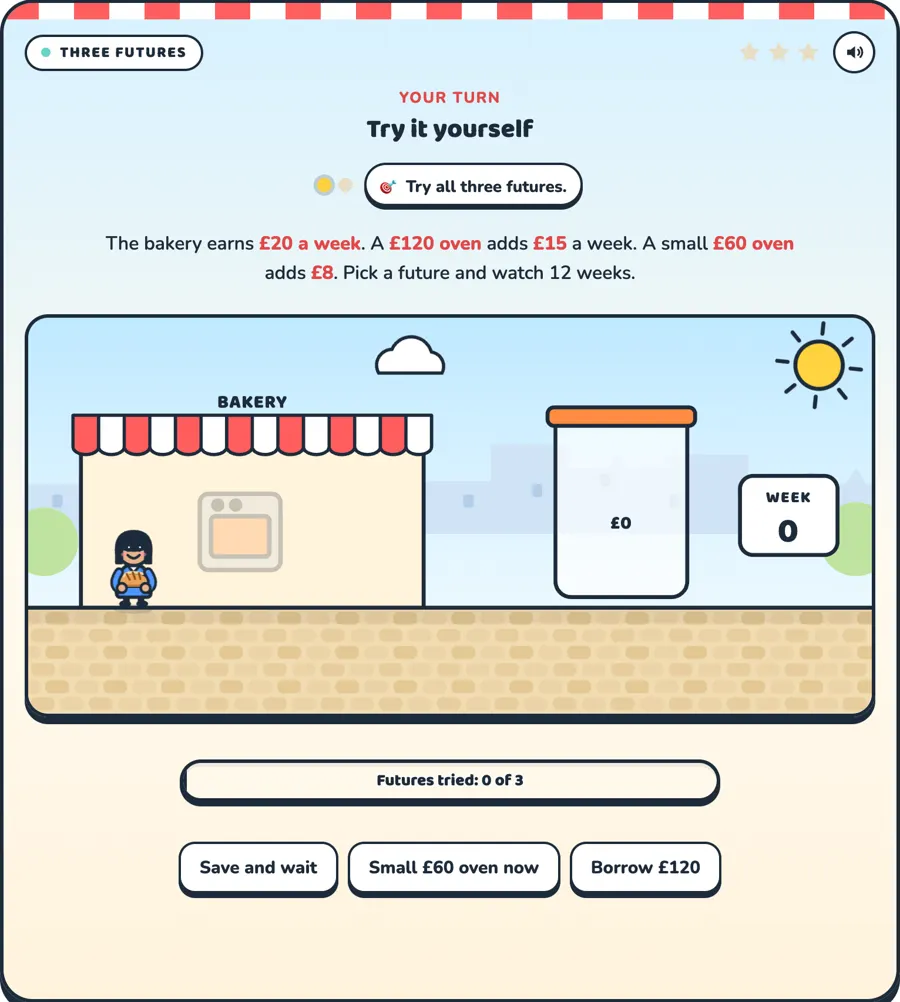
After each animated lesson, your child plays the idea out: swap goods at a market, budget tokens for a festival, run a till, pick a future for a bakery. Three stars to win on every game.
Printable worksheets with every lesson
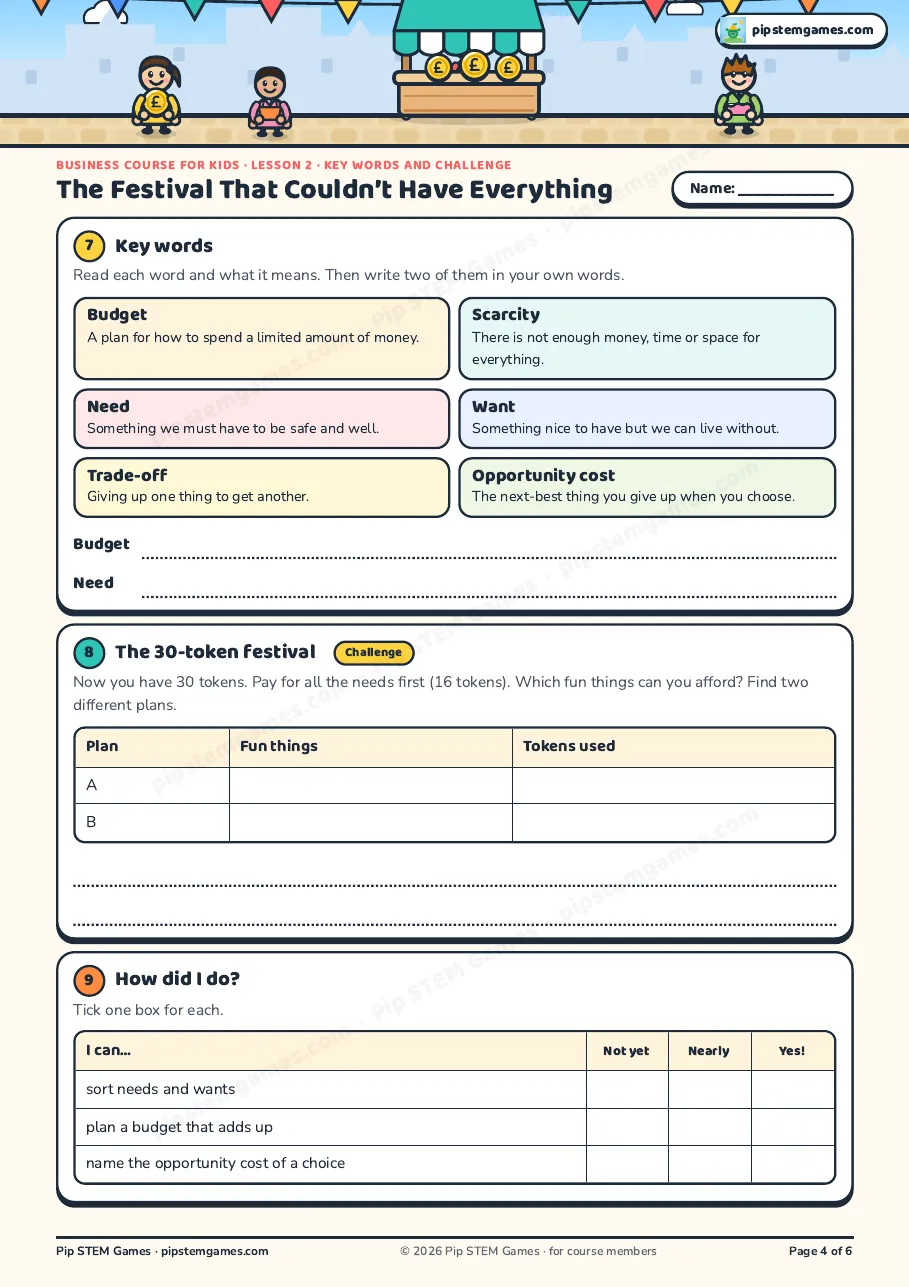
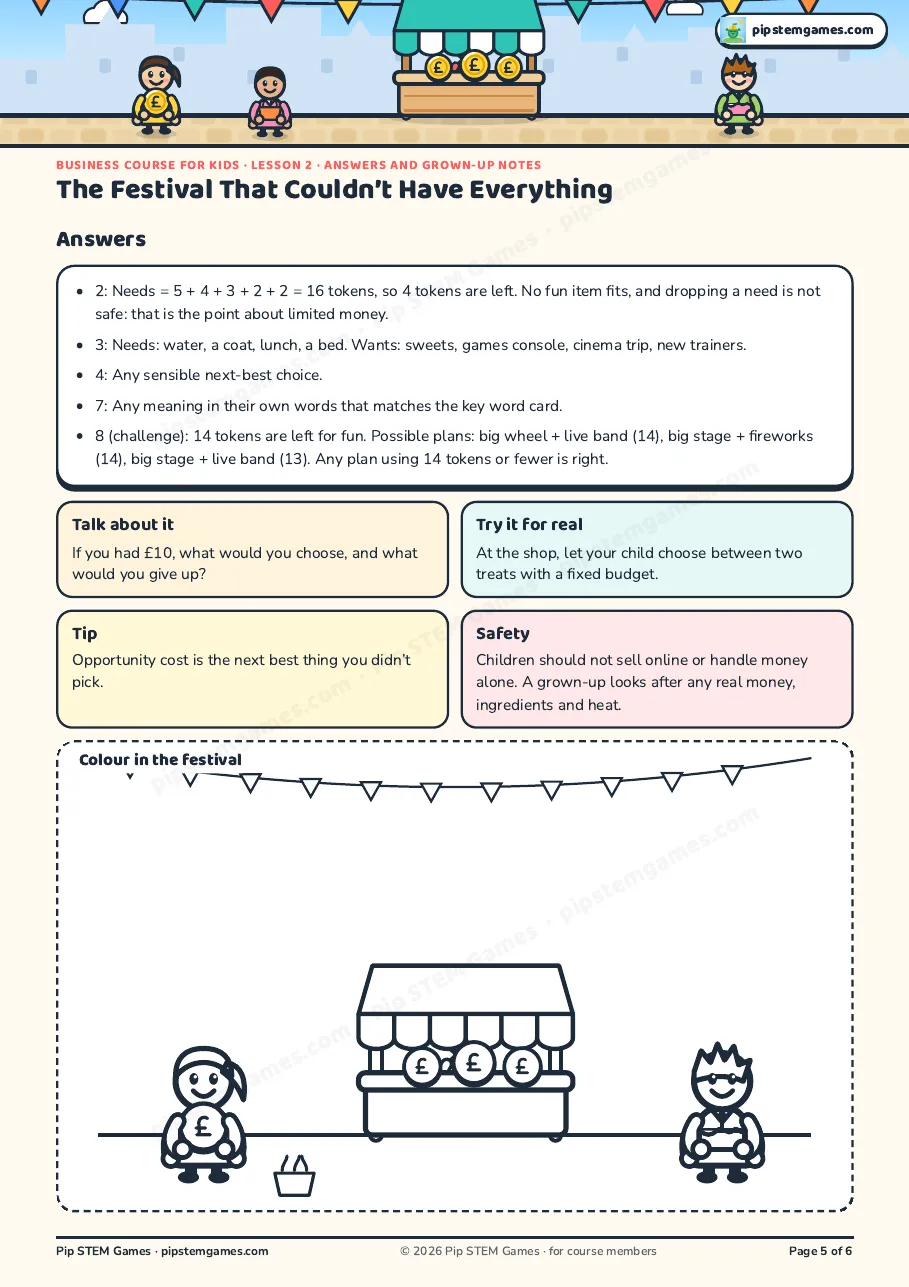
Every lesson comes with a 6-page worksheet to download and print: activities, key words, a challenge, an "I can" check, answers and notes for grown-ups, and a festival scene to colour in. Good for screen-free time, homework or a classroom.
Who it's for, by age
Picture cards, small whole numbers and an adult helping with the decisions. A gentle first look at money and choices.
Designed for upper KS2 and early KS3. Children follow the festival team, make the calls and build their own tested business project.
Optional extras such as break-even calculations, percentage margins and cash timing for older or quicker learners.
What your child builds
One project workbook grows lesson by lesson. It could be a puzzle pack, a bookmark stall, greeting cards, a simple service or a family game. By the end it holds:
- 1A goal and starting budget
- 2A useful idea and intended customer
- 3Evidence from a small test
- 4A product or service description
- 5Costs and a chosen price
- 6A production or delivery plan
- 7An honest advert
- 8A spending, saving and reserve decision
- 9A contribution to shared costs
- 10A plan for something going wrong
- 11A record of the trading session
- 12A review and improvement
Skills they take into the real world
A child who can think through a decision, check the numbers, question a claim and explain their reasoning. Useful whether they become an employee, a business owner, a researcher, a tradesperson or something that does not have a job title yet.
Work within a budget and explain the consequences of a spending choice.
Tell sales revenue from profit and explain why customers might choose an alternative.
Spot an unsupported claim and look for evidence before believing it.
Turn an observed problem into a small, testable idea.
Organise materials, tasks and time to deliver something.
Describe what could go wrong and prepare a reasonable response.
Explain an offer clearly and make a persuasive, truthful case for it.
Use results and feedback to improve a decision.
Recognise that choices affect customers, workers, shared services and the environment.
How it compares with other business courses for kids
| Pip business course | Live online clubs | Summer business schools | |
|---|---|---|---|
| Price | £29.99 one-off for the whole family | Often £5–£20 a week, ongoing | Often £500+ for a week |
| When | Any time, at your child’s pace | Fixed weekly times | Set dates in the holidays |
| Format | 12 animated lessons, games and a project | Live video sessions | Live classes, online or residential |
| Ages | 9–13, with options for 7–8 and 13+ | Usually 11+ | Usually 12+ |
| Finish with | A tested business project and a certificate | Varies by club | Certificate of attendance |
You finished all 12 lessons!
One last step: the final challenge. Twelve quick questions, one from each lesson, then your Pip certificate.
Questions from parents and teachers
How much does the course cost?
The full course is £29.99: 12 animated lessons, a project workbook and a final business challenge.
When does the course start?
The lessons are in production now. Bookmark this page and the start button will go live as soon as Lesson 1 is ready.
What age is it for?
The main course is designed for ages 9–13, covering upper KS2 and early KS3. Younger children (around 7–8) can join in with picture cards, small whole numbers and a grown-up helping with decisions. Older learners get optional challenges such as break-even calculations, percentage margins and cash timing.
Does my child need to sell anything for real?
No. The whole course works with pretend money and family members acting as customers. A real sale is an optional extension, always supported by an adult.
Why teach business and economics to children?
Because it explains how the world around them works: why things cost what they do, how people earn a living, how businesses influence their choices and how to decide when you cannot have everything. By the end, a child can think through a decision, check the numbers, question a claim and explain their reasoning. Those skills apply to employment, running a business, managing money and everyday life.
What is a business course for kids?
A business course for kids teaches how money, customers, prices and businesses work, in a way a child can try for themselves. In this course your child follows a story, makes the decisions, and builds a small, tested business project of their own alongside it.
Is the course online or in person?
Online and self-paced. Children watch each animated lesson, play its game and do the project step whenever suits your family, on a laptop, tablet or phone. There are no live sessions to book.
Do children get a certificate?
Yes. After all 12 lessons there is a final challenge of twelve quick questions, one from each lesson, and then a Pip certificate with your child’s name.
Can I use it with a homeschool group or class?
Yes, and we encourage it. Each lesson has a short animated story, a decision to make together and a practical step for the project, so it fits a lesson, club or co-op session.