

Key takeaways
- A pretend town has a broken generator, pump and lift bridge, and one crew.
- Draw an arrow wherever one machine helps another to work.
- The machine with the most arrows leaving it usually unlocks the most.
- Change one story fact at a time and check whether the answer changes.
- A strong answer names the condition it depends on.
Which machine should we repair first? In this paper challenge for ages 5 to 12, a pretend town has a broken generator, a broken water pump and a broken lift bridge, and only one repair crew. Your child traces what depends on what, counts the links and makes a case. There is no single right answer. The best first repair is the one that keeps the most people safe and unlocks the most other fixes. It takes about 30 minutes with paper, sticky notes and string.
What is the repair-first challenge?
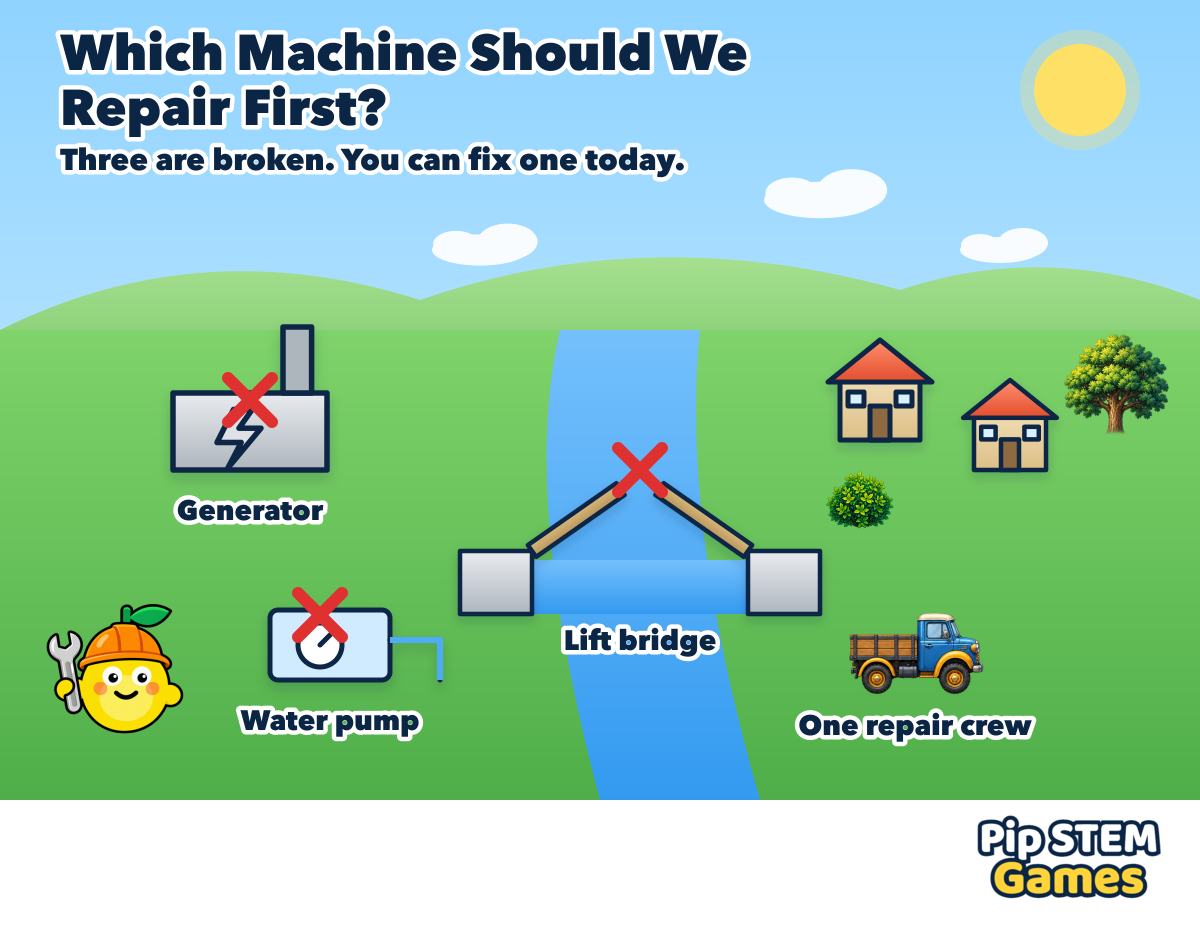
A pretend town has three broken machines. The generator makes electricity. The pump moves clean water to homes. The lift bridge lets cars and trucks cross the river. You have one repair crew, and it can fix only one machine today.
The learning is in the reasoning, not in finding a secret answer. Engineers call it prioritising: ranking jobs by what depends on them and by the harm of waiting. Real services are tangled together in the same way. Power cuts can stop water treatment, phones and hospitals at the same time, which is why planners map these links before anything breaks.
This is a made-up town for thinking. It is not a real power station, pump or railway, and it is not a guide to how real utilities choose repairs.
What do you need?
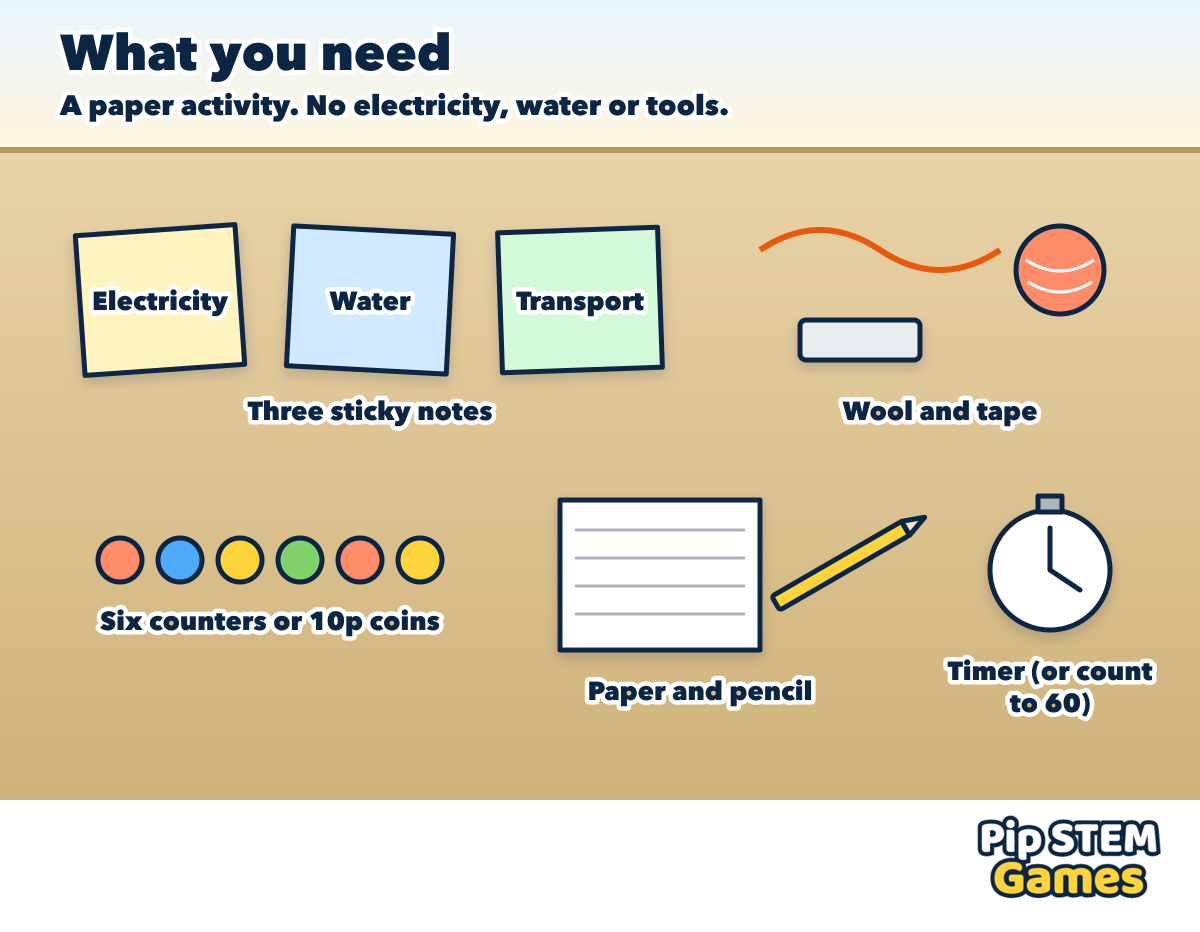
- Paper and a pencil, or the printable sheet below
- Three sticky notes or small cards labelled Electricity, Water and Transport
- Wool or string and sticky tape for arrows
- Five or six counters, buttons or UK 10p coins to stand for repair effort
- A timer, or just count to 60
Safety: this is a paper activity with no electricity or water. Counters and coins are small parts, so keep them away from mouths and young brothers and sisters.
How do you play it, step by step?
- Predict. Before drawing anything, each person writes which machine they would fix first and one reason.
- Trace. Put the three cards in a triangle. Lay string as an arrow wherever one thing helps another to work.
- Count. Count the arrows leaving each card. More arrows out means it supports more of the town.
- Test a story. Read a story card and see if it changes your answer.
- Decide and defend. Put your counters on one machine. Say in one sentence what it unlocks and what has to wait.
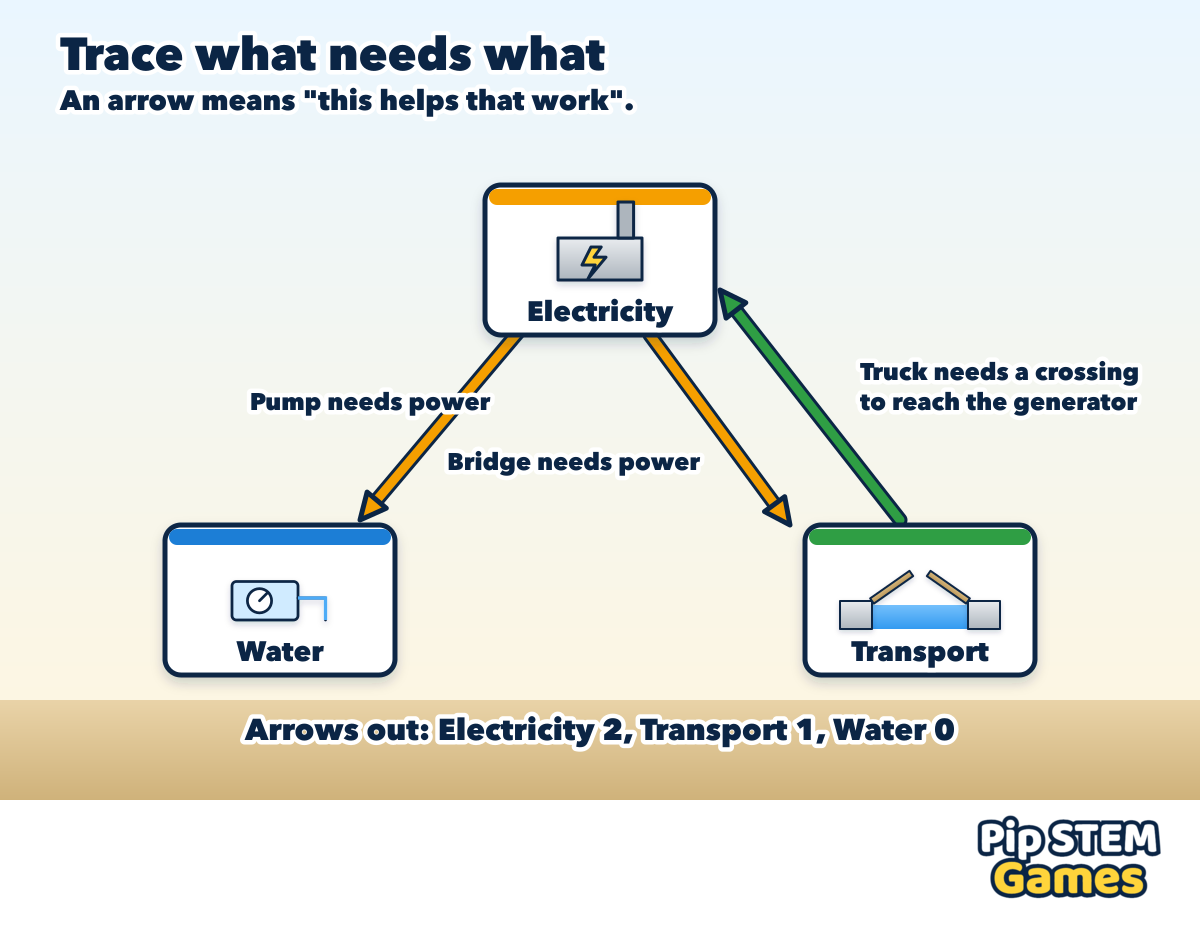
Here are the arrows for the base story. The pump needs power to run, so draw Electricity to Water. The lift bridge needs power to raise and lower, so draw Electricity to Transport. Does anything lead back to Electricity? The repair truck needs a way across the river to reach the generator, so draw Transport to Electricity.
Real lift bridges really do need power. London's Tower Bridge first raised its roadway with water pressure from steam-driven pumps. Today it uses an electric hydraulic system.
What is the worked answer?
In the base story, Electricity has two arrows leaving it, Transport has one and Water has none. Fixing the generator first unlocks the most. That is a conditional answer: if both other machines need power and nothing else can replace it, fix the generator first.
Change the story and the answer can change.
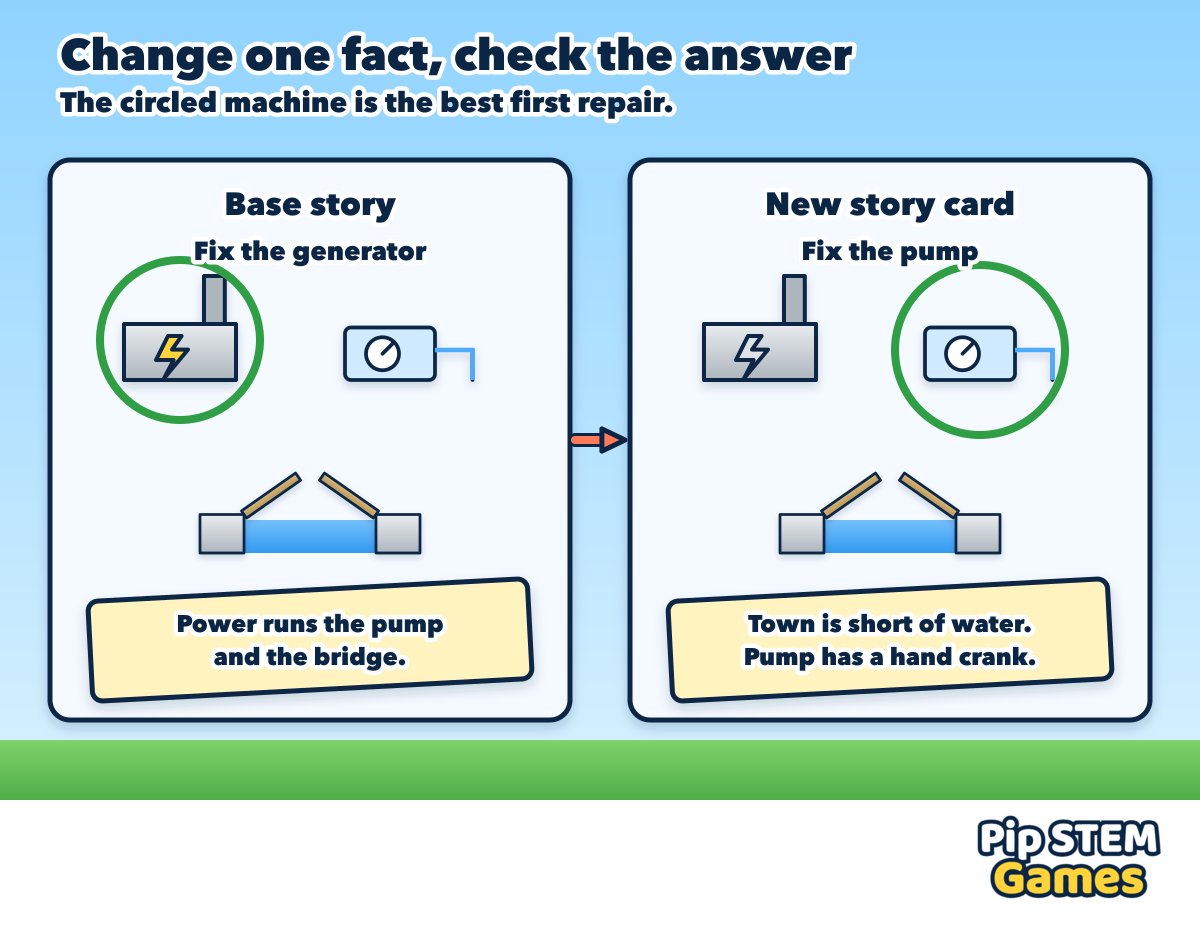
- If the town is very short of drinking water and the pump has a hand crank, the pump might come first, because people need water today.
- If the repair truck is stuck on the wrong side of the river, the bridge might come first, because nothing else can be fixed until the crew can cross.
A good answer names the condition it depends on. "We fix the generator first, because the pump and the bridge both need power" is much stronger than "the generator is the most important".
How do you make it a fair test?
- Keep the town, the number of repair counters and the time limit the same.
- Change only one story fact per round.
- Write down whether the ranking changed.
- Use your own results, because the outcome depends on the facts you chose.
If every machine feels equally urgent, add repair times: one takes 1 day, one takes 3 days and one takes 5 days. Count how many days each part of the town waits for each choice, then add them up. The plan with the smallest total wait is often a good one. You can try the same idea of finding and fixing the right fault on screen in Circuit.
What if it goes wrong?
- Everyone argues about the right answer: ask each person to point to the arrows that back up their choice.
- Every machine feels equally urgent: add the 1, 3 and 5 day repair times and count the waiting.
- The string tangles: draw the arrows on paper instead.
- Your child changes several facts at once: remind them that a fair test changes one thing only.
Next test: add a fourth machine, such as a phone mast or a drain pump, and redraw the arrows. Does it change the order? Then try two crews and see how the decision shifts. For a bigger map of how places depend on each other, try the engineering island mission map, and for choosing fixes with a budget, see you have 10 materials to save the island.
How do you adapt it by age?
- Ages 5 to 7: use two machines only and talk about what each one helps. An adult draws the arrows while the child chooses. The Junior Engineers workbook has more thinking games for this age.
- Ages 8 to 10: use all three, count arrows and write one reason.
- Ages 11 and 12: add repair times and a budget, and ask for a written case with a condition. The Engineering Workbook for Kids has more problem-solving challenges.
Print the sheet below. It has a prediction line, a space to draw the arrows, a counting table, a story card table and a sentence to finish.
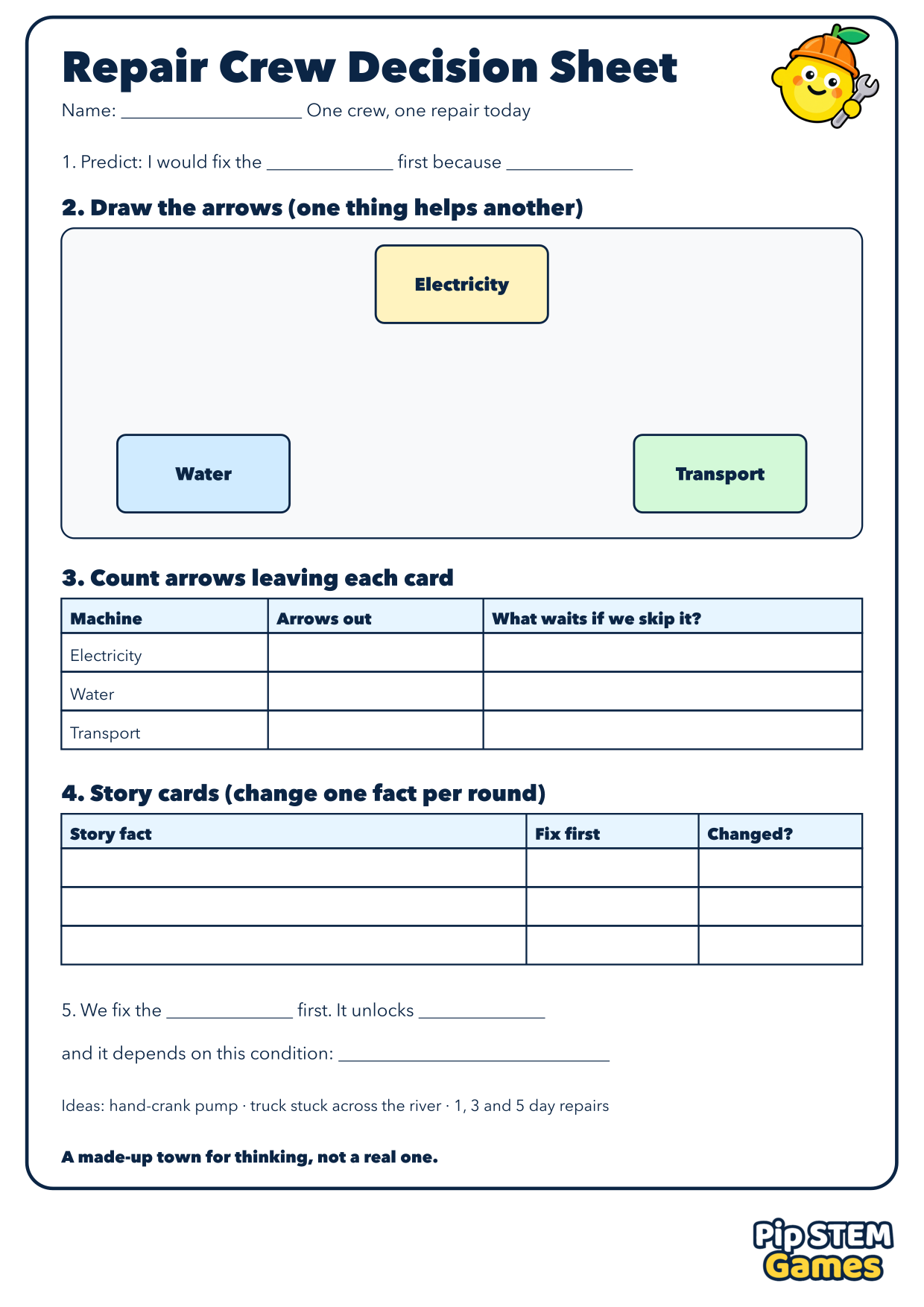
The big idea: fix the thing that unlocks the most, and always say what your answer depends on.
Questions parents ask
Which machine should be repaired first?
There is no single right answer. In the base story the generator comes first because the pump and the lift bridge both need power. If the facts change, such as a hand-crank pump or a truck stuck across the river, the best first repair can change too.
What does prioritising mean?
It means putting jobs in order. Engineers rank repairs by what depends on them and by how much harm waiting would cause.
What age is this activity for?
Ages 5 to 12. Younger children compare two machines with an adult; older children count arrows, add repair times and write a case with a condition.
Does this use real electricity or water?
No. It is a paper activity. The town and its machines are made up for discussion.
How do I stop it turning into an argument?
Ask everyone to point to the arrows that support their choice, and change only one story fact at a time so you can see what really changes the answer.
Why does a lift bridge need power?
Its roadway has to be lifted to let boats through. Tower Bridge in London first used water pressure from steam-driven pumps and now uses an electric hydraulic system.
Great STEM activities to try next...
 The Engineering Island Mission MapSystems thinking
 You Have 10 Materials to Save the IslandDesign thinking
 Build a Sustainable Island [Printable]Build challenge
More to try: Newton's First Law Examples and Experiments for Kids · Build Order Challenge: What to Repair First

Pip STEM Games
We make engineering games and workbooks for kids aged 5 to 12. Every activity here is one we'd happily run at the kitchen table: test it, watch it fail, fix it, try again.




