

Key takeaways
- Newton's first law says an object at rest stays at rest, and a moving object keeps moving in a straight line at the same speed, unless an unbalanced force acts on it.
- Inertia is an object's tendency to keep its motion as it is, and heavier objects have more of it.
- A seatbelt is a first-law example: your body wants to keep moving forward when the car stops.
- Things on Earth stop rolling because friction and air push against them, not because moving is hard to keep going.
- You can test the law at home with a coin and a card, a toy car crash test and a ramp with different floors.
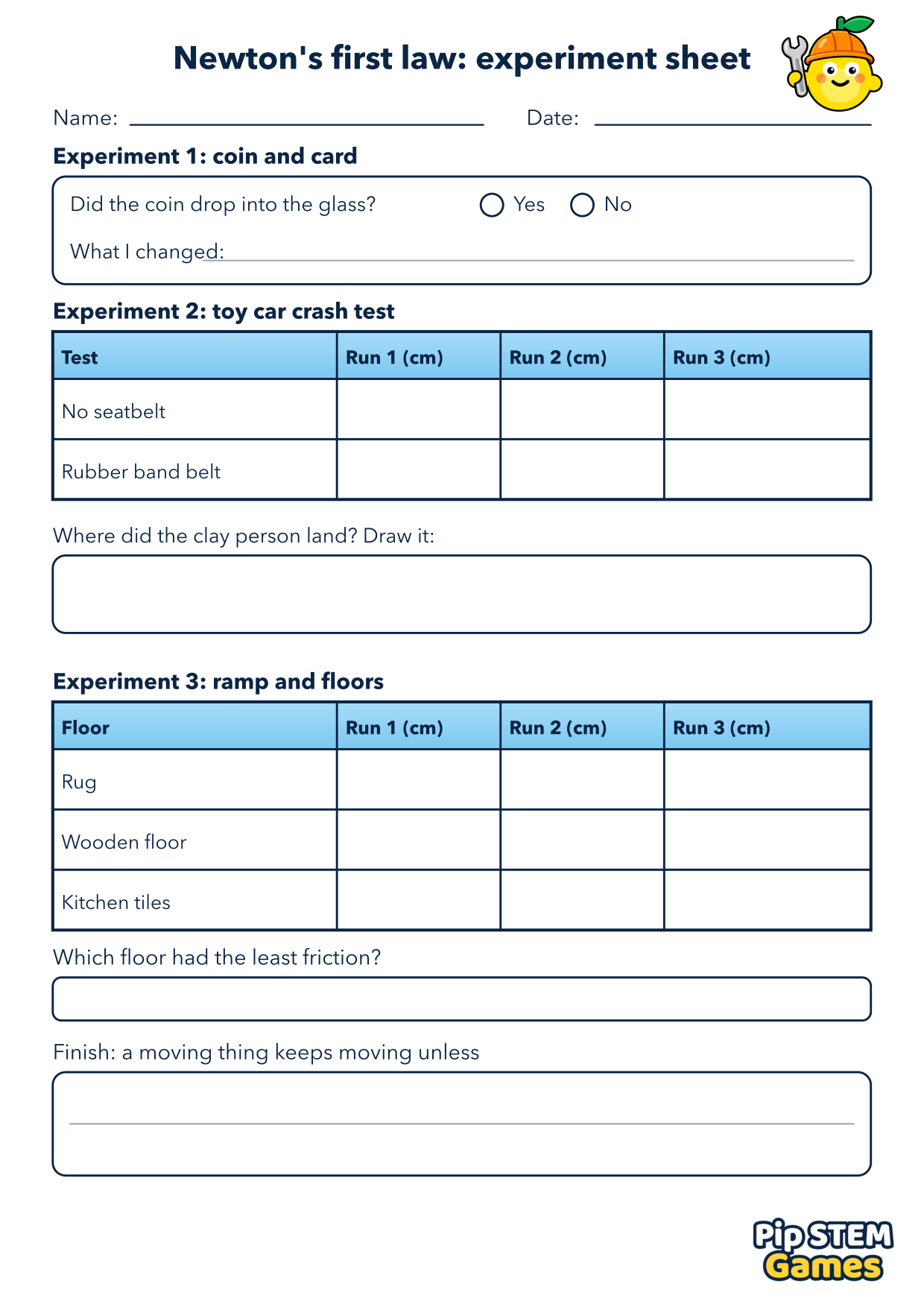
Newton's first law says that an object keeps doing what it's already doing, staying still or moving in a straight line at the same speed, unless an unbalanced force changes it. A ball on a table sits there until someone pushes it. A ball rolling across ice carries on until friction or a wall stops it. The tendency to keep going is called inertia. You'll see it in a car braking, a tablecloth pulled out from under plates, and a toy rolling off a table. This guide gives clear everyday examples and three safe experiments for ages 8 to 12. There is also a printable experiment sheet for all three tests.
What is Newton's first law of motion in simple words?
Things don't change their motion on their own: if something is still it stays still, and if it's moving it keeps moving the same way, until a force acts on it.
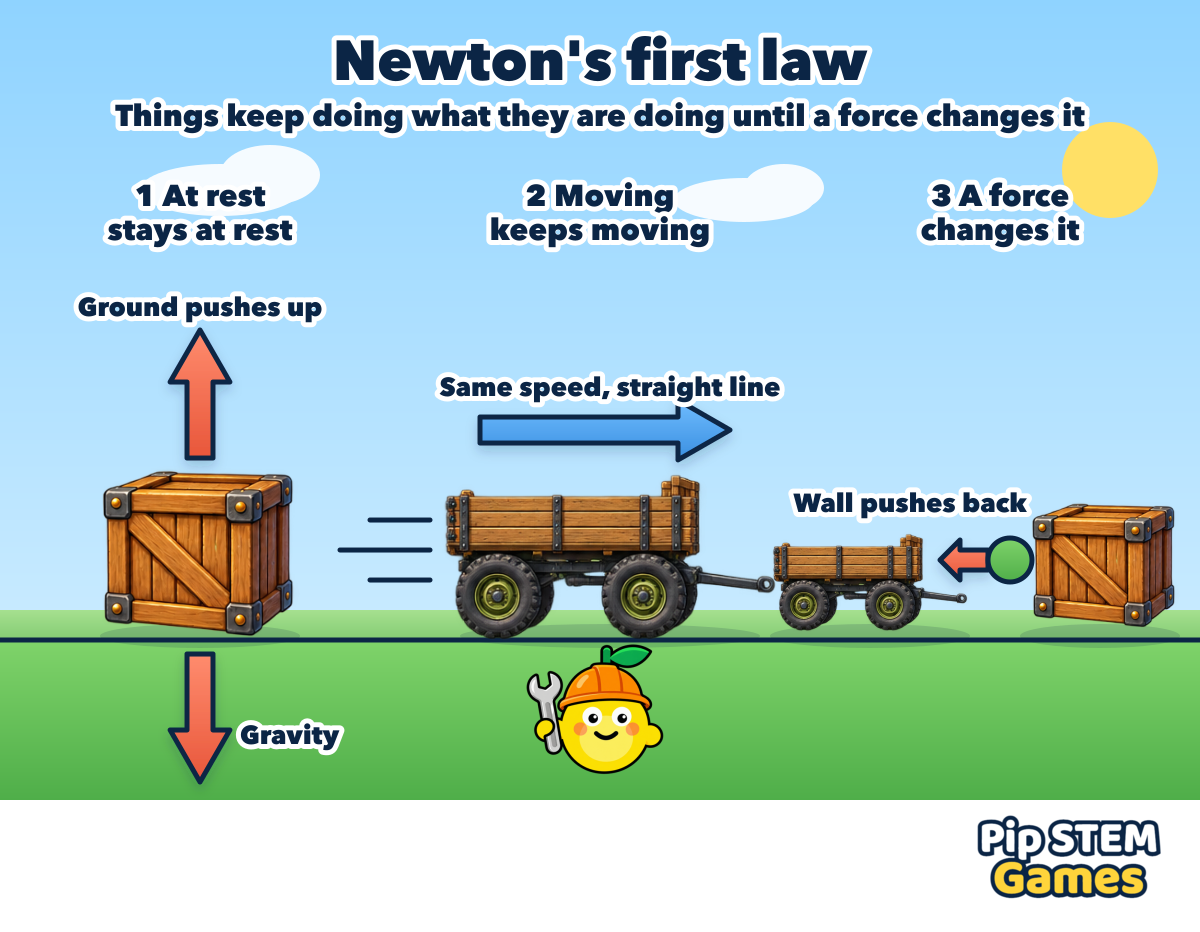
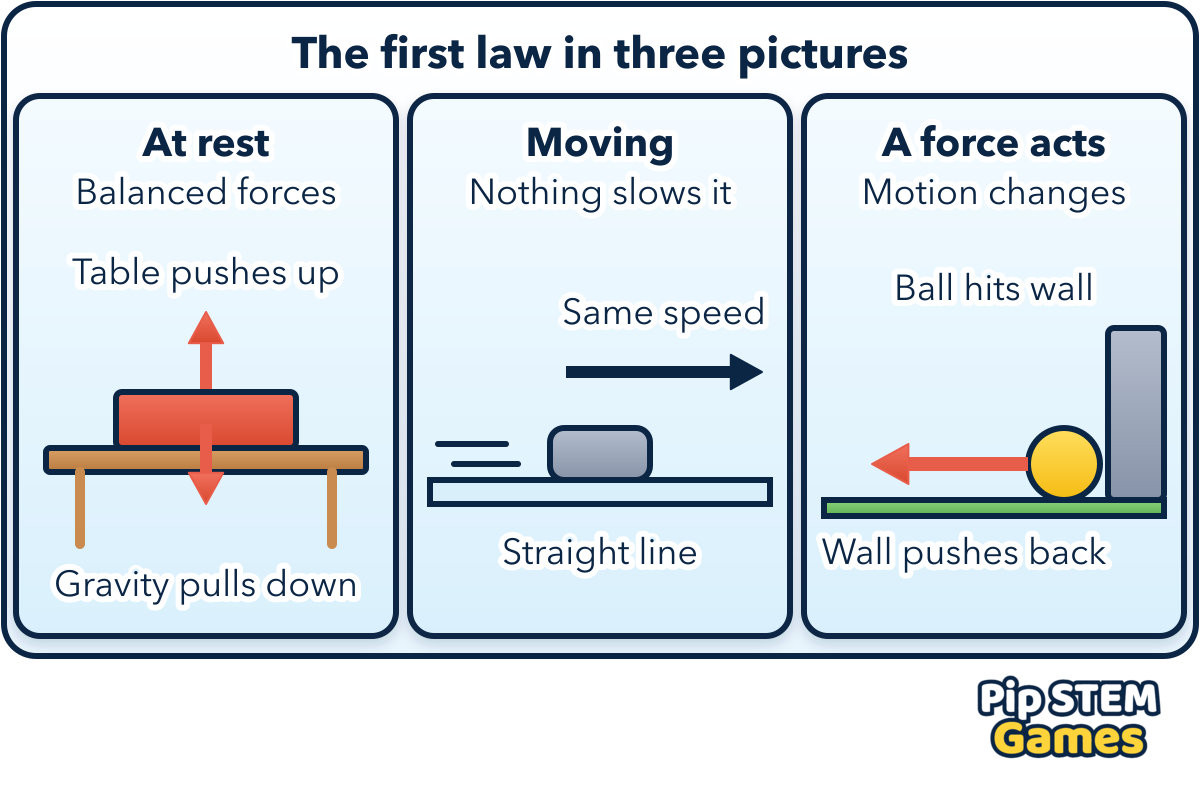
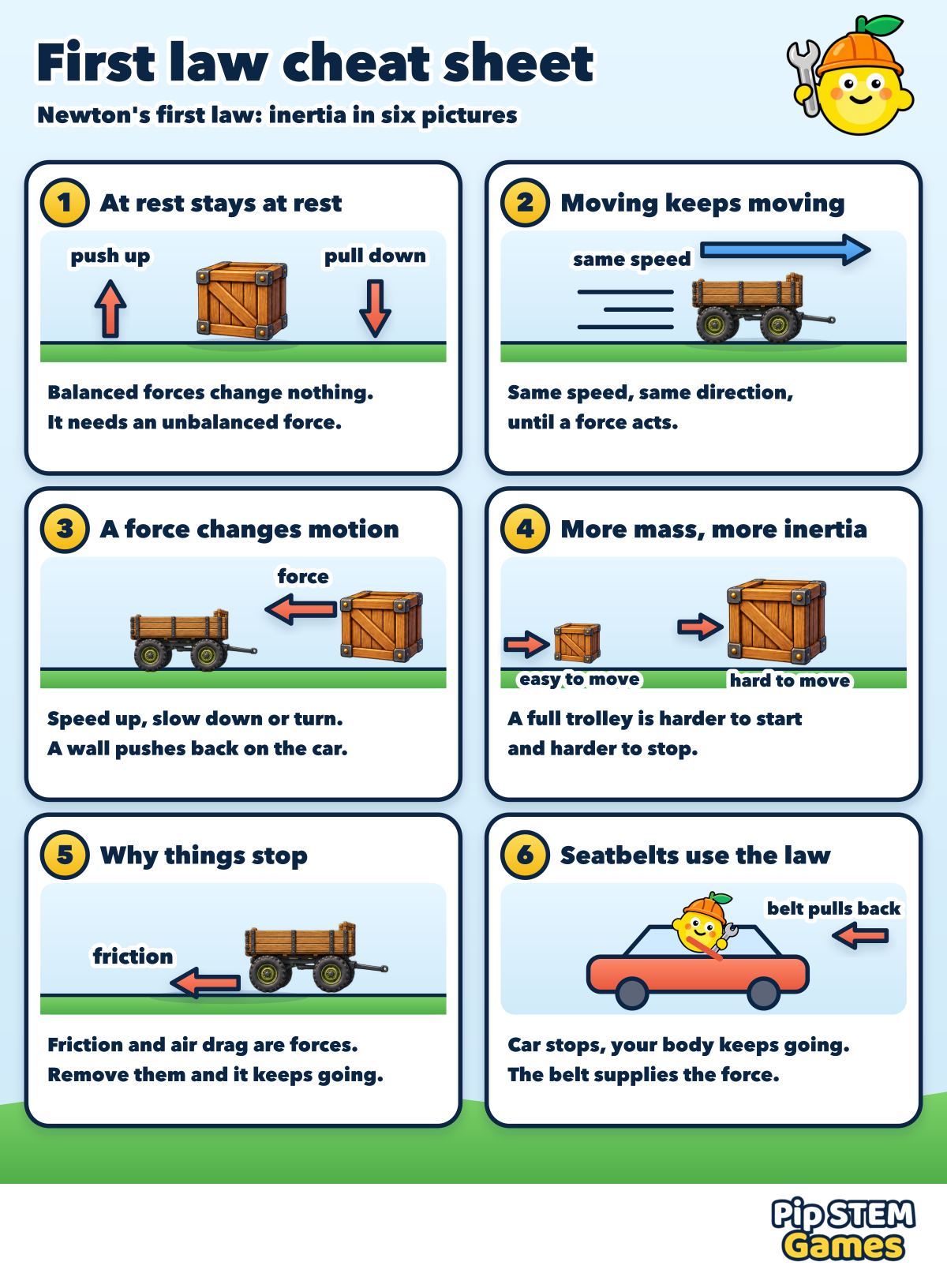
The longer version is that an object at rest stays at rest, and an object in motion stays in motion with the same speed and in the same direction, unless an unbalanced force acts on it. "Unbalanced" matters. If two equal forces push in opposite directions, they cancel out, and the object doesn't change. A book on a table has gravity pulling it down and the table pushing it up. The forces are balanced, so the book stays put.
The law is named after Isaac Newton, who published it in 1687. Before that, many people believed a moving object needed a constant push to keep going. Newton's insight was that it's the stopping and slowing that need a cause, and that cause is usually friction or a collision.
What is inertia, and why do heavy things have more of it?
Inertia is how much an object resists a change to its motion, and the more mass it has, the more inertia it has.
Try pushing an empty shopping trolley, then a full one. The full trolley is harder to get moving, and it's harder to stop once it's rolling. Same trolley, more mass, more inertia. Mass is the amount of stuff in an object, not how big it looks, so a small iron ball has more inertia than a big foam one.
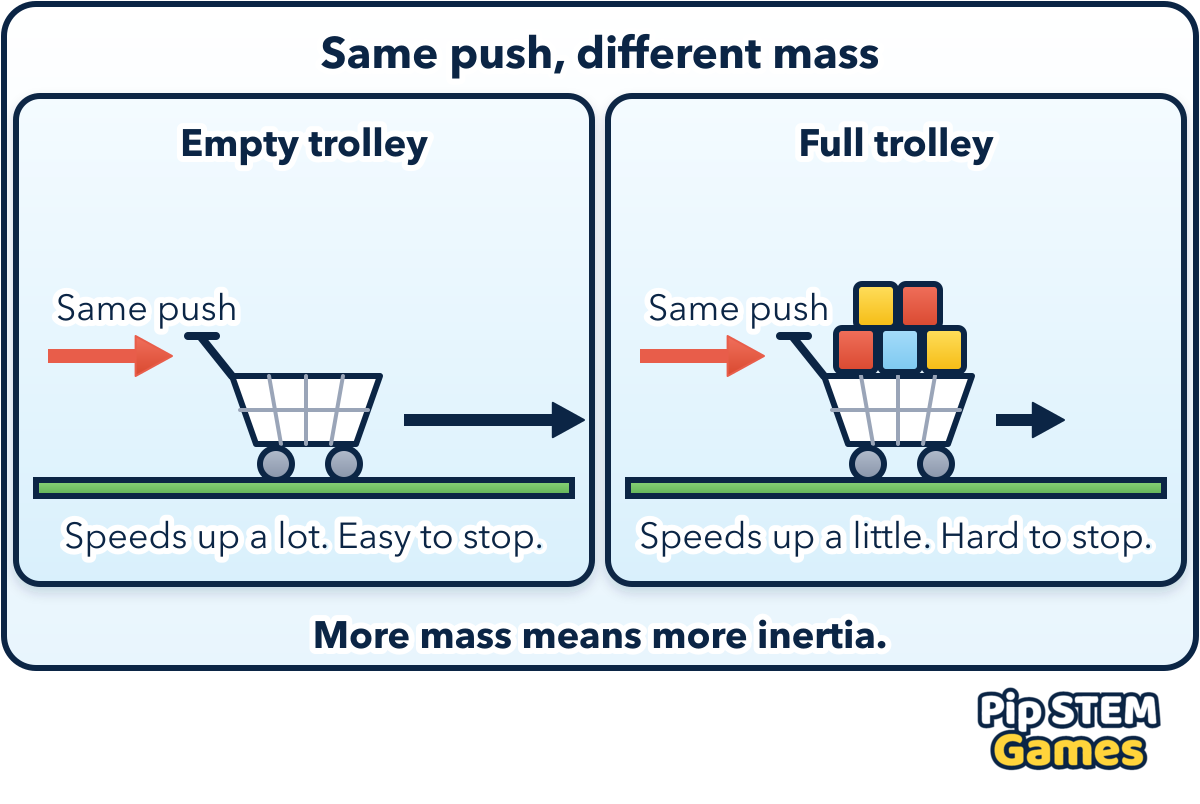
A good way to explain it to your child: inertia isn't a force that pushes. It's a stubbornness. Objects "want" to carry on as they were. It takes a force to persuade them otherwise, and a bigger object needs a bigger force.
What are some everyday examples of Newton's first law?
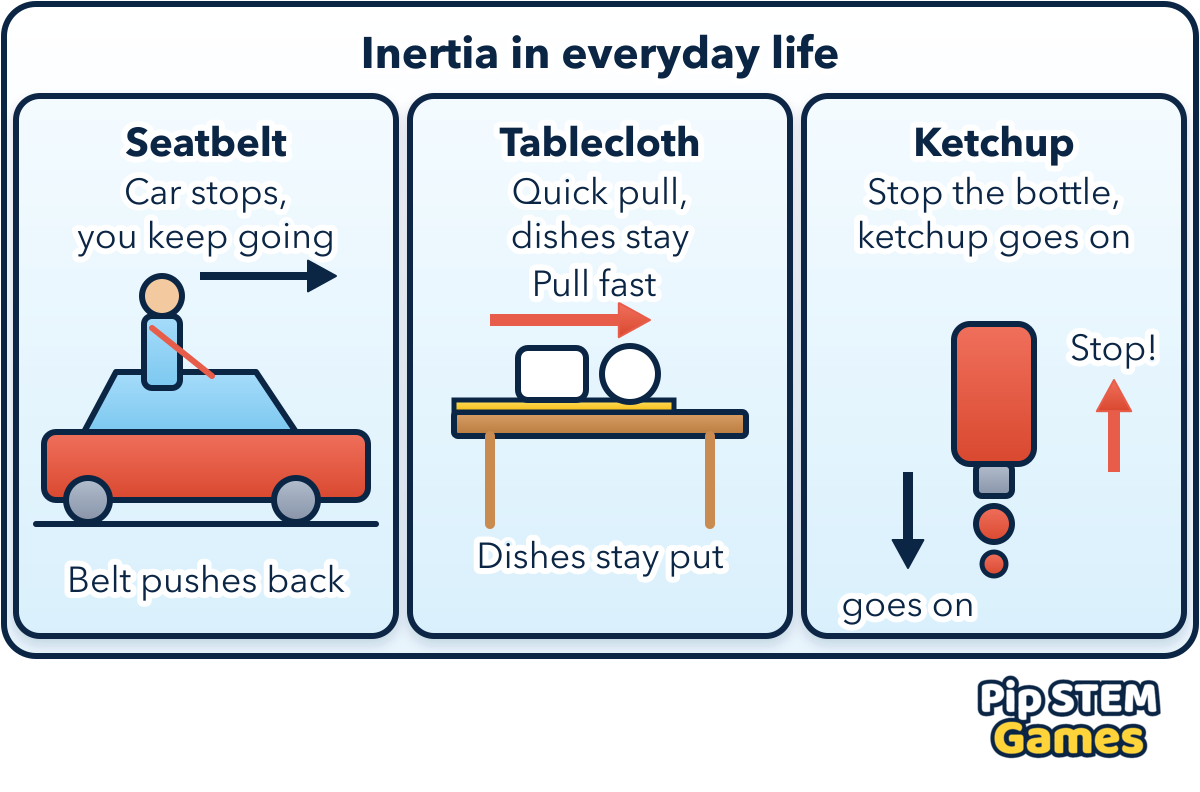
Any time something lurches forward when a car stops, or stays put when you pull the table out from under it, that's the first law.
- Seatbelts: when a car brakes hard, the car slows but your body wants to keep moving forward at the old speed. The belt provides the force that slows you down too. Without one, you'd carry on until you hit something.
- The tablecloth trick: yank a smooth cloth out quickly from under a set of light dishes and they barely move, because their inertia keeps them in place before friction has time to drag them along. (Use plastic plates with an adult nearby, never your best china.)
- Sliding on ice: there's very little friction, so you keep going a long way after you stop pushing.
- A ball rolling to a stop: it isn't running out of "push". Friction with the ground and the air is the unbalanced force that slows it.
- Astronauts and satellites: in space there's almost no friction, so a satellite keeps moving for years. School labs often show the same thing with a puck gliding across an air table, which has almost no friction.
- A pram on a flat path: it stays put until you push, and keeps rolling after you let go until friction slows it.
- Shaking ketchup out of a bottle: swing the bottle down and stop it suddenly, and the ketchup carries on moving.
Our balloon-powered car project shows what happens when you add a force to something at rest, which makes a handy follow-up.
How do you test Newton's first law at home?
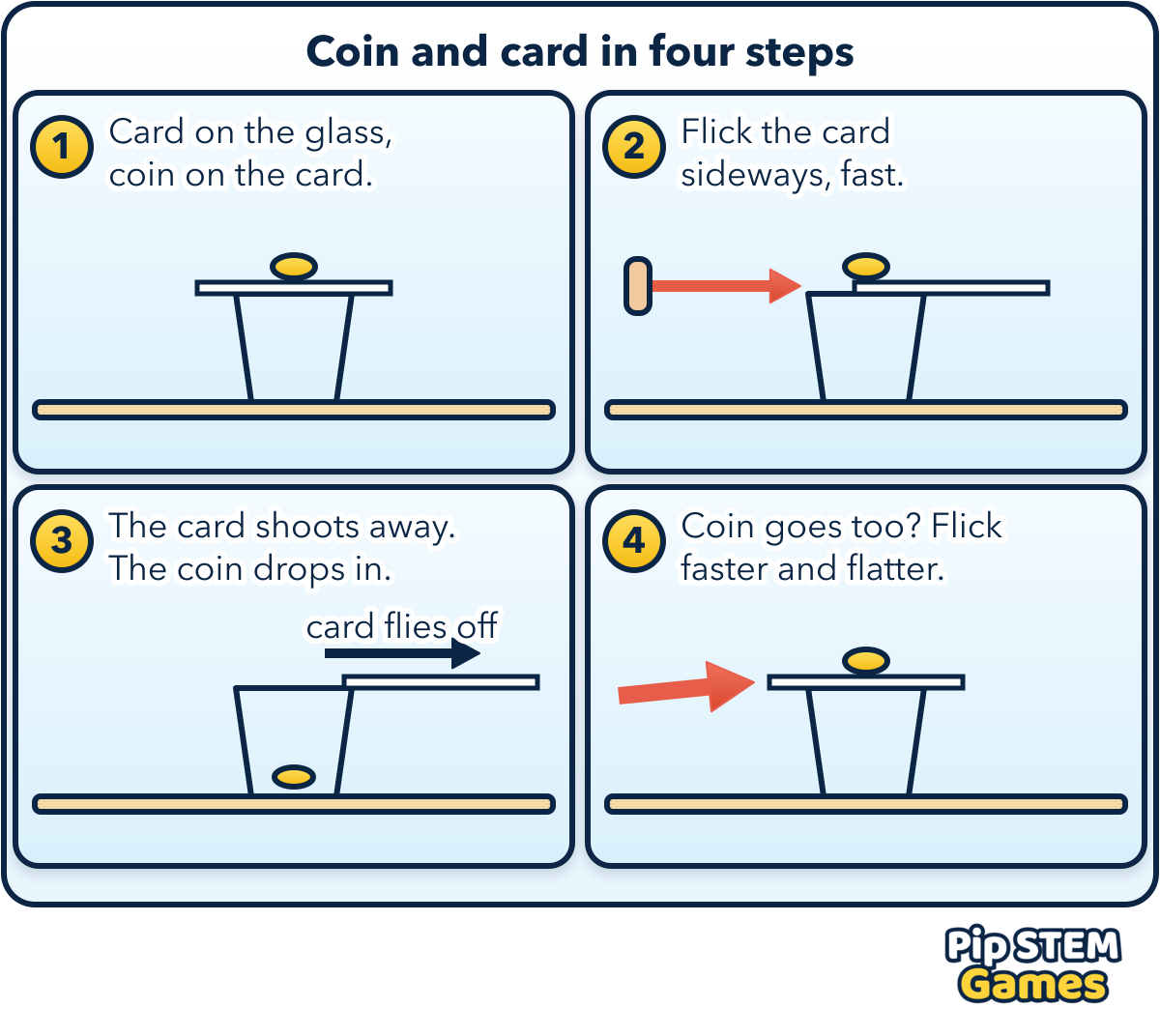
Three quick experiments show inertia: the coin-and-card flick, the toy car crash test and the ramp-and-floor roll.
Experiment 1: Coin and card.
- Balance a playing card on top of a glass or cup, with a coin on the card over the middle of the opening.
- Flick the card sharply sideways with a finger.
- The card shoots away, and the coin drops straight down into the glass. The coin's inertia kept it in place while the card was moving.
If the coin goes with the card, flick faster and flatter. Use a plastic cup, put a towel under it in case it tips, and keep the coin out of reach of under-3s, since coins are a choking hazard.
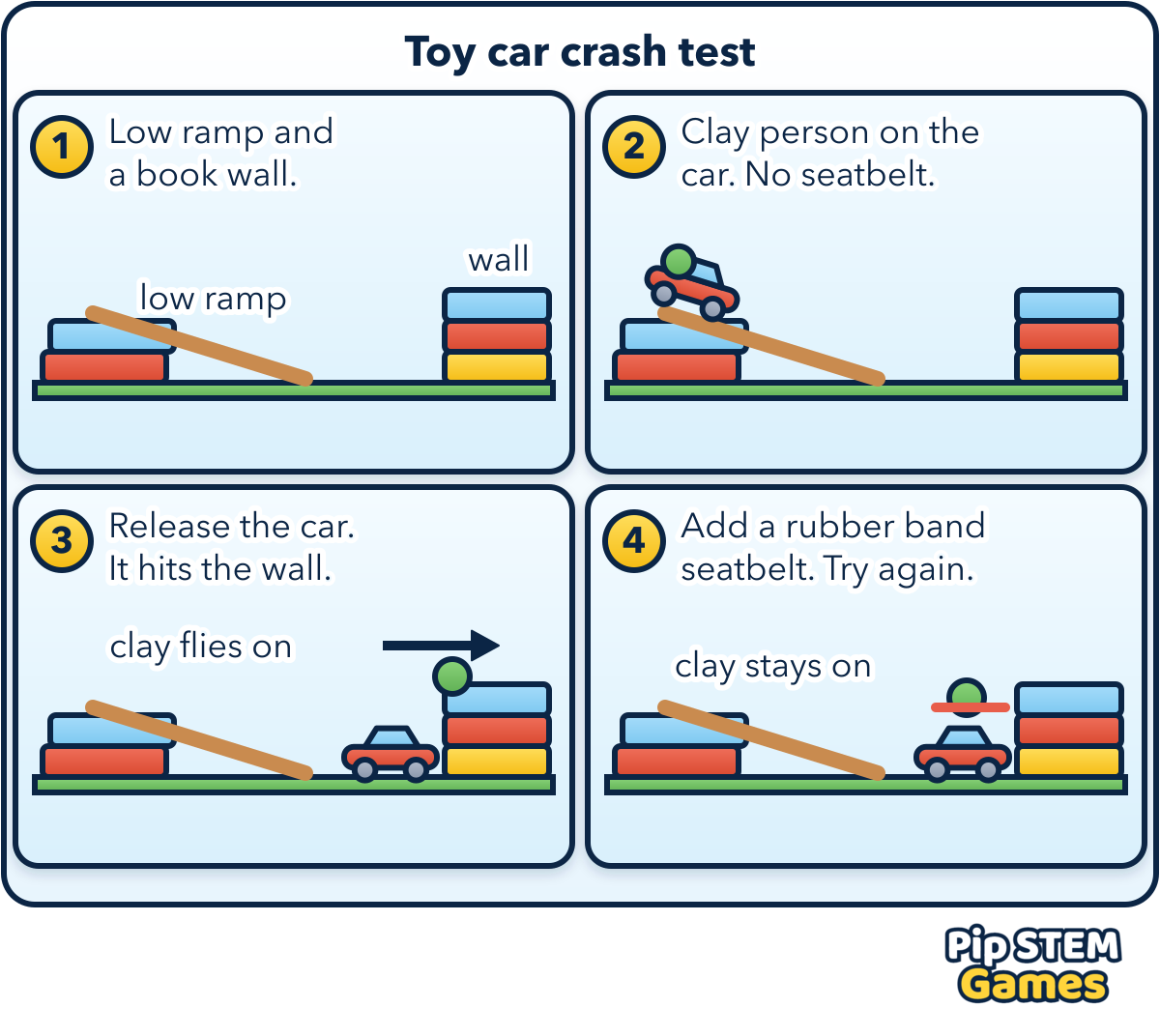
Experiment 2: Toy car crash test.
- Build a low ramp from a book and a board, no higher than a few books, so the car is slow and safe. Put a stack of books at the bottom as a wall. Use a small car and keep little figures and clay out of reach of under-3s.
- Sit a small figure or a blob of modelling clay on a toy car, loose, with no seatbelt.
- Release the car. When it stops at the wall, the clay person keeps going and flies forward.
- Now add a rubber band "seatbelt" across the clay person and the car, and try again.
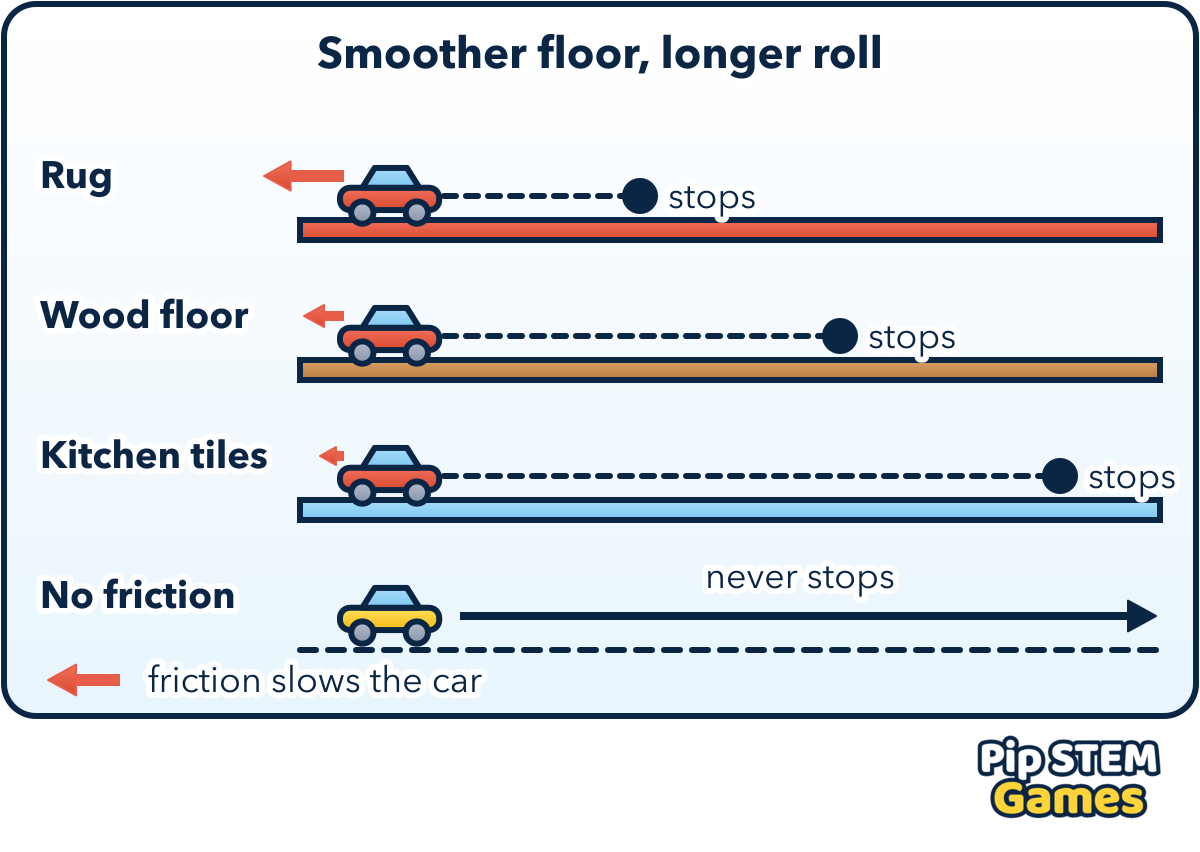
Experiment 3: Ramp and floors. Roll the same car down the same ramp and across three floors, such as a rug, a wooden floor and kitchen tiles. Measure how far it goes each time. The smoother the floor, the less friction slows it, and the farther it rolls. Imagine a floor with no friction at all: the car would never stop. That's the first law, found by thinking it through.
Why does a moving object eventually stop if the first law says it should keep going?
Moving objects on Earth stop because friction and air drag are forces acting on them, so the unbalanced-force condition is always met.
This is the most common confusion, and it's why ancient thinkers got it wrong. A rolling ball is being pushed back by the ground rubbing against it and by the air it has to shove aside. Take those away, and it would keep going. Spacecraft show this clearly: once a probe has had its engine burn, it can coast for years without using more fuel, with only tiny pulls from gravity changing its path.
Your child can see it in the ramp experiment. The car on the rug stops sooner because the rug provides more friction. It's the friction, not "running out of go", that does it. A good question to ask: "What force is stopping the car, and where does it come from?"
What mistakes do kids and adults make with Newton's first law?
The biggest mistake is thinking a moving object needs a force to keep it moving, when it only needs one to change its motion.
- "Force is needed to keep moving." Not true. A force is needed to speed up, slow down or turn.
- "Heavy things fall faster." That's a different idea. Heavier objects have more inertia but also more gravity pulling them, so in air without much drag they fall together.
- "Inertia is a force." It's a property of matter, a measure of how hard it is to change motion.
- "No movement means no forces." A book on a table has forces on it, just balanced ones.
What most people get wrong here is the word "unbalanced". If you remember that one, most of the first law falls into place.
How can your child practise Newton's first law after the experiments?
A game that makes them predict how something will move on different slopes and surfaces locks in the idea.
In the Ramp Runner game, they plan how a rolling object will travel and adjust until it works. For more forces-and-motion practice on paper, the Senior Engineers workbook suits ages 8 to 12. If towers topple in your house, why this tower keeps falling over shows a related idea about balance. And for a wheeled project where a force changes the motion, try the cardboard marble run.
A closing question for the car ride home: "What would happen to us if the car stopped, and why does the belt fix it?" If they can answer in their own words, they've got the law.
Questions parents ask
What is Newton's first law in one sentence?
An object stays at rest or keeps moving in a straight line at a steady speed unless an unbalanced force acts on it.
What is another name for Newton's first law?
The law of inertia. Inertia is the tendency of an object to keep its current motion, whether that's staying still or moving.
What is an example of Newton's first law?
A passenger lurching forward when a car brakes is the classic one. The car slows down, but the passenger's body keeps moving at the old speed until the seatbelt applies a force.
Does Newton's first law apply in space?
Yes, and it shows up clearly there. With almost no friction or air, spacecraft and satellites coast for very long times without engines, changing course only with forces such as gravity or thrusters.
What age should children learn Newton's first law?
Children around 8 to 12 can handle the idea with hands-on tests. Younger children can feel it with a push, a roll and a stop without learning the name or wording.
Why do we wear seatbelts if inertia only matters in crashes?
Inertia is always there. A seatbelt applies the force needed to slow you down along with the car, so your body doesn't keep moving forward at the old speed and hit the dashboard or windscreen.
Want more ideas like this? Explore engineering for kids: games, projects and challenges.
Great STEM activities to try next...
 Make a Balloon-Powered Car at HomeActivity
 DIY Cardboard Marble Run for KidsActivity
 Why This Tower Keeps Falling OverActivity
More to try: Newton's Third Law Examples for Kids (Printable)

Pip STEM Games
We make engineering games and workbooks for kids aged 5 to 12. Every activity here is one we'd happily run at the kitchen table: test it, watch it fail, fix it, try again.




