

Key takeaways
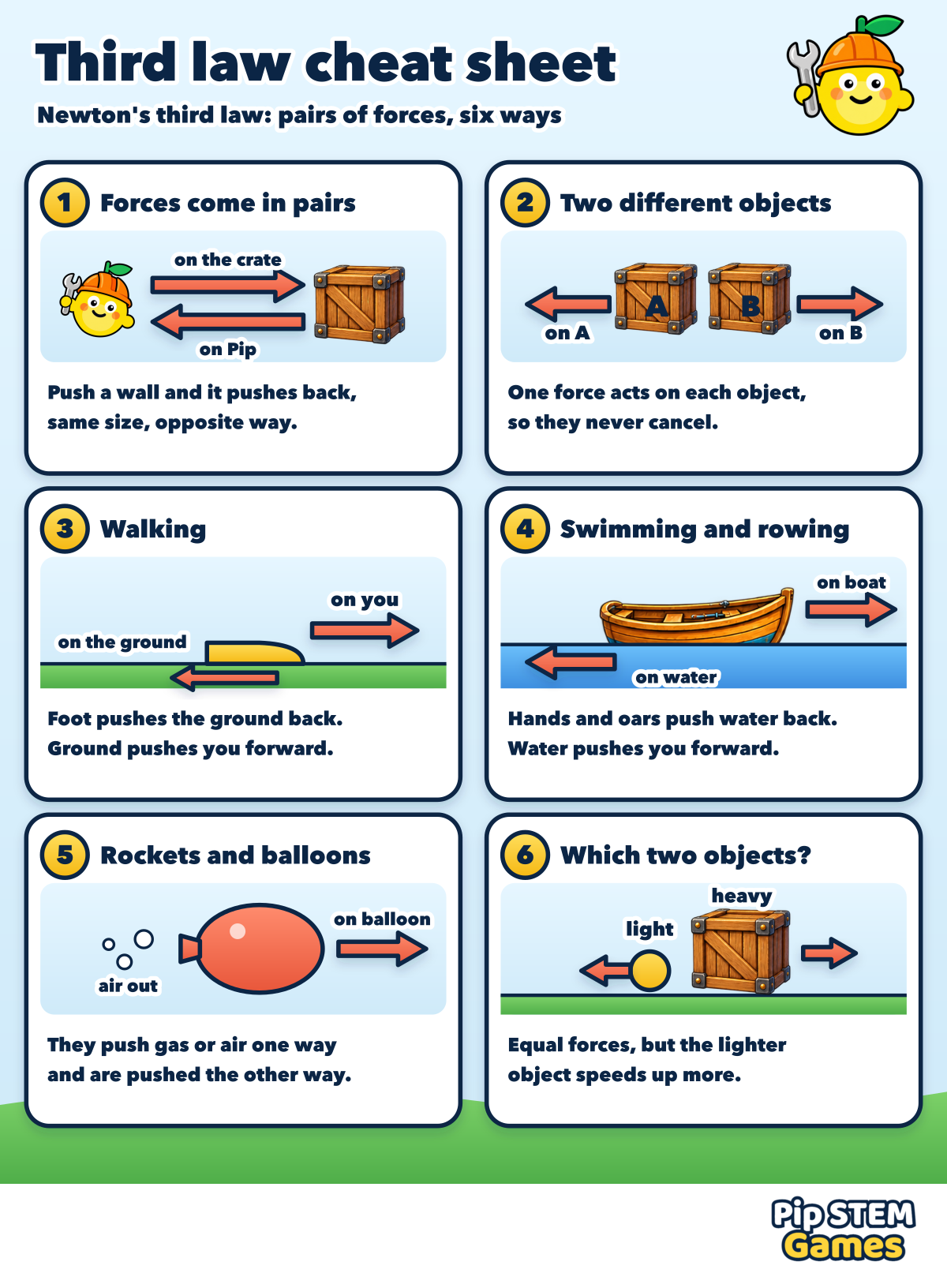
- Newton's third law: when object A pushes on object B, B pushes back on A with an equal force in the opposite direction.
- The two forces act on different objects, which is why they don't cancel out.
- Walking, swimming, jumping and rockets all work this way.
- Rockets don't push against the air. They push hot gas backwards and the gas pushes the rocket forwards.
- A balloon rocket on a string is the best first experiment.
Newton's third law says that when one object pushes on another, the second object pushes back on the first just as hard, in the opposite direction. You can see it when you walk (your foot pushes the ground back, and the ground pushes you forward), when you swim, and when a rocket launches. This page gives you clear examples, explains why the forces don't just cancel, and has two safe experiments you can do at home with kids aged 8 to 12. There is also a printable balloon rocket record sheet.
What is Newton's third law in simple words?
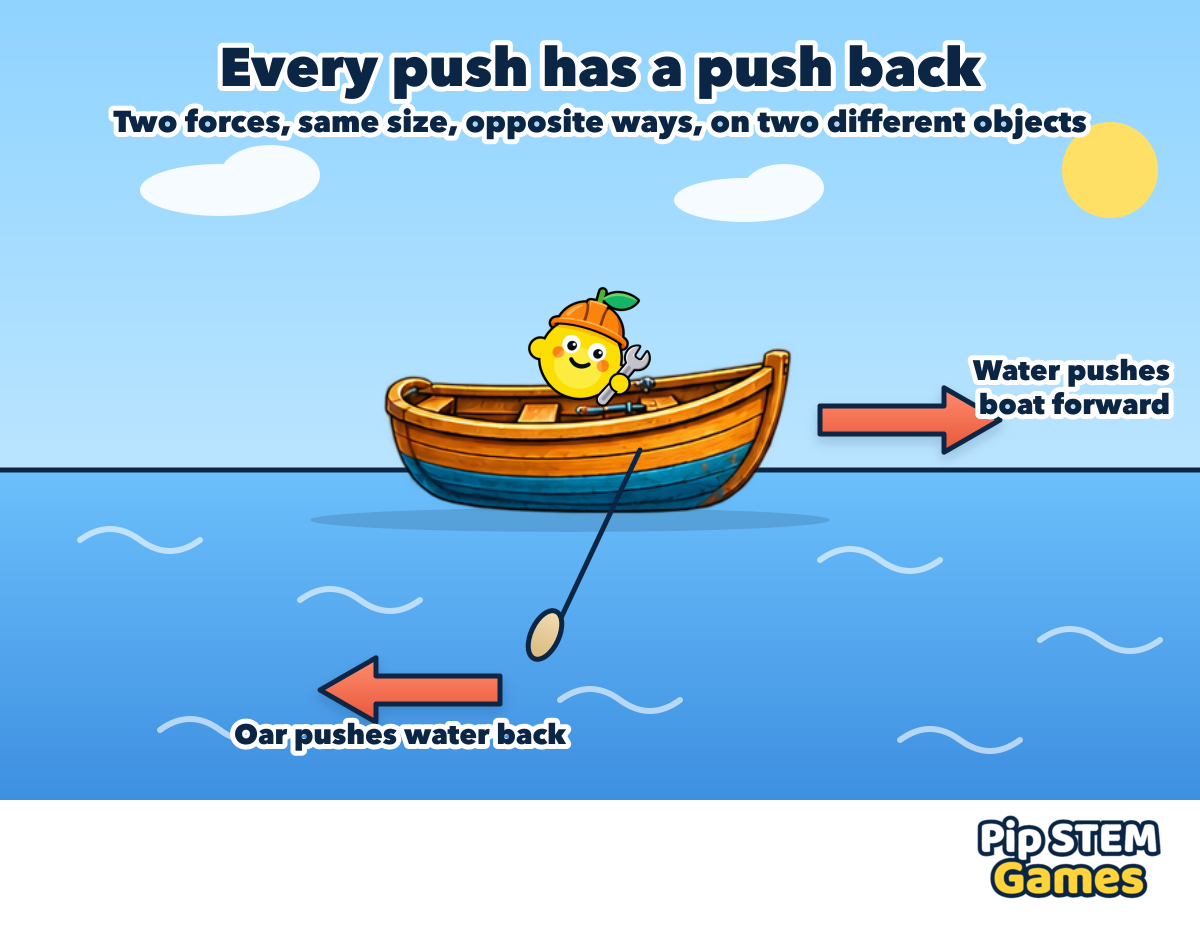
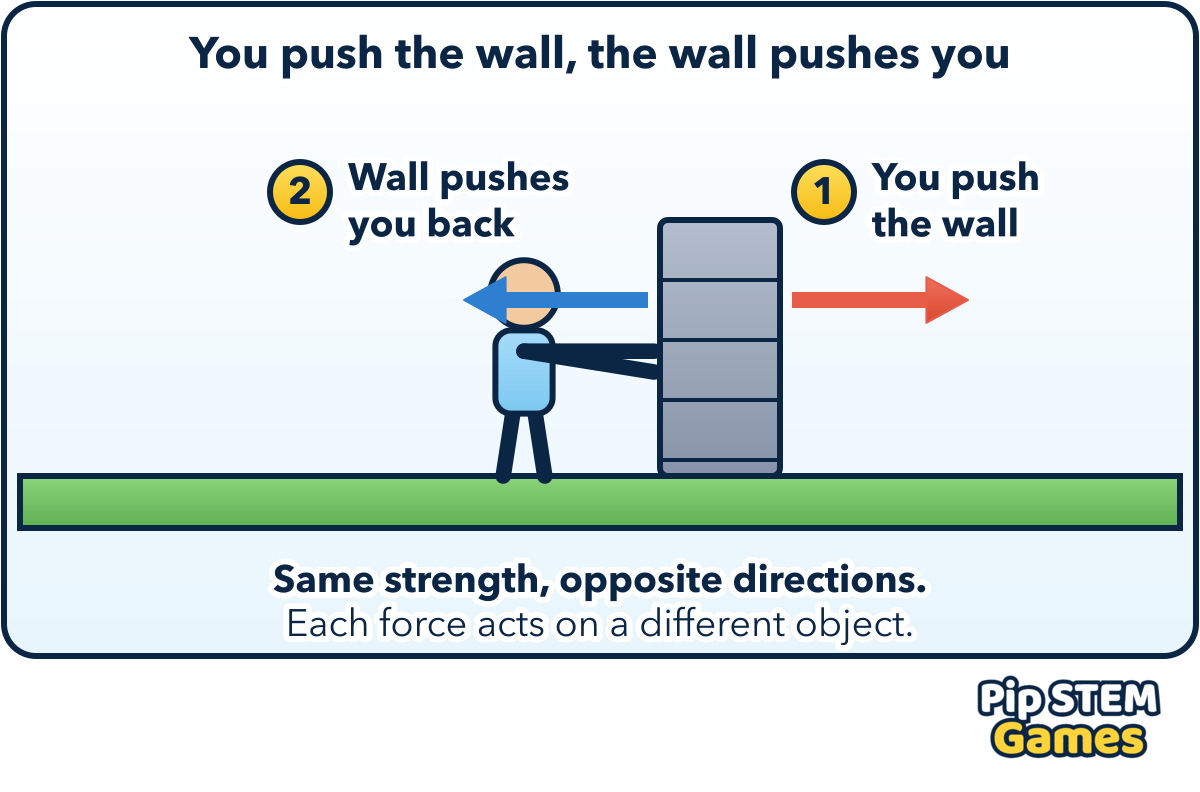
Forces always come in pairs. If you push a wall, the wall pushes you back with exactly the same strength. Scientists call the pair action and reaction, but those words can mislead. Neither force comes first, and neither causes the other. They happen at the same moment.
A kid-friendly way to say it: you can't push without being pushed. Try leaning on a wall and notice the wall holding you up. It's pushing back.
The law is the third of three published by Sir Isaac Newton in 1687. The first two are about how objects keep moving or change speed. The third is about pairs of forces between two objects.
What are some everyday examples of Newton's third law?
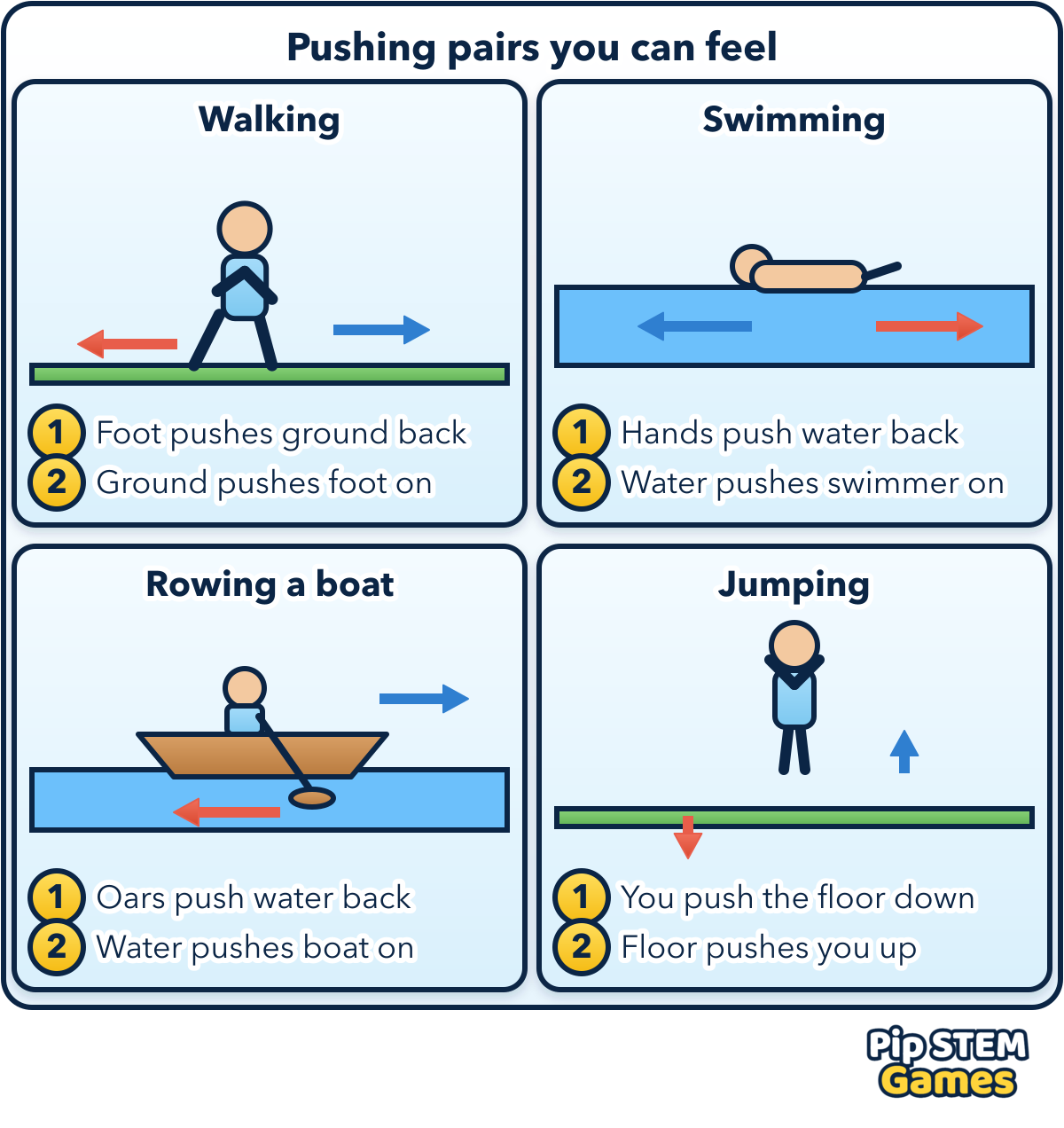
The easiest examples are walking, jumping, swimming and rowing, because you can feel them in your own body.
- Walking: your foot pushes backward on the ground; the ground pushes your foot forward. On ice there's less grip, so the push back is weak and you slip.
- Jumping: you push down on the floor; the floor pushes you up.
- Swimming: your hands push water backward; the water pushes you forward.
- Rowing a boat: the oars push water back, the water pushes the boat forward.
- Kicking a ball: your foot pushes the ball, and the ball pushes your foot. That's why a hard kick can sting your toes.
- Standing on a skateboard and pushing a wall: the wall pushes you backwards and you roll away.
- Sitting on a chair: you push down on the seat and the seat pushes up on you, just as hard.
- A cannon firing: the ball shoots forward and the cannon recoils backward. The cannon is so heavy that it moves far less.
- A hammer hitting a nail: the nail pushes back on the hammer, which you can feel in your hand.
For a boat that moves by pushing water, our build a boat that actually floats project is a good follow-up.
How does a rocket use Newton's third law?
A rocket pushes hot gas out of its back, and the gas pushes the rocket forward. Rockets don't need air to push against, which is why they work in space. The pair of forces is between the rocket and the gas it throws out.
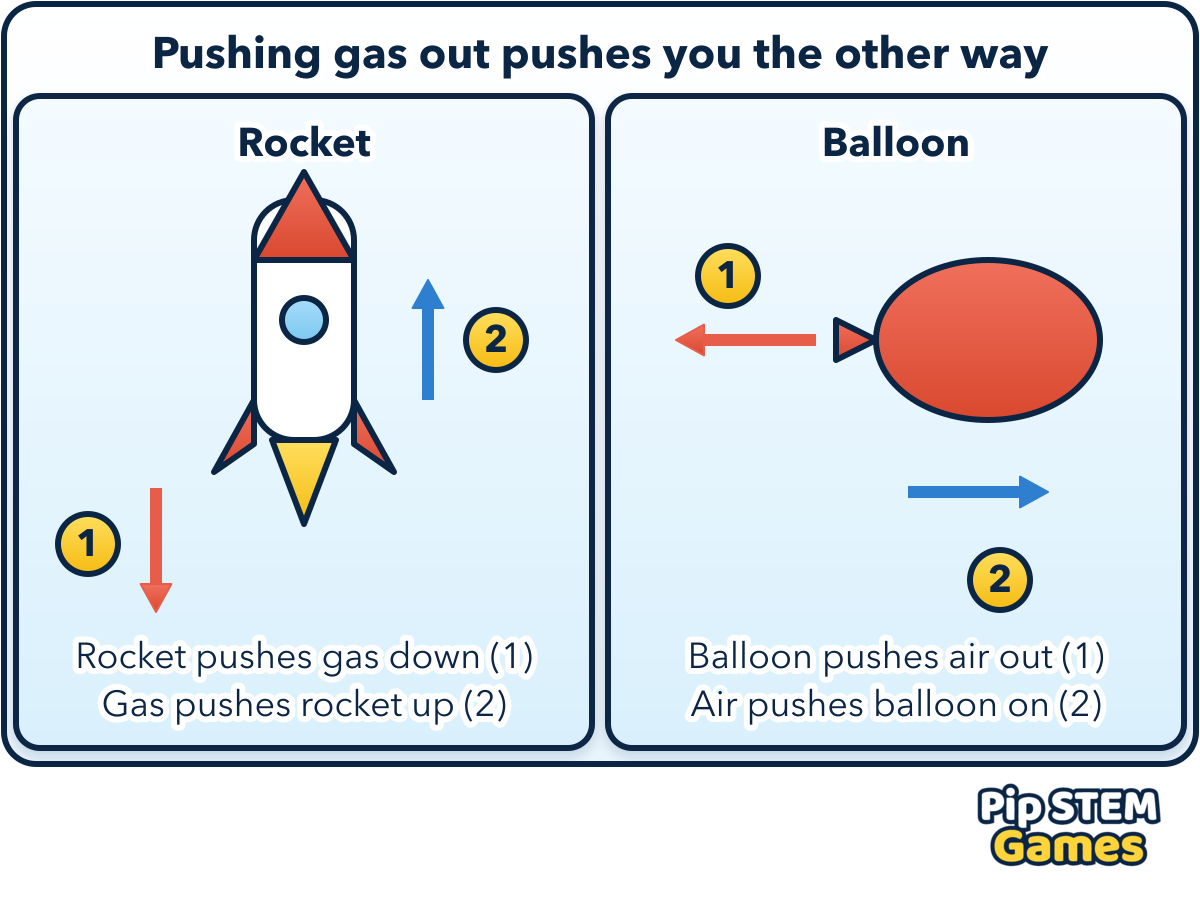
A balloon shows the same thing. When you let go of an inflated balloon, it pushes air out of its neck, and the air pushes the balloon the other way.
The same idea is used in the Lander game, where your thrusters push gas down so the ship is pushed up. Fire too long and you'll overshoot, which is a good way to feel how much push is needed.
If every force has an equal opposite force, why does anything move?
The two forces act on different objects, so they never cancel each other out. When you push a shopping trolley, the trolley pushes your hands, and your hands are what feel it. The trolley moves because the push on the trolley is bigger than the friction slowing it down.
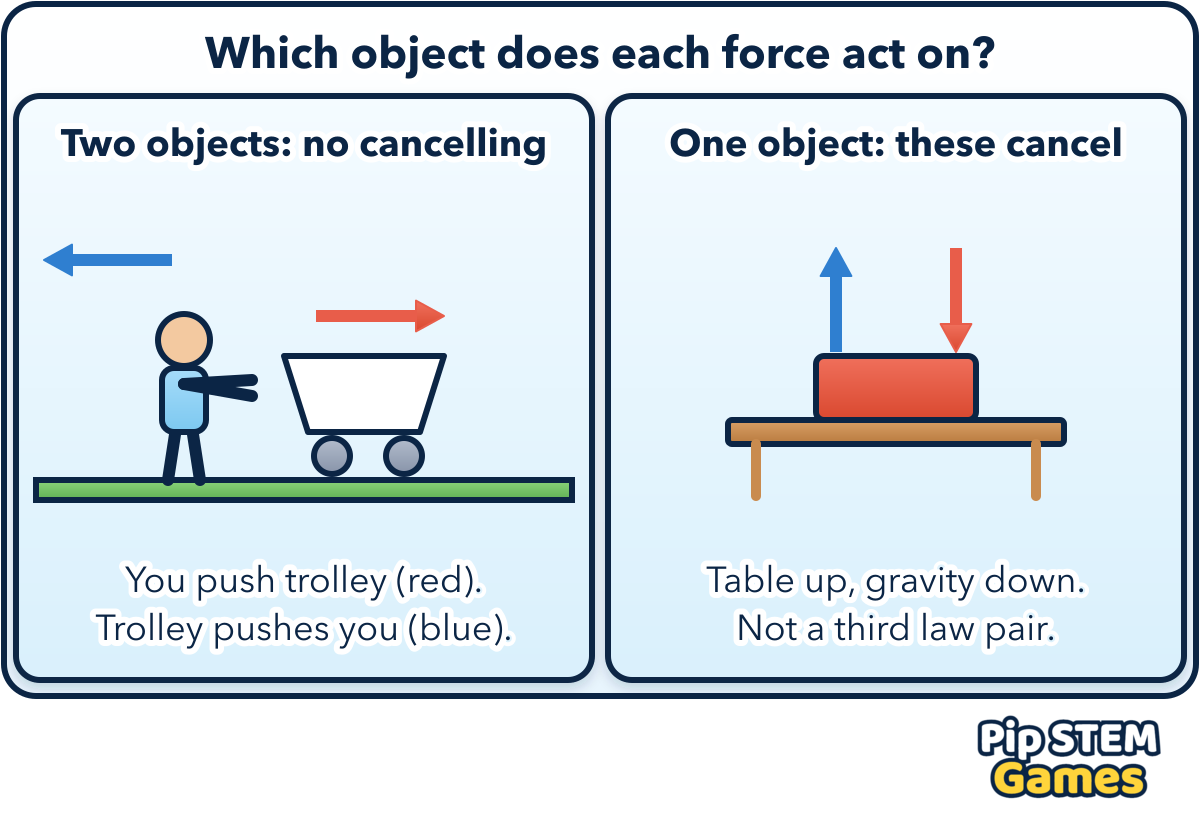
This is the part most people get wrong. Cancelling happens only when two forces act on the same object. A book on a table has gravity pulling it down and the table pushing it up, and those do cancel, so the book sits still. (Those two aren't the Newton's third law pair, but they show how balanced forces look.)
Here's a follow-up: if the forces are equal, why does the ball speed up so much more than the bat? Because the ball is lighter. The same force makes a light thing speed up more than a heavy thing, which is Newton's second law. Ask "which object?" every time and the third law gets much easier.
What Newton's third law experiments can kids do at home?
Two are reliable: a balloon rocket and a wheeled-chair push-off. Both take under 15 minutes.
Balloon rocket on a string
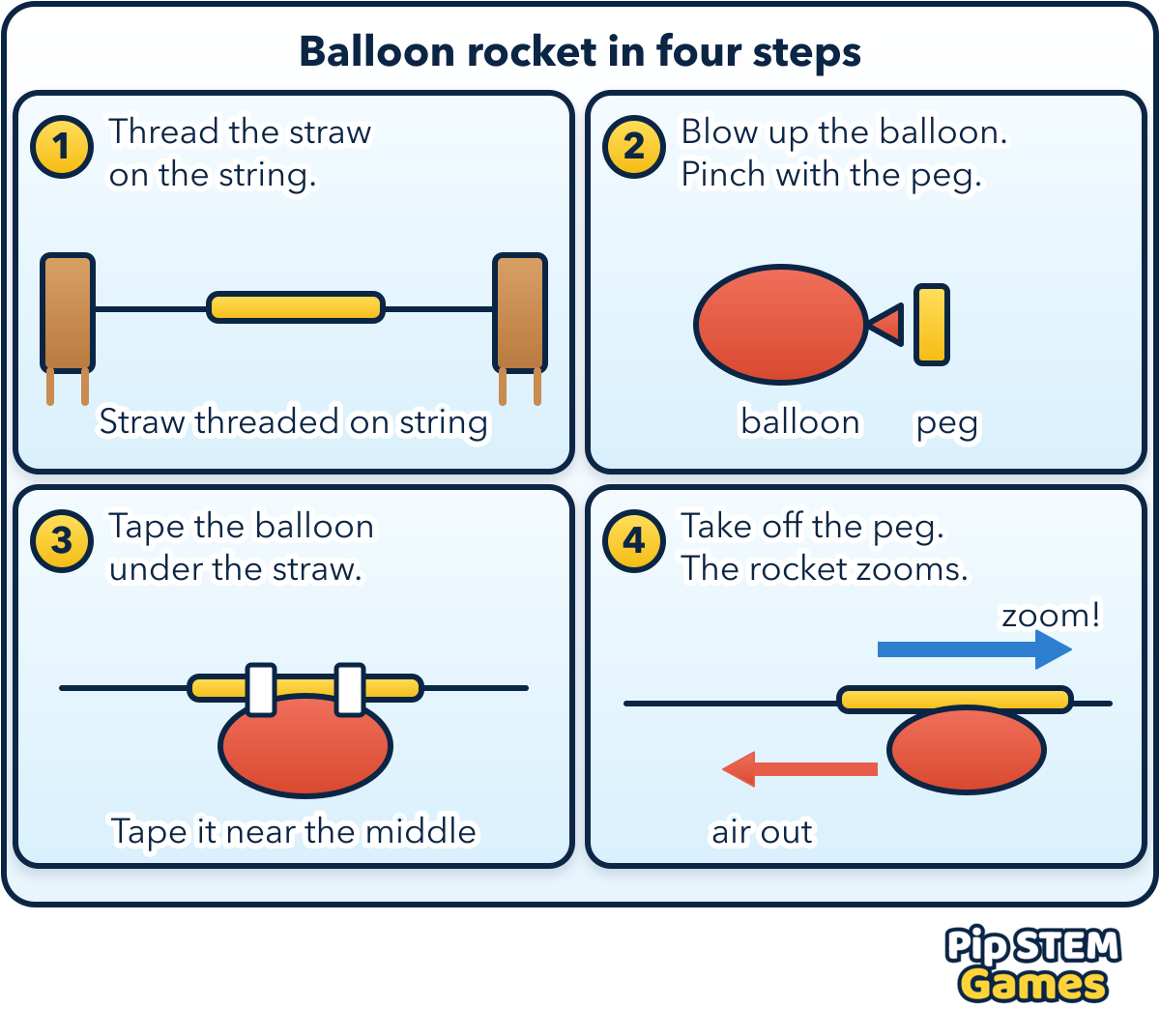
- Materials: a long balloon, a drinking straw, 3 to 4 metres of string, sticky tape, a clothes peg.
- Thread the string through the straw and tie each end to a chair, pulled tight.
- Blow up the balloon, pinch the neck with the peg, and tape the balloon to the straw.
- Take off the peg. The balloon zooms along the string.
- Tip: tape the balloon near the middle of the straw. Tape at the ends makes the straw bend and slows the rocket.
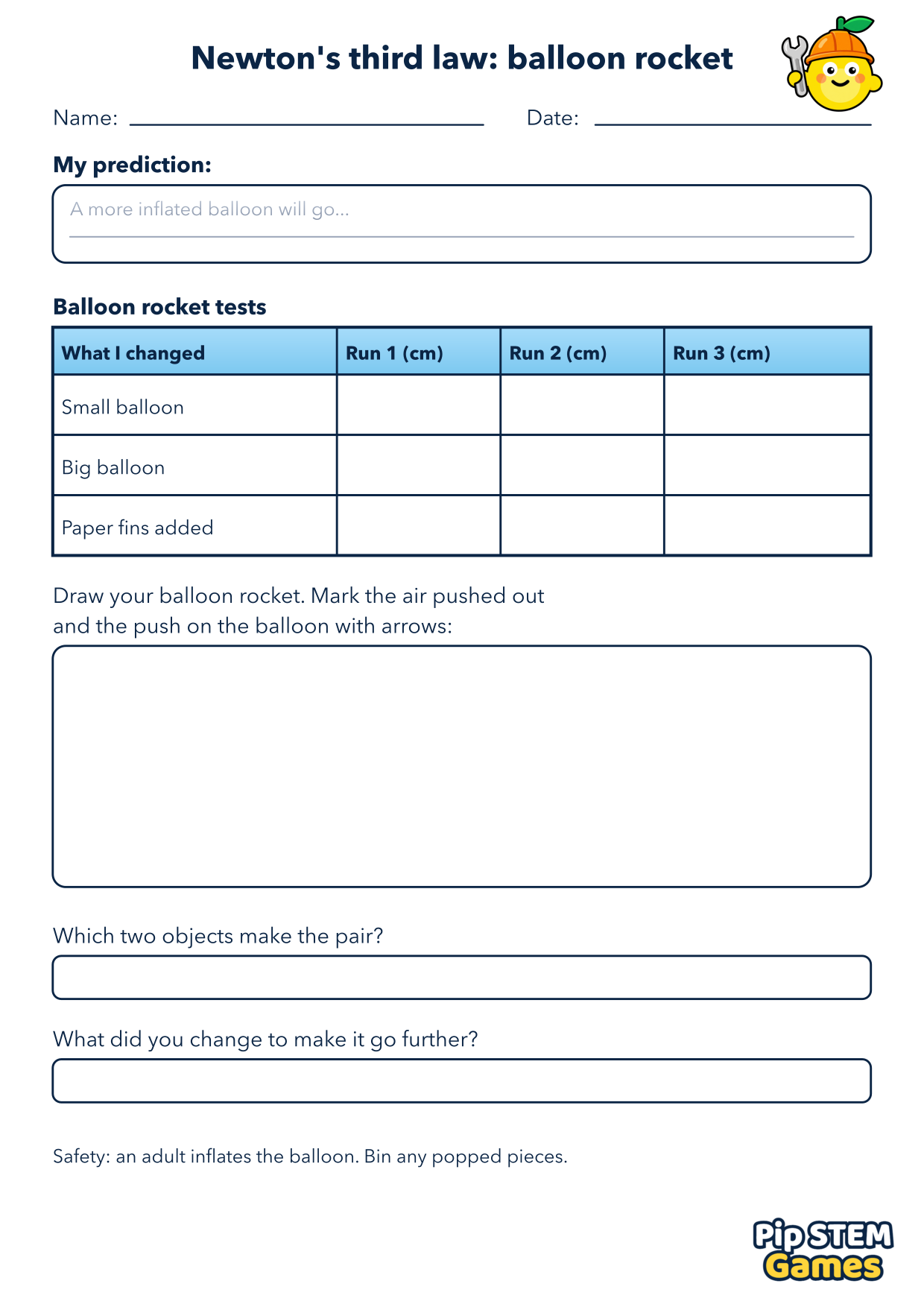
Make a prediction first, such as "A more inflated balloon will go further because more air pushes it". Then change one thing at a time (balloon size, string length, adding paper fins) and measure the distance each time. Under-8s should only play with balloons under adult supervision, and an adult should inflate them. Balloons and broken pieces are a choking hazard, so collect any popped pieces straight away and bin them. For a wheeled version, see our balloon-powered car.
Push-off on a wheeled chair or skateboard
Sit on a wheeled office chair with a clear floor around you, with an adult nearby. Push gently against a wall with your hands. You roll backwards. Next, try with a heavier friend sitting in a second chair, both pushing each other. Who moves more? The lighter one. Safety: stay seated, keep feet off the floor, and clear stairs and sharp furniture away.
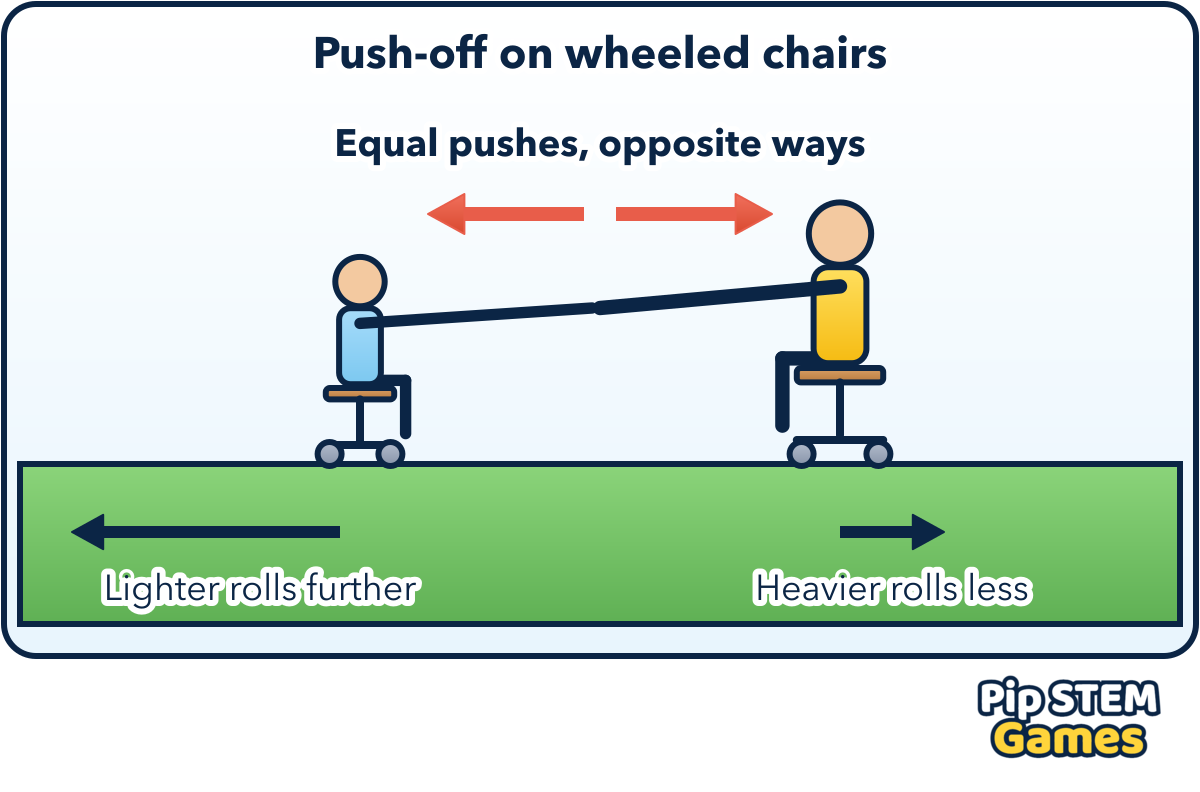
Frankly, the chair experiment lands better than any diagram. Children laugh, then they get it.
How do I explain it to different ages?
Ages 5 to 7 can feel it; ages 8 to 12 can measure it. For the younger group, use "push and push back" and the wall-lean. For older children, use the word pair, ask "Which two objects?" every time, and let them record the distance their balloon rocket travels in centimetres.
Want to practise the idea in a game? Our Senior Engineers workbook has forces and motion challenges for ages 8 to 12.
Questions parents ask
What is a simple example of Newton's third law?
Pushing a wall. You push on the wall, and the wall pushes back on you with the same strength. If you stood on a skateboard, you would roll away.
What are 3 examples of Newton's third law?
Walking (your foot pushes the ground back, the ground pushes you forward), swimming (your hands push water back, the water pushes you forward) and a rocket launch (the rocket pushes gas down, the gas pushes the rocket up).
Why don't action and reaction forces cancel out?
They act on two different objects. Forces only cancel when they act on the same object.
Does a rocket need air to push against?
No. A rocket pushes its exhaust gas backward and the gas pushes the rocket forward. That is why rockets work in the vacuum of space.
How do I explain Newton's third law to a child?
Say "you can't push something without it pushing you back." Then let them lean on a wall or push off from a wheeled chair so they can feel it.
Is a balloon rocket a good Newton's third law experiment?
Yes. It's cheap, quick and shows the effect clearly: air goes out of the back and the balloon goes forward.
Great STEM activities to try next...
 Make a Balloon-Powered Car at HomeActivity
 Build a Boat That Actually FloatsActivity
 Why This Tower Keeps Falling OverActivity
More to try: Bernoulli's Principle for Kids and Flying (Printable) · Newton's First Law Examples and Experiments for Kids · Kinetic vs Potential Energy for Kids (Printable)

Pip STEM Games
We make engineering games and workbooks for kids aged 5 to 12. Every activity here is one we'd happily run at the kitchen table: test it, watch it fail, fix it, try again.




