


Key takeaways
- A tower tips when the line down from its balance point lands outside its base.
- A wider base needs a bigger tilt before the tower tips.
- Heavy parts placed low keep the balance point low and the tower steady.
- Sliding is a different problem from tipping, and grip fixes it.
- Change one thing at a time and test again, so you know what worked.
Why does my tower keep falling over? A tower falls when the balance point of its weight moves past the edge of its base. Tall, narrow towers, and towers with heavy parts up high, tip after only a small wobble. This page has a tilt test you can run in 20 minutes, five fixes, a cheat sheet and a printable record sheet.
Why does my tower keep falling over?
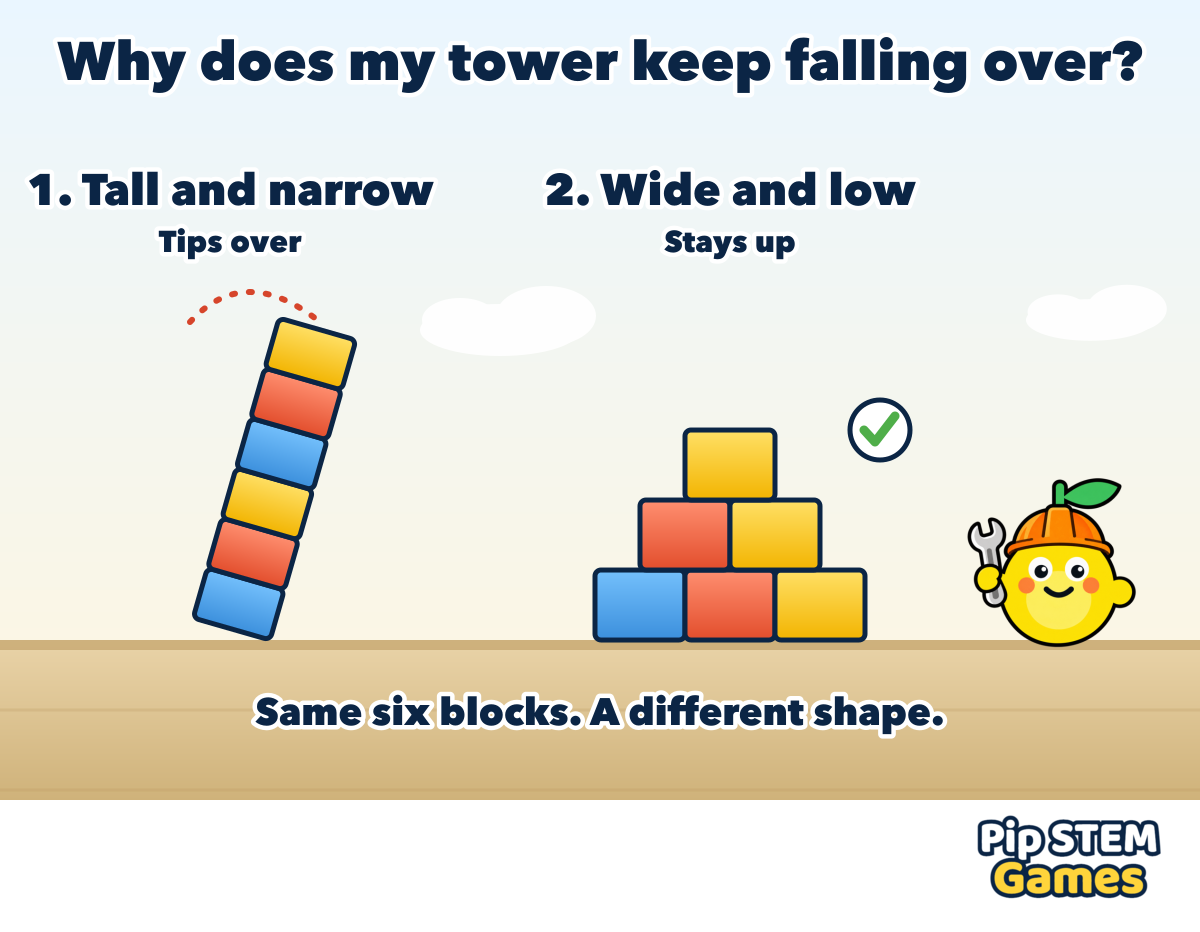
Most falling towers have one of three problems. The base is too narrow. The heavy pieces are too high up. Or the pieces are not stacked straight, so the tower leans before anyone touches it.
Each problem moves the tower's balance point closer to the edge of its base. When the balance point goes past the edge, gravity does the rest. Nobody needs to push.
Here is the good news. You can see this happening, measure it, and fix it. Start by comparing a tall, narrow tower with a wide, low one, built from exactly the same blocks.
What is the balance point of a tower?
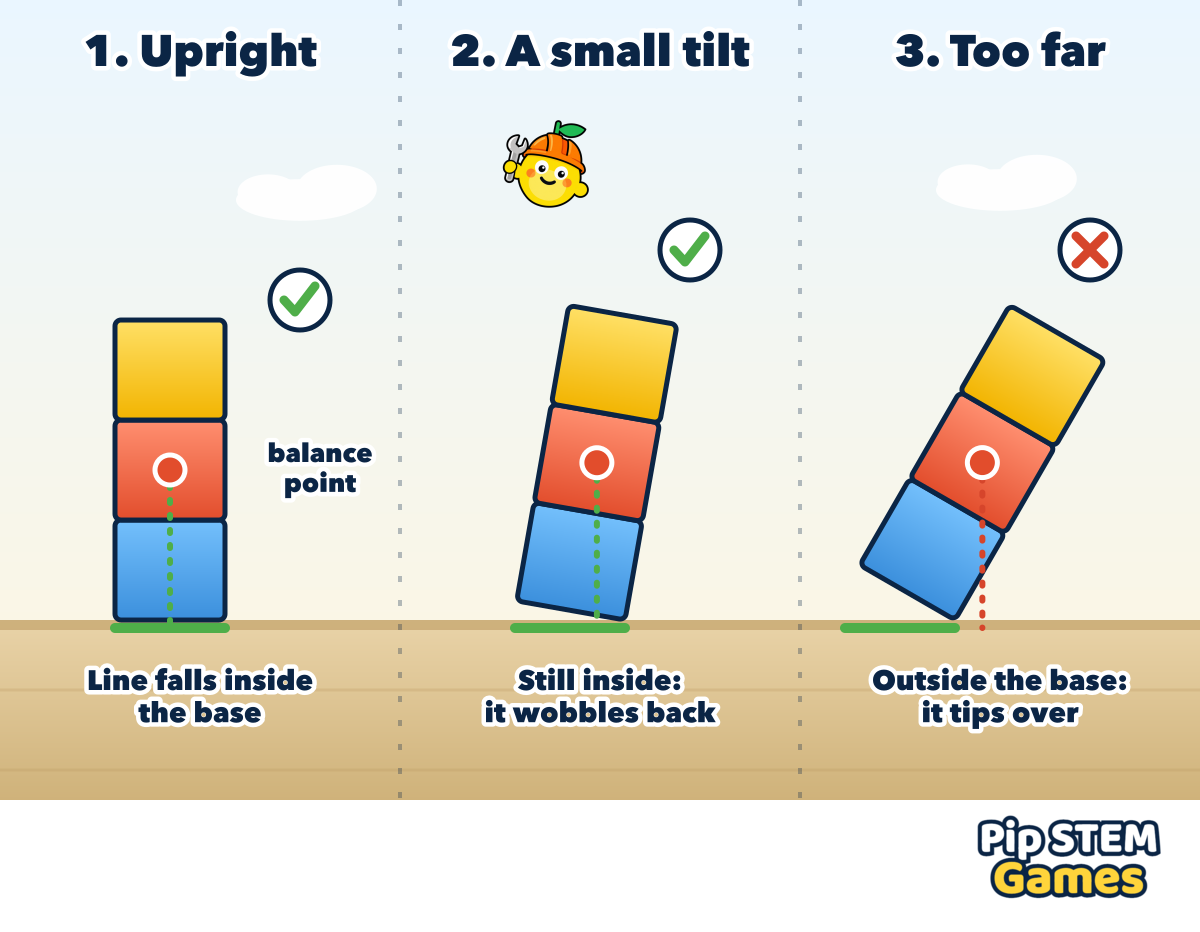
Every object has a balance point, the spot where all its weight seems to act. Engineers call it the centre of mass. Picture a string hanging straight down from that spot to the table.
If the string lands inside the base of the tower, the tower stands. Tilt the tower a little and the string moves, but if it still lands inside the base, the tower wobbles back. Tilt it far enough and the string lands outside the base. Then the tower tips over.
A wide base gives the string more room. A low balance point means the tower has to tilt much further before the string reaches the edge. That is why a wide, low tower is so hard to knock over.
What do you need for the tilt test?
The test takes about 20 minutes. You need:
- 6 small identical blocks, such as toy bricks, matchboxes or small cartons
- A flat board about 30 cm long, such as a chopping board, a hardback book or stiff cardboard
- A ruler with centimetres and a helper to hold it
- A small lump of putty or four 10p coins taped together, for the weight test
- A sheet of kitchen paper, and the record sheet below
Grown-up note: coins and putty are small parts, so keep them away from children under 3. Lift the board only a little way, keep faces and toes clear of falling blocks, and use light blocks.
How do you run the tilt test?
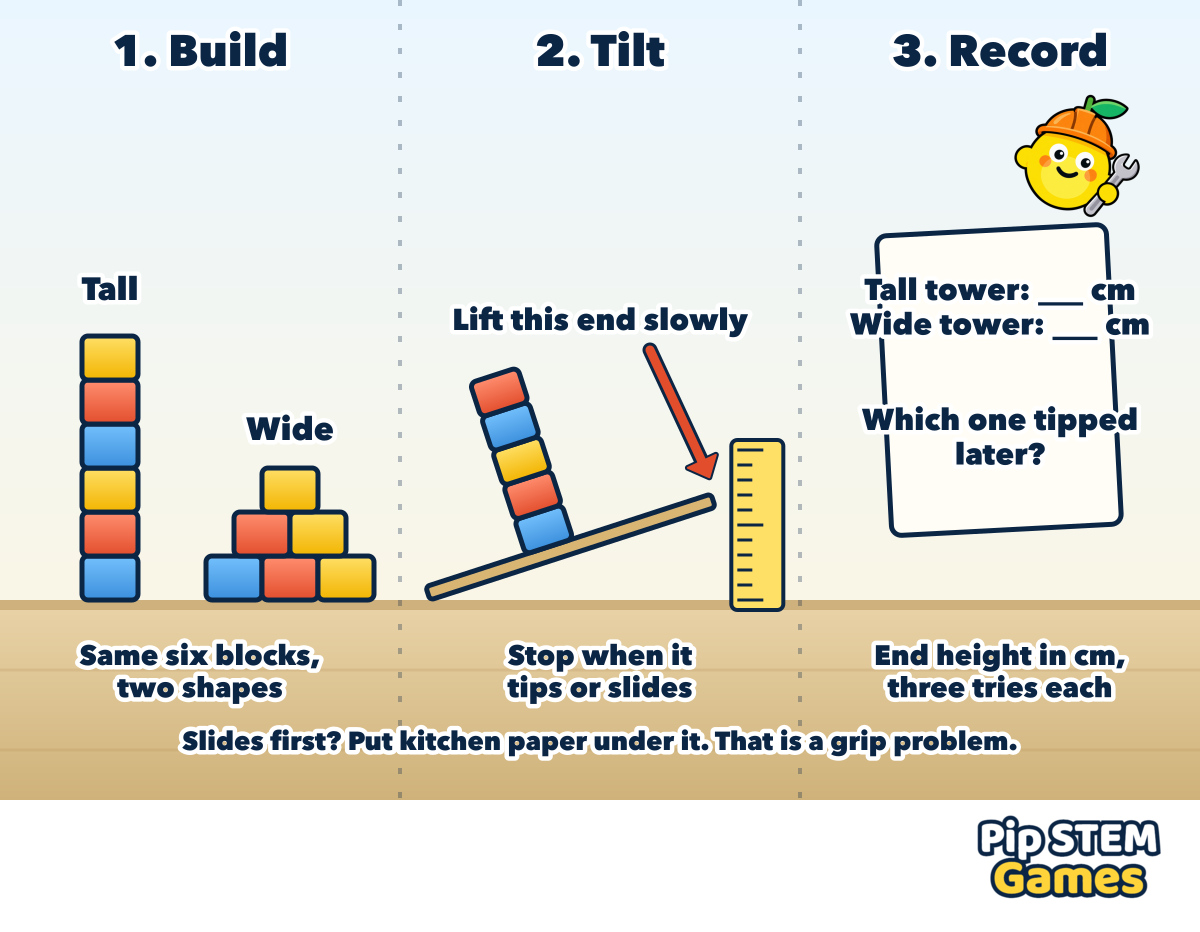
- Build a tall tower by stacking all 6 blocks in a single column.
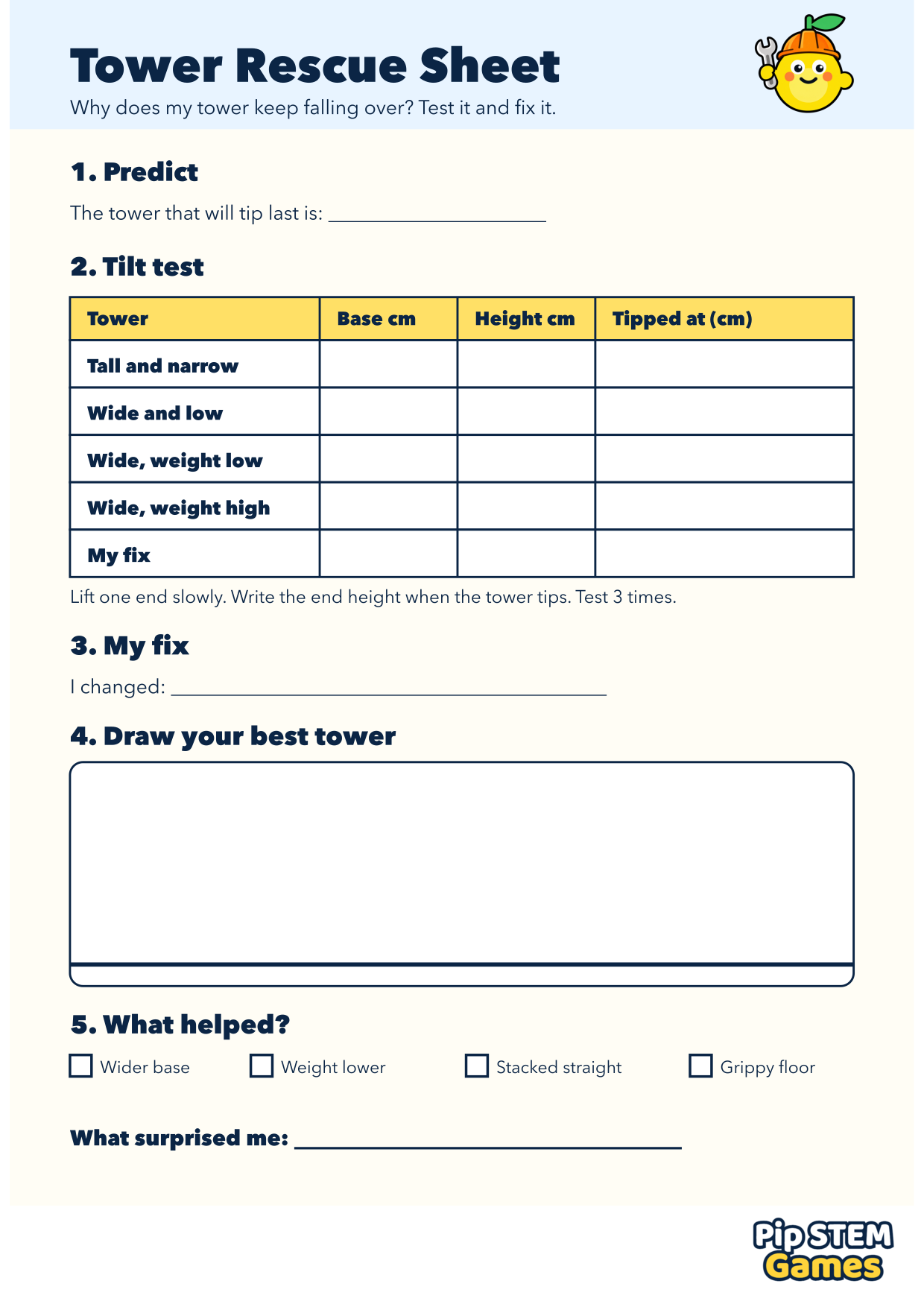
- Lay the board flat on a table and stand the tower in the middle. Write your prediction on the record sheet.
- Hold the lower end of the board down with one hand. Lift the other end slowly with your other hand.
- Stop when the tower tips. Ask your helper to read the height of the raised end on the ruler. Write it down.
- Rebuild the 6 blocks as a wide pyramid, with 3 on the bottom, 2 in the middle and 1 on top. Test it the same way.
- Repeat three times for each tower.
A hand lift is hard to match exactly, so treat your numbers as a comparison, not an exact measurement. The wide tower should need a bigger tilt before it tips.
If a tower slides instead of tipping: the board is too slippery. Put a sheet of kitchen paper under the tower and try again. Sliding is a grip problem, and a wider base will not fix it.
How do you stop a tower falling over?
Try these fixes one at a time. Test after each one, so you know which one worked.
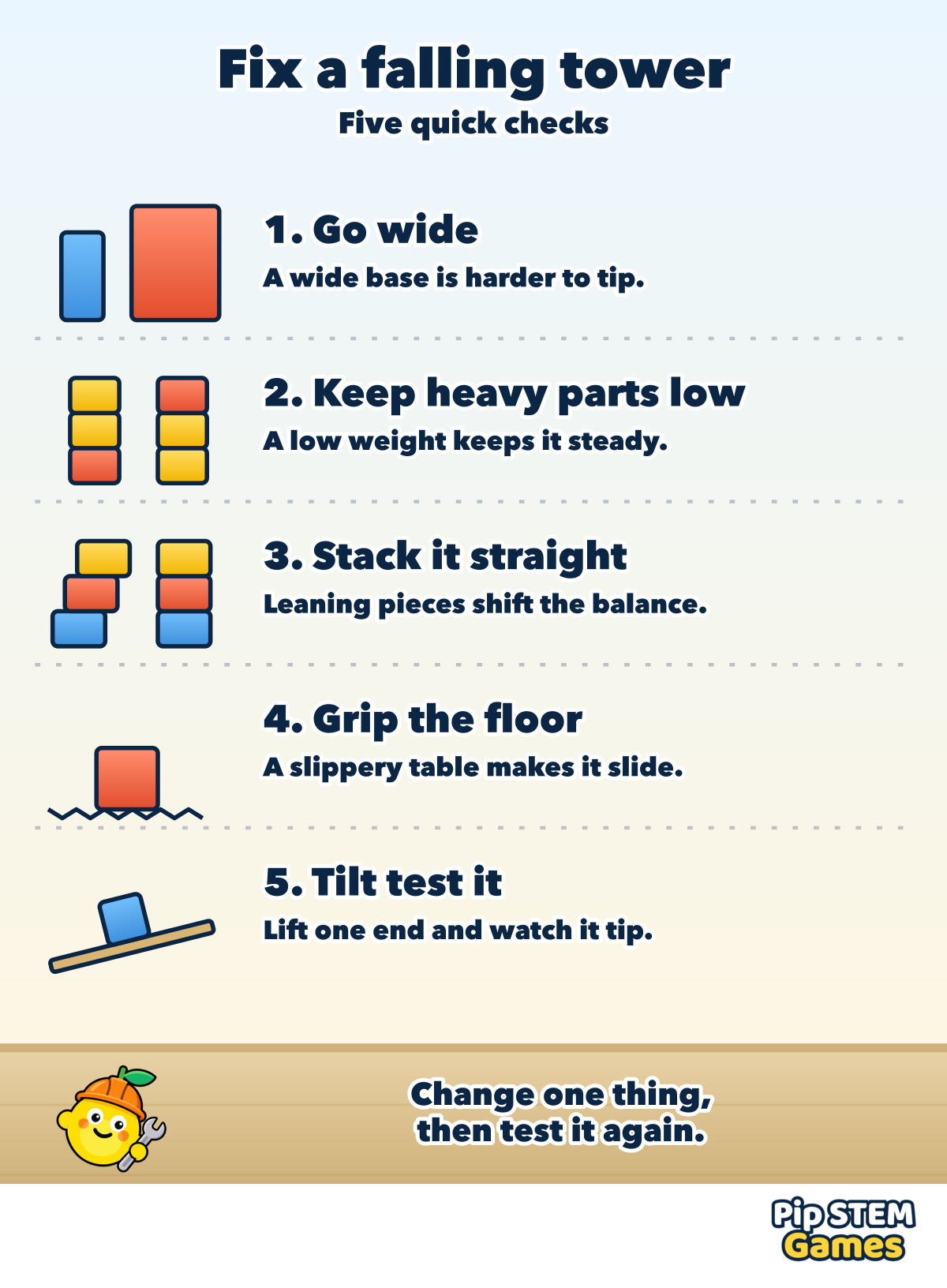
- Go wide. Spread the bottom layer out. A bigger base gives the balance line more room.
- Keep heavy parts low. Put the heaviest block at the bottom. Try the putty at the top, then at the bottom, and compare the tilt.
- Stack straight. Check each piece sits right over the one below. Sideways pieces move the balance point toward one edge.
- Grip the floor. Build on a firm, flat table. A rough mat stops sliding.
- Taper it. Make the tower narrower toward the top, so less weight sits high up.
A strong frame can still tip, because strength and balance are different things. Learn about strength in which shape makes the strongest tower. Then put your fixes to work in the Tower Stack game.
Why does the Leaning Tower of Pisa not fall over?
The Leaning Tower of Pisa leans about 4 degrees, and it still stands. Its balance line still lands inside its base. A wide base and a low balance point help it too.
Do not copy the lean with your own tower. A tower that already leans has its balance point close to the edge, so a small knock is enough to topple it. Engineers have worked on the ground under the real tower to stop the lean getting worse.
Print the sheet below, record your tests and draw your best tower. For another build, try the paper tower challenge or the spaghetti tower challenge.
How can you adapt the test for different ages?
Ages 5 to 7: skip the measuring. Ask which tower stays up when the board tilts, and let your child draw it. Use big soft blocks on a low board.
Ages 8 to 12: record the end height, test three times, and try each fix on its own. Ask older children to explain where the balance point is and why moving the weight changes the result. The workbook has more activities like this: Senior Engineers for ages 8 to 12.
These are small models. Real towers also depend on their foundations and on wind.
Questions parents ask
Why does my tower keep falling over?
Its balance point has moved past the edge of its base. This happens when the base is narrow, the heavy parts are high up, or the pieces lean to one side.
What is the centre of mass?
It is the balance point of an object, the spot where all its weight seems to act. If a line dropped straight down from it lands inside the base, the object stands.
How do I make a tower more stable?
Widen the base, put the heaviest parts low, stack the pieces straight, and build on a firm flat surface. Change one thing at a time and test again.
Why does a wide tower fall less easily?
A wide base gives the balance line more room, so the tower has to tilt further before the line leaves the base.
Is tipping the same as sliding?
No. Tipping happens when the balance line leaves the base. Sliding happens when the surface is too slippery. Grip fixes sliding, and a wider base fixes tipping.
What age is this activity for?
Ages 5 to 12. Younger children can compare which tower stays up. Older children can measure the tilt and test each fix.
Great STEM activities to try next...
 Which Shape Makes the Strongest Tower? Triangle, Square or Tube [Printable]Build challenge
 Paper Tower Challenge: How Tall Can Your Child Build With Paper and Tape? [Printable]Build challenge
 The 10-Spaghetti Tower Challenge [Printable]Build challenge
More to try: Potato and Lemon Battery Experiment for Kids · Find the Missing Component: Circuit Test for Kids

Pip STEM Games
We make engineering games and workbooks for kids aged 5 to 12. Every activity here is one we'd happily run at the kitchen table: test it, watch it fail, fix it, try again.




