

Key takeaways
- The challenge: build the tallest tower that stands on its own using only paper and tape.
- A wide base and rolled paper tubes make a tower much stronger than flat sheets.
- Weak points are nearly always the joins and the bottom, so strengthen those first.
- Test, measure, improve and rebuild. The second tower is almost always taller.
- For ages 5 to 7, use 10 sheets of paper and 1 metre of tape, with an adult as helper.
The paper tower challenge asks children to build the tallest free-standing tower they can from paper and a small amount of tape. A good first set of rules is 10 sheets of A4 paper (or 5 to 10 sheets of newspaper), 1 metre of masking tape and 15 minutes. The tower has to stand on its own for at least ten seconds without anyone holding it. The trick most kids discover is that rolled tubes and a wide base beat flat, folded paper. This guide has the rules, a build plan, fixes for wobbly towers and ways to run it for ages 5 to 7. A printable design sheet is included.
What are the rules of the paper tower challenge?
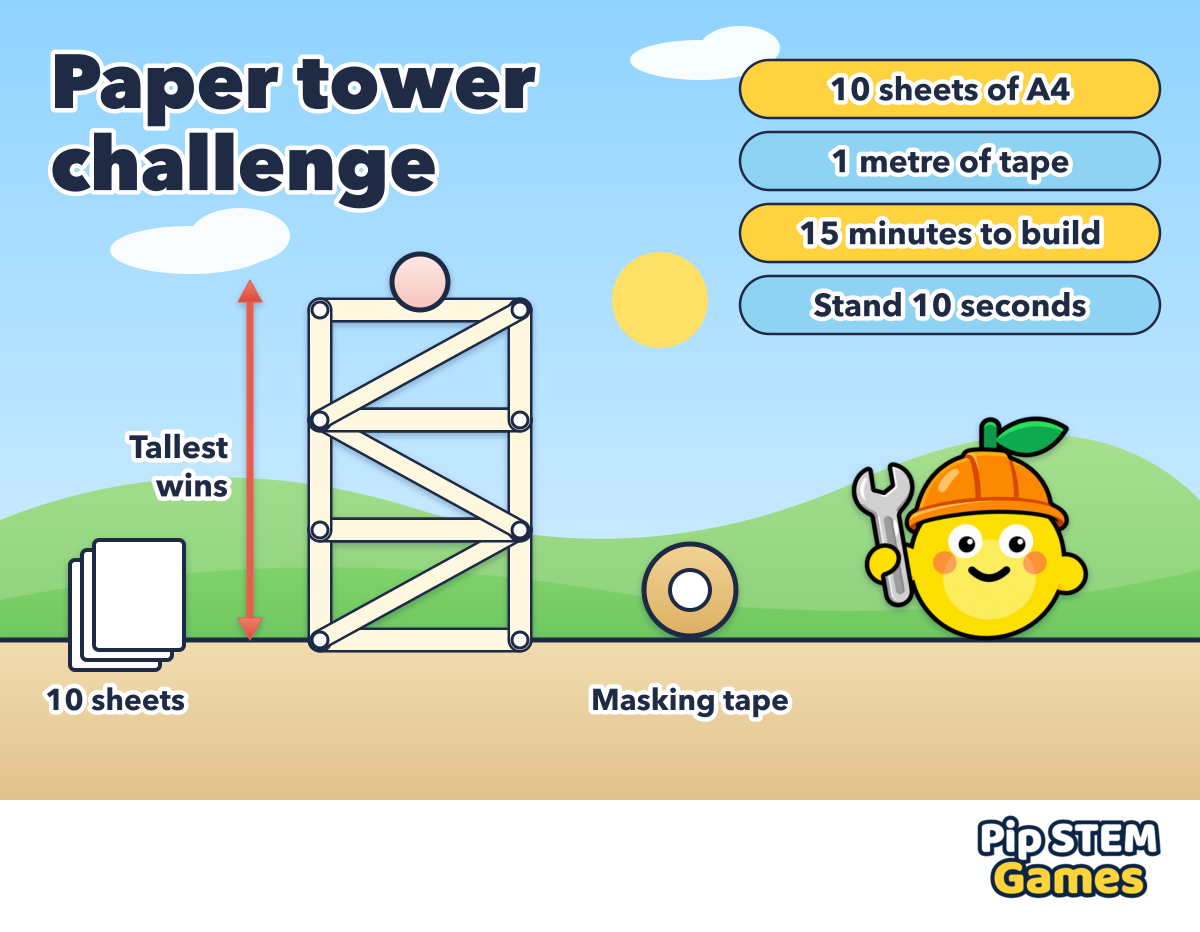
Build the tallest tower you can that stands up alone, using only the paper and tape you're given. Keep the rules short so a young child can remember them.
- Materials: 10 sheets of A4 paper (a newspaper tower uses 5 to 10 sheets of newspaper) and 1 metre of masking tape.
- Time: 15 minutes to build, 2 minutes to test.
- Free-standing: it must stand alone for at least ten seconds, with no holding, leaning on walls or taping to the table.
- Height: measure from the table to the top of the tower with a tape measure.
- Paper tricks allowed: rolling, folding, tearing and cutting with child scissors, with an adult nearby.
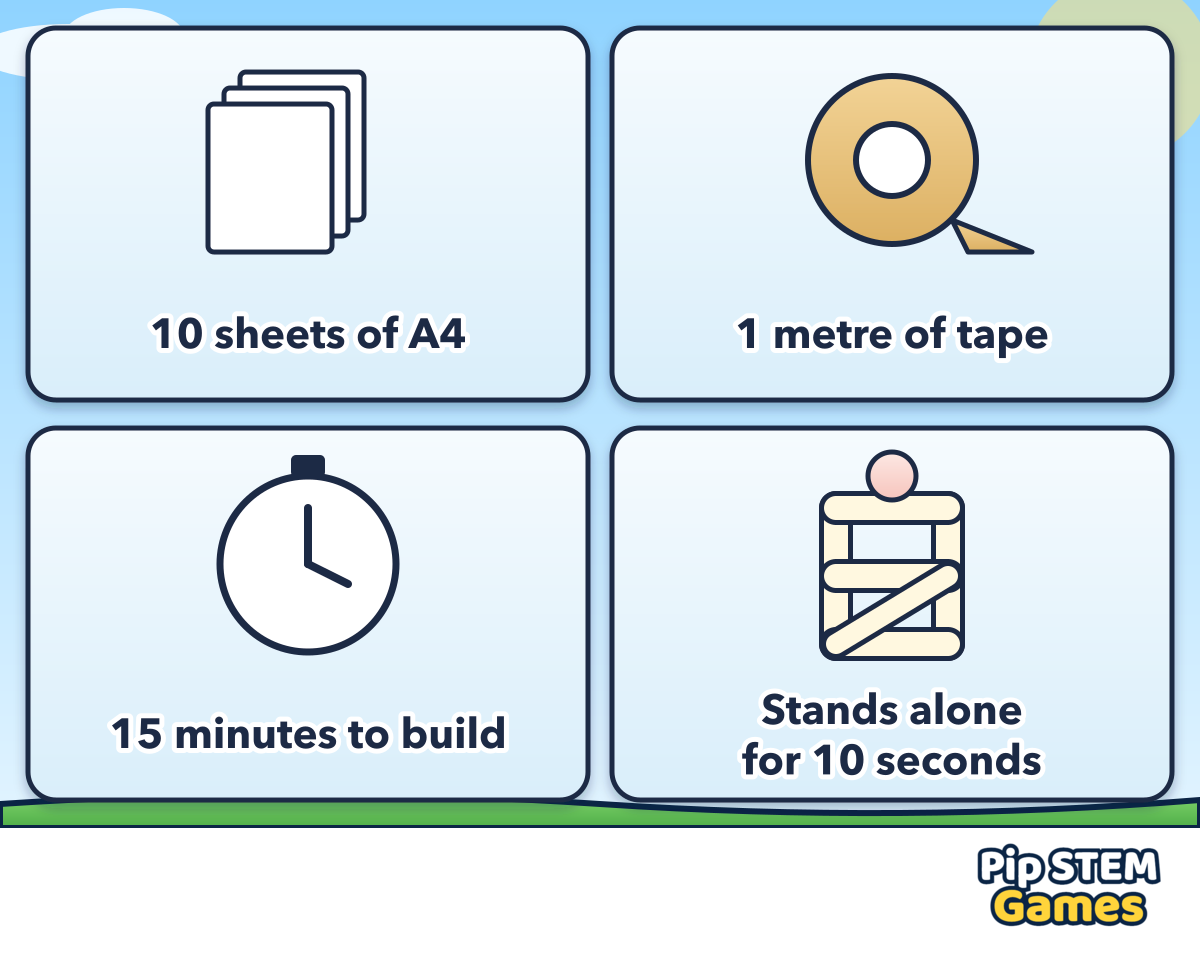
Use a timer on a phone and a sheet of paper for height records. Younger children enjoy a "mystery topper" like a soft toy on the very top, because it makes stability matter. A light item such as a pom-pom or a small ball is fine to start with.
How do you build a strong paper tower step by step?
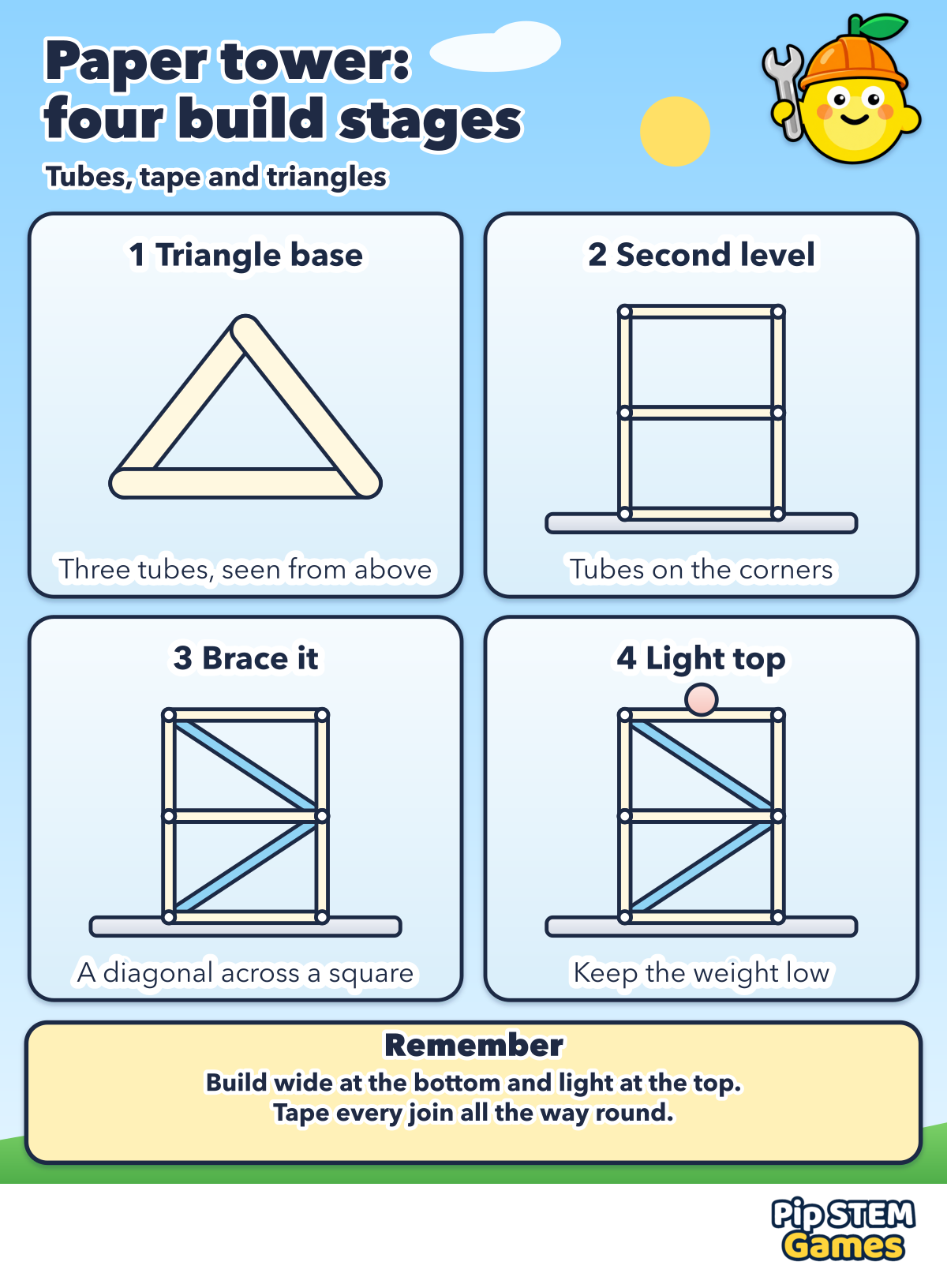
Roll paper into tubes, join them into a wide base, then stack narrower layers on top. Tubes are strong because the paper curves around the load instead of folding flat.
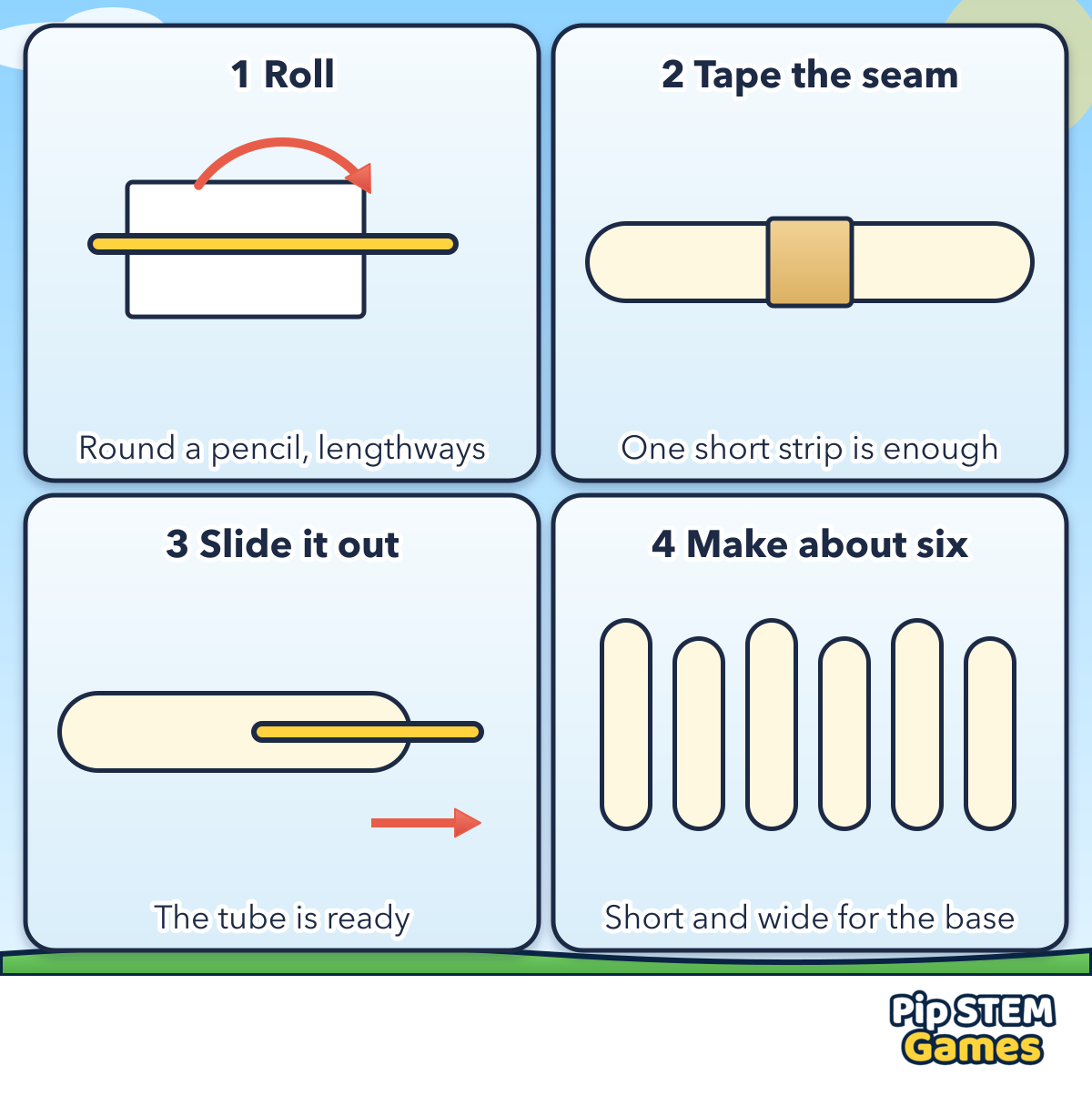
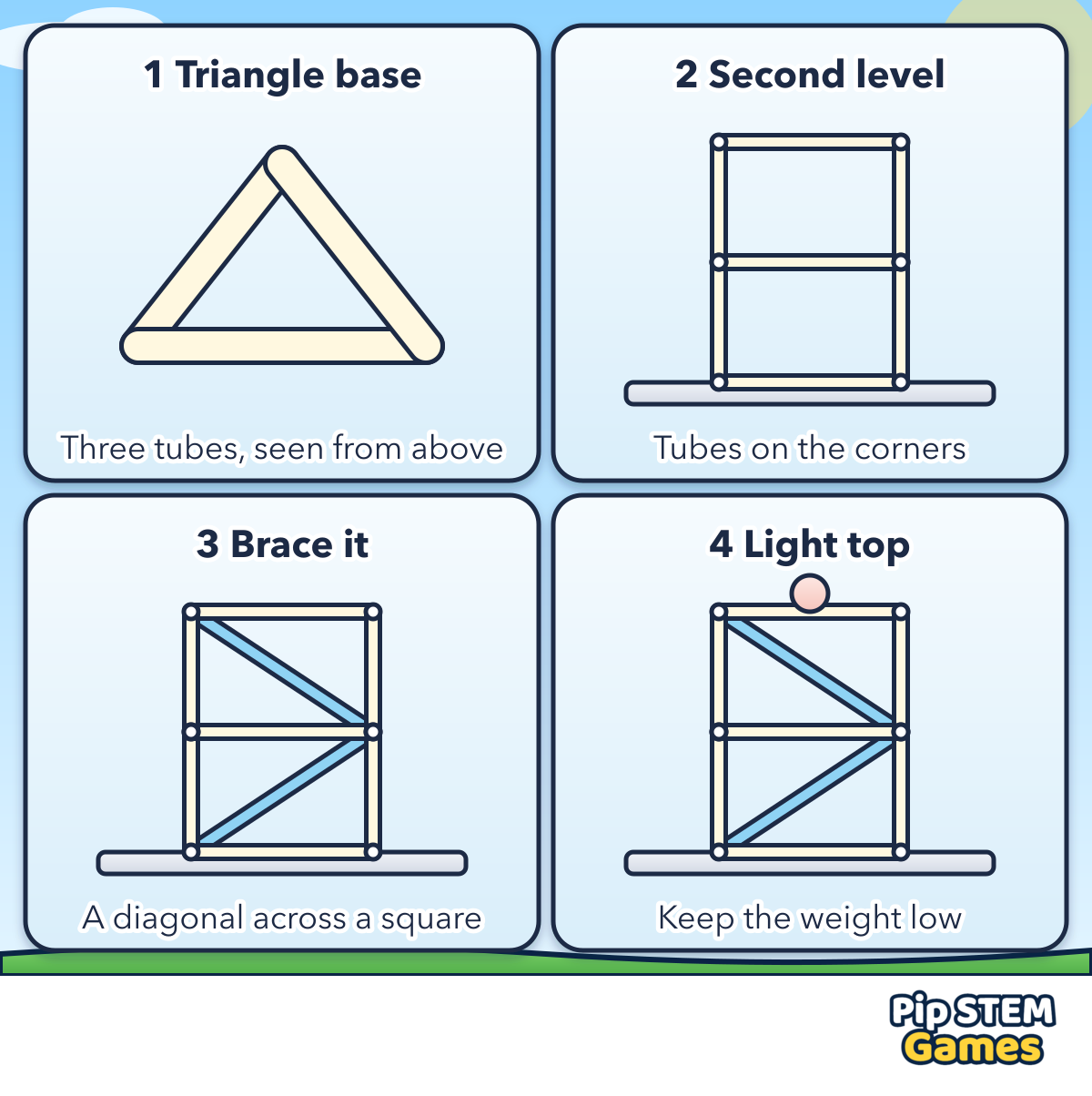
- Roll. Roll a sheet of paper lengthways around a pencil or marker for a thin tube, then slide the pencil out. Tape the seam. Make about six tubes. Short, wide tubes make better bases.
- Make a base. Tape three tubes into a triangle on the table, or four into a square. A triangle can't squash out of shape. A square can lean unless you add a diagonal.
- Add a second level. Stand tubes on the corners of the base and join their tops with taped tubes across the top.
- Brace it. Tape a diagonal tube across any square. This is the quickest way to stop wobbling.
- Add the top. Keep the top lightweight. Heavy things at the top make towers topple.
Frankly, the tape is the real limit. One metre disappears fast, so use short strips on joins and seams, and don't tape past what each join needs. If you want a different material to compare, the spaghetti tower challenge works the same way.
The Tower Stack game is a good warm-up for balance and stacking before the real build.
Why does a paper tower fall over?
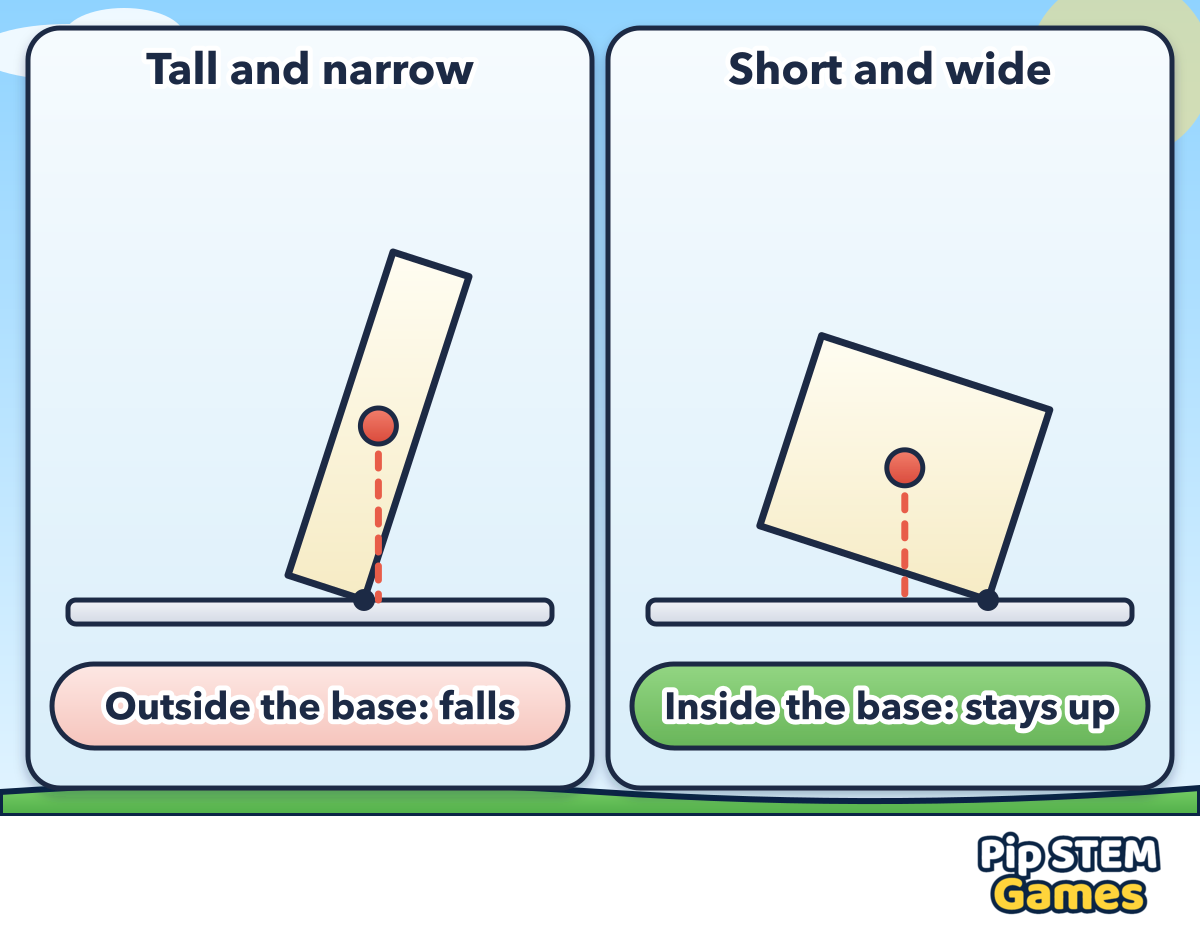
A paper tower falls when its weight is too high up, its base is too narrow or its joins are weak. Any one of those is enough.
Every object has a balance point, called the centre of gravity. The taller and narrower the tower, the more a small wobble pushes that point outside the base, and over it goes. A wide base keeps the point inside the base for longer.
Paper also folds under weight. A flat sheet bends easily, but a rolled tube resists a squash because the load spreads around the curve. Triangles hold their shape because they have no way to change angle without bending a side. Our post on which shape makes the strongest tower shows this with an easy test, and why this tower keeps falling over is a quick puzzle to try with your child.
Ask your child a good question: "Where did it break first?" The answer is usually a join or the bottom layer, and it tells them exactly what to strengthen.
What can you do if the tower wobbles or collapses?
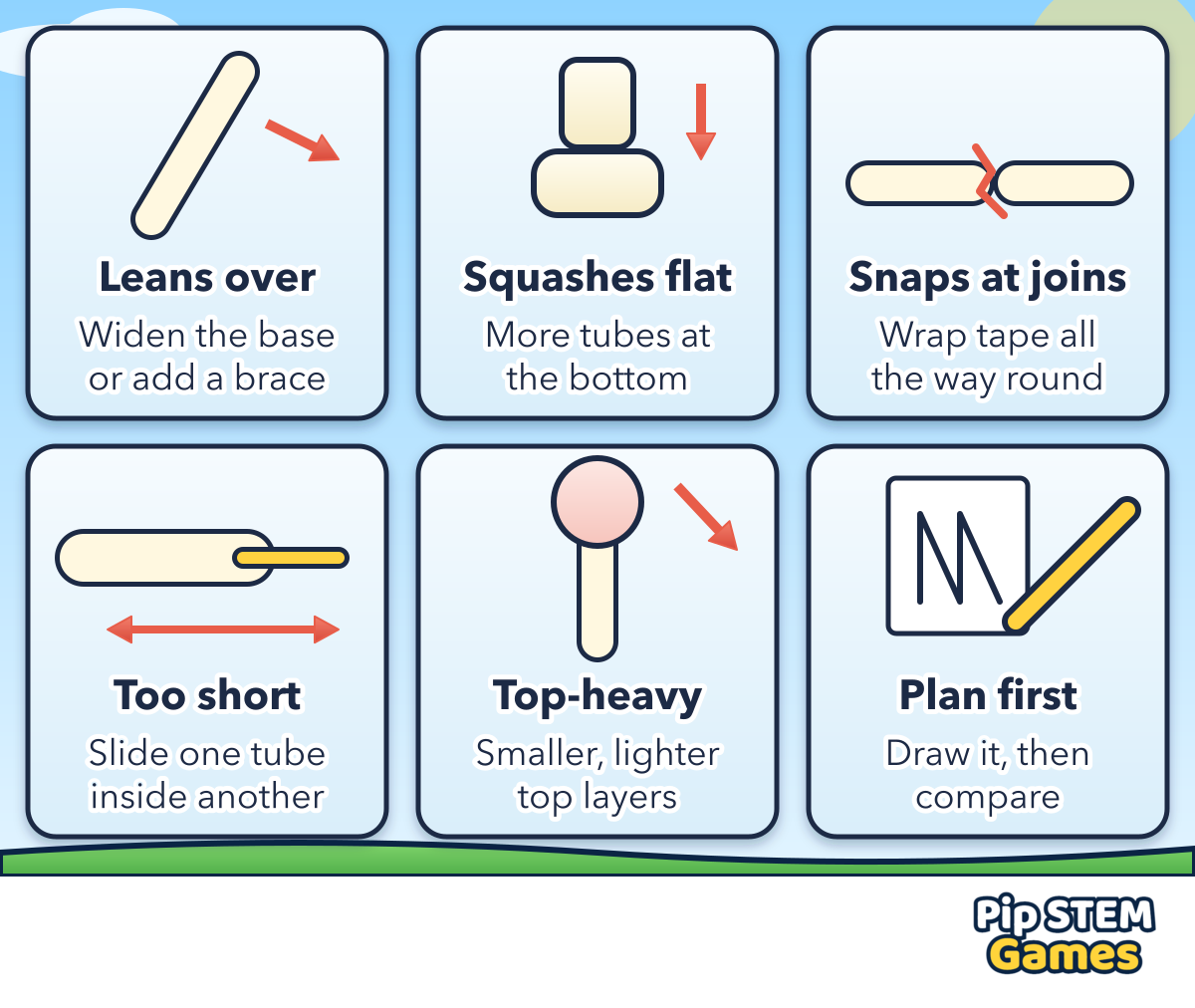
Fix one thing, then retest. A collapse is the most useful part of the activity.
- Leans to one side: widen the base or add a diagonal brace.
- Squashes at the bottom: use more tubes in the bottom layer, or thicker tubes.
- Snaps at the joins: wrap tape all the way around the join instead of sticking one flat strip.
- Too short: make the tubes longer by sliding one inside another and taping.
- Top-heavy: move weight to the bottom and make the top layers smaller.
Let the child rebuild. The second tower usually beats the first. Measure both and write the numbers down. Example figures only: "Tower one, 38 cm. Tower two, 61 cm." Seeing that number grow is the pay-off.
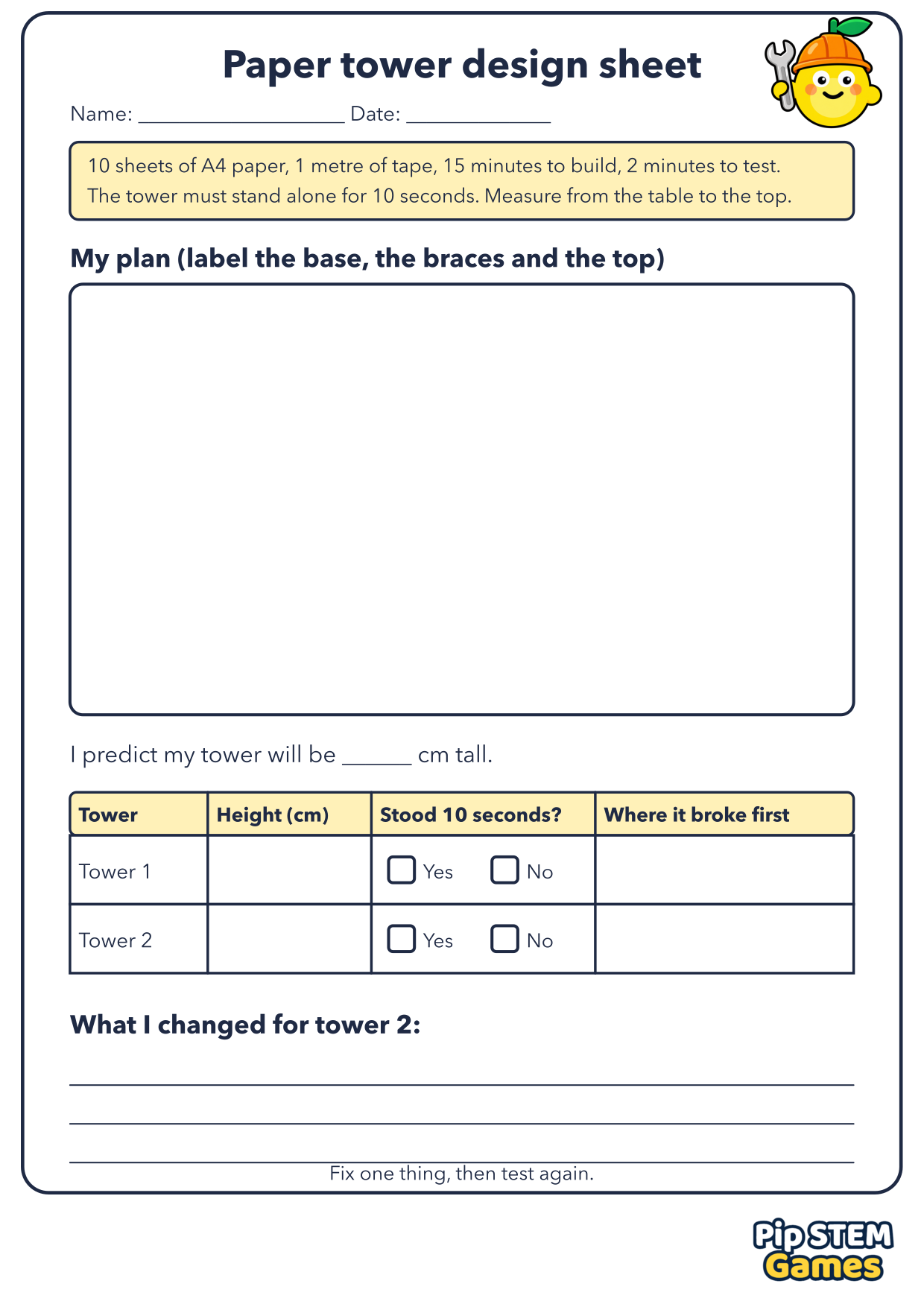
Pro tip: before building, ask them to draw a plan. Even a scribble helps. Then compare the plan with the finished tower and talk about what changed.
How do you adapt the paper tower challenge for different ages?
For ages 5 to 7, keep the rules simple and the adult as an extra pair of hands. For ages 8 to 12, add limits, targets and teamwork.
Ages 5 to 7 (Junior): use 10 sheets of paper and tape strips pre-cut to about 10 cm. Let the child roll the tubes and tell you where to put them. Celebrate any tower that stands, however short. Any tower that stands is a real success. The Junior Engineers workbook has more building challenges like this one.
Ages 8 to 12 (Senior): cut the tape to 50 cm, add a weight on top such as a tennis ball, or make it a team of three with one rule each. Ask for a labelled drawing and a height prediction. The Engineering Workbook for Kids goes further into structures.
A quick variation: swap paper for index cards or newspaper and compare. Newspaper is lighter and floppier, so tubes need to be thinner and more of them.
Questions parents ask
What is the paper tower challenge?
It's a build challenge where children make the tallest free-standing tower they can from paper and a small amount of tape. The tower must stand on its own.
What materials do you need for a paper tower?
10 sheets of A4 paper (or 5 to 10 sheets of newspaper), 1 metre of masking tape, scissors and a tape measure. A pencil helps for rolling tubes.
How tall can a paper tower be?
It depends on the paper and tape you allow. Measure from the table to the top, then try to beat your own record.
What is the strongest shape for a paper tower?
Rolled tubes for the legs and triangles for the bracing. Tubes resist squashing and triangles hold their shape.
How do you make a newspaper tower?
Roll sheets of newspaper into tight tubes, tape the seams, and build a wide base from three or four tubes. Then add narrower layers on top and brace with diagonals.
What age is the paper tower challenge for?
Children aged 5 to 7 can do it with an adult helping with tape. Ages 8 to 12 can handle tougher limits, such as less tape or a weight on top.
Why does my child's tower keep falling?
The base is probably too narrow or the joins are too weak. Widen the base, tape around the joins and move weight lower.
Great STEM activities to try next...
 The 10-Spaghetti Tower ChallengeActivity
 Why This Tower Keeps Falling OverActivity
 Which Shape Makes the Strongest Tower?Activity
More to try:

Pip STEM Games
We make engineering games and workbooks for kids aged 5 to 12. Every activity here is one we'd happily run at the kitchen table: test it, watch it fail, fix it, try again.




