

Key takeaways
- A triangle cannot change shape unless one of its sides bends or breaks.
- A square can lean over into a diamond, even when its sides stay the same length.
- A diagonal stick turns a square into two triangles and stops it leaning.
- A strong frame can still tip over, so the base and the weight matter too.
- The best shape depends on the job, so test yours and write down what happens.
Which shape makes the strongest tower? For a frame that must not lean over, the answer is a triangle, because three sides can only make one shape. A square leans, but adding a diagonal stick fixes it. This page has a card-strip test you can run in 20 minutes, a second test with paper tubes, a cheat sheet and a printable record sheet.
Which shape makes the strongest tower?
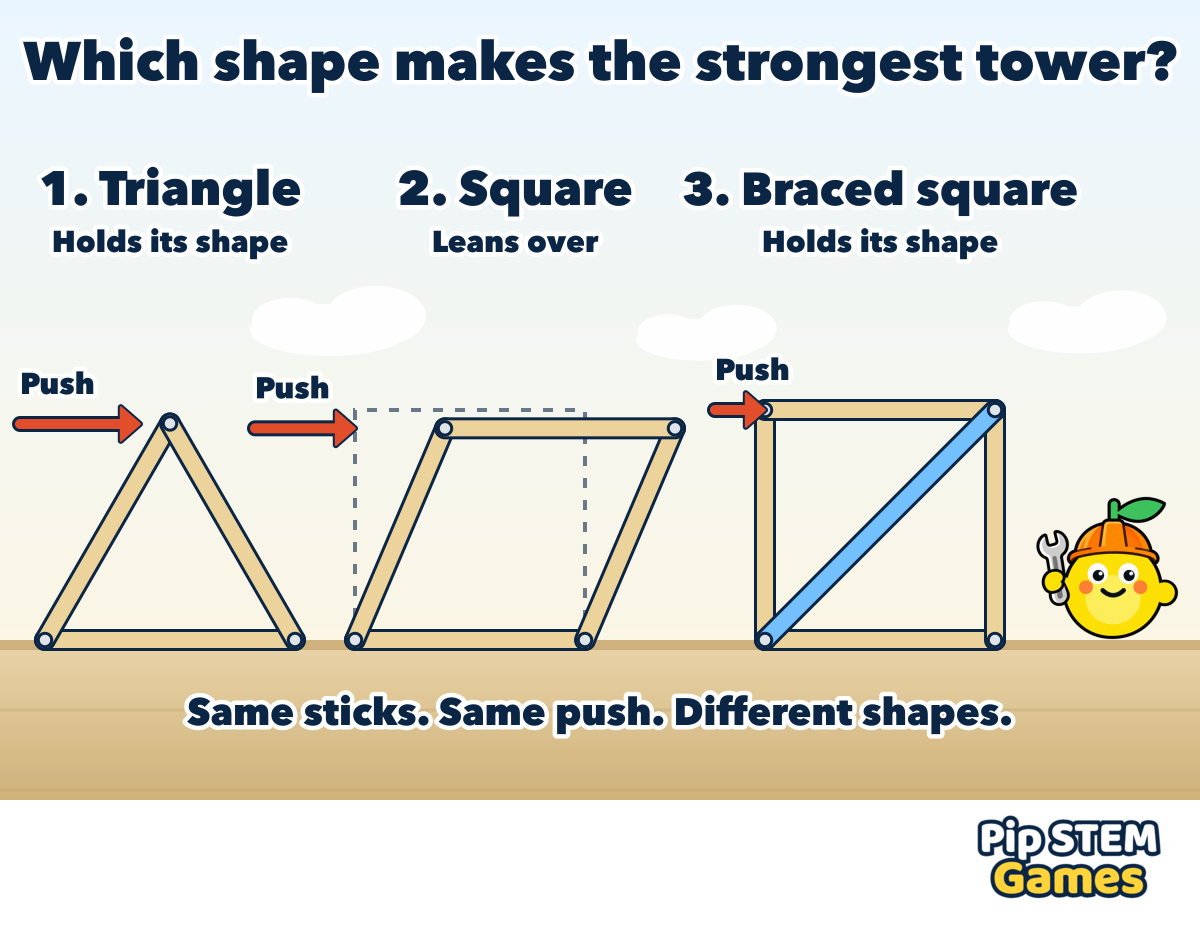
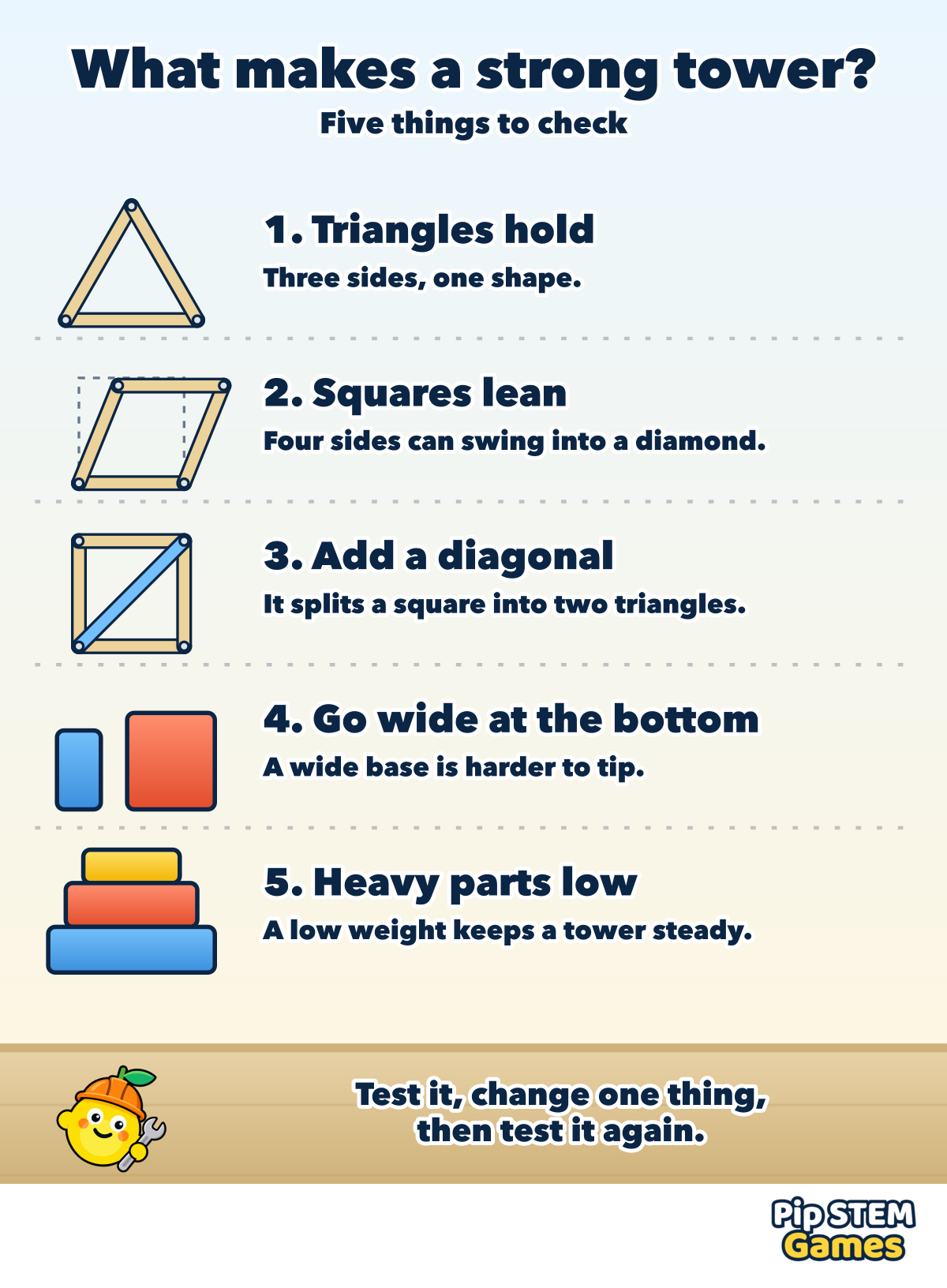
It depends what the tower has to do. If a push from the side could lean it over, a triangle is the strongest shape. Three sticks joined at the corners make one shape and no other. Four sticks joined at the corners can swing into a diamond. That is why bridges, cranes and pylons are full of triangles.
If the job is to carry weight pressing straight down, the best shape depends on the material, the height and how it is joined. So we test that too. Try the sideways push first, then the paper tubes.
Why does a triangle hold its shape?
Imagine a triangle made from three sticks with a hinge at each corner. The side lengths are fixed. Only one triangle can be made from them, so when you push, the shape cannot change. Something would have to bend or break.
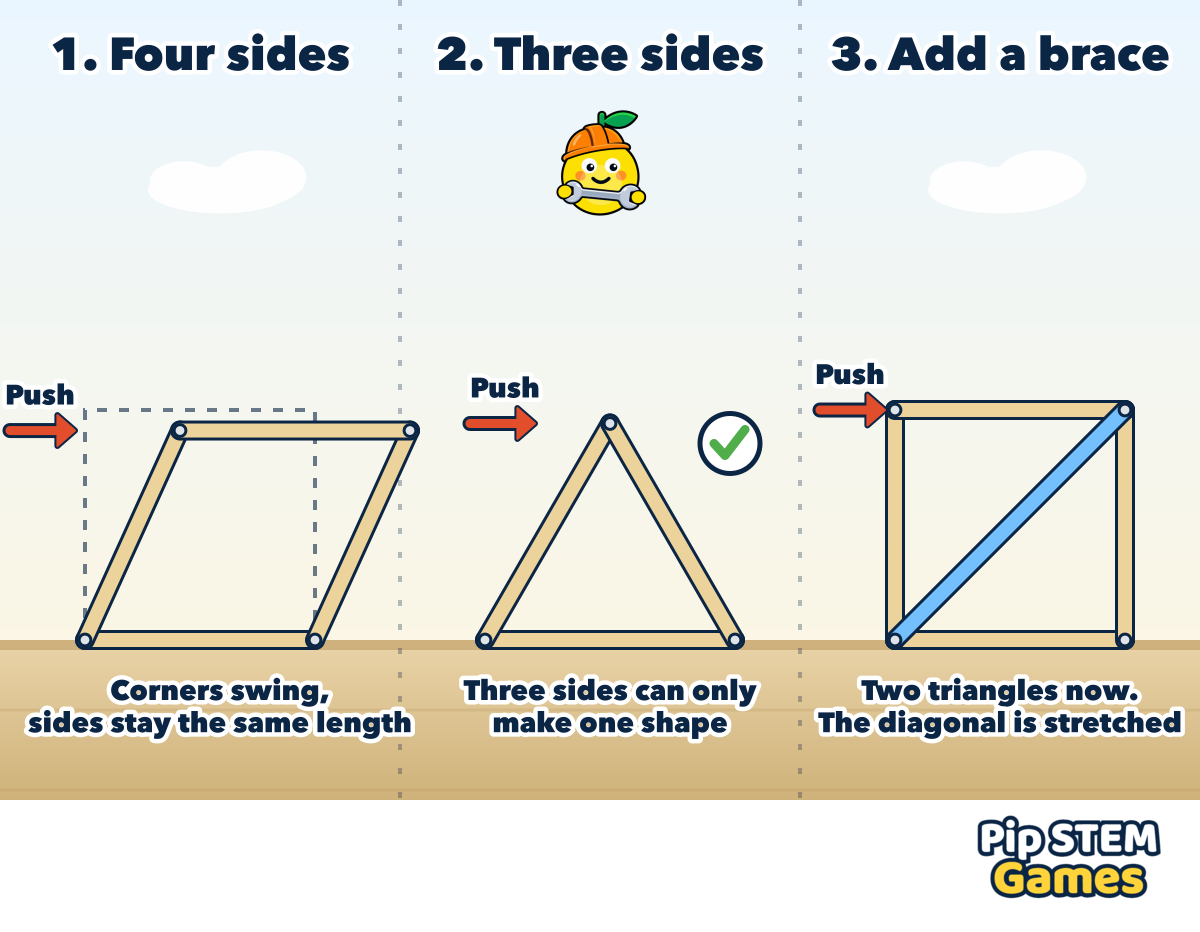
Do the same with four sticks and the corners can swing. The sides stay the same length, but the square leans into a diamond. We say the frame racks.
A diagonal stick across the square fixes that. It splits the square into two triangles. When you push, the diagonal is stretched, so the corners cannot swing.
You can see this in real life. A bicycle frame has triangles in it. Electricity pylons are built from a lattice of triangles. So are many bridges and the arms of tall cranes. Read how it works in why are arches so strong and which bridge would you build.
What do you need for the card-strip test?
The test takes about 20 minutes. You need:
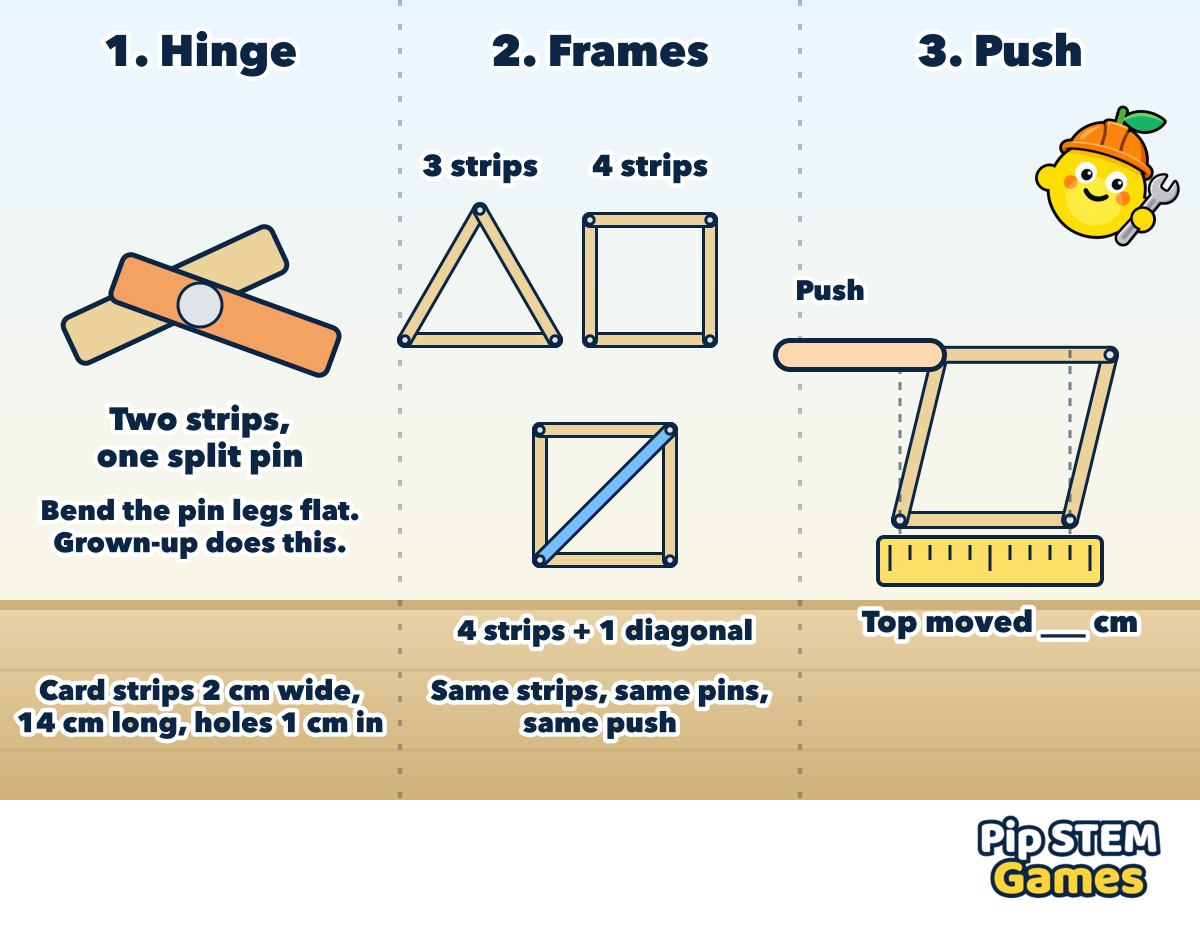
- Thin card from a cereal box, cut into 12 strips, each 2 cm wide. Cut 11 strips 14 cm long and 1 strip 19 cm long.
- About 15 split pins (brass paper fasteners)
- A hole punch
- A ruler with centimetres
- A pencil, and the record sheet below
No split pins? Lolly sticks and small balls of putty or modelling clay also work. Your joins will be less like hinges, so your push test will be less clear.
Grown-up note: split pins have sharp legs, so an adult should bend the legs flat. Pins and putty are small parts, so keep them away from children under 3. Push gently and keep frames away from faces.
How do you run the push test?
- Punch a hole 1 cm in from each end of every strip.
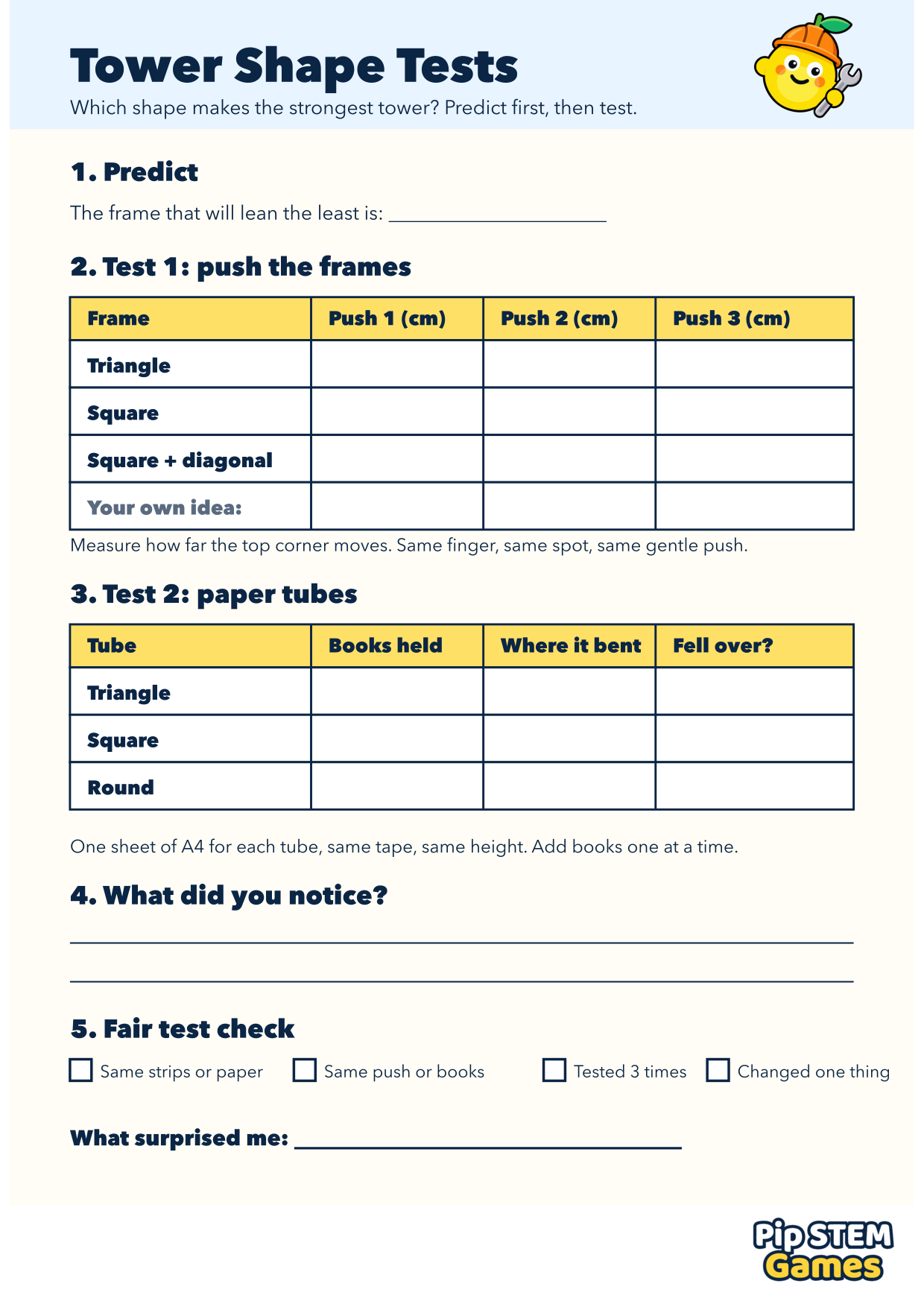
- Join strips with split pins to make three frames. A triangle uses 3 short strips. A square uses 4 short strips. For the third frame, make another square and pin the long strip across it corner to corner.
- Write your prediction on the record sheet. Which frame will lean the least?
- Stand a frame on the table, with one side flat on the table. Hold the bottom side down with one hand.
- Push the top corner sideways with one finger. Use a gentle push, the same each time.
- Measure with the ruler how far the top corner moved. Write it down.
- Repeat three times for each frame.
A hand push is hard to match exactly, so treat your numbers as a comparison, not a precise measurement. If all three frames feel stiff, your pins may be too tight. Loosen them a little so the corners can turn.
What happens when you test paper tubes?
This second test asks about weight pressing straight down. Make three tubes from three sheets of A4 paper. Roll each sheet the long way, overlap the edges by 1 cm and tape the seam from top to bottom. Make one tube round, one with 3 sides and one with 4 sides. Fold sharp creases at the corners of the triangle and square.
- Stand a tube on the table. Put a light tray or book on top.
- Place paperback books on top one at a time. Stand clear and keep your toes out of the way.
- Stop when the tube bends, crumples or falls. Write down the number of books.
- Look at where the paper bent first. It is often a corner or a flat side.
- Test each shape three times.
We do not tell you which tube wins, because it depends on how neatly you tape and fold. Your results are the answer. Then compare them with the frames. A shape can be good at one job and not at another.
Why can a strong frame still fall over?
A triangle frame can stand without leaning and still tip over. Strength is about keeping the shape. Tipping is about where the weight sits over the base. A tall narrow tower tips easily, and a wide one does not. See why this tower keeps falling over for a tilt test, or build towers in the Shape Strength game.
Print the sheet below and record both tests. Then try the challenge: build the tallest tower you can from 20 strips and pins that still stands when you give it a gentle push. The spaghetti and marshmallow tower is a good one to try next.
How can you adapt the tests for different ages?
Ages 5 to 7: use lolly sticks and putty, or build the frames from straws and clay. Skip the measuring. Ask which frame wobbles and which one stays put, and let your child draw the shapes.
Ages 8 to 12: use card strips and pins, measure the push, and do the paper-tube test. Ask older children to average three pushes and write why they think the diagonal works. The workbook has more pages like this: Senior Engineers for ages 8 to 12.
These are small models. Real towers also depend on strong materials, strong joints and the loads they must carry.
Questions parents ask
Which shape is the strongest for a tower?
For a frame that must not lean over, a triangle. It can only make one shape, so it holds its form when pushed. For weight pressing straight down, the best shape depends on the material and how it is joined, so test it.
Why are triangles used in bridges and cranes?
A triangle keeps its shape when it is pushed. Engineers use triangles so frames stay stiff with fewer, lighter parts.
How do you make a square frame stronger?
Add a diagonal brace from one corner to the opposite corner. It splits the square into two triangles, so the corners cannot swing into a diamond.
Is a triangle always stronger than a square?
Not always. A triangle resists leaning better. When weight presses straight down, the result depends on the material, the height and the joints. The tube test lets you see this yourself.
Can a strong tower still fall over?
Yes. A strong frame can still tip if its base is narrow or its heavy parts are high. Strength and balance are different problems.
What age is this activity for?
Ages 5 to 12. Younger children can compare wobble with sticks and putty. Older children can measure the push and test paper tubes.
Great STEM activities to try next...
 Why This Tower Keeps Falling OverActivity
 Spaghetti and Marshmallow Tower: How to Build the Tallest One [Printable]Build challenge
 Which Bridge Would You Build? Beam, Arch or Truss [Printable]Build challenge
More to try:

Pip STEM Games
We make engineering games and workbooks for kids aged 5 to 12. Every activity here is one we'd happily run at the kitchen table: test it, watch it fail, fix it, try again.




