


Key takeaways
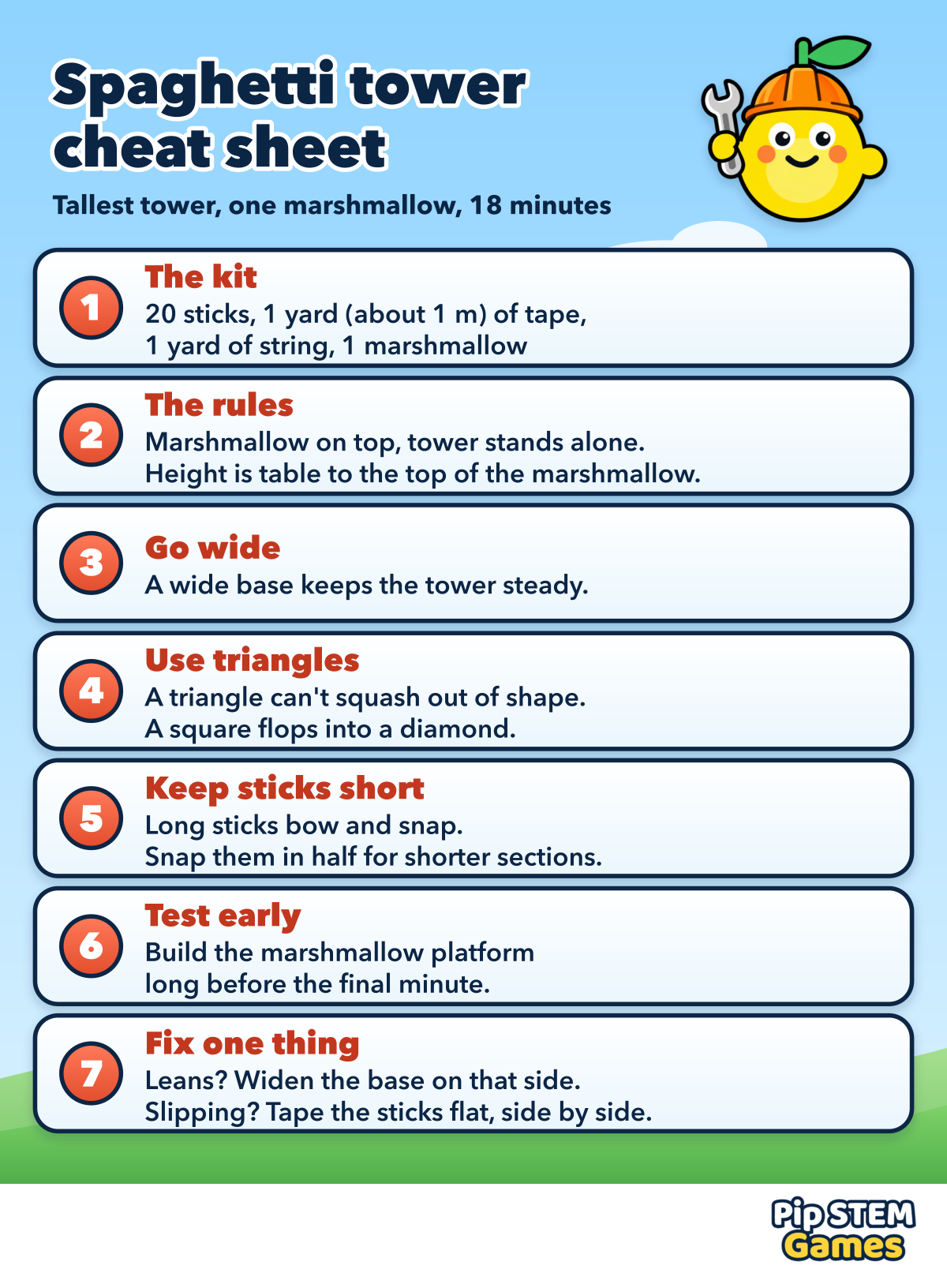
- The classic challenge gives you 20 sticks of spaghetti, tape, string and one marshmallow, and the marshmallow must end up on top.
- Most towers fail because the marshmallow goes on last and is heavier than the builders expected.
- Triangles and a wide base make a spaghetti tower far harder to tip or buckle.
- Test the marshmallow on the tower early and often, then fix the weakest joint.
- Ages 5 to 7 can build a simple triangle tower with help; ages 8 to 12 can race the clock and measure height.
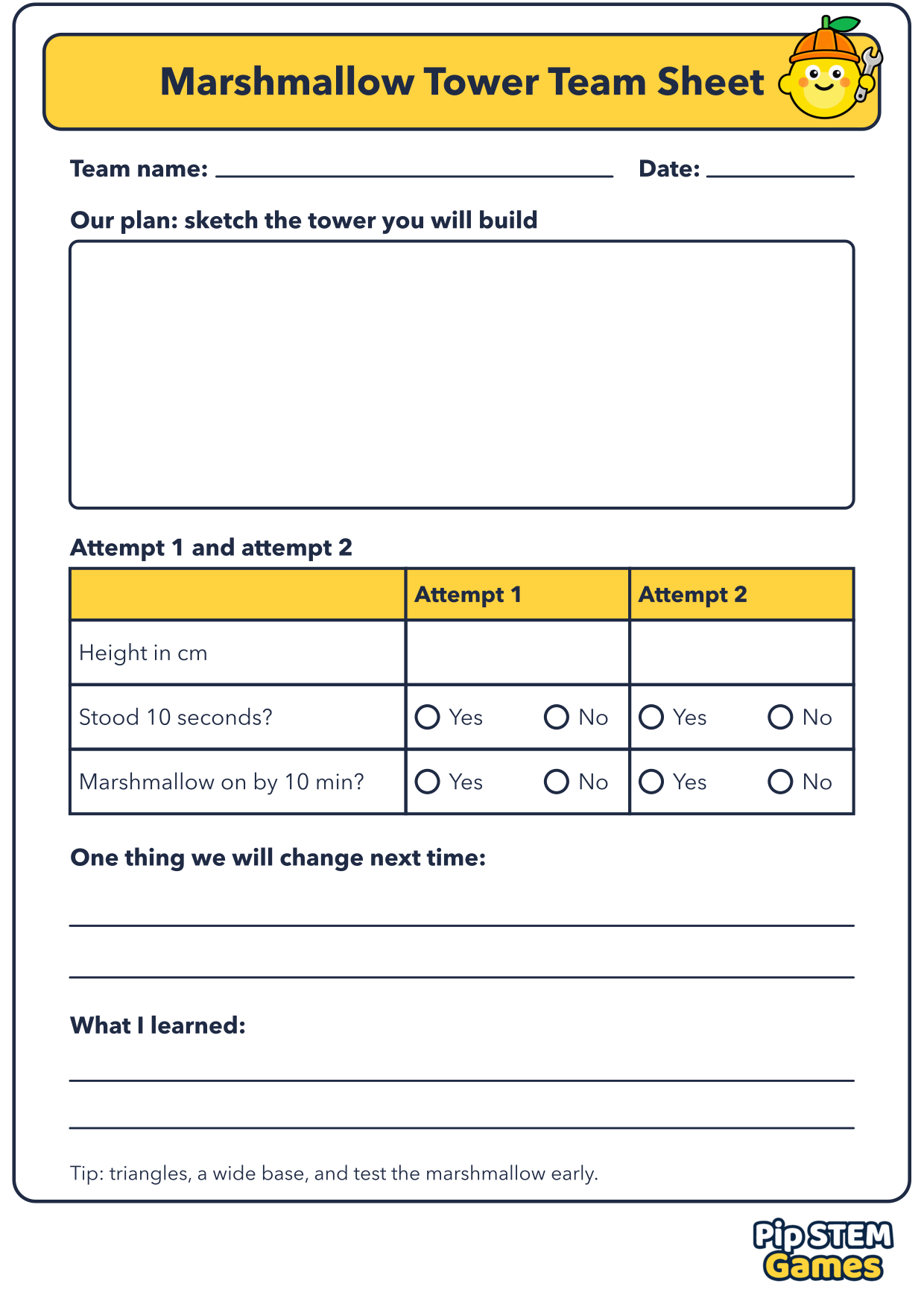
A spaghetti and marshmallow tower is a team challenge: build the tallest freestanding tower you can from 20 sticks of dry spaghetti, tape and string, with one marshmallow on top. The usual time limit is 18 minutes. The winning idea is simple. Build triangles, make the base wide, and test the marshmallow early, because it weighs more than the spaghetti can comfortably carry. It suits ages 5 to 12, needs no special kit, and it's one of the best ways to show a child that failing and fixing is how engineers actually work. A printable team sheet is included for recording your plan and results.
What are the rules of the spaghetti and marshmallow tower challenge?
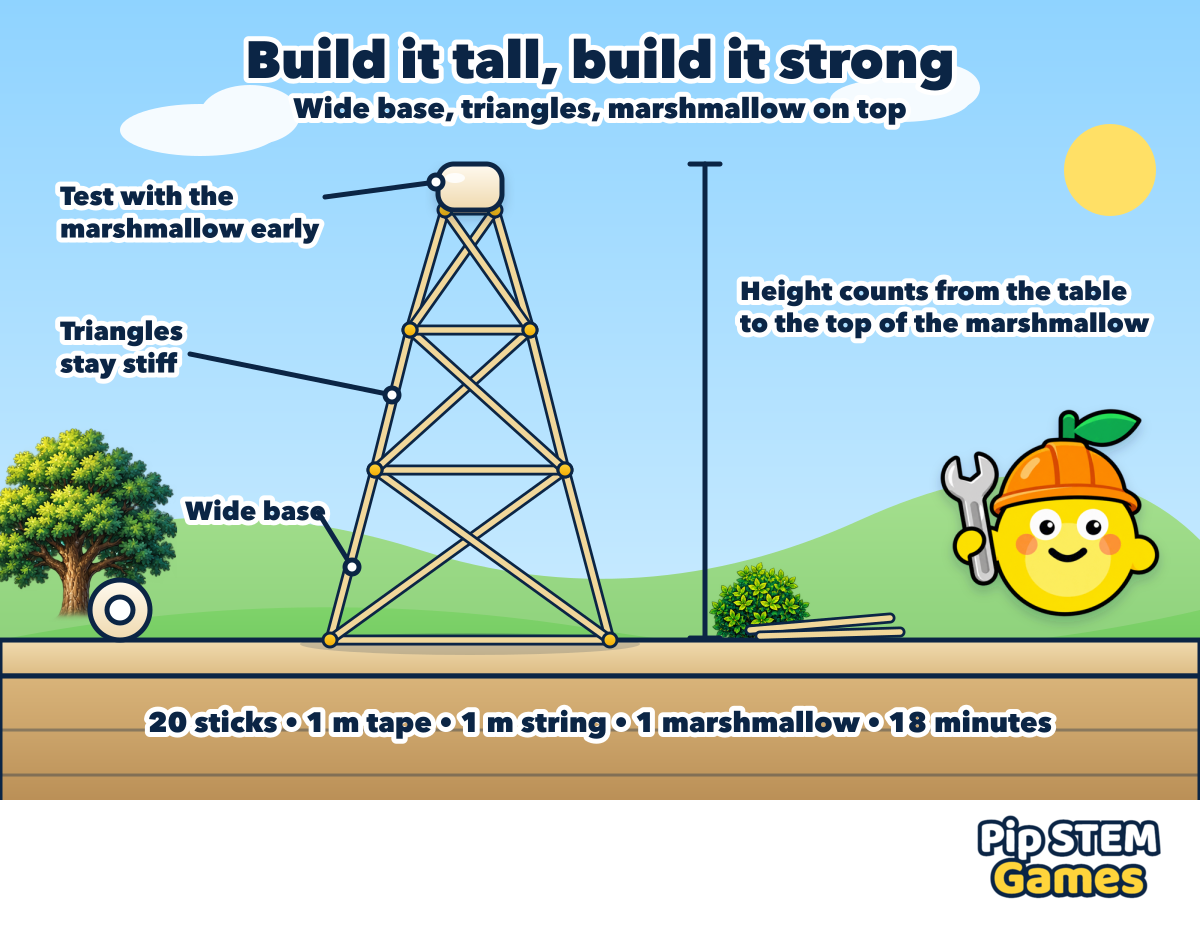
The original challenge gives each team 20 sticks of dry spaghetti, one yard (about 1 metre) of masking tape, one yard of string and one marshmallow, and 18 minutes to build the tallest freestanding tower. That's the version designer Tom Wujec made famous in his TED talk.
- The marshmallow must sit on top of the tower, not beside it or hanging off it.
- The tower must stand on its own when time is up. Nobody can touch or hold it.
- You can snap the spaghetti and cut the tape and string, but you can't use anything else.
- Height is measured from the table to the top of the marshmallow.
For a family, shorten the time to 15 minutes, allow two attempts, and give younger children a little extra tape. Keep it a team game: two or three children per tower works best, and so does a grown-up who builds a rival tower and is happy to lose.
What do you need to build a spaghetti tower?
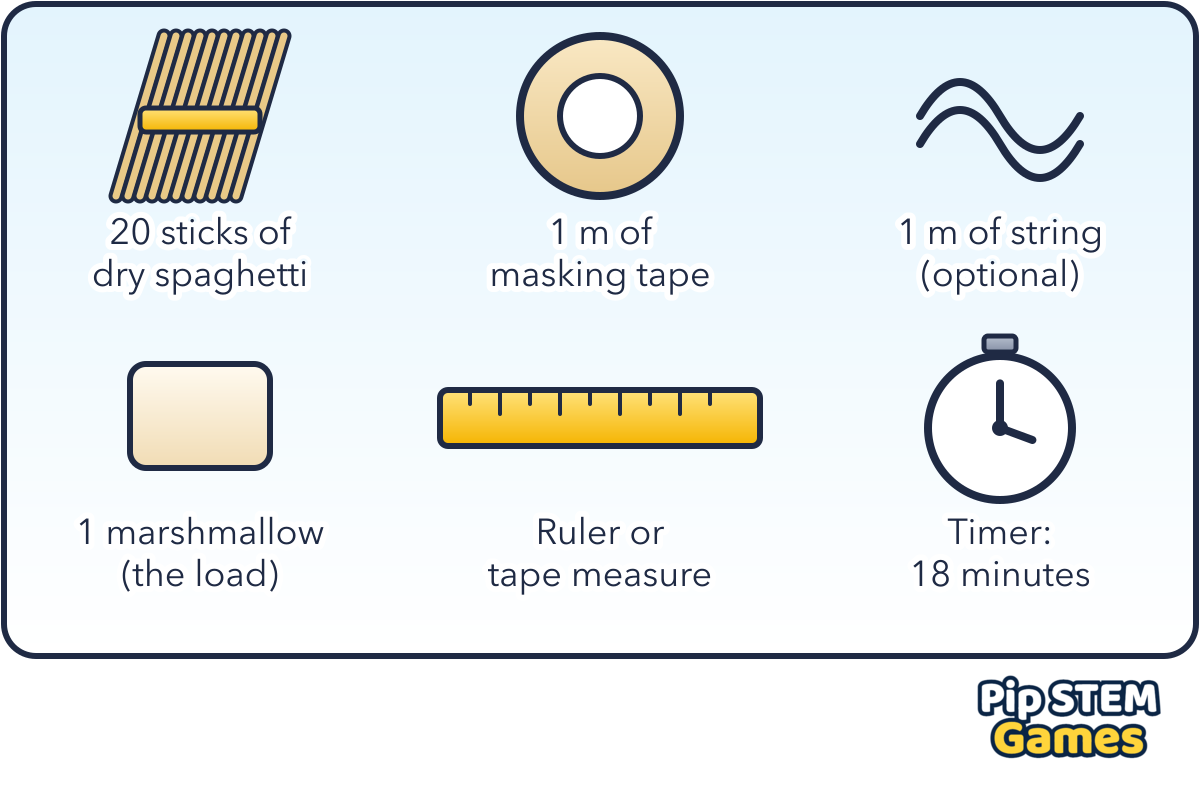
You need dry spaghetti, tape, a marshmallow and a flat table. That's the whole kit.
- 20 sticks of dry spaghetti per team (one packet makes several kits, with spares for snapped sticks)
- About 1 metre of masking tape, which is easier to peel and reposition than sticky tape
- About 1 metre of string
- 1 regular marshmallow. It looks light until you try to balance it on a spaghetti stick
- Scissors, for an adult or older child to cut the tape and string
- A tape measure or ruler, and a timer
- A tray or newspaper to catch the broken spaghetti
Dry spaghetti snaps into sharp little pieces. Keep faces away when breaking it, sweep the floor afterwards, and don't let small children eat the raw sticks or mouth the tape.
How do you build a tall spaghetti tower that holds a marshmallow?
Build a wide triangle-based frame, stack it in sections, and put the marshmallow on a platform long before the final minute.
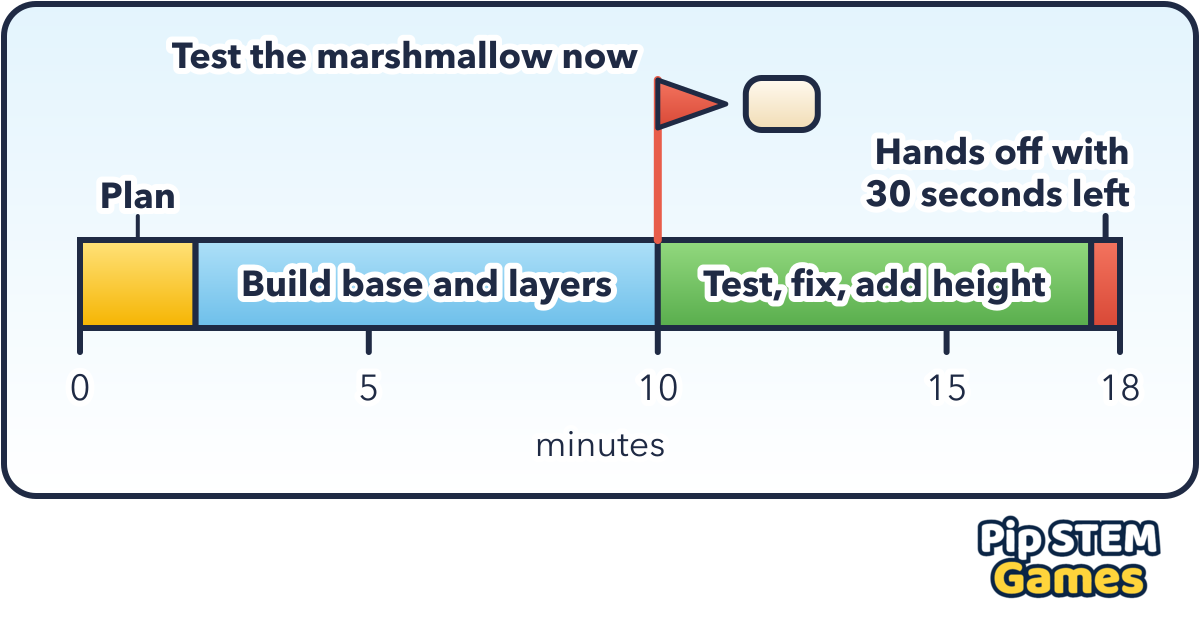
- Plan for two minutes. Sketch a tower. Agree who does what.
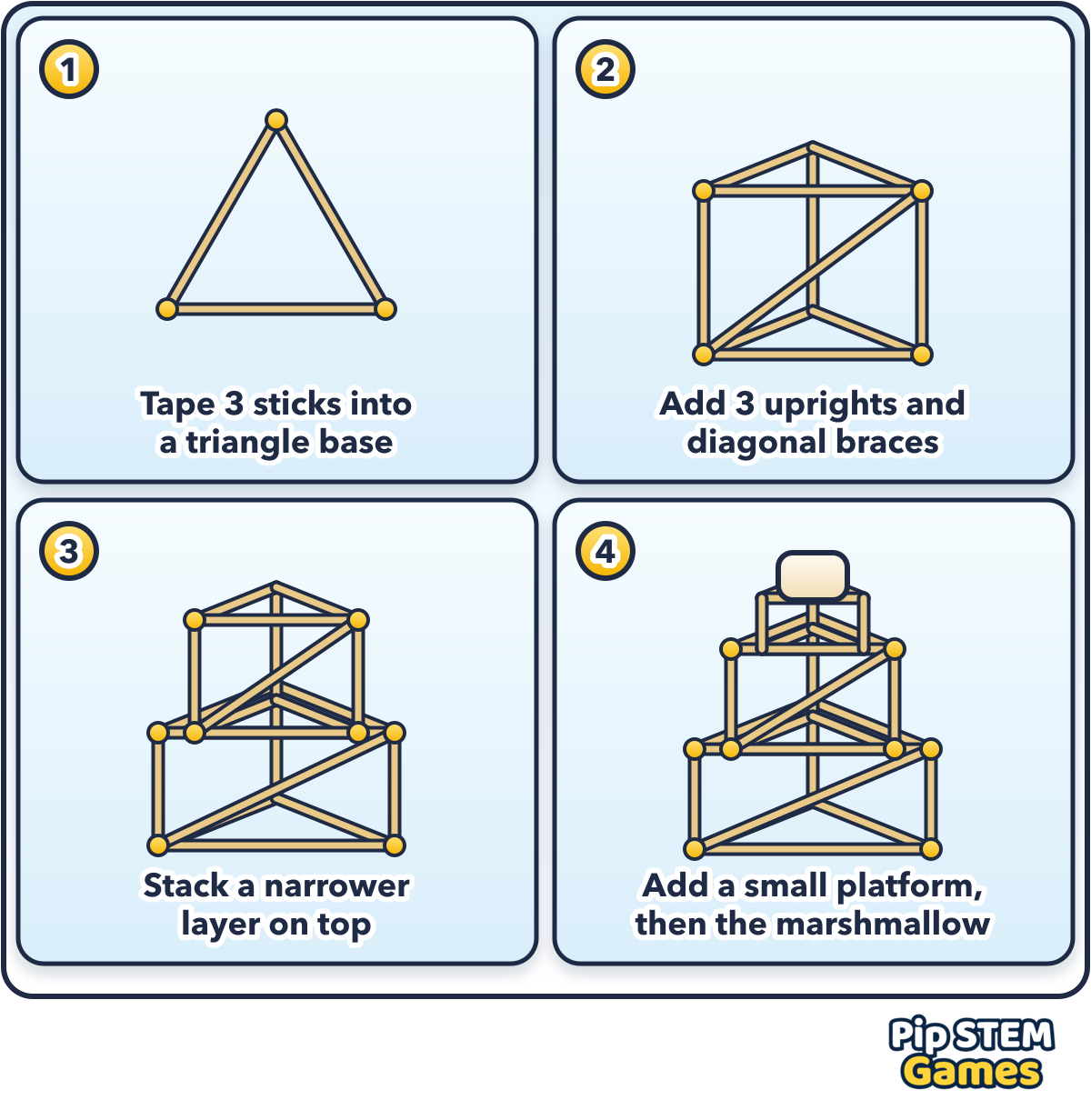
- Make the base. Tape three sticks into a triangle. Make a second triangle the same size. A triangle can't squash out of shape the way a square can.
- Join the triangles with uprights. Tape three sticks upright between the two triangles to make a triangular prism. Add diagonal sticks across the sides to brace it.
- Stack a second layer on top, slightly narrower than the one below, and tape it firmly.
- Add a small platform on top for the marshmallow, such as a tiny triangle of three sticks or a cup of tape loops.
- Test with the marshmallow at the 10-minute mark, not the 17th. If the tower bows, stop and fix it.
- Add height with what's left. Only extend the tower once the lower part has survived the marshmallow.
The string is the least useful part of the kit for most builders. You can use it to tie a joint, but tape does the job better. Treat it as optional.
Why do spaghetti towers collapse?
Spaghetti towers collapse because dry spaghetti is brittle, it bows under load, and wobbly joints let a tower twist.
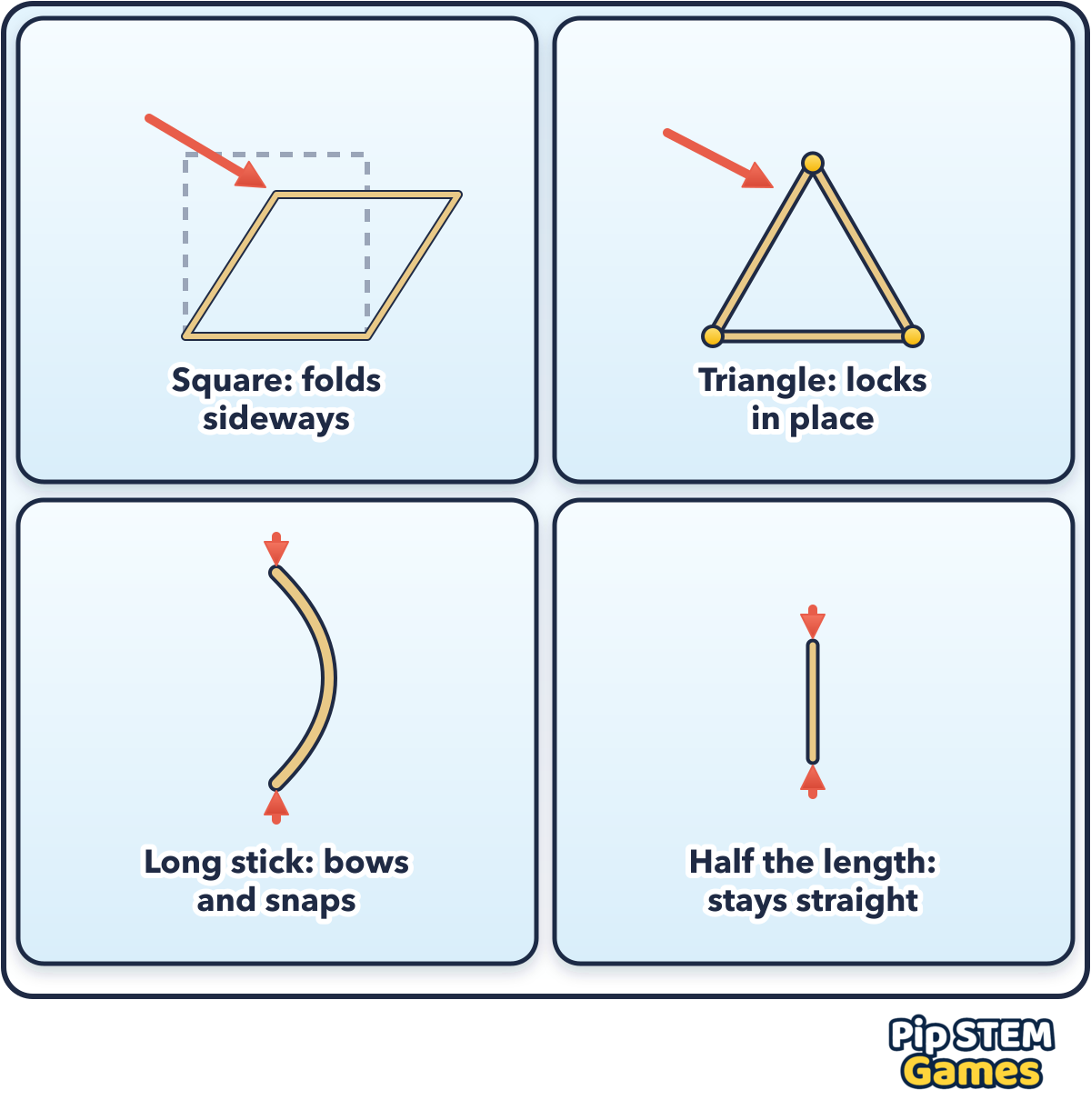
Dry spaghetti can take a decent push straight down its length, but it hates bending. A long, thin stick under load bows sideways and snaps. Engineers call this buckling. The longer the stick, the worse it gets. In the ideal case, the textbook formula for a thin, straight column says halving the length lets a stick carry about four times the load before it buckles. Real spaghetti is messier, but short pieces are a real advantage.
The second problem is shape. A square frame can flop sideways into a diamond. A triangle can't, because its three sides lock each other in place. This is why bridges and cranes are covered in triangles, and it's the same reason the diagonal braces in your tower help. Our post on which shape makes the strongest tower shows the triangle-versus-square test in a few minutes.
The third problem is the base. A tower tips when its weight moves outside its footprint, so a wide base and a lower centre of gravity keep it standing. If you've got a tower that keeps toppling, read why this tower keeps falling over.
What lessons do kids learn from the marshmallow challenge?
The big lesson is to build a prototype early and test it with the real load, which kids tend to do better than adults.
Wujec says tens of thousands of people have run the challenge. The Toffler Associates write-up says kindergarten children typically do better than business school graduates. The usual explanation is that adults spend most of the time planning, then add the marshmallow at the end and discover the tower can't hold it. Children start building straight away, put the marshmallow on early, and keep adjusting. Neither source publishes detailed data, so treat this as an anecdote rather than a controlled study. The pattern is the point: testing beats planning.
It's also a lesson in the real brief. The marshmallow is the customer's requirement. If the tower can't hold it, it doesn't matter how tall the spaghetti is. Frankly, that's a better introduction to engineering than most worksheets.
For a smaller, marshmallow-free version, our 10-spaghetti-strand tower challenge is a calm warm-up for younger children.
What if your spaghetti tower leans, bends or won't hold the marshmallow?
Match the fix to the failure, and change one thing at a time.
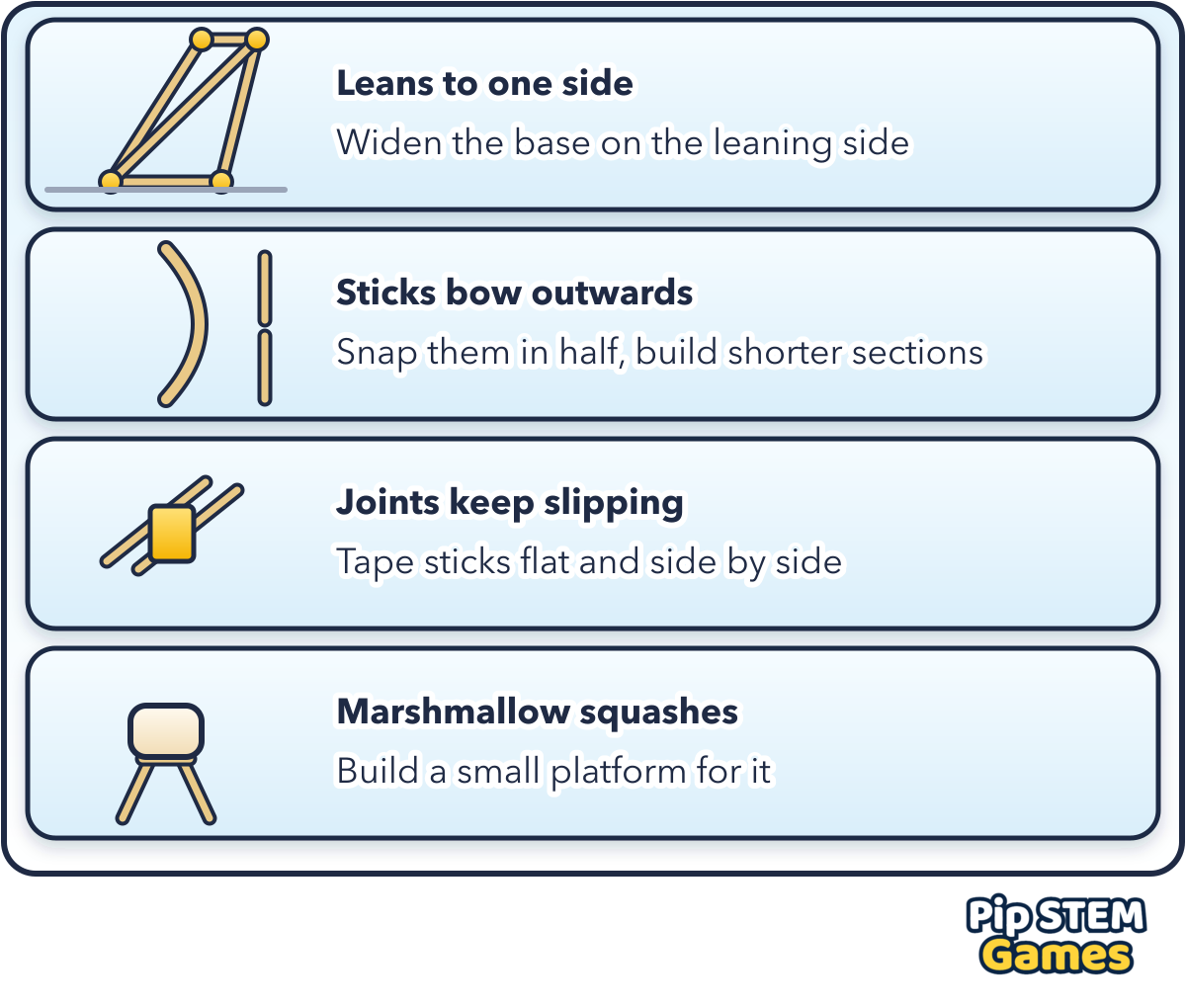
- Tower leans to one side: the base is lopsided or one joint is loose. Re-tape the weak corner and widen the base on the leaning side.
- Sticks bow outwards: they're too long. Snap them in half and build shorter sections.
- Joints keep slipping: tape the sticks flat, side by side, rather than just at the tips. More overlap means more grip.
- Marshmallow squashes the top: build a small platform for it, or push the sticks into the marshmallow so it grips them.
- Tower is steady but short: add a layer, but only after you've tested the layers underneath.
- It collapses at the last second: you probably moved or tightened something. Stop touching the tower with 30 seconds left.
A useful house rule: after a collapse, everyone names one thing they'll change before the next attempt. It stops the same mistake being made twice.
How do you adapt the spaghetti tower for ages 5 to 7 and 8 to 12?
Make it a gentle build for ages 5 to 7, and a timed team contest with measurement for ages 8 to 12.
Ages 5 to 7: Use mini-marshmallows that an adult places, give them more tape, and drop the clock. Marshmallows are a choking risk for young children, so nobody eats one during the build. Let them build a triangle on the table first, then stand sticks up from it. Praise the idea of a wide base. If you'd like a wider set of build-and-test pages, the Junior Engineers workbook follows the same pattern of making, testing and fixing.
Ages 8 to 12: Add the 18-minute limit and measure each tower in centimetres. Run two rounds, then ask them to predict how much taller the second can be. Try a weight twist: swap the marshmallow for a bigger, heavier one, or allow only 12 sticks.
After the build, they can practise the same ideas on screen in the Tower Stack game, where balance and a good base decide how high you get.
Questions parents ask
How many spaghetti sticks do you need for the marshmallow challenge?
The classic kit uses 20 sticks of dry spaghetti per team, plus one yard of tape, one yard of string and one marshmallow. You don't have to use all of it.
How tall can a spaghetti tower get?
Heights vary a lot with the spaghetti, the tape and the builders, and Wujec's page doesn't publish figures. Measure your own first tower and treat it as the record to beat.
What is the best shape for a spaghetti tower?
Triangles. A triangle keeps its shape under load, and a tower built from triangular sections with diagonal braces is much harder to twist or collapse than one built from squares.
Why does the marshmallow have to go on top?
That's the rule, and it's the whole point. It forces the team to build a structure that can carry a load at the very top, which is the hardest place to hold it.
Can you do the marshmallow challenge with a young child?
Yes, with a grown-up. An adult should handle the marshmallows, since they are a choking risk for young children. Use extra tape and no timer. Focus on one idea, such as making a triangle base, rather than on height.
Can you eat the marshmallow and spaghetti afterwards?
Skip anything that's been handled, taped or dropped on the floor. Keep a separate bag of marshmallows for snacking, and bin the raw spaghetti.
Want more ideas like this? Explore engineering for kids: games, projects and challenges.
Great STEM activities to try next...
 The 10-Spaghetti Tower ChallengeActivity
 Which Shape Makes the Strongest Tower?Activity
 Why This Tower Keeps Falling OverActivity
More to try:

Pip STEM Games
We make engineering games and workbooks for kids aged 5 to 12. Every activity here is one we'd happily run at the kitchen table: test it, watch it fail, fix it, try again.




