

Key takeaways
- A beam, an arch and a truss each carry weight in a different way.
- There is no single best bridge. The right one depends on the gap, the ground and the parts you have.
- A beam bends, so its top is squeezed and its bottom is stretched.
- An arch squeezes along its curve but needs the ends held, or the feet slide apart.
- A truss uses triangles to stay stiff with light parts, and only needs supports that hold it up.
Which bridge would you build: a beam, an arch or a truss? There is no single winner. The best bridge depends on how wide the gap is, what the ground at each end can do, and what you have to build with. This page gives you a 20-minute card test with 10p coins, a cheat sheet for choosing, and a printable record sheet.
What is the difference between a beam, an arch and a truss?
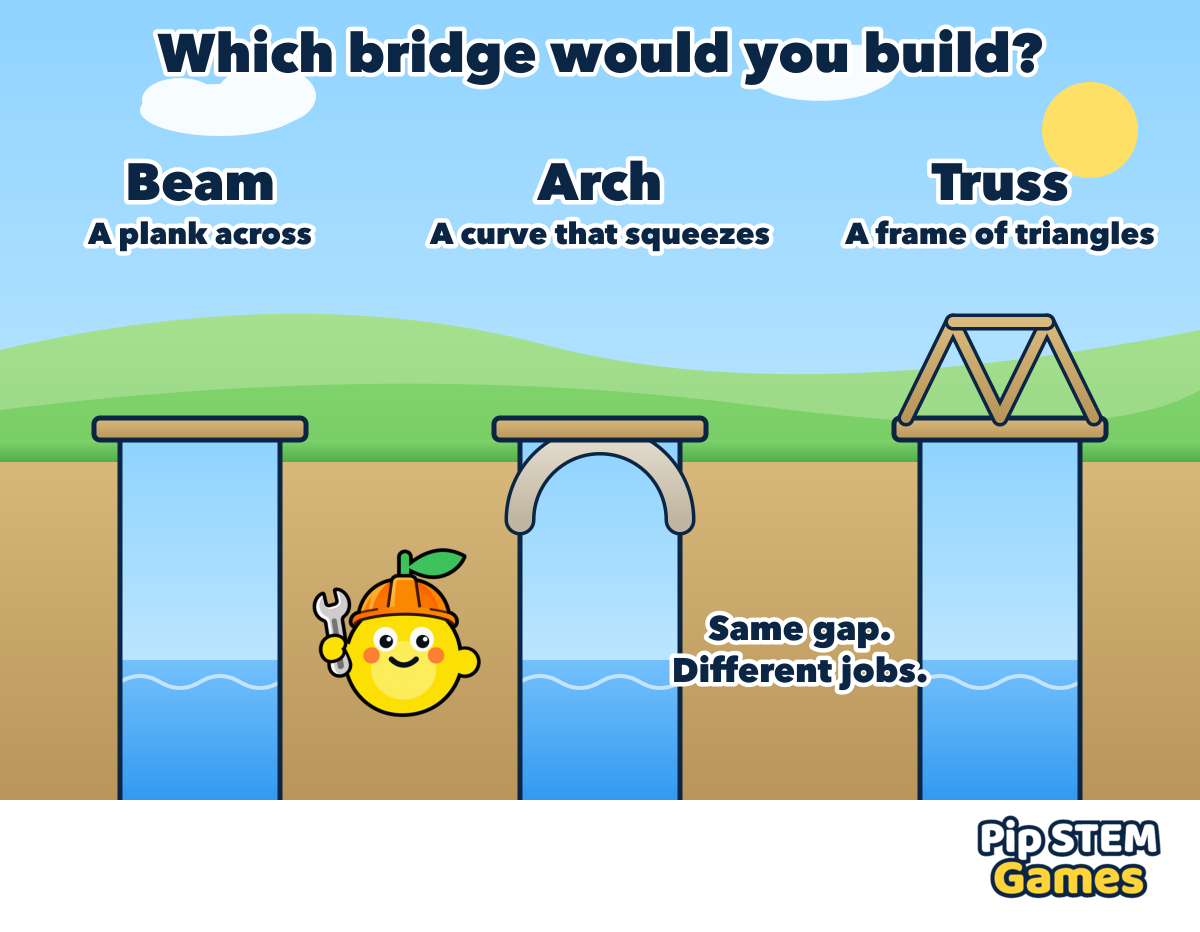
All three cross a gap, but each one passes the weight along in its own way.
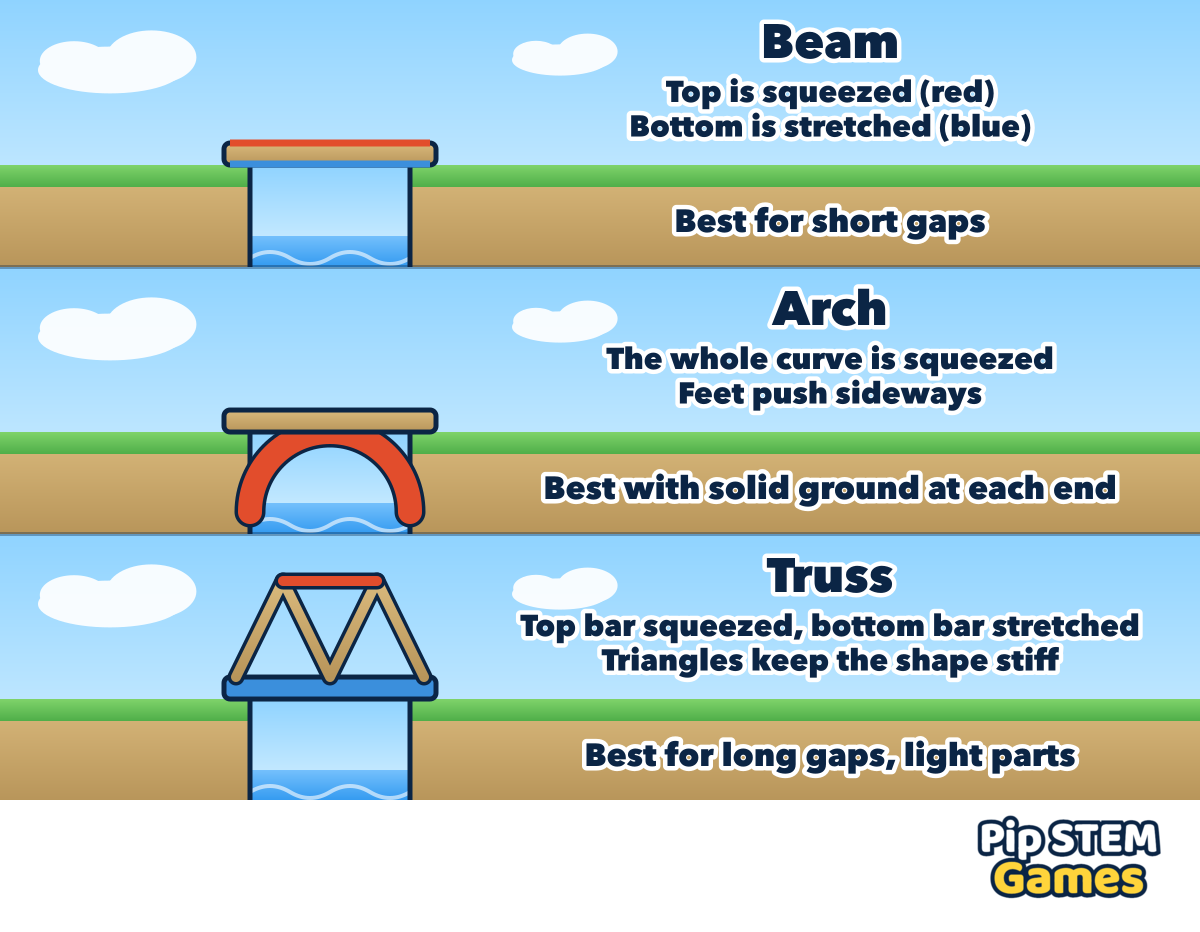
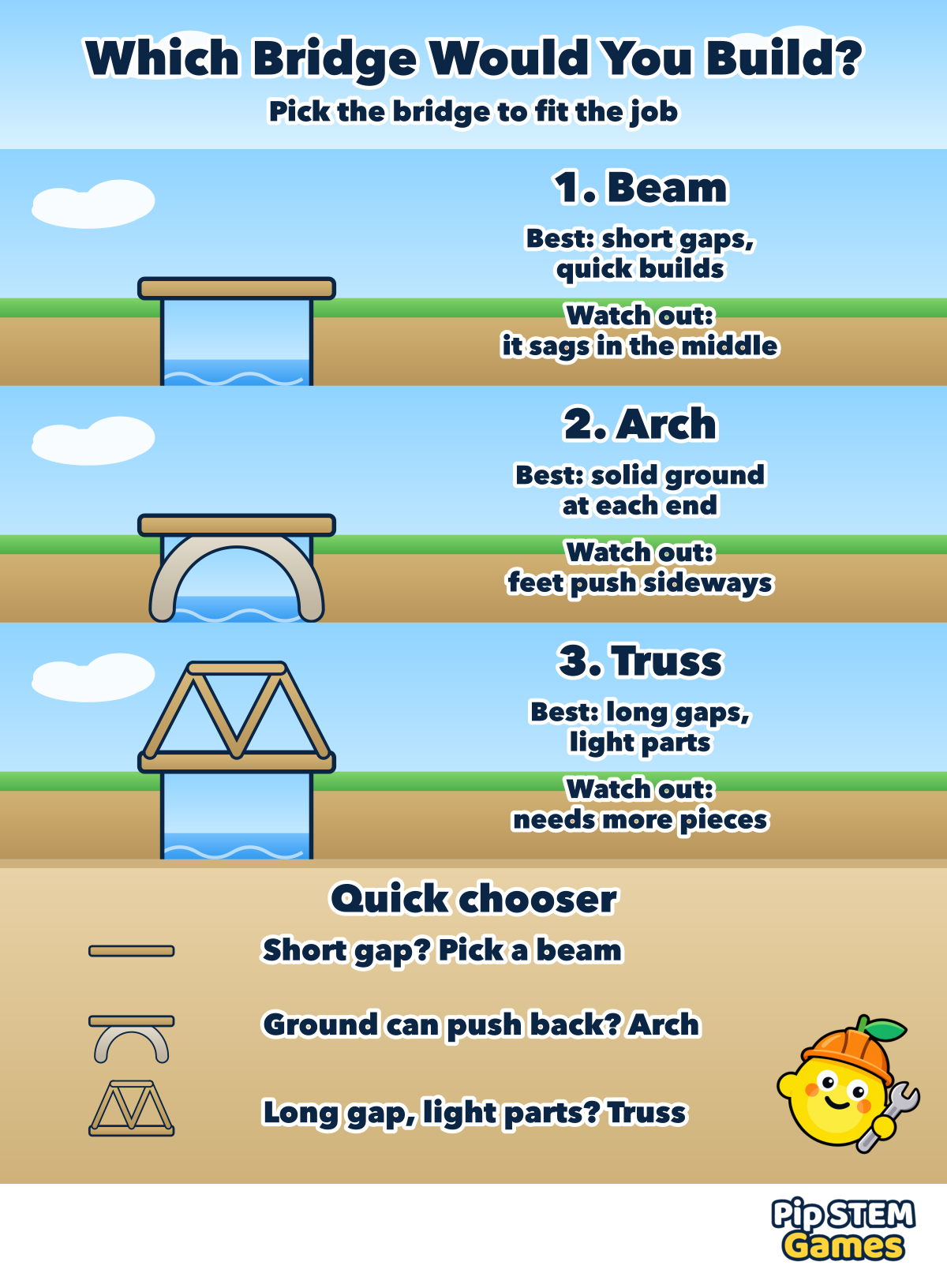
- A beam is a flat bar or plank resting on two supports. It is the simplest bridge. A load pushes the middle down, so the top is squeezed and the bottom is stretched.
- An arch is a curve. The load travels along the curve into the two ends, so most of the arch is being squeezed. The feet push sideways, so the ground or abutments at each end have to push back. We test that in why are arches so strong.
- A truss is a frame of triangles. A triangle cannot change shape when you push it, so the frame stays stiff, and it can do the job of a thick beam with much less material. Its supports only need to hold it up, not push sideways. See the triangle test in which shape makes the strongest tower.
Squeezing is called compression. Stretching is called tension. Engineers check both for every part of a bridge.
What do you need for the three-bridge card test?
You will test the same amount of card in three shapes. It takes about 20 minutes.
- Thin card from a cereal box, cut into three strips, each 8 cm by 30 cm
- 4 hardback books, as supports
- A ruler and some sticky tape
- A light plastic lid, such as a yogurt-pot lid
- About 40 UK 10p coins (one weighs about 6.5 g)
- The record sheet below, a pencil and a pen
Grown-up note: coins are a choking risk for children under 3, so keep them away from little ones. Put the books on a steady table and keep toes out from under the stacks.
How do you run the card test?
Test the three strips one at a time, with everything else the same.
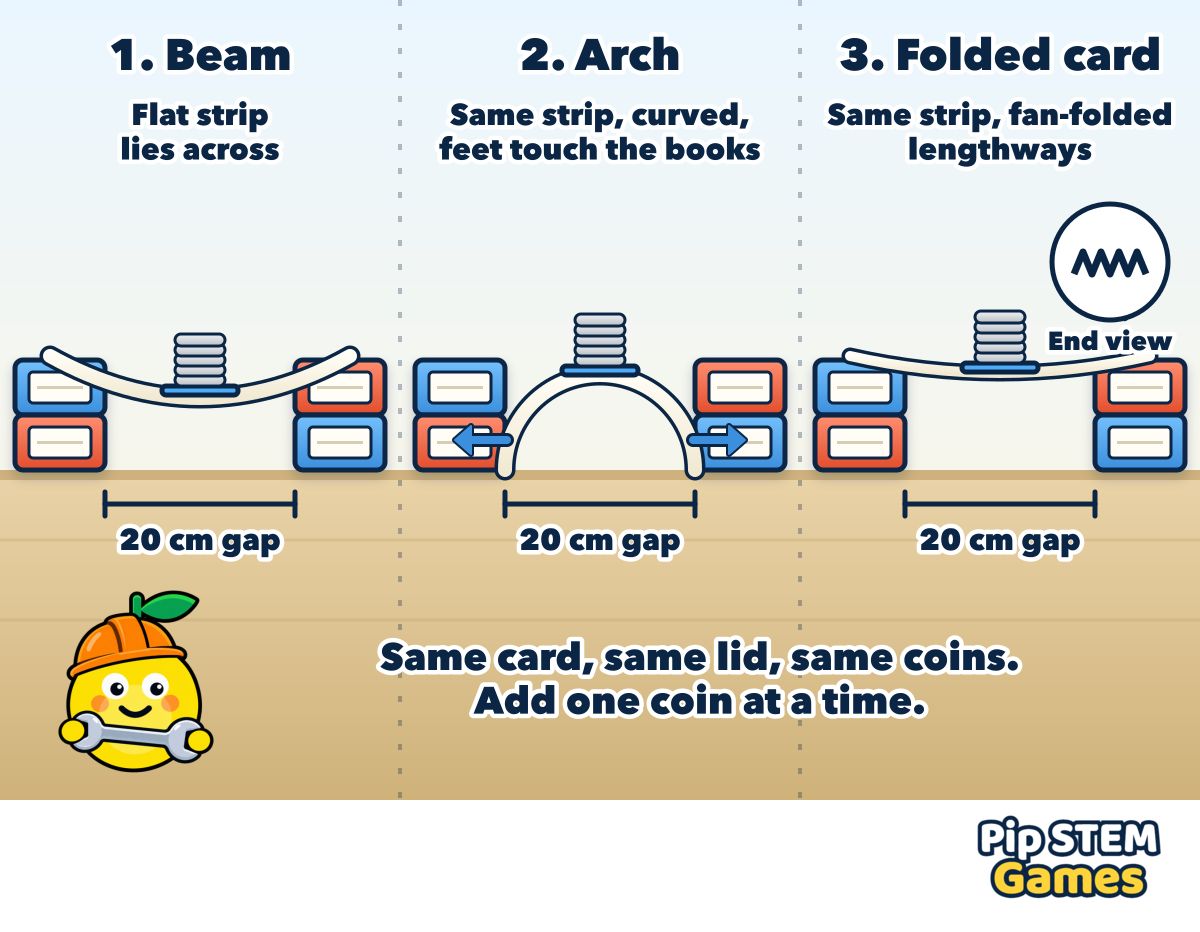
- Make two stacks of two books. Put them so the inner edges are 20 cm apart. Measure with the ruler.
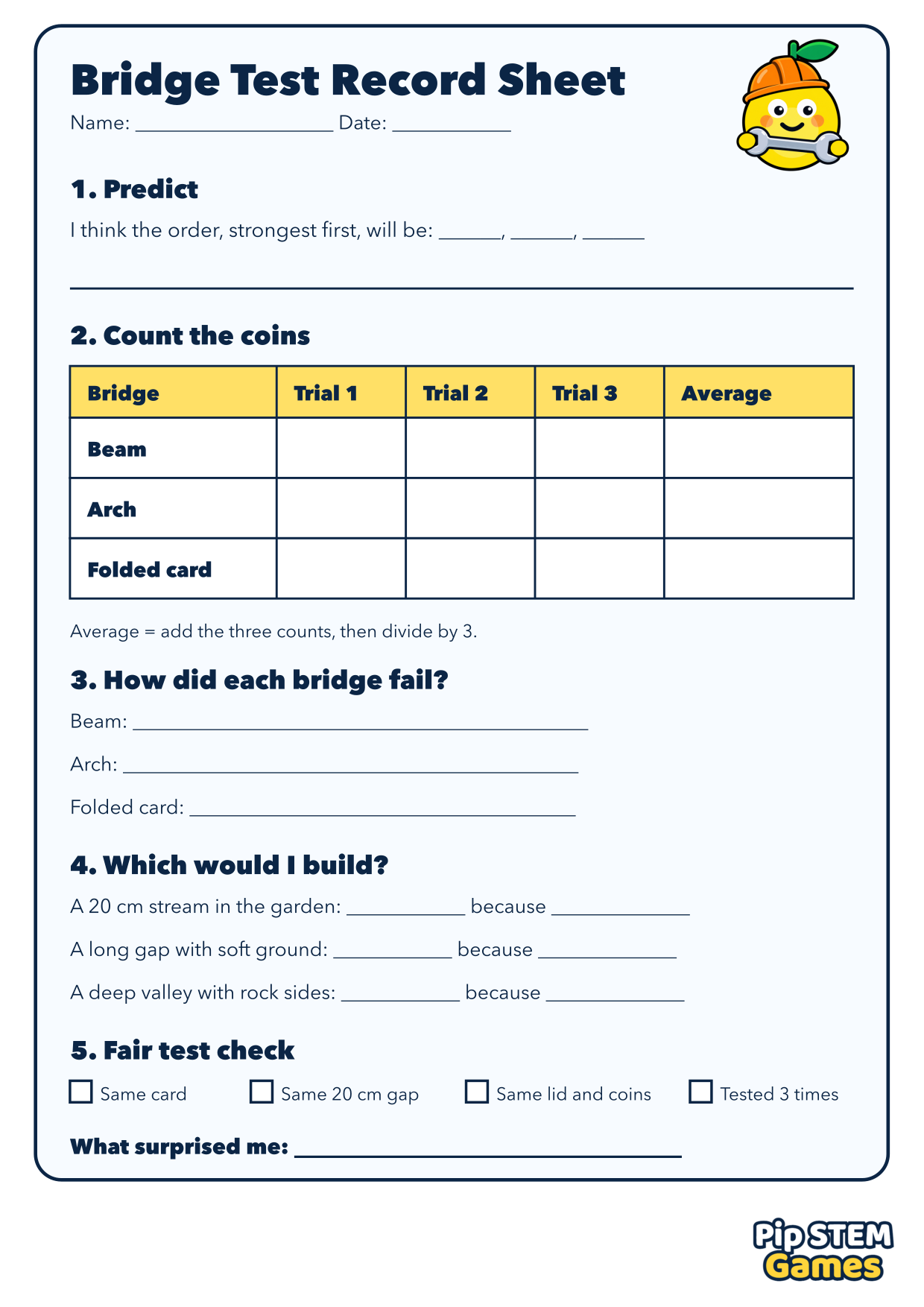
- Write your prediction on the record sheet. Which bridge will hold the most coins?
- Beam: lay the first strip flat across the gap, with 5 cm resting on each stack. Put the lid in the middle and add coins one at a time. Stop when the lid touches the table or slides off. Write the number down.
- Folded card: fan-fold the second strip lengthways, like a paper fan, with folds about 1 cm apart. It stays 30 cm long but ends up narrow and ridged. Lay it across the gap like the beam and add coins.
- Arch: bend the third strip into a curve, about 9 cm tall. Stand its feet on the table, pressed against the inner faces of the book stacks. The books stop the feet sliding. Put the lid on top and add coins.
- Repeat each test three times and write down all three counts.
Do not trust a guess, even a good one. Your card and your books will give your own numbers.
What should happen to each bridge?
Make a prediction first, then compare. Here is what we expect, and why.
- The flat beam should give way first, because the whole strip bends and the middle sags.
- The folded card should hold more than the flat strip. The ridges make the strip deeper, and a deeper beam bends less. This is a model of why trusses stay stiff, not a real truss.
- The arch can carry well, but only if the feet cannot slide. If the books are pushed against the feet, the load travels along the curve. If the feet slip, the arch flattens.
If your results do not match, that is useful. Check the feet, the fold and the lid first. Then change one thing and test again. The average of three trials is the add-up of the counts divided by 3. If the beam holds 4, 6 and 5 coins, the average is 5.
Which bridge would you build for each job?
The best bridge answers three questions. How wide is the gap? What can the ground at each end do? What parts do you have?
- Short gap and simple parts: a beam. A plank across a garden stream is a beam.
- Solid ground at each end that can push back: an arch. The curve keeps most of the bridge squeezed, and the abutments take the sideways push.
- Long gap and light parts, or ends that can only hold weight straight down: a truss. The triangles keep the frame stiff, and the supports only hold it up.
Real engineers also think about cost, time, the wind, boats passing underneath and how long the bridge must last. A cheat sheet is only a start. Try the choices yourself in the Bridge Builder game, where you can pick parts for each gap.
What can go wrong with the test?
Most problems have a quick fix.
- The arch feet slide out. Push the books closer to the feet, put a heavier book behind each stack, or tape the feet to the table.
- The card creases under the lid. The coins are pressing on a small spot. Use a flat lid and add coins slowly.
- The books shuffle. Move to a bare table or add a second book behind each stack.
- Every bridge holds all 40 coins. Widen the gap to 25 cm and test again.
A collapse is data. Write down where it started, change one thing, then try again. This is the same fix-and-retry loop as in the engineering design process.
What is the next challenge?
Pick one bridge shape and make it stronger using only two sheets of A4 paper. You may fold, curve, roll or tape. Keep the gap at 20 cm and count the coins again.
Then compare your best design with the best from a friend. The paper bridge challenge and three paper bridge designs have more ideas. Print the sheet below and fill it in as you go.
How can you adapt the test for different ages?
Ages 5 to 7: skip the coins. Use building blocks as supports and press gently on each bridge with a finger. Ask which one feels wobbly and which one pushes back.
Ages 8 to 12: count coins, work out averages, and use the record sheet to say how each bridge failed. Older children can weigh ten 10p coins on kitchen scales and turn the count into grams.
The workbook has more pages like this: Senior Engineers for ages 8 to 12. This is a simple model of three bridge types, not a design for a real bridge.
Questions parents ask
Which bridge is the strongest?
No bridge is the strongest in every case. A beam suits a short gap, an arch suits solid ground at each end, and a truss suits a long gap built from light parts. The best choice depends on the job.
What is the difference between an arch and a truss?
An arch is a curve that squeezes along its length and pushes sideways at its feet. A truss is a frame of triangles that stays stiff and only pushes straight down on its supports.
Why does a flat beam sag?
The load pushes the middle down. The top of the beam is squeezed and the bottom is stretched, so the beam bends. A deeper or folded beam bends less.
Is a folded card the same as a truss?
No. A folded card is deeper and stiffer than flat card, which shows why depth helps, but a real truss is a frame of triangles. Treat the folded card as a simple model.
How many coins should each bridge hold?
It depends on your card, your gap and your supports. We do not give a number, because the point is to measure your own results.
What age is the bridge test for?
Ages 5 to 12. Younger children can press and compare. Older children can count, average and explain how each bridge failed.
Great STEM activities to try next...
 Paper Bridge Challenge: Build a Bridge From One Sheet of Paper [Printable]Build challenge
 Three Paper Bridge Designs, Same Materials, Very Different ResultsBuild challenge
 Why Are Arches So Strong? [Printable]How it works
More to try: Bored 10-Year-Old? 12 Things to Build and Solve · Mini Crane for Kids: 3 Ways to Build One · How Do Engineers Build Spacecraft? 5 Home Tests

Pip STEM Games
We make engineering games and workbooks for kids aged 5 to 12. Every activity here is one we'd happily run at the kitchen table: test it, watch it fail, fix it, try again.




