


Key takeaways
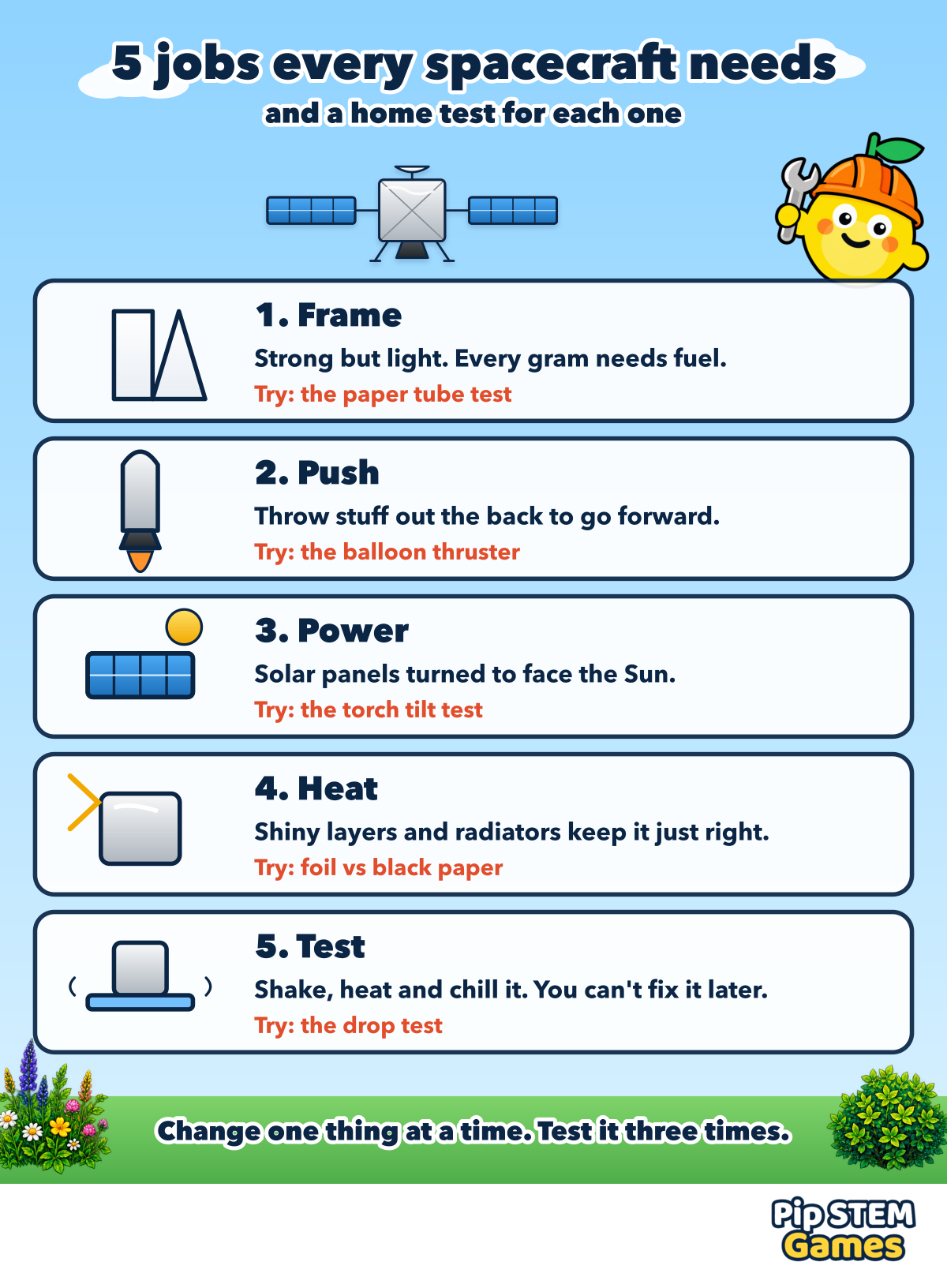
- Engineers split a spacecraft into five jobs: frame, push, power, heat control and testing.
- The frame must be strong and light, because every extra gram needs more fuel to launch.
- Rockets push gas out of the back, so the spacecraft is pushed forward, even with no air.
- Solar panels make the most power when they face the Sun square on.
- Spacecraft are shaken, heated and chilled on the ground, because they can't be fixed after launch.
Engineers build spacecraft by splitting one huge problem into five jobs: a strong, light frame, a way to push, a way to make electricity, a way to stay at a safe temperature, and lots of testing before launch. Each job affects the others, so engineers keep trading weight, strength, power and heat. Below you'll find what each job does and a simple home test for each one, for ages 5 to 12, using paper, a balloon, a torch and two cups.
How do engineers build a spacecraft?
Engineers build a spacecraft by splitting one huge problem into five smaller jobs: a strong, light frame, a way to push it, a way to make electricity, a way to stay at a safe temperature, and lots of testing on the ground. Each job affects the others. A bigger solar panel gives more power, but it adds weight, and extra weight needs more fuel to launch.
So engineers spend most of their time trading one thing against another: weight against strength, power against size, heat against cold. Frankly, that juggling is the real skill, and kids can practise it at a kitchen table.
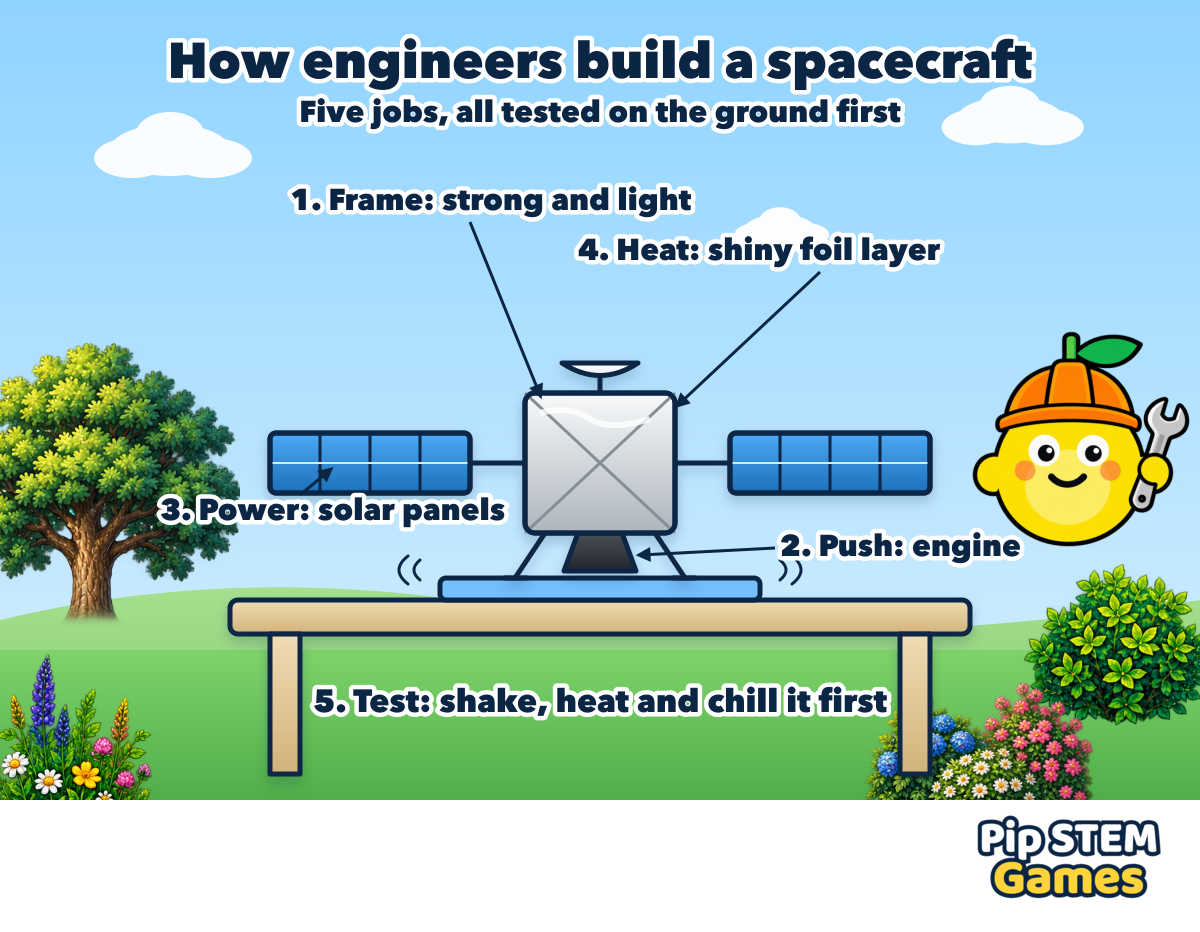
The five home tests below are models for learning. They use paper, balloons, torches and cups, and they show the ideas rather than the real machines. Each one takes 10 to 30 minutes.
What does the frame of a spacecraft do?
The frame holds every part in place and has to survive the hard shaking of launch. It must be strong and light at the same time, because every extra gram needs more fuel to lift off the ground. That's why engineers use tubes, triangles and thin panels: they carry a lot of load without much material.
Try it: the tube test
- 4 sheets of A4 paper
- Sticky tape
- A pile of paperback books or exercise books of the same size
- Roll one sheet into a round tube and tape the whole seam.
- Fold the second sheet into a triangle tube and the third into a square tube. Tape them.
- Fold the last sheet into a flat strip, a few layers thick.
- Ask your child to guess which shape will win and write the guess down.
- Stand each shape upright on a table. Add books one at a time on top, gently.
- Count how many books each shape holds before it bends.
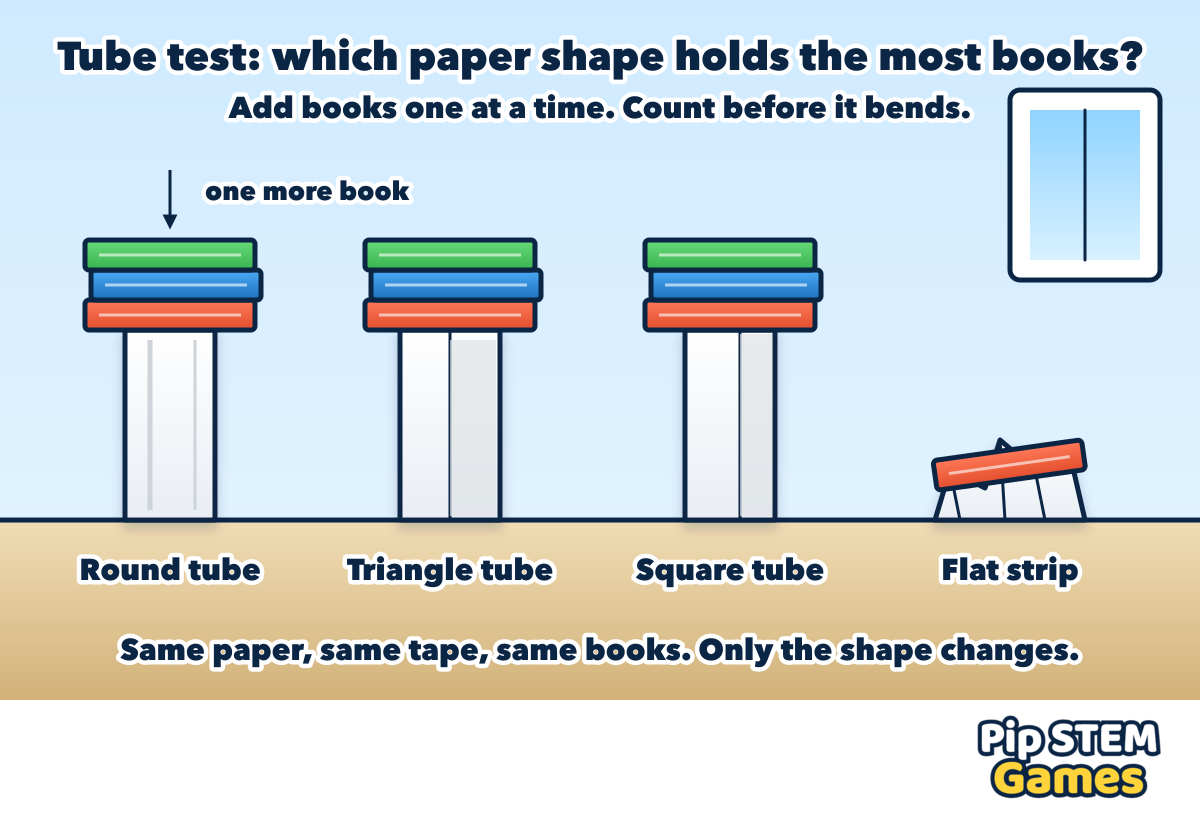
Most children are surprised how much one rolled sheet can carry. There's more on why shapes matter in which shape makes the strongest tower, and the Shape Strength game lets them test it on screen too.
How does a spacecraft move in space?
A spacecraft moves by throwing material out of the back, which pushes the spacecraft forward. There's no air in space to push against, so a rocket carries its own fuel and blasts the hot gas out of its engine. Gas goes one way and the rocket goes the other.
Try it: the balloon thruster
- A balloon
- A long piece of string (3 to 4 metres)
- A drinking straw
- Sticky tape and two chairs
- Thread the string through the straw.
- Tie the string tightly between two chairs, about 3 metres apart.
- An adult blows up the balloon and pinches the neck shut.
- Tape the balloon under the straw, with the neck pointing towards one chair.
- Let go and watch it zip along the string.
- Mark where it stops. Try again with a smaller or bigger balloon.
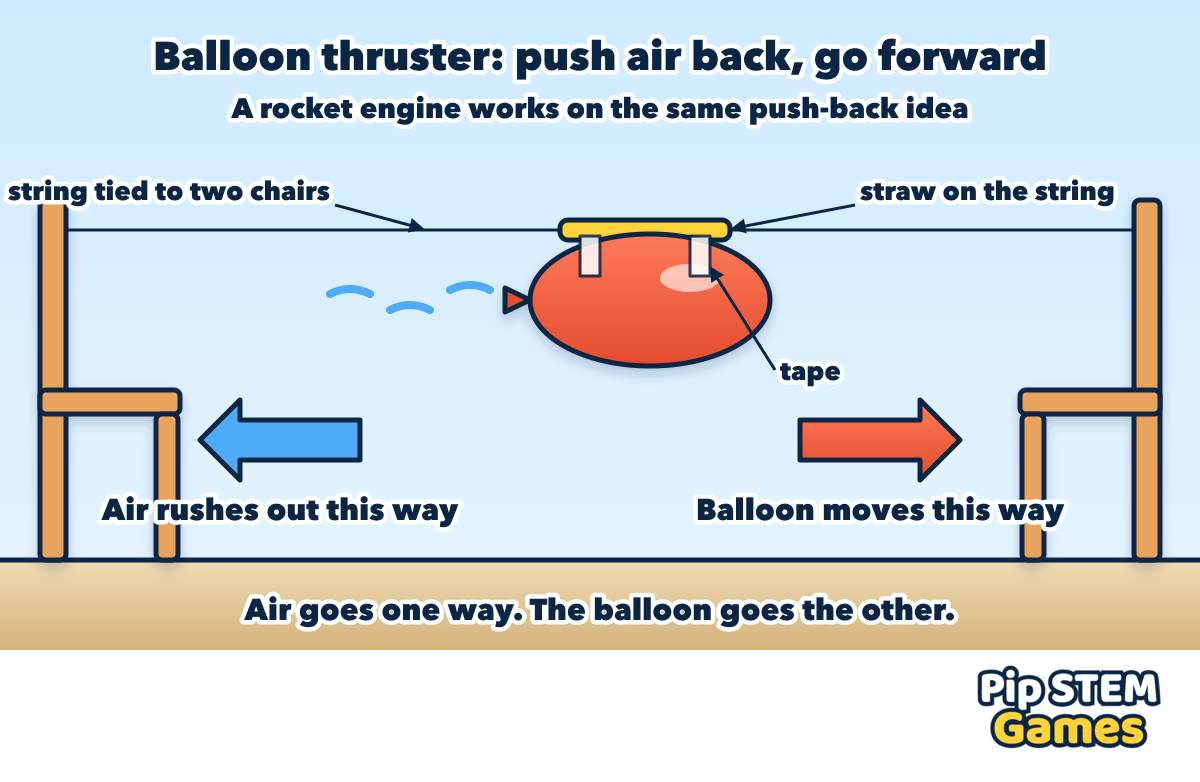
Safety: balloons are a choking risk for children under 8. An adult should blow them up, stay close, and pick up every piece of a popped balloon straight away.
Real rocket engines work very differently inside, but the push-back idea is the same. Our balloon-powered car uses the same push on wheels.
Where does a spacecraft get its power?
Most spacecraft get their electricity from solar panels, which turn sunlight into electricity. A panel makes the most power when it faces the Sun square on. Tilt it away and the same light spreads over more of the panel, so each bit gets less. That's why many spacecraft turn their panels to follow the Sun.
Try it: the torch tilt test
- A torch
- A piece of white card
- A ruler
- Darken the room a little.
- Hold the torch 20 cm above the card, pointing straight down. Look at the size and brightness of the light patch.
- Keep the torch still and tilt the card.
- Watch the patch stretch out and look dimmer.
- Draw round both patches with a pencil and compare their size.
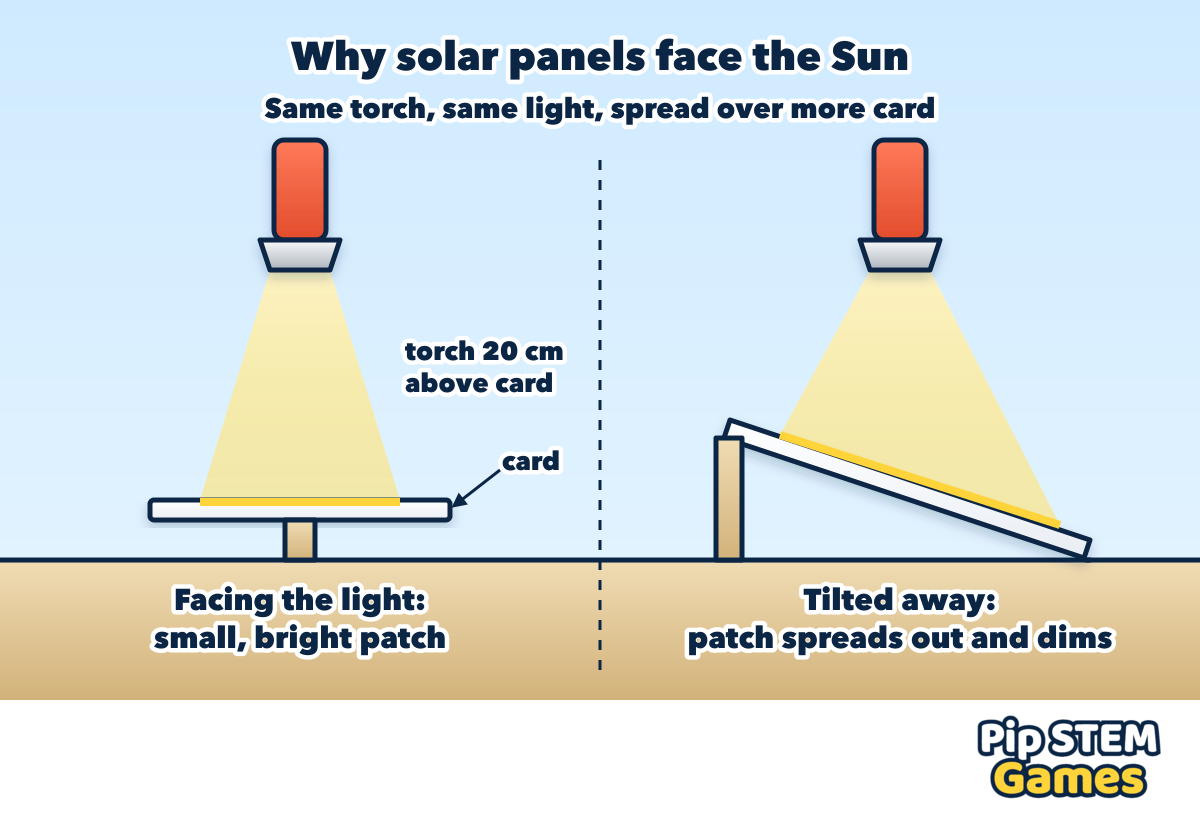
Try the Solar Tracker game to turn panels towards the Sun yourself, or the solar panel placement puzzle for a paper version. If you want a circuit add-on, use only 2 AA batteries with a matching bulb holder. Never use mains electricity.
How do engineers stop a spacecraft getting too hot or too cold?
Engineers wrap spacecraft in shiny layers that bounce sunlight away, pick surface colours that soak up more or less heat, and fit radiators that let extra heat escape. In space the side facing the Sun gets very hot while the shaded side gets very cold. Every part inside has a safe temperature range, and the job is to keep it there.
Those gold and silver blankets you see in spacecraft photos are layers of thin, shiny insulation. NASA's guides describe them as roughly 10 to 20 thin layers stacked together.
Try it: foil vs black paper
- 2 identical cups or jars
- Room-temperature tap water (never hot water)
- Kitchen foil and black paper
- A sunny windowsill
- A kitchen or aquarium thermometer, if you have one
- Fill both cups with the same amount of water.
- Wrap one cup in foil and the other in black paper.
- Put both cups side by side in the same sunny spot.
- Wait 20 minutes.
- Measure the water in each cup, or feel the outside with a finger.
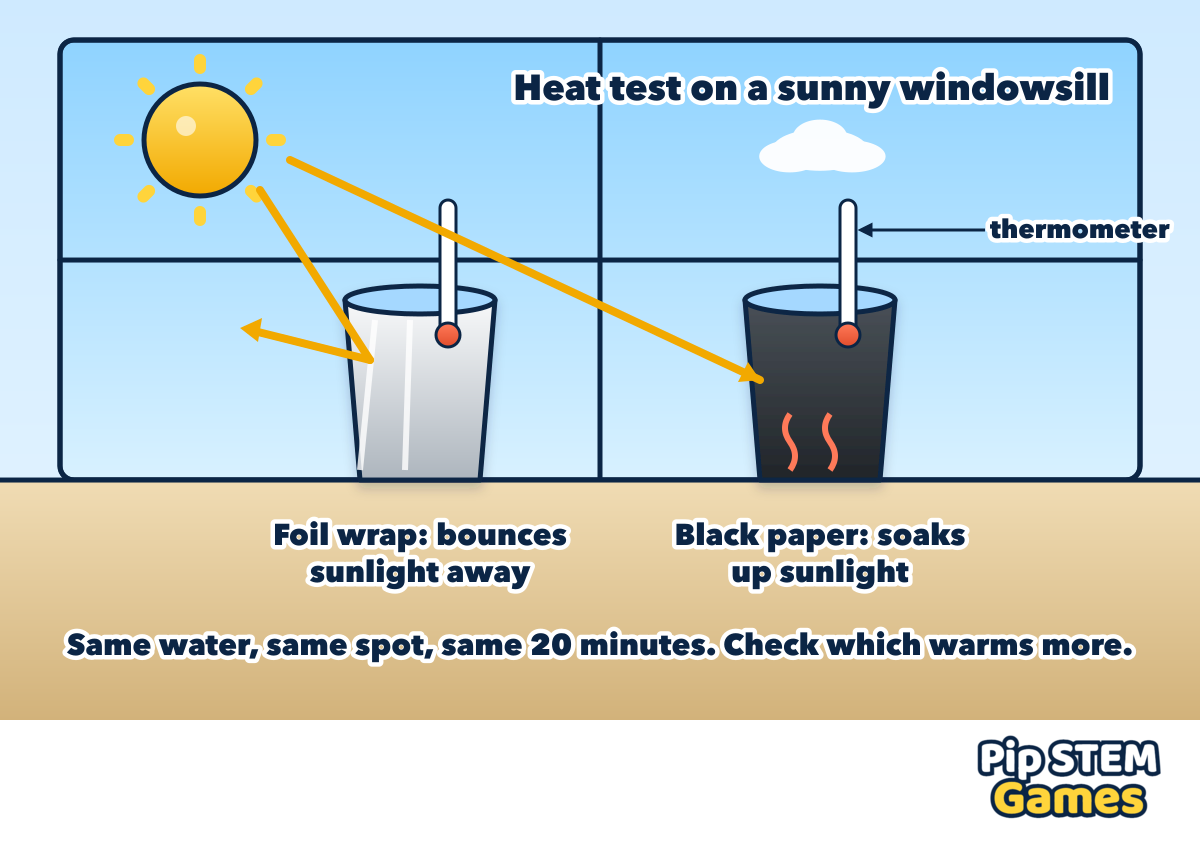
Keep everything else the same: same spot, same time, same water. That's what makes it a fair test. If there's no sun, a desk lamp works, but keep it at a safe distance and don't touch the bulb.
Why do engineers test spacecraft so much?
Engineers test spacecraft again and again because once one is launched, it almost never comes back to be fixed. So they find the weak spots on the ground first. Space agencies have huge test rooms for this. ESA's test centre in the Netherlands has shaking tables, a room that blasts the spacecraft with launch-level noise, and chambers that suck out the air and swing the temperature hot and cold.
Every failed test is good news. It's a weakness found while you can still fix it, which is the whole point of getting it wrong in engineering.
Try it: the drop test
- A small soft toy or a sponge
- A paper cup
- Cotton wool, card and tape
- A cushion
- Build a protective case for the toy with the cup, cotton wool and card.
- Pick a drop height, such as the height of a table, and use it every time.
- Drop the case onto the cushion.
- Check the toy. Did it fall out? Did the case squash?
- Fix the weakest part and drop it again.
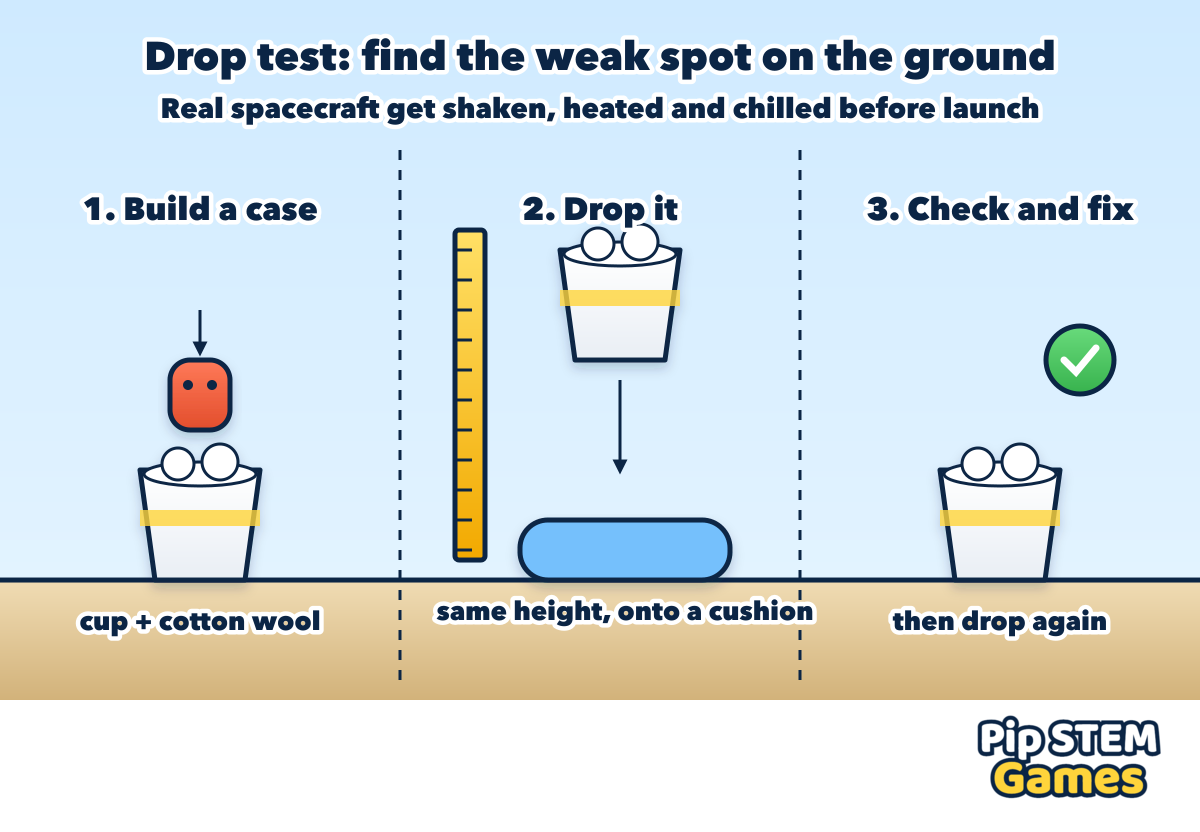
Never drop anything from a balcony, stairs or a window. A table height onto a cushion is plenty.
How do you make these fair tests?
Change one thing at a time and keep everything else the same. If you change the shape and the paper at once, you won't know which one made the difference. Run each test three times and use the middle result.
If a test goes wrong, try this:
- Tubes crumple at the seam: tape the whole seam, not just the ends.
- The balloon thruster stalls: pull the string tighter and keep it level.
- Both cups feel the same: leave them longer or use a thermometer.
- The drop case bursts open: tape the lid on and add more cotton wool round the sides.
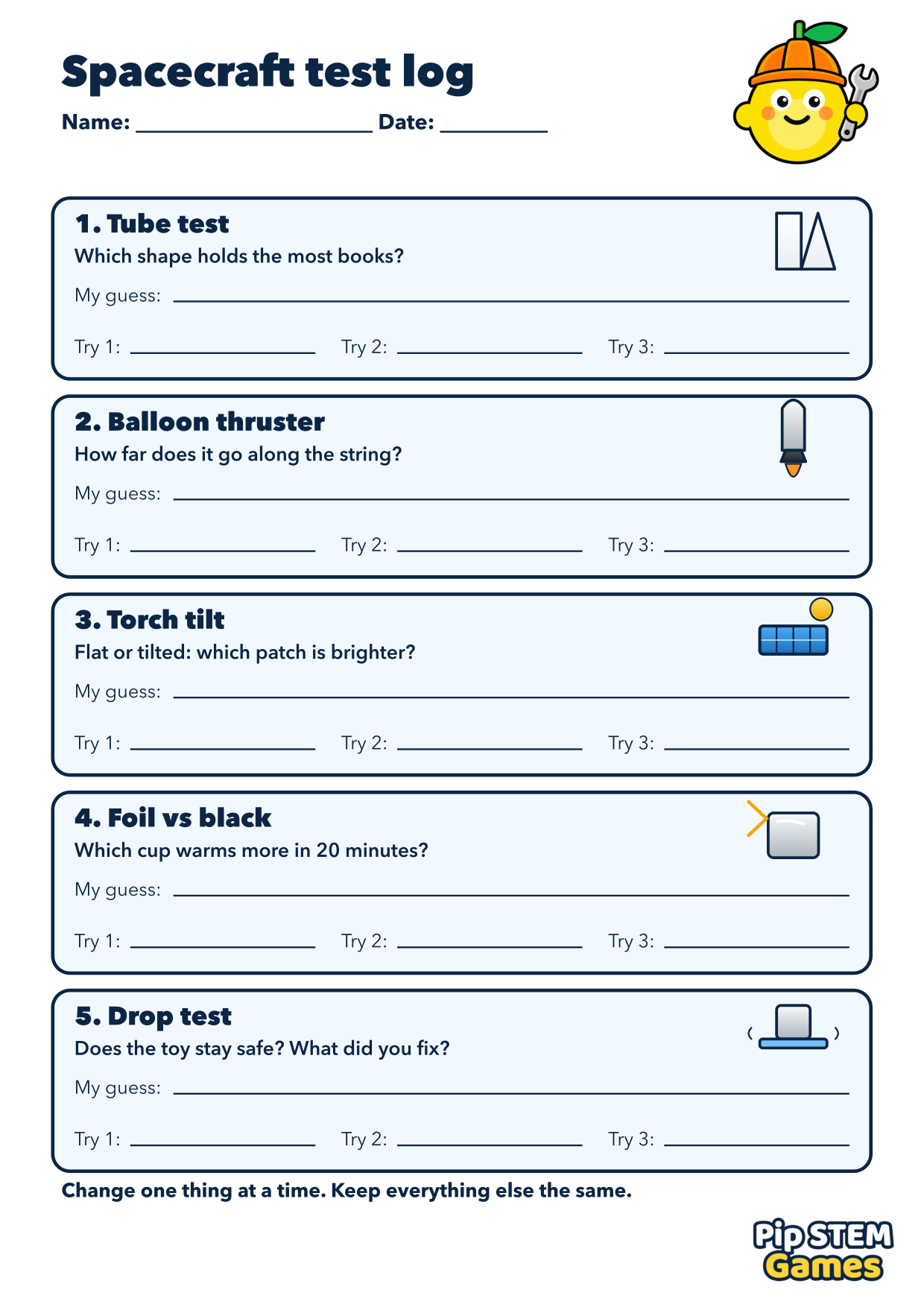
Record every result on the sheet below. Writing down a guess first is a habit real engineers have, and kids love checking whether they were right.
Next, try a mash-up: build a paper tube spacecraft, tape on a paper solar panel, wrap it in foil and see if it survives the drop test.
How can you adapt this for ages 5 to 7 and 8 to 12?
Ages 5 to 7 do the tube test and the balloon thruster with an adult, and talk about what they see. Keep it to one or two tests per session. Ask "Which one held the most?" and "Why do you think that happened?"
Ages 8 to 12 can run all five tests and record numbers: books held, balloon distance in centimetres, temperature after 20 minutes. Older children can draw a trade-off table with weight, strength and heat, and decide which design they'd send to space. The engineering workbook for ages 8 to 12 has more design-and-test challenges like these.
What most people get wrong is jumping straight to the build. Get your child to say what job the part has to do first, and the testing makes far more sense.
Questions parents ask
How long does it take to build a spacecraft?
Usually several years from first design to launch. Much of that time goes on testing, because a fault found on the ground can be fixed and a fault found in space usually can't.
What materials are spacecraft made of?
Mostly light, strong metals such as aluminium and titanium, plus carbon-fibre panels. Shiny insulation blankets cover the outside to control heat.
Why are some spacecraft covered in gold foil?
It's thin, shiny insulation that bounces sunlight away and keeps heat in or out. It's made of many thin layers stacked together.
How does a rocket move if there's no air in space?
It doesn't need air. The engine throws hot gas out of the back, and that pushes the rocket the other way.
Is the balloon thruster safe for young children?
Yes, with an adult close by. Balloons are a choking risk for under 8s, so an adult should blow them up and pick up any popped pieces straight away.
What age is this spacecraft activity for?
Ages 5 to 12. Younger children do the tube and balloon tests with an adult; older children can run all five tests and record numbers.
Great STEM activities to try next...
 Which Shape Makes the Strongest Tower?Activity
 The Solar Panel Placement PuzzleActivity
 What Does a Civil Engineer Do?Activity
More to try:

Pip STEM Games
We make engineering games and workbooks for kids aged 5 to 12. Every activity here is one we'd happily run at the kitchen table: test it, watch it fail, fix it, try again.




