

Key takeaways
- Panel A gets the most light because nothing shades it.
- Half the shade can cost more than half the power, because cells work in lines.
- In the UK, panels do best facing south at a tilt of about 30 to 40 degrees.
- Light that hits a panel square-on gives each part more light than a slanting beam.
- A solar calculator and a card make a safe shade test, and the printable sheet records the results.
Panel A gets the most light. In this solar panel placement puzzle three panels match in size, tilt and direction, but one sits in full sun, one is half shaded and one is mostly shaded. This guide shows why shade matters, which way UK panels should face, and a safe calculator test your child can try at home.
Which solar panel gets the most light?
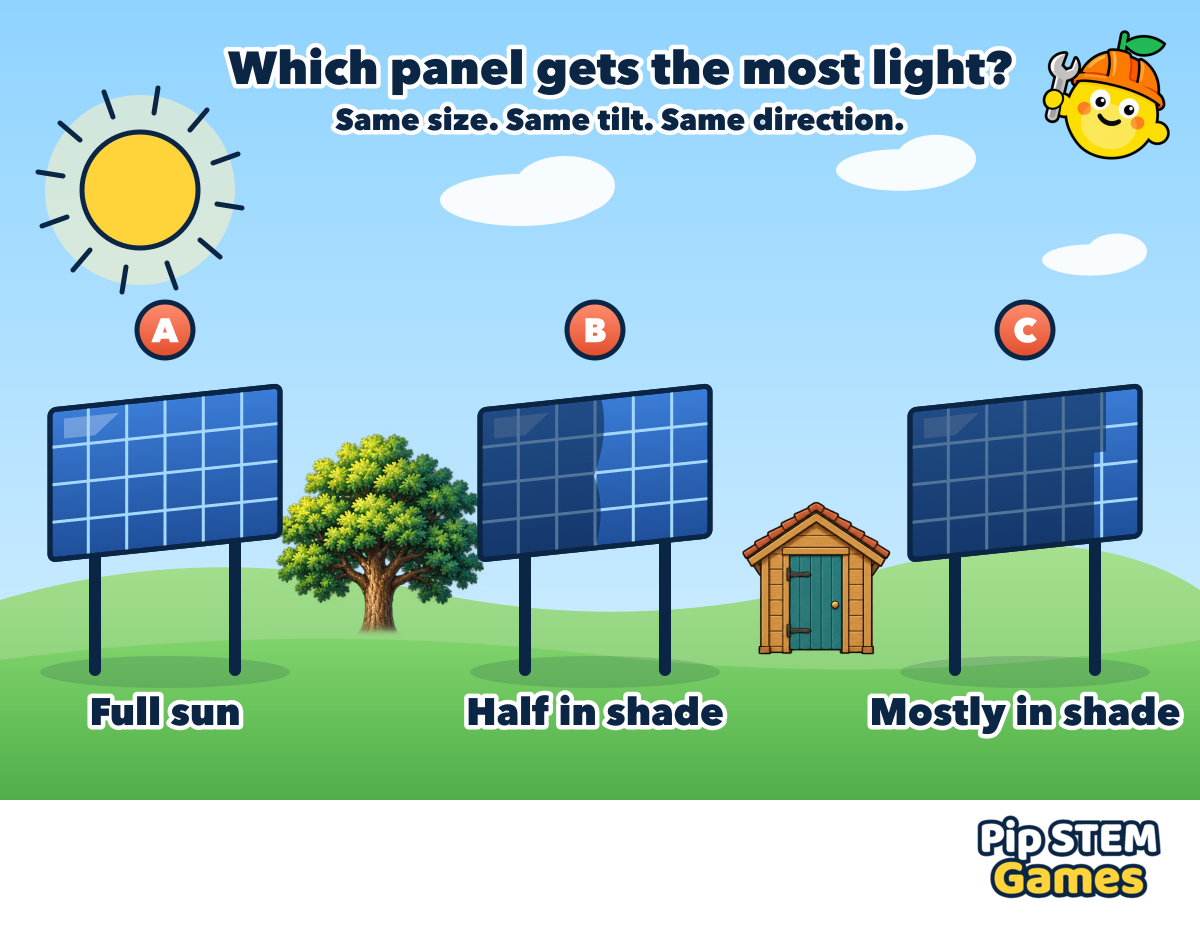
Panel A gets the most light. All three panels are the same size, tilt and direction, so shade is the only difference. Panel A has nothing in the way of the sunlight, so more light reaches its cells.
A solar panel is a flat sheet of small cells. Each cell turns light into electricity. Less light on the cells means less electricity to make.
This is the puzzle engineers face before a roof gets panels. Where will the sun shine, and what will block it? Try the same thinking in the Solar Tracker game, where you point panels at the sun.
Does half the shade mean half the power?
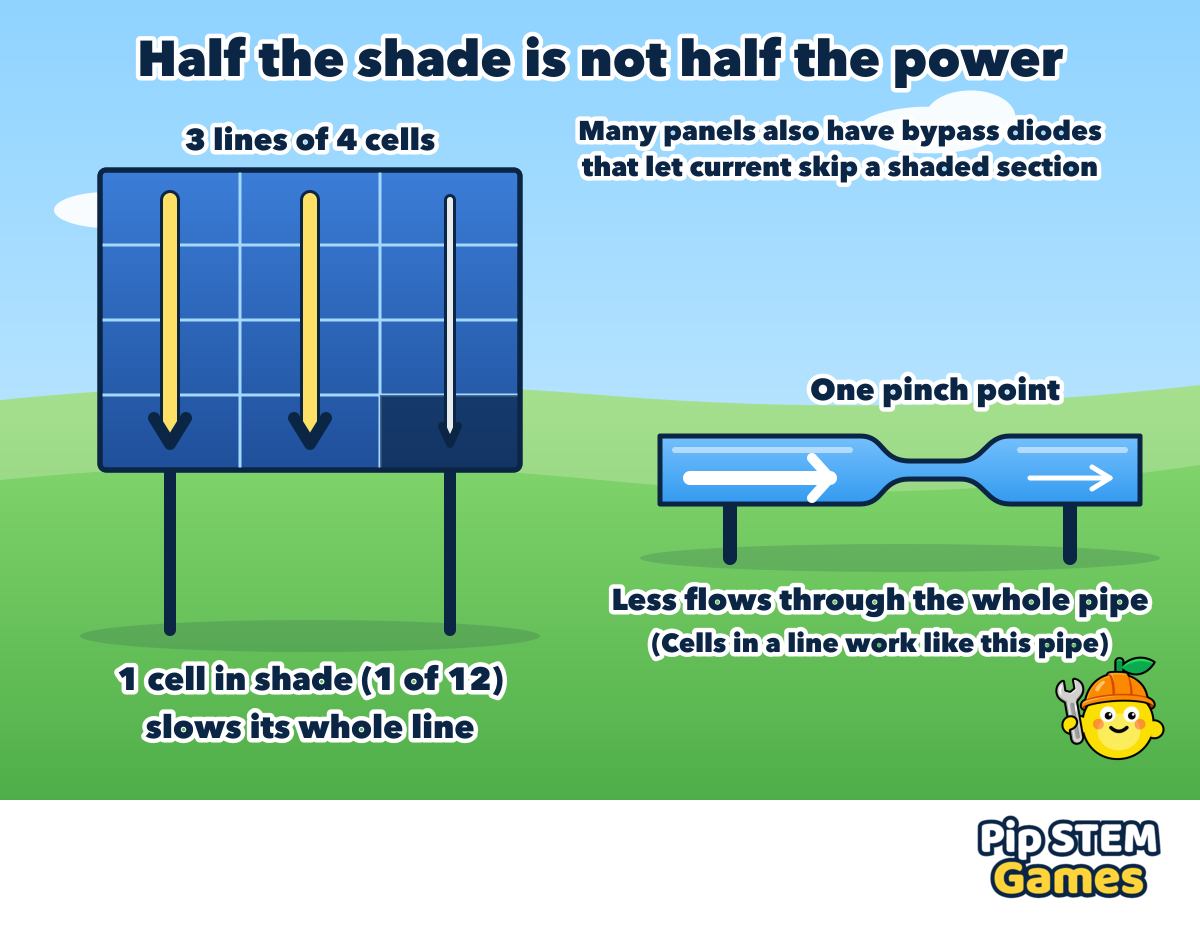
No. Shade can cost more power than the shaded area suggests. Inside a panel, cells are joined in lines, one after another. Think of a line of cells as a water pipe. If one part of the pipe is pinched, less water flows through the whole pipe.
It works the same way in a line of cells. One shaded cell can slow the whole line. Many panels also have bypass diodes. These are small parts that let the electricity skip a shaded section, so the panel loses some power but not all of it.
So we can say Panel A should get the most light. We cannot work out the exact power of Panel B or Panel C from the picture alone. That is a good thing to say out loud to a child. Engineers say "it depends" until they have measured.
Which way should solar panels face in the UK?
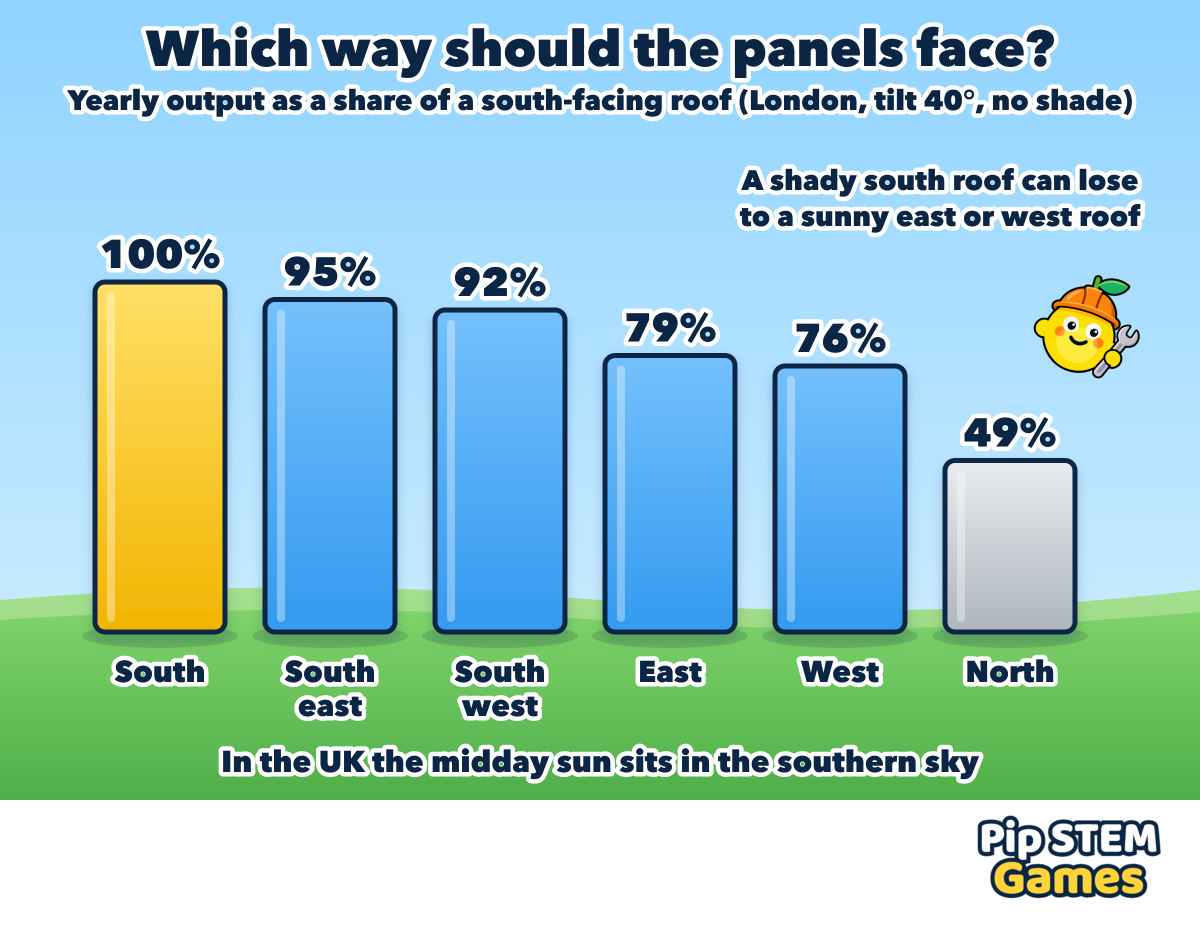
In the UK, panels do best facing south. The UK is in the northern half of the world, so at midday the sun sits in the southern part of the sky. A panel that faces south looks straight at it for the longest time.
The chart shows rough yearly output compared with a south-facing roof. East and west roofs still make plenty, about three quarters as much. A north-facing roof makes about half. The exact numbers change a little with where you live and how steep the roof is, so treat them as a guide.
Here is a twist for the puzzle. A south-facing roof that is shaded by a tall tree can make less than a sunny east or west roof. Direction matters, and so does what stands in the way.
How steep should a solar panel be?
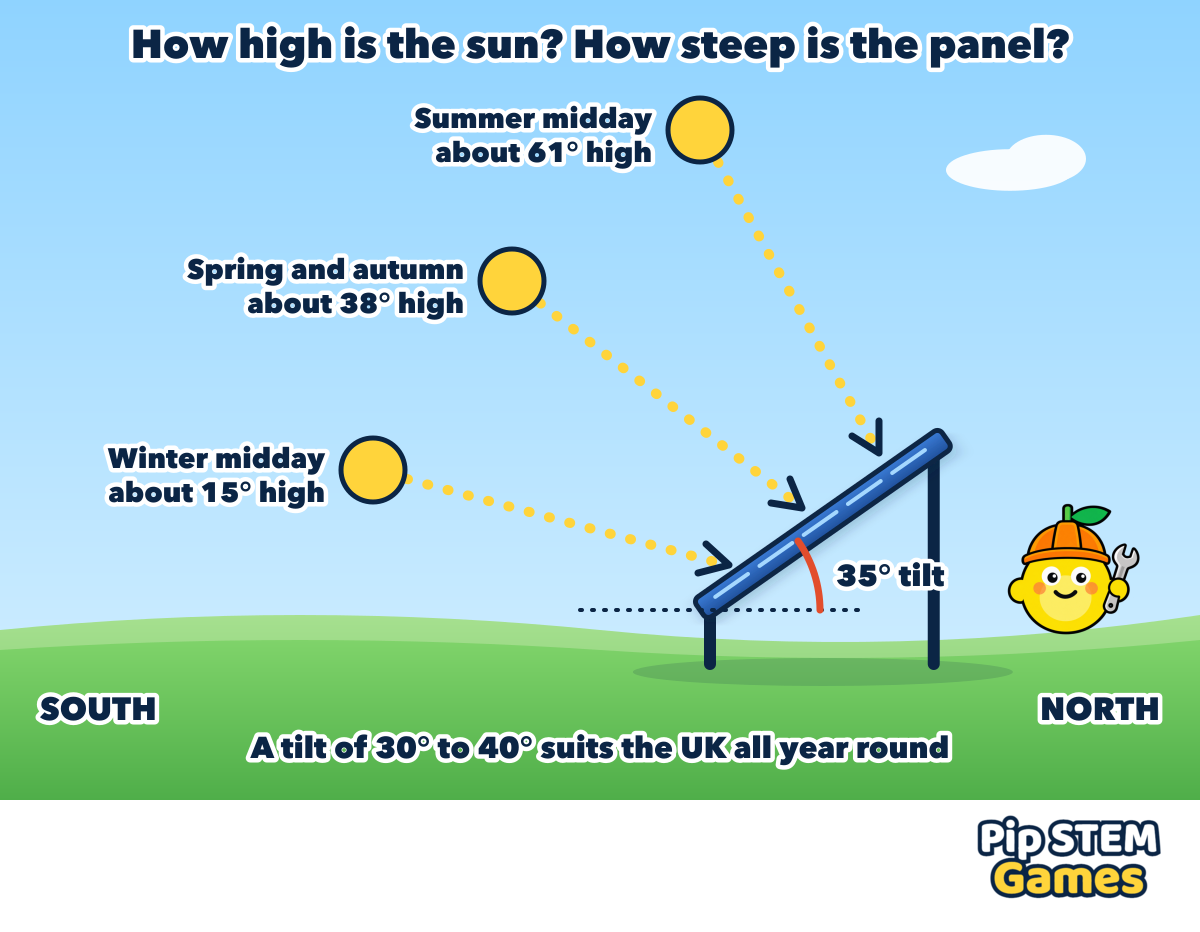
A tilt of about 30 to 40 degrees suits the UK all year. Tilt is the angle between the panel and flat ground. Light is strongest when it hits a panel square-on. Light that arrives at a slant is spread over a bigger area, so each part of the panel gets less.
The sun is not at the same height all year. In central England at midday it is about 61 degrees above the horizon in midsummer, about 38 degrees in spring and autumn, and only about 15 degrees in midwinter. No single tilt is perfect for every day. A middle tilt, around 35 degrees, is a good deal across the whole year.
Try this idea on paper. Draw three panels tipped at different angles and ask which one faces the midday sun best. The next section lets you test it for real.
How can your child test shade at home?
You need a solar calculator, a folded piece of card, a sunny windowsill and some tape. It takes about 10 minutes. A calculator that runs on a battery as well as light may not show the effect, so check the model first.
You need:
- a solar-powered calculator
- a piece of card, folded in half so it stands up
- masking tape
- a sunny window, ideally one that faces south
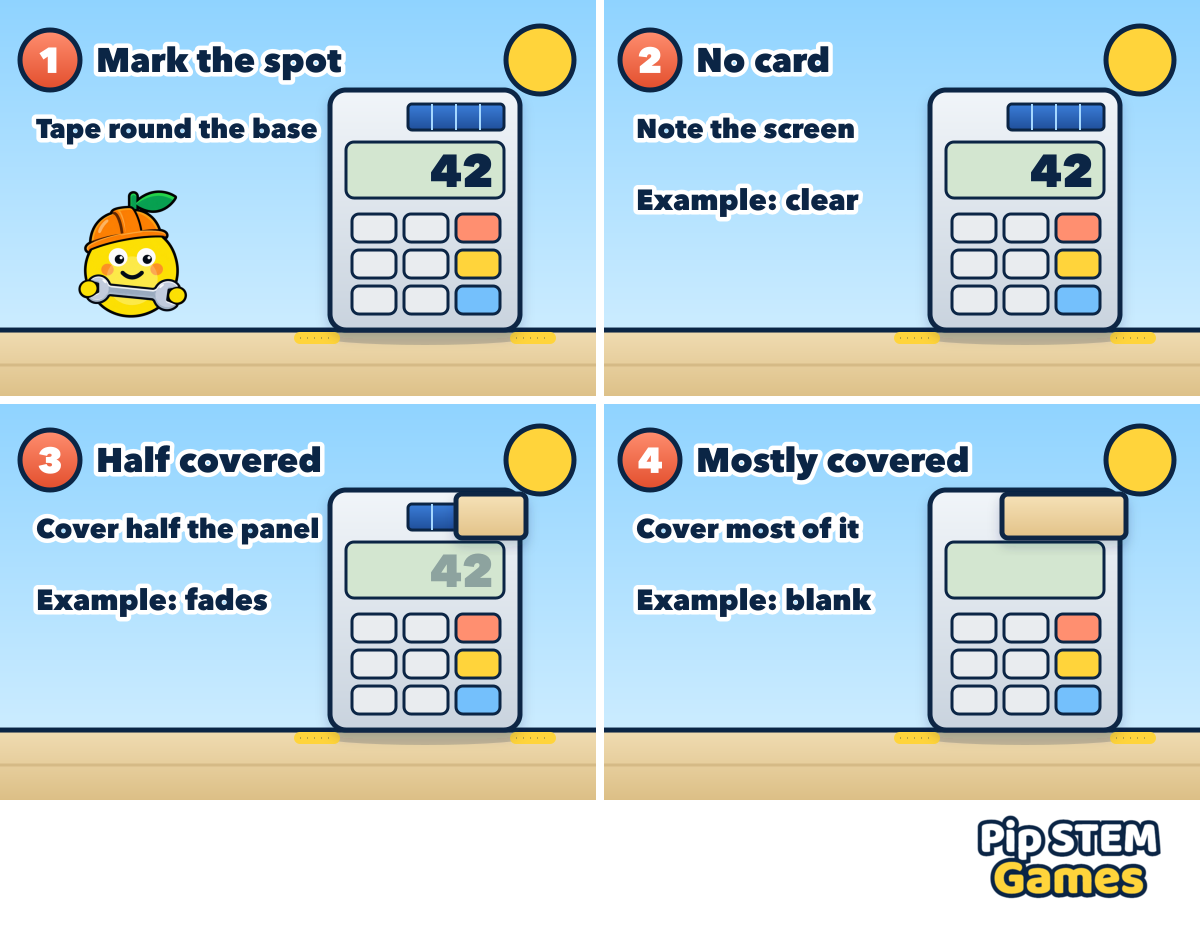
- Put the calculator on the windowsill in the sun. Stick tape round its base so it goes back to the same spot every time.
- Switch it on and look at the screen with nothing covering the panel. Is it clear?
- Slide the card over half of the small solar panel. Watch the screen. Does it stay clear or fade?
- Cover most of the panel. What does the screen do now?
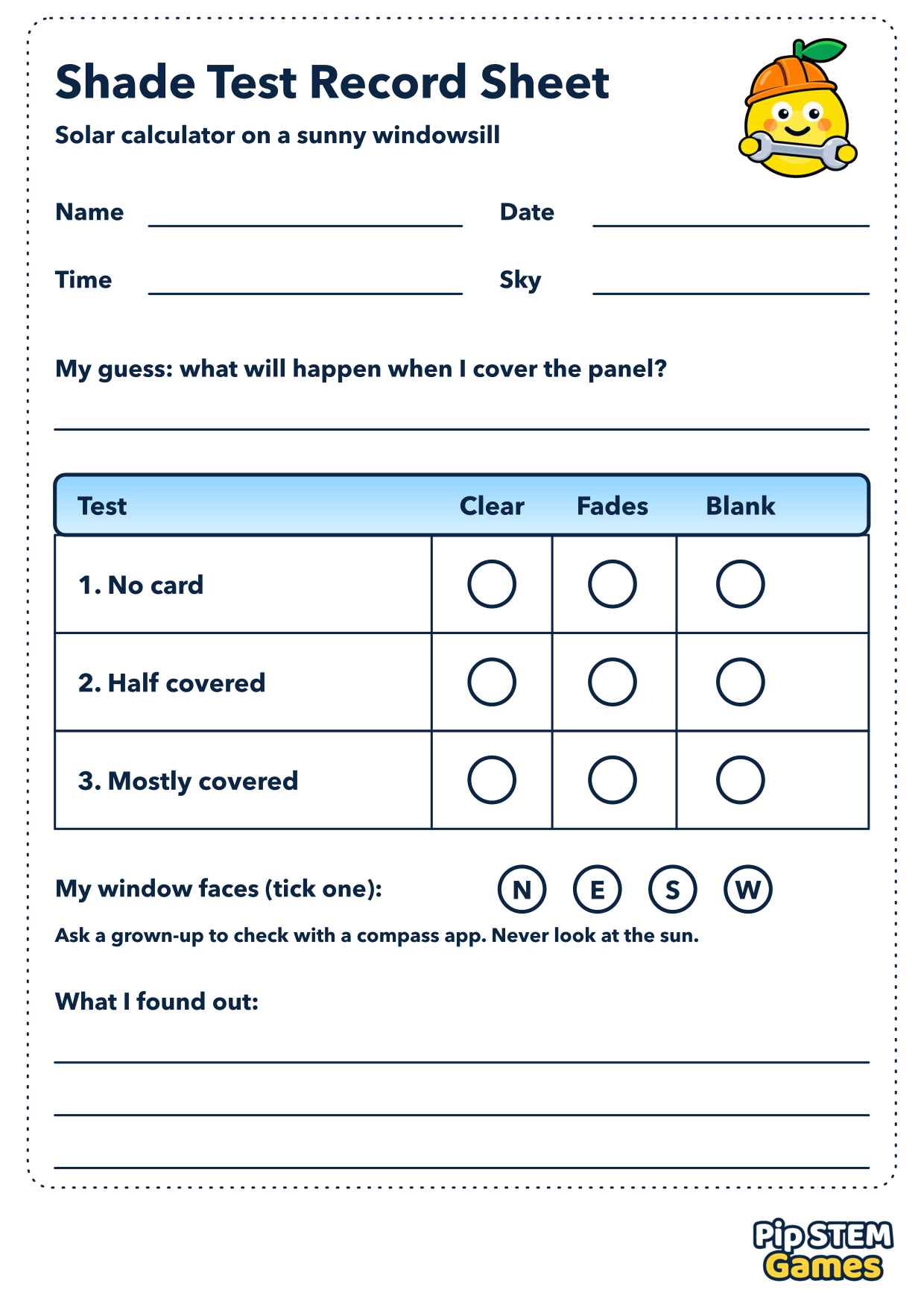
- Write down the three results. Use the printable sheet below.
Keep the calculator in the same place and at the same angle each time. That makes it a fair test, because you change only one thing: the amount of shade.
Stay safe: never look at the sun, even through glass. Keep your eyes on the calculator. Do the test at a low windowsill, never lean out of an open window, and do not climb on anything to reach a sunny spot. If you are in direct sun for a while, wear a hat, drink water and put on sunscreen, and take breaks in the shade.
What if nothing changes on the screen?
The light may be too strong for the shade to matter. A bright sun can still power a calculator when half the panel is covered. Try again on a cloudier day, or move the calculator a little way back from the window so it gets less light.
Check the back of the calculator too. Some have a small battery that keeps the screen on. If yours does, borrow a calculator that runs on light only.
This test shows that shade matters. It does not measure exact power. If the result surprises your child, that is a good thing. Ask what they would change and try again. Our page on the engineering design process shows how to turn a surprise into a better test.
How do you change the puzzle for each age?
- Ages 5 to 6 (easier): do the puzzle in the picture, then do the calculator test with a grown-up. Ask, "Which one is brightest?"
- Ages 7 to 9: fill in the sheet, then talk about why Panel A wins.
- Ages 10 to 12 (harder): change only the tilt, using books to prop the calculator at different angles. Ask which angle gives the clearest screen, and why.
Want more shade and sun puzzles? Our Engineering Workbook for Kids has challenges for ages 8 to 12, and the Junior Engineer's Workbook is made for ages 5 to 7. For another way to make clean power, see how to make a wind turbine spin faster.
Questions parents ask
Which solar panel gets the most light in the puzzle?
Panel A, because nothing shades it. The panels are the same size, tilt and direction, so shade is the only difference.
Does shade on part of a solar panel cut all of its power?
Not all of it, but it can cut more than the shaded area suggests. Cells in a line work like a pipe, so one shaded cell can slow the whole line. Many panels have bypass diodes to reduce the loss.
Which way should solar panels face in the UK?
South is best, because the midday sun sits in the southern sky. East and west roofs still make about three quarters as much over a year, and north makes about half.
What angle should a solar panel be in the UK?
About 30 to 40 degrees from flat. The sun is high in summer and low in winter, so a middle tilt works well all year.
Can solar panels work on a cloudy day?
Yes, but they make less. Daylight still reaches the cells through cloud, just not as much as on a bright day.
Is the shade test safe for children?
Yes, when it is done on a low windowsill with a grown-up near. Remind children never to look at the sun, never to lean out of a window, and to use shade, a hat and sunscreen if they are in the sun for long.
Why do people trim trees near solar panels?
Because shade cuts the light that reaches the cells. A tree that shades part of a roof can lower the power of the whole system.
Great STEM activities to try next...
 Can You Make the Wind Turbine Spin Faster? [Printable]Forces & energy
 How Does Hydroelectric Power Work?Activity
 STEM Activities by Age: 5–7, 8–10 and 11–12Parent guide
More to try: Bernoulli's Principle for Kids and Flying (Printable) · Kinetic vs Potential Energy for Kids (Printable) · 6 Best Paper Airplane Designs [Printable]

Pip STEM Games
We make engineering games and workbooks for kids aged 5 to 12. Every activity here is one we'd happily run at the kitchen table: test it, watch it fail, fix it, try again.




