

Key takeaways
- A fair test changes one thing and keeps everything else the same.
- Four blades do not always beat six, so count and compare instead of guessing.
- Count three tries for each wheel and use the average.
- A real turbine turns spin into electricity with a generator.
- A cheat sheet and printable record sheet help children run the test at home.
To make a wind turbine spin faster, test it. Compare two paper pinwheels with the same size, one with four blades and one with six, and count the turns in 10 seconds. This guide shows the fair test step by step, with a cheat sheet and a printable record sheet, and ends with a tiny generator that can light an LED.
How do you make a wind turbine spin faster?
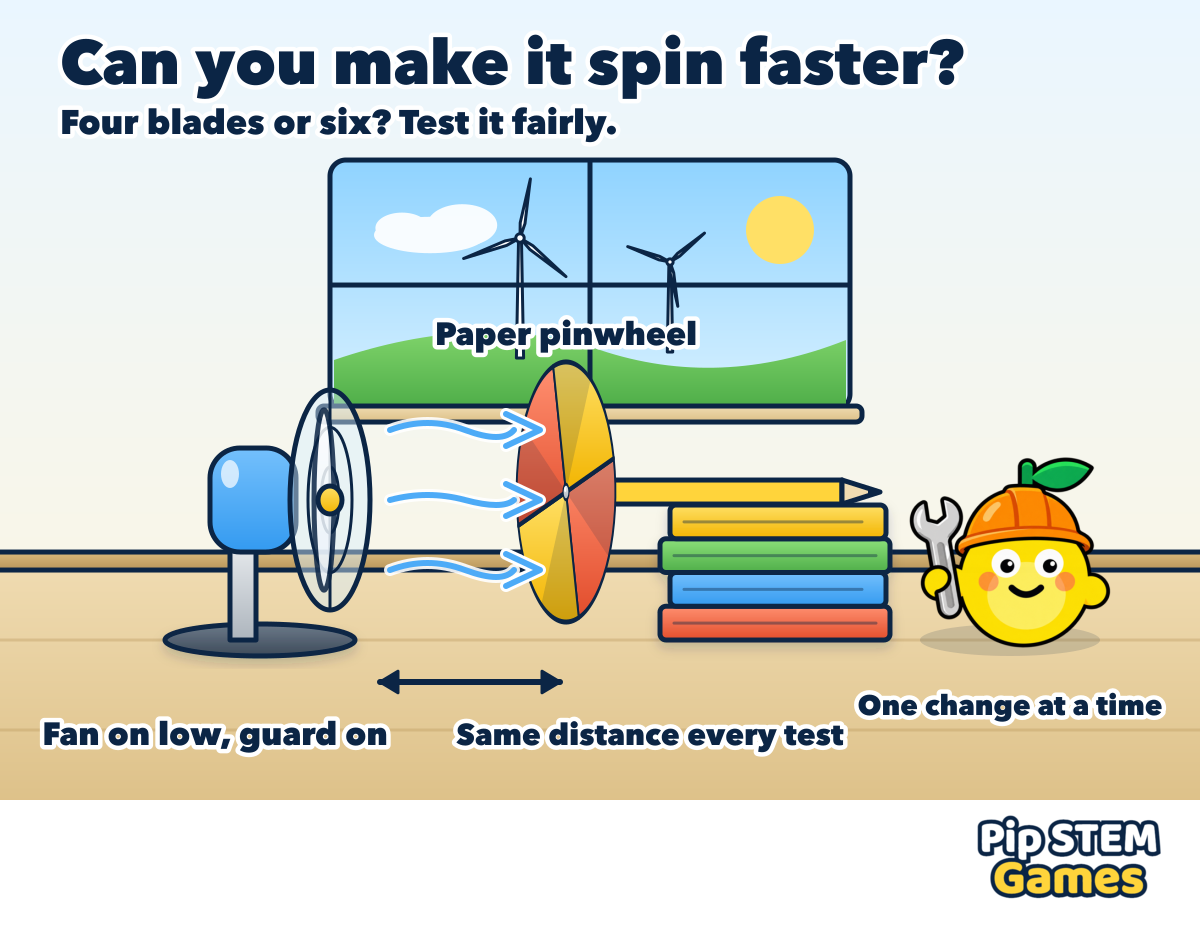
Test it. Make two pinwheels that differ in one way, such as four blades and six blades, and count how fast each one turns. The wheel that wins tells you something real, and it may not be the one you expected.
Engineers do this all the time. Blade shape, blade angle and how freely the wheel turns all change the speed, so nobody can guess the best design. They build, measure and improve.
This activity takes about 30 minutes. It suits ages 5 to 12, with an adult doing the cutting and the pins. It ends with a way to turn your pinwheel into a tiny generator. A pinwheel only spins in moving air. It does not make electricity, but the same test helps you improve a real turbine design.
What do you need for the pinwheel test?
You need:
- two paper circles of the same size, cut from the same paper
- a ruler and pencil
- scissors (for the adult)
- tape
- two pencils with erasers on the end
- two pins (for the adult)
- a timer or phone
- a desk fan with a guard, on its lowest setting
Safety first. An adult cuts the paper and pushes in the pins. Keep the pins away from children under 5, and put them in the eraser so the point is covered when you finish. An adult sets the fan on a steady surface. Keep fingers, hair and paper away from the grille, and switch it off before anyone touches a wheel.
How do you make the two pinwheels?
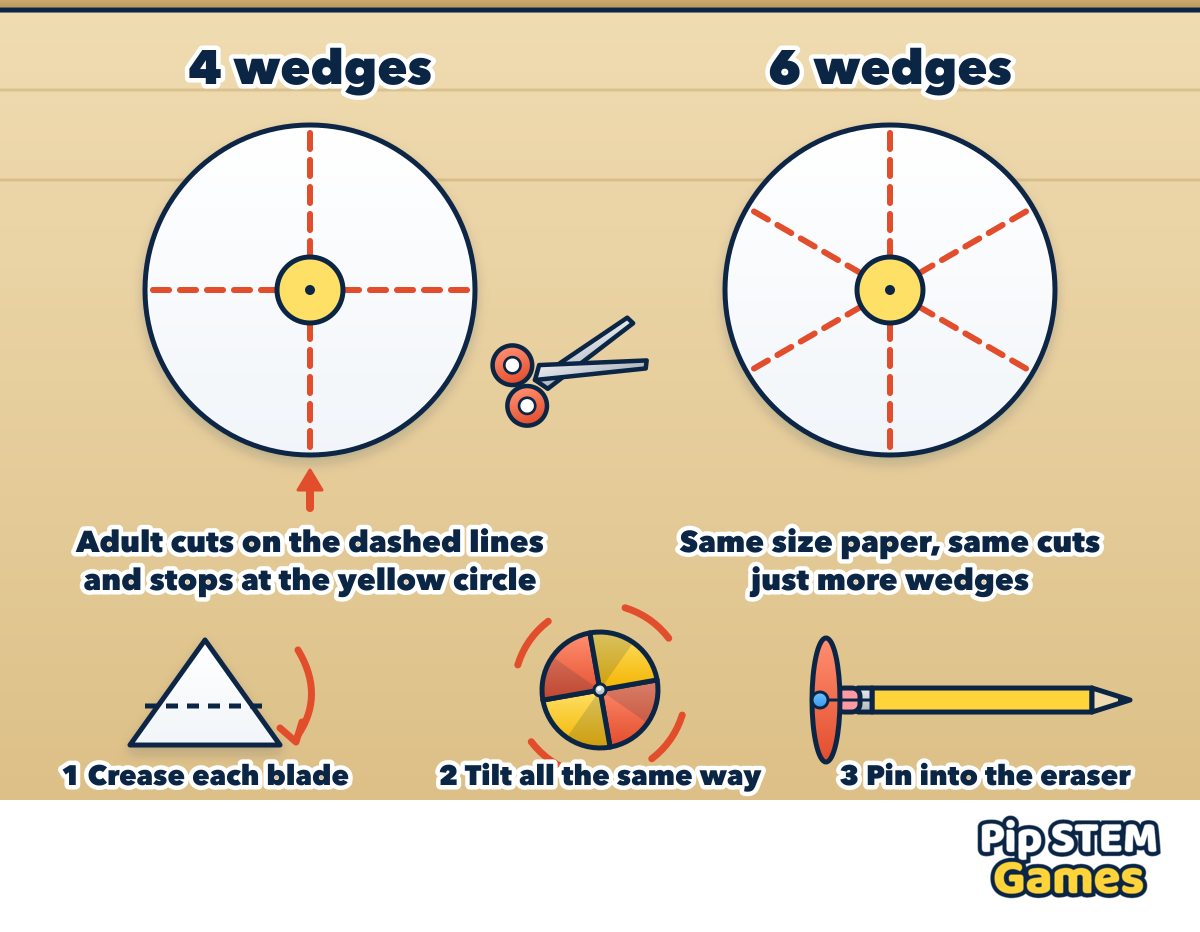
- Mark the centre of each circle. Draw a small circle about 2 cm wide around it.
- Divide the first circle into four equal wedges and the second into six. Draw the lines with the ruler.
- An adult cuts along each line, but stops at the small centre circle. The wheel must stay in one piece.
- Crease the base of each wedge. Tilt every blade the same way, so they all catch the wind in the same direction.
- An adult pushes a pin through the centre into a pencil eraser. Leave a little room so the paper can turn freely.
Try to tilt both wheels by the same amount. If one wheel has steeper blades, you will not know whether the blade count or the tilt made the difference.
How do you test the two wheels fairly?
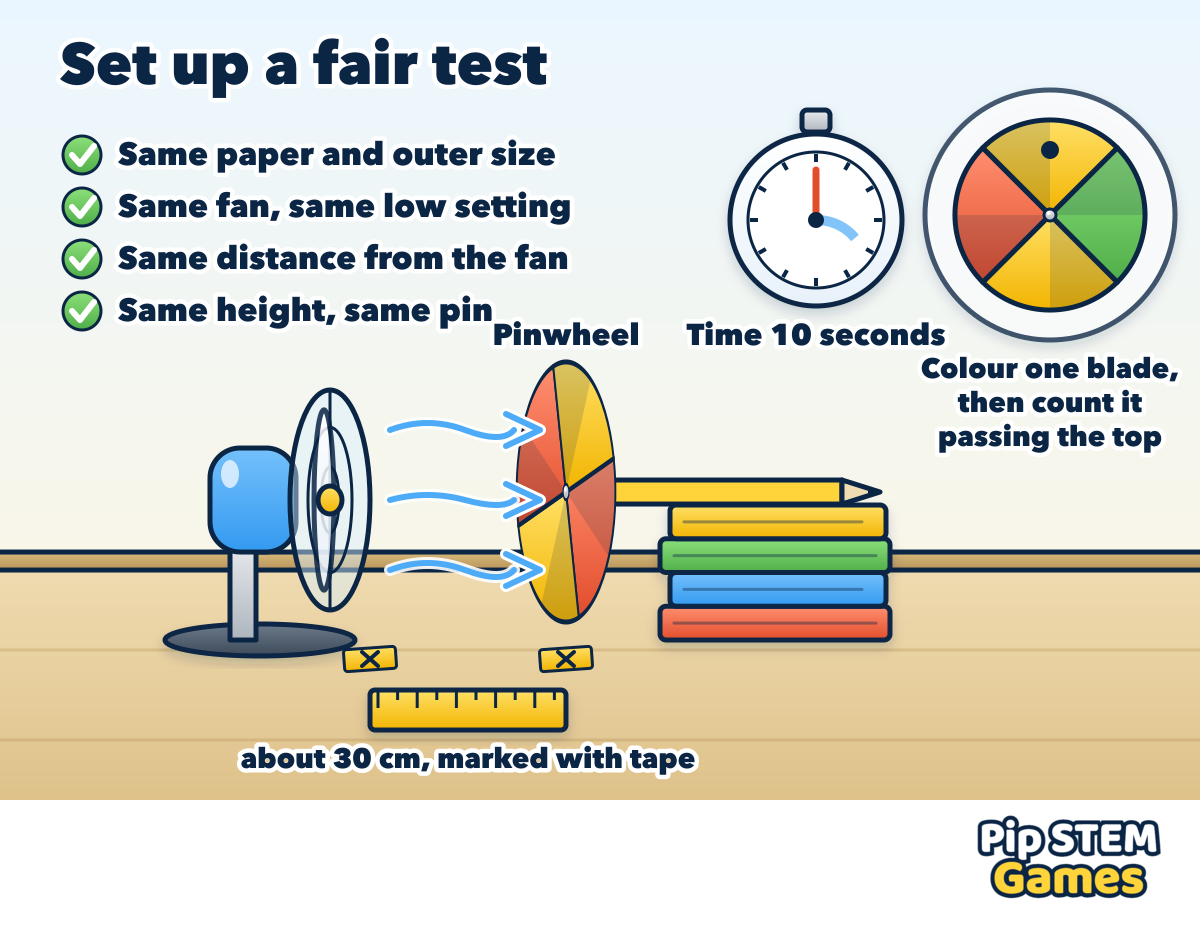
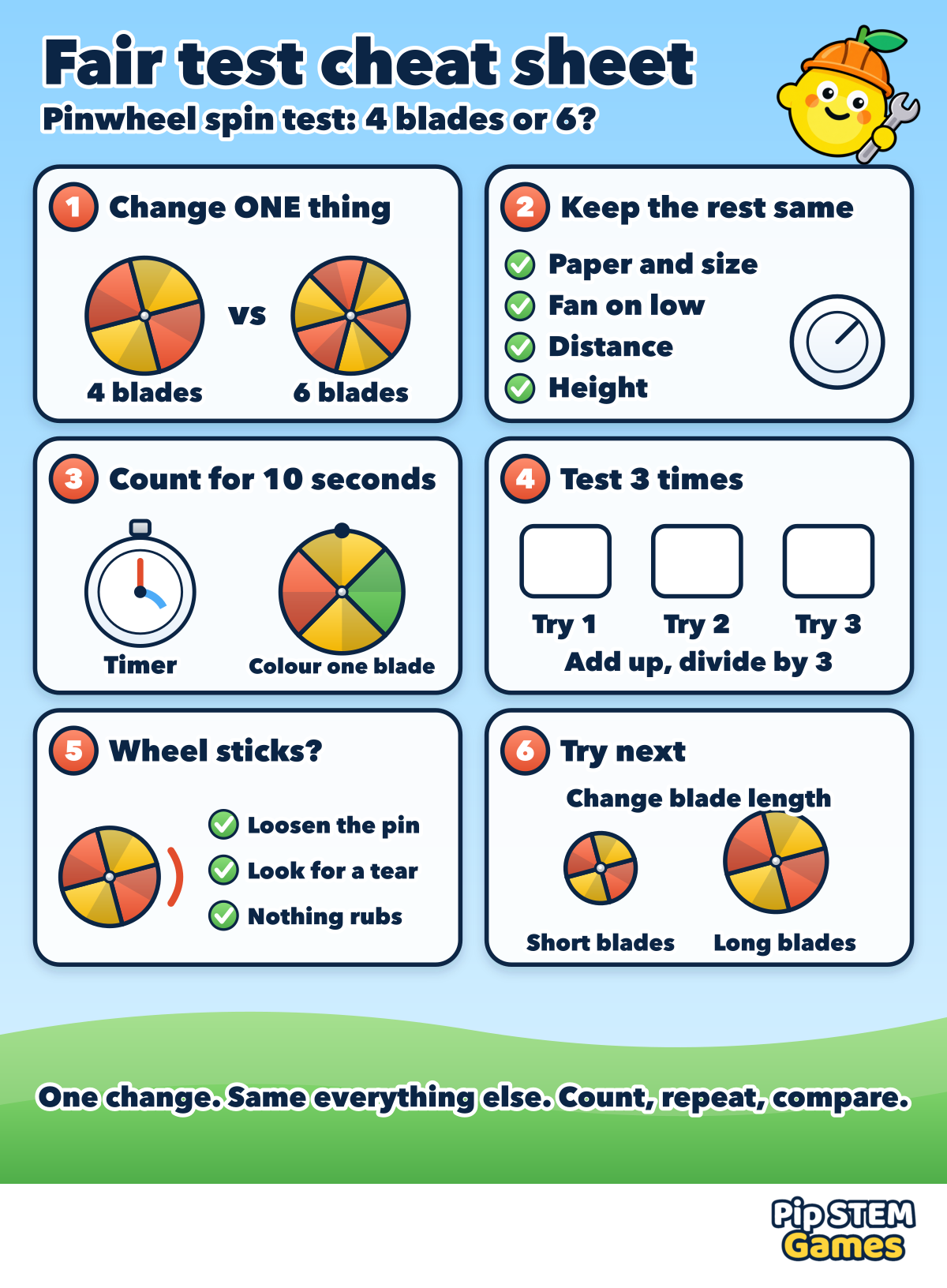
A fair test changes one thing and keeps everything else the same. Here you change only the number of blades.
- Colour one blade on each wheel so you can see it go round.
- Mark a test spot on the table with tape, about 30 cm from the fan. Use the same spot every time.
- Keep the fan on one low setting. Hold the wheel at the same height every time.
- Start the timer. Count how many times the coloured blade passes the top in 10 seconds.
- Do it three times for each wheel. Write down all three counts.
- Add the three counts and divide by 3. That is the average. Compare the two averages.
If the wheel goes too fast to count, move both test spots farther from the fan. Predict first, then test. Was your prediction right? Our engineering design process guide shows how to turn a surprise into a better design.
What if the wheel sticks, and what should you try next?
A tight pin is the usual problem. Ask the adult to loosen it a little. Then check for a torn blade, and check that the paper is not rubbing the pencil. If the three counts are very different, repeat the test at the marked spot with the fan on the same setting.
When you have a result, change something new. Keep four blades and compare short blades with long ones. Predict first, then repeat the three tries. Then ask: did blade length change the result, or did something else change too? If something else changed, the test was not fair.
You can also try a different blade tilt, or card instead of paper. Change only one thing each time.
How does a real wind turbine make electricity?
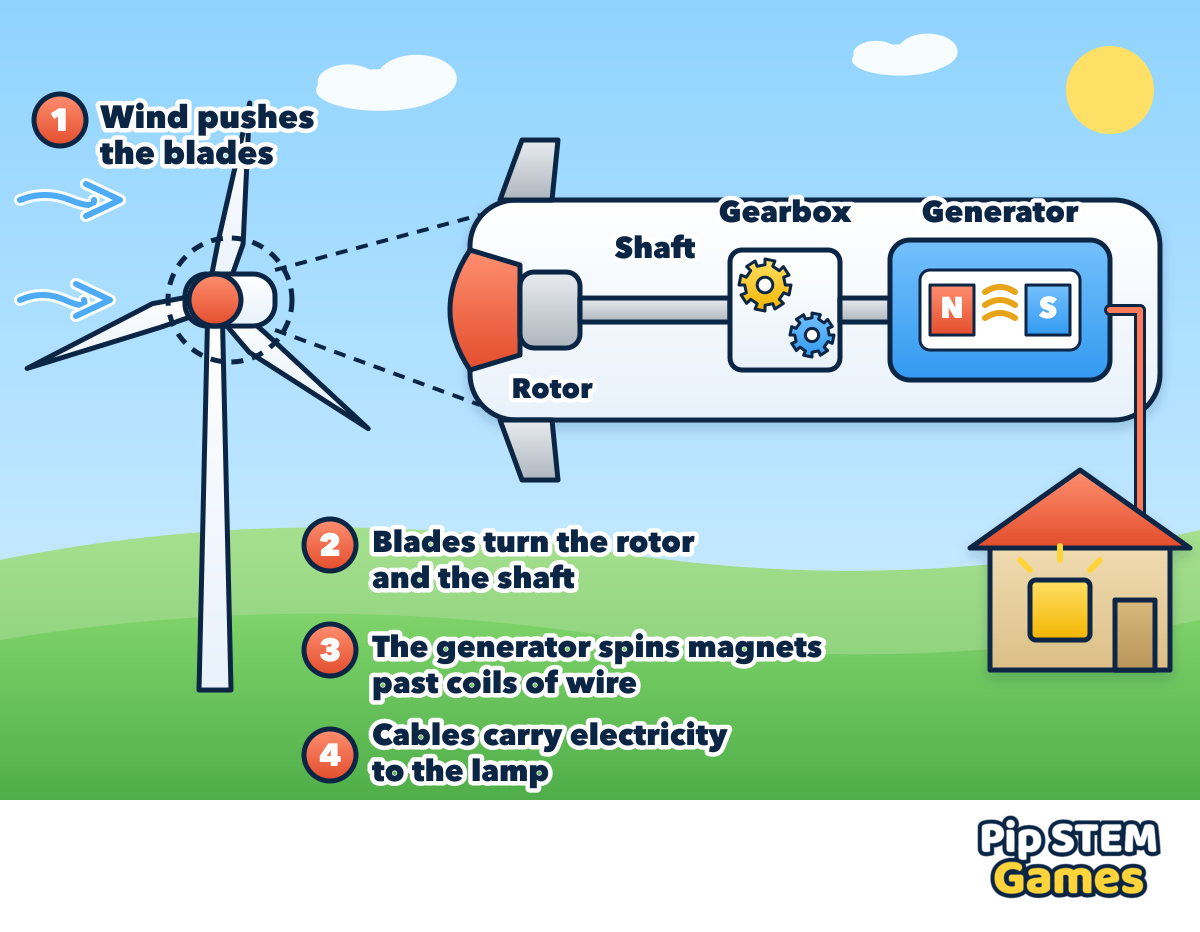
A pinwheel only spins. A real turbine turns that spin into electricity in four steps. Wind pushes on the blades. The blades turn the rotor. The rotor drives a generator, where magnets and coils of wire move past each other and push electric charge along the wire. Cables then carry the electricity away.
Real turbines are huge and far more complex than your pinwheel. The US Department of Energy has a clear overview of how wind turbines work. To place turbines on a windy island and keep the lights on, try the Wind Farm game.
Wind is not steady, so planners also use backup power. Our post about one broken turbine and three problems explores that idea.
Can your pinwheel light a lamp?
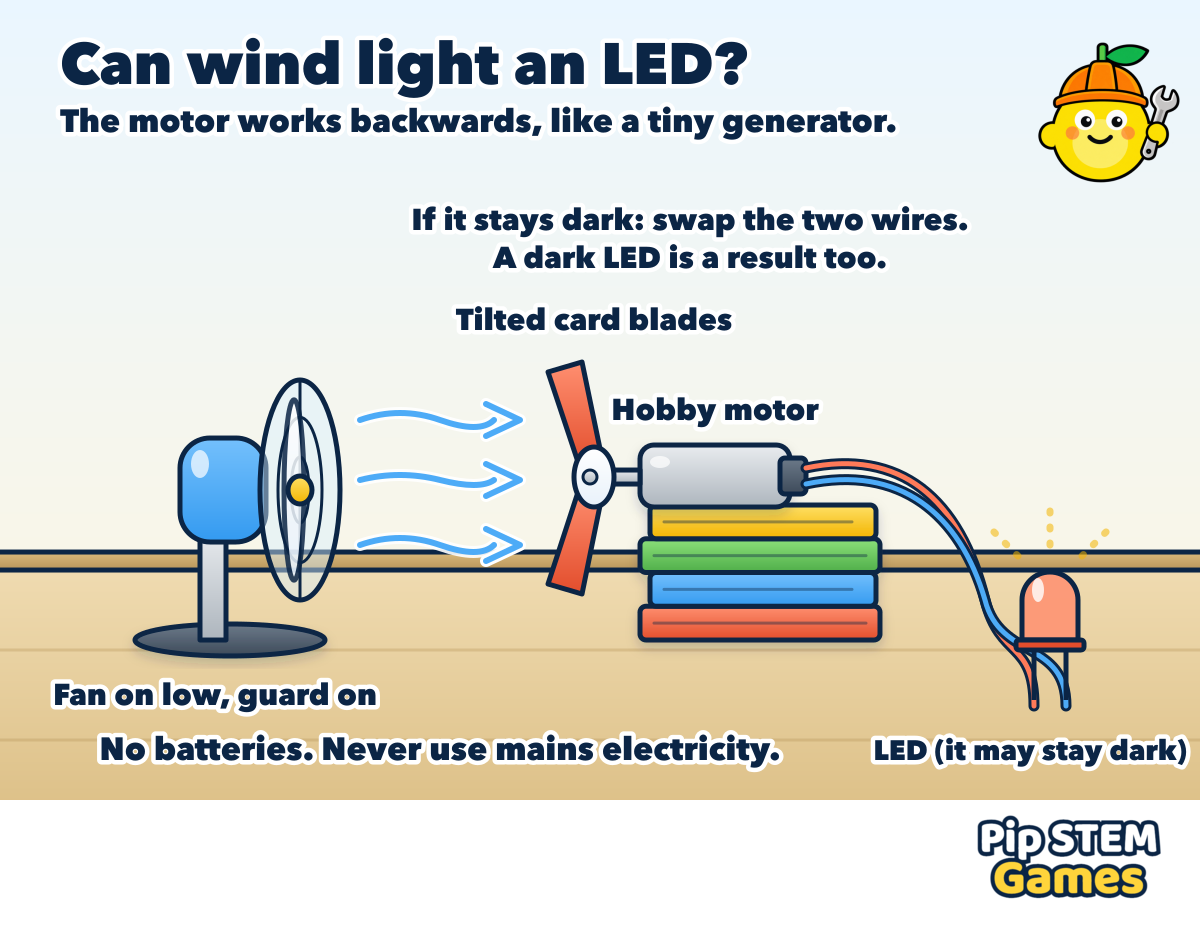
Swap the pin for a small hobby motor and your pinwheel becomes a tiny generator. When the motor shaft spins, the motor makes a little electricity. This works best with a very small LED, and a weak motor may make too little power to light it at all. An adult should lead this part.
You need: a small hobby motor (an adult checks it has no sharp parts), a small LED, a card or plastic lid for the hub, four blades cut from thin card, tape, and the same fan on low.
Safety: the motor and LED are small parts, so keep them away from children under 5. Never connect your model to mains electricity, and no batteries are needed. Keep fingers away from the fan and the moving blades.
- An adult cuts four equal blades from thin card.
- Tape the blades to the hub, each tilted a little like a fan. Fix the hub firmly to the motor shaft. An adult checks it.
- Connect the two motor wires to the two legs of the LED. Keep the contacts tight.
- Hold the model in front of the guarded fan and watch the blades and the LED.
- Say the path out loud: wind, blades, rotor, generator, wires, lamp.
If the LED stays dark, swap the two wires, because an LED only works one way round. Flat blades barely turn, so give them more tilt. A wobbly hub wastes spin, so rebuild it evenly. Then run a fair test with 2 blades, then 4, then 6, and note how bright the LED looks. Our circuits for kids guide explains the wires.
How do you change it for each age?
- Ages 5 to 7 (easier): an adult builds and wires everything. Your child feels the wind, spins the wheel and names the four steps of a real turbine. Count the spins out loud together.
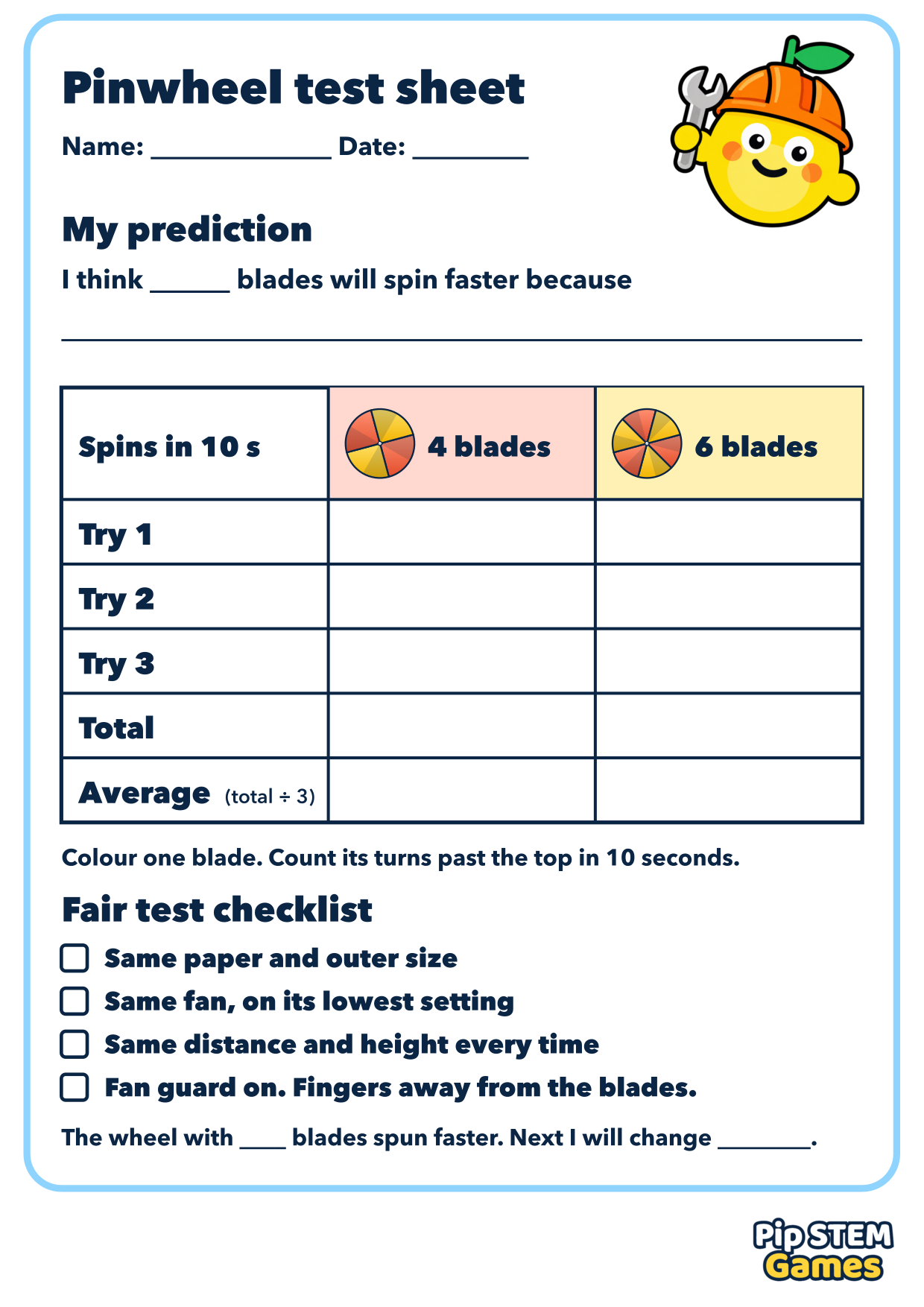
- Ages 8 to 10: use the printable sheet. Predict, record three tries for each wheel, and find the averages.
- Ages 11 to 12 (harder): compare blade length and blade tilt, and explain why a generator needs both movement and magnets.
The aim is not to build the fastest wheel. It is to learn to test one thing at a time. Want more ideas like this? See the Senior Engineers workbook, the Junior Engineers workbook, or our list of STEM activities by age.
Questions parents ask
Do more blades make a turbine spin faster?
Not always. More blades catch more wind but also get in each other's way. The only way to know for your pinwheels is to count the turns, so test four blades against six.
How do you make a pinwheel spin faster?
Check that the pin is not too tight, tilt every blade the same amount, and keep the paper flat and untorn. Then change one thing at a time, such as blade length, and count again.
Why do you test three times?
One count can be a fluke. Three tries show whether the numbers are close. The average of three is a fairer result than any single count.
Is it safe to use a fan for this experiment?
Yes, with care. Use a fan with a guard on its lowest setting, put it on a steady surface, and keep fingers, hair and paper away from the grille. An adult handles the cutting and pins.
Can a paper pinwheel make electricity?
No. A pinwheel only spins. To make electricity you need a generator, such as a small hobby motor. A very small motor may make too little power to light even a tiny LED.
What age is this activity for?
Ages 5 to 12. Younger children watch and count while an adult builds. Older children can record results, work out averages and explain how a generator works.
Great STEM activities to try next...
 One Broken Turbine. Three Problems Across the Island. [Printable]Build challenge
 Circuits for Kids: How a Simple Circuit Works and How to Build One [Printable]Circuits
 STEM Activities by Age: 5–7, 8–10 and 11–12Parent guide
More to try:

Pip STEM Games
We make engineering games and workbooks for kids aged 5 to 12. Every activity here is one we'd happily run at the kitchen table: test it, watch it fail, fix it, try again.




