

Key takeaways
- A circuit is a complete loop. Electricity only flows when the loop has no gaps.
- The battery pushes the electricity, wires carry it and the bulb uses it.
- A switch works by closing or opening a gap in the loop.
- Metals conduct electricity. Plastic, wood and rubber don't.
- Use AA or AAA batteries in a holder, keep button batteries away from young children, and never touch mains sockets.
A circuit is a complete loop that electricity can travel around. A simple one has a battery, wires and a bulb, and the bulb lights only when the loop is joined up with no gaps. This guide covers the components of a circuit, what a switch in a circuit does and what a battery in a circuit is for. It also has a build for the kitchen table that suits ages 5 to 12 with an adult nearby. There's a printable circuit detective sheet too.
What is a circuit, and why does it need to be a loop?
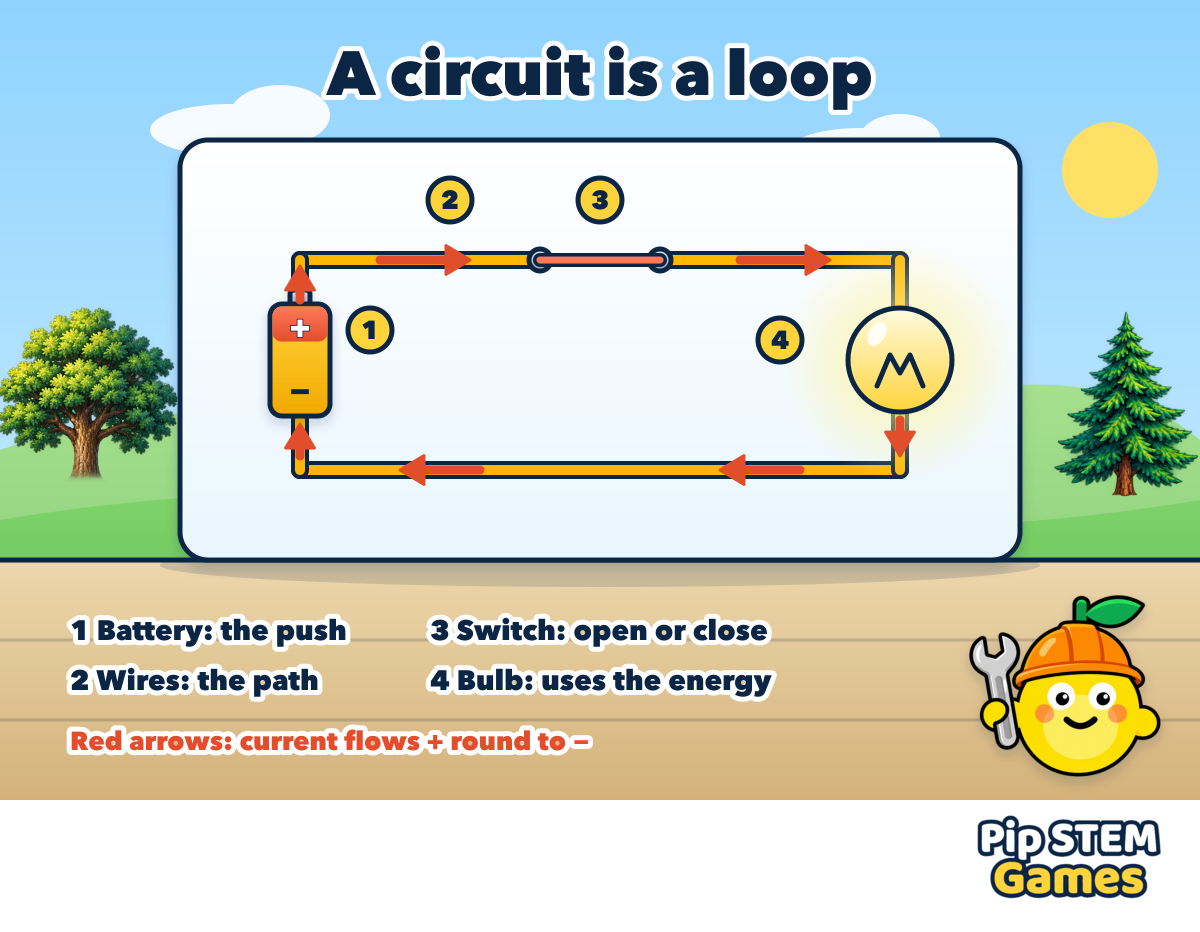
A circuit is a path that electricity can flow around from one end of a battery back to the other. If the path breaks anywhere, the flow stops and nothing works.
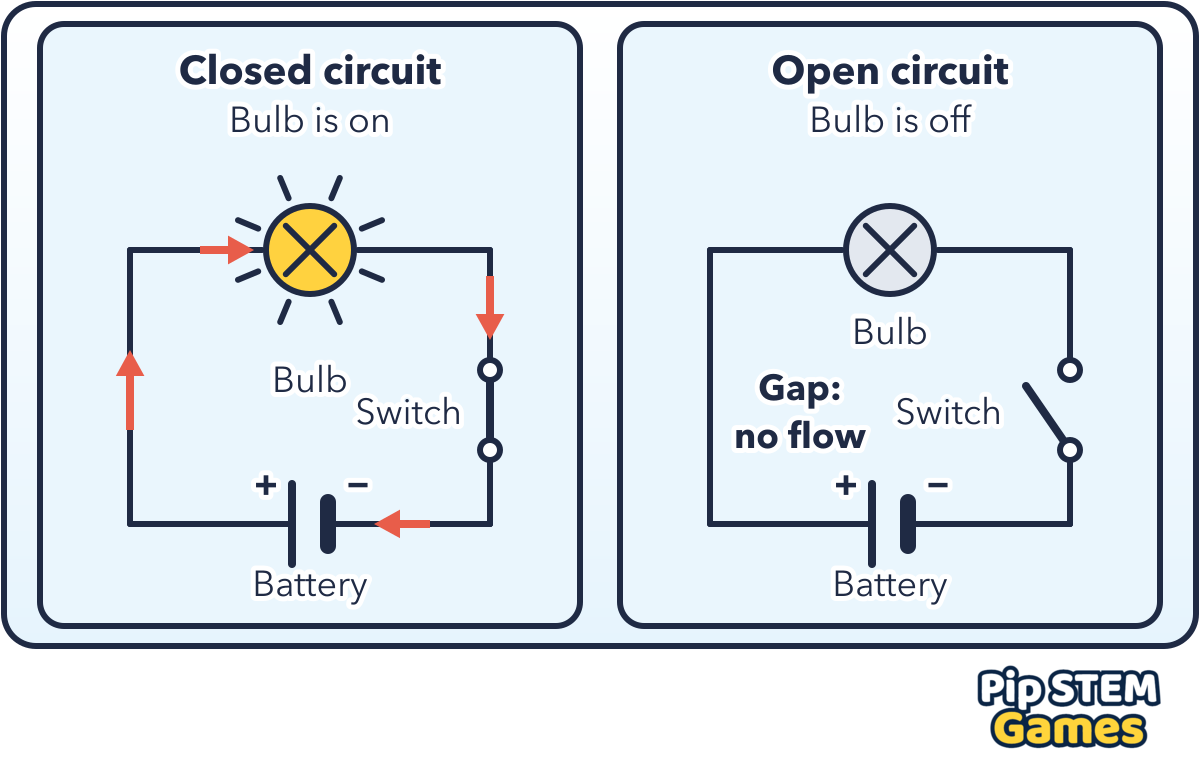
Think of a toy train track that must join up. Take out one piece and the train stops, however good the engine is. A closed circuit is joined up all the way round, so the bulb is on. An open circuit has a gap, so the bulb is off.
The battery gives the electricity a push. Each wire is the track. The bulb is a stop on the route where some of that energy turns into light and heat.
This is why a torch goes dark the moment you slide the switch off. The switch hasn't "turned off the light". It has made a gap in the track.
What are the components of a circuit?
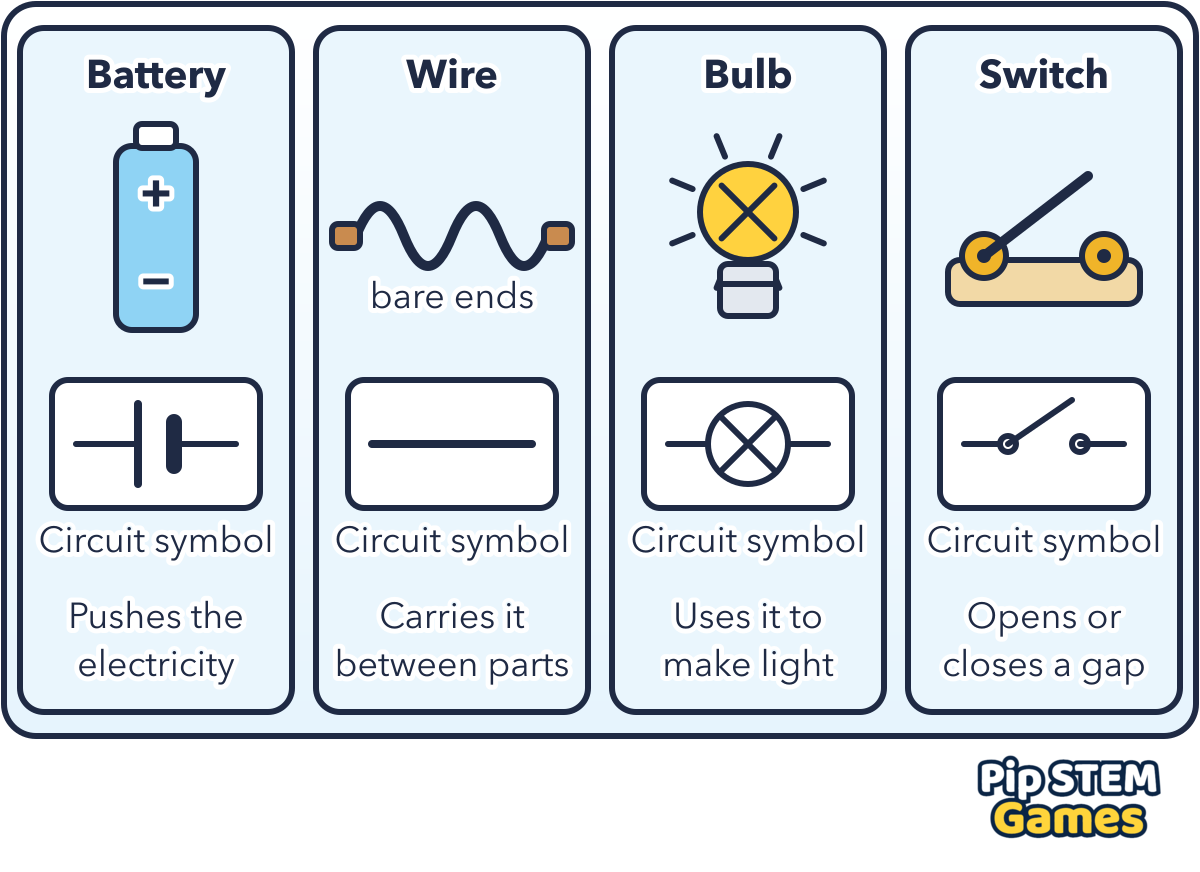
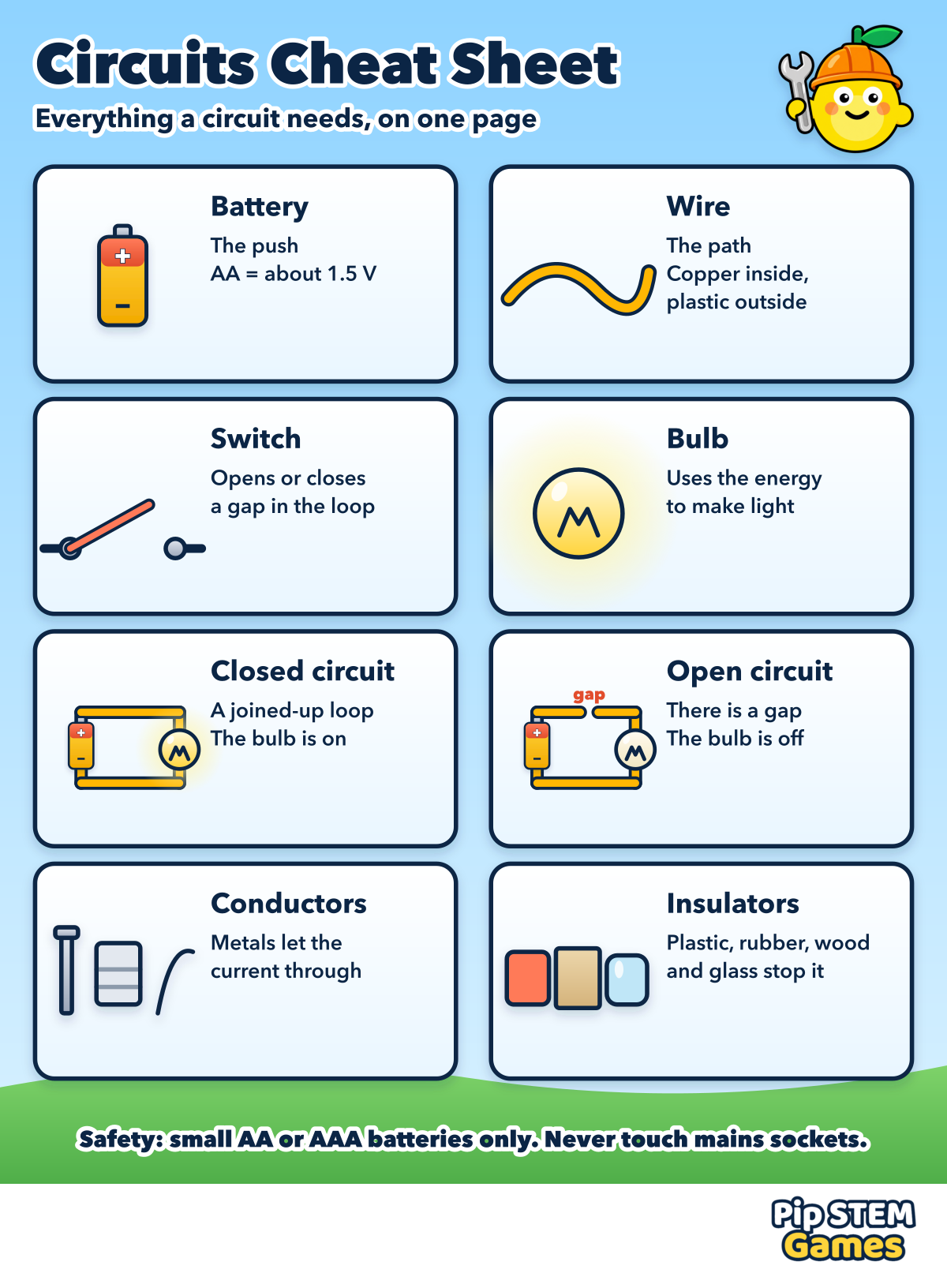
The main parts of a simple circuit are a power source, wires, something that uses the power and a switch.
| Part | Job | Everyday example |
|---|---|---|
| Battery (cell) | Pushes electricity round the loop | AA battery in a remote |
| Wire | Carries electricity between parts | Copper wire inside a charging cable |
| Bulb, buzzer or motor | Uses the electricity to do something | Doorbell, fan, lamp |
| Switch | Opens or closes a gap | Light switch, torch button |
Real kit has a plastic coating on the wire. That coating is an insulator, so the electricity stays in the copper and doesn't leak into your fingers. The bare metal ends are where connections happen.
Kids aged 5 to 7 only need these four names. Kids aged 8 to 12 can draw each part with its circuit symbol and label the loop.
What does a battery do in a circuit?
A battery stores chemical energy and uses it to push electricity round the circuit. It has two ends, a positive (+) and a negative (-), and the loop has to connect both.
The strength of the push is measured in volts. One AA battery gives about 1.5 volts, and two joined end to end give about 3 volts. More volts means a stronger push, so a bulb shines brighter, up to the limit the bulb can take. A bulb fed more volts than it's made for can burn out, so match the bulb to the battery pack.
A battery doesn't make electricity out of nothing. It runs down as it works, and the bulb gets dimmer. A dim bulb is often just a tired battery, which is a good first thing to check when a circuit seems weak.
Safety: use only AA or AAA batteries in a holder. Keep button and coin batteries away from young children, because swallowing one is an emergency. Never join the two battery ends with a bare wire, a coin or a paper clip alone. That's a short circuit and the wire heats up fast.
What does a switch do in a circuit?
A switch lets you open or close the loop on purpose. Closed, the electricity flows. Open, it stops.
You can make one quickly, and it's the best way to turn the idea into something a child can see.
You need:
- a 2 x AA battery holder with two AA batteries
- a small 3 volt torch bulb in a bulb holder (or a buzzer rated for 3 volts)
- three wires with bare ends, or crocodile clip leads
- a paper clip, two metal paper fasteners (brads) and a piece of card
Build it:
- An adult pushes the two brads through the card about 3 cm apart and bends the legs flat underneath.
- Hook the paper clip round one brad so it can swing to touch the other.
- Connect battery to bulb holder with a wire.
- Connect bulb holder to one brad. Connect the other brad to the battery.
- Swing the paper clip across. The bulb lights. Swing it away and it goes out.
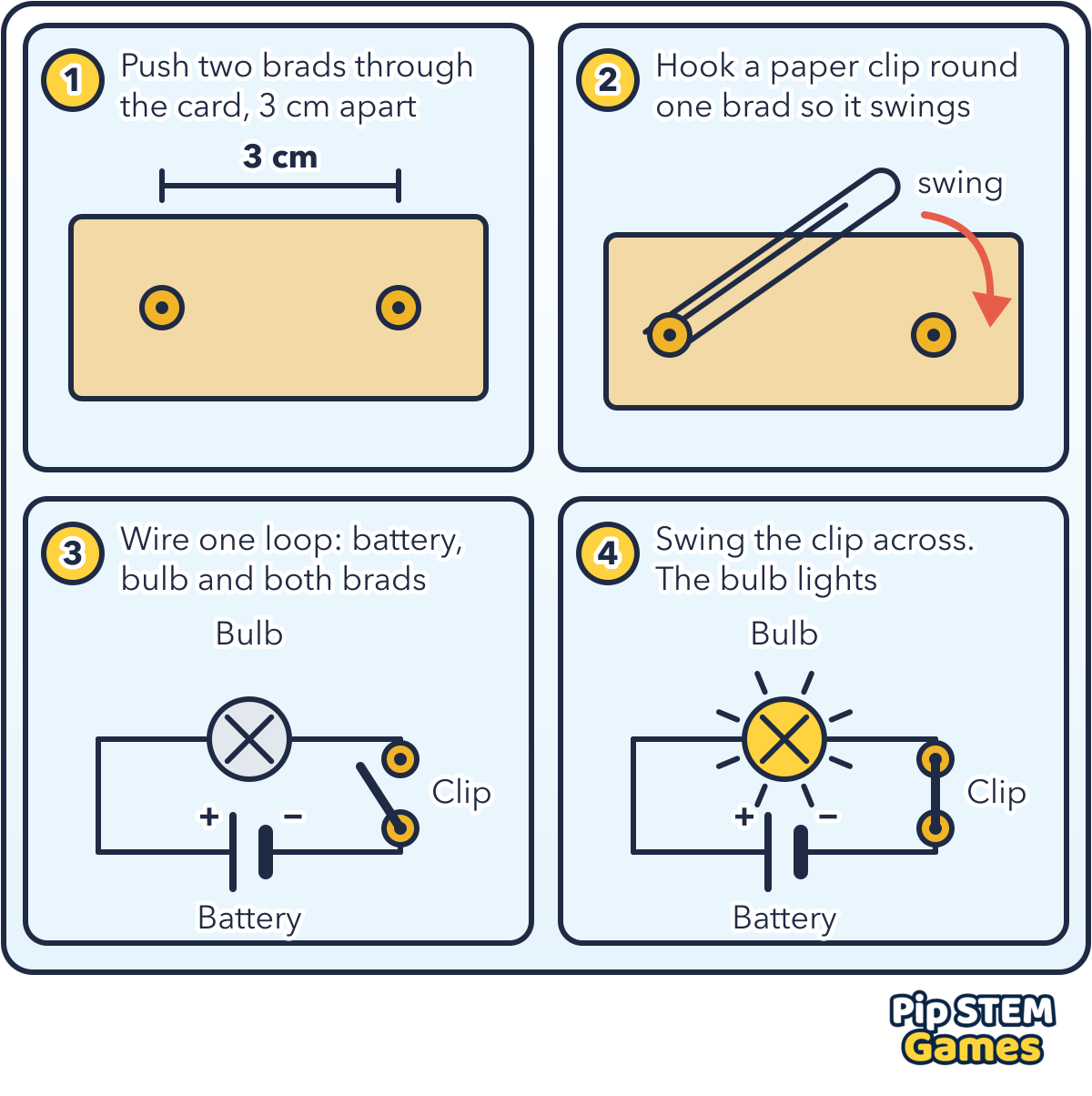
The paper clip is the "bridge". It closes the gap when it touches both brads. Our broken circuit puzzle is a nice follow-up for spotting where a gap hides.
What if the bulb won't light?
If the bulb stays dark, there's almost always a gap somewhere. Check these in order.
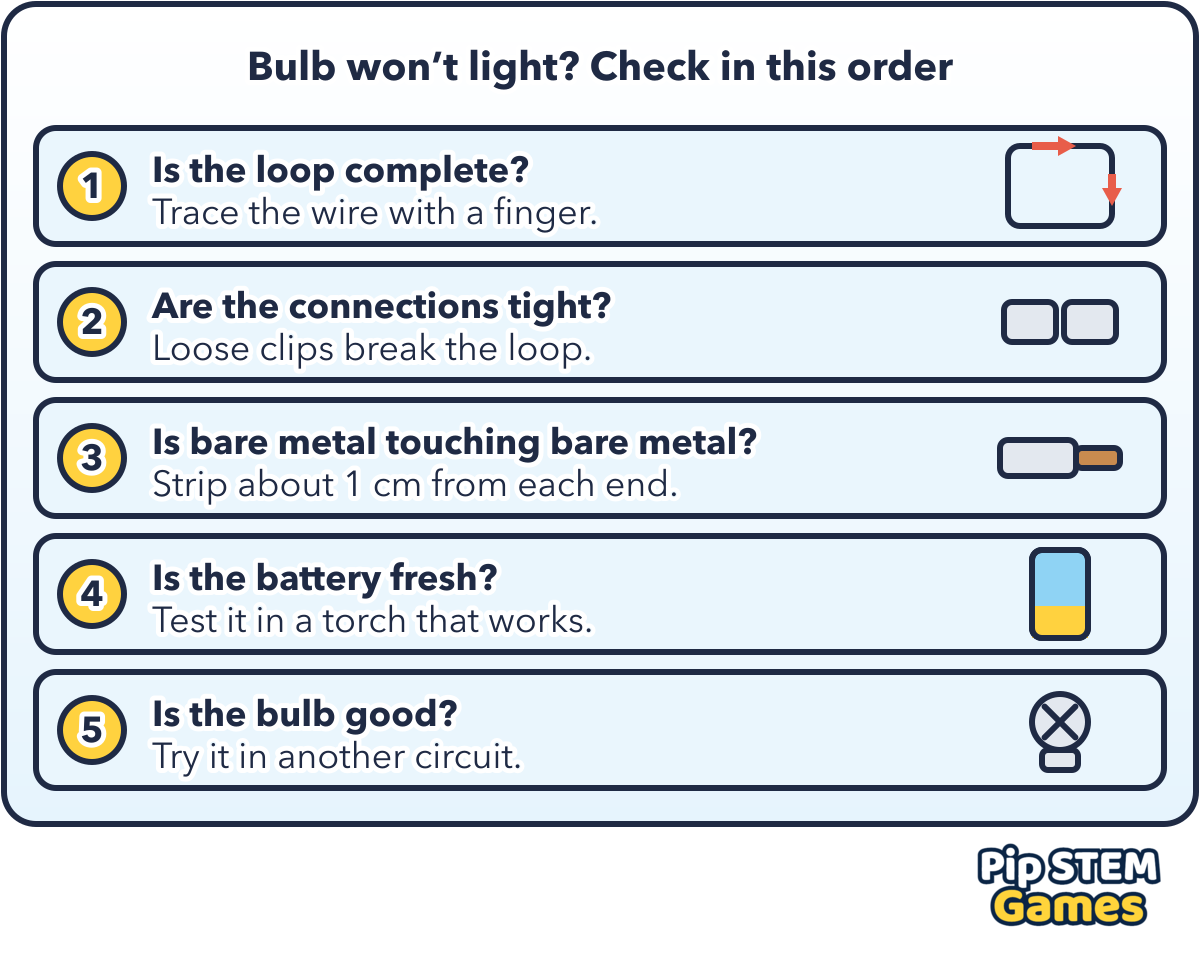
- Is the loop complete? Follow the wire with a finger from the battery, through every part and back.
- Are the connections tight? A loose crocodile clip or a bulb not fully screwed in breaks the loop.
- Is bare metal touching bare metal? Wire coating stops the flow. Strip about 1 cm from each end.
- Is the battery fresh? Test it in a torch you know works.
- Is the bulb good? Try it in another circuit.
Frankly, this troubleshooting is the real skill. Real electricians do the same: test one part at a time. Let your child lead and keep your hands in your pockets for a minute.
You can practise the same hunt in the Circuit Connect game, where pieces have to join up to light the lamp.
Which materials conduct electricity?
Metals conduct electricity and most other household materials don't. Conductors let electricity pass. Insulators block it.
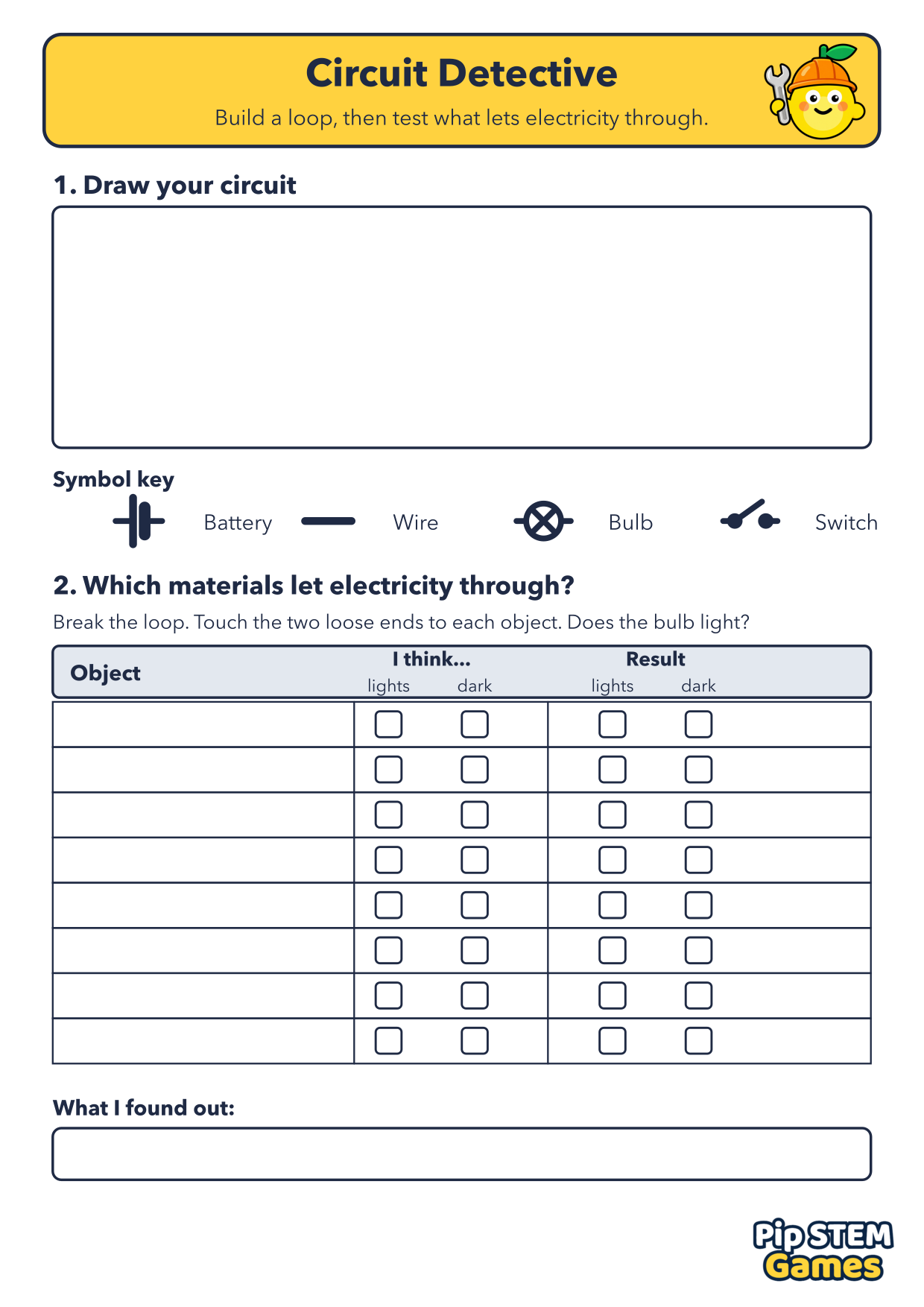
Break the circuit and put a gap in it. Touch the two loose ends to an object and see if the bulb lights. Predict first.
- Likely to light the bulb: paper clip, coin, aluminium foil, a steel spoon.
- Likely to stay dark: wooden spoon, rubber band, plastic comb, paper, glass.
Pencil lead (graphite) conducts a little, which surprises people. Never use anything plugged into the wall for this. Mains electricity can kill, and wall sockets are for adults only.
Kids aged 5 to 7 can sort objects into "yes" and "no" piles. Kids aged 8 to 12 can ask why wire is metal inside and plastic outside, then design a better switch. The Engineering Workbook for Kids has circuit puzzles at this level, and the Junior Engineers workbook starts with simpler loops.
What next? Add a second bulb in the same loop and watch both get dimmer. Then try bulbs on separate branches. That's your first look at series and parallel. If your child likes following a signal through a system, the conveyor belt logic puzzle uses the same kind of step-by-step thinking.
Questions parents ask
What is a circuit in simple words?
A circuit is a complete loop that electricity can flow around. If the loop has a gap, the electricity stops and the bulb goes out.
What are the 4 parts of a simple circuit?
A power source such as a battery, wires, something that uses the power such as a bulb or buzzer, and a switch to open and close the loop.
What is an open circuit and a closed circuit?
A closed circuit has no gaps, so electricity flows and the bulb lights. An open circuit has a break, so nothing flows.
Why does a switch turn a light off?
A switch moves a piece of metal so it no longer joins the two ends of the loop. The gap stops the electricity.
What age can kids build a circuit?
Children from about 5 can build one with an adult beside them and a safe battery holder. Ages 8 to 12 can draw circuit diagrams and troubleshoot faults.
Is it safe for kids to make circuits?
Yes, with AA or AAA batteries and a few small parts. Keep button batteries from young children, never connect a battery with a single wire, and never use mains sockets.
What is the difference between a series and a parallel circuit?
In a series circuit the parts sit in one single loop. In a parallel circuit the current has more than one path, so each branch can work on its own.
Great STEM activities to try next...
 Can Your Child Fix This Broken Circuit?Activity
 The Factory Conveyor Belt Logic PuzzleActivity
 The 10-Spaghetti Tower ChallengeActivity
More to try:

Pip STEM Games
We make engineering games and workbooks for kids aged 5 to 12. Every activity here is one we'd happily run at the kitchen table: test it, watch it fail, fix it, try again.




