

Key takeaways
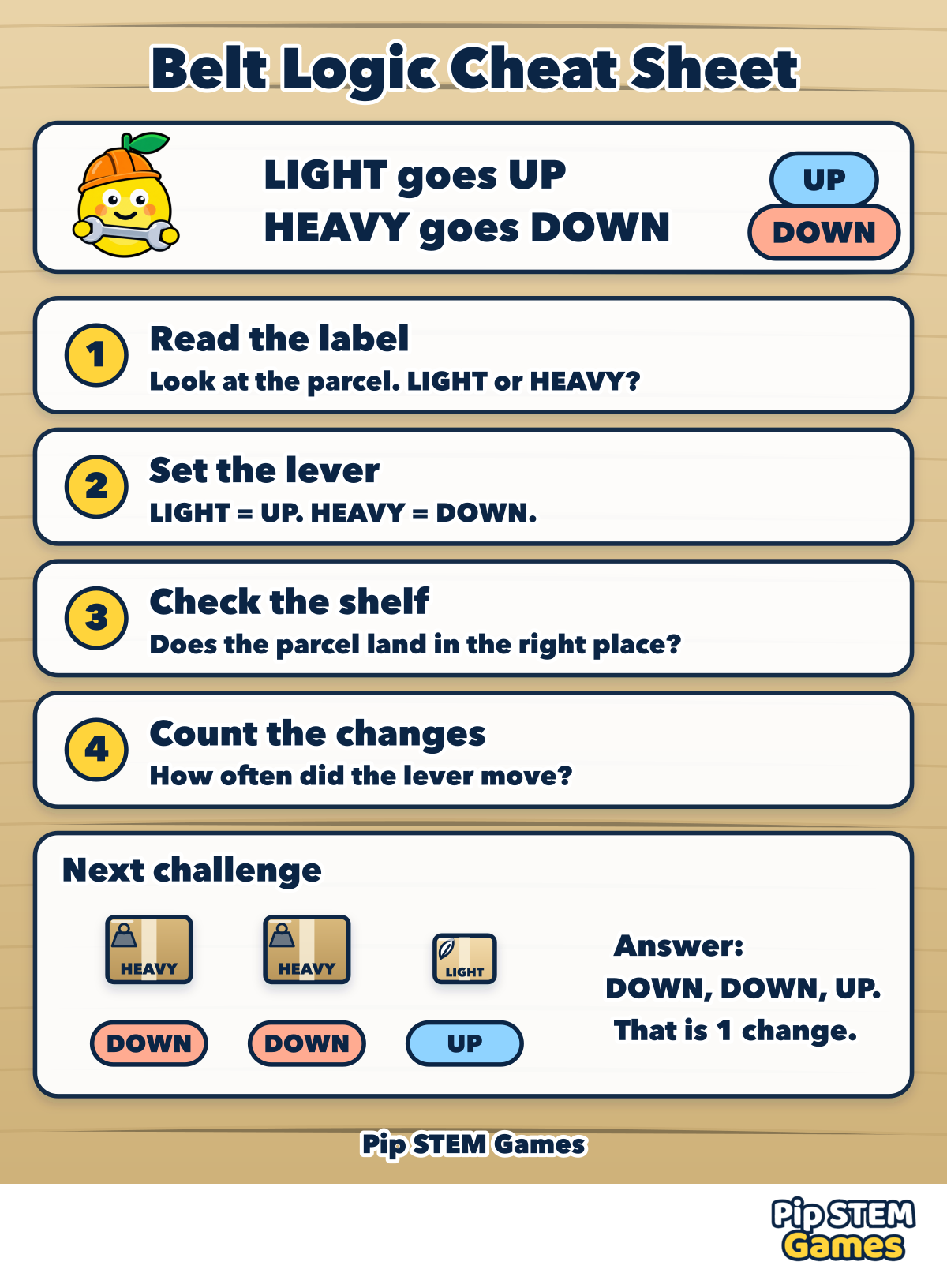
- LIGHT parcels go UP and HEAVY parcels go DOWN, so each label sets the lever.
- The lever can only point one way at a time, so the order of parcels matters.
- HEAVY, HEAVY, LIGHT needs DOWN, DOWN, UP, which is one change after the first setting.
- Of the eight orders of three parcels, two need no changes, four need one and two need two.
- Real factories do the same job with a scanner or scale, a computer and a pusher.
The factory conveyor belt logic puzzle asks a simple question: which way should the lever point for each parcel? LIGHT goes UP and HEAVY goes DOWN. Your child can solve it on paper, act it out with a cardboard ramp, then count how often the lever has to move.
How does the factory conveyor belt logic puzzle work?
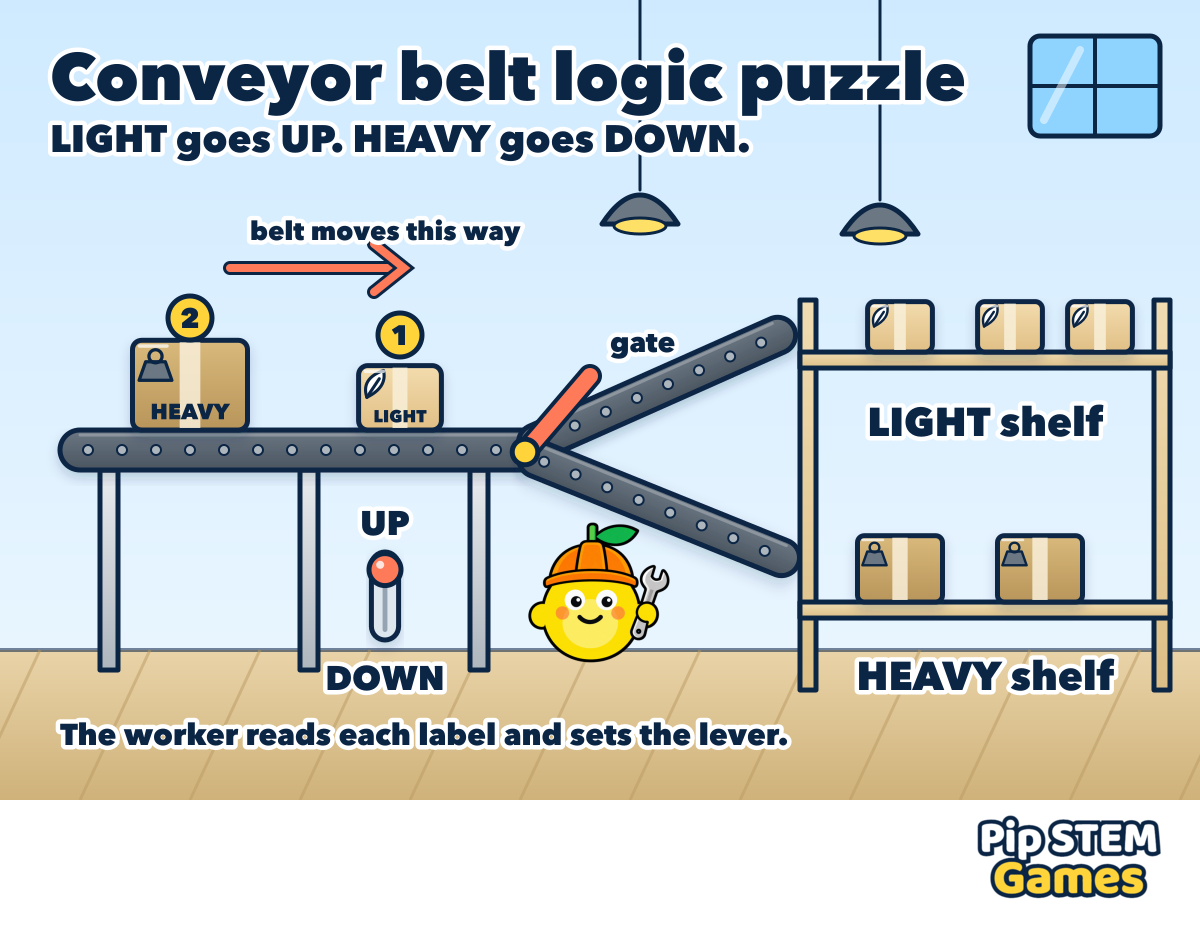
A belt carries parcels towards a split. A lever at the split sends each parcel to one of two shelves. UP points to the upper LIGHT shelf. DOWN points to the lower HEAVY shelf. There are no sensors in this puzzle. A person reads each label and sets the lever before the parcel arrives.
Sorting like this is really a list of if/then rules. If the label says LIGHT, choose UP. If it says HEAVY, choose DOWN. Your child is practising the same kind of rule thinking that sits behind many computer programs, with no screen needed.
What is the answer to the puzzle?
The worker moves the lever UP for the first parcel, which is LIGHT. Then the worker moves it DOWN for the second parcel, which is HEAVY. The lever is moved by hand each time, so the worker has to watch the order of the parcels.
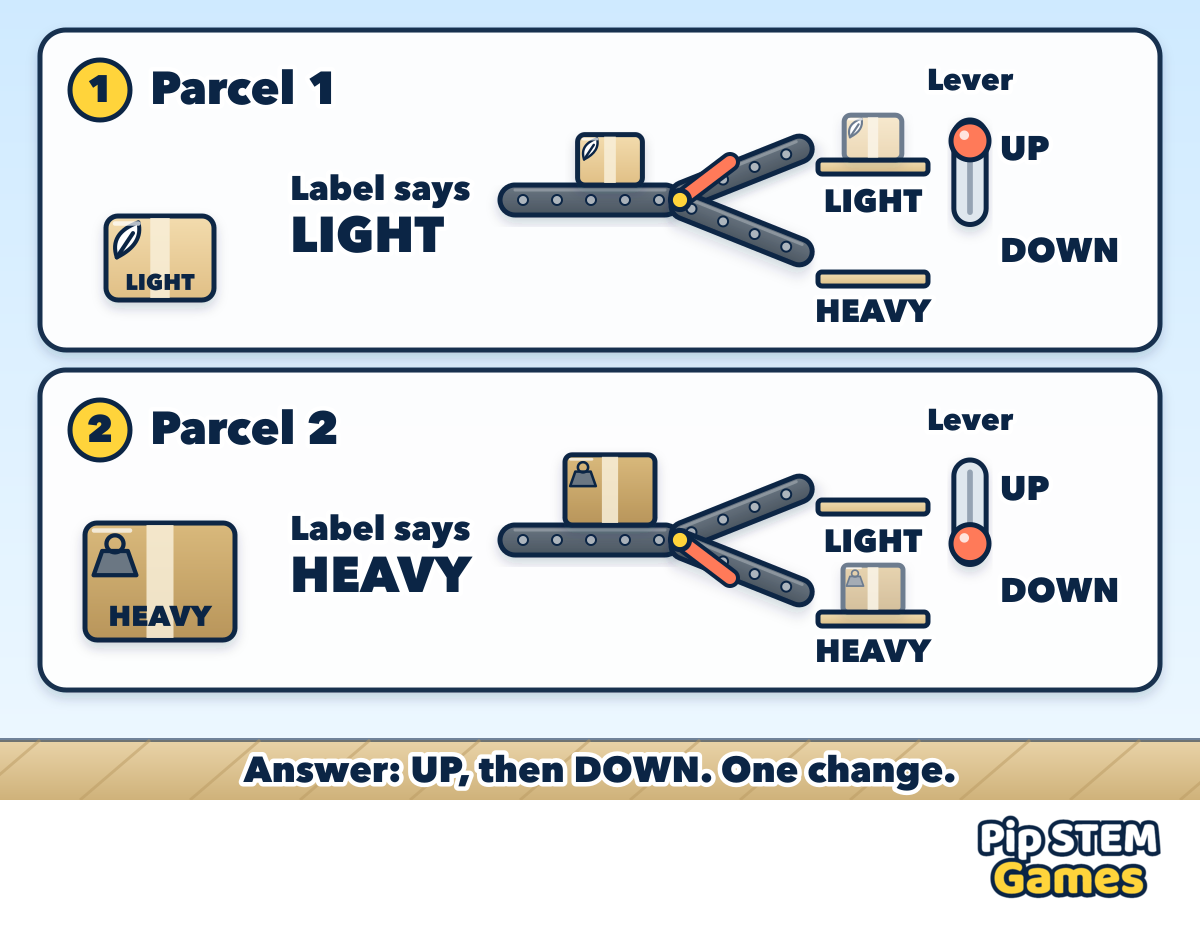
Why does order matter? The lever can only point one way at a time. If the worker leaves it UP, the HEAVY parcel lands on the LIGHT shelf. That is the whole puzzle: read the label, then set the lever, every single time.
How do you build the ramp sorter at home?
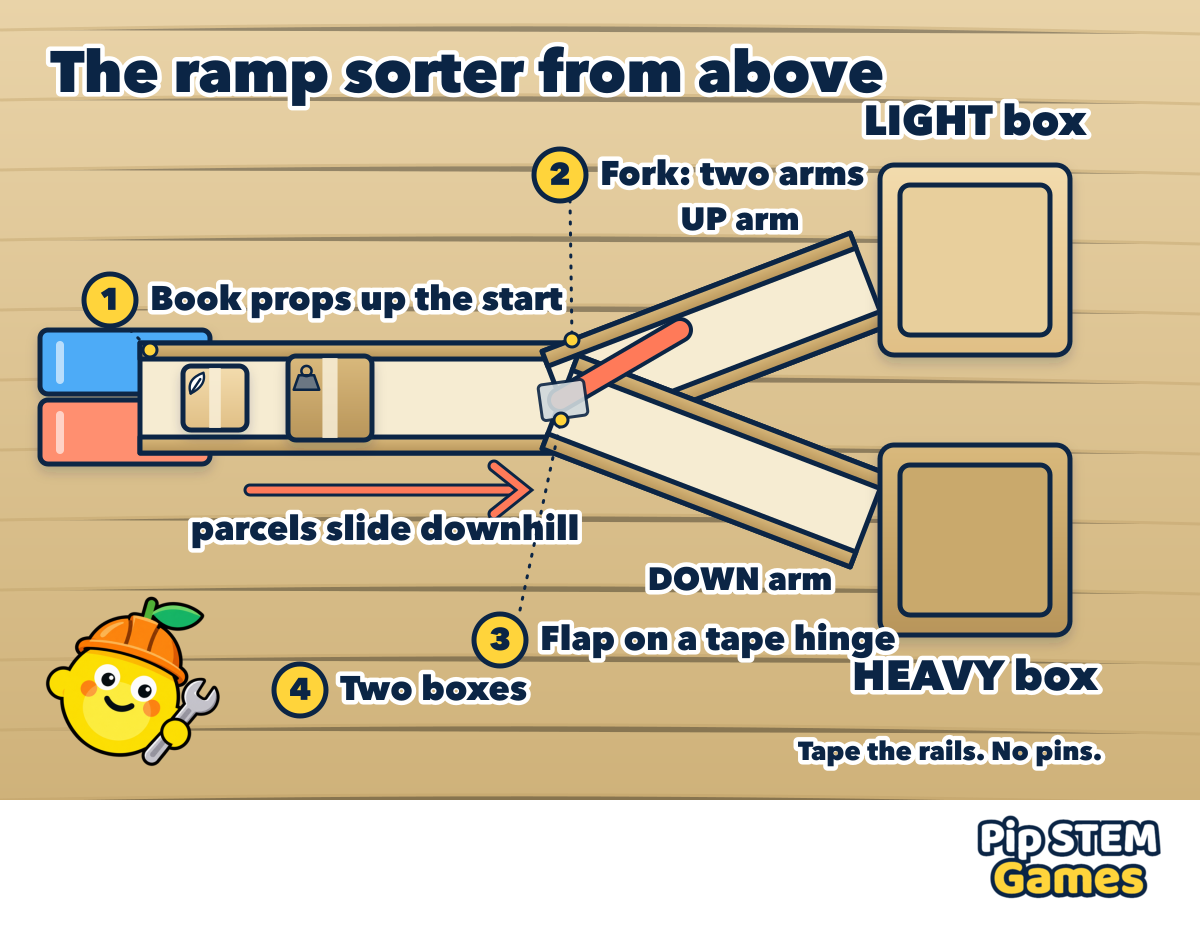
You can act the puzzle out on a table with cardboard. The parcels slide down a ramp, and a flap on a tape hinge sends each one to the left or right box.
You need: a long strip of cardboard, a few books, tape, two boxes, sticky notes, and two small boxes or paper parcels that look the same.
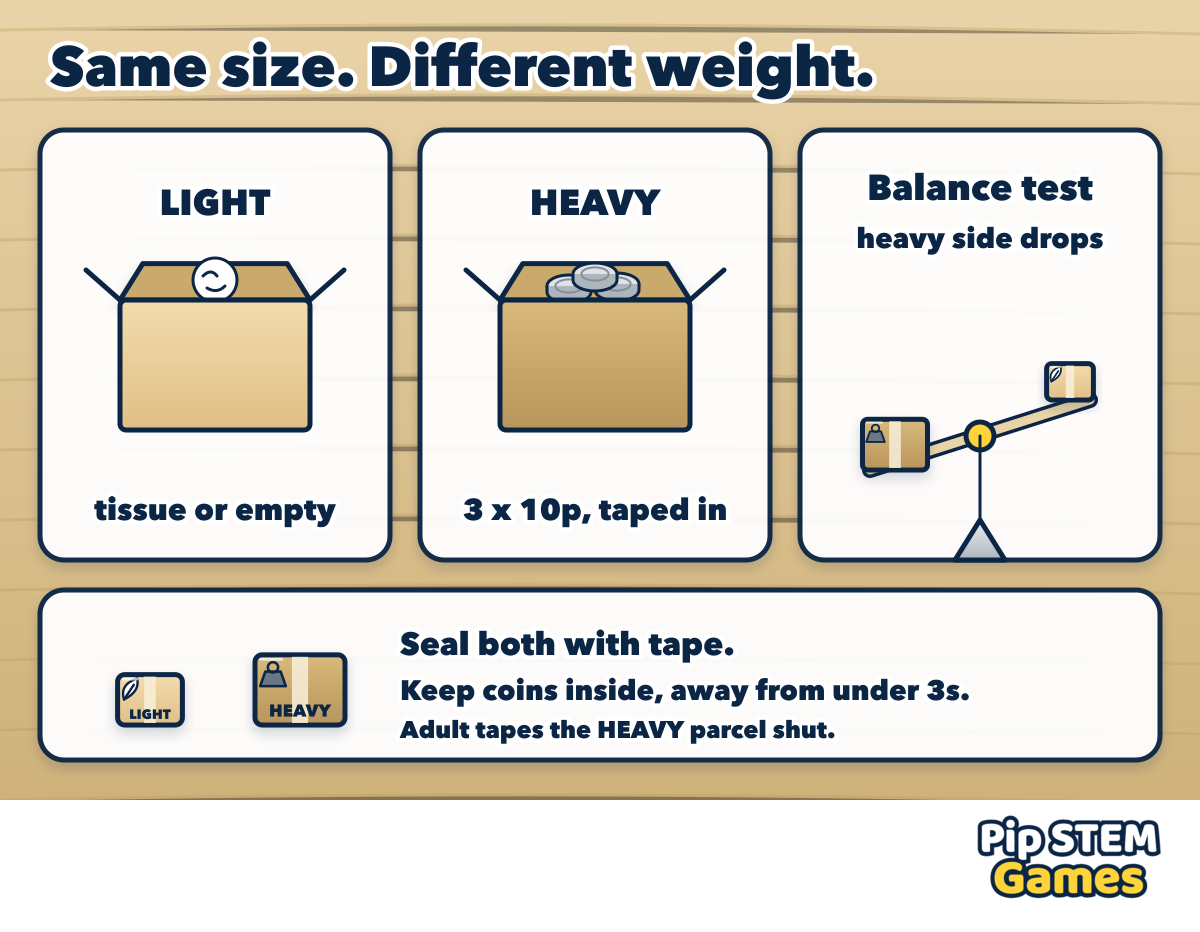
- Make two parcels of the same size. Leave the LIGHT one empty or put in one scrunched tissue.
- Put three 10p coins in the HEAVY one. An adult tapes it shut so the coins cannot fall out.
- Write LIGHT and HEAVY on sticky notes and stick one on each parcel.
- Prop one end of the cardboard on a stack of books to make a ramp.
- At the bottom, tape a flap on one side so it swings like a gate. An adult does any cutting.
- Put one box at each end of the flap. Label them LIGHT and HEAVY.
- Say the lever move out loud, set the flap, then let the parcel go.
Safety: coins and small toys are a choking risk for children under 3, so keep them away from little ones and make sure the tape holds. Use tape, not pins, to fix the flap. An adult does all the cutting.
How many times does the lever change?
Try this question next. If the parcels come in the order HEAVY, HEAVY, LIGHT, the settings are DOWN, DOWN, UP. Set the first position before you start. After that, you change the lever only once.
Can your child find an order that needs no changes after the first setting? Three LIGHT parcels work, and so do three HEAVY ones. Ask them to explain the rule before testing.
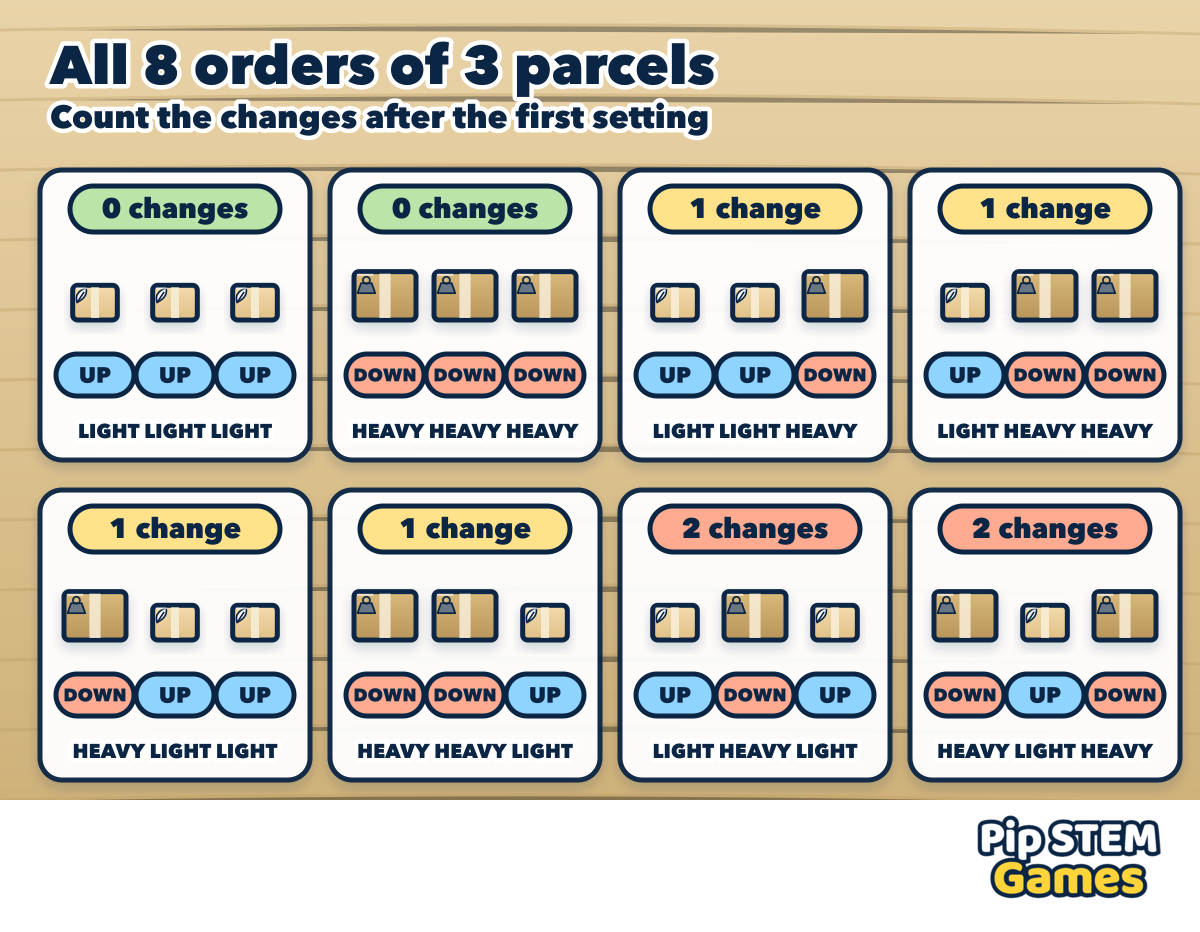
There are eight possible orders for three parcels. Two of them need no changes, four need one change, and two need two changes. LIGHT, HEAVY, LIGHT is one of the busy ones: UP, DOWN, UP is two changes. The pattern is simple. Count every place where two neighbouring labels are different.
How do real factories sort parcels?
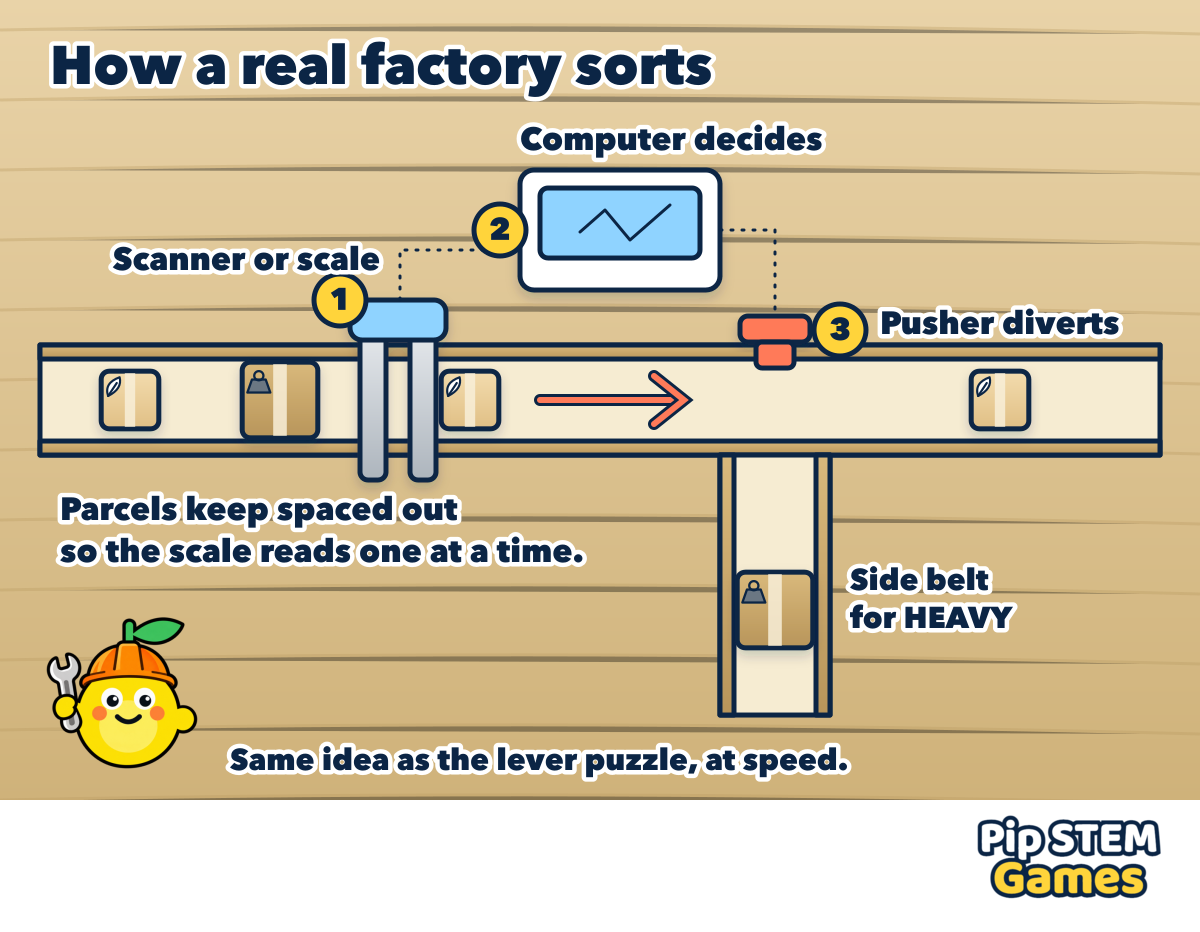
Real sorting lines do the same job, just very fast. Something identifies each item, such as a barcode scanner, a camera or a scale. A computer decides where it should go. Then a pusher, a tilting tray or a pop-up wheel diverts it onto the right belt.
Some lines weigh items as they pass. A weighing belt reads one item at a time, so the items are spaced out first. A pusher further along then slides any item outside the wanted weight onto a side belt. That is your lever, with a sensor and a computer doing the reading.
Why might a real factory group similar parcels together? Think about how often the pusher would need to move. If you want to read more about rules and steps, unplugged coding for kids has more ways to practise at the table.
How do you check your thinking fairly, and fix problems?
Use the same ramp angle and the same parcels each round. Before sliding, have your child say the lever move out loud. One person sets the flap and another releases the parcels, then swap jobs. Write down each parcel, the planned move and where it landed.
- Parcels get stuck: make the ramp a little steeper or smoother.
- The flap flops about: add tape so it stays where you set it.
- A parcel lands in the wrong box: check the label and the flap position before blaming the ramp.
- The HEAVY parcel tips the ramp: tape the ramp down to the table.
Questions to ask: What happens if the worker forgets to switch the lever? How many changes does LIGHT, HEAVY, LIGHT need? For a puzzle where a robot follows steps and drops the box, read the robot keeps dropping the box.
How do you adapt it by age, and what is in the printable?
- Ages 5 to 7: use two parcels and let your child say UP or DOWN out loud. The Junior Engineers workbook has more hands-on builds at this level.
- Ages 8 to 10: try three and four parcels and count the lever changes.
- Ages 11 and 12: find the rule for how many changes any order needs, and explain it in writing. Then build a bigger sorter with a third shelf.
Keep the cheat sheet next to the ramp, and print the puzzle sheet to write your answers.
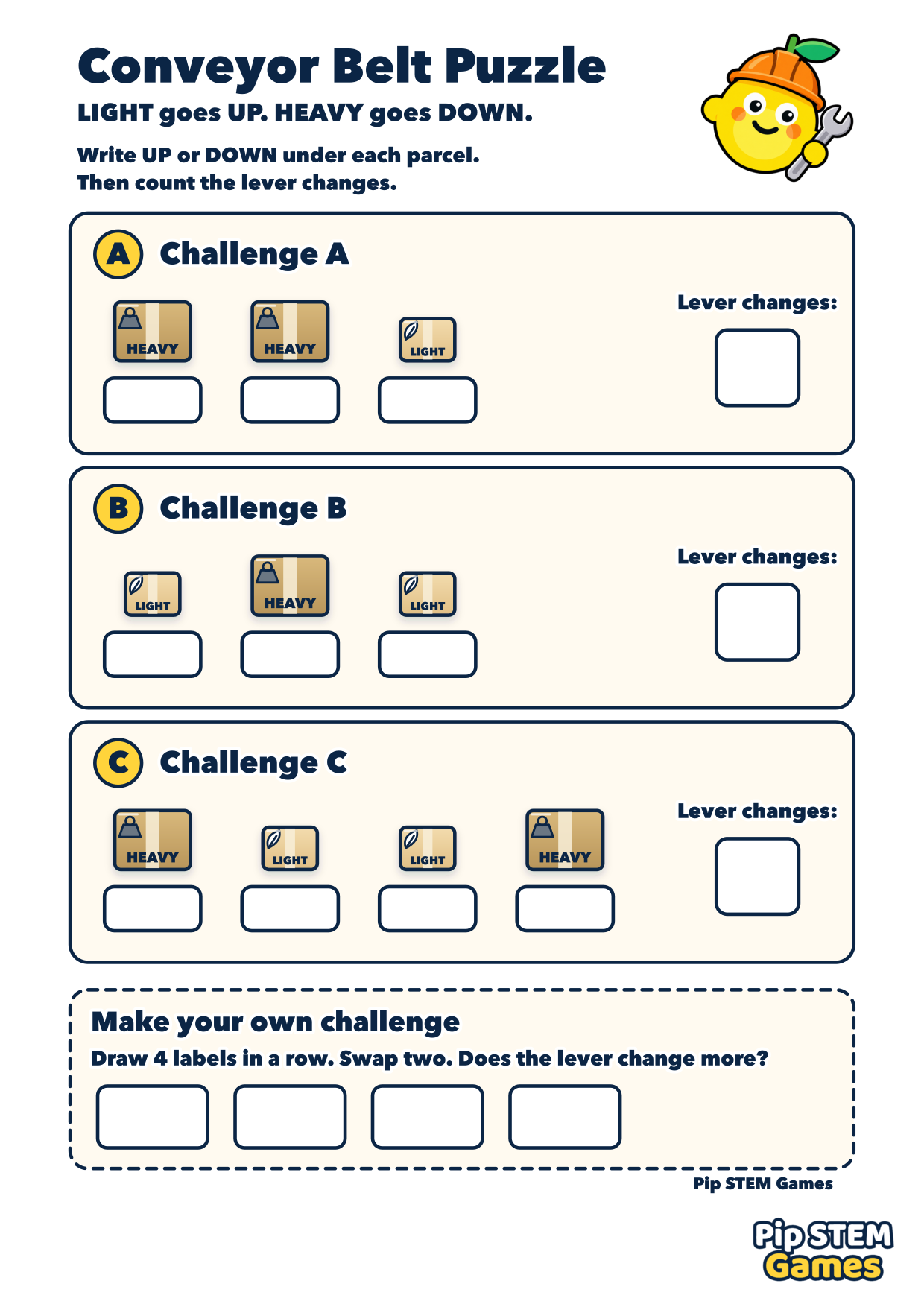
Want to try a similar sorting puzzle on screen? Play Conveyor Factory in the Pip app, then come back and build your own.
Questions parents ask
What is the answer to the factory conveyor belt logic puzzle?
Move the lever UP for the first parcel, which is LIGHT, then DOWN for the second parcel, which is HEAVY. Each parcel needs its own lever setting, set before it reaches the split.
How many lever changes does LIGHT, HEAVY, LIGHT need?
Two changes after the first setting. The lever goes UP, then DOWN, then UP again, because each neighbouring pair of labels is different.
Can an order of parcels need no lever changes?
Yes. Three parcels with the same label, such as three HEAVY ones, need no changes after the first setting. Of the eight possible orders of three parcels, only those two need none.
How do real factories sort parcels by weight?
A scale or checkweigher reads each item in line, a computer decides, and a diverter such as a pusher moves items outside the wanted weight onto a side conveyor. Items are spaced out so only one is weighed at a time.
Is this puzzle safe for young children?
Yes with care. Coins and small toys are a choking risk for under 3s, so seal parcels with tape and keep them out of reach. An adult does all the cutting and uses tape, not pins.
What age is the conveyor belt puzzle for?
Ages 5 to 12. Younger children sort two parcels and say UP or DOWN out loud. Older children count lever changes and look for the rule behind them.
Great STEM activities to try next...
 Build a Robot to Sort RecyclingBuild challenge
 Unplugged Coding for Kids: Learn Programming Without a Computer [Printable]Guide
 The Robot Keeps Dropping the Box. Why? A Gripper Test for KidsBuild challenge
More to try:

Pip STEM Games
We make engineering games and workbooks for kids aged 5 to 12. Every activity here is one we'd happily run at the kitchen table: test it, watch it fail, fix it, try again.




