


Key takeaways
- A robot gripper holds a box with friction between its finger pads and the box.
- Squeezing harder and using a grippy pad both give more friction.
- Gripping near one end makes the box swing round, so grip at the balance point.
- Change one thing at a time and try each test three times.
- Keep a cushion on the floor and keep small parts away from little ones.
A robot gripper drops a box when the friction at its fingertips is too small to hold the weight, or when it grips the box away from its balance point. Friction depends on how hard the fingers squeeze and how grippy the pads are. You can test all of this at home with two card fingers, a small cereal box and a few coins. This page gives you the build, a fair test, a record sheet to print and a fix list for when the box still slips.
Why does a robot gripper drop a box?
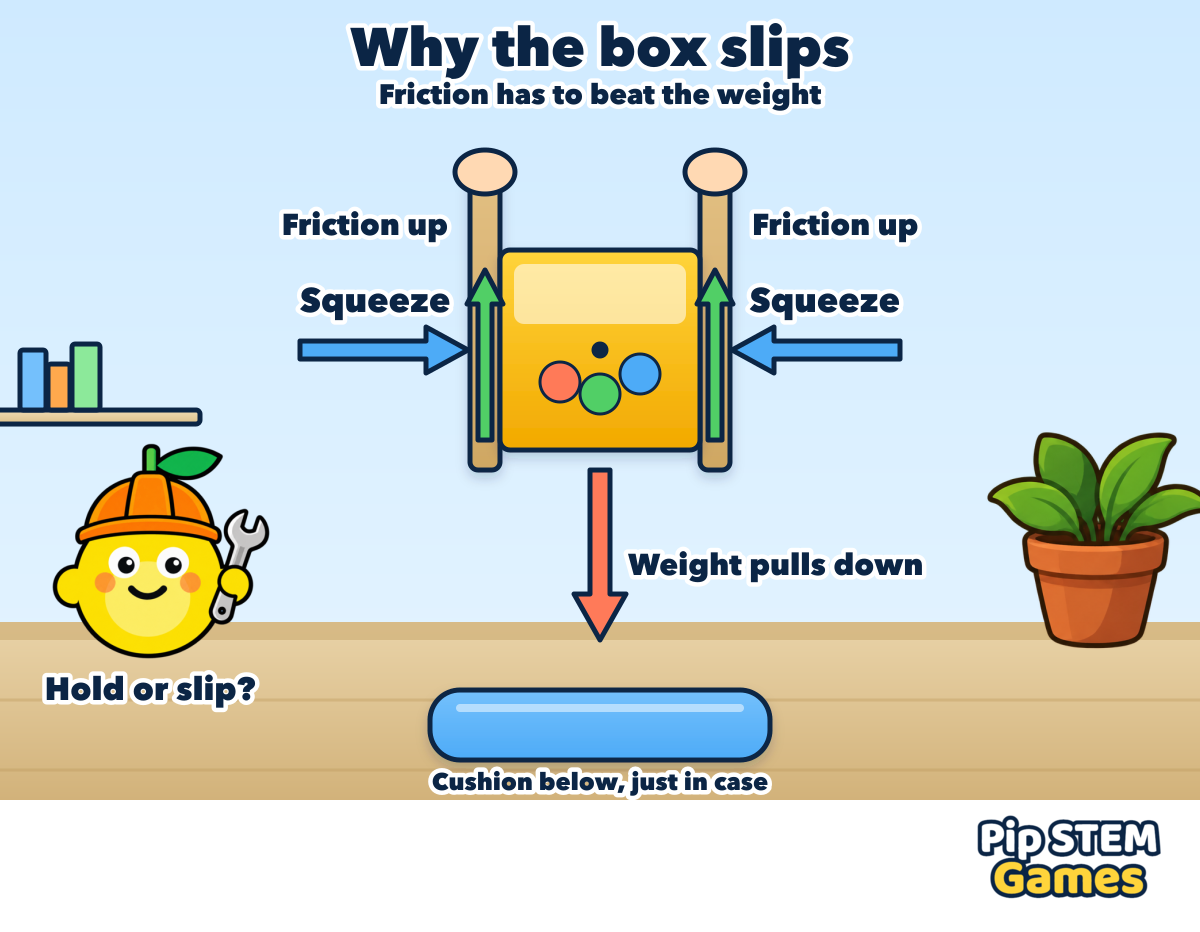
A gripper drops a box when the friction on each side is smaller than the box's weight. Two things are fighting: gravity pulls the box down, and friction at the finger pads holds it up.
Each finger pushes sideways on the box. That sideways push is the squeeze. It is the squeeze that makes friction along the pad, and friction acts upwards against the weight. Squeeze harder and there is more friction. Add weight and you need more of it. Engineers who build robot arms work through exactly this idea, and the VEX robotics education pages on grabbers describe the same thing: clamping force gives friction, and that friction acts upwards against gravity.
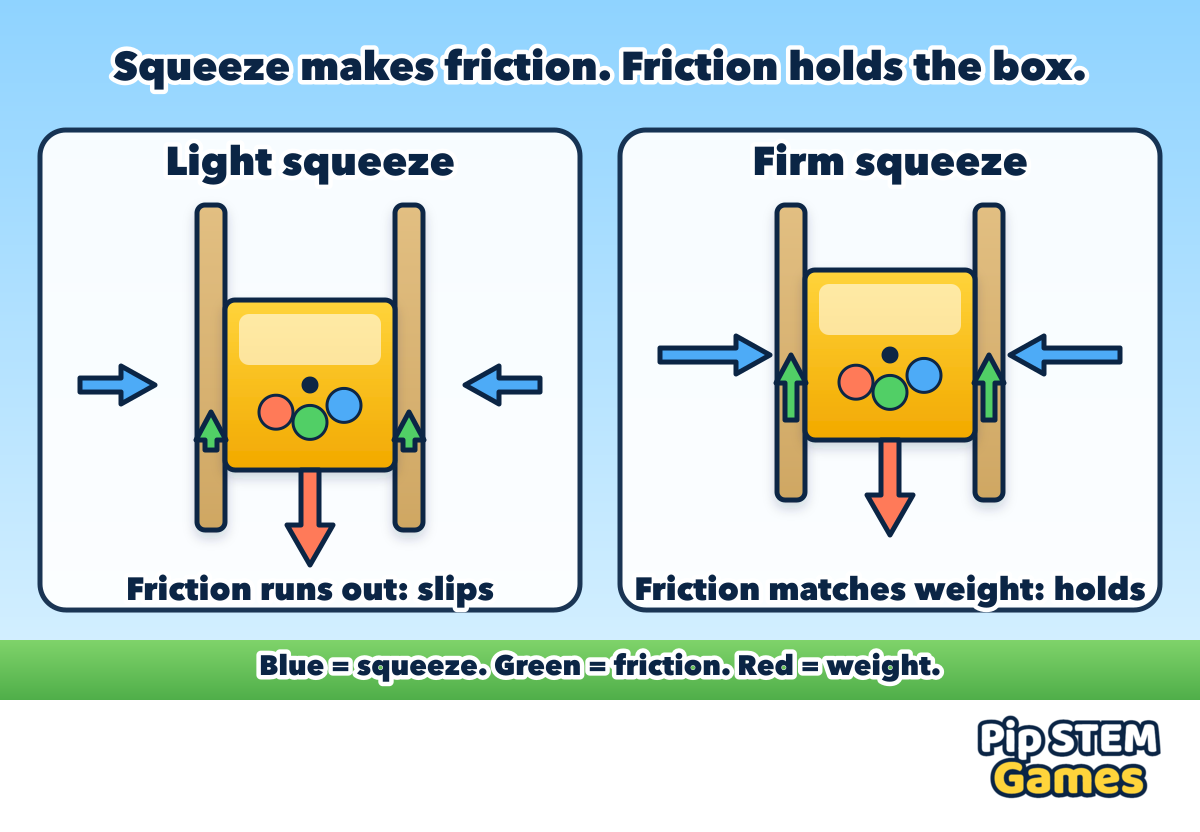
This is a small model made from card, not an industrial robot. The idea is the same, though, and a model lets you change one thing at a time and see what happens.
What is happening at the fingertips?
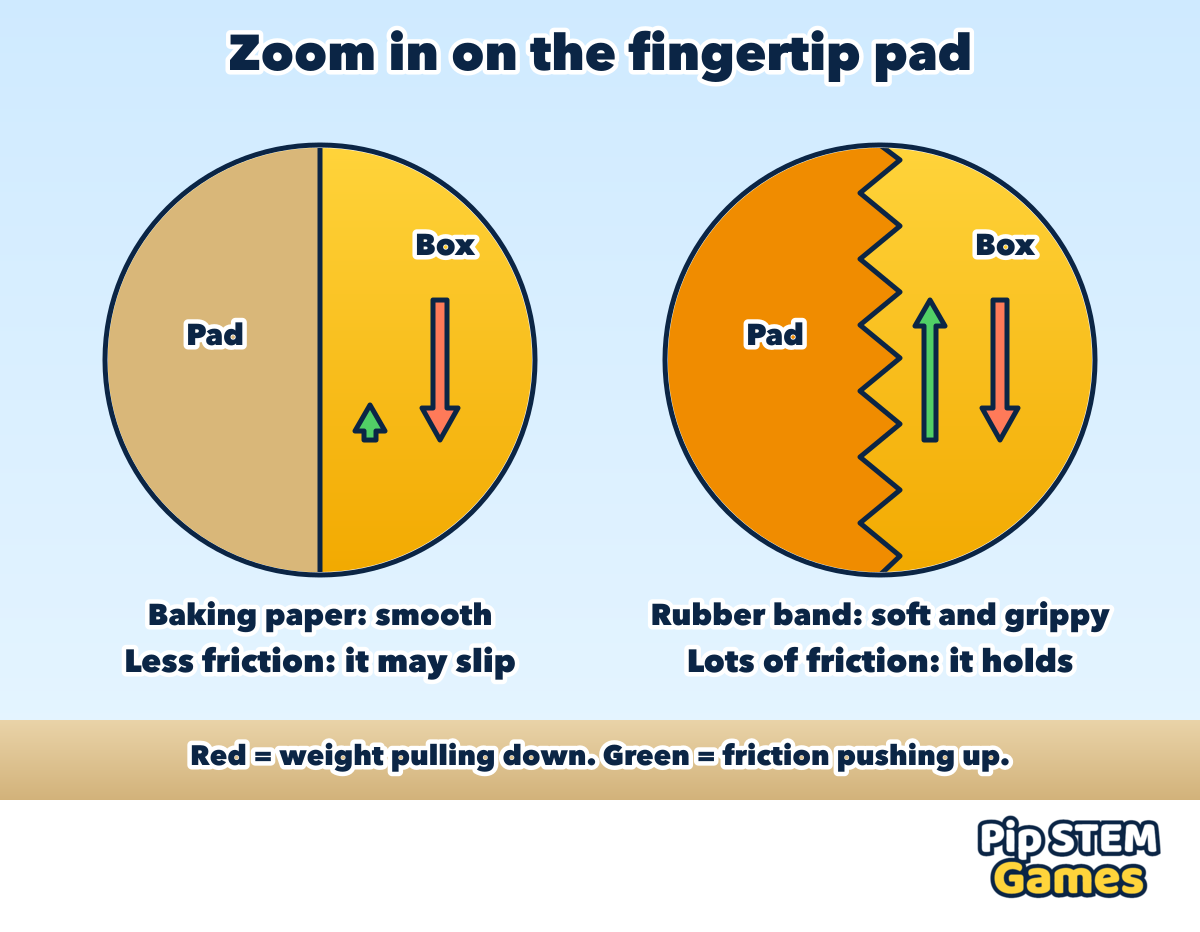
The pad and the box touch along a surface, and the pad material decides how much friction you get. A soft, rubbery pad grips more than smooth baking paper.
Zoom in far enough and no surface is truly flat. A rubber band is soft and bumpy, so it presses into the box and is hard to slide. Baking paper is smooth and slippery. Make a guess before you test: which pad will hold best? Write it on the record sheet below.
What do you need for a card gripper test?
You need a handful of things from the recycling bin and the kitchen drawer, and a cushion for the floor.
- Two strips of stiff card, about 3 cm wide and 20 cm long, for the fingers
- Sticky tape
- A small empty cereal box to lift
- Coins or dry rice in a sealed bag, to add weight
- Rubber bands, a sheet of kitchen paper and a piece of baking paper for the pads
- A cushion or folded towel on the floor under your test area
Safety: an adult should supervise. Coins, rubber bands and rice are small parts, so keep them away from children under 3 and do not let anyone put them in their mouth. Seal the rice bag well so it cannot burst. Work over the cushion so a dropped box lands softly.
How do you build and test the gripper?
Fold, tape, squeeze and lift. The whole build takes about five minutes.
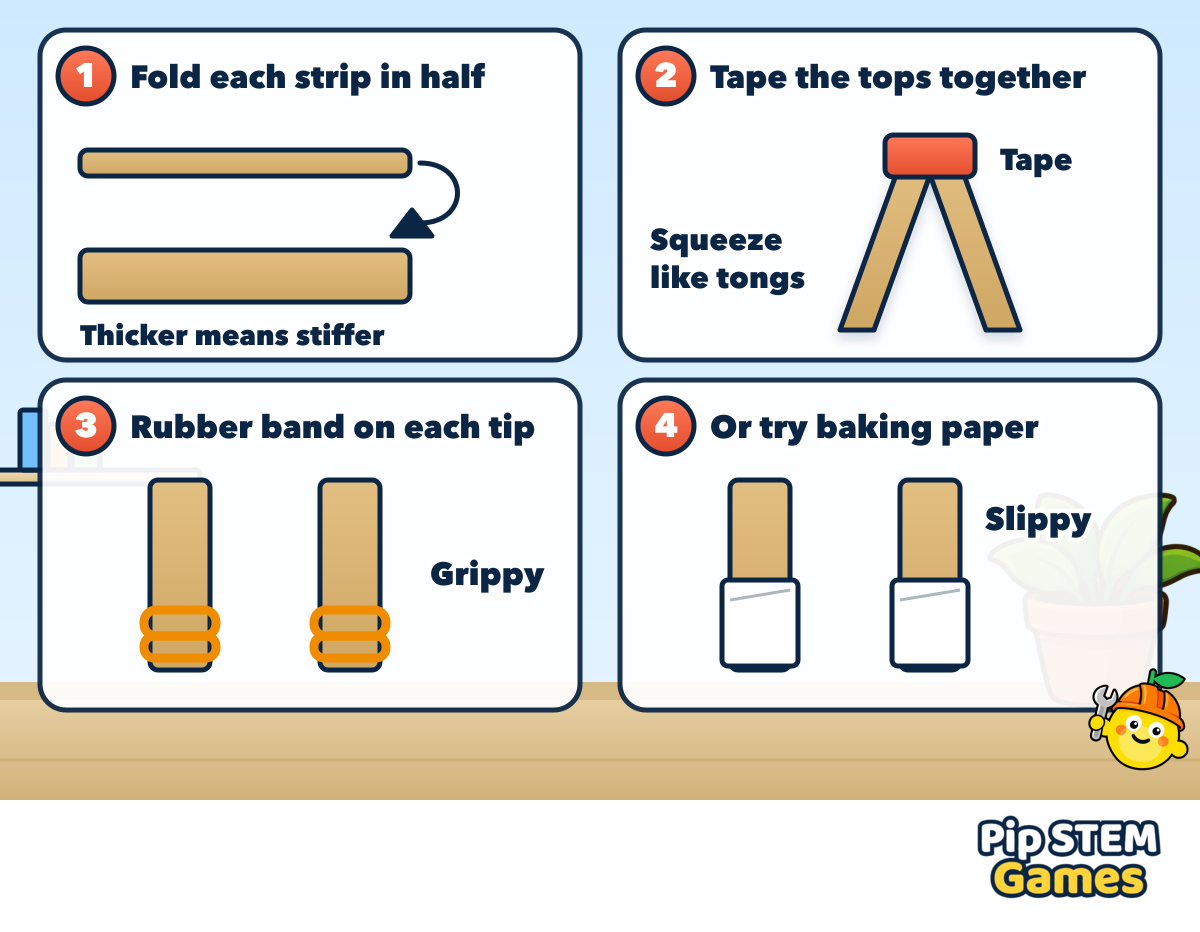
- Fold each card strip in half so it is double thickness. Thicker card bends less.
- Tape the two folded strips together at the top so they make a V, like kitchen tongs.
- Hold the fingers on opposite sides of the box, near the middle.
- Squeeze lightly and lift the box a few centimetres over the cushion. Does it hold or slip?
- Squeeze harder and lift again.
- Wrap a rubber band around each tip and repeat, then swap to baking paper and repeat.
Want to see the same idea on a screen? Try it in the Robot Steps game and think about what a robot needs to do to hold something steady.
How do you make it a fair test?
Change one thing at a time and keep everything else the same. That is how you know which change caused the result.
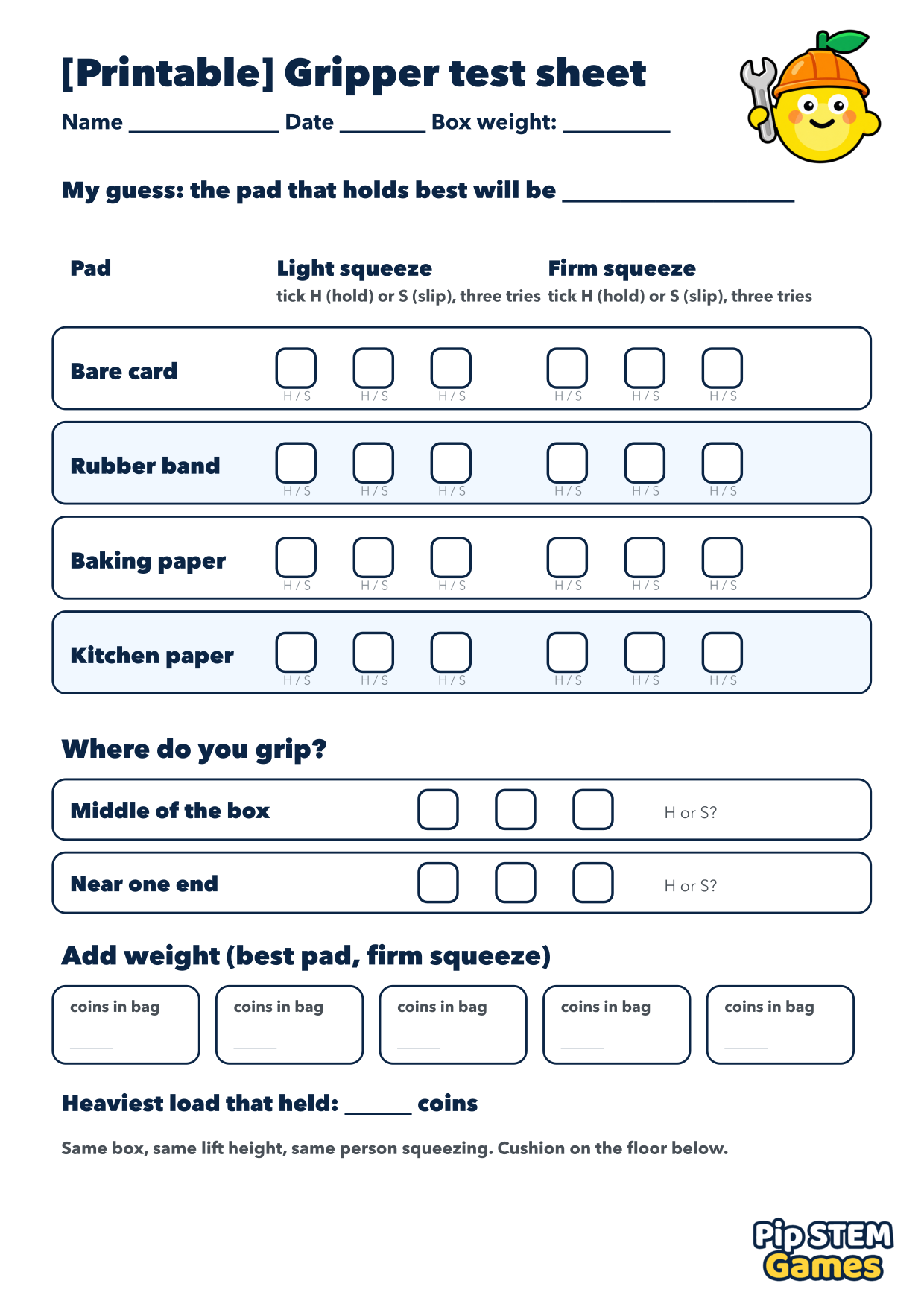
Use the same box, the same weight inside, the same lift height and the same person squeezing. Test light squeeze, firm squeeze, rubber band and baking paper, and record each as hold or slip. Do each test three times, so one lucky try does not decide the answer. Print the record sheet and tick it as you go.
The same habit shows up in other builds too. Our engineer's five-step fix-it checklist uses it for any model that does not work first time.
Why does the box twist or swing when I lift it?
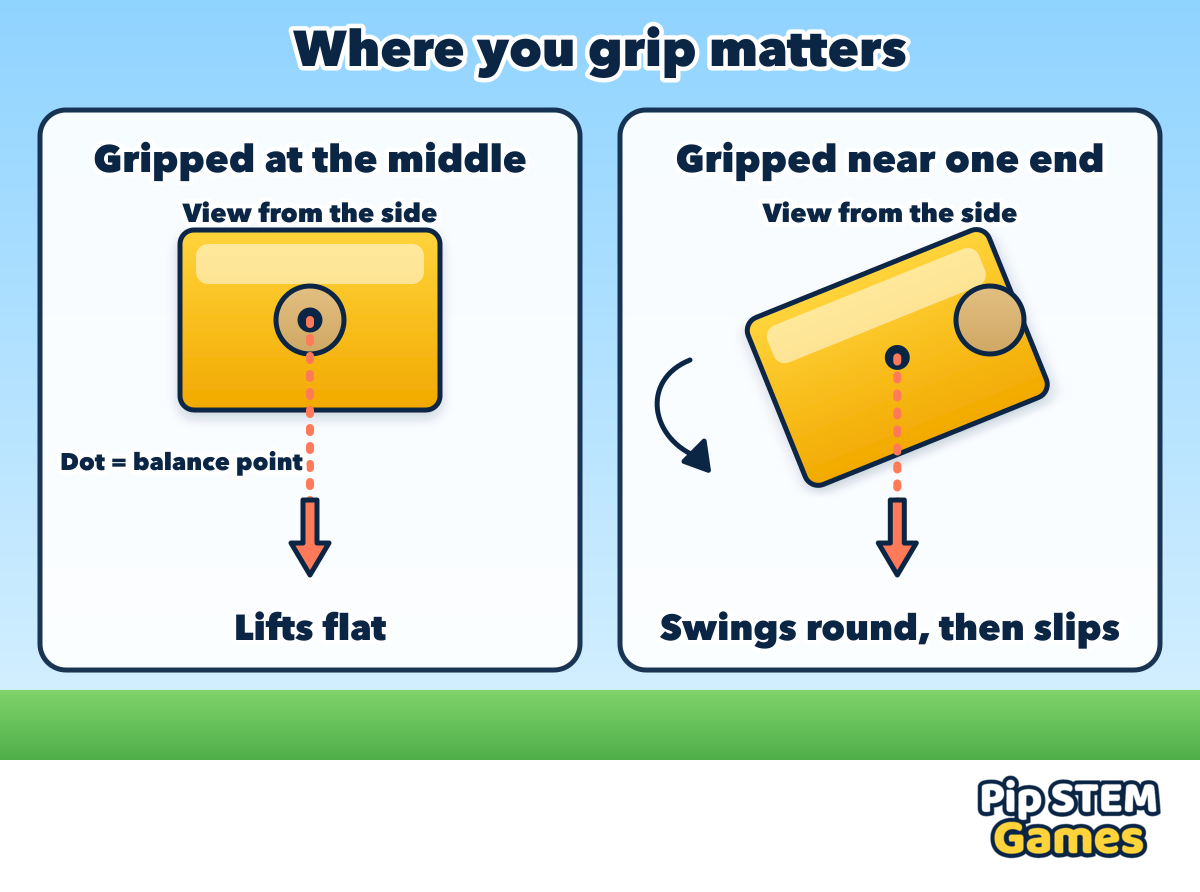
The box twists when you grip it away from its balance point. The weight then pulls on one side of the pads and swings the box round.
The balance point is roughly the middle of the box, as long as the weight inside is spread out evenly. Grip there and the box lifts flat. Grip near one end and gravity turns it, which also makes the pads slide. Try both and compare. If the weight inside shifts, the balance point moves, so tape your coins or bag in place.
What can I try if the box still slips?
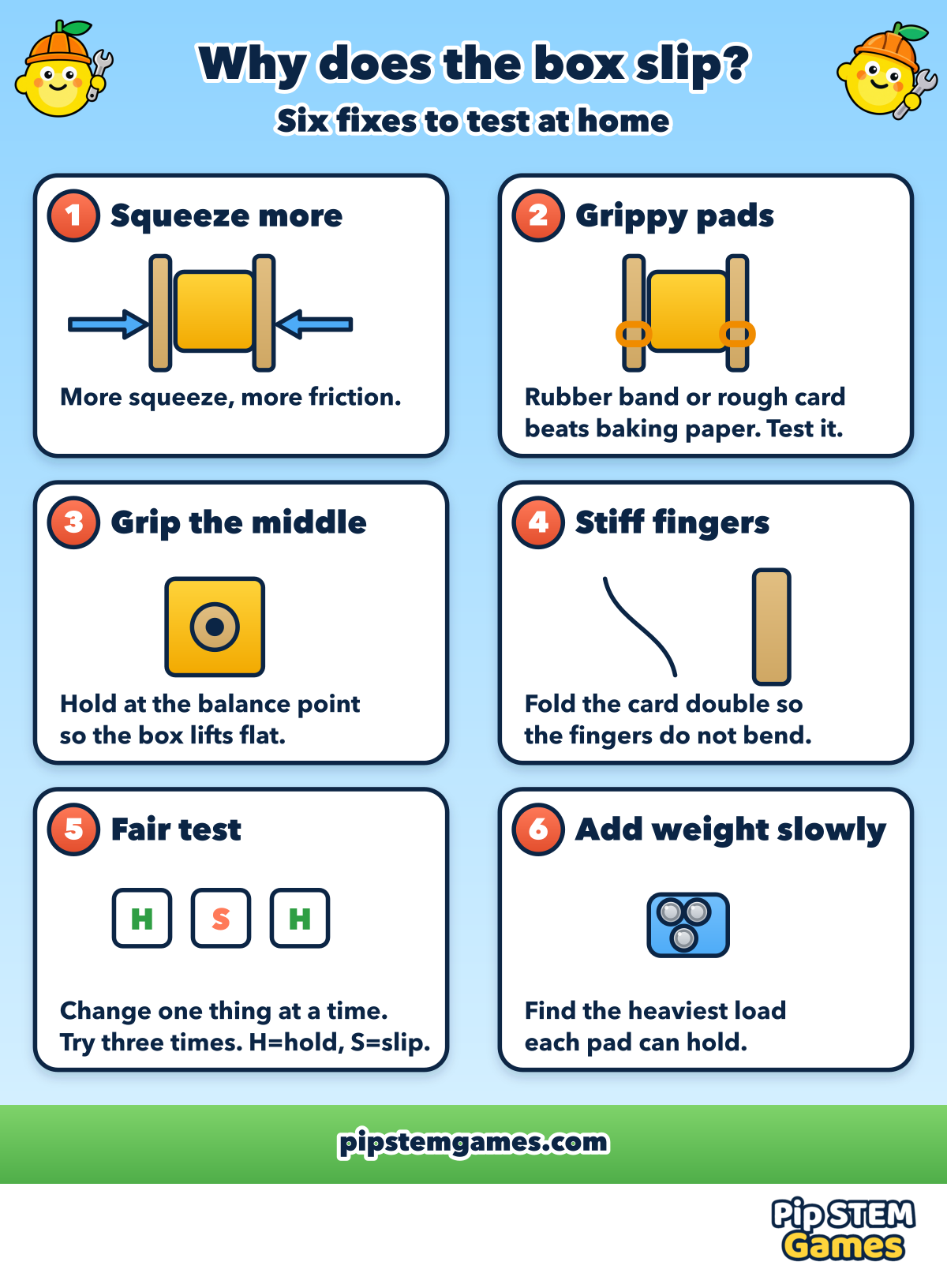
Match the symptom to the fix, and change one thing at a time.
- Slips even with a firm squeeze: the pads are too smooth. Add a rubber band or use rough card.
- Twists as it lifts: you gripped off centre. Move the fingers to the balance point.
- Fingers bend and let go: the card is too thin. Fold it double.
- Results change every time: check the weight inside is not moving about.
Getting it wrong first is normal. Why getting it wrong is part of engineering explains why.
What should we test next?
Add weight in small steps and find the heaviest load each pad can hold. Record the number of coins at the point it slips.
Then tilt the box and see how alignment changes the result. Real hands do something clever here: research on human grip, such as a study from TU Delft, found that people squeeze with a safety margin of about 25% more than the minimum needed. You can copy that. Once you know the squeeze where the box just holds, try squeezing a little more and see if it feels steadier. We have not tested a particular result for you, so write down your own.
More forces to try next: forces for kids and our STEM activities for kids.
How do I adapt this for ages 5 to 7 and 8 to 12?
Younger children compare hold or slip, and older children measure and graph.
Ages 5 to 7: use a light box, take turns squeezing and lifting, and just say hold or slip. The Junior Engineer's Workbook has more challenges for this age.
Ages 8 to 12: weigh the load, record each trial in a table and plot hold or slip against the weight. The Engineering Workbook for Kids has pages for ages 8 to 12.
Questions parents ask
Why does a robot gripper drop things?
Usually the friction at the finger pads is smaller than the weight of the object. The squeeze is too light, the pads are too smooth, or the object is held away from its balance point.
How does friction hold a box in a gripper?
The fingers squeeze the box from both sides. That squeeze makes friction along the pads, and the friction pushes upwards against the weight pulling the box down.
What pad material grips best?
Test it yourself. Rubber bands are soft and usually grip better than smooth baking paper, but your own results matter more than a guess.
Why should I grip a box at its middle?
The middle is usually the balance point, so the weight pulls evenly on both pads. Gripping near one end lets the weight swing the box round.
How many times should I repeat each test?
Three times is enough for a home test. One lucky or unlucky try can fool you, so repeat and look for the same result.
Is this safe for young children?
Yes with an adult nearby. Coins, rubber bands and rice are small parts, so keep them away from children under 3, seal the rice bag and put a cushion on the floor.
What age is the card gripper test for?
Ages 5 to 7 can compare hold and slip with a light box. Ages 8 to 12 can weigh the load and plot a graph.
Great STEM activities to try next...
 The Engineer’s Five-Step Fix-It Checklist for KidsBuild challenge
 Forces for Kids: Pushes, Pulls and Why Things Move [Printable]Forces & energy
 12 Easy STEM Activities for Kids to Try at Home (Ages 5 to 12)By age
More to try: Bridges and Towers for Kids: 9 Builds to Try at Home

Pip STEM Games
We make engineering games and workbooks for kids aged 5 to 12. Every activity here is one we'd happily run at the kitchen table: test it, watch it fail, fix it, try again.




