

Key takeaways
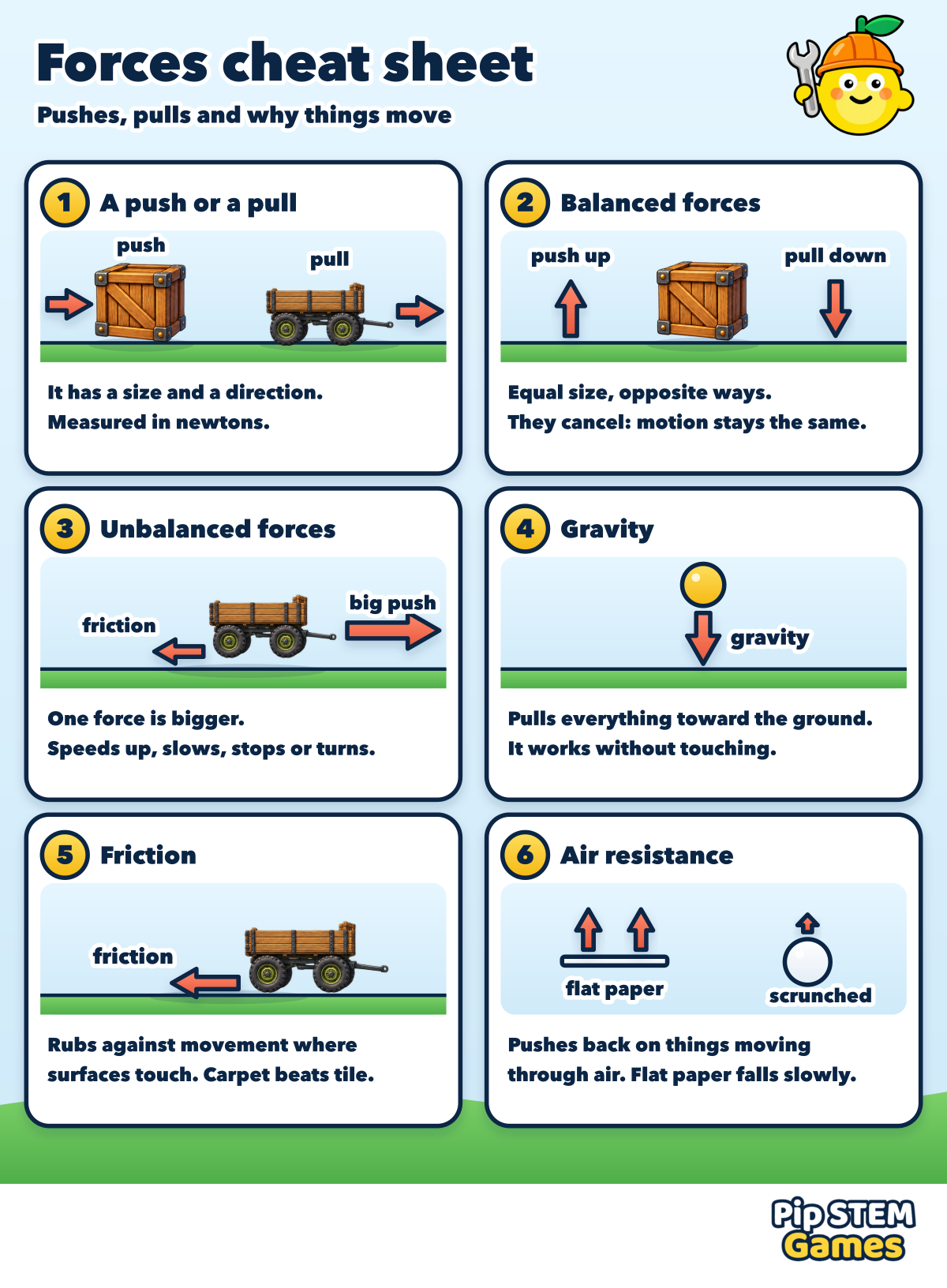
- A force is a push or a pull, and every force has a size and a direction.
- Balanced forces cancel out, so the motion stays the same. Unbalanced forces change it.
- Gravity, friction and air resistance act on almost everything that moves.
- A toy car, a ramp and a tape measure are enough to test forces at home.
- Change one thing at a time and write down what happens. That's how engineers learn.
A force is a push or a pull. It can start something moving, stop it, speed it up, slow it down or turn it a new way. Scientists measure forces in newtons. This guide gives you the plain definition, the difference between balanced and unbalanced forces, and four tests you can run on the kitchen floor with a toy car. Kids aged 5 to 7 can sort pushes and pulls. Kids aged 8 to 12 can measure, compare and explain. There is also a printable record sheet for the ramp test.
What is a force, in words a child can repeat?
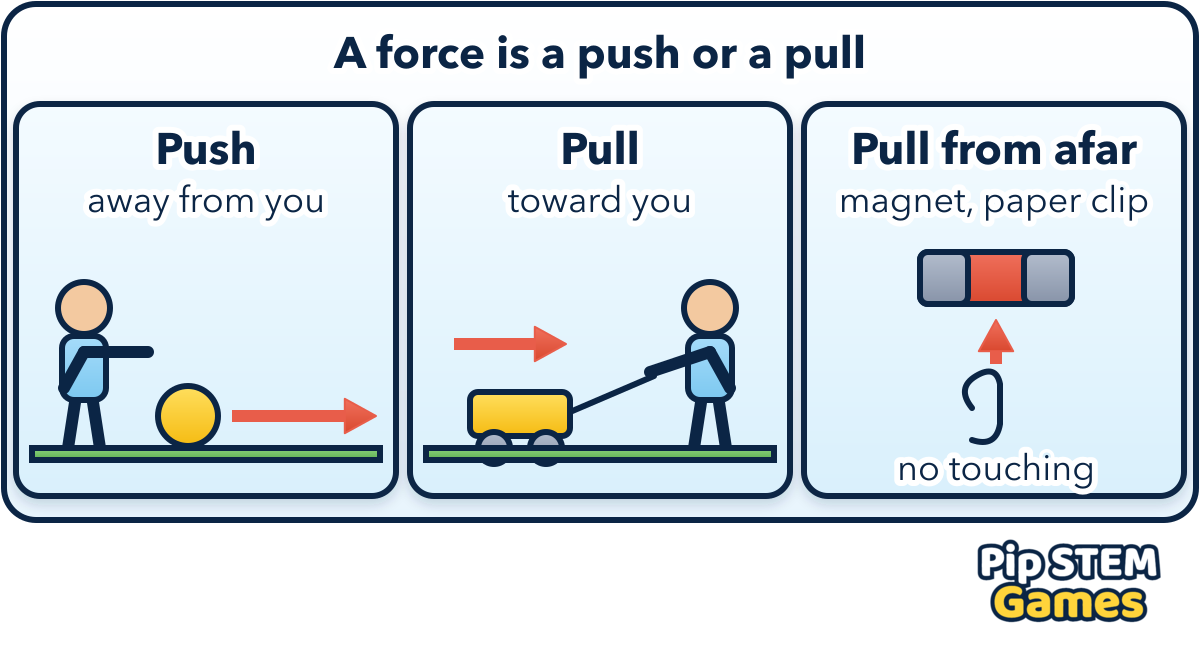
A force is a push or a pull on an object. If you kick a ball, that's a push. If you drag a wagon by its handle, that's a pull. Nothing moves, stops or changes direction without one.
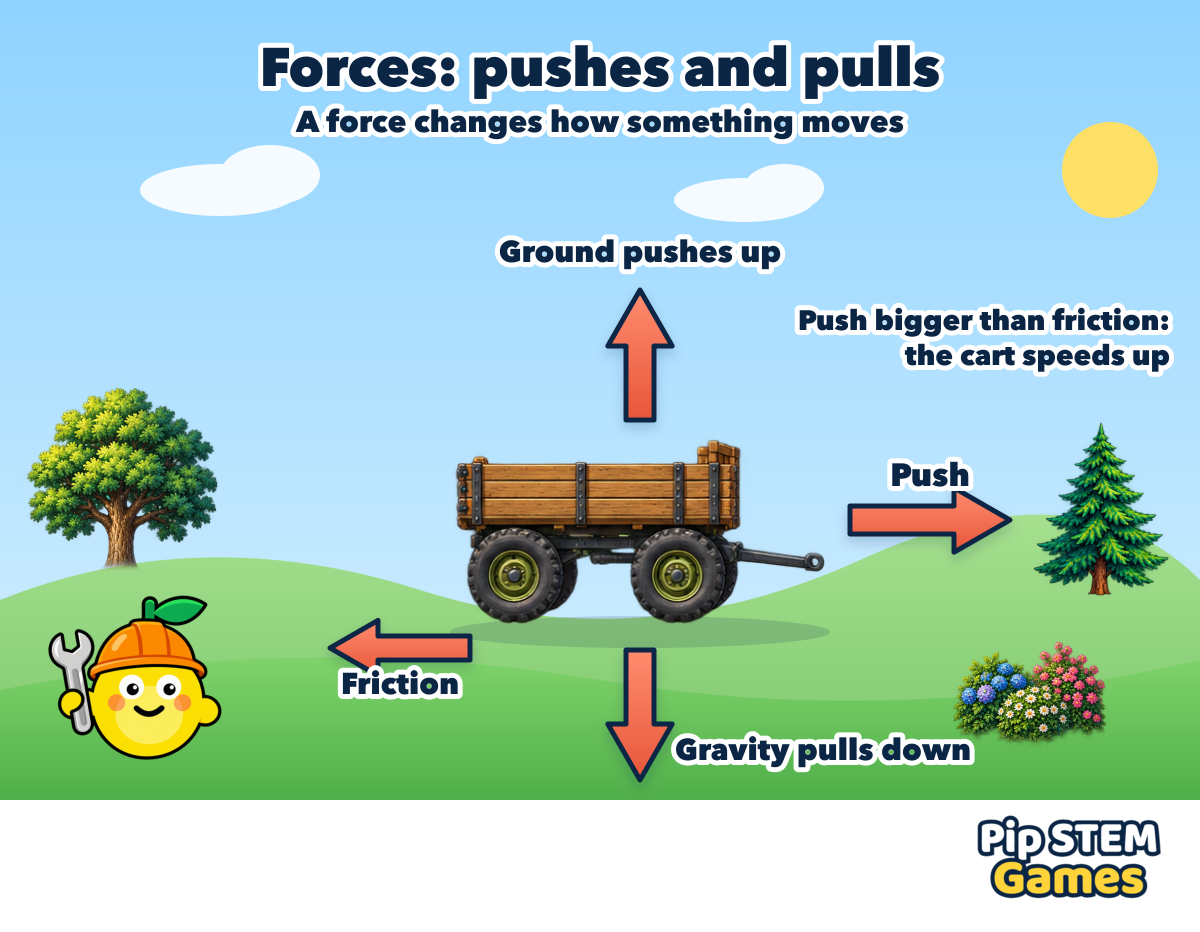
Every force has two features: how strong it is and which way it goes. A gentle tap on a toy car sends it a few centimetres. A hard flick sends it across the room. Push it sideways and it goes sideways.
Some forces need contact, like your hand on a door. Others act from a distance. Gravity pulls a dropped spoon to the floor without touching it, and a magnet can tug a paper clip across the table.
Pro tip: ask your child to "find ten forces" on a walk. Opening a gate, a puddle splash, a swing, a wind that bends a tree. Most kids spot pushes easily and have to think harder about pulls.
What are balanced and unbalanced forces?
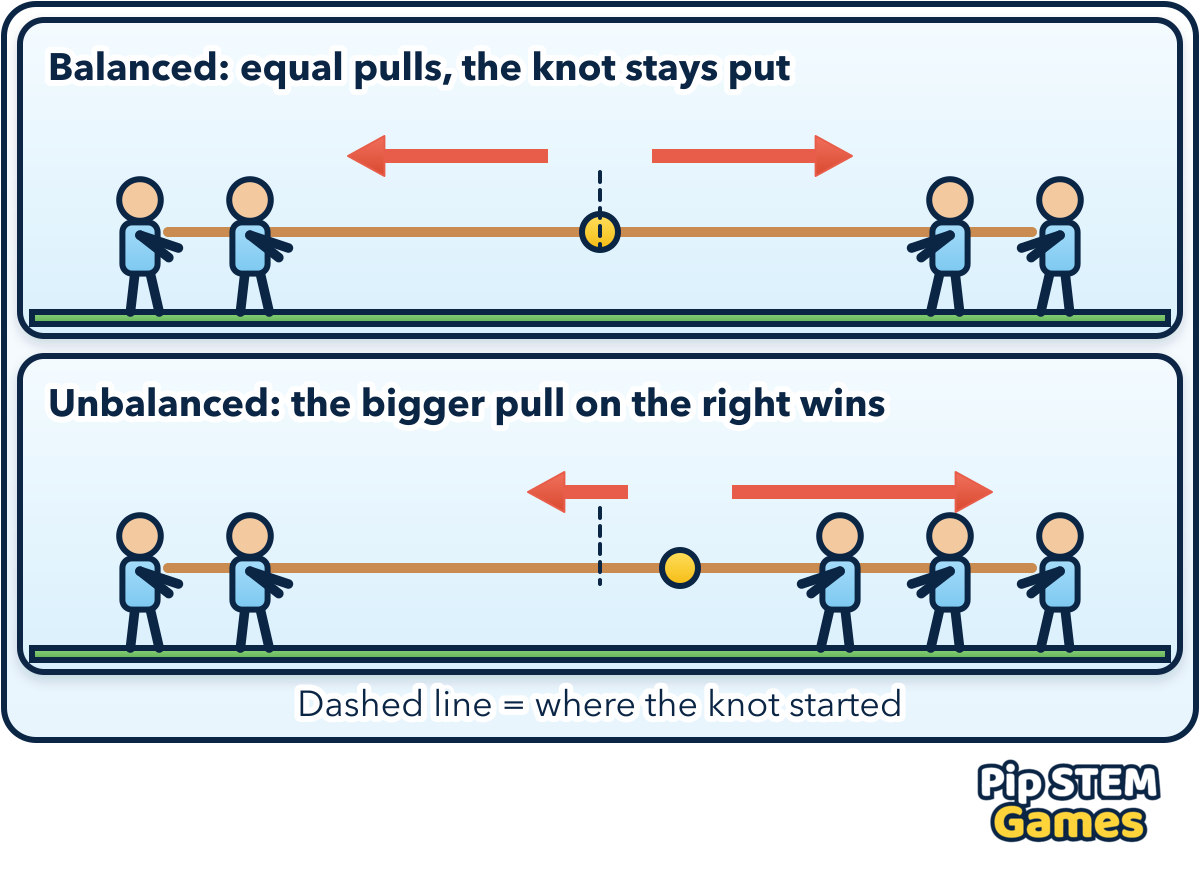
Balanced forces are equal in size and point in opposite directions, so they cancel and the motion doesn't change. Unbalanced forces are not equal, so the object speeds up, slows down, stops or turns.
Tug-of-war is the picture to keep in mind. If both teams pull with the same strength, the rope stays put: balanced. If one team pulls harder, the rope moves their way: unbalanced.
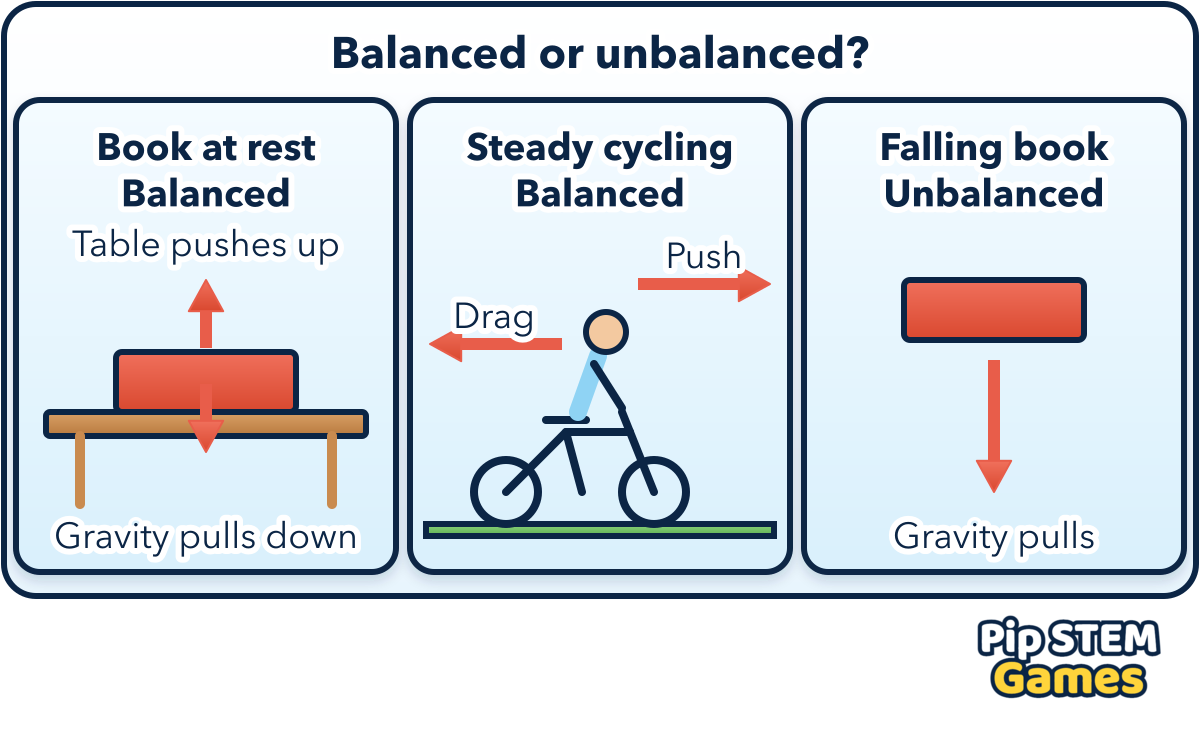
A book on a table is balanced too. Gravity pulls it down and the table pushes it up with the same strength, so it sits still. Take the table away and the forces are unbalanced. The book falls.
| Balanced | Unbalanced | |
|---|---|---|
| Sizes | Equal | One is bigger |
| Motion | No change | Starts, stops, speeds up, slows or turns |
| Example | Even tug-of-war | Kicking a football |
Here's the part most adults get wrong. Balanced doesn't always mean "not moving". A cyclist riding at a steady speed on a flat road is also in balance: the push forward matches the drag from the air and the ground. Steady motion and standing still are both "nothing is changing".
Which forces act on everyday things?
Four forces turn up again and again: gravity, friction, air resistance and the push or pull you add yourself.
- Gravity pulls everything towards the ground.
- Friction rubs against movement where two surfaces touch. It's why a car stops faster on carpet than on tile.
- Air resistance pushes back on things moving through air. A flat sheet of paper falls slowly and the same sheet scrunched into a ball drops fast.
- Applied force is any push or pull from you, a motor or a spring.
A sliding toy car shows three at once. Your push gets it going. Friction and air resistance slow it. Gravity pulls it down onto the floor. Once the push ends, the slowing forces win, so the car stops.
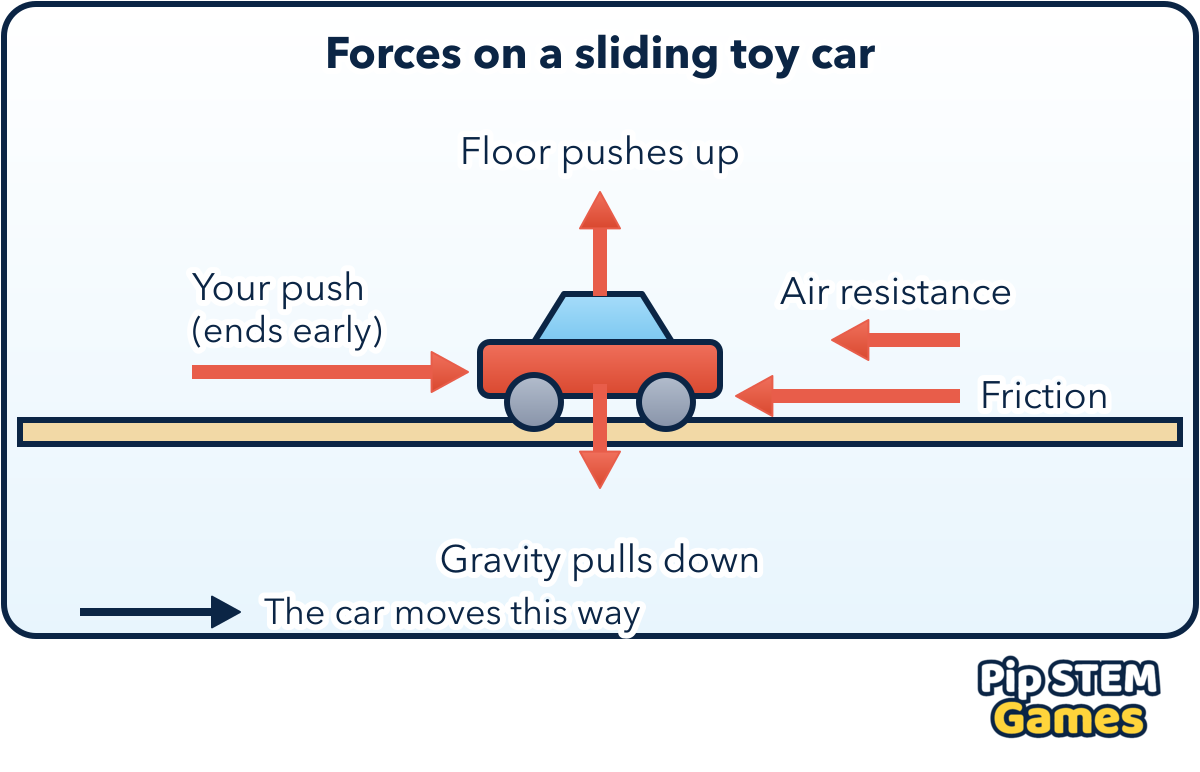
That is also the idea behind Newton's first law: a moving thing keeps moving the same way until an unbalanced force changes it. A toy car on ice would slide much further than on a rug.
How can you test forces at home with a toy car and a ramp?
Prop a board or a big hardback book on a pile of books, release a toy car at the top and measure how far it rolls. Then change one thing and repeat.
You need:
- a toy car with wheels that roll freely
- a plank, tray or stiff cardboard for a ramp
- a tape measure and some masking tape for a start line
- paper and pencil for results
Method:
- Make the ramp two books high. Mark where the car is let go.
- Let the car roll without pushing. Measure from the bottom of the ramp to the front wheels.
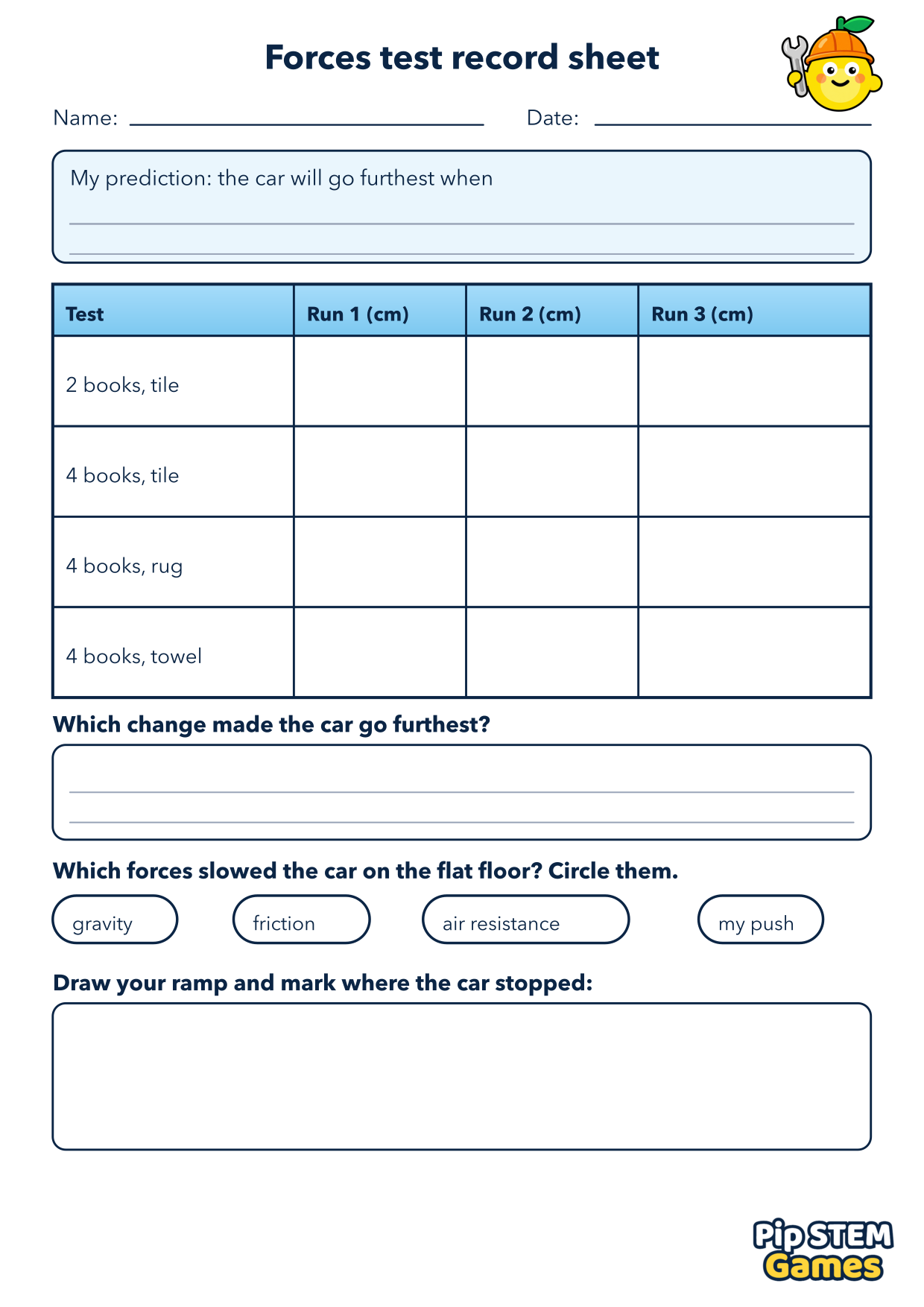
- Run it three times and write down all three distances.
- Raise the ramp to four books and repeat.
- Now keep the ramp the same and change the floor: smooth tile, a rug, a towel.
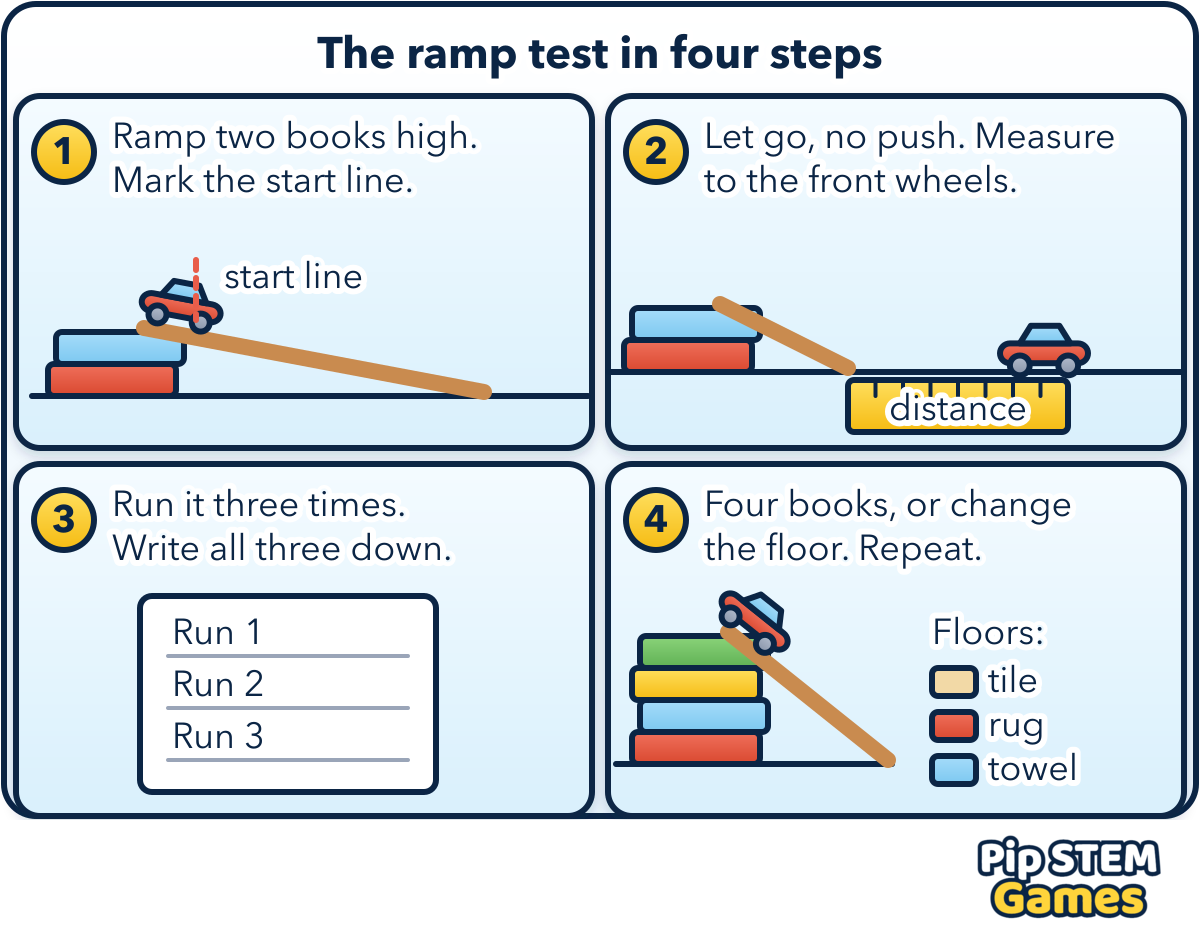
A steeper ramp gives gravity a bigger share of the job, so the car leaves faster and goes further. A rug or towel adds friction, so the car stops sooner. Kids aged 8 to 12 can chart the results and spot which change mattered most. Kids aged 5 to 7 can just call out "further" or "shorter" and put the car in a race order.
You can try the same idea on screen in the Ramp Runner game, where changing the slope changes how the run ends.
What can a tug-of-war and a balloon teach about force?
A tug-of-war teaches balanced and unbalanced forces, and a balloon teaches that forces come in pairs. Both take five minutes.
Tug-of-war with a rope or scarf. Two players pull equally and the middle knot barely moves. Add a third player to one side and it slides their way. Ask, "What changed? Which way did the winning force point?" For a quieter version, use two toy cars joined by string and a hair elastic. Watch which one drags the other.
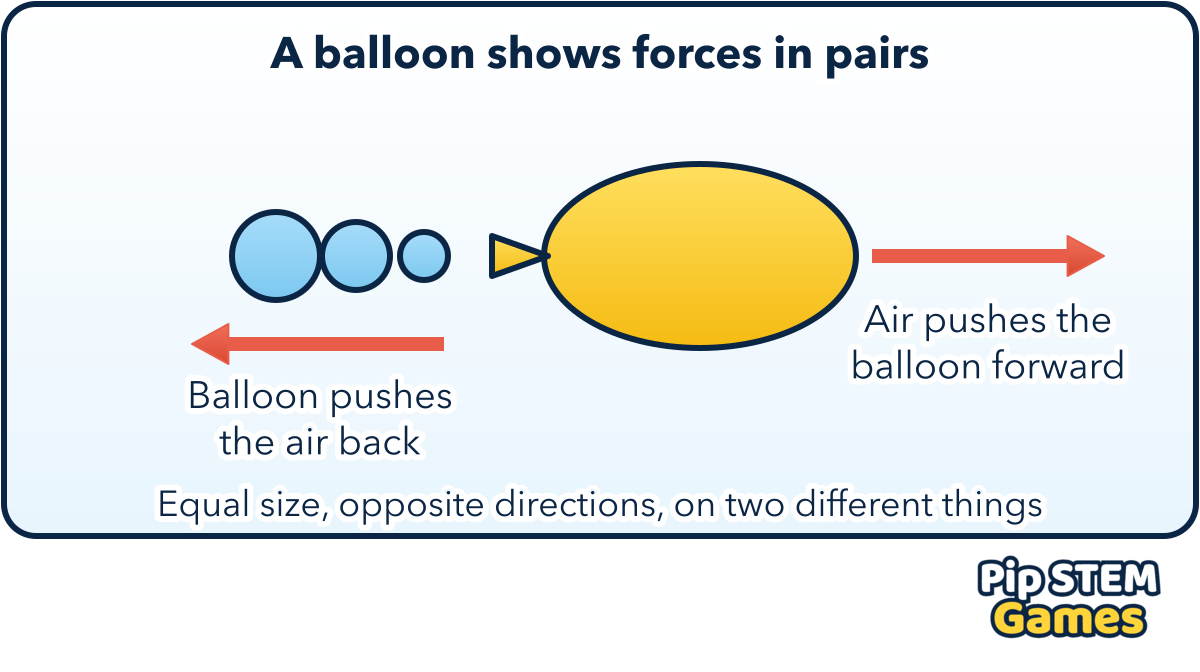
Balloon push. An adult blows up the balloon, because burst pieces are a choking risk for under-8s. Pinch the neck, then let go. The balloon pushes the air backwards, and the air pushes the balloon forwards with an equal force. That pair of pushes is Newton's third law, simplified. Our balloon-powered car project uses the same trick to drive wheels, and the pulley build shows how a rope can change the direction of a pull.
If something doesn't work, check the basics first. Is the rope slipping? Is the balloon pinched shut? Failed tests are data. Ask your child what they'd change, then change only that.
How do you teach forces to ages 5 to 7 versus 8 to 12?
Ages 5 to 7 learn forces through words and bodies. Ages 8 to 12 add measuring and explaining. Same activities, different questions.
Ages 5 to 7 (Junior). Keep it to push, pull, fast, slow and stop. Sort objects into "push" and "pull" cards: swing, zip, drawer, doorbell. Roll cars down a ramp and say which went furthest. Don't mention newtons yet.
Ages 8 to 12 (Senior). Bring in balanced and unbalanced forces, friction and gravity. Ask for a prediction before every test, then compare it with the result. Hang a small bag from an elastic band and mark how far it stretches as you add coins. That's how a spring scale measures newtons. Ask why a heavier toy needs a bigger push to move.
The Junior Engineers workbook has simple push-and-pull puzzles for the younger group, and the Engineering Workbook for Kids has harder challenges for ages 8 to 12.
Pro tip: ask "what would happen if" before each test. Predicting is half the learning, and being wrong is welcome.
Questions parents ask
What is the simplest definition of a force?
A force is a push or a pull. It can make an object start moving, stop, speed up, slow down or change direction.
What is the difference between balanced and unbalanced forces?
Balanced forces are equal and opposite, so they cancel and nothing about the motion changes. Unbalanced forces are not equal, so the object's speed or direction changes.
Is gravity a push or a pull?
Gravity is a pull. It tugs everything towards the centre of the Earth, which is why dropped things fall.
What unit do we use to measure force?
Force is measured in newtons (N). Kids don't need the number yet; the idea matters more at first.
What age can children learn about forces?
Children as young as 5 can learn pushes and pulls by playing. Balanced and unbalanced forces suit ages 8 and up, with measuring and graphs for ages 10 to 12.
Why does a toy car stop rolling?
Friction between the wheels and the floor, plus air resistance, slow it down. With no new push, those forces win and the car stops.
What is the easiest force experiment at home?
Roll a toy car down a ramp and measure how far it goes. Change the ramp height or the floor surface, one at a time, and compare.
Great STEM activities to try next...
 Make a Balloon-Powered Car at HomeActivity
 Build a Simple Pulley With Household ItemsActivity
 10 Things in Your Recycling Bin That Can Become STEM ProjectsActivity
More to try:

Pip STEM Games
We make engineering games and workbooks for kids aged 5 to 12. Every activity here is one we'd happily run at the kitchen table: test it, watch it fail, fix it, try again.




