

Key takeaways
- A fixed pulley is a grooved wheel with a rope over it, and it changes the direction of the pull.
- You can build one in about 15 minutes from a thread spool, string and a firm hook.
- Keep the load soft and under 200 grams, stand beside it, and keep string off fingers and necks.
- Pulling down 30 cm lifts the load about 30 cm, so the gain is direction, not less effort.
- A printable sheet and a cheat sheet help children record and share what they find.
A simple pulley is a grooved wheel with a rope over it, and you can build one at home from an empty thread spool, some string and a firm hook. Pull one end of the string down and a light pouch on the other end goes up. This guide shows how to build it safely, what to notice, and how to fix it when it sticks, with a printable test sheet.
What is a pulley and how does it work?
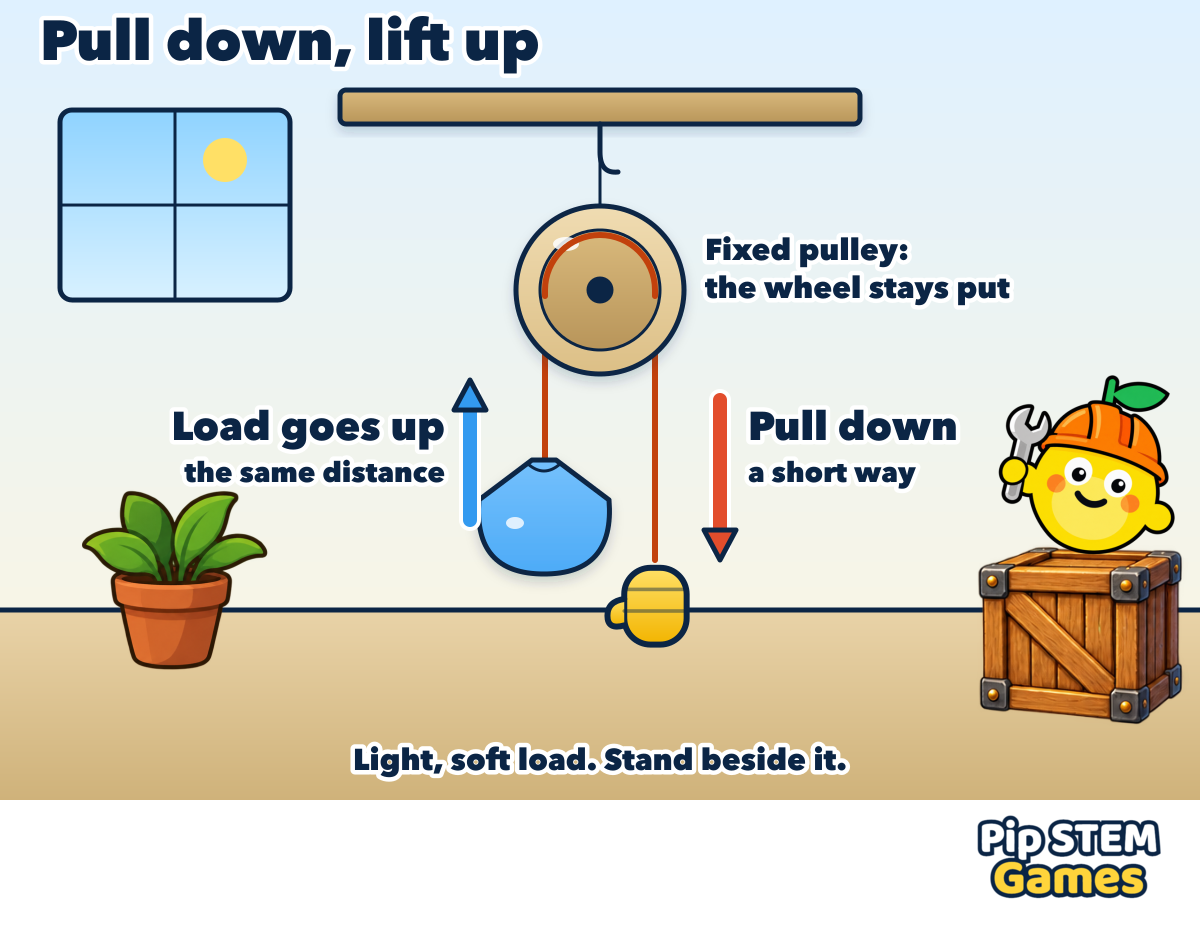
A pulley is a wheel with a groove that a rope runs over. When you pull one end of the rope down, the wheel turns and the other end goes up. The rope changes direction, and that is the whole trick.
The pulley you build here is a fixed pulley, because the wheel stays in one place. It doesn't make the load feel lighter. What it gives you is a better way to pull: down is usually easier than up, because you can lean your weight into it and stay out from under the load.
You have seen the same idea on flagpoles, window blinds, cranes and sailing boats. For more on how machines like this fit together, read simple machines for kids.
What do you need to make a pulley at home?
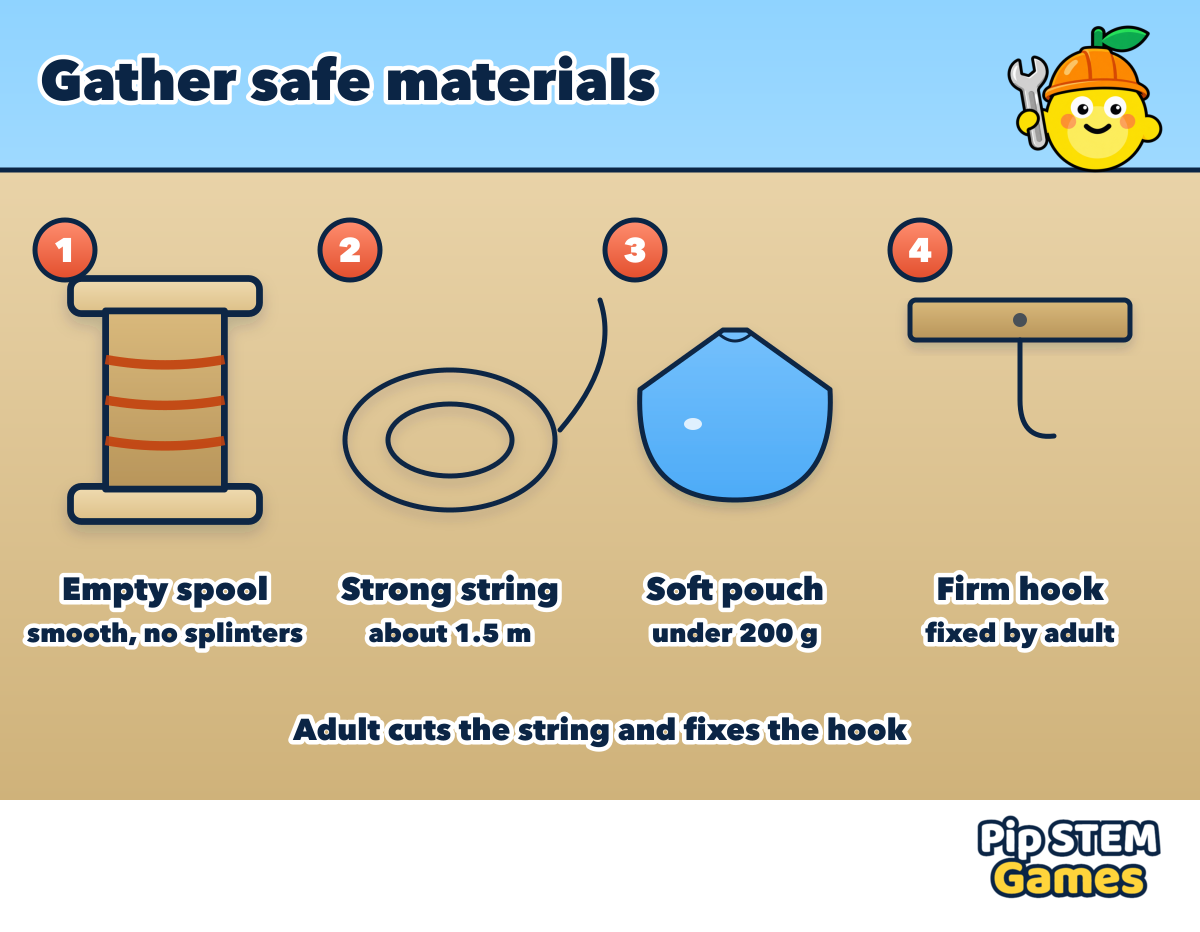
You need four things, and most homes have them already. It takes about 15 minutes.
- An empty thread spool, wood or plastic. Check it is smooth with no splinters or cracks. A ribbon spool with wide rims works well too.
- About 1.5 metres of strong, smooth string. Cotton twine or a shoelace is good. Avoid stretchy yarn or elastic, because it stretches instead of pulling the load.
- A soft, light pouch such as a small fabric bag with one scrunched sock inside. Keep it under 200 grams.
- A firm hook that an adult has screwed in, such as a cup hook in the underside of a solid wooden shelf. No stick-on hooks.
Adult jobs: cut the string, fix the hook, and give it a hard tug before every test. If the hook moves even a little, stop and fix it properly.
How do you build and test a simple pulley?
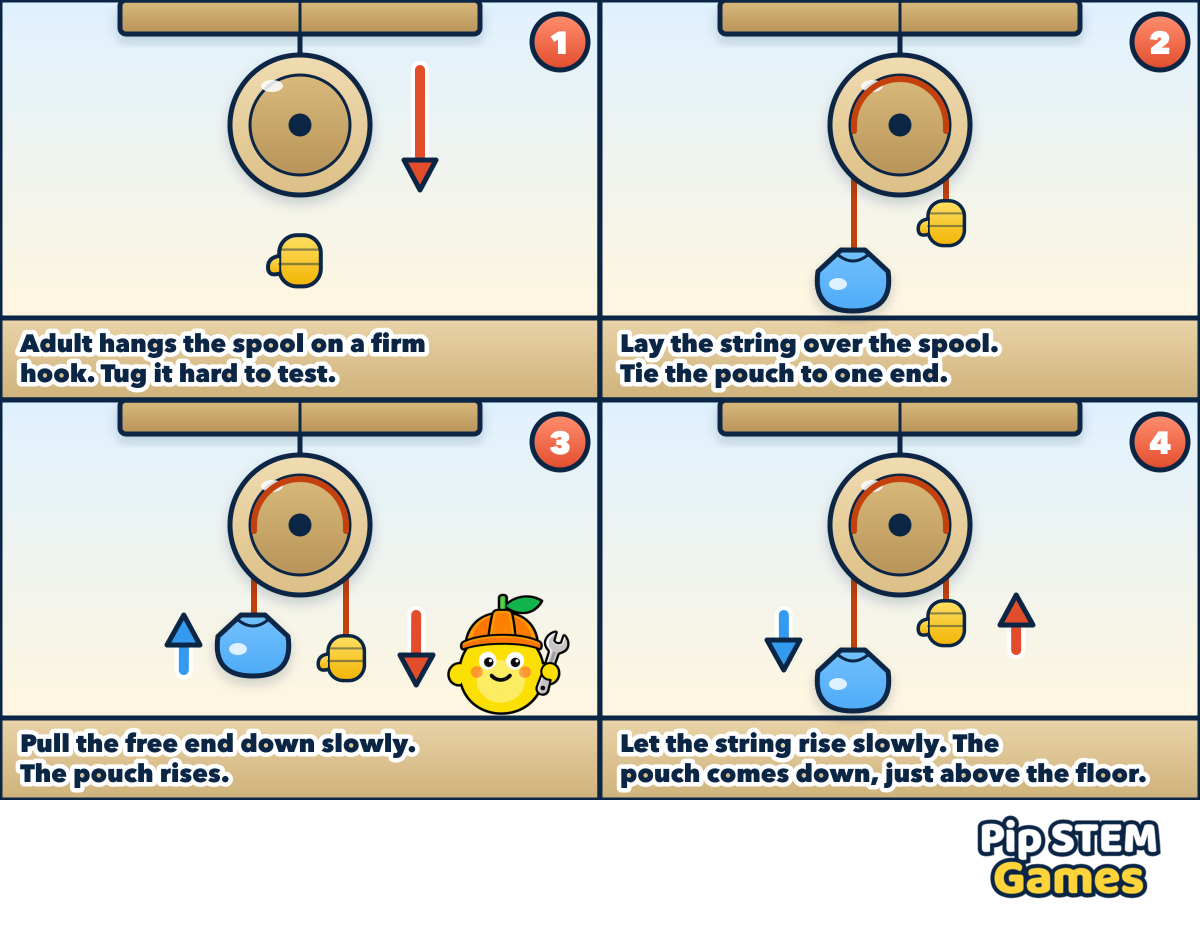
Follow these steps. An adult stays nearby for the whole test.
- An adult fixes the hook at about a child's head height or a little higher, then tugs it hard to check it is firm.
- Thread a loop of string through the spool's hole and hang the loop on the hook. The spool should hang free and turn.
- Lay the long string over the top of the spool, in the middle of the groove, so one end hangs on each side.
- Tie the soft pouch to one end. Let it hang just above the floor.
- Hold the other end. Pull it down slowly and watch the pouch rise.
- Let the string rise slowly so the pouch comes down gently. Don't drop it.
Safety: stand beside the pouch, never under it. Keep fingers away from the gap between string and spool, where they can pinch. Never wrap string round a hand, wrist or neck. Don't lift people, heavy things or anything breakable. Take the string down when you've finished, especially around under-fives. Stop if the hook moves or the string frays. Use the pulley only at a low height, never from a high shelf or a chair.
What should your child notice?
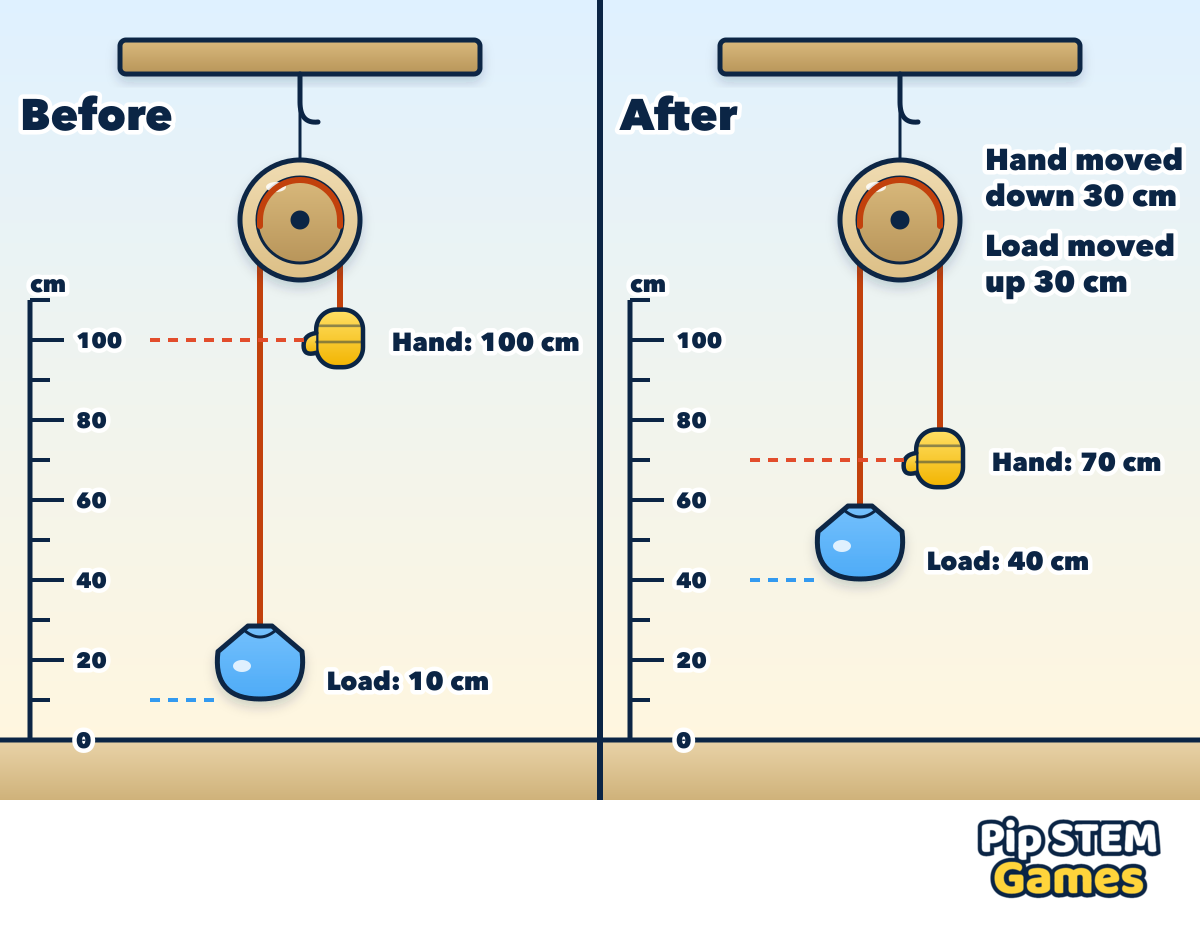
Your child should notice that the hand goes down while the pouch goes up, and that both move about the same distance. Measure it. Stick a strip of tape on the string, hold a ruler or tape measure beside it, and compare.
Does it feel easier than lifting the pouch by hand? Not really, and some of it may even feel harder, because the spool rubs a little. That rubbing is called friction. The win is the direction. Ask your child where pulling down would be handier than lifting up, such as a flag high on a pole.
Pro tip: ask for a prediction before every test. Children remember a surprise far longer than an answer you tell them.
The Pulley Puzzle game asks the same question on screen. Children can try it in the Pulley Puzzle game once the real one has made sense.
What if the string slips or the spool sticks?
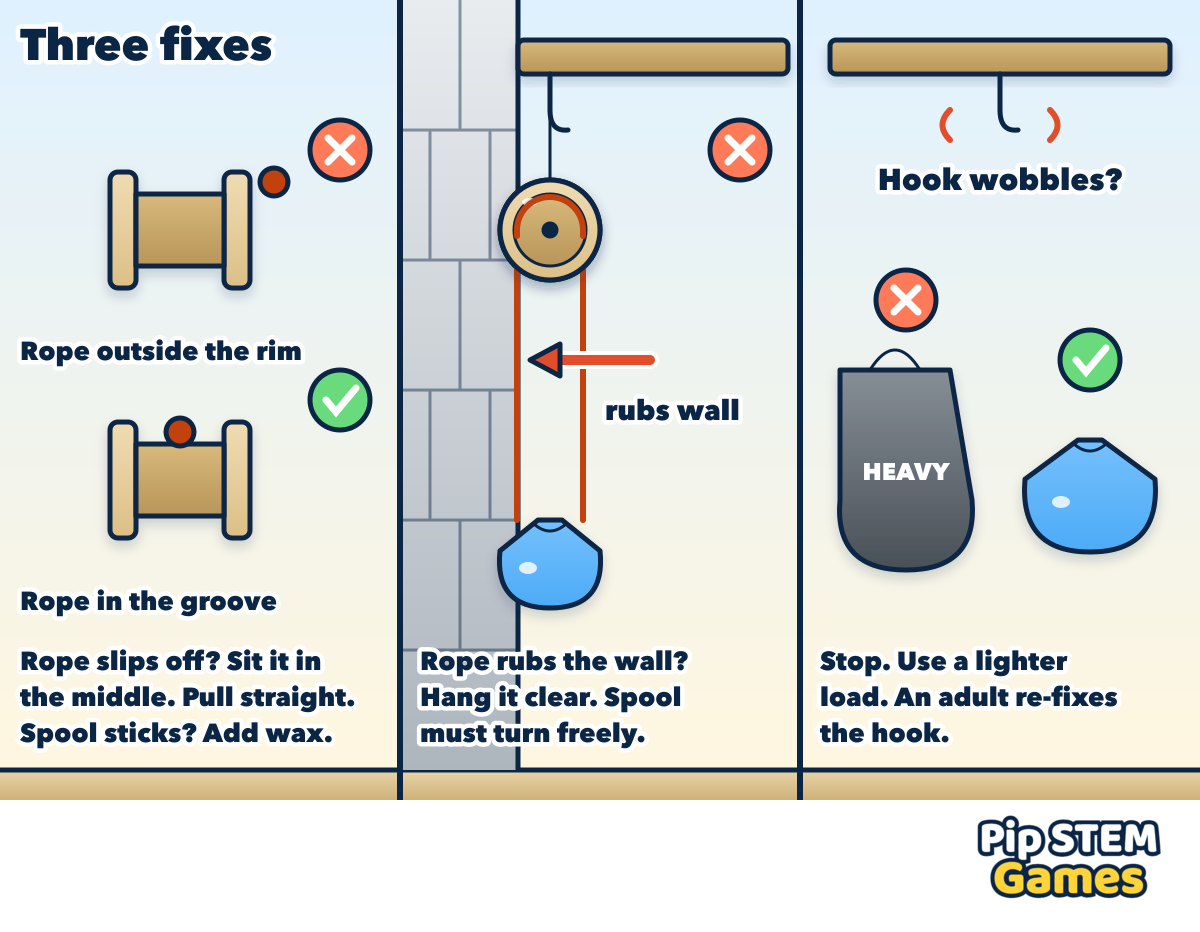
Most problems come from the string, the spool or the support. Fixing them is the best part, because that is what engineers do all day.
- The string slips off the spool. Check it sits in the middle of the groove and the pull is straight down.
- The spool sticks or squeaks. Use smooth string, hang the spool clear of walls, and rub a little candle wax on the loop.
- The pouch swings or twists. Pull slowly and straight down.
- The hook wobbles. Stop. An adult needs to fix it again, or move to a firmer spot.
If the stuck spool is still a problem, try a small ready-made pulley wheel from a hardware shop. It turns more freely.
What is the difference between a fixed and a movable pulley?
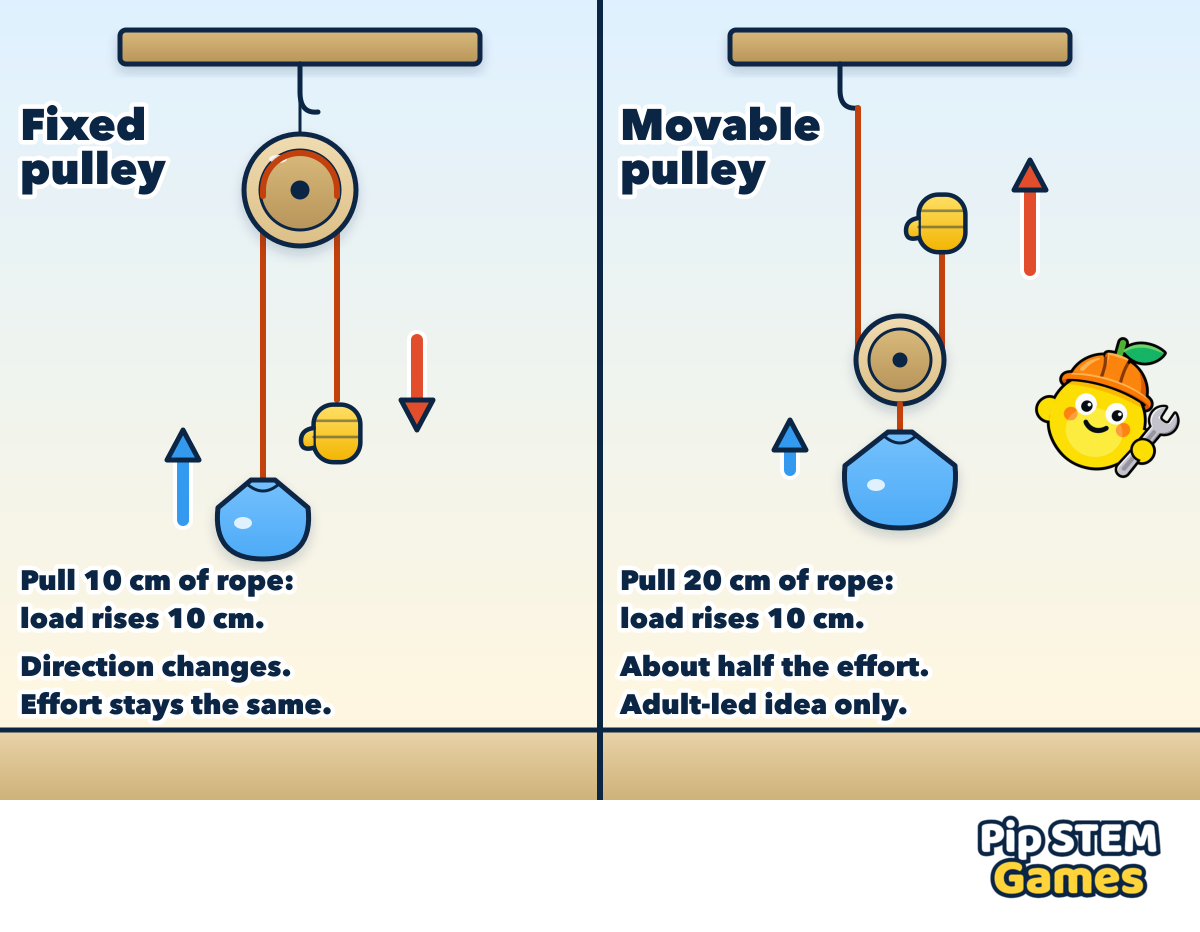
A fixed pulley changes the direction of the pull, and a movable pulley cuts the effort. A movable pulley hangs on the load itself, with one end of the rope fixed above. In an ideal case, with no friction, you pull about half as hard, but you pull twice as much rope.
The trade is always the same: less effort costs more distance. That is why a crane with many wheels uses a lot of rope. Try this one only as a thinking exercise, or with an adult leading and a very light load. Our lever examples show the same trade between effort and distance.
How do you change it for each age?
Match the job to the child.
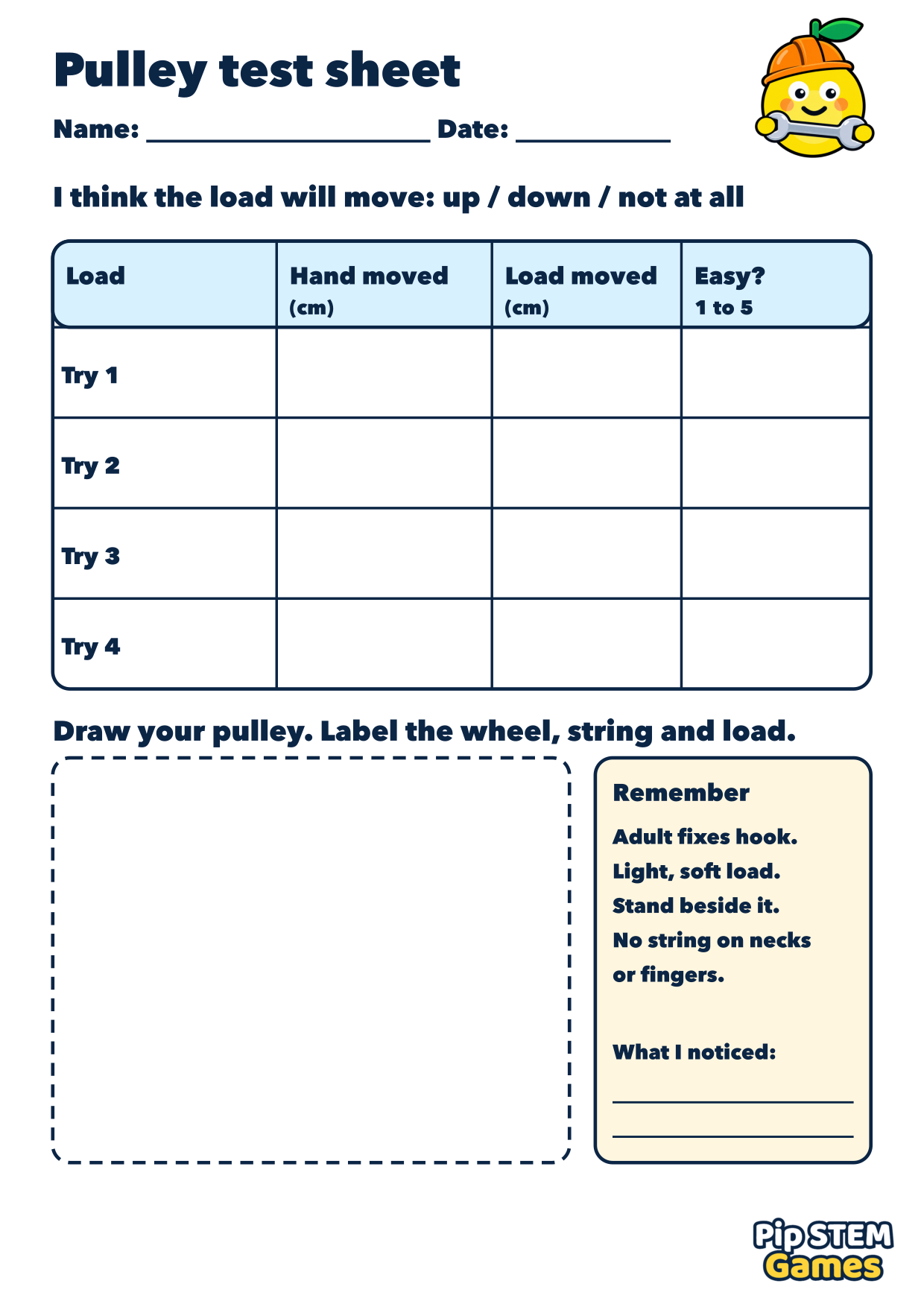
- Ages 5 to 7 (easier): an adult fixes the hook and threads the string. The child pulls and watches, then says up or down. Use the printable sheet to tick what they saw.
- Ages 8 to 12 (harder): measure hand distance and load distance for three tries, add one more sock, and compare how easy each pull feels. Then draw what a movable pulley would look like.
Print this sheet to record each try.
Save this cheat sheet for the fridge, or for the next rainy afternoon.
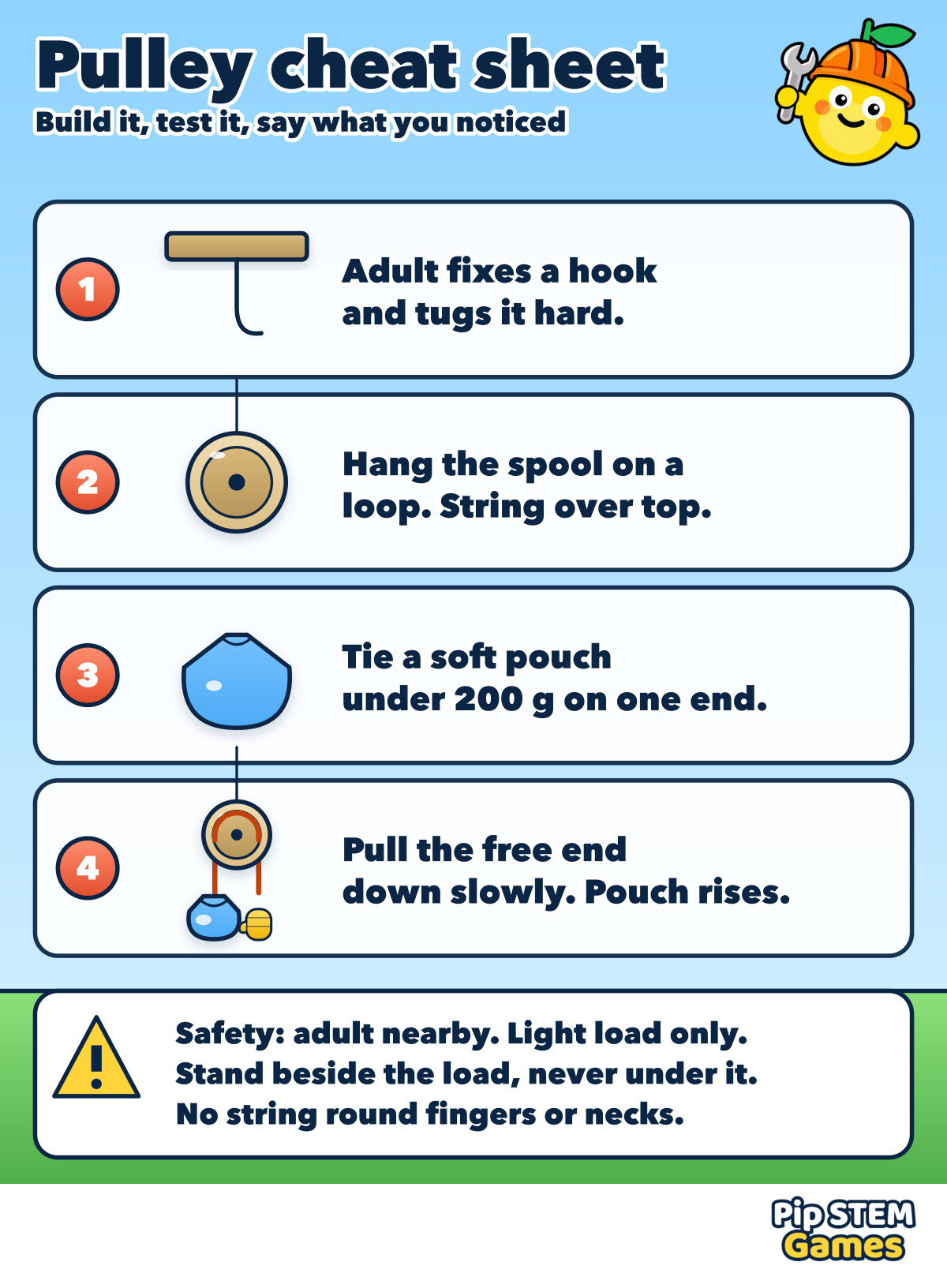
Pulleys also appear in the Gear and Crane games, and the Senior Engineers workbook has more machine challenges for ages 8 to 12. Younger children can try the Junior Engineers workbook. For a bigger build, see three ways to build a mini crane.
Questions parents ask
Does a pulley make lifting easier?
A single fixed pulley doesn't reduce the effort. It changes the direction, so you pull down instead of lifting up. Pulleys with a movable wheel can cut the effort, but you pull more rope.
What can I use instead of a thread spool?
A ribbon spool works well, and so does a small ready-made pulley wheel from a hardware shop. Whatever you pick, it must turn freely and have a rim or groove to hold the string.
How heavy a load is safe?
Keep it soft and under 200 grams, such as a small fabric pouch with a scrunched sock. Never lift anything heavy, breakable or alive, and never stand under the load.
What age is this activity for?
It suits ages 5 to 12 with an adult nearby. Under 8s need an adult to fix the hook and thread the string. Keep spools and string away from children under 3.
Why use a spool and not just the bare hook?
A string dragged over a bare hook rubs and sticks. A spool turns, so the string rolls over it with much less friction.
Where do we see pulleys in real life?
Flagpoles, window blinds, cranes and sailing boats all use pulleys. Many cranes use several wheels to cut the effort.
Great STEM activities to try next...
 Simple Machines for Kids: The 6 Types, With Examples and Activities [Printable]How it works
 Three Ways to Build a Mini CraneBuild challenge
 STEM Activities by Age: 5–7, 8–10 and 11–12Parent guide
More to try:

Pip STEM Games
We make engineering games and workbooks for kids aged 5 to 12. Every activity here is one we'd happily run at the kitchen table: test it, watch it fail, fix it, try again.




