

Key takeaways
- A lever is a stiff bar that turns around a fixed point called the fulcrum.
- Every lever has a fulcrum, an effort (your push) and a load (what moves).
- The part in the middle gives the class: fulcrum, load or effort.
- A seesaw, a wheelbarrow and tweezers show one class each.
- A ruler and coin test shows that weight times distance sets the balance.
A lever is a stiff bar that turns around a fixed point, called the fulcrum, to help you move a load with a push or pull called the effort. Seesaws, wheelbarrows and tweezers are all levers. This page shows how each one works, how to tell the three classes apart and how to test a lever at home with a ruler.
What is a lever?
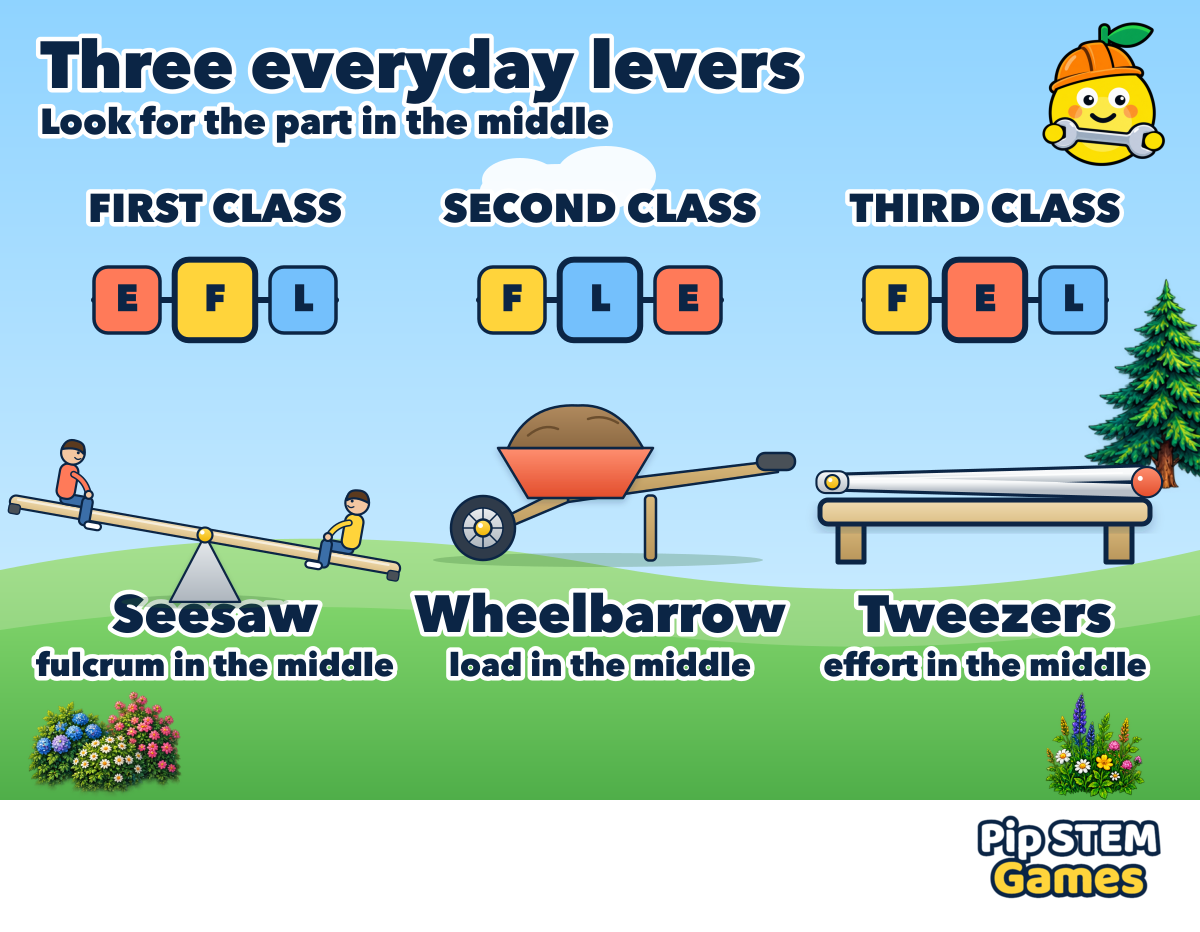
A lever is a stiff bar that turns around one fixed point. You push or pull on it, and it helps you move something. Every lever has three parts.
- Fulcrum: the pivot the bar turns around.
- Effort: the push or pull you put in.
- Load: the thing you want to move, or the thing pushing back.
If you can find all three, you have found a lever. The trick is which part sits in the middle. That decides whether it is a first, second or third class lever. This page picks one everyday example of each, so you can see all three kinds. Our guide to levers goes further into the classes, so here we keep to three objects and one test.
Why is a seesaw a first class lever?
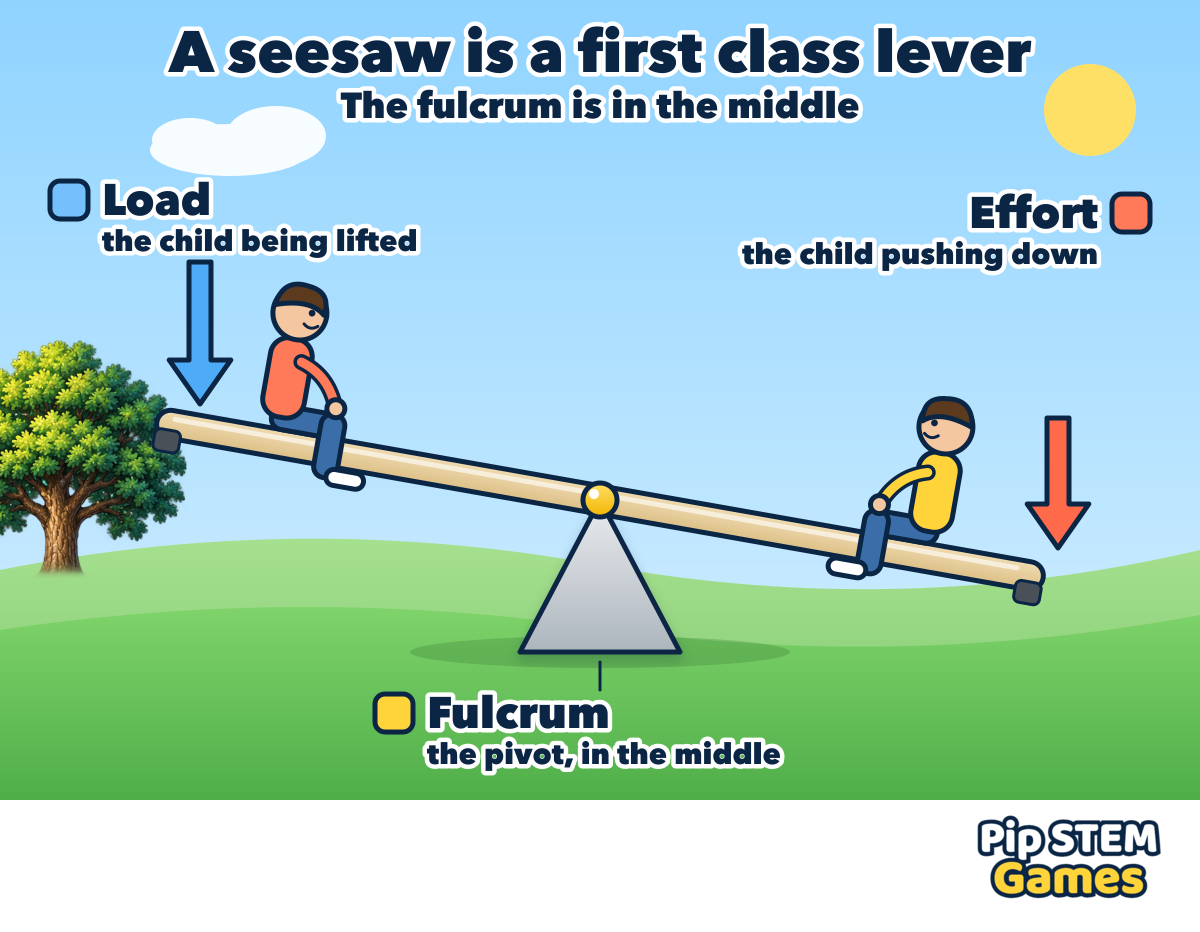
Look at the seesaw. The pivot sits in the middle, so the fulcrum is in the middle. One child pushes down (the effort) and the other child goes up (the load). Either child can be either one, which is why a seesaw swaps roles all the time.
A heavy child sitting close to the pivot can balance a lighter child sitting far from it. Distance matters as much as weight. Hold on to that idea, because the home test below uses it.
Why is a wheelbarrow a second class lever?
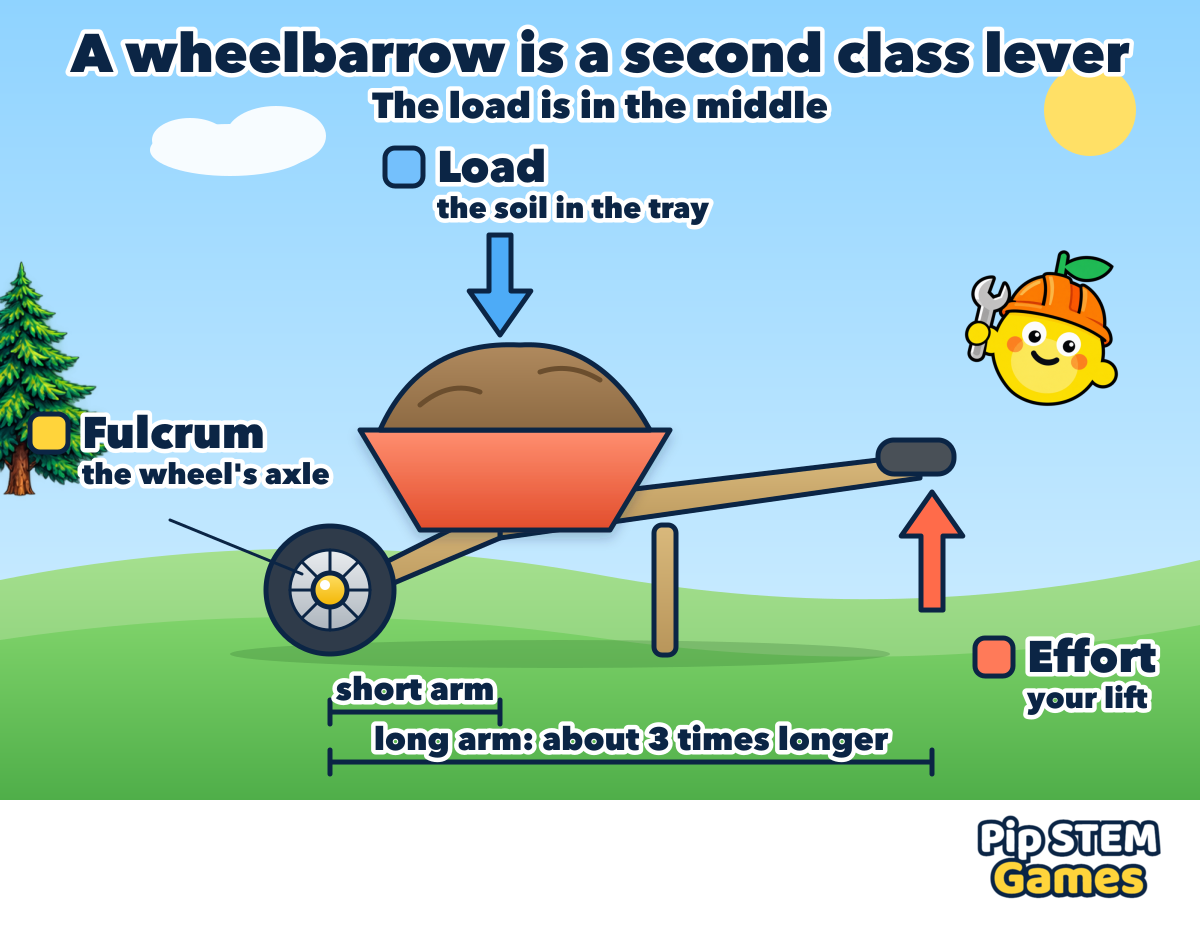
In a wheelbarrow the load is in the middle. The wheel is the fulcrum, at the front. The soil sits in the tray, between the wheel and your hands. Your hands on the handles are the effort, at the far end.
The handles are roughly three times as far from the wheel as the soil is. So in a simple model you lift about a third of the weight, and the wheel carries the rest. That is why a heavy load feels lighter than it is. Real wheelbarrows vary, so treat that as a rough guide.
Why are tweezers a third class lever?
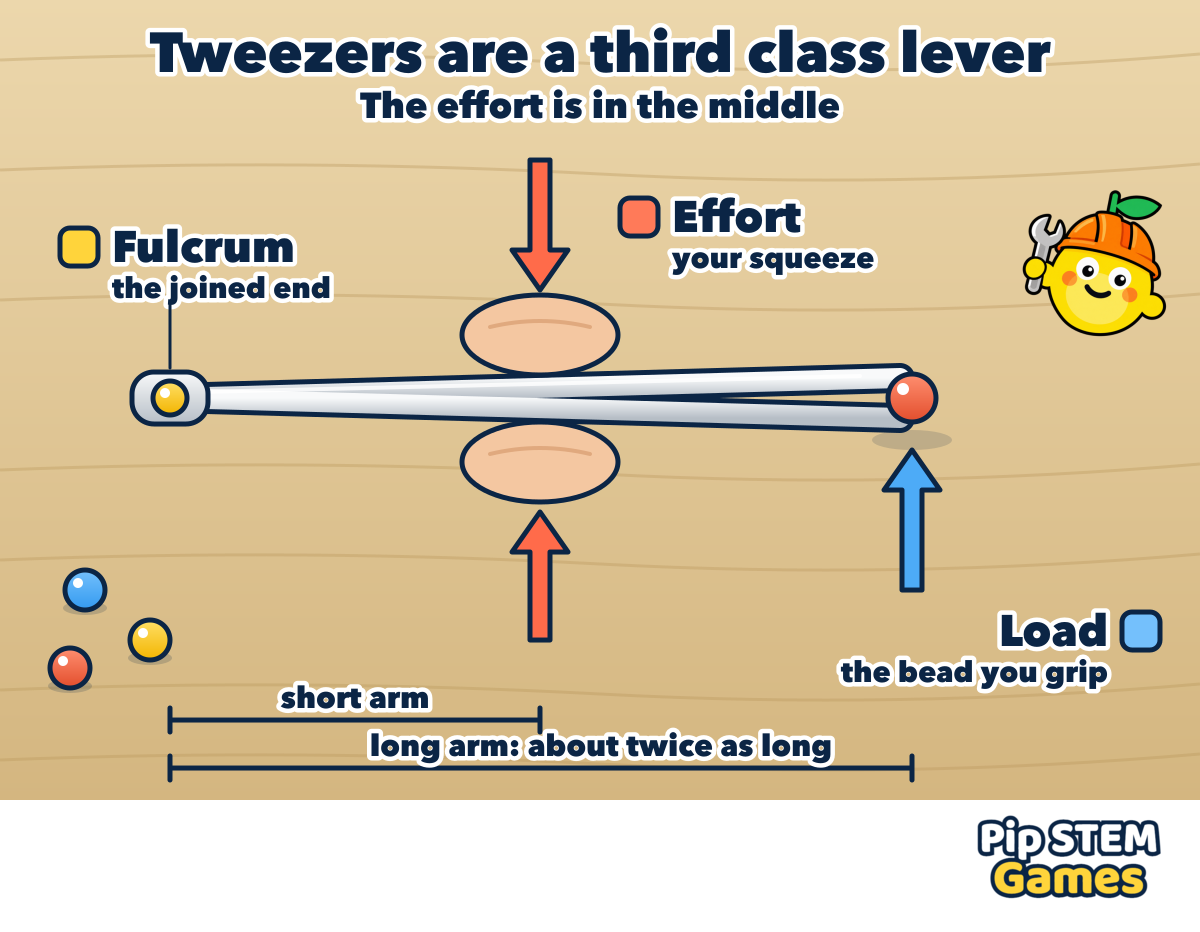
Tweezers are two bars joined at one end. The joined end is the fulcrum. The tips grip the load, which is the bead or splinter. Your fingers squeeze in the middle, so the effort is in the middle.
The effort is closer to the pivot than the load is. So you have to squeeze harder than the grip at the tips. The reward is control, because the tips move further than your fingers and let you pick up tiny things. Fishing rods work the same way.
Class check: a bottle opener or a crowbar can sit in different classes depending on how you hold them, so we left them out. These three are clear.
What is the quick way to tell the three classes apart?
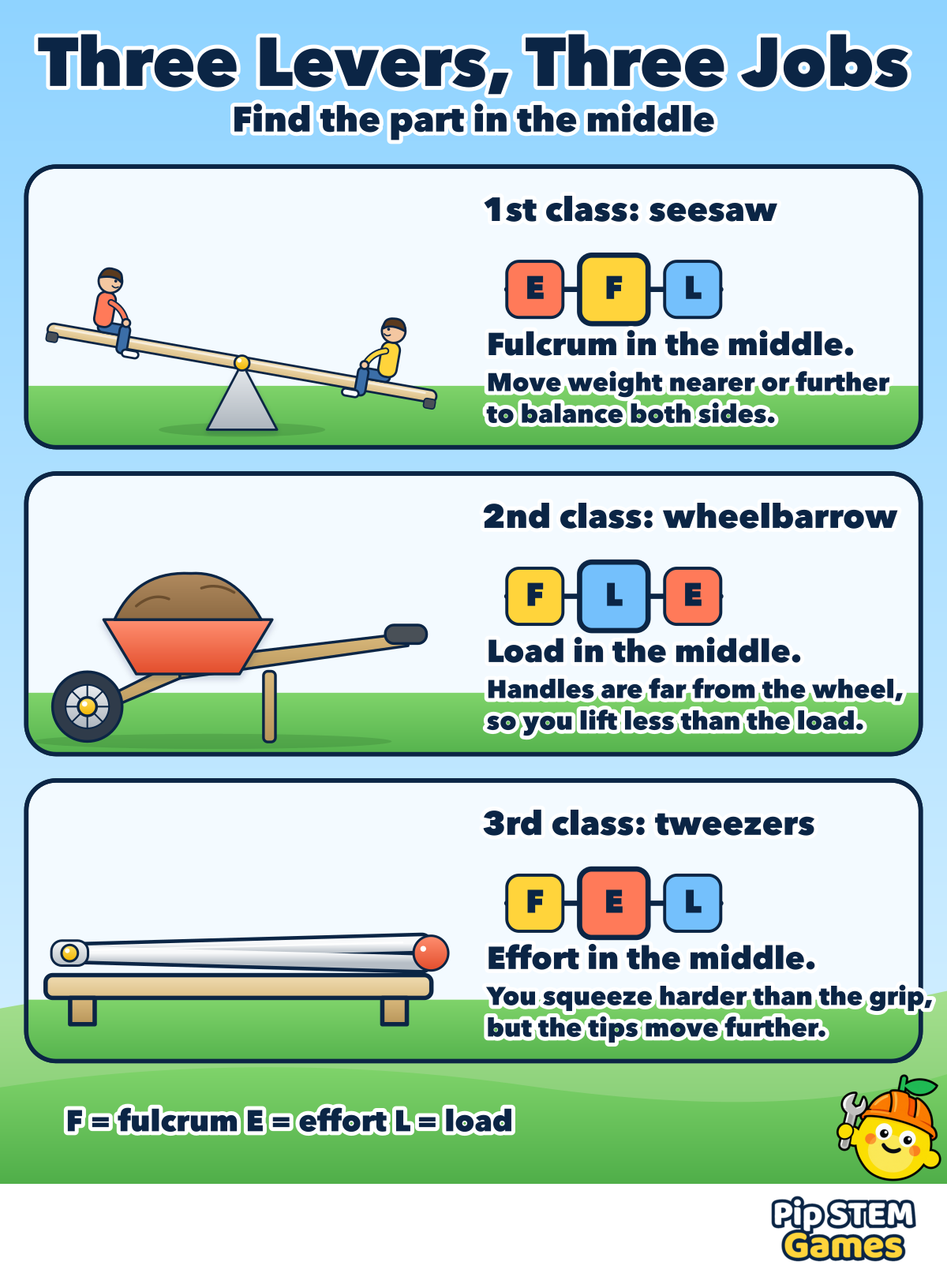
Write F, E and L on a scrap of paper and put the middle one in the centre. Fulcrum in the middle is first class. Load in the middle is second class. Effort in the middle is third class. Save the picture to your phone or print it for the fridge.
You can also meet a lever in a game. Try it in the Lever Lab game and see how far you have to move the fulcrum to lift a heavy load.
How can you test a lever at home?
This takes about 10 minutes. It shows that weight times distance decides the balance. It fits ages 8 to 12, and younger children can do it with a grown-up.
You need: a 30 cm ruler, a round pencil, a roll of masking tape and about six 10p coins.
- Tape the pencil to the table so it cannot roll.
- Rest the ruler across the pencil at the 15 cm mark. Using the middle means the ruler's own weight cancels out.
- Put one coin on the left at 10 cm from the pencil. Put one coin on the right at 10 cm. It should balance.
- Now keep one coin on the right at 10 cm. Try two coins on the left. Predict where they must go to balance, then slide them until it levels. They should sit at 5 cm.
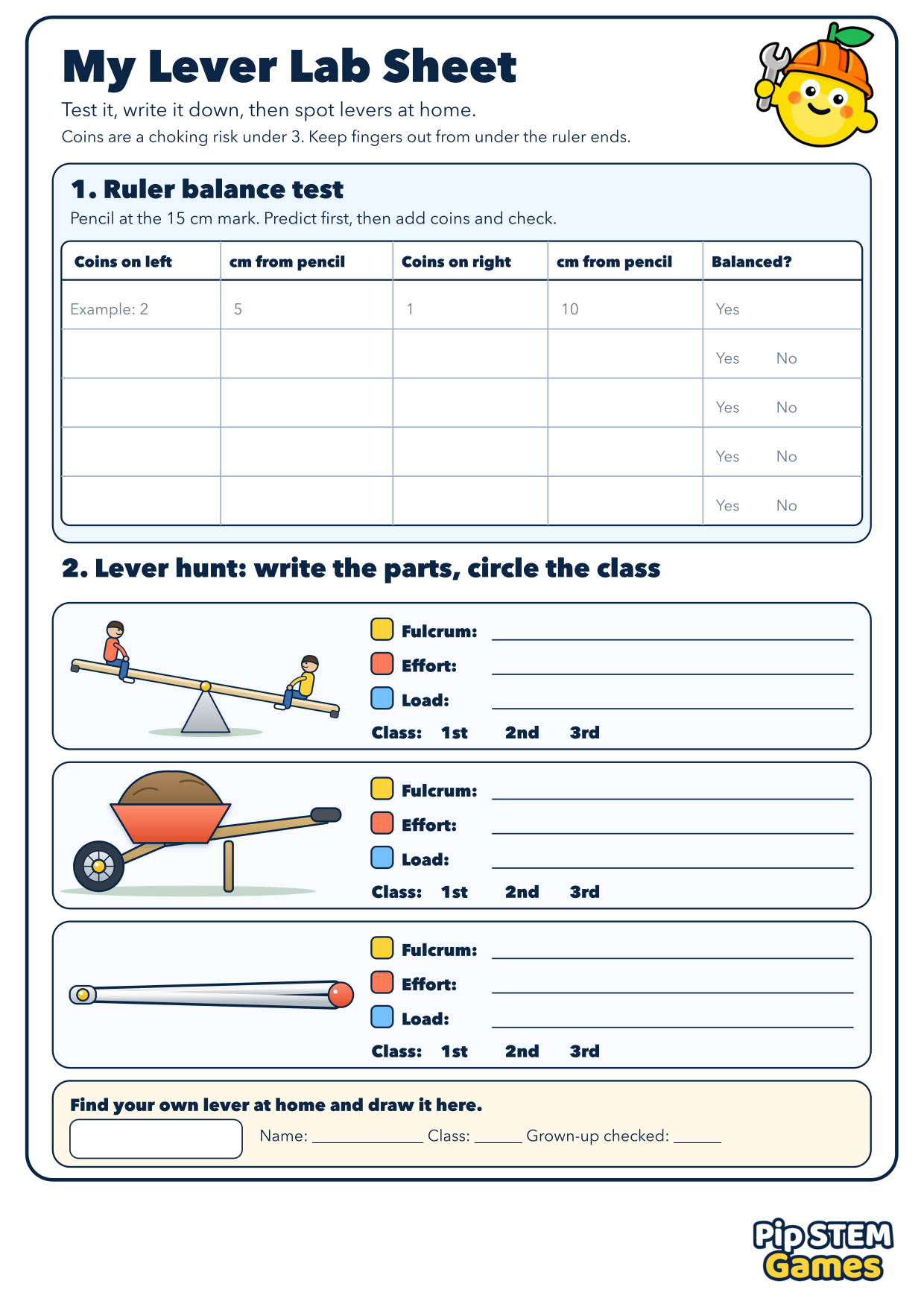
- Fill in the table on the printable sheet.
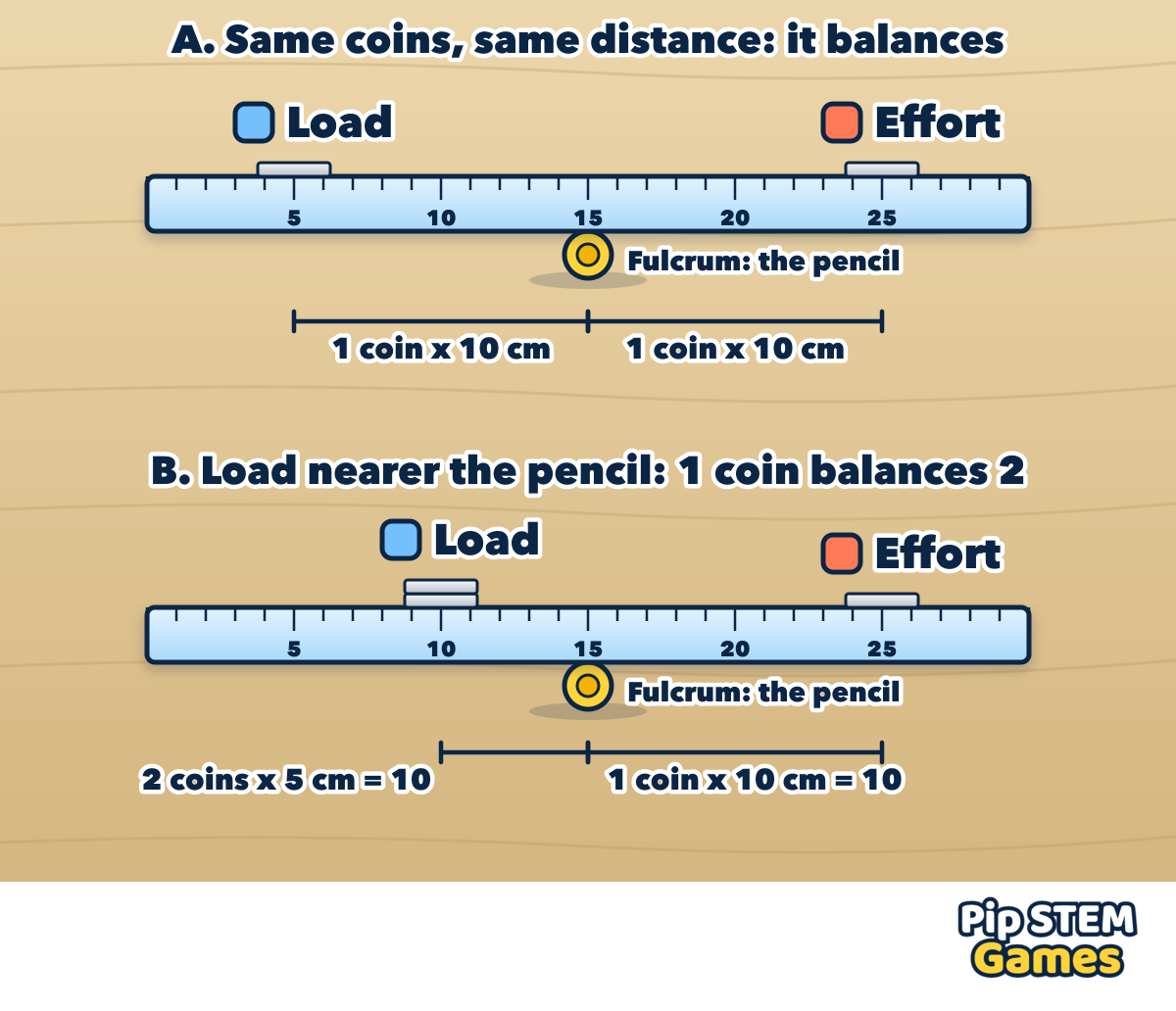
If it does not work: check that the pencil is taped and the ruler is flat. Stack coins neatly and measure from the pencil to the middle of each stack. Real rulers are a little uneven, so a coin might sit a few millimetres out. That is normal.
Safety: coins are a choking risk for children under 3. Keep fingers out from under the ruler ends, because it can tip and pinch. Do not flick or launch coins off the ruler. Use blunt tools and ask a grown-up before testing real tools such as a crowbar or a pair of scissors.
How can you change it for each age?
- Ages 5 to 7: use the seesaw picture. Point at the fulcrum, effort and load, and balance two coins at the same distance on both sides.
- Ages 8 to 10: do the whole test and fill in the table. Predict first, then check.
- Ages 11 and up: write weight times distance for each side. Use the idea to explain why the handles of a wheelbarrow are long.
Want more to try? The simple machines for kids page shows how levers sit alongside pulleys and wheels. Then hunt for levers at home, such as a door handle or a spoon. Talk about where the pivot is and what moves.
Questions parents ask
What is a lever in simple words?
A lever is a stiff bar that turns around a fixed point. You push or pull on one part, and it moves something else. A seesaw is a good example.
What are the three parts of a lever?
The fulcrum is the pivot. The effort is the push or pull you apply. The load is the thing you want to move, or the thing that pushes back.
What are the three classes of lever?
In a first class lever the fulcrum is in the middle, like a seesaw. In a second class lever the load is in the middle, like a wheelbarrow. In a third class lever the effort is in the middle, like tweezers.
Do levers make work easier?
Some do. A long wheelbarrow handle means you lift less than the full weight, though you move your hands further. Tweezers do the opposite. You squeeze harder, but you gain control and small movements.
Is a pair of scissors a lever?
Yes, in a way. Scissors are two levers joined at one pivot. Because they can be sharp, let a grown-up help younger children and use blunt-ended ones.
How do I test a lever at home safely?
Use a taped pencil, a ruler and a few 10p coins. Keep coins away from children under 3 and keep fingers clear of the ruler ends. Never launch coins or use sharp tools for the test.
Great STEM activities to try next...
 Simple Machines for Kids: The 6 Types, With Examples and Activities [Printable]How it works
 How Do Lifts Work? [Printable]How it works
 Build a Simple Pulley With Household Items [Printable]Build challenge
More to try: Newton's Third Law Examples for Kids (Printable) · 10 Simple Machines Examples at Home for Kids

Pip STEM Games
We make engineering games and workbooks for kids aged 5 to 12. Every activity here is one we'd happily run at the kitchen table: test it, watch it fail, fix it, try again.




