

Key takeaways
- A balloon-powered car takes about 20 minutes to build from cardboard, three straws, two dowels, four bottle caps and a balloon.
- An adult blows up the balloon first, then attaches it; nobody blows in through the straw.
- Burst balloon pieces are a choking risk for children under 8, and most balloons are latex, so check for allergies.
- Air rushes out backwards and the car is pushed forwards, which is Newton's third law.
- A printable test sheet turns the build into a fair test of straw direction.
A balloon-powered car is a small cardboard car pushed along by air rushing out of a balloon. You can build one in about 20 minutes from cardboard, straws, bottle caps and a balloon. An adult blows up the balloon, because children under 8 can choke on balloons and burst pieces. Air shoots backwards out of the straw, and the car rolls forwards. This guide covers the build, the safe way to add the balloon, why it works, six fixes and a printable test sheet.
What do you need to make a balloon-powered car?
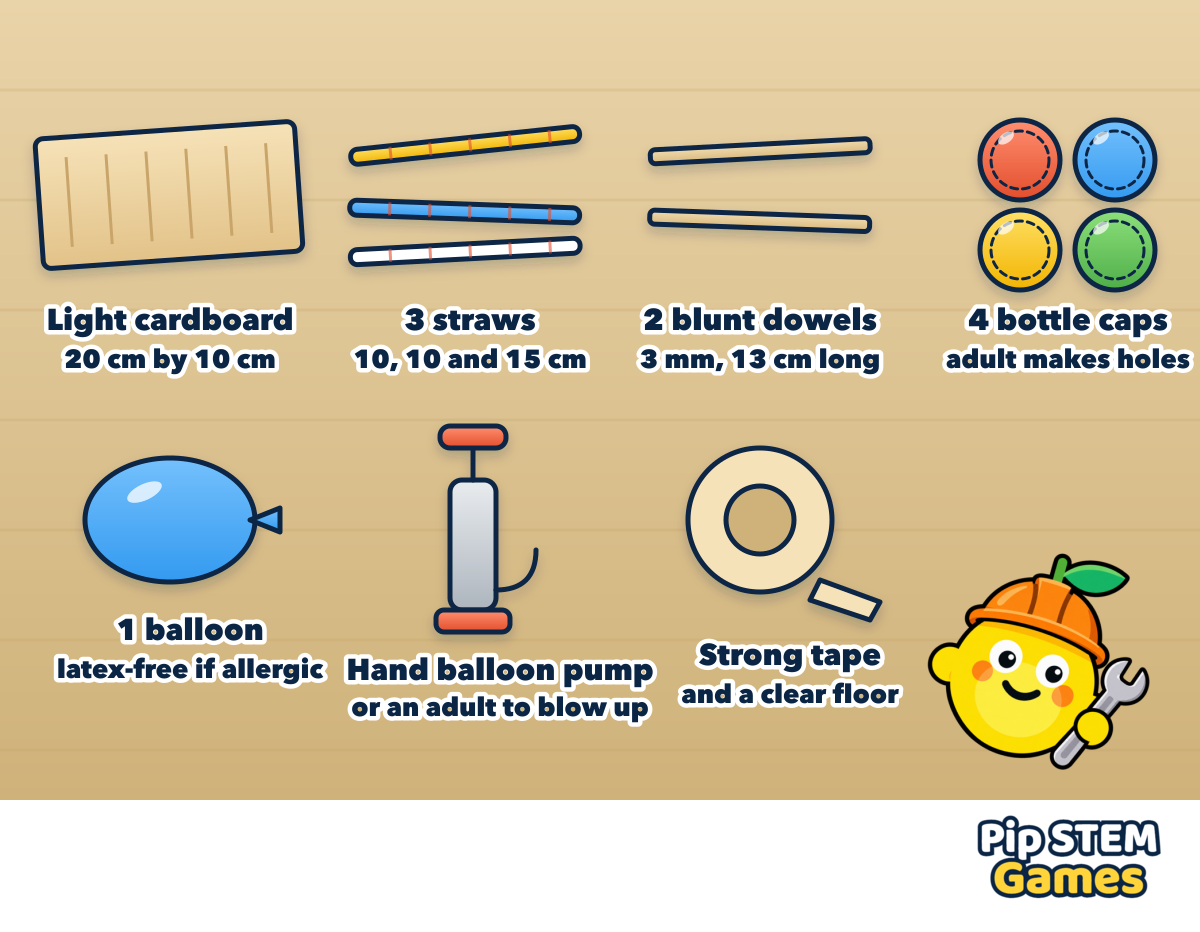
You need light cardboard, three straws, two dowels, four bottle caps, a balloon and tape. It takes about 20 minutes and suits ages 5 to 12, with an adult doing the cutting, the cap holes and the balloon blowing.
- Light cardboard: one piece, 20 cm long and 10 cm wide (a cereal box works)
- 3 drinking straws: cut two to 10 cm and one to 15 cm
- 2 blunt wooden dowels: 3 mm wide and 13 cm long, thin enough to slide through a straw
- 4 matching plastic bottle caps for wheels
- 1 balloon, latex-free if anyone nearby has a latex allergy
- A hand balloon pump (or an adult to blow up the balloon)
- Strong tape and a clear, flat floor
Three jobs belong to the adult: cutting the cardboard and straws, making a hole in the middle of each bottle cap, and blowing up the balloon. For the holes, rest each cap on a scrap of wood and push through the centre with a bradawl or small nail. Then twist a dowel in to widen it a little. You want the cap to grip the dowel, not slide about.
How do you build the car?
Tape two short straws across the bottom of the card, slide a dowel through each, press a cap on each end, then tape the long straw on top so it points backwards.
- Tape the axle straws. Turn the card over. Tape a 10 cm straw across the card, 4 cm in from each short end. Keep both straws parallel and square to the edges.
- Add the axles. Slide a dowel through each straw. About 1.5 cm should stick out at each side.
- Press on the wheels. Push a cap onto each dowel end, open side facing outwards. Leave a gap of about 3 mm between each cap and the card.
- Tape on the jet straw. Turn the car the right way up. Tape the 15 cm straw along the middle of the card, with 5 cm sticking out past the back edge. Use two bits of tape.
- Test the wheels. Give the car a gentle push on a smooth floor. It should roll in a straight line without wobbling.
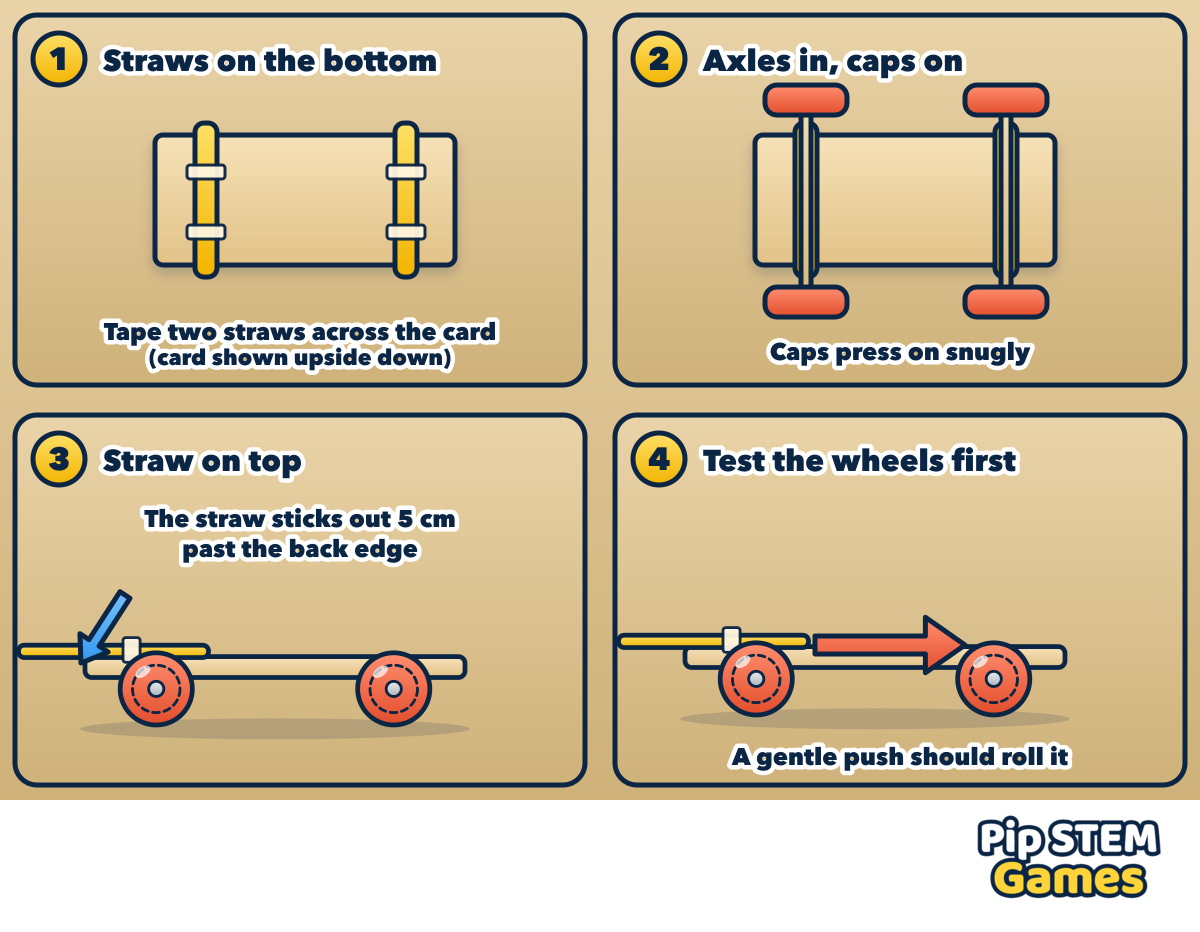
Don't skip the push test. A car that won't roll with a push won't roll with a balloon either, and the wheels are easier to fix before the balloon is on. If you spot a wheel rubbing, slide the cap outwards a little.
How do you add the balloon safely?
An adult blows up the balloon away from the car, pinches the neck shut, then slides the neck over the straw and tapes it. Nobody blows in through the straw.
Plenty of online guides tell children to inflate the balloon through the straw. Don't. A quick breath in could pull the straw or the wet end of a balloon towards the throat. Blowing the balloon up first keeps it well away from the mouth.
- Stretch it. An adult stretches the balloon a few times so it fills easily.
- Inflate it off the car. Use a hand pump, or the adult blows it up. Stop at about the size of a grapefruit.
- Pinch the neck. Hold it shut with two fingers so the air stays in.
- Slide it on. Keep pinching while a helper slides the neck about 2 cm over the front end of the long straw.
- Tape it tight. Wrap tape around the neck and straw so air can only leave through the straw. Never tape the straw shut.
- Launch. Put your finger over the back end of the straw, set the car on the start line, then let go.
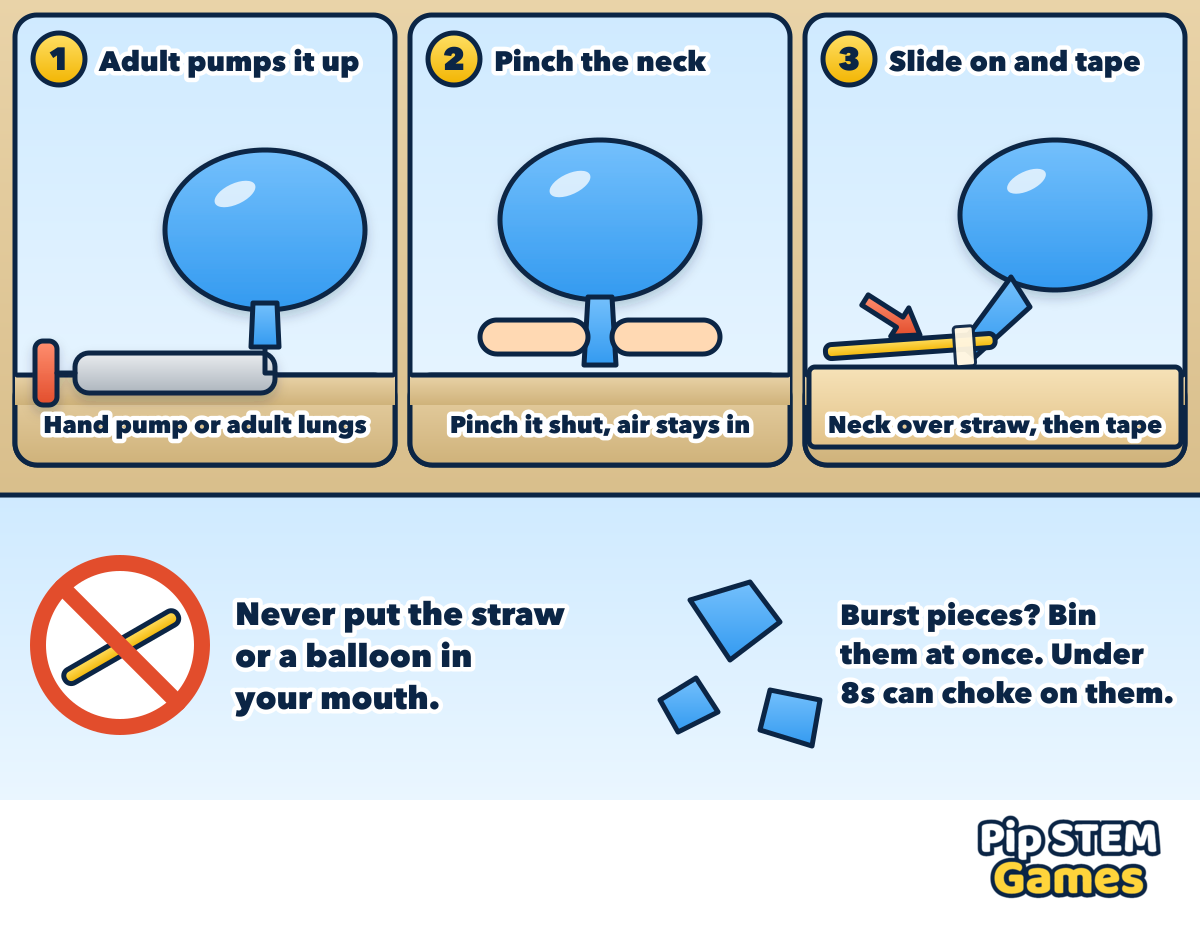
Please read these balloon rules before you start:
- Choking: children under 8 can choke or suffocate on uninflated balloons and on burst pieces. Adults should supervise closely and pick up every burst piece at once. Keep balloons, caps and dowels well away from children under 3.
- Latex allergy: most party balloons are made from latex, which can cause itchy skin, a runny nose or wheezing in people who are allergic, and rarely a severe reaction that needs a 999 call. If anyone nearby is allergic, use a latex-free balloon or choose a different project.
- Faces: point the car along the floor, and keep dowel ends and straw ends away from eyes.
Why does a balloon push a car forwards?
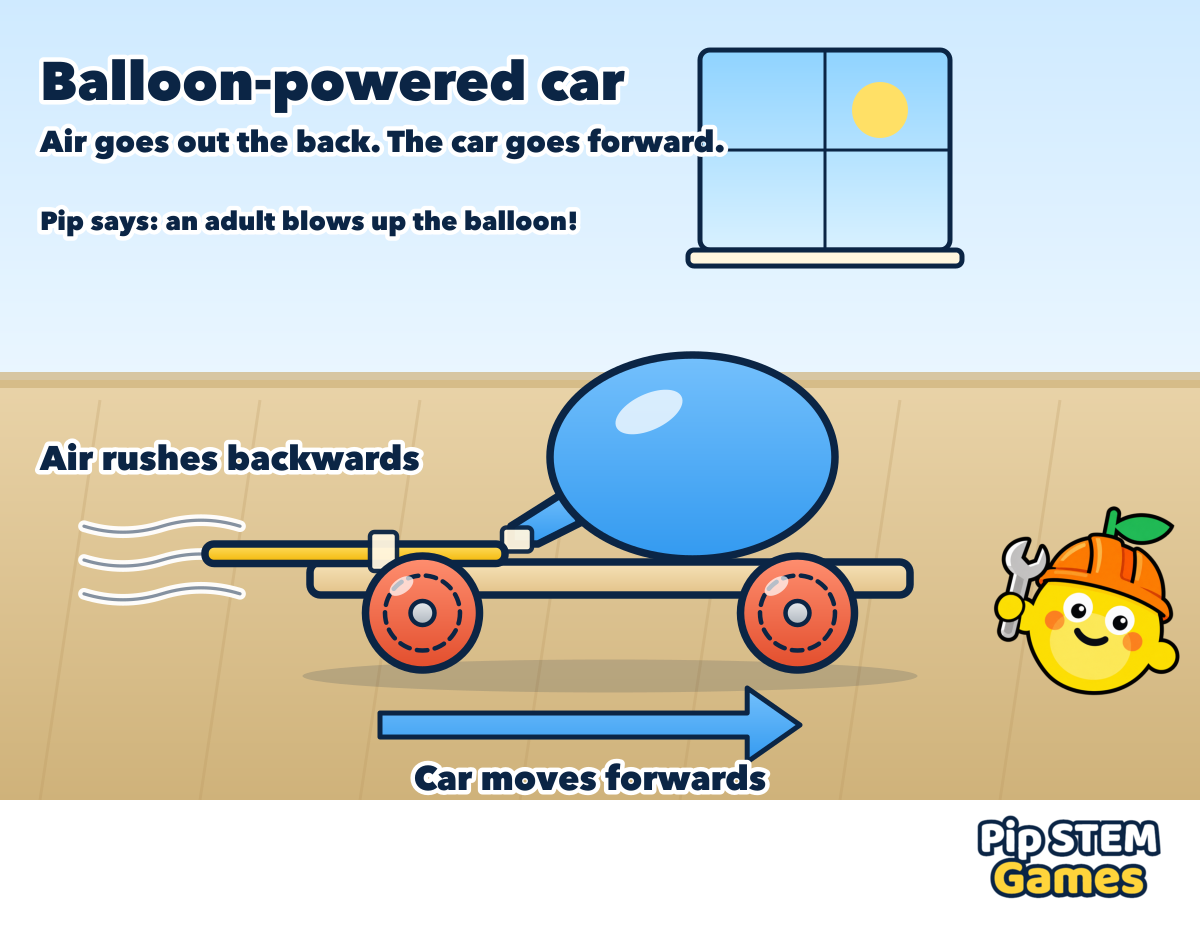
The balloon squeezes the air, the air rushes out backwards, and the car gets an equal push forwards. That's Newton's third law: every push has an equal push back in the opposite direction.
A stretched balloon works like a squeezed spring. The rubber presses on the air inside, so the air wants out, and the straw is the only way. As the air shoots backwards, it pushes back on the balloon. The balloon is taped to the car, so the whole car moves forwards.
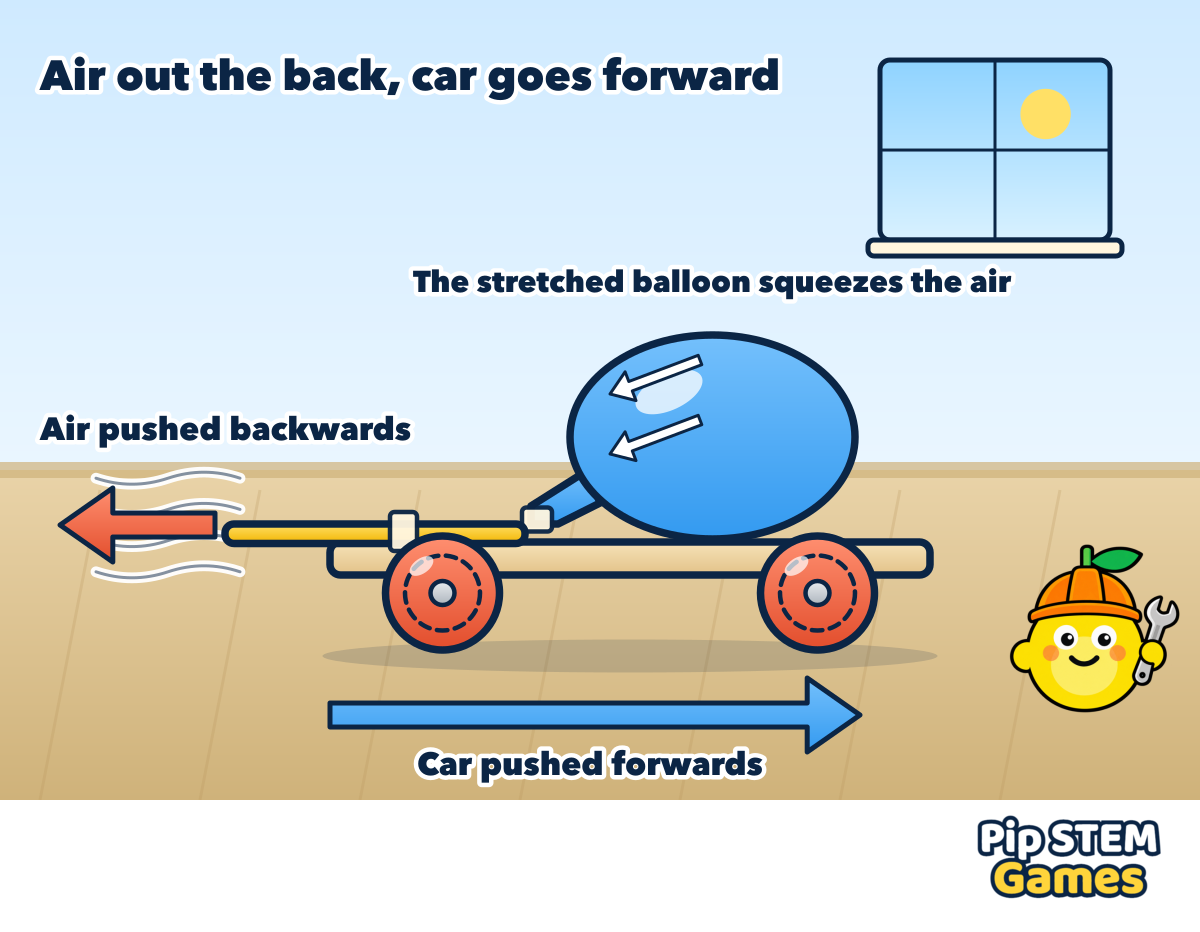
The air doesn't push on the floor or on the wall behind. The push happens between the balloon and the air it throws out. Rockets use the same idea, with hot gas instead of air.
When the balloon goes floppy, the push stops. The car keeps rolling for a bit, because a moving object carries on moving until friction slows it down. For more everyday examples, see Newton's third law examples for kids or the basics in forces for kids.
What if your balloon car won't go?
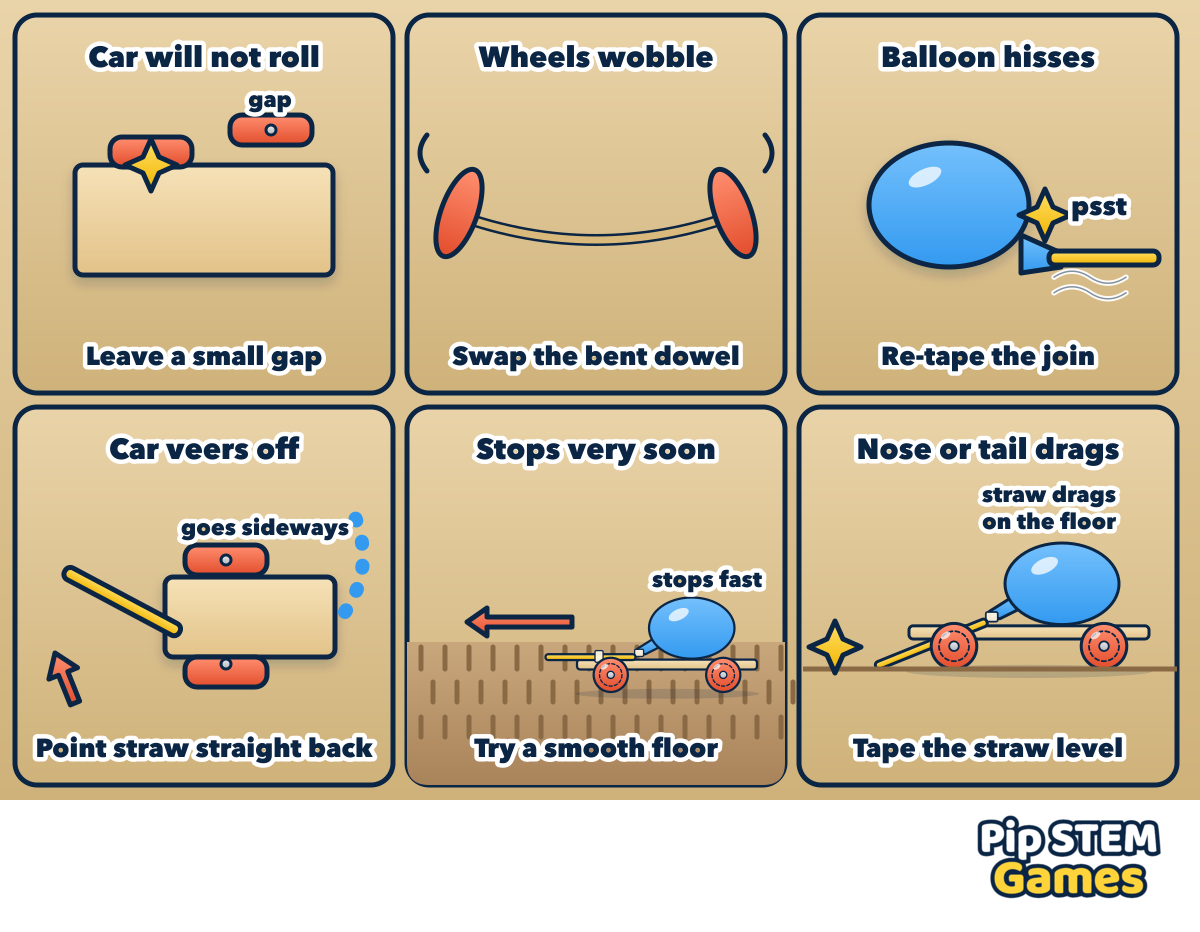
Most balloon cars stall for one of six reasons, and each one takes a minute to fix. Change one thing at a time, then test again.
- The car won't roll: a cap or tape is rubbing the card. Slide the cap outwards until there's a gap of about 3 mm.
- The wheels wobble: the dowel is bent or the cap hole is off-centre. Swap the dowel, or ask an adult to redo the hole.
- The balloon hisses at the join: air is leaking. Add tape around the neck and straw, without blocking the straw.
- The car veers off: the straw points sideways. Re-tape it straight along the middle, pointing directly backwards.
- The car stops very soon: rugs and carpet slow it down, and so does a half-empty balloon. Try a smooth floor and a fuller balloon.
- The back of the car drags: the straw sags and scrapes the floor. Tape it level, so it points straight back.
A car that fails first time has just told your child something useful. Our engineer's five-step fix-it checklist turns that into a method children can reuse on any build.
What happens if the straw points somewhere else?
The car goes the opposite way to the air. A straw pointing straight back sends the car forwards, a sideways straw turns it, and an upward straw pushes it down into the floor.
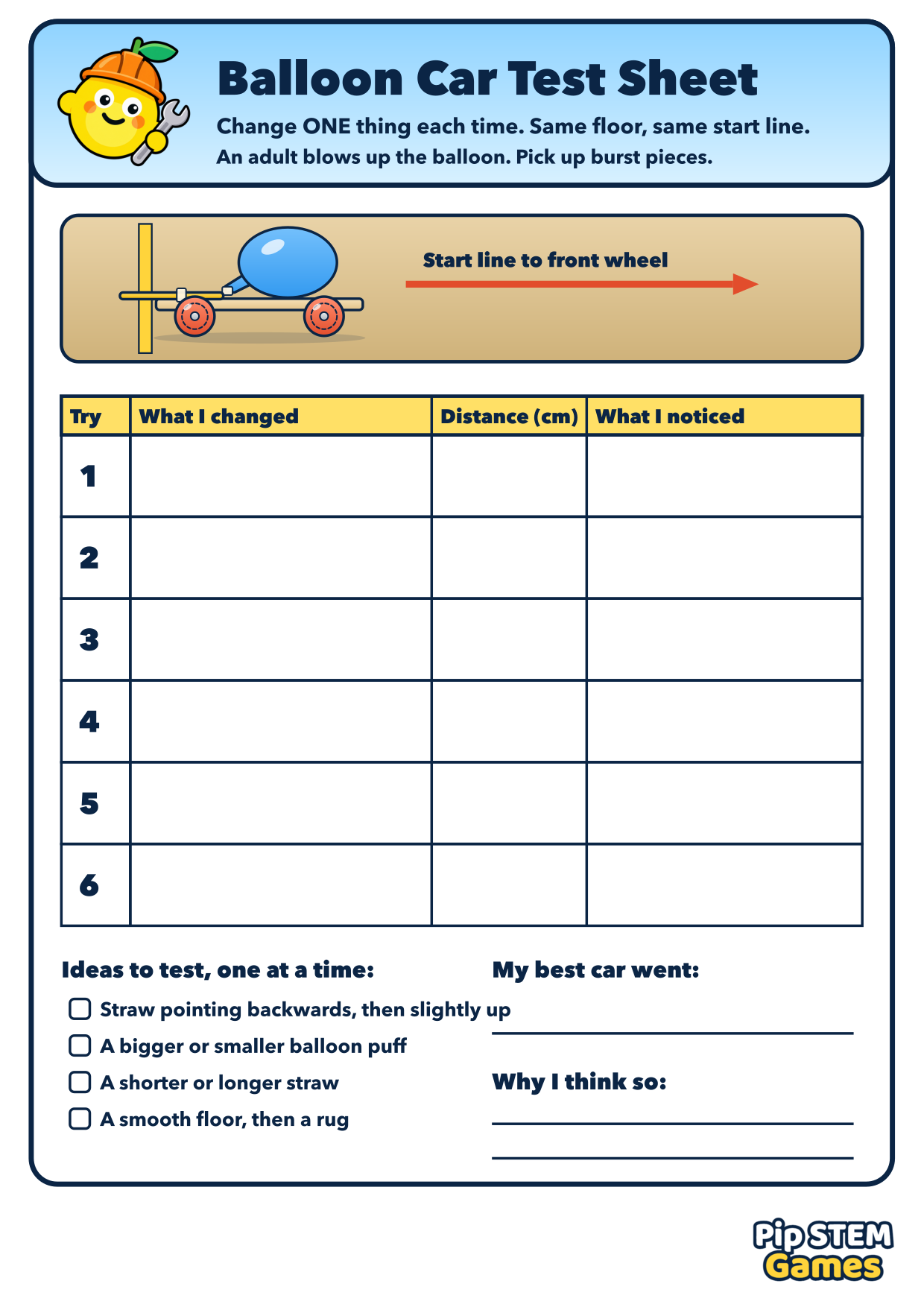
That makes a lovely test. Ask your child to predict first, then try three setups: straw pointing backwards, pointing a little to one side, and pointing up. Roll each one three times from the same start line, and measure to the front wheel each time.
Keep everything else the same: floor, balloon size and car. If two things change at once, you can't tell which one made the difference. Frankly, this is the step most children (and adults) skip, and it's the one that turns play into engineering.
Pro tips: mark the start line with tape, keep a spare balloon, and ask "where do you think the air is going?" before every run.
Which ages is the balloon car for?
It suits ages 5 to 12, with the adult's jobs staying the same at every age: cutting, cap holes and the balloon.
Ages 5 to 7: an adult builds with the child. The child can tape the straws, press on the caps, give the push test and say which way the air goes. Ask them to guess where the car will stop and mark it with a toy. The Junior Engineers workbook has simple machine pages that go well with this.
Ages 8 to 12: they can build most of it, run the straw-direction test, fill in the printable and work out the average of three runs. A bigger challenge: change only the wheel size, or only the straw length, and explain the result. After that, try the Wheel and Axle game, or read how engineers plan and test in the engineering design process.
Questions parents ask
How does a balloon-powered car work?
A stretched balloon squeezes the air inside, and the air rushes out backwards through the straw. The air pushes back on the balloon with an equal force, which moves the car forwards. This is Newton's third law.
Is a balloon car safe for young children?
Only with an adult in charge. Children under 8 can choke on uninflated balloons and burst pieces, so an adult should blow up the balloon, supervise closely and pick up broken pieces at once. Keep all parts away from children under 3.
Why shouldn't you blow up the balloon through the straw?
A quick breath in could pull the straw or balloon towards the throat. It's safer for an adult to inflate the balloon first, using a pump or by mouth, and then attach it to the straw.
What if someone is allergic to latex?
Most party balloons are latex, so use a latex-free balloon or pick a different activity. Itchy skin, a runny nose or wheezing can be signs of an allergy, and trouble breathing needs a 999 call.
What size balloon works best?
A medium balloon blown up to about the size of a grapefruit works well. A bigger balloon often gives a longer push, but it's more likely to burst.
Can I make a balloon car without bottle caps?
Yes. Wheels cut from thick cardboard, or old plastic lids, also work. The hole must be in the exact centre, and the wheel must spin freely without rubbing the body.
Why does my balloon car spin or veer off?
The straw is probably pointing a little sideways. Re-tape it along the middle of the car so it points straight back, and check both axles are parallel.
Great STEM activities to try next...
 Newton's Third Law Examples Kids Can Try at Home [Printable]Forces & energy
 DIY Cardboard Marble Run for Kids: Build a Floor-Low Ramp Track [Printable]Build challenge
 12 Easy STEM Activities for Kids to Try at Home (Ages 5 to 12)By age
More to try:

Pip STEM Games
We make engineering games and workbooks for kids aged 5 to 12. Every activity here is one we'd happily run at the kitchen table: test it, watch it fail, fix it, try again.




