

Key takeaways
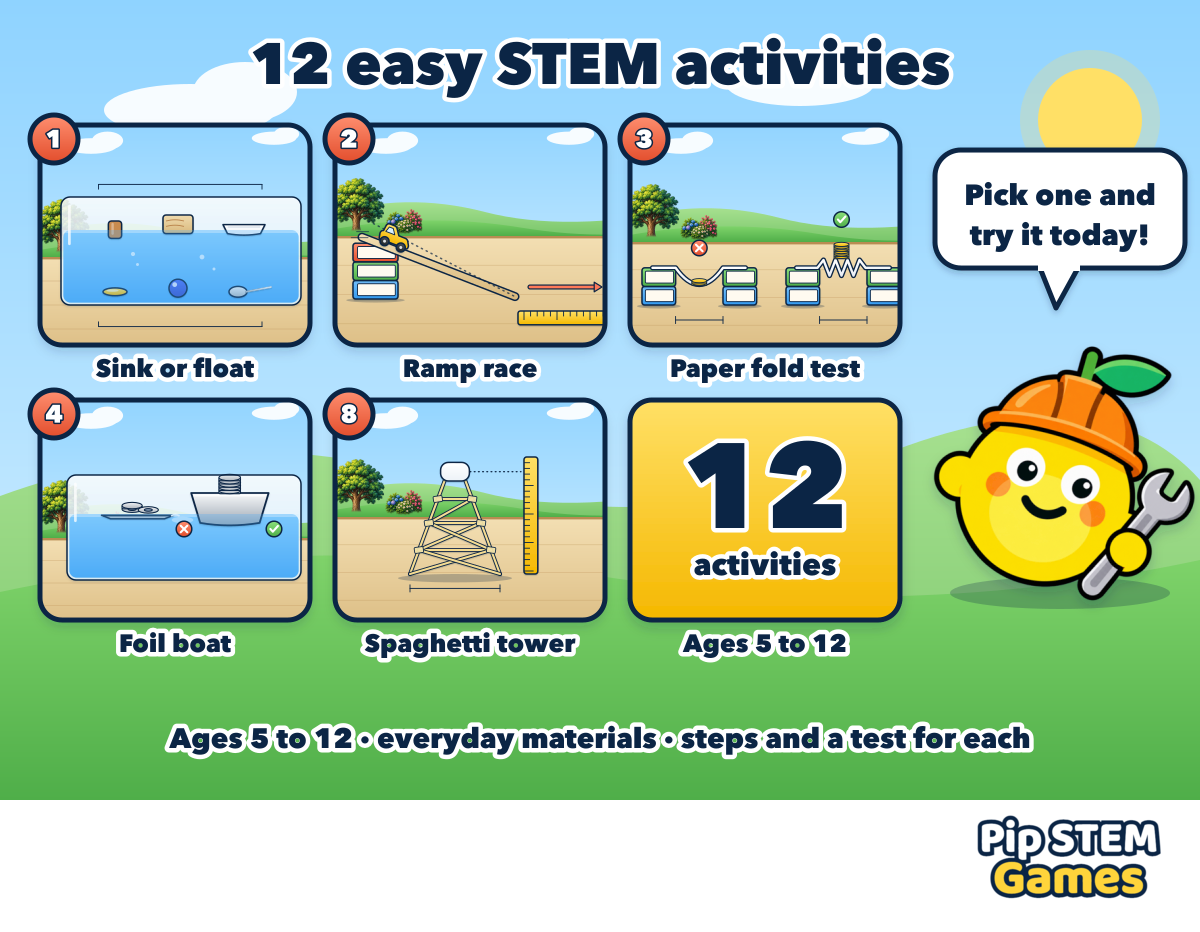
- The 12 activities run from youngest to oldest: sink or float suits ages 5 and up, the circuit suits ages 8 and up.
- The older activities add measuring, planning and a fair test.
- Most use paper, foil, cardboard, string and tape you already own.
- Pick one build, test it, then change one thing and test again.
- An adult handles scissors, pins, balloons and electrical setups, and small parts stay away from under-6s.
These are 12 easy STEM activities for kids that you can do at home, sorted from age 5 up to age 12.
1. Sink or float
Ages 5–7 · 10 minutes. Guess which things float in a bowl of water, then test every guess.
You need:
- A big bowl of water on a towel
- A coin, a large marble, a metal spoon
- A cork, a plastic lid, a block of pine
How to do it:
- Line the objects up and ask your child to guess which will float.
- Drop them in one at a time.
- Sort them into two piles: floats and sinks.
- Pick one sinker and try to make it float, for example by putting it on the lid.
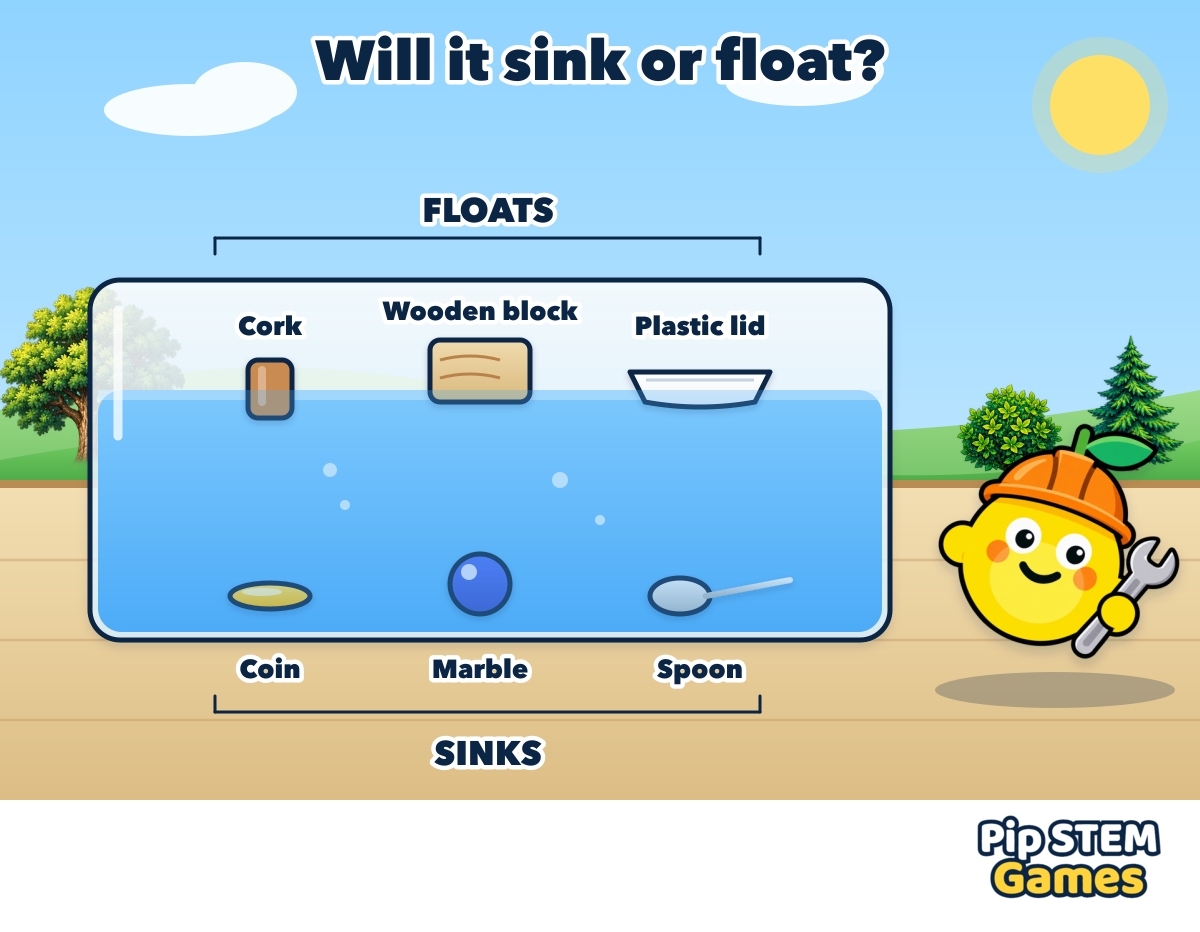
It teaches that weight alone doesn't decide it, because shape and material matter too. Nothing goes in the mouth, and keep small objects away from under-3s.
2. Ramp race
Ages 5–7 · 15 minutes. Roll a toy car down a ramp and measure how far it goes.
You need:
- A board or tray
- A stack of books
- A toy car and a tape measure
How to do it:
- Rest the board on one book to make a ramp.
- Let the car go from the top without pushing it.
- Measure how far it rolls past the bottom of the ramp.
- Add a book and race it again. Then try a carpet.
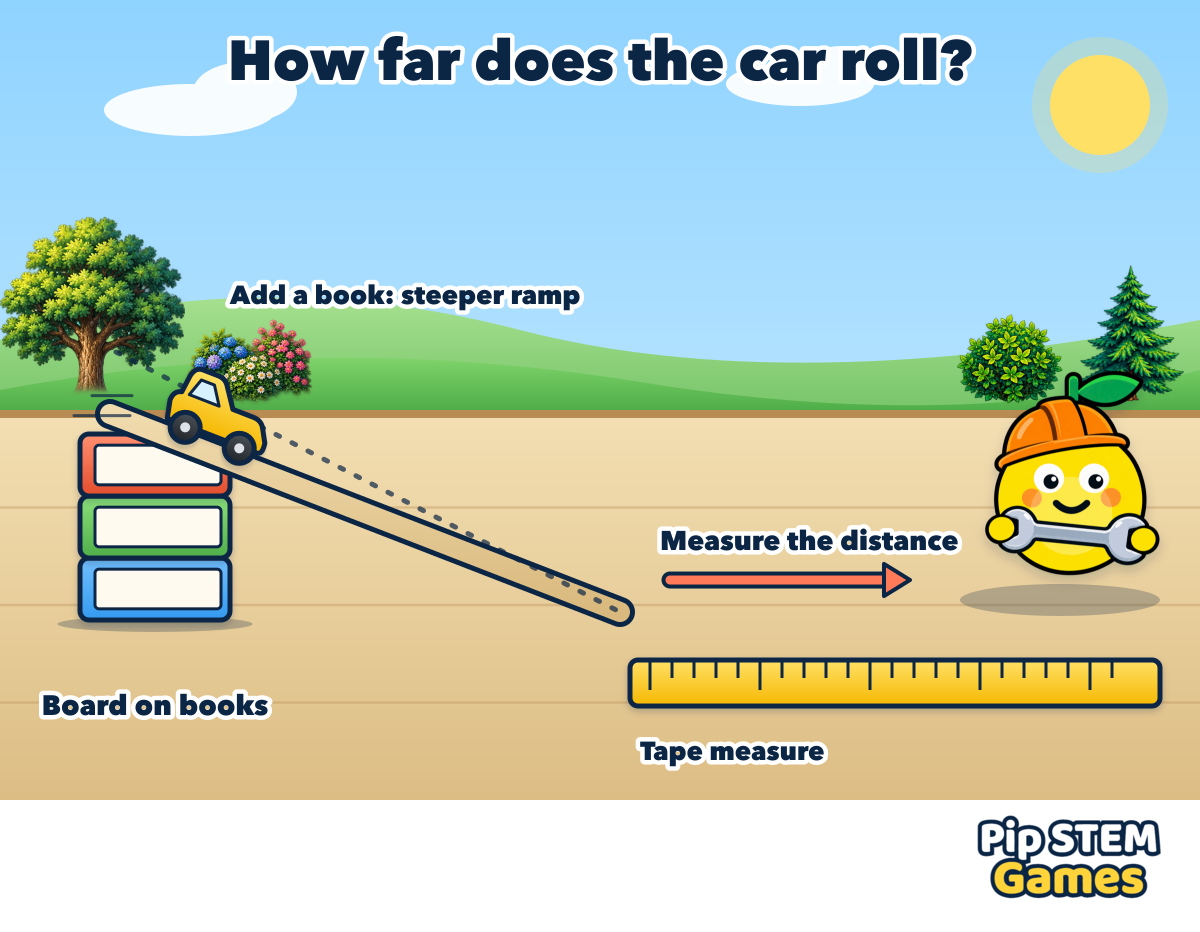
It teaches that a steeper slope means a faster car and that rough floors slow it down. More on pushes and pulls in forces for kids.
3. Paper fold test
Ages 5–12 · 10 minutes. Fold a sheet of paper and see how it changes how much it holds.
You need:
- 2 sheets of paper
- 2 equal stacks of books
- Identical coins
How to do it:
- Rest one flat sheet across a gap between the book stacks.
- Add coins gently, one at a time, until it sags.
- Fold a second sheet into an accordion and test it with the same gap.
- Compare the two counts.
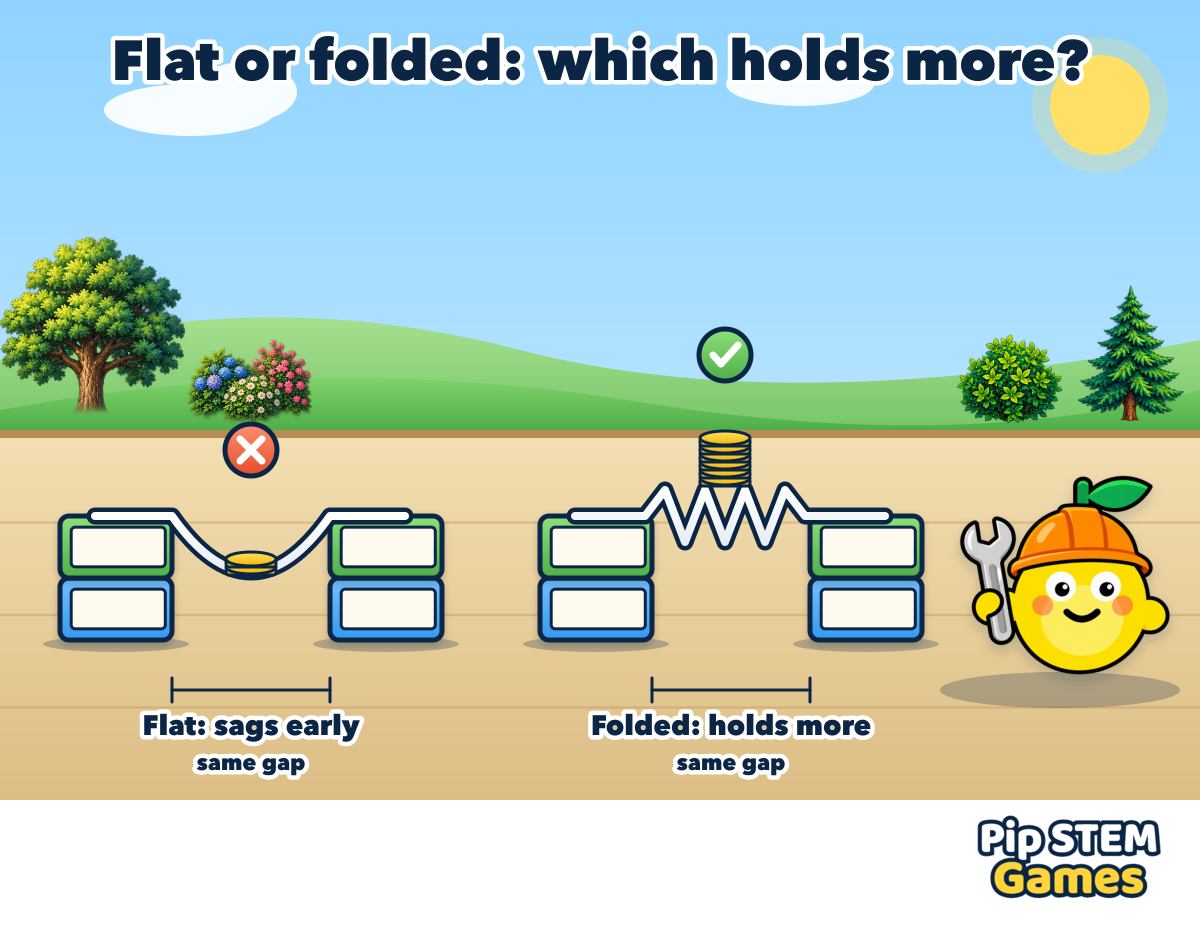
It teaches that folding makes paper stiffer. If both fail, narrow the gap. See watch what happens when you fold paper. Keep coins out of the mouth of under-6s.
4. Foil boat
Ages 5–12 · 15 minutes. Shape a foil boat and count how many washers it carries.
You need:
- A shallow bowl of water on a stable surface
- Squares of kitchen foil
- Identical washers or coins
- A towel
How to do it:
- Fold one square into a boat shape.
- Float it gently and add washers one at a time near the centre.
- Count the washers when water first comes in.
- Fold a different shape and test again.

It teaches that a wide hollow shape holds more than a flat sheet. Never leave water or small weights unattended. See how to build a boat that actually floats.
5. Recycling bin builds
Ages 5–12 · 20 minutes. Pick three recycled items and make a machine with a job.
You need:
- Clean, dry cereal boxes, tubes, bottle caps and egg boxes
- Tape and child scissors
- A toy or coin to move
How to do it:
- Choose a goal, such as "carry a toy across the table".
- Pick three items and sketch a plan.
- Build and test.
- Change one thing and test again.

It teaches kids to see what an object can do. Avoid sharp tin cans. See 10 things in your recycling bin that can become STEM projects.
6. Balloon-powered car
Ages 6–12 · 30 minutes. Build a car that a balloon pushes across the floor.
You need:
- Cardboard, 2 straws and 2 blunt axles
- 4 bottle tops
- A balloon, a drinking straw and tape
How to do it:
- Tape the straws under the cardboard and thread the axles through.
- Fix a bottle top wheel to each end.
- Push a drinking straw into the balloon's neck and tape it. Tape the balloon and straw on top of the car, straw pointing backwards.
- Inflate through the straw, pinch it, let go on a flat floor and measure how far it goes.

It teaches that a push one way moves things the other way. An adult should inflate the balloon for under-6s, and balloon pieces are a choking risk. Steps in make a balloon-powered car at home.
7. Cardboard marble run
Ages 6–12 · 30 minutes. Tape a sloped track that guides a marble into a tray.
You need:
- Scrap cardboard and tubes
- Masking tape
- A tray and 1 large marble
How to do it:
- Tape a sloped track to a box or wall.
- Add a gentle turn.
- Put a tray at the end and roll the marble.
- Find where it stalls and change one slope.

It teaches that gravity pulls the marble down the slope and sharp turns slow it. Keep the marble large and an adult nearby. See our marble run guide.
8. Spaghetti tower
Ages 7–12 · 30 minutes. Build a tower from 10 strands of spaghetti that holds a marshmallow.
You need:
- 10 strands of dry spaghetti
- A short length of masking tape
- 1 marshmallow (check for allergies)
How to do it:
- Make a wide base.
- Bring the strands together as it rises, taping at the joins.
- Put the marshmallow on top.
- It must stand alone for 10 seconds. Measure it and rebuild.

It teaches that a wide base and crossed supports beat tall and thin. Handle brittle pasta gently. See the 10 spaghetti tower challenge.
9. Bridge test
Ages 8–12 · 30 minutes. Build a beam, an arch and a truss from the same card and compare how many coins they hold.
You need:
- Card, exactly 2 sheets per bridge
- Two stacks of books 20 cm apart
- A small cup and coins
How to do it:
- Build each bridge from the same amount of card.
- Set each across the same gap.
- Put the cup in the middle.
- Add coins until the bridge sags.

It teaches that each shape handles force differently. See which bridge would you build.
10. Wind turbine spin test
Ages 8–12 · 45 minutes. Make two pinwheels and test whether 4 or 6 blades spin faster.
You need:
- Paper squares and a pencil
- A straw and split pins (adult handles)
- A desk fan on low and a phone stopwatch
How to do it:
- Make a 4-blade and a 6-blade pinwheel. Guess the winner.
- An adult sets the fan on low and marks the spots.
- Count the turns in 10 seconds, three times each.
- Compare the averages, then change the blade size.

It teaches fair testing: one change at a time. Keep fingers clear of the fan. See make a wind turbine spin faster.
11. Homemade pulley
Ages 8–12 · 30 minutes. Lift a light load with a pulley hung from a sturdy support.
You need:
- A small grooved pulley or spool
- String and a very light soft load
- A sturdy low support fixed by an adult
How to do it:
- An adult fixes the pulley to the support.
- Thread the string and tie the load.
- Pull down slowly.
- Try a slightly heavier load.

It teaches that a fixed pulley changes the direction of the pull. Keep fingers clear and never lift people. See build a simple pulley with household items.
12. Simple circuit
Ages 8–12 · 20 minutes. Find the gap in a loop of battery, lamp and switch.
You need:
- 2 AA batteries in a holder (no button cells)
- A small lamp in a holder, a switch and wires
How to do it:
- An adult builds a loop with one fault.
- Ask your child to guess why the lamp is off.
- Trace the wire with a finger from the battery round to the battery.
- Fix the gap and close the switch.

It teaches that electricity needs a complete loop. Never use mains sockets. More in circuits for kids, and the full puzzle in can your child fix this broken circuit.
What to do when an activity doesn't work
Ask questions instead of fixing it for them. Look first at the join, wheel or base, guess why, change one thing, then test again and write the number down.
- An adult handles scissors with points, pins and anything dropped from height.
- Keep coins, marbles, balloons and marshmallows away from under-6s, and use AA batteries only.
- A tub of paper, card, tape, straws, string and a tape measure covers nearly every project here.
For a quick test-and-adjust loop on a screen, try it in the Tower Stack game. The Junior Engineers workbook (ages 5 to 7) and Senior Engineers workbook (ages 8 to 12) turn these into guided pages.
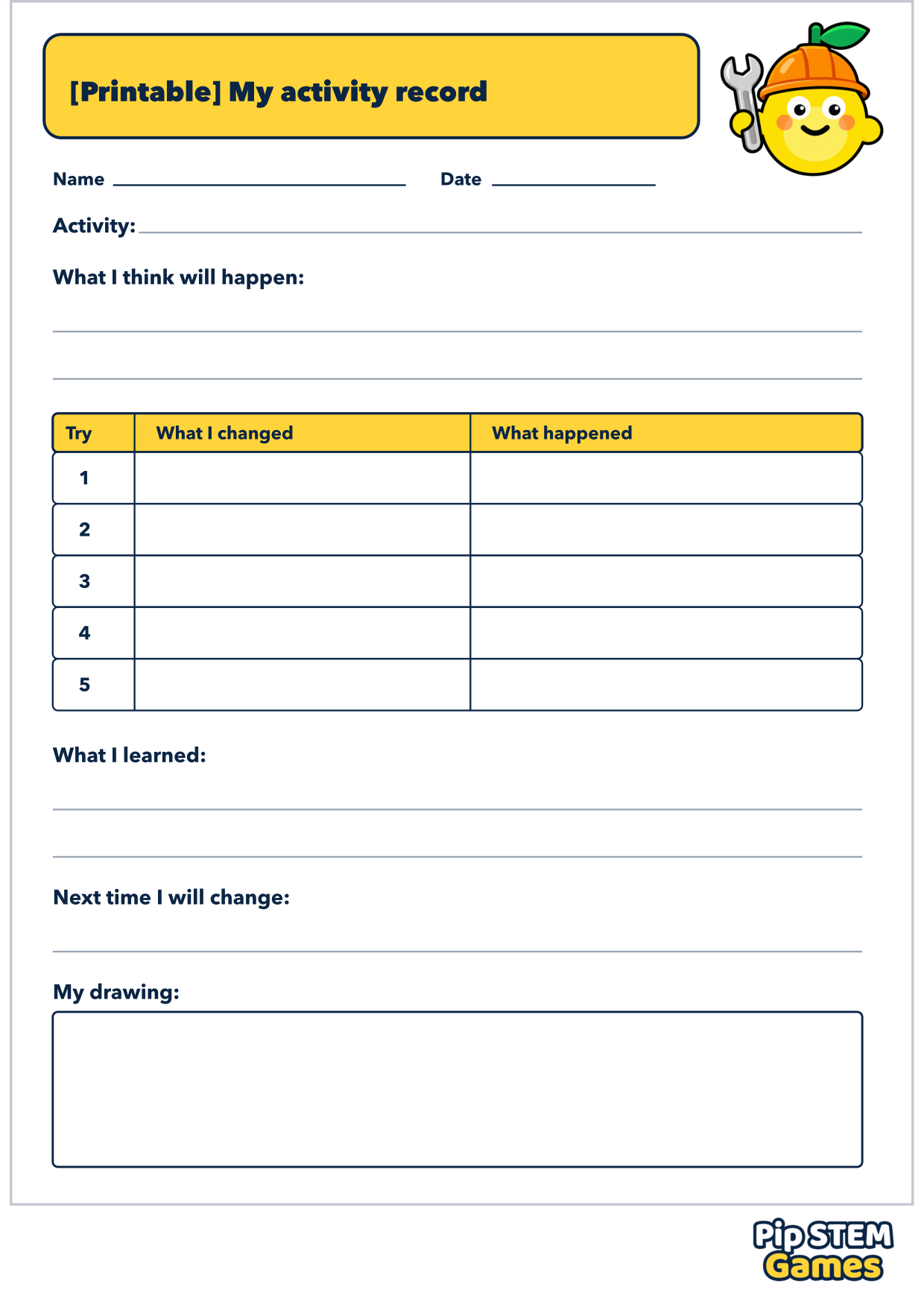
Print this record sheet to write down what you predict, what you change and what happens each time.
Questions parents ask
What are some easy STEM activities for kids?
Sink or float, a ramp race, a foil boat, a paper fold test and a balloon car are all easy. Each uses household items and most take 10 to 30 minutes.
What STEM activities can I do with a 5 year old?
Try sink or float, a ramp race with a toy car, a paper fold test and a foil boat. Keep each to a few steps and stay close for scissors and balloons.
What are good STEM projects for 10 year olds?
Pulleys, bridge tests, wind turbine spin tests and circuits with switches. Ask them to predict, measure and explain the result.
Do you need to buy a STEM kit?
No. Paper, tape, cardboard, straws and balloons cover most of the best activities. A kit is optional.
How long should a STEM activity take?
10 to 30 minutes suits most children. Younger kids often do best with the short end, with room to rebuild.
What if my child gets frustrated when a build fails?
Treat the failure as information. Ask what broke, change one thing and test again. Seeing the second try work is the lesson.
What does STEM stand for?
STEM stands for science, technology, engineering and maths. Most hands-on activities for children use several of these at once.
Great STEM activities to try next...
 The 10-Spaghetti Tower ChallengeActivity
 Make a Balloon-Powered Car at HomeActivity
 10 Things in Your Recycling Bin That Can Become STEM ProjectsActivity
More to try: Bridges and Towers for Kids: 9 Builds to Try at Home · 4-Week STEM Learning Plan for Kids at Home · 15 STEM Challenges for Kids (Easy, Cheap)

Pip STEM Games
We make engineering games and workbooks for kids aged 5 to 12. Every activity here is one we'd happily run at the kitchen table: test it, watch it fail, fix it, try again.




