


Key takeaways
- A flat sheet of paper sags under a few coins, but the same sheet folded into pleats usually holds far more.
- Folds put material higher and lower, which makes the paper stiffer to bend across a gap.
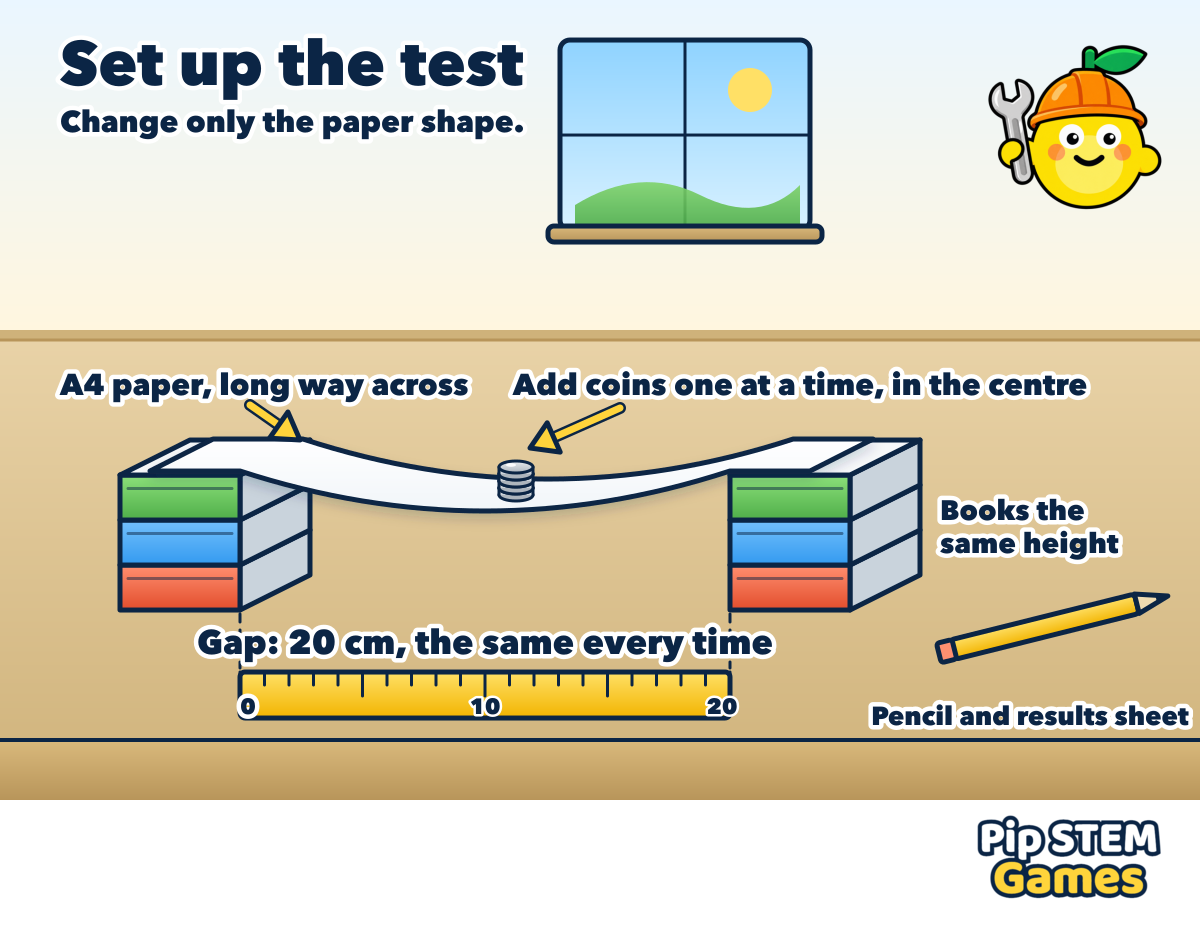
- Fold lines 2 cm apart, a 20 cm gap and identical 10p coins keep the test fair.
- Folded paper is stiffer to bend, not stronger in every way: it still tears as easily.
- Coins are a choking hazard for under-5s, so an adult supervises and counts them back.
Folding a sheet of paper into pleats usually makes it much stiffer to bend across a gap. Lay a flat sheet across two stacks of books and it sags under a few 10p coins. Fold the same sheet and it often holds far more. This page shows how to test it fairly, why it works, and what to try next, with a printable fold template.
What happens when you fold a sheet of paper?
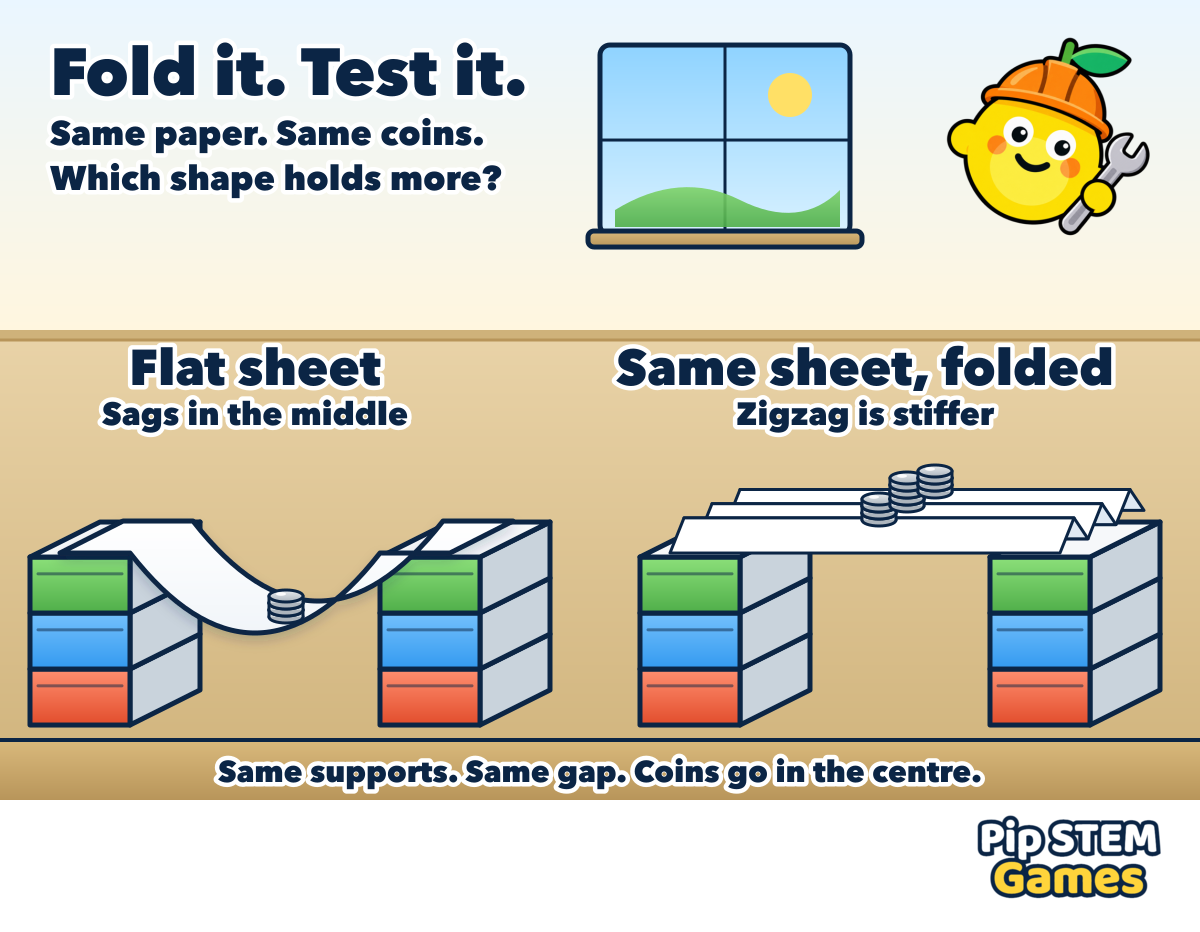
A flat sheet of paper sags under a few coins, but the same sheet folded into pleats usually holds far more across the same gap. Nothing was added. Only the shape changed.
Engineers use this trick all the time. Corrugated cardboard has a wavy layer inside it, and many roofing sheets are ridged, so thin material can carry a load without being thick.
The test takes about 15 minutes and uses one sheet of A4 per try. It suits ages 5 to 12, with an adult close by for the coins. Frankly, it's one of the cheapest experiments you can run, and the result surprises almost every child.
What do you need for the paper folding test?
- 6 or more sheets of A4 printer paper from the same pack
- Two stacks of books, each the same height (three books is plenty)
- 20 to 30 identical UK 10p coins
- A ruler and a pencil
- The printable test sheet below, or any paper to record results
- Blunt-ended scissors, if you cut out the printable strip (adult nearby)
Keep it safe. Coins are a choking hazard for children under 5, so keep them out of reach of little ones and supervise closely. Use UK 10p coins, because they are big enough to be easy to spot and pick up. Count every coin back into the pot at the end. Build on a steady table, kneel or sit so nobody leans over the books, and never throw coins or books. If a bridge collapses, the coins just slide off, so clear the floor around the table first.
How do you fold the paper and run the test?
Make the folded bridge first, then test the flat sheet and the folded sheet over the same gap. The whole thing takes about 15 minutes.
Make the folded bridge
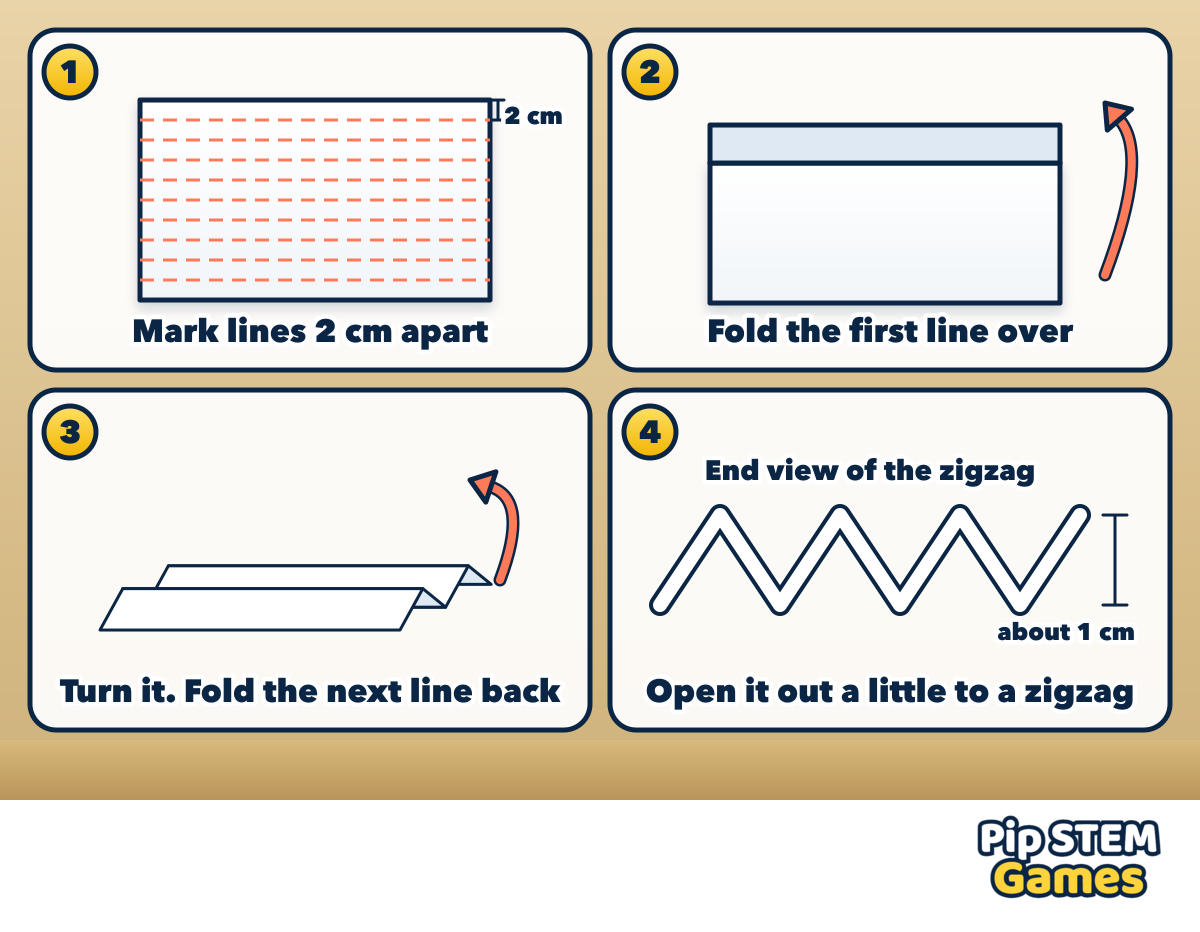
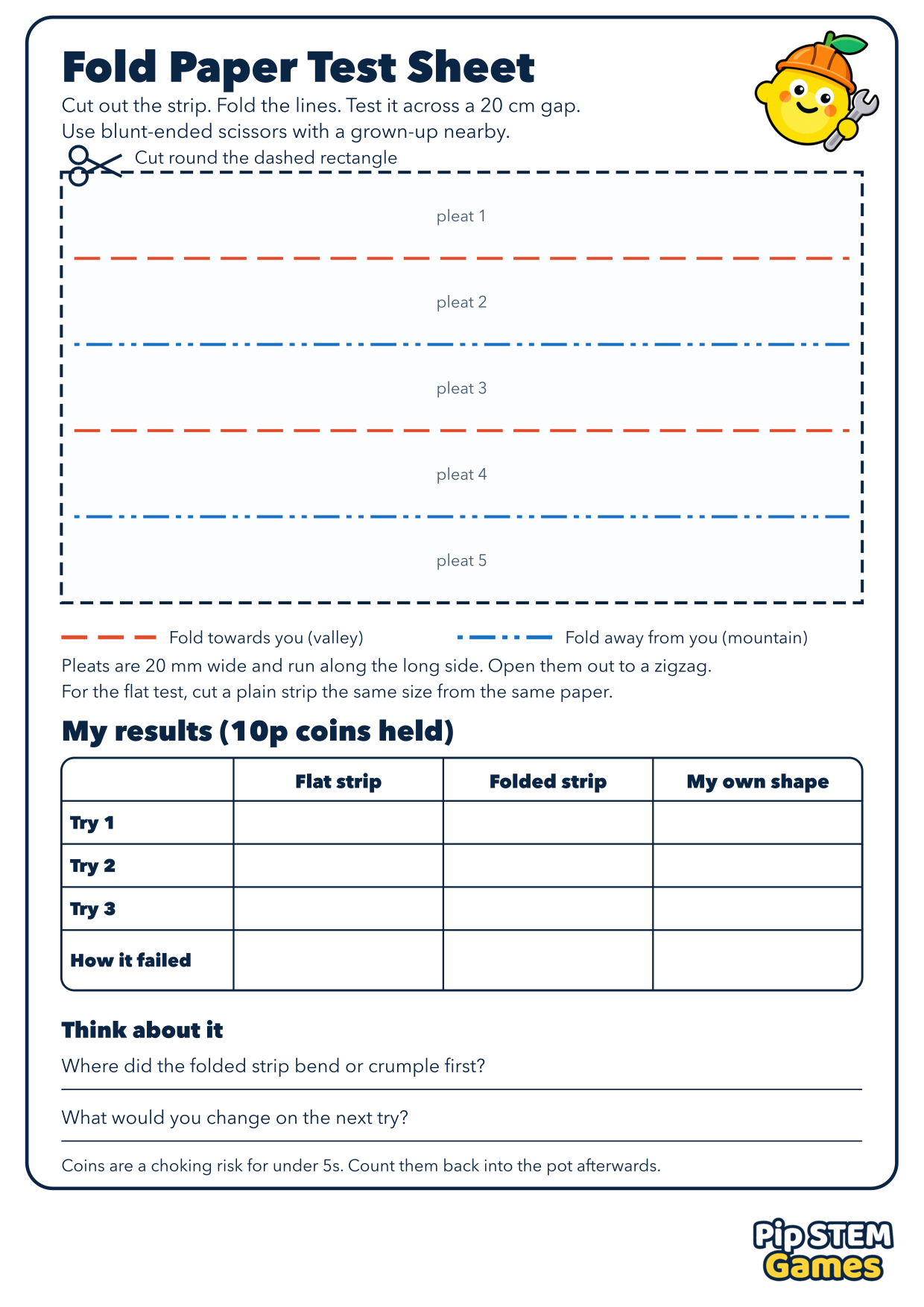
- Lay a sheet of A4 on the table with the long side facing you. Use the ruler to mark a line every 2 cm along the short edge, so the lines run along the long side. That gives nine lines.
- Fold on the first line and press the crease flat with your finger.
- Turn the sheet over and fold the next line the other way, like a paper fan.
- Keep going, turning each time. Then open the pleats out a little so the end of the paper looks like a zigzag about 1 cm tall.
Run the test
- Put the two book stacks 20 cm apart. Check the gap with the ruler.
- Lay a fresh flat sheet along its length across the gap. About 5 cm of paper should rest on each stack.
- Add 10p coins one at a time to the centre. Hold each coin just above the paper and let it go gently. Stop when the paper folds, slips or sags onto the table, or when you reach 30 coins.
- Write down the coin count and how the paper gave way.
- Set the folded sheet across the same gap, resting about 5 cm on each stack. Add coins to the middle in exactly the same way and count again.
- Compare the numbers. Which shape held more, and where did each one bend?
Why does folding paper make it stiffer?
A fold puts some of the paper higher and some lower, and that shape is much harder to bend than a flat sheet.
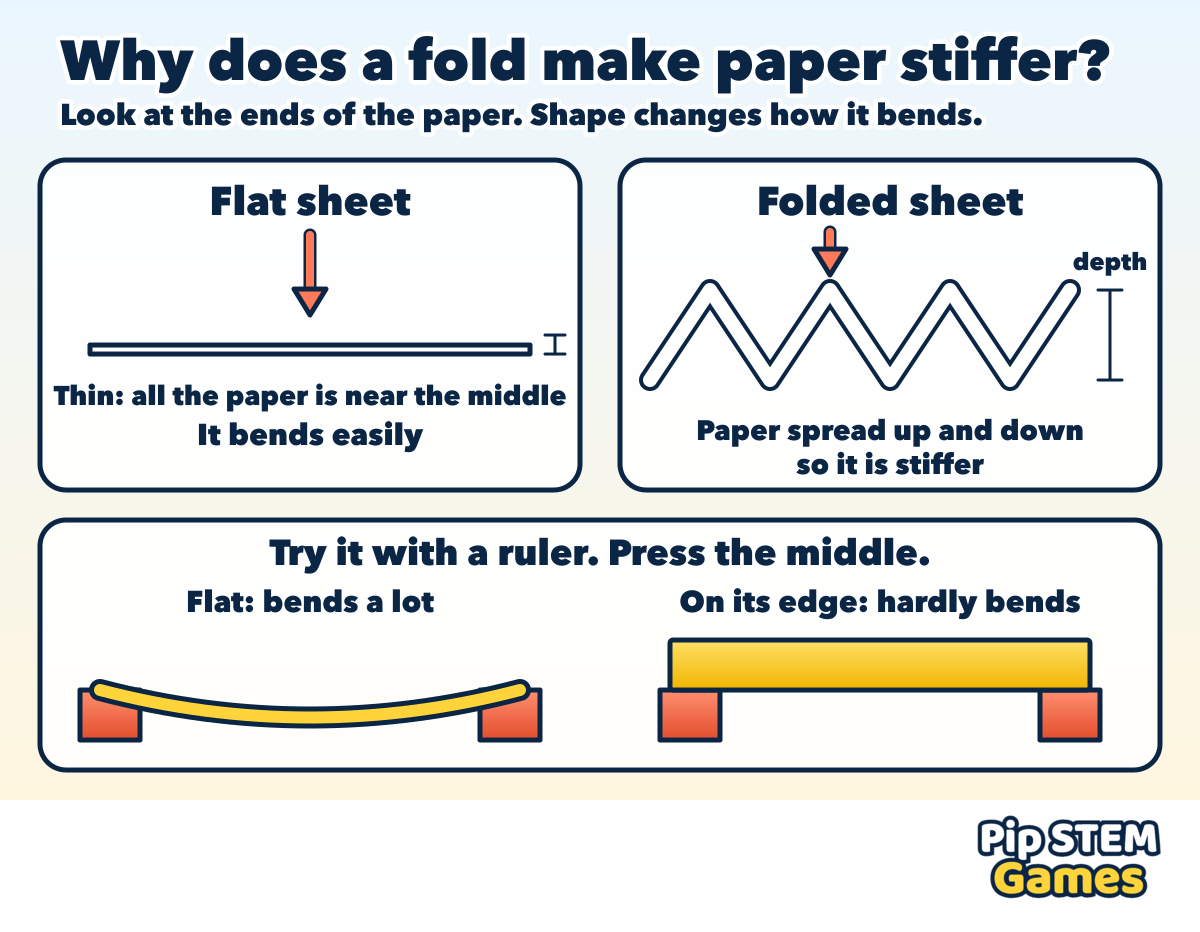
When a beam bends, its top edge gets squashed and its bottom edge gets stretched. The middle hardly changes. So the material far from the middle does most of the work of holding the beam straight.
A flat sheet keeps all its paper right at the middle, in a layer about a tenth of a millimetre thick. A zigzag spreads the same paper up and down by about a centimetre. Engineers measure this with the second moment of area. For a solid rectangular beam it grows with the cube of its depth: make it twice as tall and it's about eight times stiffer to bend. Folded paper isn't a solid block, so the sums are different, but the idea is the same. Depth wins.
Try it with a ruler. Lay it flat across two books and press the middle: it bends. Stand the same ruler on its edge and it hardly moves. You can also feel a version of this in corrugated cardboard.
What most people get wrong is saying that folded paper is stronger. It's stiffer to bend across a gap. It still tears as easily as flat paper when you pull it, and under a big load a sharp crease can crumple. For more on shapes that carry loads, see why arches are so strong.
How do you make the paper test fair?
Change one thing, the shape, and keep everything else the same.
- Same paper. Use fresh sheets from one pack. A sheet that has already been folded isn't a flat sheet any more, even when you smooth it out.
- Same gap. Check 20 cm with the ruler each time, and rest the same amount of paper on each stack.
- Same coins, same spot. Add them one at a time at the centre, using the same hand.
- Same rule for failing. Agree it before you start: folds, slips, touches the table, or 30 coins.
- Repeat three times. One result might be luck. Three results show a pattern.
Print the sheet below on A4, cut out the strip, and fold along the dashed lines. The results table is on the same page. Right-click the picture to save it.
What if the paper bridge slips or collapses straight away?
A flat sheet that holds only one or two coins is a normal result, so write it down. For anything else, check these first.
- The bridge slides off. The folded sheet is narrower than flat paper. Make sure it rests on both stacks, and use books with grippy covers.
- The pleats flatten out. Crease sharply, then open the pleats just a little. Fully open means flat again.
- It crumples at one crease. That's real engineering information. Note where it happened and try a narrower or wider pleat next time.
- The numbers jump around. Usually it's a coin placed off-centre or a sheet that was already creased. Use a fresh sheet and try again.
Failing is the point of the test. Our page on why getting it wrong is part of engineering has a few lines to use when a bridge collapses and a child gets cross.
What should you try next?
Change one thing at a time and test again. Guess the coin count before you test, then see how close you were.
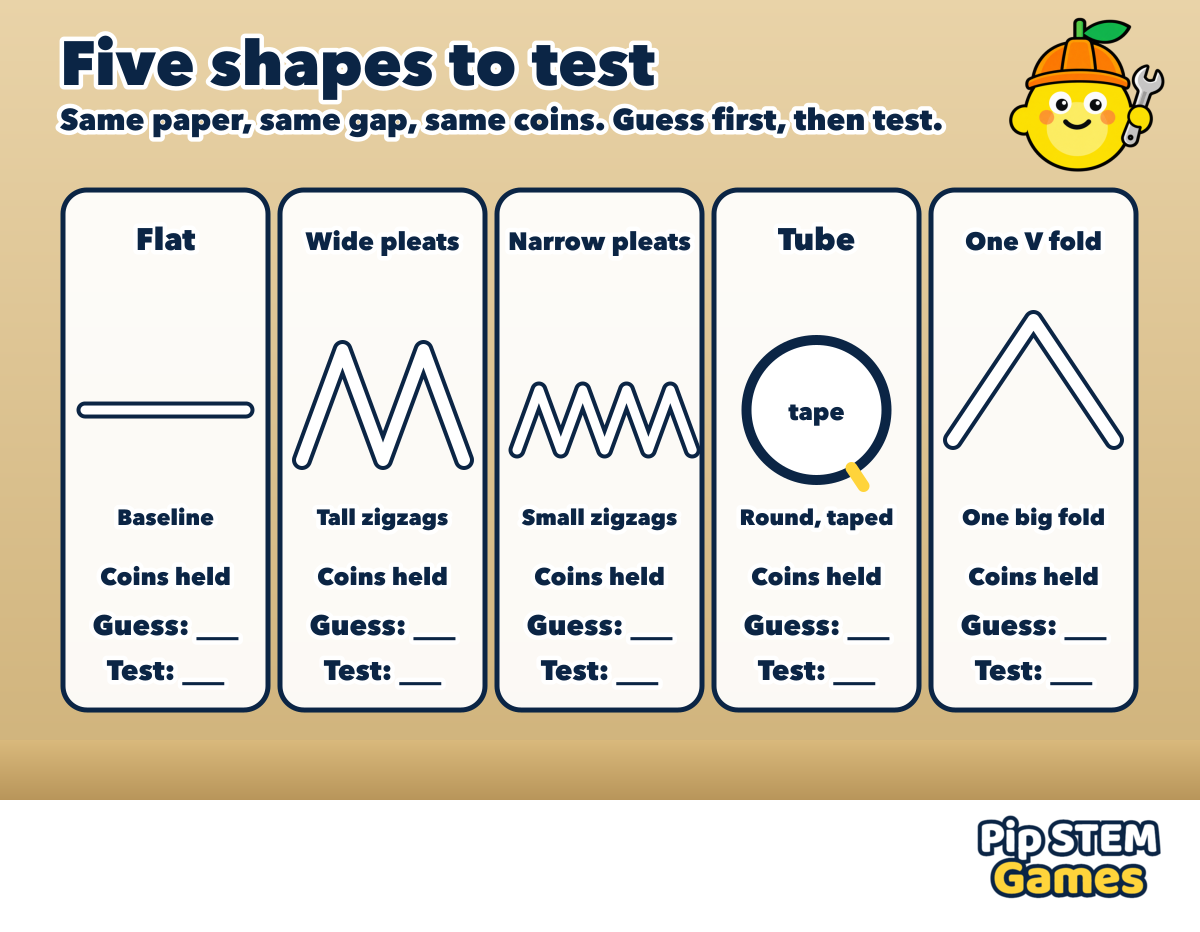
- Wide pleats against narrow pleats. Which holds more, and why might that be?
- A rolled tube taped along its edge (adult helps with the tape).
- One V fold down the middle.
- A wider gap, such as 25 cm.
- Thin paper against card, to see whether a folded sheet of thin paper can beat a flat sheet of card.
Want a bigger challenge? Try the one sheet, 20 coins challenge or the full paper bridge challenge. You can also try it in the Shape Strength game, where shapes carry loads on the island. The Junior Engineers workbook has more hands-on challenges for ages 5 to 7.
How do you change the test for each age?
- Ages 5 to 7 (easier): an adult sets the gap and hands out coins one at a time. The child tests one flat sheet and one folded sheet and says which held more. Stop at 10 coins.
- Ages 8 to 10: record three tries per shape in the table, then add them up and compare. Predict first.
- Ages 11 to 12 (harder): vary pleat width, draw the end views, and explain the results using the word depth. Design the best bridge from one sheet of paper.
A good question for any age is, "What did you change, and what happened?" The answer matters more than the coin count.
Questions parents ask
Does folding paper make it stronger?
It makes paper stiffer to bend across a gap, because the folds spread the material up and down. It doesn't help paper resist tearing when you pull it, so folded paper isn't stronger in every way.
How many coins should a folded paper bridge hold?
There's no fixed number. It depends on the paper, the gap, the pleats and where you put the coins. Your own counts are the answer, so write them down.
What is the best fold for a paper bridge?
There isn't one best fold. Pleat width, number of pleats and paper weight all change the result, so test a few and compare them.
Why use 10p coins?
Identical coins weigh the same and are easy to count. Keep them away from children under 5 because they are a choking hazard, and supervise older children.
Can I use something other than coins?
Yes. Use identical small weights of the same size, such as same-size toy bricks. For under-5s, choose pieces too big to swallow.
What age is the fold paper experiment for?
Ages 5 to 12. Under 7s need an adult to set the gap and manage the coins, and older children can record results and explain them.
Great STEM activities to try next...
 Paper Bridge Challenge: Build a Bridge From One Sheet of Paper [Printable]Build challenge
 Can One Sheet of Paper Hold 20 Coins? [Printable]Activities
 Which Shape Makes the Strongest Tower?Activity
More to try: Bridges and Towers for Kids: 9 Builds to Try at Home · What to Do When Your Child Says 'I Can't' · What Happens When You Stop Giving Children the Answer?

Pip STEM Games
We make engineering games and workbooks for kids aged 5 to 12. Every activity here is one we'd happily run at the kitchen table: test it, watch it fail, fix it, try again.




