


Key takeaways
- Copying a design teaches steps. Testing your own ideas teaches predicting, measuring and improving.
- Run the same ramp challenge twice: once copying, once solving. Then compare.
- Change one thing at a time and test three times, so the result is fair.
- Watch for a prediction, one change on purpose, a pattern in the numbers and a second try.
- The research is strong for teenagers and mixed for ages 10 to 12, so treat this as a home experiment.
When you stop giving children the answer, they start asking better questions, trying more ideas and noticing why some ideas fail. This guide gives you a simple 20-minute ramp test to try at home. You'll compare a child copying a design with a child solving the problem, and you'll see the difference for yourself.
What happens when you stop giving children the answer?
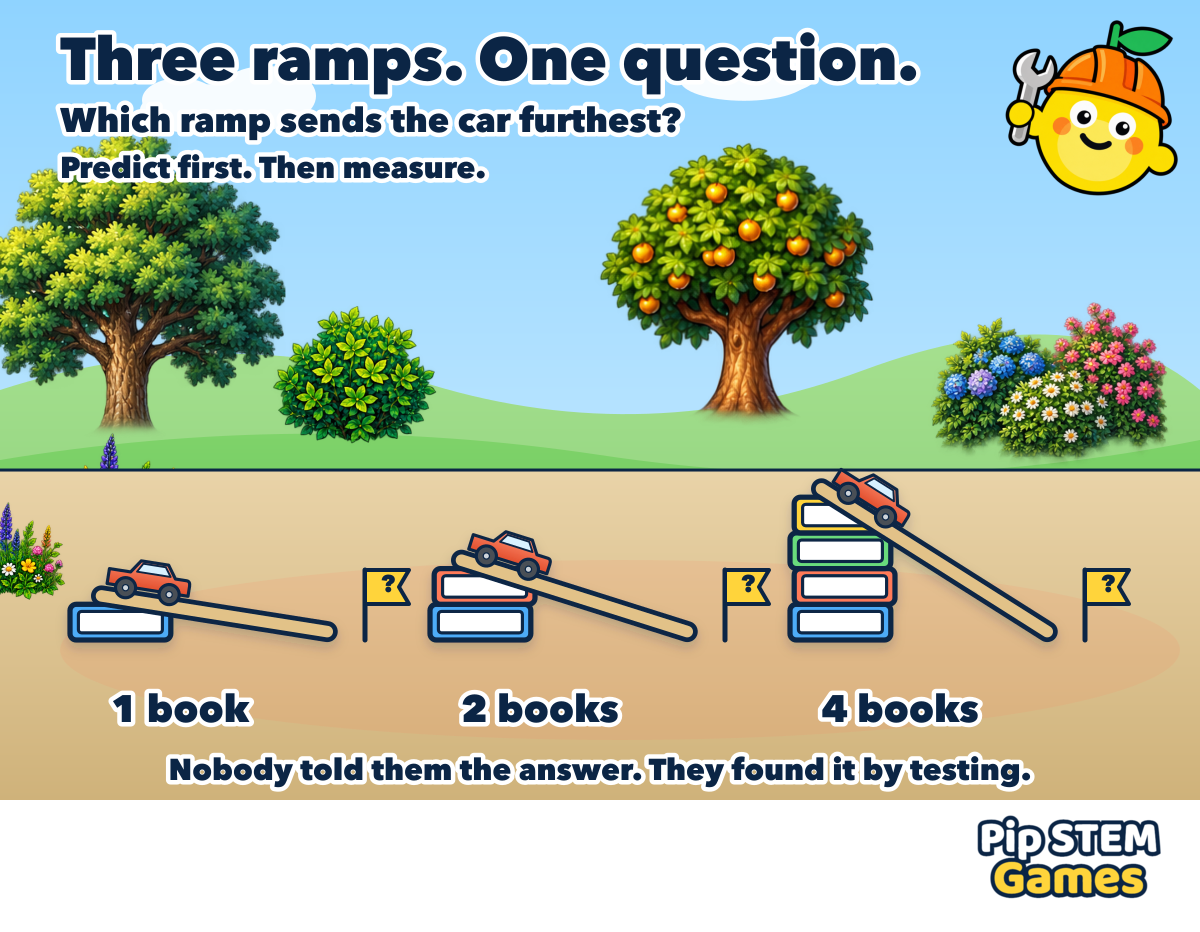
They start asking better questions. A child who is handed a finished design learns to follow steps. A child who is handed only the problem learns to guess, test, measure and try again, which is a big part of what engineers do all day.
This page gives you a home test that takes about 20 minutes. You run the same ramp challenge twice: once with a design to copy, once with only the problem to solve. Then you compare what your child said and did.
One honest note first. The idea of letting learners try a problem before they are taught is called productive failure. The research is strong for teenagers, aged about 13 to 19. For younger children it is mixed. In one study of 228 German pupils aged 10 to 12, trying first did not beat being taught first. The researchers think younger children may still be building focus and persistence. So treat this as a home experiment, not a promise. Your own two rounds will tell you more about your child than any study.
What do you need for the ramp test?
You need things you already have at home, and no small parts.
- A stiff piece of cardboard or a flat tray, about 40 cm long, for the ramp
- Four to six books
- A small toy car that rolls straight
- A ruler or tape measure
- Masking tape
- Paper and a pencil
- Optional: a tea towel or a sheet of kitchen foil to change the surface
Safety: a rolling marble is a choking risk, so use a toy car. If you use a marble in a cardboard channel anyway, an adult should stay close and keep it away from children under 3. Clear the floor of anything that could trip your child.
How do you run the copy round?
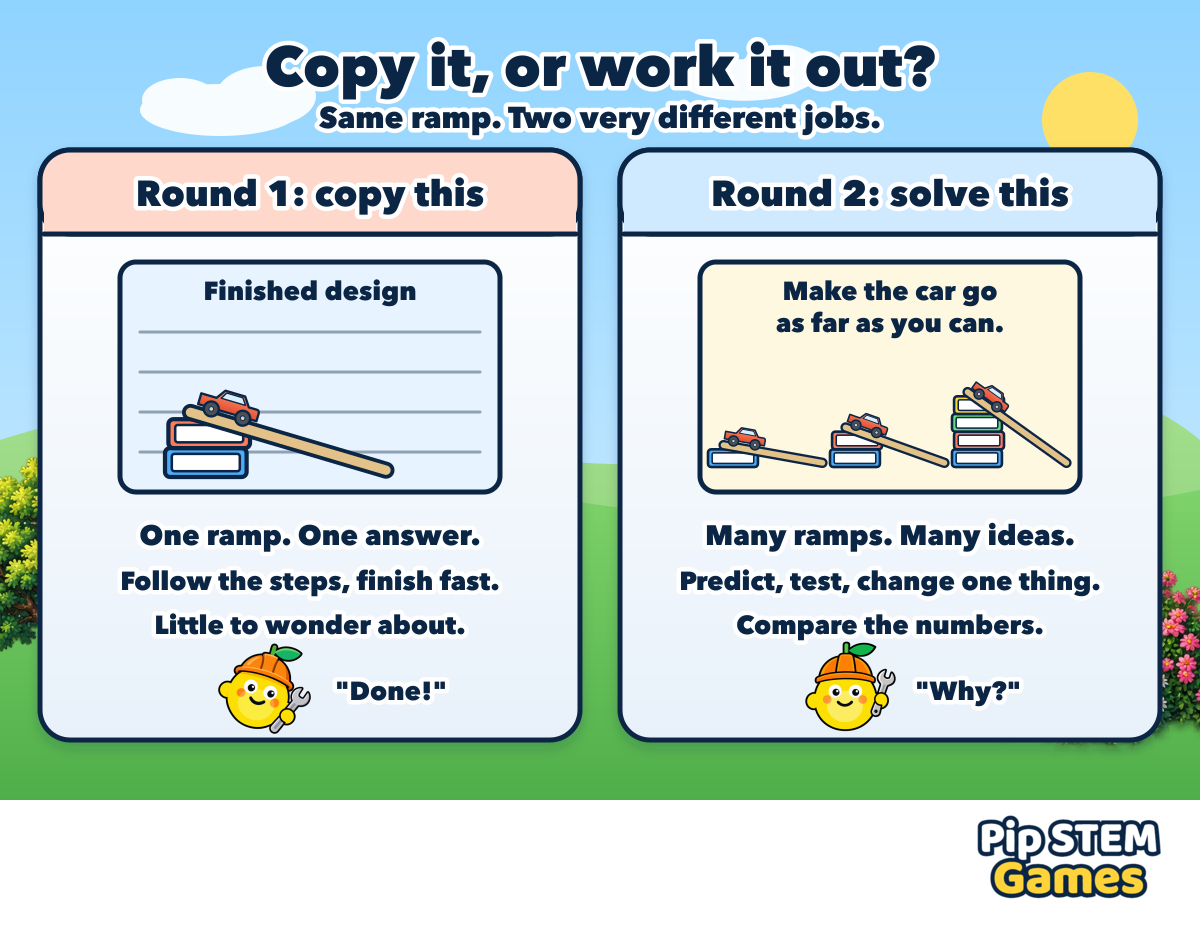
Hand over the design and let your child follow it. This is the control: it shows what happens when the thinking is already done.
- Build one ramp yourself: cardboard resting on a stack of two books.
- Show it to your child and ask them to build the same one.
- Let the car go from the top mark. Measure from the end of the ramp to where the car stops, and write the number down.
- Ask: what do you think made it go that far?
Expect a quick build and few ideas. That's normal. The child has a working answer, so there's little to wonder about.
How do you run the independent test round?
Give the problem and the materials, and keep the answer to yourself. Say: make the car roll as far as you can.
- Ask for a prediction before each try. Which ramp will go further, and why?
- Let your child build a first ramp and test it. Measure and write it down.
- Change one thing at a time: the height (add a book), the surface (bare cardboard or foil) or the start point.
- Test each version three times and write down all three distances.
- Ask your child to tell you what the numbers say.
Pro tip: when your child gets stuck, ask a question instead of giving a fix. "What did you change last time?" works better than "Try one more book."
Pro tip: count to ten, slowly, before you say anything. Most children use the silence.
How do you make it a fair test?
Change one thing between tests and keep everything else the same. If the height changes, the car, the surface and the start mark must stay put.
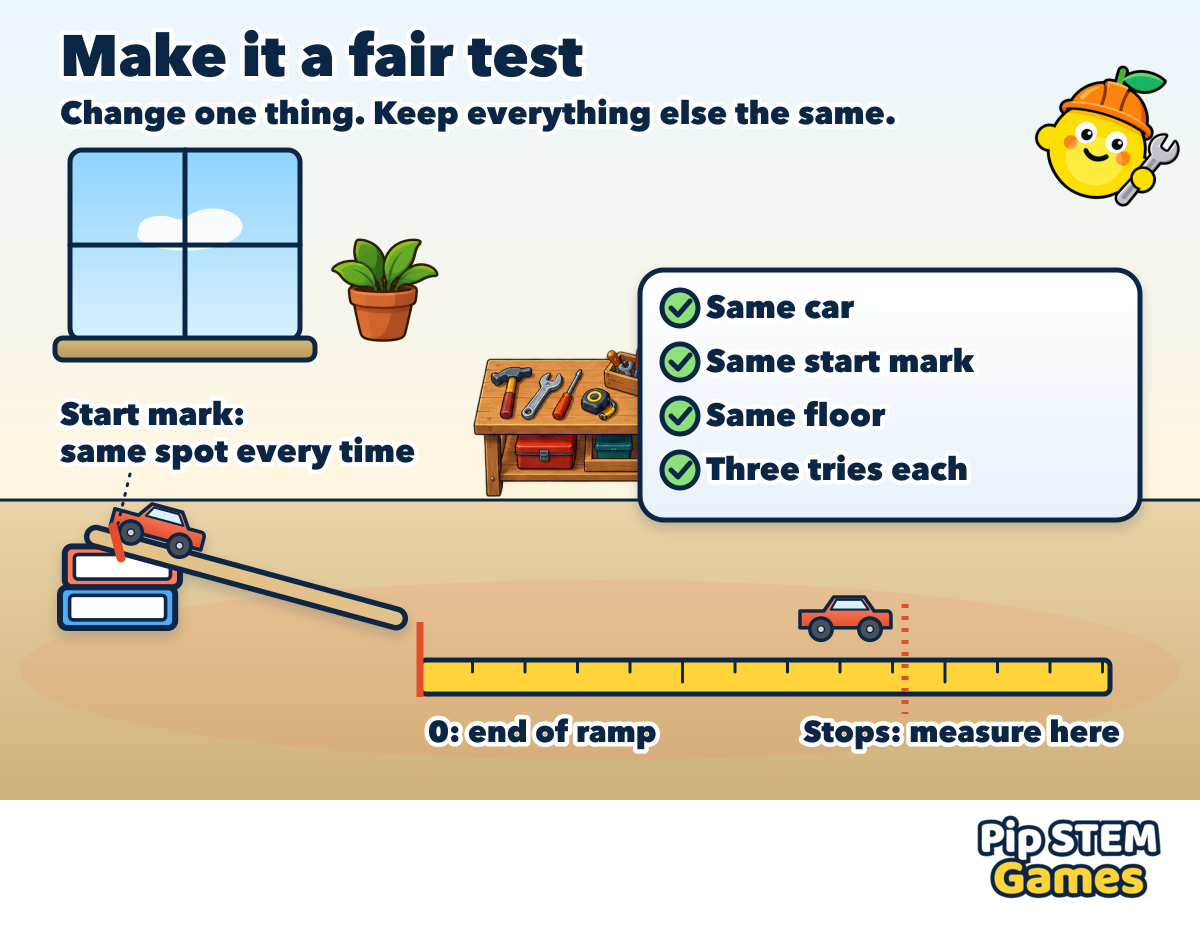
Let the car go without pushing it, from the same mark every time. Measure from the same place, the end of the ramp, to the spot where the car stops. Do three tries, because a single roll can be a fluke.
What should you watch for?
Watch for thinking, not for a perfect ramp. Four things tell you the most.
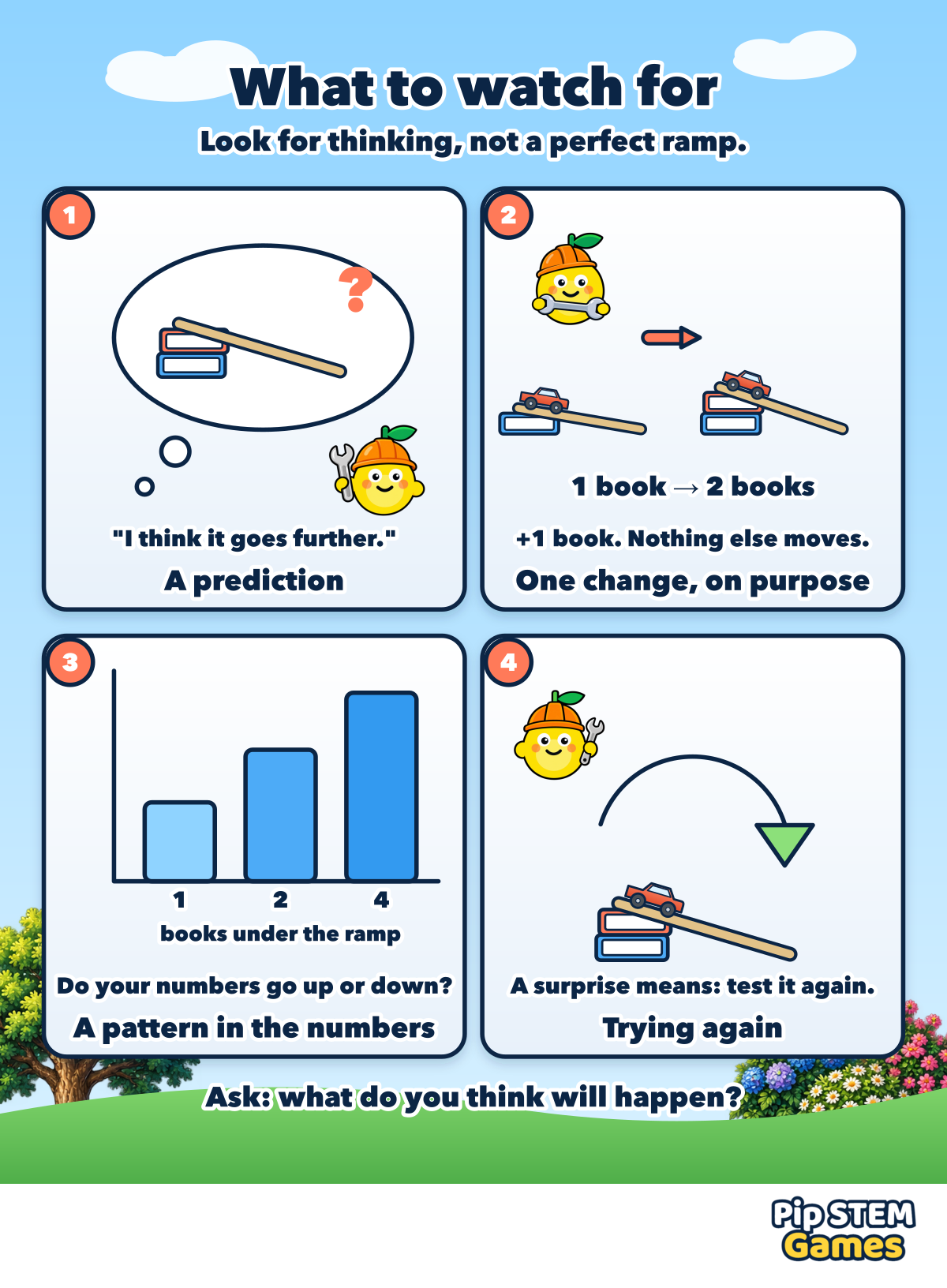
- Did your child make a prediction before testing?
- Did they change one thing on purpose?
- Did they notice a pattern in the numbers?
- Did they try again after a surprise?
Write down what actually happens at your table. Floors and cars differ from home to home, so compare your own two rounds with each other. Don't expect set numbers.
Want a place to record it? Save this sheet, print it on A4 and fill it in as you go.
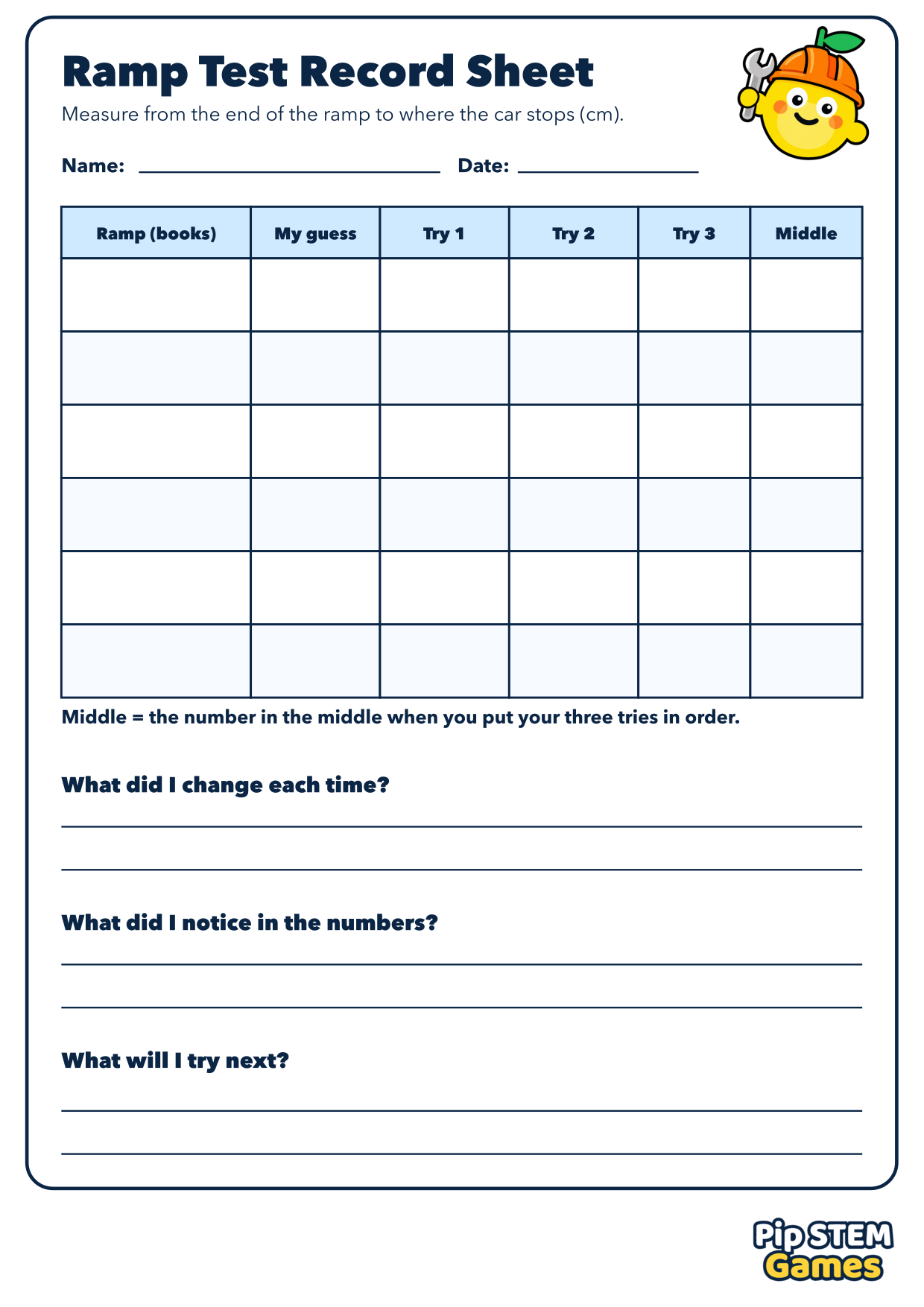
What can go wrong, and what should you try next?
Most problems come down to the car or the floor.
- The car veers sideways. Add two strips of tape along the ramp as rails, or use a straighter edge.
- The distances jump around. Check that you're letting go, not pushing, and that the floor is the same each time.
- The ramp slides. Tape the bottom edge to the floor.
- Your child changes three things at once. That's fine as a first go. Then say, "Let's find out which change mattered," and test them one at a time.
For a next test, mark a square on the floor with tape. Challenge your child to stop the car inside it three times out of five. Now it isn't about distance. It's about control, and your child has to tune the design.
Want more ways to ask instead of tell? Try 7 questions to ask instead of giving your child the answer. And if your child hits a wall, here's what to do when they say "I can't do it". Our Ramp Runner game lets children test ramps on screen too.
How do you change the test for each age?
Match the measuring to the child.
- Ages 5 to 6 (easier): compare two ramps, high and low. Make a tally of which went further. Use a bigger toy car.
- Ages 7 to 9: measure in centimetres, record three tries and find the middle value.
- Ages 10 to 12 (harder): draw a graph of height against distance. Write one sentence about the pattern and where it might stop working.
The goal isn't the best ramp. It's a child who feels that their own testing can find the answer. If you want the bigger picture of why failing and fixing is part of the job, read why getting it wrong is part of engineering.
Questions parents ask
Should I never help my child?
No. Help with questions, not fixes. If your child is upset or truly stuck, show one small idea and let them carry on. Struggle only helps when the problem is just beyond what they can do now.
How long should I wait before stepping in?
Try ten slow seconds first. Then ask a question such as "What did you change last time?" before you offer any answer.
What if my child gets frustrated and quits?
Make the problem smaller. Compare just two ramps instead of many. Quitting often means the task is too big, not that your child can't do it.
Is it true that struggling always helps children learn?
No. Studies with teenagers are encouraging, but a study of pupils aged 10 to 12 found no benefit from trying first. It helps most when the problem is well chosen and an adult talks it through afterwards.
Can I use a marble instead of a toy car?
You can, in a cardboard channel, with an adult close by. A marble is a choking risk, so keep it away from children under 3. A toy car is safer and easier to measure.
What age is this test for?
Ages 5 to 12. Younger children compare two ramps and tally. Older children measure, find the middle value and draw a graph.
Great STEM activities to try next...
 7 Questions to Ask Instead of Giving Your Child the AnswerActivity
 Why Getting It Wrong Is Part of EngineeringActivity
 What to Do When Your Child Says 'I Can't Do It'Build challenge
More to try: How Do Traffic Lights Know When to Change?

Pip STEM Games
We make engineering games and workbooks for kids aged 5 to 12. Every activity here is one we'd happily run at the kitchen table: test it, watch it fail, fix it, try again.




