

Key takeaways
- "I can't do it" usually means the job feels too big right now, not that the child cannot learn it.
- Stay calm, ask what they have tried, and let them find the first small step.
- Splitting one big job into three parts, then ticking each one, makes progress easy to see.
- A tower of six paper cups gives you a safe, cheap way to practise the method.
- Praise the method ("you split it into parts") rather than the height or the talent.
Stay calm, ask questions instead of giving the answer, and break the job into small parts your child can finish one at a time. When a child says "I can't do it", it usually means "this feels too big right now." The cup tower challenge below lets you practise that response with ages 5 to 12, using things from the kitchen cupboard.
What does "I can't do it" really mean?
It usually means the task feels too big, too unclear or too risky to get wrong. Children aged 5 to 12 often stop when they can't see the first step. Your job isn't to rescue them. It's to help them find a first step small enough to try.
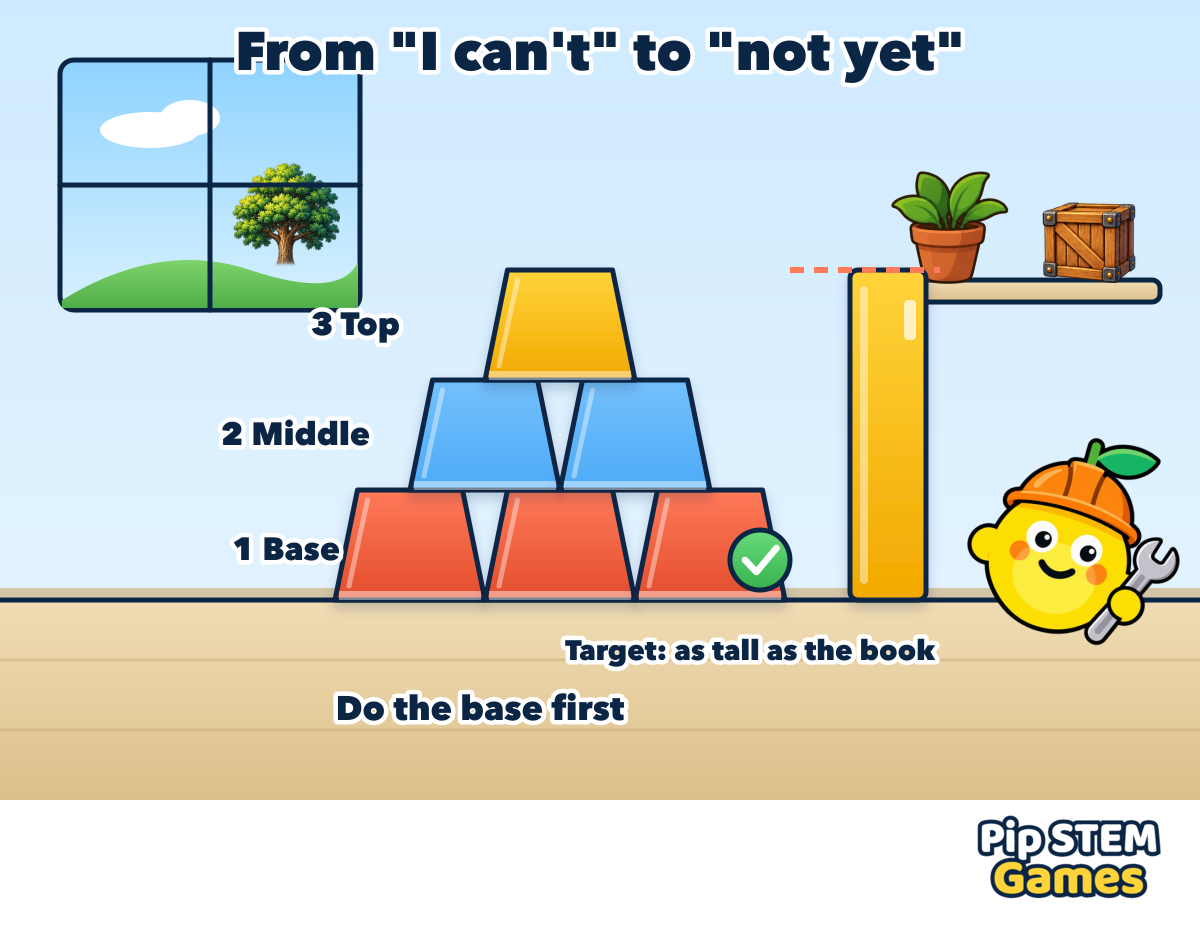
Many parenting guides suggest adding one small word: "I can't do this yet." It turns a verdict into a stage. The word helps, but it isn't magic. If a child has worked hard and still feels stuck, they need a different way in, and that's what the cup tower practises.
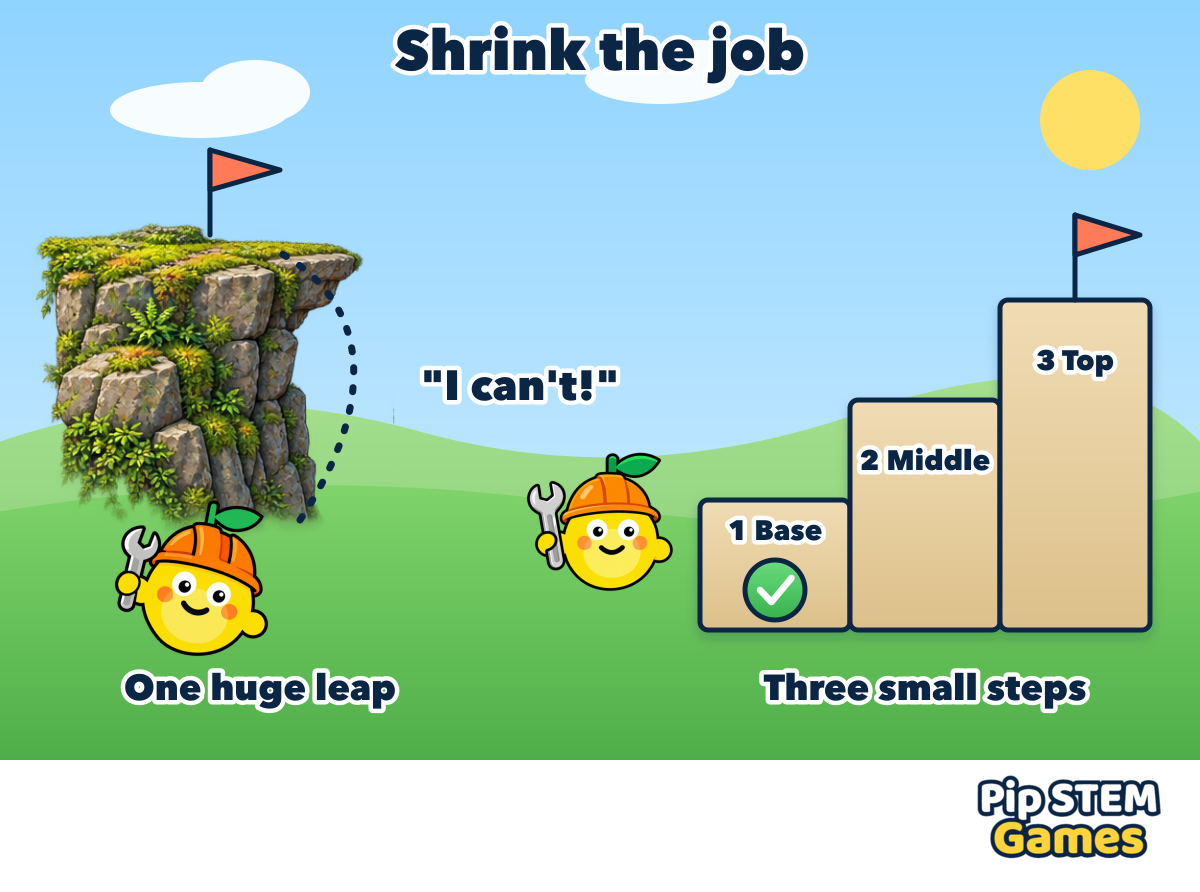
Frankly, most meltdowns over building and homework come from the same place: the child can see the finish line but not the first step. The picture below shows the difference.
What can you say when your child says it?
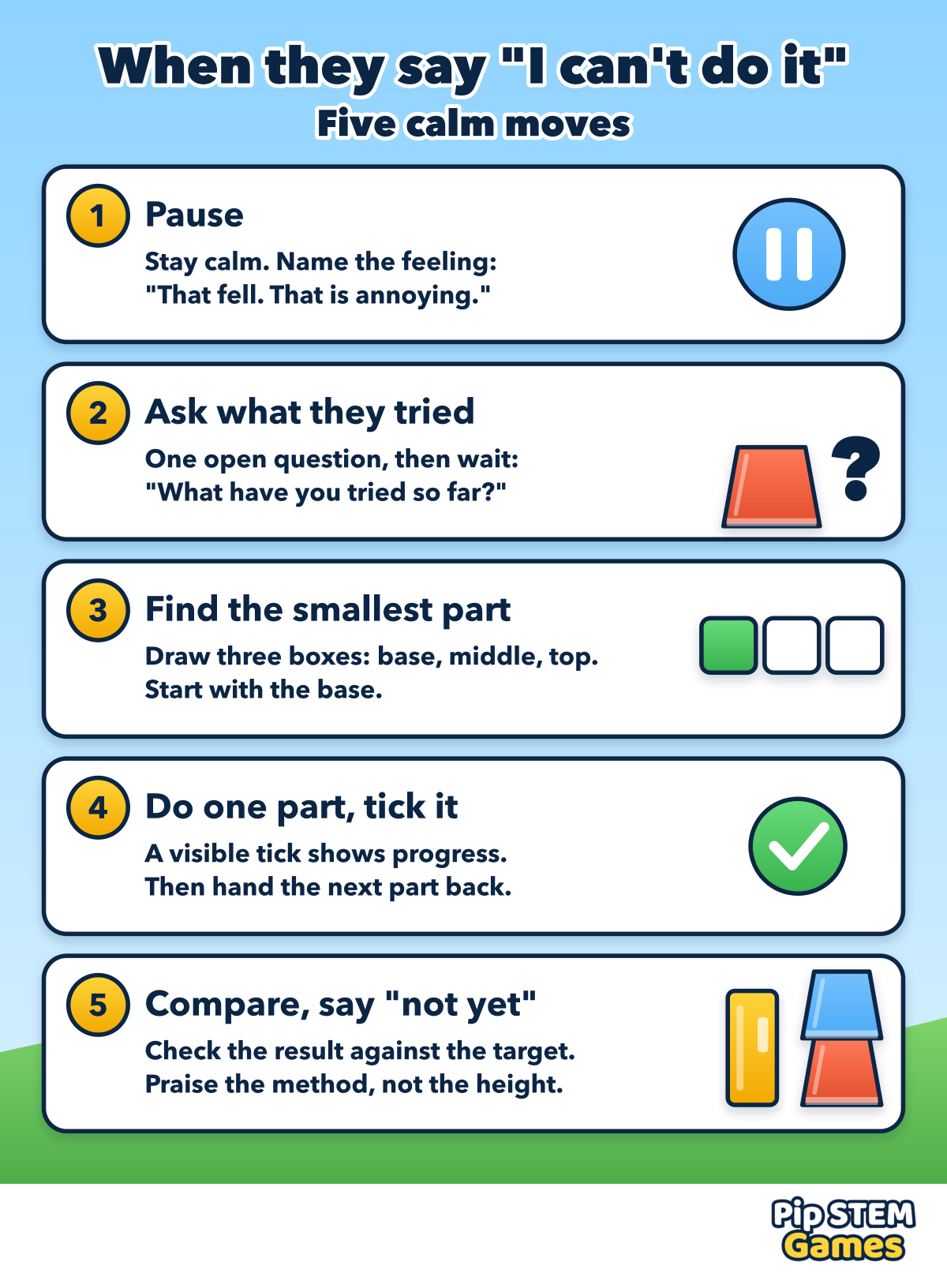
Say what you see, then ask one open question. "That fell down. That's annoying. What have you tried so far?" works better than "It's easy, just do this", which can make a child feel worse for not seeing it.
- Name the feeling. "This looks frustrating" shows you've noticed.
- Ask, don't tell. "What have you already tried?" and "What's the smallest part you could do?"
- Wait. Count to five in your head before you add anything.
- Add "yet". "You can't do it yet" says learning is still going on.
- Praise the method. "You split it into parts and that worked" beats "you're so clever".
Our post on seven questions to ask instead of giving the answer has more phrases to borrow.
What materials do you need for the cup tower?
You need about six paper cups and a book. Everything else is optional.
- 10 to 15 paper cups, or a stack of small cardboard boxes (six are used in the main build)
- A table or clear floor space
- A book stood on its end as the target height (a large picture book is about 25 cm tall)
- Paper and a pencil, or our printable plan sheet below
- A timer, if your child likes one (optional)
Safety: no small parts are needed. If you add counters or coins to the game, keep them with an adult and away from children under 5. Build on a table or on the floor, never up a step stool.
How do you run the cup tower challenge step by step?
You set a big challenge, hold back, ask questions, then split the job into base, middle and top. The whole thing takes about 20 minutes.
- Set the challenge: "Build a tower as tall as this book using only these six cups."
- Wait. Let your child try, or say "I can't". Don't fix it yet.
- Ask a prediction question: "What do you think will happen if we put one cup on top of one cup?" Let them answer, then test it.
- Ask a trace question: "Where did it start to wobble?" Point at the exact cup together.
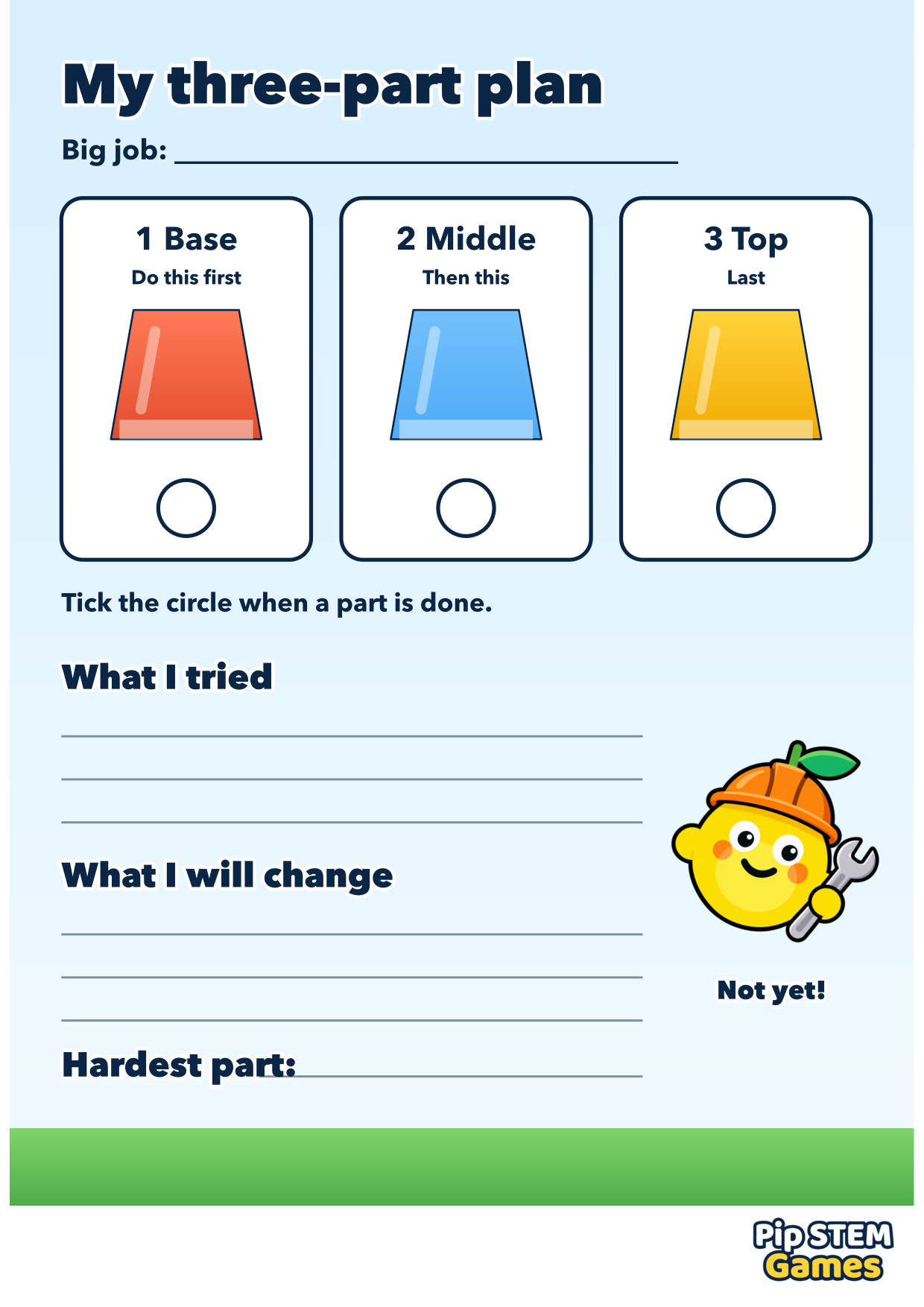
- Draw three boxes on paper: base, middle, top. Say, "Let's only do the base first."
- Finish one part, then tick it. A visible tick shows progress.
- Move to the next part. Ask, "What did the base teach you that helps the middle?"
- Compare the finished tower with the book. Celebrate the method, not only the height.
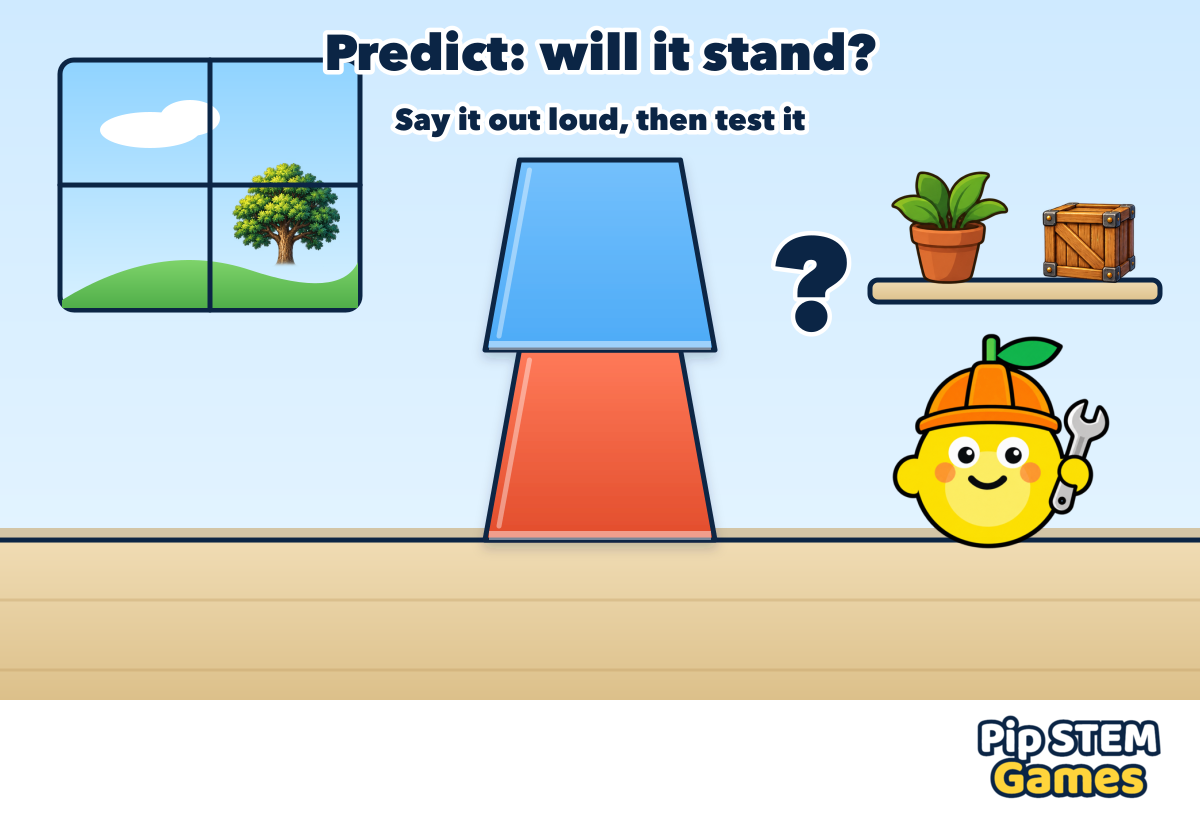
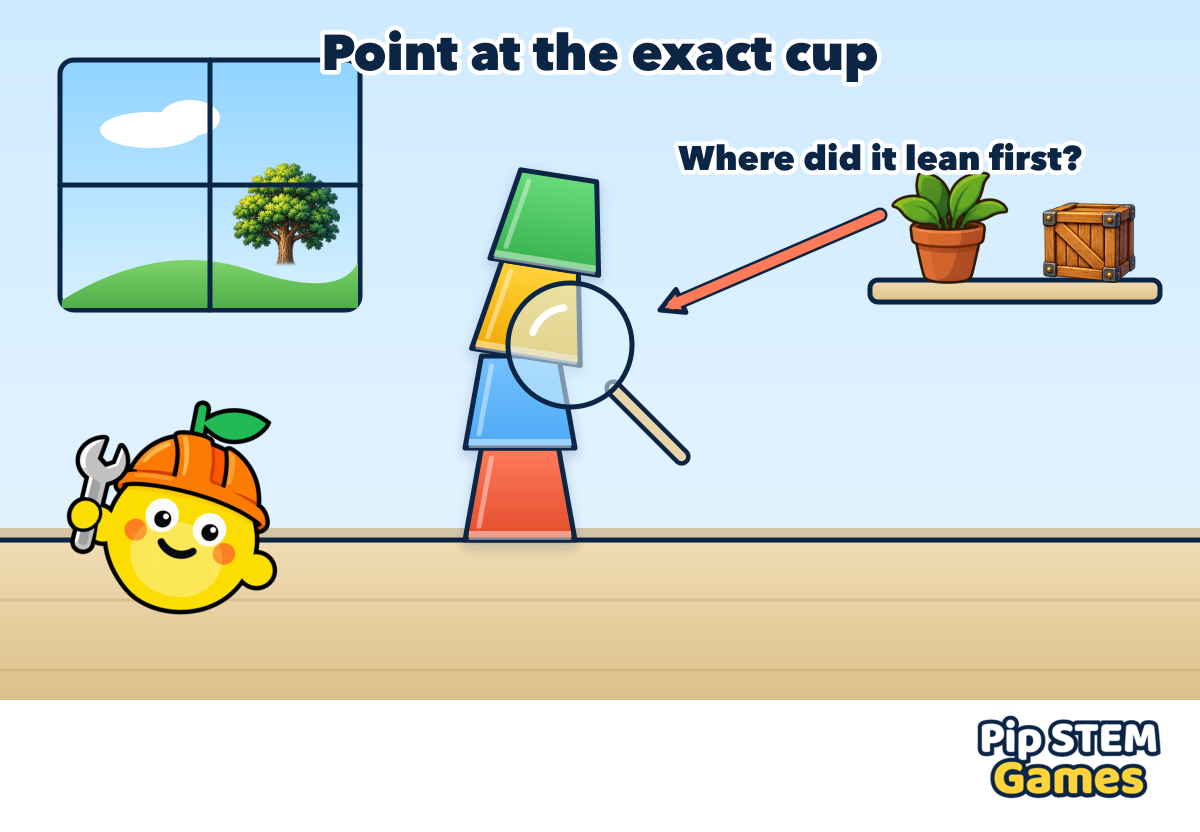
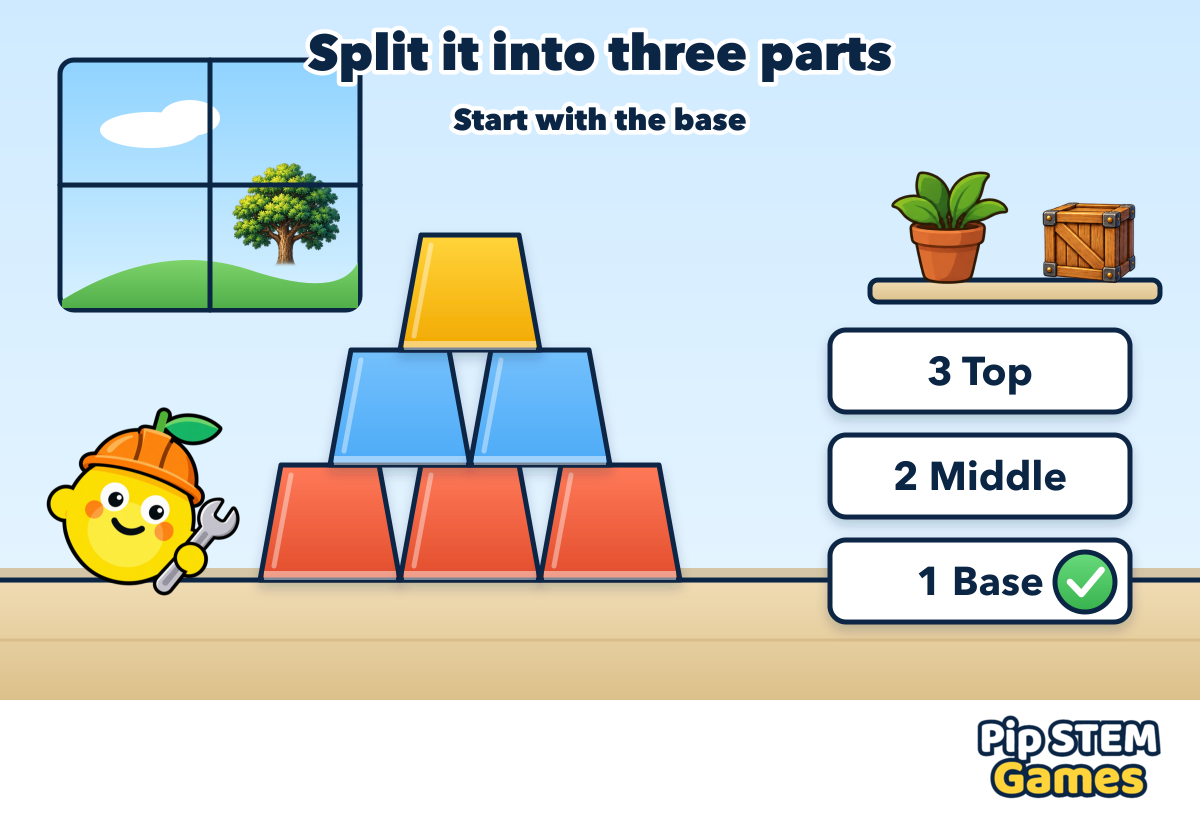
Cups placed upside down work best. A base row of three, a middle row of two sitting across the gaps, and one cup on top makes six. A wide base is steadier than a tall narrow stack, so the pyramid usually survives where the single column falls.
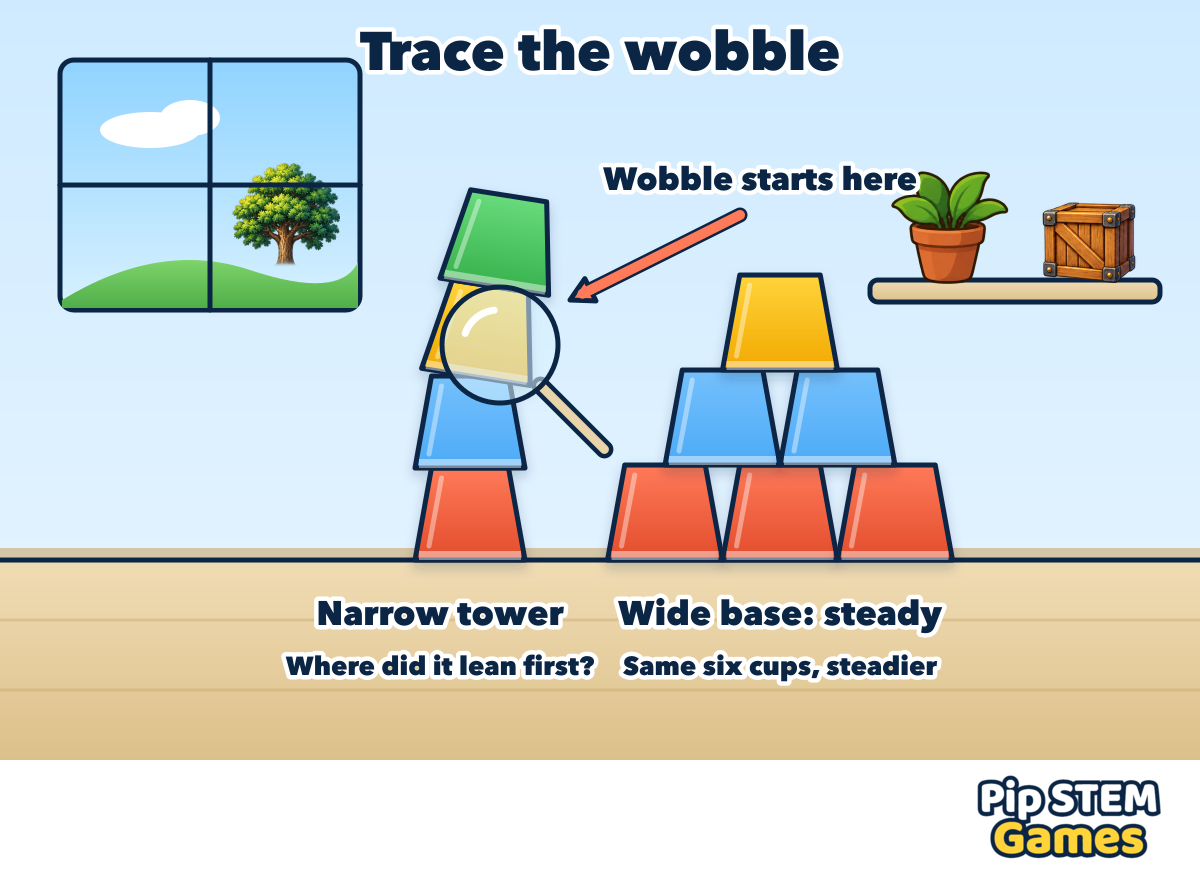
You can practise the same idea in the Tower Stack game, where a shaky tower has to be fixed one block at a time.
Which questions help most?
Open questions that make your child do the thinking help most, because they hand the decision back to them.
- "What have you already tried?"
- "What is the smallest part you could do?"
- "What do you think will happen next?"
- "What would you change?"
Keep it to one question at a time. Even good questions feel like an interrogation if they come nonstop. Mix them with quiet watching and the odd "hmm" or "I see".
Pro tip: say your own "I can't" out loud next time you get stuck, then say what you try next. Children copy that far more than they copy advice.
What if it still goes wrong?
Stop, take a break and come back when everyone is calm. Pushing on while a child is upset teaches them to dread the task.
- Your child gets more upset: stop the task and take a short break. Return when calm.
- The tower keeps falling: make the challenge smaller, such as only three cups tall, or start with the pyramid shape.
- Your child wants you to do it: offer to do one part together, then hand it back.
- They say it's boring: add a small twist, such as a timer or a new target height.
- Effort isn't helping: trying harder isn't always the answer. Help them try a different way, such as a wider base.
Our post on why getting it wrong is part of engineering goes into why a collapse is useful information.
How can you make it a fair test?
Change one thing at a time and keep everything else the same. For example, build one tower with a wide base and one with a narrow base, using the same number of cups on the same table.
Count how many cups each holds before it falls. If you change the cups and the table at once, you won't know which change mattered. Write each result down so you compare facts, not memories. Run each version three times, because one lucky try can mislead you.
Here is the printable plan sheet. Print it, or draw the same three boxes on a piece of paper.
What is a good next challenge?
Try the same method on a new job: a bridge between two books made of paper strips. Ask your child to name the three parts before starting, then work through them one at a time.
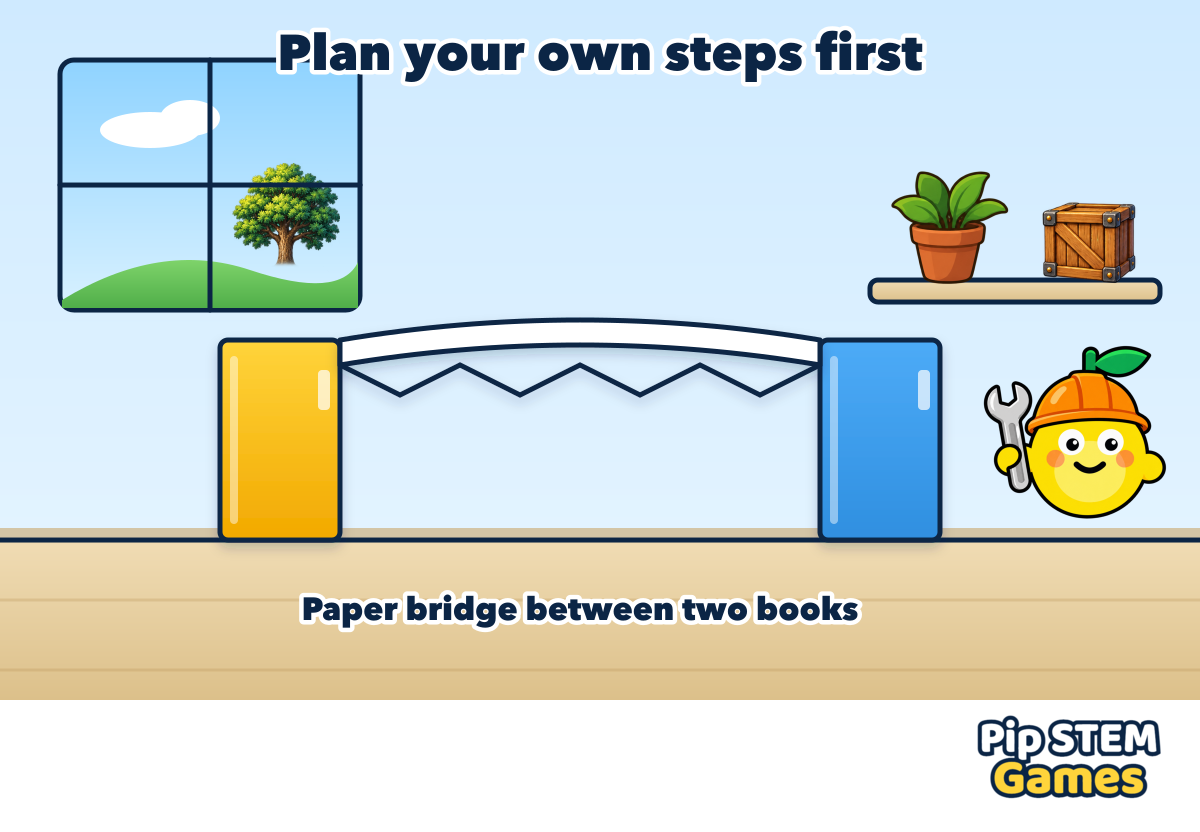
Notice whether they split the job without your help. If they do, you've seen the habit start. Our paper bridge challenge has the full method, and the Senior Engineers workbook has more jobs to split into parts.
How do you adapt it by age?
Make it smaller for ages 5 to 7 and add planning and writing for older children.
- Ages 5 to 7: use three to five cups and a very clear target. Do the splitting together and draw big boxes.
- Ages 8 to 10: let them write their own three steps and predict the result before testing.
- Ages 11 to 12: ask them to plan the steps, test two designs, and explain which was better and why.
Each small success teaches that effort and method work. Over time your child learns to find their own first step, and that's the real prize.
Questions parents ask
What should I say when my child says 'I can't do it'?
Stay calm, name what you see, and ask one open question such as "What have you tried so far?" Then wait. Adding the word "yet" can also help.
Why does my child give up so quickly?
Often the job feels too big or the first step isn't clear. Children aged 5 to 12 stop when they can't see where to start. Splitting the job into small parts usually helps.
Should I just show them how to do it?
Try not to rescue straight away. Offer to do one part together, then hand it back, so your child still makes the decisions.
Is praising effort enough?
No. Effort matters, but if hard work isn't getting results, help your child try a different method, not just a harder try.
What if my child gets very upset?
Stop and take a break. Come back when they are calm, with a smaller version of the challenge.
What age is the cup tower challenge for?
Ages 5 to 12. Younger children use three to five cups and a clear target, and older children plan and test two designs.
Great STEM activities to try next...
 7 Questions to Ask Instead of Giving Your Child the AnswerActivity
 Why Getting It Wrong Is Part of EngineeringActivity
 Paper Bridge Challenge: Build a Bridge From One Sheet of Paper [Printable]Build challenge
More to try: What Happens When You Stop Giving Children the Answer? · How Do Traffic Lights Know When to Change?

Pip STEM Games
We make engineering games and workbooks for kids aged 5 to 12. Every activity here is one we'd happily run at the kitchen table: test it, watch it fail, fix it, try again.




