

Key takeaways
- A flat sheet of paper usually sags and slides off after a few coins; a folded one can hold 20 or more, so count yours.
- Folds make paper deeper, and a deeper shape is much harder to bend.
- Run the folds from support to support, along the bridge.
- A bridge can bend, slip or twist: find which one, then fix that.
- Coins are a choking risk for under-6s, so a grown-up handles them.
Can one sheet of paper hold 20 coins? Often, yes, if you fold it into an accordion. This test compares a flat sheet with two folded shapes across a 10 cm gap, and shows why folding works. There is a printable record sheet too.
Can one sheet of paper hold 20 coins?
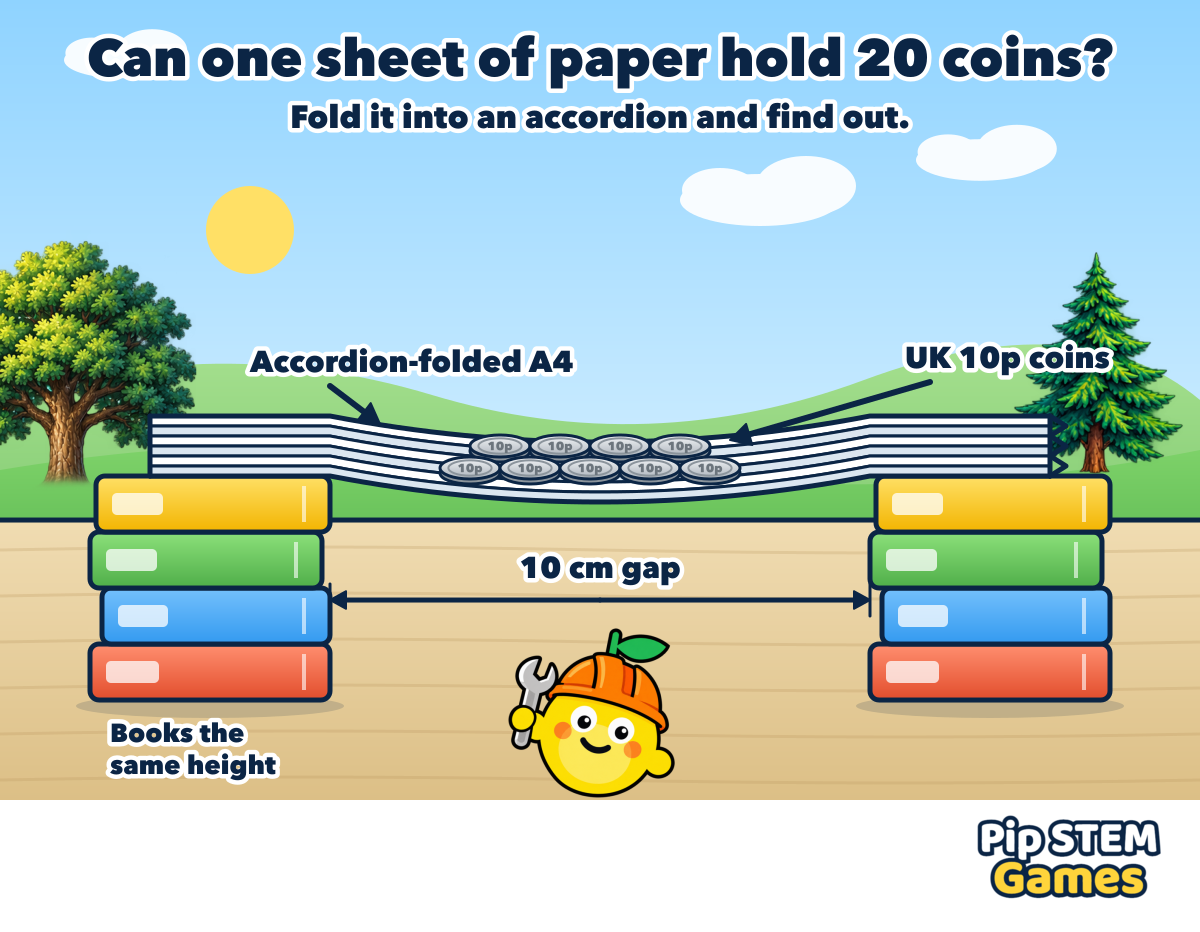
Often, yes, if you fold it. A flat sheet of paper usually sags and slides off the supports after only a few coins. The same sheet folded like a fan can hold 20 or more. I have not counted your sheet, so count yours and see.
The paper is the same. Only the shape changes. That is the whole trick, and it is a real idea that engineers use for roofs, floors and bridges.
This test takes about 15 minutes. You compare three shapes, count the coins each one holds, and write the numbers down. There is a printable record sheet too.
What do you need for the paper bridge test?
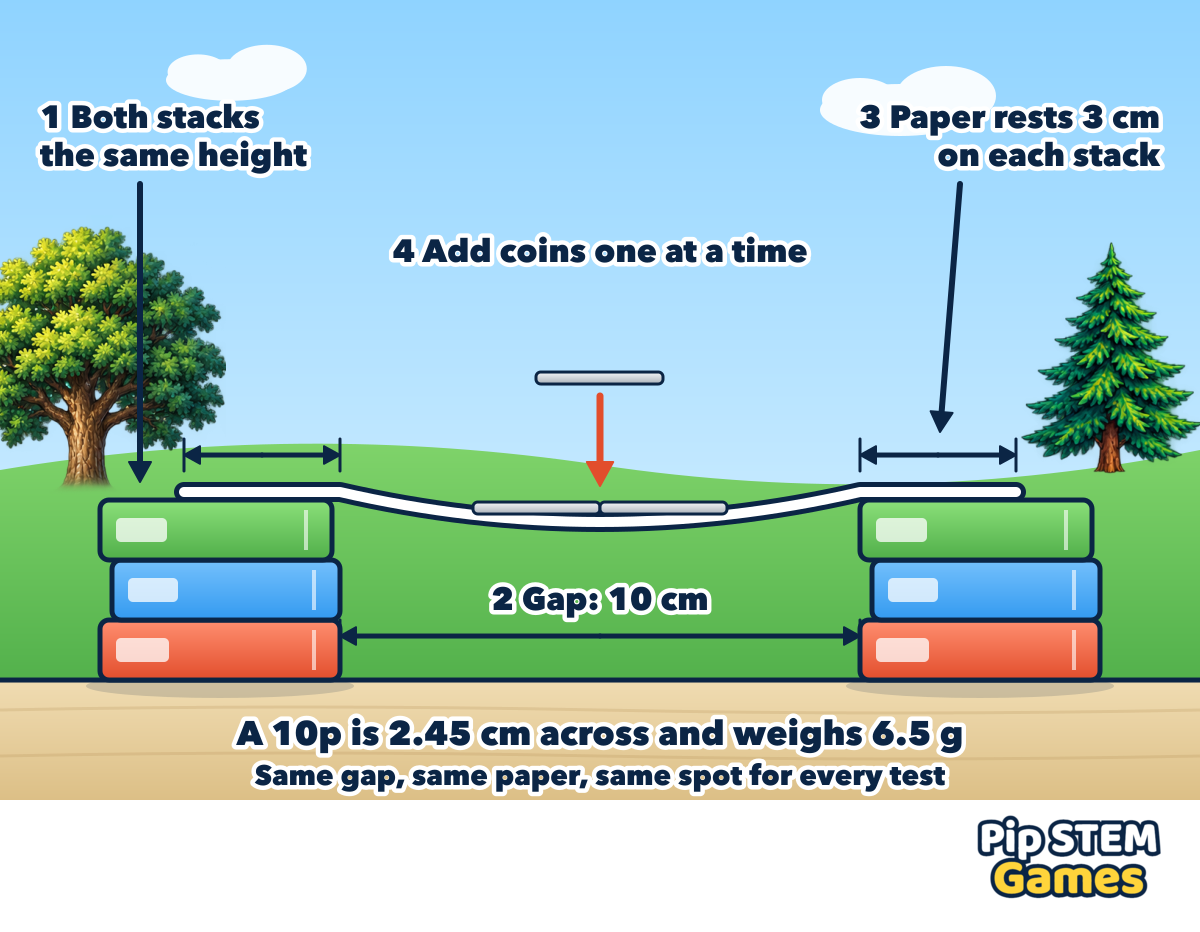
You need:
- 3 sheets of A4 printer paper, all from the same pack
- 2 matching stacks of books or 2 matching boxes, the same height
- About 30 UK 10p coins, all the same
- A ruler and a pencil
- A tray or tea towel to put under the bridge
A UK 10p is 24.5 mm across and weighs 6.5 g. Twenty of them weigh 130 g. An A4 sheet of normal printer paper weighs only about 5 g, so the coins are around 26 times heavier than the bridge. That is why this feels surprising.
Safety: coins are a choking risk for children under 6, and children under 3 should not take part. A grown-up counts and handles the coins for little ones. Keep the paper edges away from fingers, because paper can cut. You do not need scissors for this test, so leave them in the drawer.
How do you run the test?
Follow the steps in order. Change only the paper shape each time.
- Set the gap. Place the two stacks 10 cm apart. Measure it with the ruler. Check both stacks are the same height. Put the tray underneath.
- Test the flat sheet. Lay one sheet across the gap with 3 cm resting on each stack. Add coins one at a time, in the middle. Stop when the paper sags a lot, slips or twists. Write down the number.
- Fold a second sheet in half along the long side. Lay it across with the fold running from stack to stack. Add coins the same way and count.
- Fold a third sheet like an accordion, with folds about 2 cm wide, again running from stack to stack. Test it and count.
- Compare. Which shape held the most? Which bent first?
Only add coins one at a time and keep your hands off the paper while you do. If the coins slide, put each one down gently in the same spot.
Pro tip: try each shape three times and take the best number. One test can be a fluke.
How do you fold the accordion bridge?
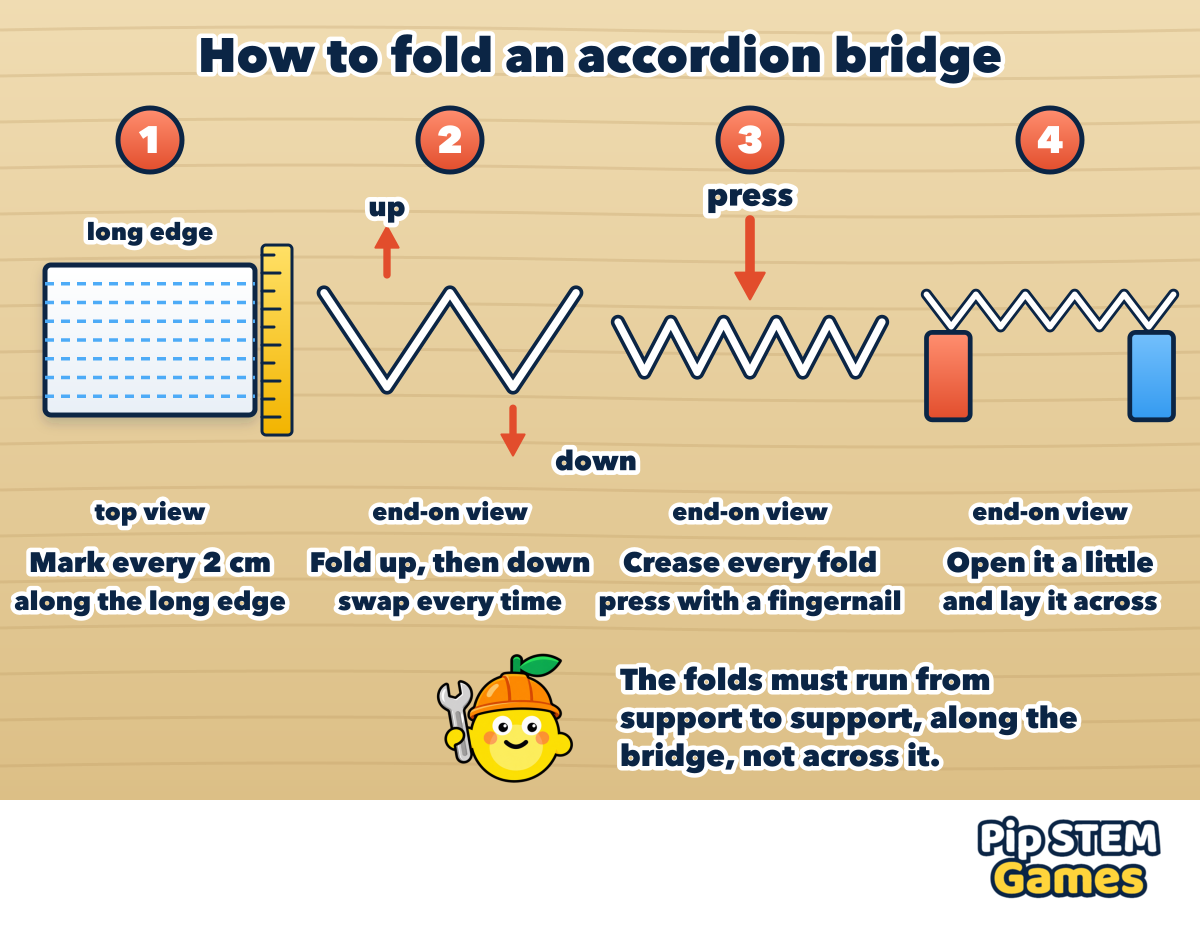
The folds must run along the bridge, from one support to the other. Fold the wrong way and you get no benefit at all.
- Lay an A4 sheet flat with the long side towards you.
- Fold a 2 cm strip up along the long edge. Crease it with your finger.
- Flip the sheet over and fold the next strip the other way, like a paper fan.
- Keep going until the whole sheet is a zigzag, then stand it on its edge across the gap.
Press each crease flat so the folds are even. Uneven folds can twist the bridge or make it slip off a support.
Why does folding make paper stronger?
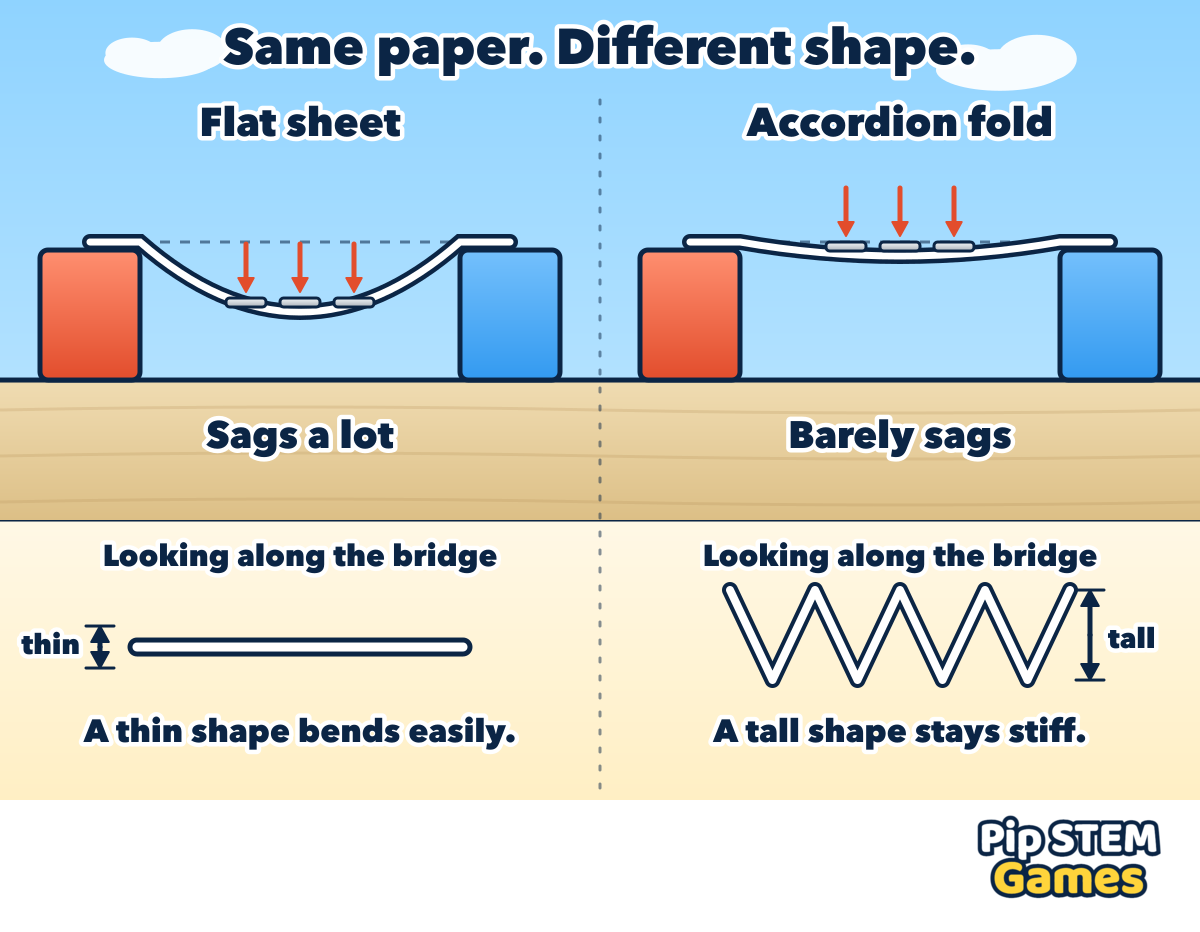
Look at the sheet end-on. A flat sheet is very thin, only about 0.1 mm. When coins press on it, the top squashes and the bottom stretches, and a thin sheet gives way easily.
A folded sheet has zigzags that stand up from the table. They make the paper much deeper, even though the paper is the same. A deeper shape is far harder to bend. Engineers say it has more stiffness. Shape matters more than material here.
You see the same idea in corrugated cardboard, in metal roof sheets and in steel beams. To see more paper tricks, try watch what happens when you fold paper, or learn about why arches are so strong.
What if the bridge fails straight away?
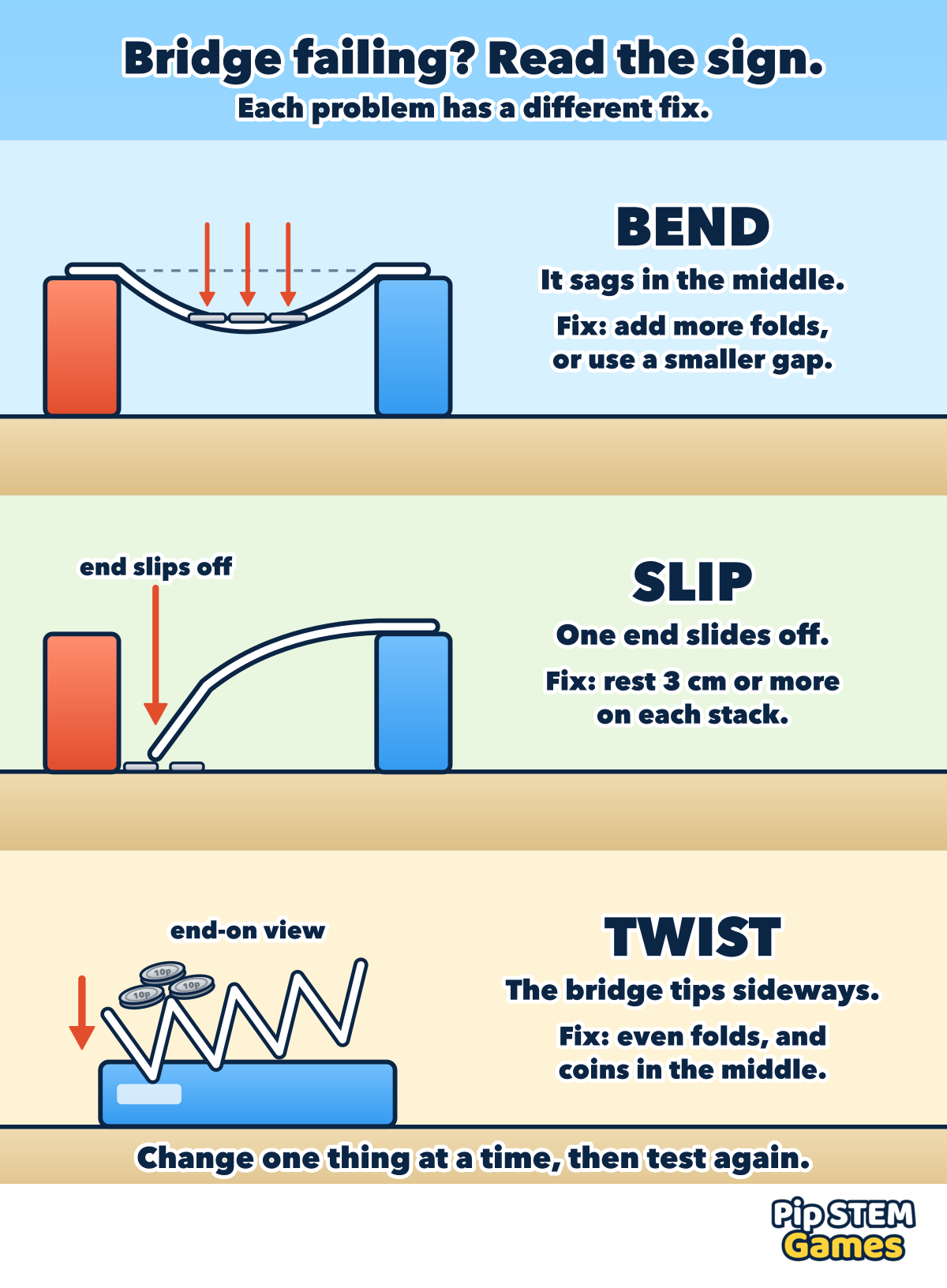
A bridge can fail in three different ways. Work out which one you have, then fix that one.
- Bend. The middle sags. Add a fold, or move the supports closer.
- Slip. The paper slides off a support. Rest 3 cm on each stack, or put a book on each end.
- Twist. One side drops. Make the folds even and put the coins in the exact middle.
More folds are not always better. Folds that are uneven or too wide make the bridge twist. Keep them neat.
For a longer bridge challenge, try the paper bridge challenge. You can also test bridges on screen in our Bridge game.
How do you record a fair test?
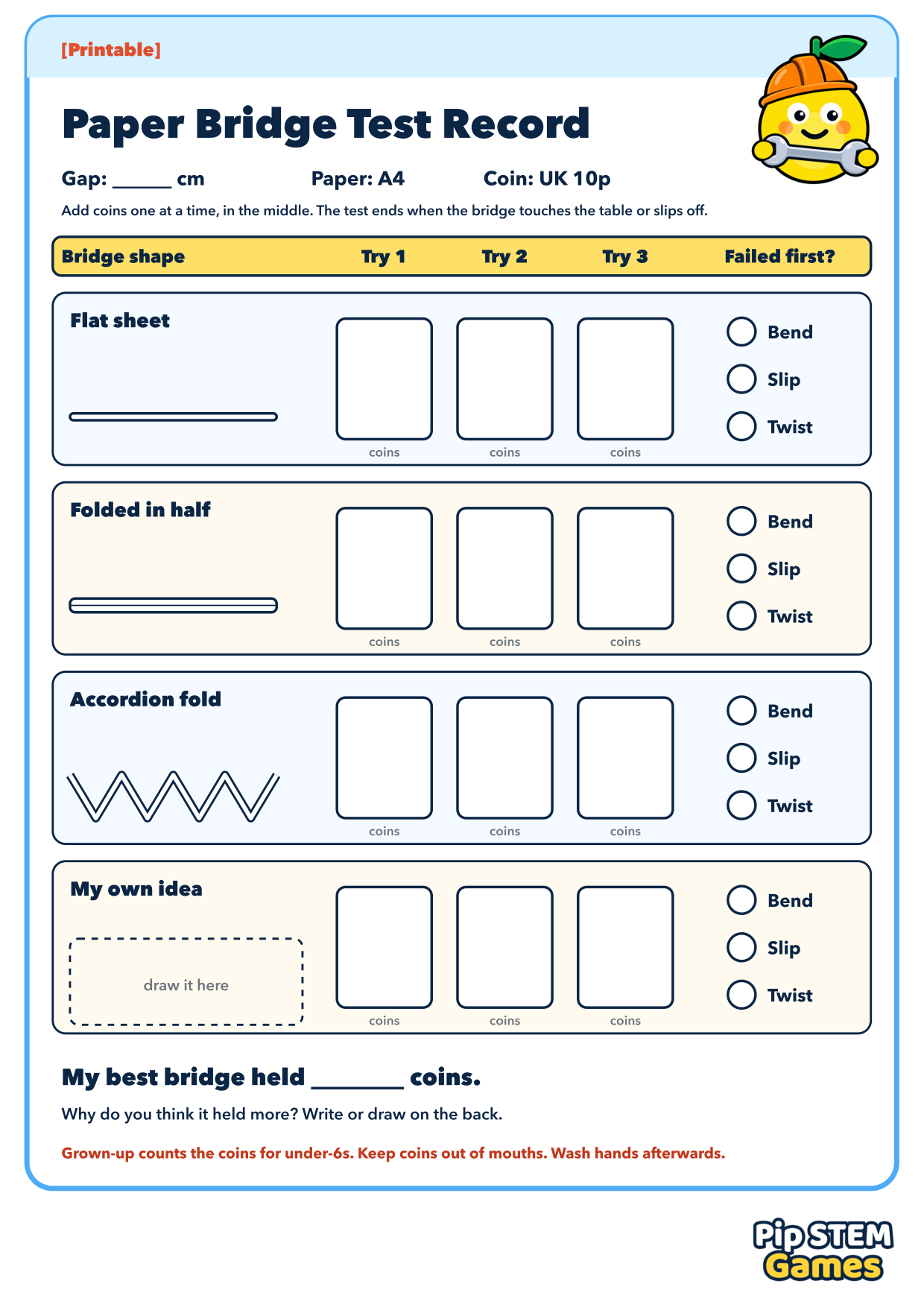
Print the record sheet and fill it in as you go. A fair test changes only one thing. Keep the gap, the paper, the coins and the coin spot the same, and change only the paper shape.
Write down the gap, the shape and the coin count. Circle whether it bent, slipped or twisted first. Use a fresh sheet each time, because a creased sheet gives a different answer.
Then try something new: a tube, a wider gap, or two sheets taped together. Change one thing and test again.
How do you change it for each age?
Match the task to the child.
- Ages 3 to 5: no coins. Use a few light cotton balls or soft toys instead, and let a grown-up do the counting.
- Ages 6 to 7: test a flat sheet and a folded sheet. A grown-up hands over the coins. Say which held more.
- Ages 8 to 9: run all three shapes, count the coins and fill in the record sheet.
- Ages 10 to 12: change the gap to 15 cm, then 20 cm, and plot gap against coins. Try folds of different widths.
The goal is not to win. It is to see that a clever shape can do the job of a stronger material.
Questions parents ask
Can one sheet of paper hold 20 coins?
Often, yes, when it is folded into an accordion across a small gap. A flat sheet usually sags and slips after only a few coins. Results vary with the paper, the gap and where the coins sit, so count your own.
How much does a UK 10p coin weigh?
A UK 10p weighs 6.5 g and is 24.5 mm across, according to the Royal Mint. Twenty coins weigh about 130 g.
Why does folded paper hold more weight?
Folds make the paper deeper, and a deeper shape is much harder to bend. The paper is the same, but the shape resists bending better.
Is this safe for young children?
Coins are a choking risk for children under 6, so a grown-up should count and hand over the coins. Children under 3 should not take part. No scissors are needed.
What if my paper bridge fails straight away?
Check the gap is about 10 cm and the supports are level. Then see whether it bent, slipped or twisted. Add folds for bending, rest more paper on the supports for slipping, and even out the folds for twisting.
Great STEM activities to try next...
 Paper Bridge Challenge: Build a Bridge From One Sheet of Paper [Printable]Build challenge
 Watch What Happens When You Fold Paper [Printable]Build challenge
 Why Are Arches So Strong? [Printable]How it works
More to try: Bridge Collapsed: A Paper Bridge Test for Kids

Pip STEM Games
We make engineering games and workbooks for kids aged 5 to 12. Every activity here is one we'd happily run at the kitchen table: test it, watch it fail, fix it, try again.




