

Key takeaways
- Span is the gap, load is the weight, and every material has a limit.
- A flat sheet of paper bends because it has no depth.
- Folding the same paper adds depth, so it holds more.
- Triangles keep their shape, which is why trusses are strong.
- Test each bridge 3 times and use the middle number.
This paper bridge challenge for kids starts with a story: the bridge has collapsed and supplies are stuck. Your child builds a flat, a folded and a truss bridge across a 20 cm gap, then counts how many 10p coins each one holds. It takes about 45 minutes and suits ages 5 to 12.
What is the bridge challenge?
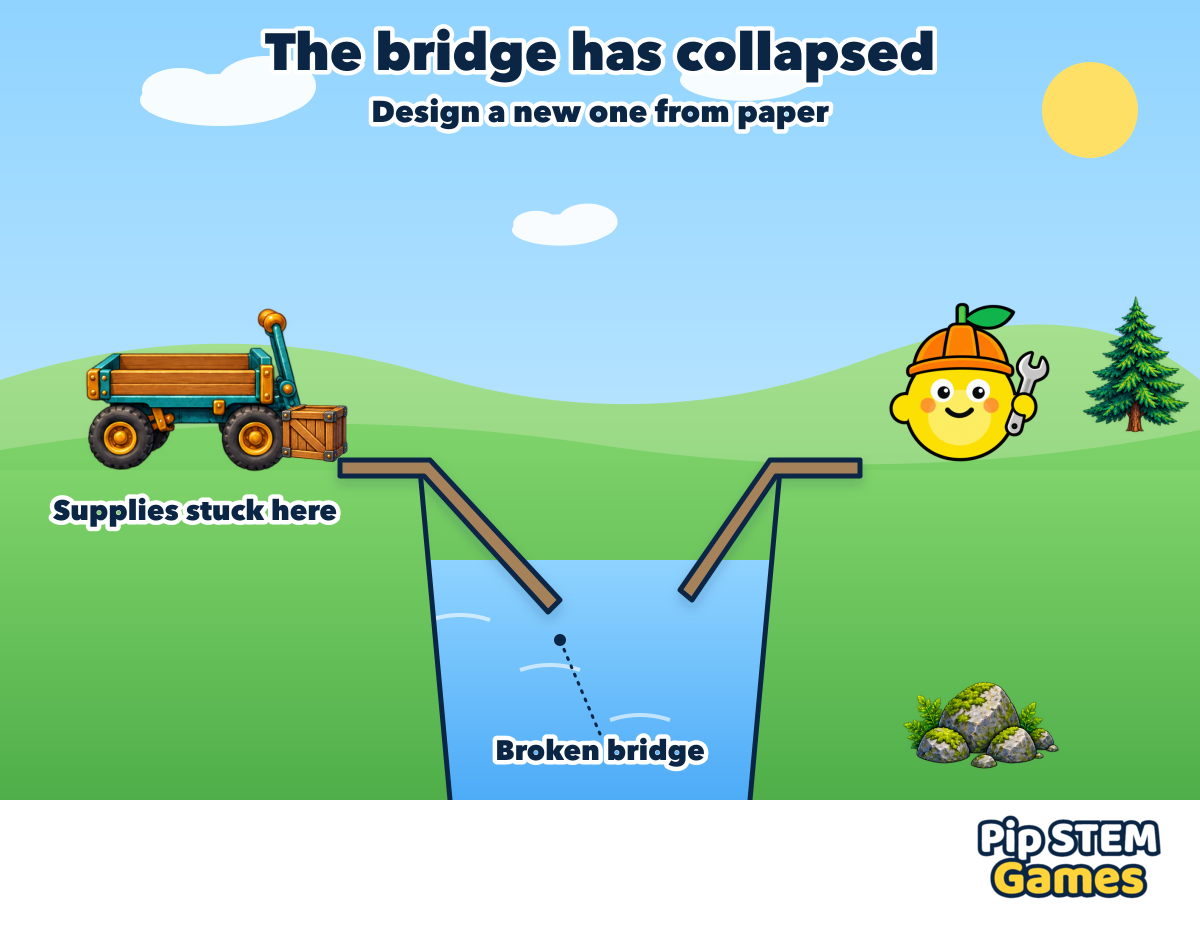
Imagine a river with a collapsed bridge. Supplies are stuck on one bank. You have paper, tape and some 10p coins. Your child's job is to design a new bridge, guess which design will hold the most, and test it fairly.
Three words matter here. Span is the gap the bridge has to cross. Load is the weight it must carry. A material limit is how much a material can take before it bends or fails. Paper is thin and weak, but its shape can make it strong. This is a paper model of real ideas, not a real bridge.
What do you need?
- 6 sheets of A4 printer paper
- Masking tape
- Two stacks of books the same height, for the river banks
- A ruler
- A small paper cup
- A pile of UK 10p coins
- A pencil and the printable results table
Safety first. Coins are a choking risk, so keep them away from children under five and have a grown-up nearby. You do not need scissors.
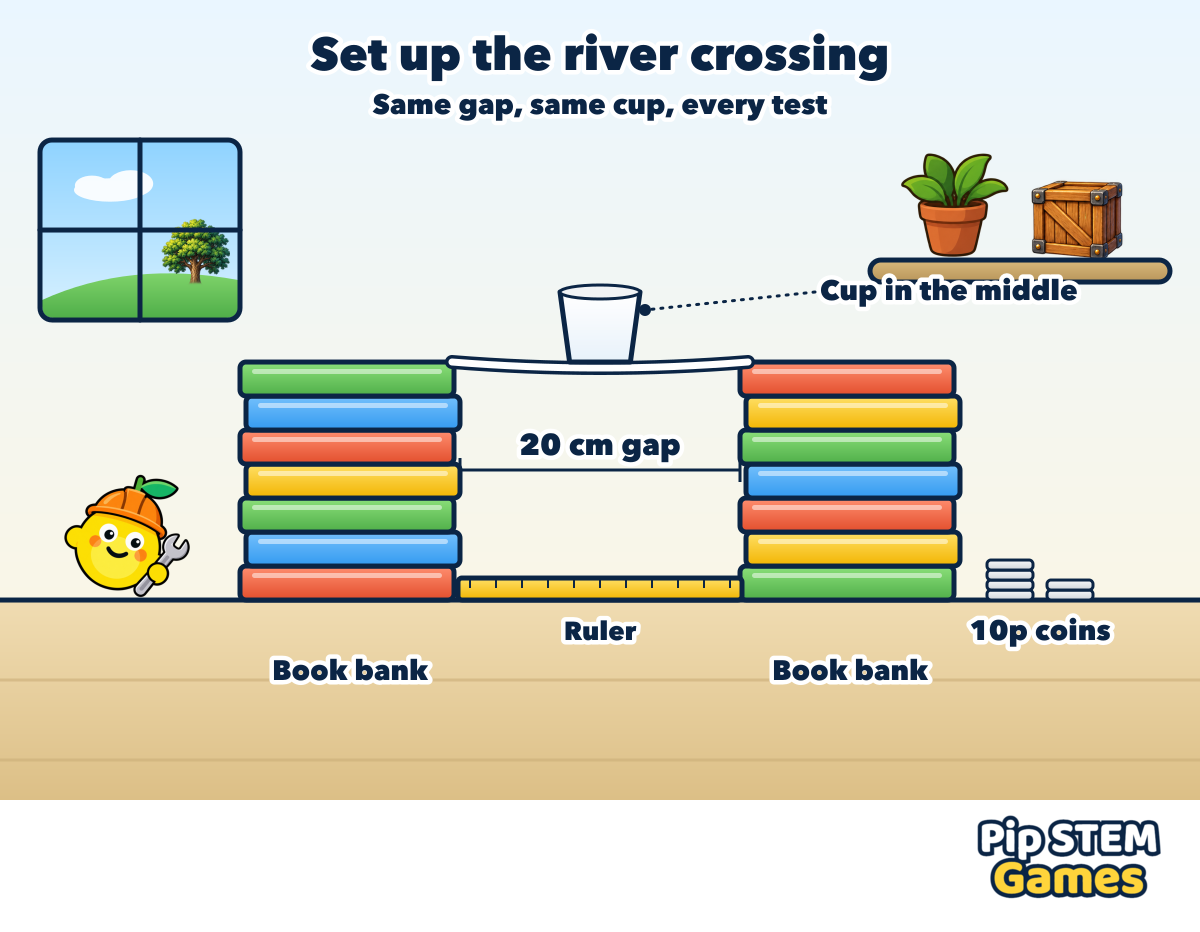
How do you set up the river?
- Make two book stacks the same height.
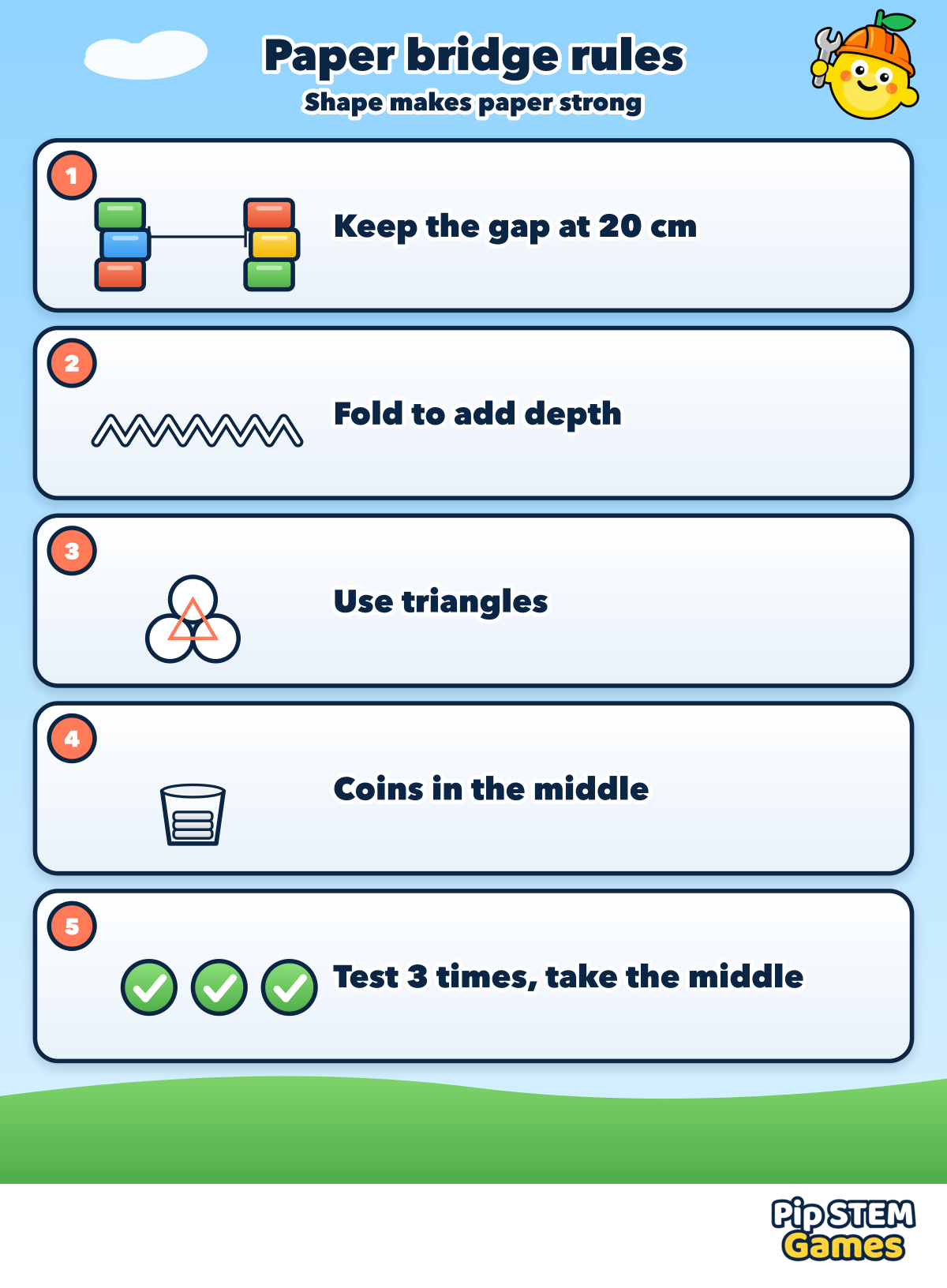
- Put them 20 cm apart. Measure with the ruler.
- Keep this gap the same for every test.
- Put the cup in the middle of each bridge.
- Add 10p coins one at a time.
- Stop when the cup falls or touches the table. Count the coins.
How do you test the three bridges?
- Flat bridge: lay one sheet flat across the gap. Do the coin test and write the number down.
- Concertina bridge: fold a new sheet back and forth, with folds about 1.5 cm wide. Lay it across the gap and test again.
- Truss bridge: roll 3 sheets into thin tubes and tape each one shut. Tape the tubes together in a triangle. Lay it across the gap with a flat sheet on top as the road. Test again.
- Compare: which bridge held the most coins? Why do you think shape made a difference?
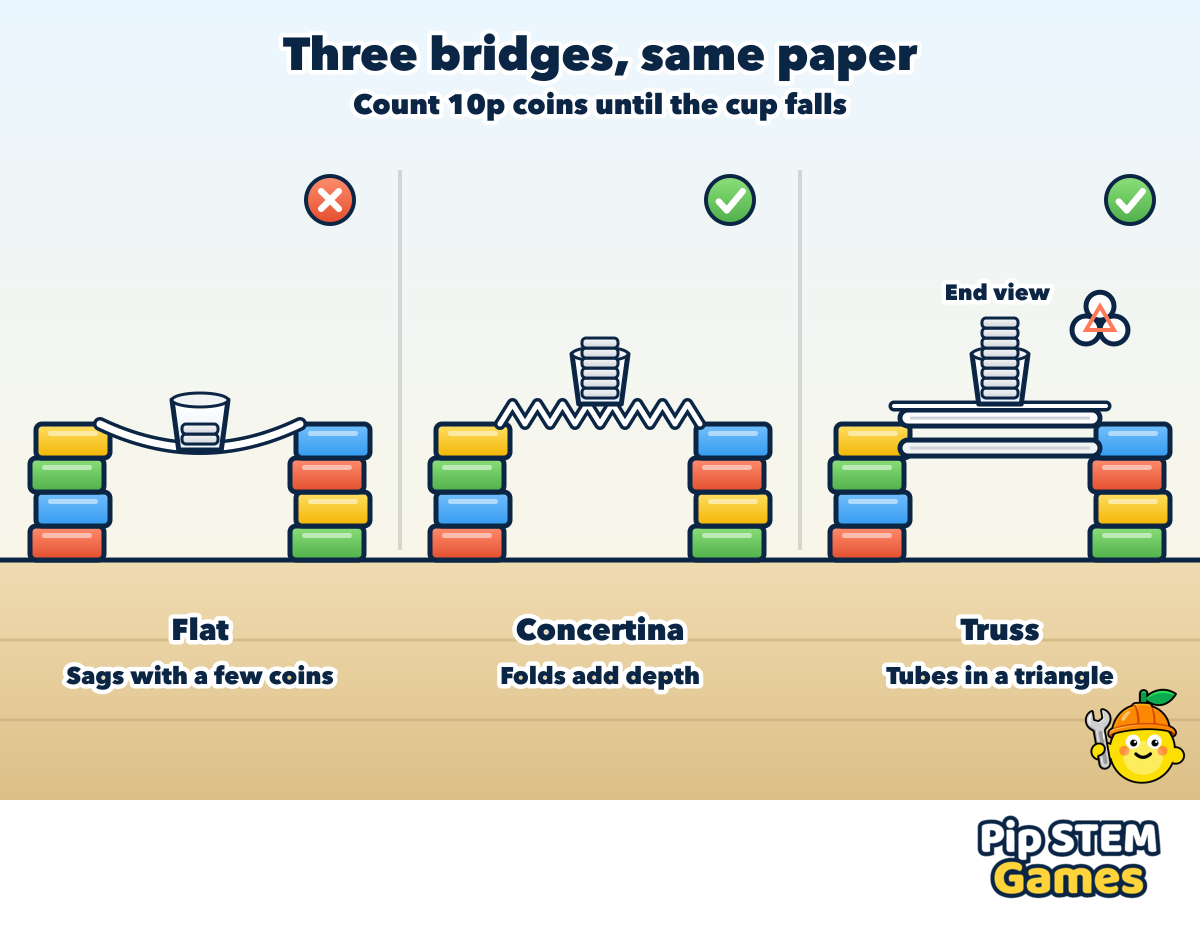
Most families find the flat sheet holds only a few coins. The folded and truss bridges usually hold many more. Your numbers depend on how neatly you fold and roll, so write down what really happened. Try more bridge shapes in our bridge game.
Why does shape change how much a bridge can carry?
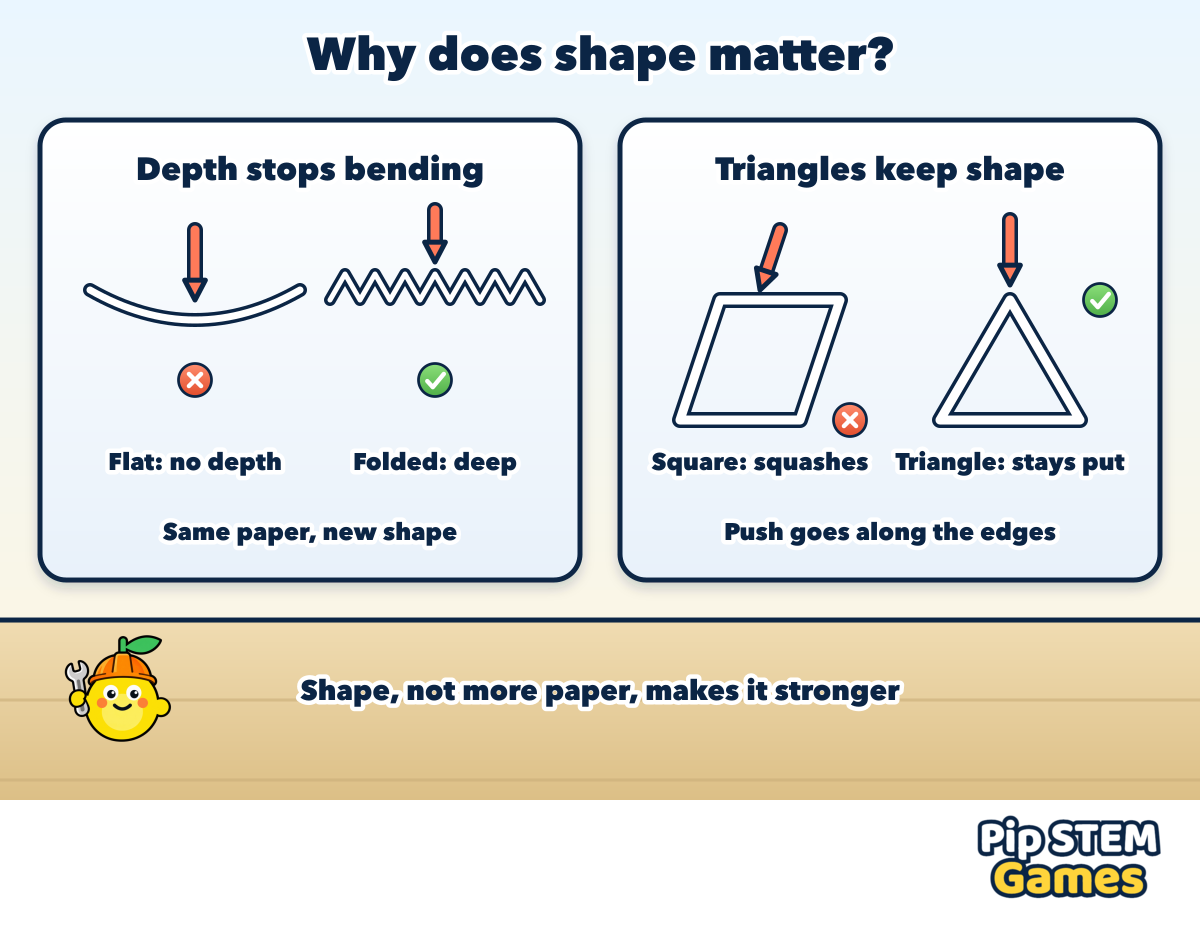
A flat sheet bends because the coins push the middle down and the paper has no depth to fight back. Folding gives the same paper depth, so it bends much less. A triangle is a stiff shape. Push on one corner and the push travels along the sides, so it cannot squash. A square can fold into a diamond. That is why many real bridges, like the Forth Bridge in Scotland, are built from triangles. For more on this, see three bridge designs from the same materials.
How do you keep it a fair test?
Change only the bridge shape. Keep the gap, the paper, the cup and the coin spot the same. Do each bridge 3 times and use the middle number, because one test can be a fluke.
What if the test goes wrong?
- The bridge slides off: tape the ends down, or rest a book on each end.
- All the results are close: make the folds tight and even, and put the cup in the exact middle.
- The tubes squash flat: roll them tighter and tape along the whole seam.
- The cup tips over: use a wider, lower cup.
Still puzzled? Our post on why a spaghetti bridge collapsed shows how to spot the weak point.
What is the next test?
Move the books to 30 cm apart. Which design still works? Then try to rebuild the winning bridge with only 2 sheets. A longer span bends more under the same load, so you may need deeper folds or a bigger triangle. For a longer build, try our paper bridge challenge.
How do you change it for each age? [Printable]
- Ages 5 to 7: test only the flat and folded bridges. Count the coins together.
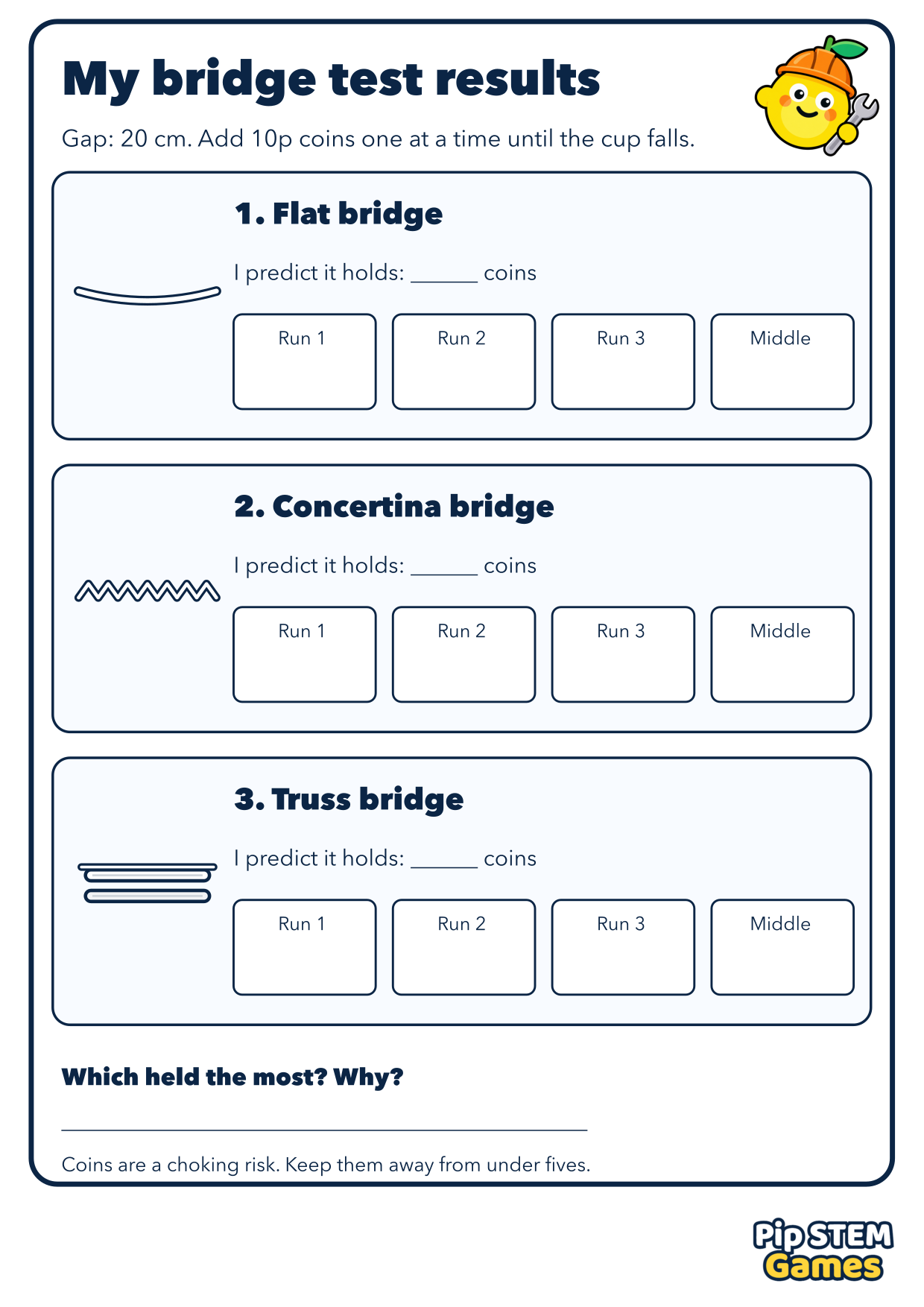
- Ages 8 to 10: add the truss, fill in the results table and talk about why.
- Ages 11 to 12: test at 20 cm and 30 cm, draw a bar chart, and explain the result using the words span, load and rigid.
Questions parents ask
Which paper bridge is strongest?
In most tests the folded or truss bridge holds far more than a flat sheet. The winner between those two depends on how neatly it is built, so test and see.
Why is a flat sheet so weak?
It has no depth. The load pushes the middle down and nothing stops it bending.
Why do engineers use triangles?
A triangle cannot change shape unless a side changes length. The push travels along the sides, so the frame stays stiff.
How many 10p coins can a paper bridge hold?
It depends on the design and the gap. A flat sheet may hold only a few. A good fold or truss can hold many more. Record your own numbers.
Why use the middle result of 3 runs?
One test can be a fluke. The middle number of three is a fairer guide to what the bridge can really carry.
Is this safe for young children?
Yes, with a grown-up nearby. Keep coins away from under fives, as they are a choking risk. No scissors are needed.
Great STEM activities to try next...
 Paper Bridge Challenge: Build a Bridge From One Sheet of Paper [Printable]Build challenge
 Three Paper Bridge Designs, Same Materials, Very Different ResultsBuild challenge
 Why Did This Spaghetti Bridge Collapse?Build challenge
More to try:

Pip STEM Games
We make engineering games and workbooks for kids aged 5 to 12. Every activity here is one we'd happily run at the kitchen table: test it, watch it fail, fix it, try again.




