

Key takeaways
- When one turbine feeds everything, one break stops every machine on the cable.
- Engineers call a part with no backup a single point of failure.
- You can model it with 2 AA batteries, a bulb, a small motor and clip leads.
- Unclipping the shared lead stops both machines; unclipping one branch stops only that one.
- A separate battery pack for the lighthouse shows how a backup keeps the key job running.
When one broken turbine powers a whole island, everything on its cable stops at once: the lighthouse goes dark, the water pumps stop and the factory belt halts. This guide shows you how to build that island as a safe 2 AA circuit in about 20 minutes, test what stops, and then add a backup so the most important job keeps running.
What happens when one turbine breaks?
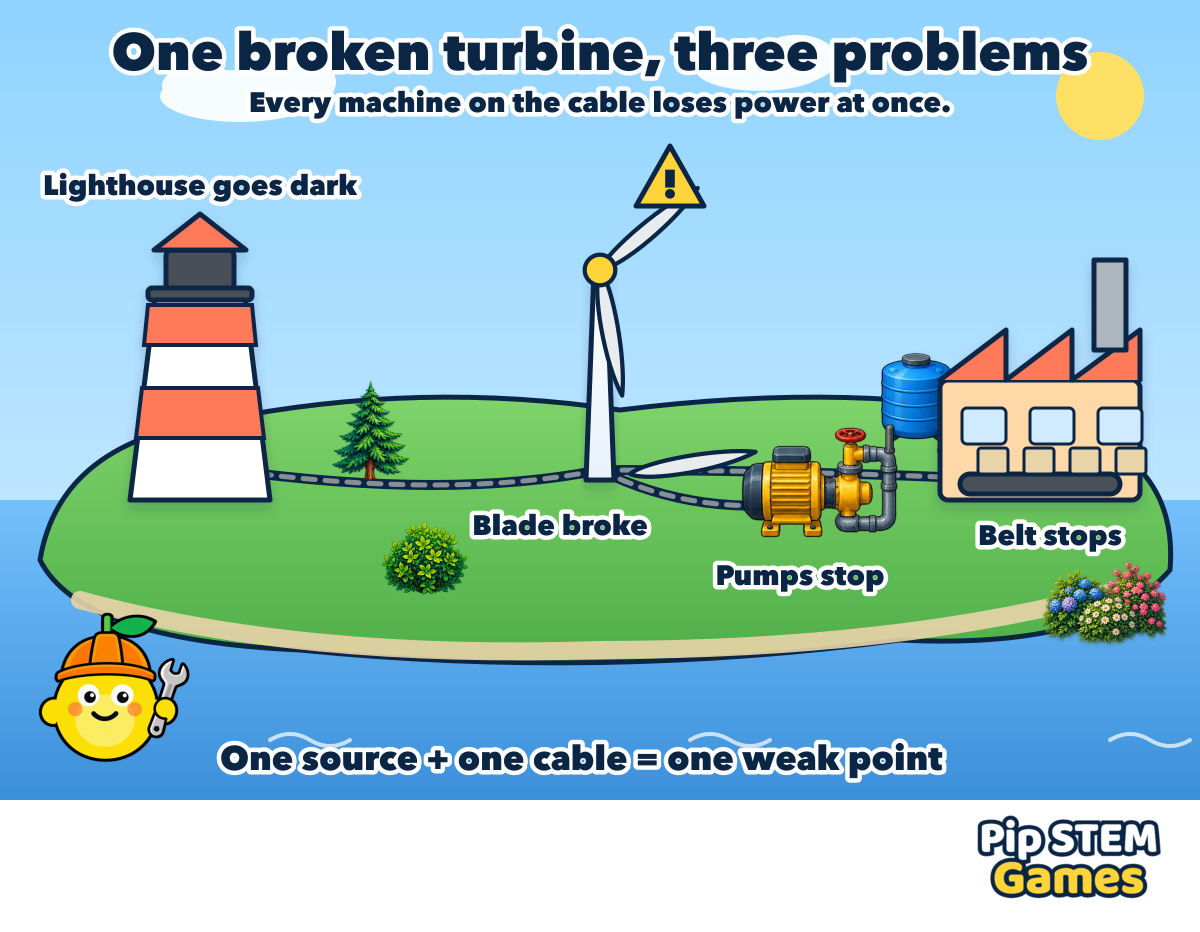
Everything wired to it stops at the same moment. On our made-up island, one wind turbine feeds one cable, and that cable feeds three machines: the lighthouse lamp, the water pumps and the factory belt. When the turbine stops, no electricity flows along the cable, so the lamp goes dark, the pumps stop lifting water and the belt grinds to a halt.
Those are three different problems with one cause. The lighthouse needs light. The pumps need a motor to push water uphill. The factory needs steady movement. A child who sees three broken things usually wants to fix three things, and spotting that they share one source is the real lesson here.
The island is a story model, not a real power network. Real grids link many power stations together, so one turbine breaking doesn't black out a town.
What is a single point of failure?
It's one part that can stop a whole system on its own. Engineers use the phrase for any part with no backup: one turbine, one cable, one pump, one bridge into a town. If that part fails, everything that depends on it fails too.
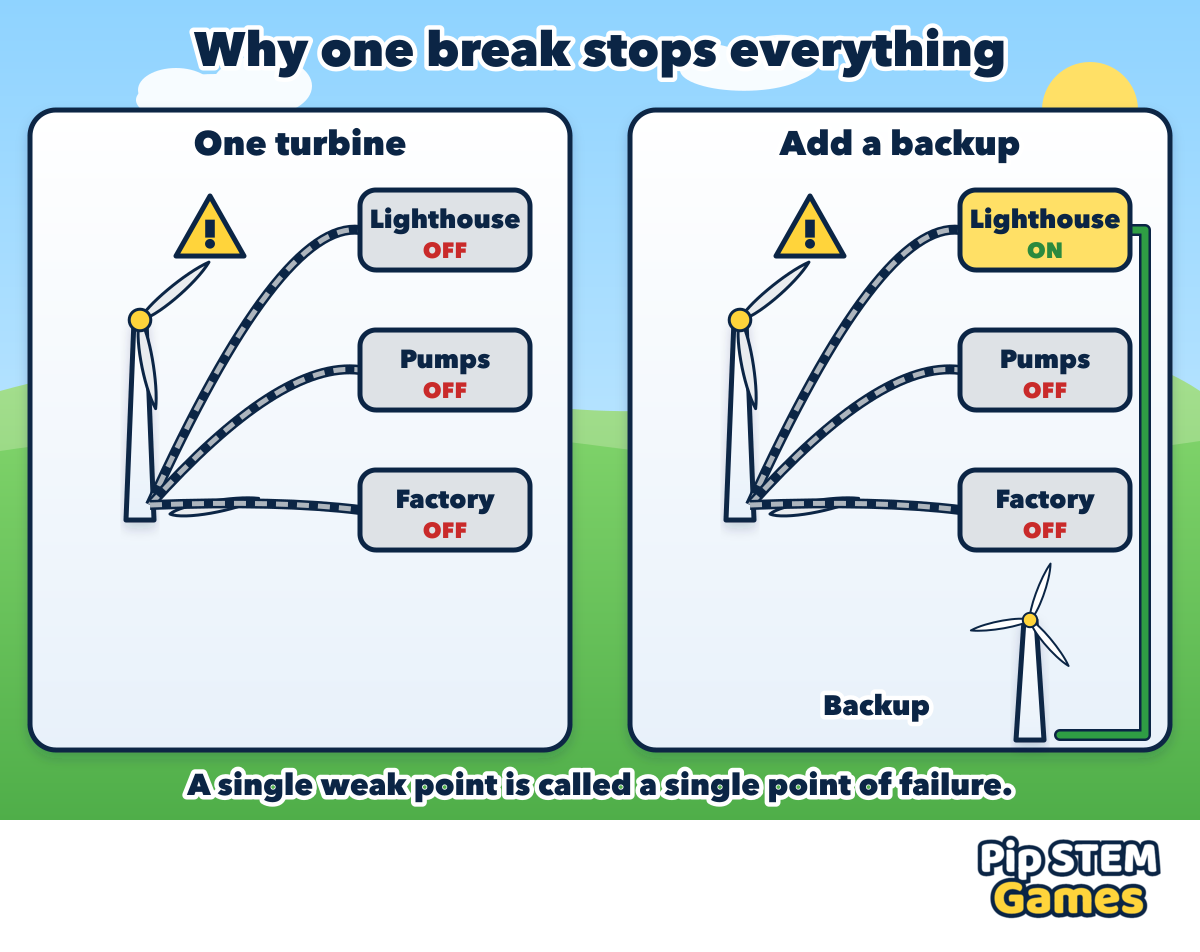
The fix is to give the most important jobs a second route. Hospitals keep backup generators for exactly this reason, and fairy lights wired in one long loop go out together when one bulb fails. Ask your child which island job matters most when it breaks. Most children pick the lighthouse, because ships need it at night, and that's a sound engineering call.
What do you need to build the island circuit?
You need a 2 AA battery pack, one small bulb, one small motor and a few clip leads. Most of it comes in a basic school circuit kit for a few pounds.
- 2 AA batteries in a battery holder with a red and a black lead
- 1 small bulb in a bulb holder, rated for about 3 volts (this is the lighthouse)
- 1 small battery motor with a paper fan or a card circle taped on (the factory belt)
- 4 crocodile clip leads
- A sheet of card, felt pens and sticky tape
- The printable sheet below, if you want to record results
Safety: use only 2 AA batteries and never mains power. Never clip the two battery leads straight to each other, because that short circuit makes wires and batteries hot. Keep water well away from every electrical part. Bulbs, motors and clips are small parts, so an adult stays close with children under 8 and keeps them away from toddlers.
How do you build the island circuit?
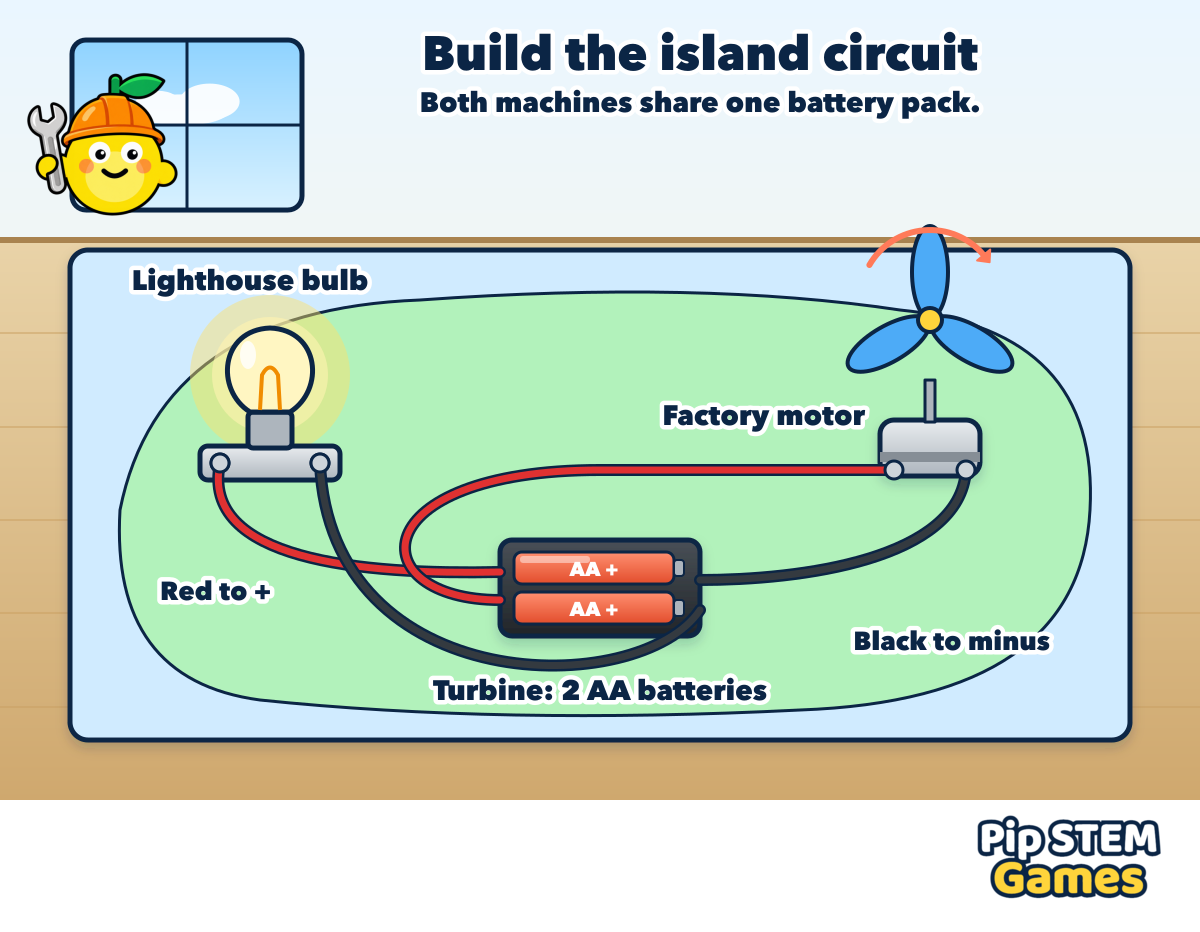
- Draw an island on the card. Put a lighthouse at one end, a pump in the middle and a factory at the other.
- Tape the bulb holder at the lighthouse and the motor at the factory.
- Put the battery pack in the middle. This is your turbine.
- Clip a red lead from the battery's plus side to one side of the bulb holder. Clip a black lead from the minus side to the other side.
- Do the same for the motor: one lead from plus, one from minus. Now each machine has its own path to the same pack.
- Check that every clip bites bare metal. The bulb should glow and the fan should spin.
This layout is called a parallel circuit. Each machine gets the full push from the batteries, so the bulb stays bright while the motor runs. Our circuits for kids guide explains loops and switches if your child wants the basics first.
What should you predict before you break the turbine?
Ask one question first: if I unclip the turbine, which machine stops first? Write the guess on the printable. Most children say the one nearest the battery, and that's a great wrong answer to test.
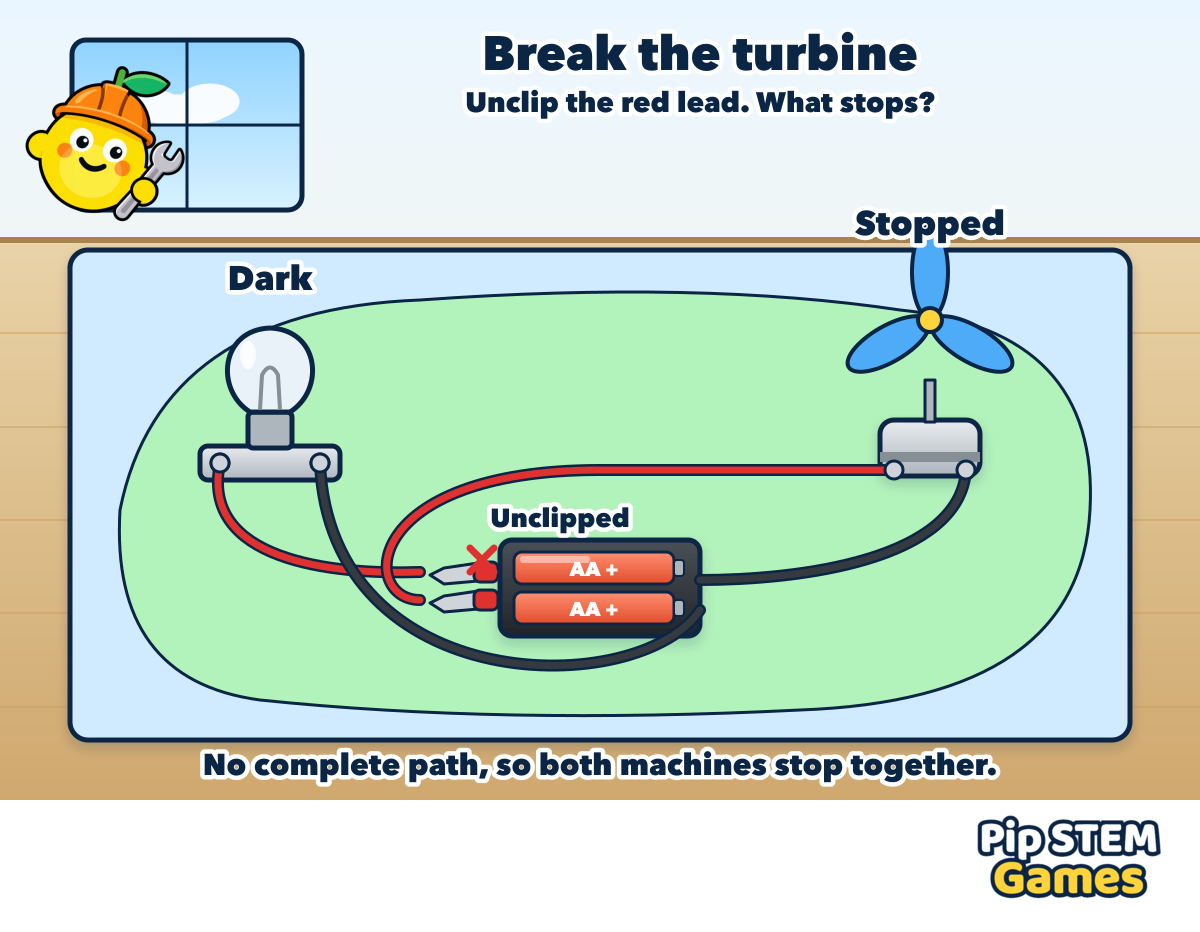
- Unclip the red lead where it joins the battery pack.
- Watch both machines at the same time.
- Clip it back on and watch again.
- Now unclip just the motor's own lead. What happens to the bulb?
When the shared lead comes off, both stop at once, because electricity needs a complete path back to the battery. When only the motor's own lead comes off, the bulb keeps glowing. That second test is the big idea: a break on a shared part stops everything, and a break on one branch stops only that branch.
How do you give the island a backup?
Give the lighthouse its own battery pack. Take the bulb's two leads off the shared pack and clip them to a second 2 AA pack. Now unclip the first pack again. The factory stops, but the lighthouse stays lit.
That's the same thinking engineers use when they keep a backup generator for the most important job. Don't join the two packs together, though. Two packs wired to each other can push current into one another, so each machine should connect to one pack only.
Ask your child to explain why two sources are more reliable than one. A good answer sounds like: if one breaks, the other still works. You can also try it in the Wind Farm game, where children place turbines and keep the island powered.
How do you run a fair test?
Change one thing and keep everything else the same. Try the circuit with fresh batteries, then with tired ones from the drawer. Keep the same bulb, the same motor and the same leads each time.
Compare how bright the bulb looks and how fast the fan spins. You won't get exact numbers without a meter, so use words like brighter, dimmer, faster and slower. Write them in the table. Frankly, the words are enough at this age, and the habit of changing one thing is worth more than any number.
The Senior Engineers workbook has more predict-and-test pages in the same style for ages 8 to 12.
What if it doesn't work?
- Bulb won't light: check the batteries face the way the holder shows, and that the clips touch bare metal, not plastic.
- Motor twitches but won't spin: the fan may be too heavy. Try a smaller paper fan, or check for a loose clip.
- Bulb is very dim: check the bulb is rated for about 3 volts, and try fresh batteries.
- Something feels warm: unclip it straight away and let it cool. Check that no two bare clips are touching each other.
- Only one machine works: follow that machine's two leads back to the pack with a finger. The gap is where your finger stops.
If your child likes hunting faults, the lighthouse gone dark challenge is a good next puzzle.
How do you change it for each age?
Ages 5 to 7: an adult builds the circuit. The child predicts, unclips the lead and says what stopped. Keep it to one test.
Ages 8 to 10: the child builds it with help, does the branch test and fills in the printable.
Ages 11 and 12: add the fair test with fresh and tired batteries, then let them design the backup pack themselves and explain which job should get it first.
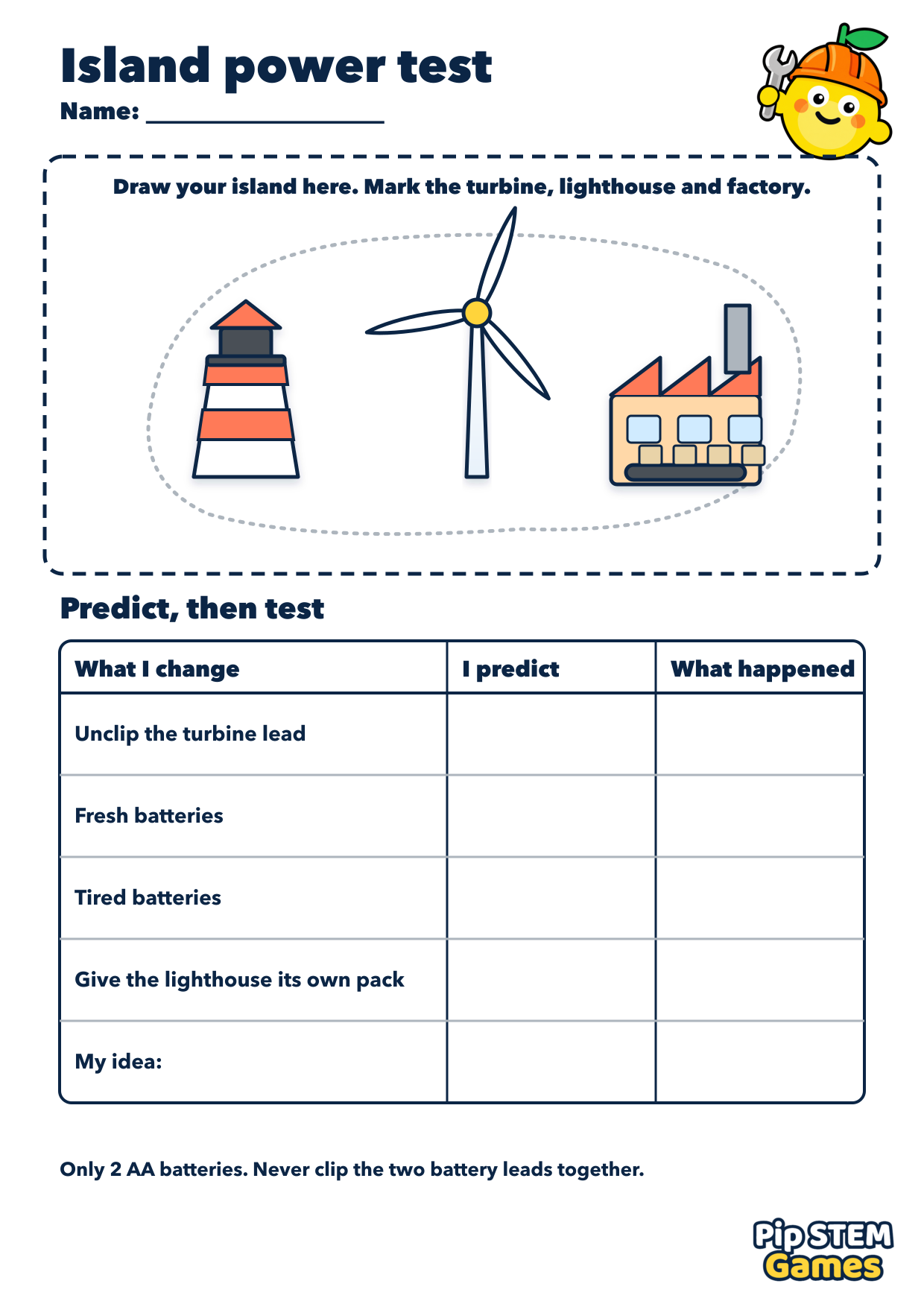
Print it on A4, or right-click and save it. For the decision side of this story, see which machine should we repair first?
Questions parents ask
Why does everything stop when one turbine breaks?
Because every machine gets its electricity from that one turbine along a shared cable. With no source, no current flows, so all of them lose power together.
What is a single point of failure in simple words?
It's one part that can stop a whole system by itself because nothing else can do its job. Engineers add backups to remove these weak spots.
Is this circuit safe for children?
Yes, with 2 AA batteries, a bulb rated for about 3 volts and an adult nearby. Never use mains power, never clip the battery leads to each other, and keep water away.
Why does the bulb stay on when I unclip only the motor?
The bulb and motor each have their own path to the battery. Breaking the motor's path leaves the bulb's path complete, so it keeps glowing.
Can I join two battery packs together for a backup?
Don't. Give the lighthouse its own separate pack instead, so each machine connects to one pack only.
What age is this activity for?
Ages 5 to 12. Younger children predict and unclip while an adult builds; older children build, run a fair test and design the backup.
Great STEM activities to try next...
 The Lighthouse Has Gone Dark. Can Your Child Restore Power?Activity
 Can You Make the Wind Turbine Spin Faster?Activity
 Circuits for Kids: How a Simple Circuit Works and How to Build One [Printable]Circuits
More to try: Design a Moon Base Energy System: Kids Activity · Mini Crane for Kids: 3 Ways to Build One · Circuit Games for Kids: Connect a Working Circuit

Pip STEM Games
We make engineering games and workbooks for kids aged 5 to 12. Every activity here is one we'd happily run at the kitchen table: test it, watch it fail, fix it, try again.




