

Key takeaways
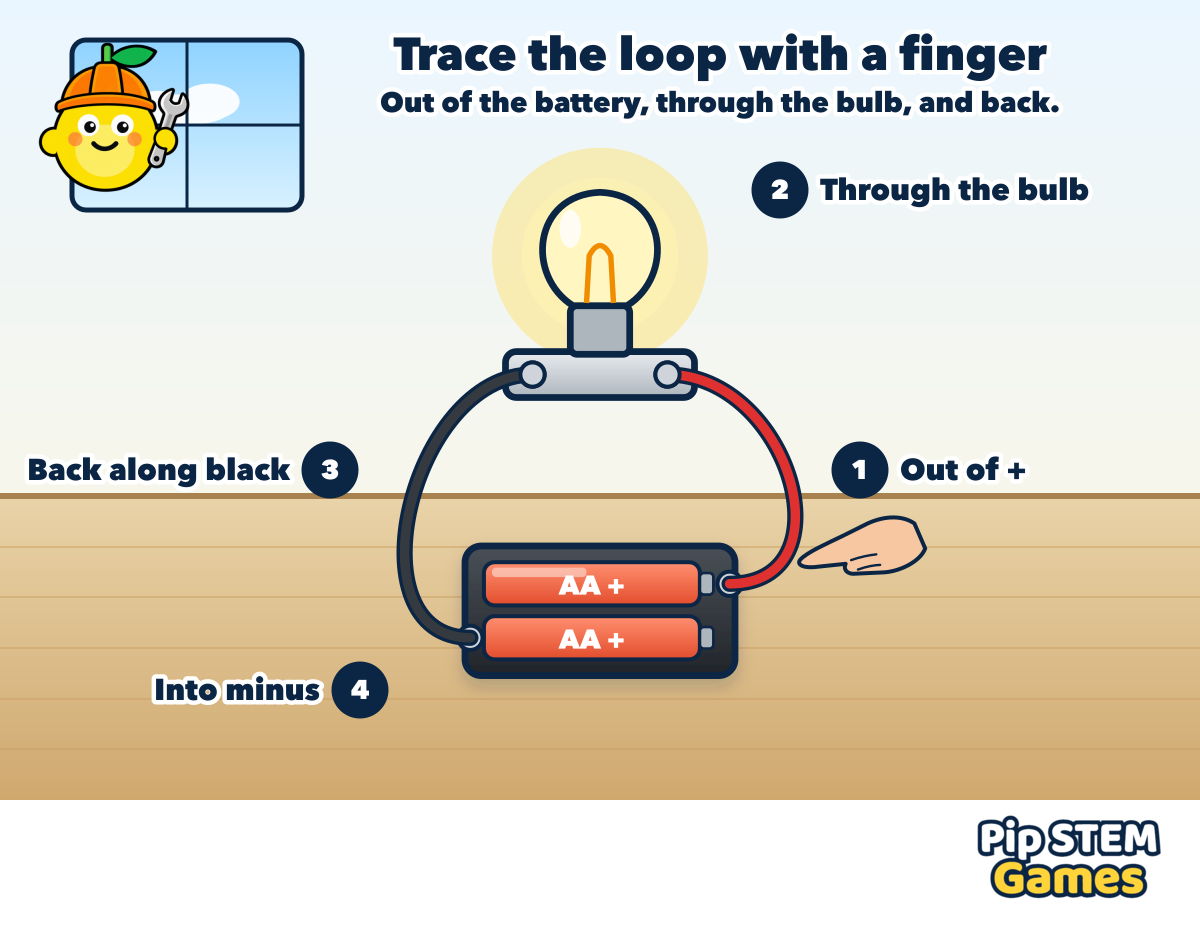
- A working circuit is one unbroken loop: out of the battery, through the bulb and back.
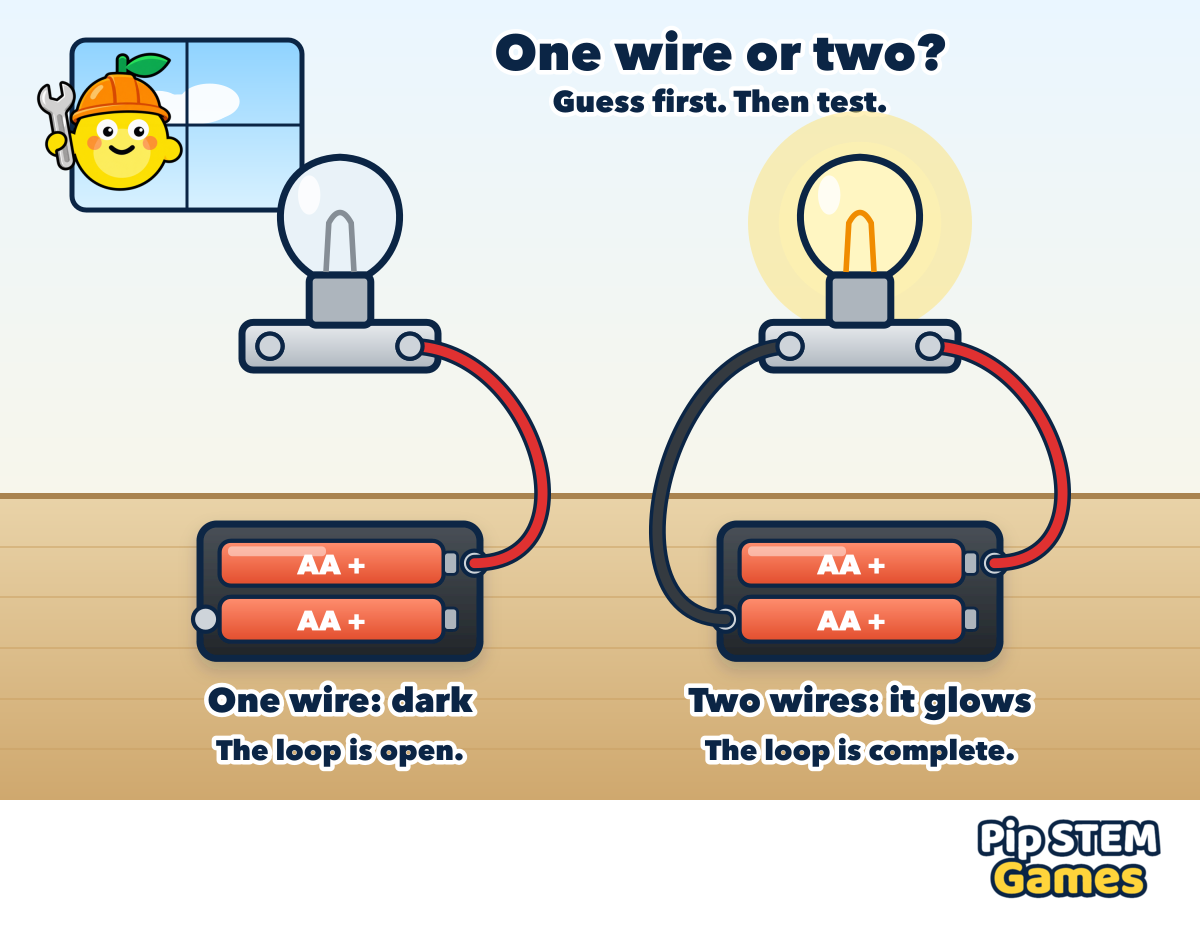
- With one wire the bulb stays dark, because the loop is open.
- A paperclip switch opens and closes a gap in the loop on purpose.
- If the bulb won't light, trace the loop with a finger. It stops at the gap.
- Use only 2 AA batteries and a 3 volt bulb, keep the bulb in the loop, and never use mains power.
The best circuit games for kids start with one idea: a working circuit is an unbroken loop. Electricity goes out of the battery, through the bulb and back again. If the loop has a gap, the bulb stays dark. This guide turns that into a game of guess, trace, test and fix.
What will you need?
- 2 AA batteries and a battery holder, with wire leads if it has them
- 1 small bulb made for about 3 volts, with a bulb holder
- 3 short insulated wires with crocodile clips, or with the ends stripped by an adult
- A simple switch, or a paperclip and two drawing pins on a piece of card
- Paper and a pencil, and the detective sheet at the end of this guide
Safety: use only 2 AA batteries and a bulb made for that voltage. Never connect any of this to a plug socket or mains power. An adult strips the wire ends and pushes the drawing pins into the card. Batteries, bulbs and clips are small parts, so keep them away from toddlers and stay close the whole time.
What is a circuit, in simple words?
A circuit is a path for electricity to travel round. The battery pushes, the wires carry, and the bulb uses the energy to glow. The easiest word to remember is loop.
If you can trace a finger from one end of the battery, through the bulb, and back to the other end without lifting it, the loop is complete. If your finger has to jump a gap, the loop is open and the bulb stays dark. That one idea is the whole game.
How do you connect the circuit, step by step?
- Put the batteries in the holder the right way round. Match the plus and minus marks.
- Screw the bulb into its holder.
- Ask your child to guess: will the bulb light with just one wire? Write the guess down.
- Join one wire from the battery holder to one side of the bulb holder.
- Test it. With one wire the loop is open, so the bulb stays dark.
- Add a second wire from the other side of the bulb holder back to the other battery end.
- Watch the bulb. If every join is firm, it glows.
Children often expect one wire to be enough, because a lamp at home seems to have just one cable. That cable has two wires inside it. Saying this out loud after the test is a lovely moment.
How do you make a paperclip switch?
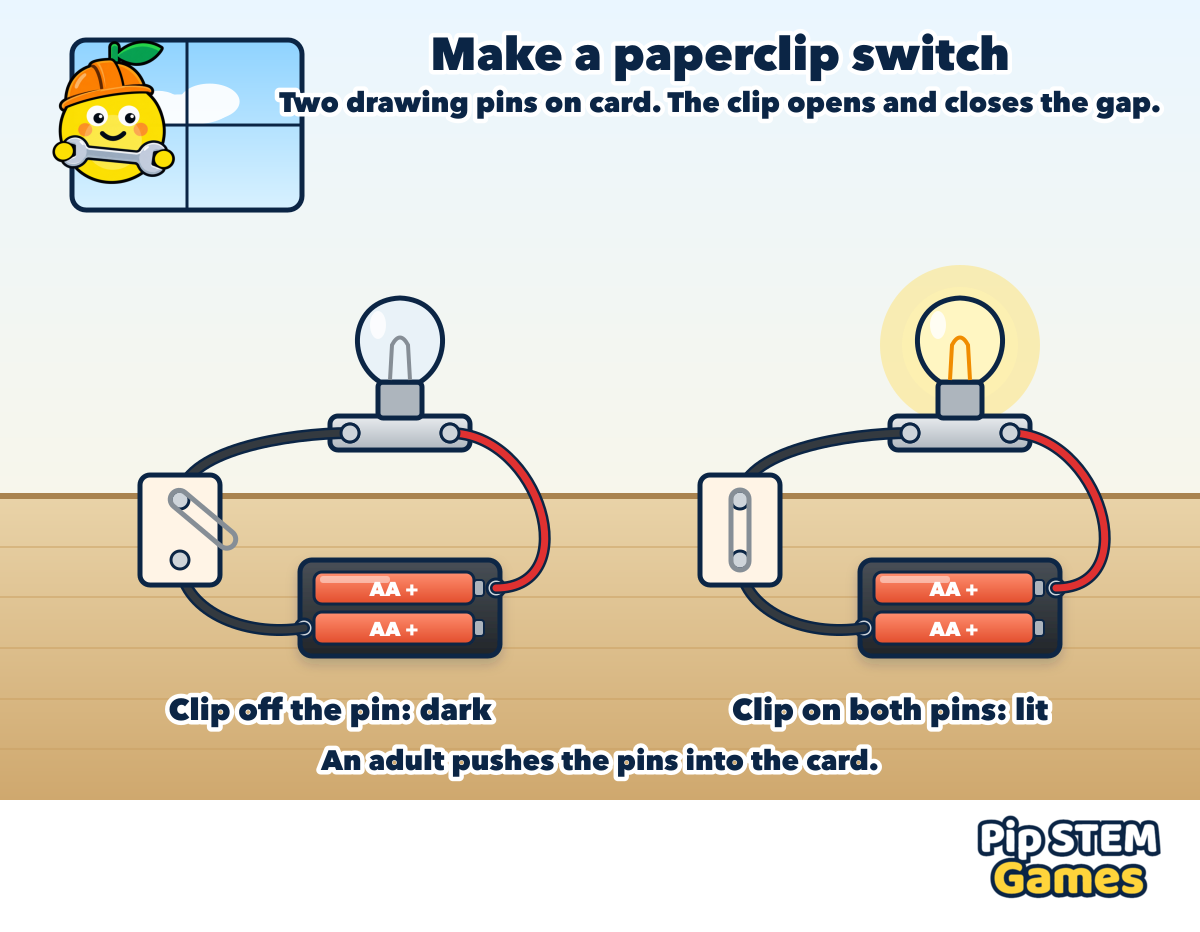
- An adult pushes two drawing pins into a piece of card, about 3 cm apart.
- Hook a paperclip round one pin.
- Take one wire off the bulb holder and clip it to the first pin.
- Use the third wire to join the second pin to the bulb holder.
- Turn the paperclip so it touches both pins. The bulb lights.
- Turn it away. The bulb goes out.
A switch doesn't make electricity. It just opens and closes a gap in the loop on purpose. Your light switch at home does the same job.
Why is the bulb not lighting?
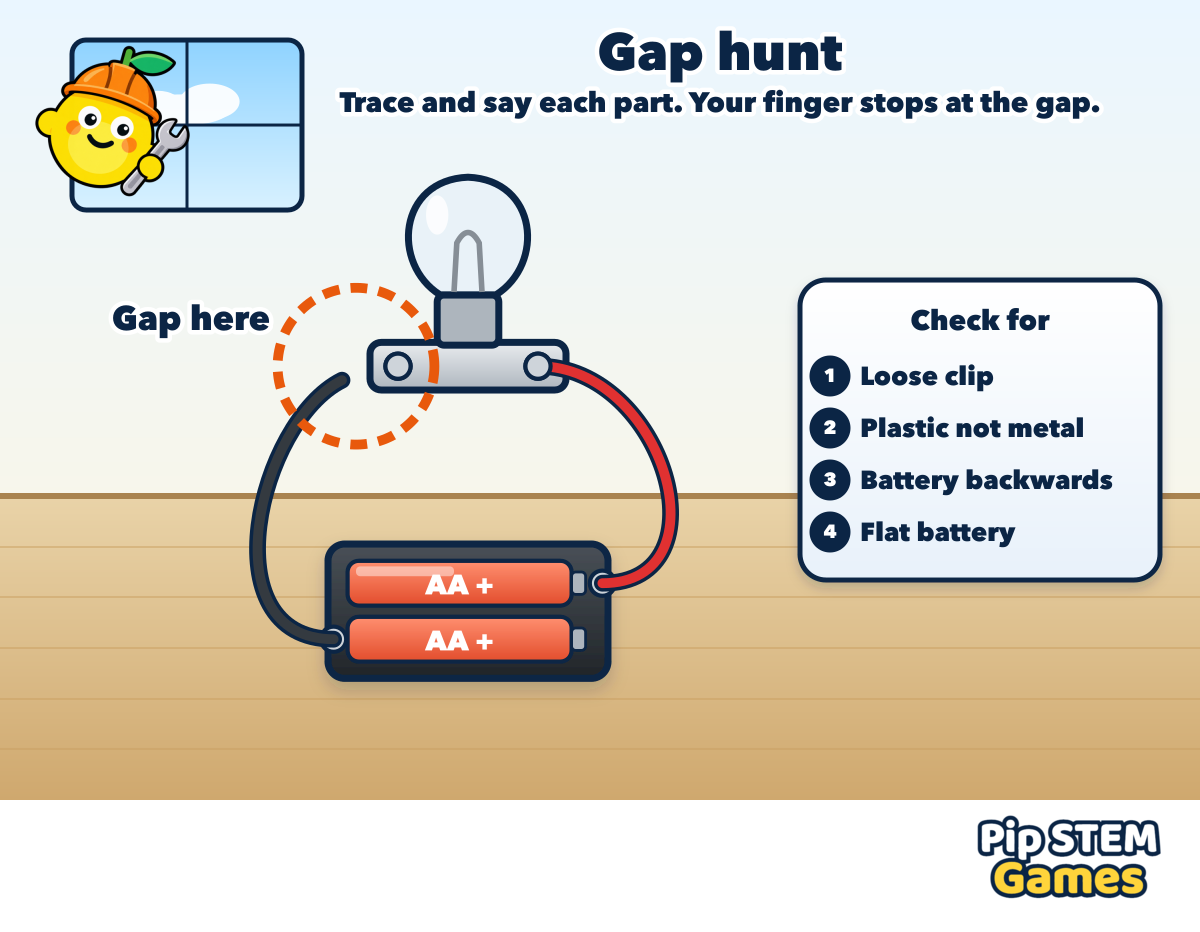
- Loose join: press each clip firmly onto its metal end. A wire that only looks joined may not touch.
- Plastic in the way: the metal must be bare where it joins. The plastic coating blocks the flow.
- Battery backwards: check the plus and minus marks.
- Wrong bulb: a bulb for a different voltage may stay dim or dark.
- Flat batteries: ask an adult for fresh ones.
- Still stuck: do a gap hunt. Trace the loop and name each part out loud.
If any part gets warm, unclip it and let an adult check. A wire joined straight from one battery end to the other, with no bulb, can get hot. Always keep the bulb in the loop. Short circuits are a big idea in themselves, and circuits for kids explains more.
How do you make it a fair test?
Change only one thing at a time. Test the same circuit with the switch open, then closed. Or swap one wire for another and see if the result stays the same.
Write down what the bulb does each time: lit or not lit. Only write what you actually see, not what you hoped for. Repeat each test twice. If you get the same answer both times, you can trust it. If you don't, a join is probably loose, which is a clue in itself.
What is the next challenge?
Play broken circuit detective. An adult secretly builds a loop with one hidden fault, such as a clip resting on the plastic instead of the metal. The child traces the loop, guesses where the gap is, fixes it and tests again. Can your child fix this broken circuit? has more faults to hide.
Then try a story version. In the lighthouse gone dark challenge, the bulb is a lighthouse and the child has to restore power. You can also practise building loops on screen in the Circuit game.
How do you change it for each age?
Ages 5 and 6: the adult builds the circuit. The child is the switch operator and guesses lit or dark each time.
Ages 7 and 8: the child joins the wires with help and traces the loop with a finger.
Ages 9 and 10: the child draws the circuit first, guesses, builds it, and then writes why each fault stopped the bulb.
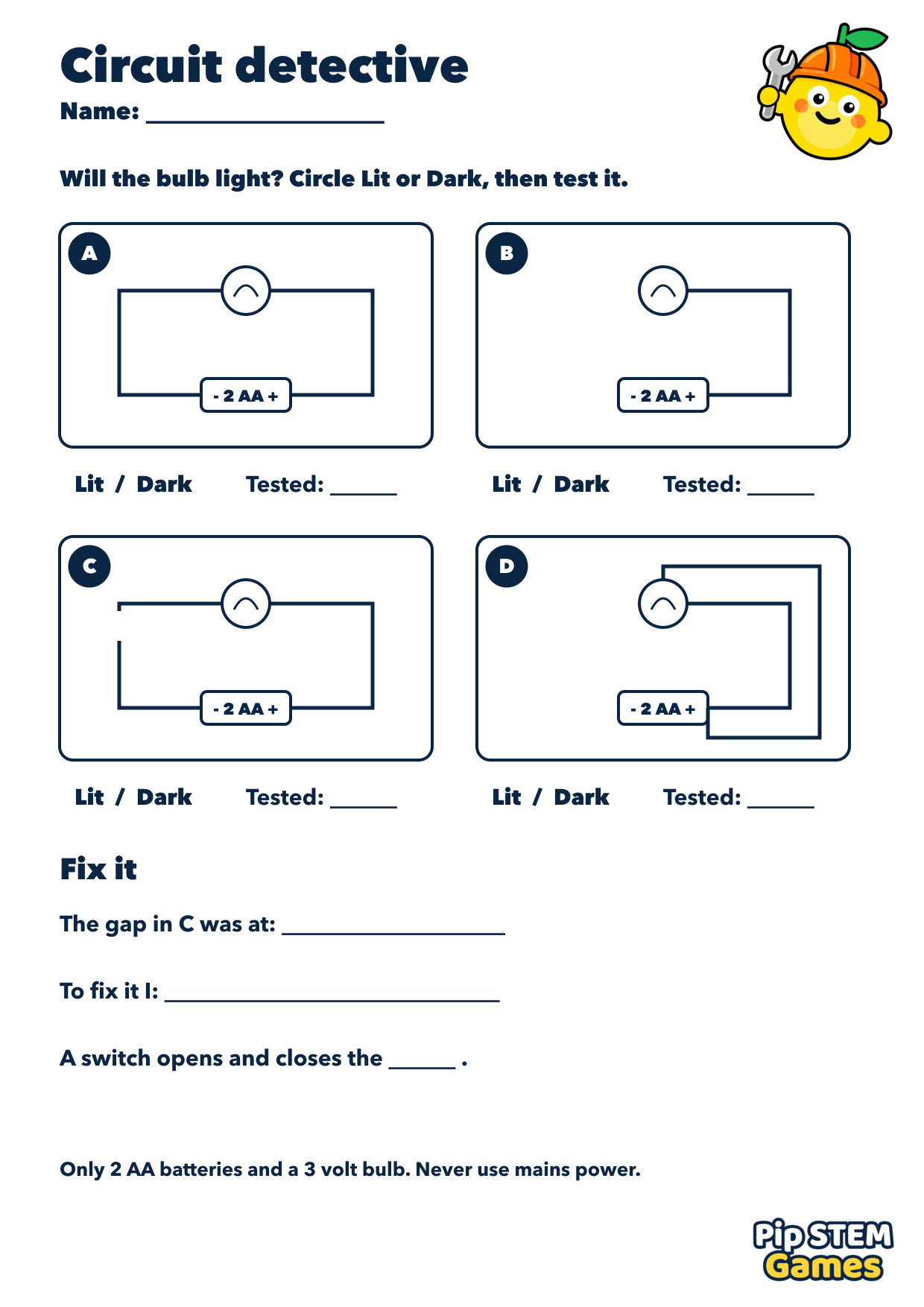
Print it on A4, or right-click and save it. These are simple models to learn the idea of a loop. Real devices are far more complicated, but the loop rule is the same.
Questions parents ask
What is a simple circuit for kids?
A loop that runs from one end of a battery, through a bulb, and back to the other end. If the loop is complete, the bulb lights.
Why won't the bulb light with one wire?
One wire leaves the loop open. Electricity needs a path back to the battery, so you need a second wire.
What batteries and bulb should we use?
2 AA batteries in a holder and a small bulb made for about 3 volts. Never use mains power or a plug socket.
How does a paperclip switch work?
The paperclip bridges the gap between two drawing pins. Touching both pins closes the loop and the bulb lights. Turning it away opens the loop.
Why should the bulb always stay in the loop?
A wire joined straight across the battery with no bulb is a short circuit and can get hot. Keep the bulb in the loop and unclip anything that feels warm.
What age is this circuit game for?
Ages 5 to 10. Younger children work the switch and guess; older children build, draw and explain the faults.
Great STEM activities to try next...
 Circuits for Kids: How a Simple Circuit Works and How to Build One [Printable]Circuits
 Can Your Child Fix This Broken Circuit?Activity
 The Lighthouse Has Gone Dark. Can Your Child Restore Power? [Printable]Electricity
More to try: Connect the Lighthouse Without Crossing the River

Pip STEM Games
We make engineering games and workbooks for kids aged 5 to 12. Every activity here is one we'd happily run at the kitchen table: test it, watch it fail, fix it, try again.




