

Key takeaways
- Route B is the only route that passes both rules: over the bridge, 12 units.
- Rule 1 keeps the cable out of the river. Rule 2 keeps it within 14 units.
- The shortest route, A at 10 units, fails because it goes through the water.
- Test every route against every rule before you pick one.
- A 2 cm grid, string and a ruler turn the puzzle into a fair test at home.
Route B is the only cable route that works: it crosses the river on the existing bridge and uses 12 units of cable, inside the budget of 14. This path puzzle for kids has a map, two rules and three routes to test, plus a paper version your child can build in about 30 minutes with string and a ruler.
What is the lighthouse cable puzzle?
It's a route puzzle on a map. A power station on one side of a river needs a cable to a lighthouse on the other side, and your job is to pick a route that obeys two rules.
- Rule 1: the cable can't go into or through the river. It can cross only on the bridge that's already there.
- Rule 2: the cable can't be longer than 14 units. One square on the map is one unit.
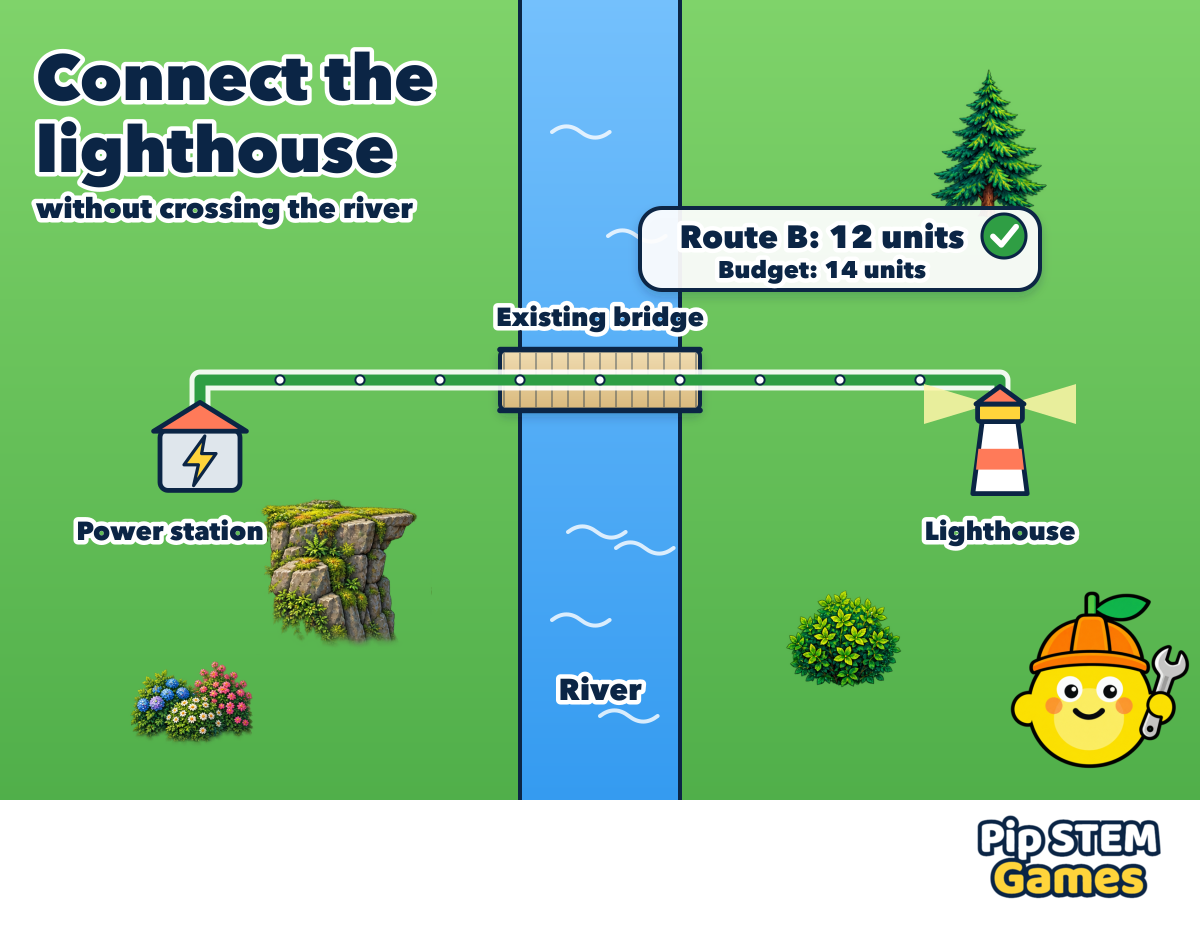
The bridge sits one square above the straight line between the power station and the lighthouse. That one square is the whole trick. Three routes are on offer, and only one of them passes both rules.
Mathematicians call a map like this a graph: dots joined by lines, where each line has a cost. Satnavs and mapping apps search graphs like this every time they plan a journey, so your child is practising a real method.
Which cable route reaches the lighthouse?
Route B. It's the only route that stays out of the water and fits the budget. Here's the test for each one, using the map above.
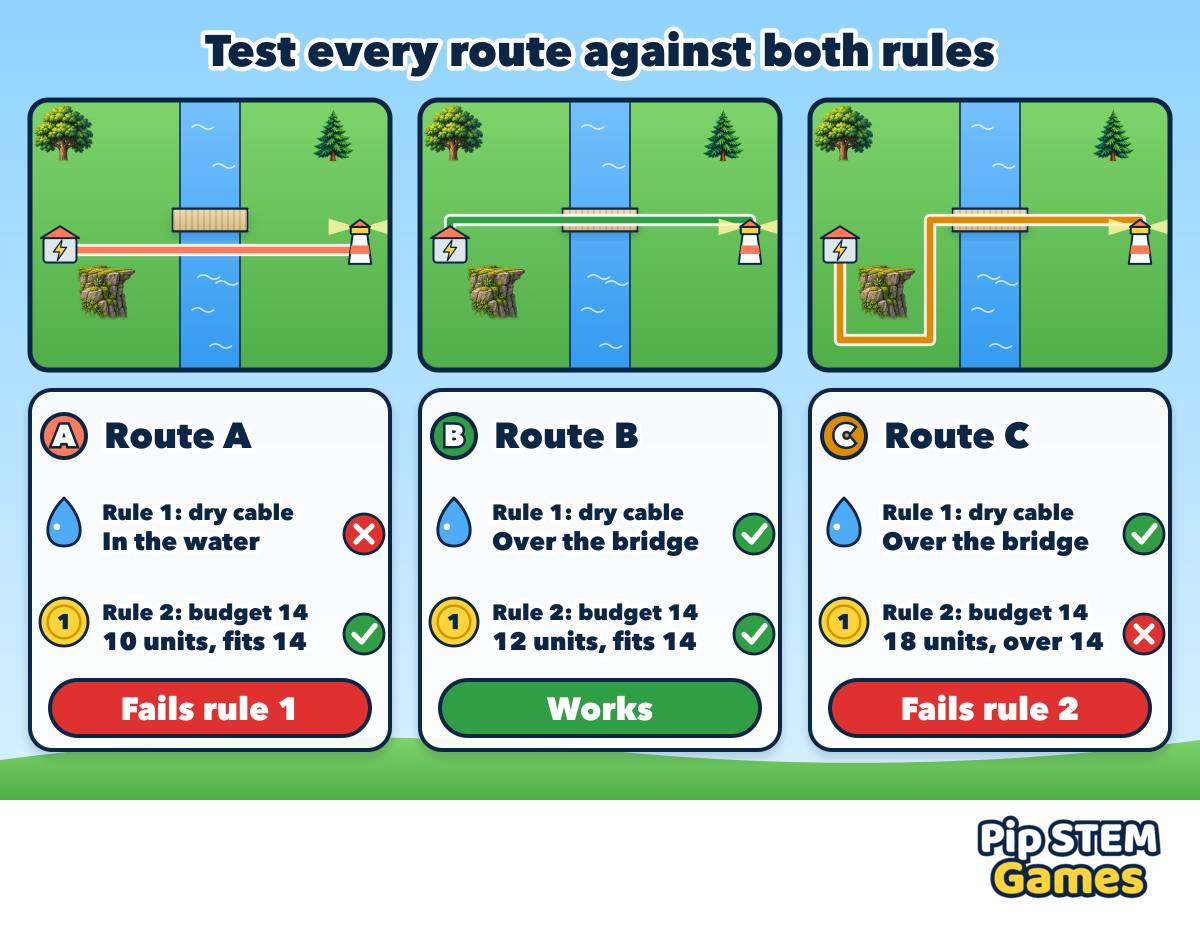
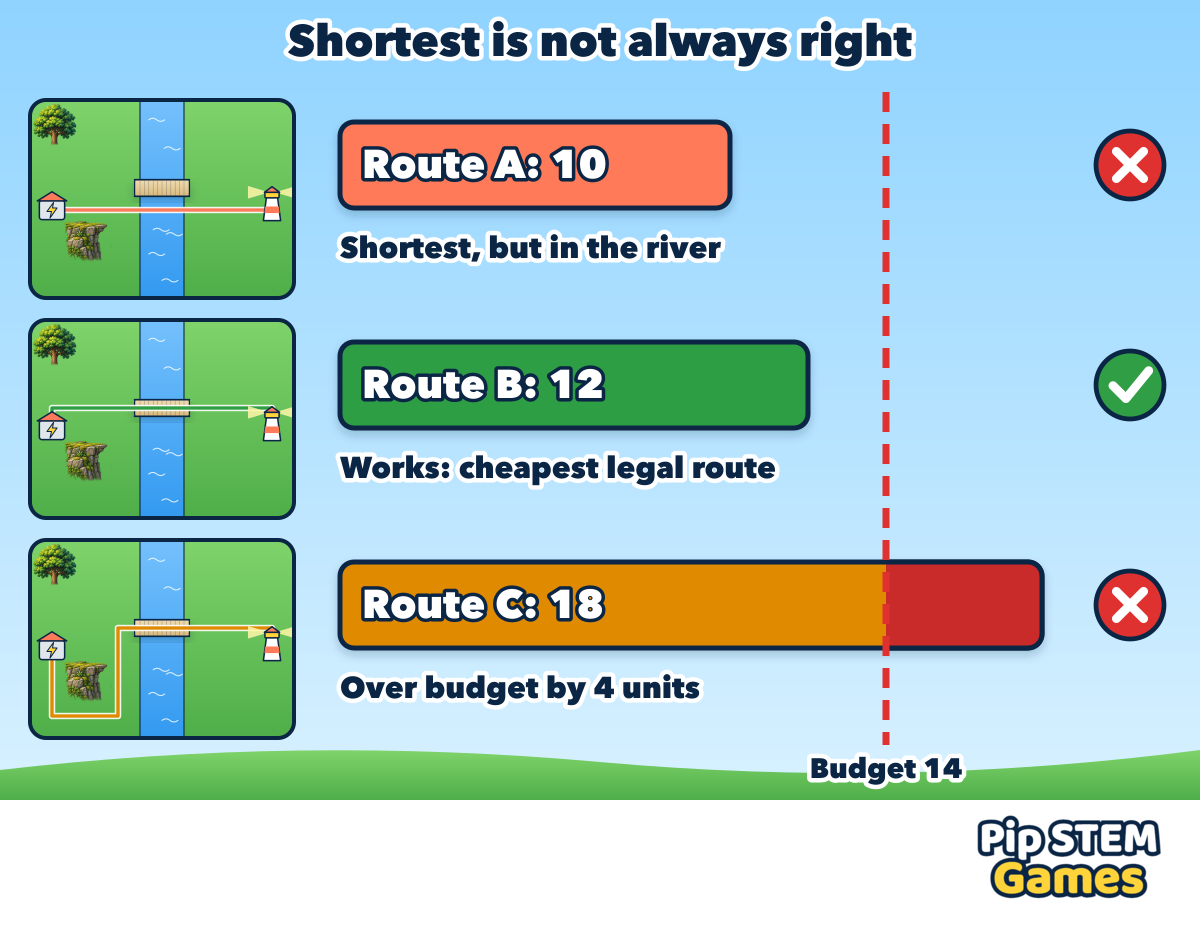
- Route A runs straight along the row of the power station and lighthouse. It's 10 units, the shortest of the three. But two of those units are in the river, so it breaks rule 1.
- Route B goes up 1 square to the bridge, runs 10 squares along it and the bank, then down 1 square. That's 1 + 10 + 1 = 12 units. The cable crosses the river on the bridge, so rule 1 is fine, and 12 is under 14.
- Route C goes down 3, right 3, up 4, then across the bridge for 7 and down 1. That's 3 + 3 + 4 + 7 + 1 = 18 units. It uses the bridge, but it's 4 units over the budget, so it breaks rule 2.
Could a better route be hiding? No. Any legal cable has to climb 1 square to reach the bridge, travel 10 squares across and come back down 1 square. That's 12 at the very least, so Route B is the cheapest route that's allowed.
Why isn't the shortest route the best one?
Because a route has to follow the rules before its length counts. Route A wins on length and loses on rule 1.
Real cable planners work the same way. They sometimes lay cable under a river, but that usually needs special waterproof cable and extra work, so a bridge that's already there can be the sensible choice. In the puzzle we simply say the river is off limits, and the budget decides the rest.
A good habit for any route puzzle: filter first, compare second. Throw out every route that breaks a rule. Then pick the cheapest of what's left.
Ask your child, "Which rule did that route break?" instead of "Is that right?" It turns a yes-or-no guess into a check they can do themselves.
What do you need to build the map at home?
You need a sheet of A4 paper, a ruler, a pencil, a blue marker, one lolly stick, tape and string. The whole thing takes about 30 minutes. You can also skip the drawing and print the sheet below, which has the map and a results table ready to go.
- 1 sheet of A4 paper, turned wide, or the printable map
- A ruler with centimetres
- A pencil and a blue marker or blue pencil
- 1 lolly stick (about 11 cm long) for the bridge
- Tape
- String: 3 pieces, each cut to no more than 40 cm by an adult
Safety: an adult cuts the string and does any cutting with scissors. Keep string, tape and the lolly stick away from children under 5, and never loop string round fingers or necks. The river is just marker, so there's no real water anywhere near this activity.
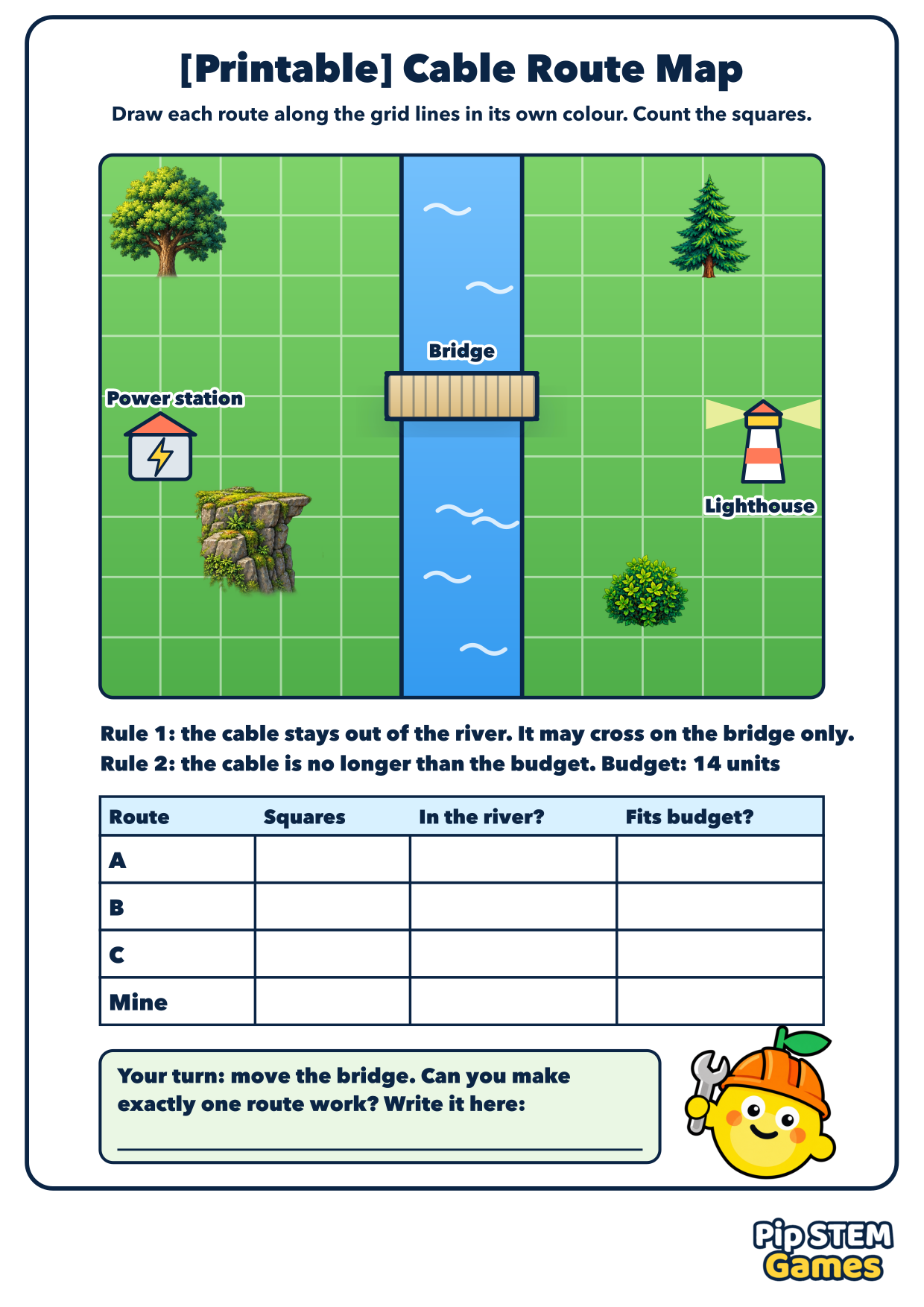
Want to practise on a screen too? The Train Tracks game asks for the same kind of thinking: join two places with a route that follows the rules. The Junior Engineers and Senior Engineers workbooks have more paper puzzles like this one.
How do you build and test the puzzle?
Draw the map, add the bridge, then measure each route with string. The steps below are for ages 8 and up; younger children can use the printable and count squares instead.
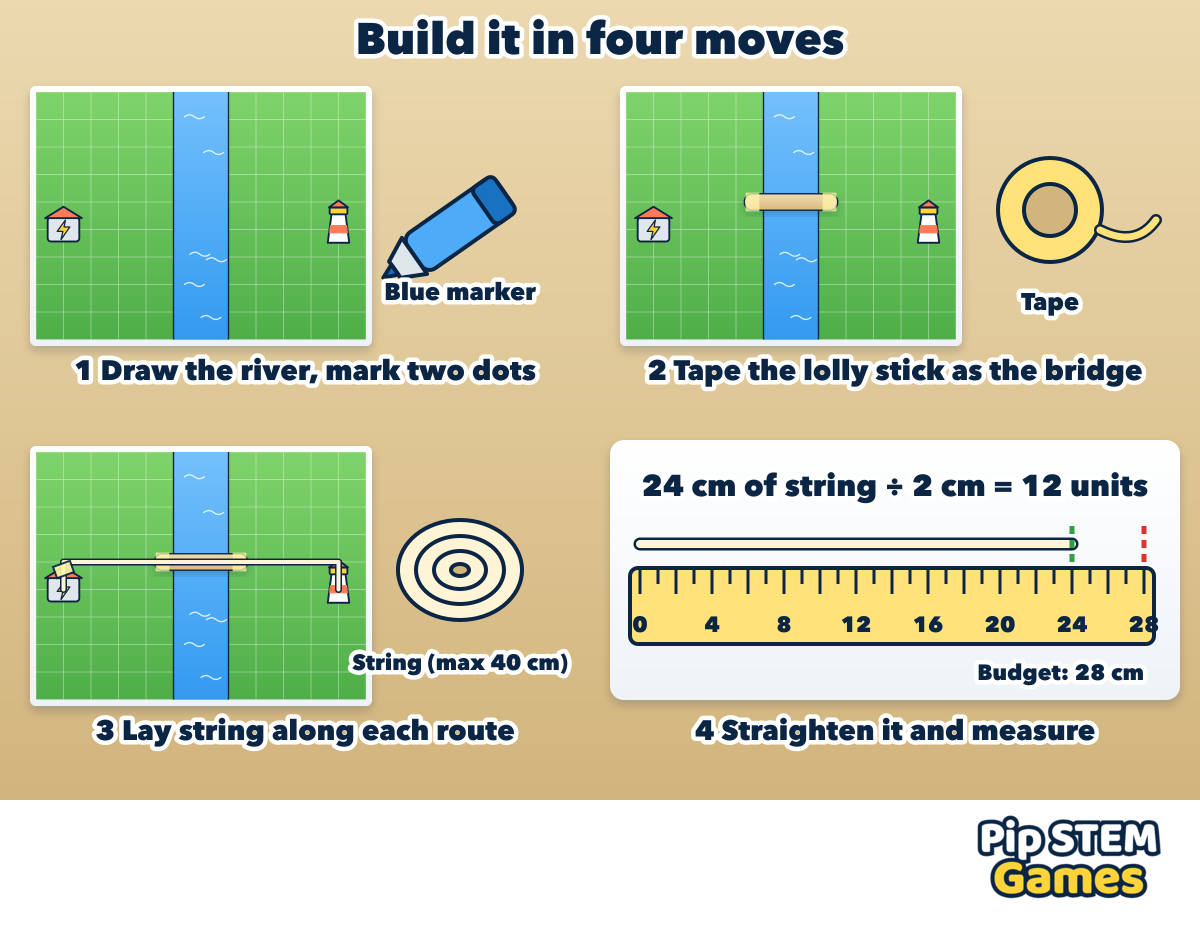
- Draw a rectangle 24 cm wide and 18 cm tall on the paper. This is the map.
- Colour a river strip 4 cm wide from the top of the map to the bottom, starting 10 cm from the left edge.
- Mark the power station 2 cm from the left edge and 10 cm down from the top. Mark the lighthouse 22 cm from the left edge and 10 cm down. Draw a little building and tower if you like.
- Tape the lolly stick across the river, 8 cm down from the top, as the bridge.
- Lay a piece of string along Route A. Tape the start down. Pinch the string where it reaches the lighthouse, then lift it and pull it straight against the ruler.
- Write the length in centimetres, then divide by 2 to get units. Do the same for Routes B and C. You should get about 20, 24 and 36 cm, which is 10, 12 and 18 units.
- Check each route against both rules and write a tick or a cross.
For Route C, go round the rocks as shown on the map. For Route B, the string should lie right along the lolly stick.
What if your measurements look wrong?
Most wrong answers come from stretched or slipping string. Here's what to check.
- String pulled too tight. Pull it straight, but don't stretch it.
- String slid. Tape the start down and hold the other end still while you pinch the mark.
- Rounded corners. The string must turn at sharp corners, like the cable on the map. Cutting a corner makes a route look shorter.
- String off the bridge. If Route B drifts into the blue, it breaks rule 1. Move it onto the stick.
A centimetre or two out won't change any answer. The closest call is Route B at 24 cm against a budget of 28 cm, so there's 4 cm to spare.
How do you keep the test fair?
Change one thing at a time and measure every route the same way. Use the same string, the same ruler, the same starting dot and the same unit (2 cm) for all three.
- Write each result in the table on the printable as you go.
- Measure each route twice. If the two lengths differ by more than 1 cm, measure a third time.
- Let your child be the checker and you be the one who makes mistakes. Spotting a deliberate error is great practice.
Fair testing is a big part of engineering. You can see more of it in our paper bridge challenge.
How do you make the puzzle harder?
Change one rule at a time and see what happens. Each change below has been checked on the map.
- Budget 20. Now Routes B and C both fit. Which would you pick? B, because it's cheaper.
- Budget 12. Route B just fits, because 12 is not more than 12.
- Budget 10. Nothing fits. Route A is 10 units but it's in the river. Can your child move the bridge so a route works? Move it onto the same row as the power station and the lighthouse. The straight route now rides on the bridge and costs exactly 10.
- Design your own. Make a map with exactly one correct route, then test it on someone in your family. They have to prove the others fail.
Our factory conveyor belt logic puzzle and which bridge would you build use the same habit of testing every option against clear rules.
What is the quick method for any route puzzle?
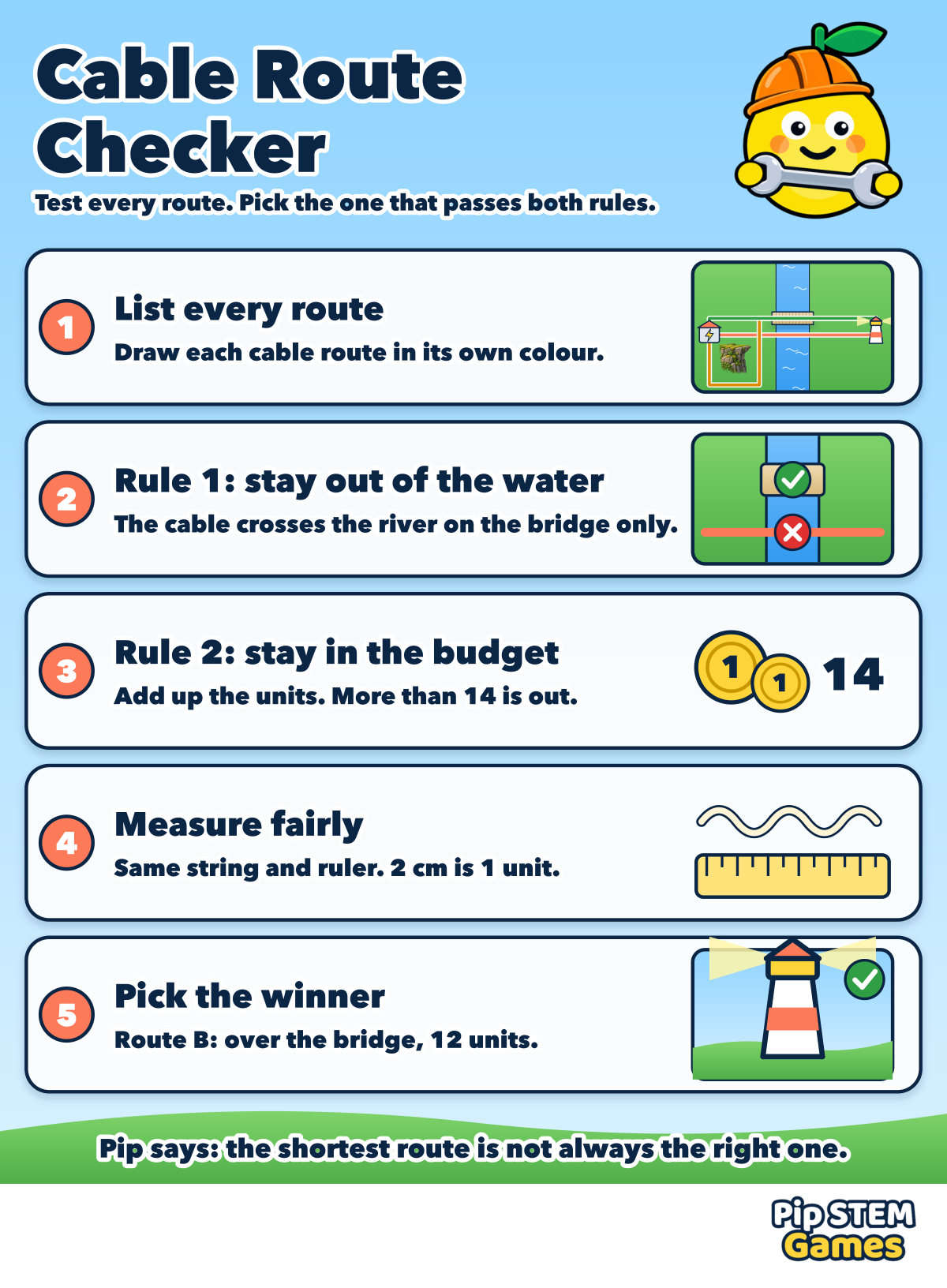
List every route, test each one against every rule, then pick the winner. This cheat sheet fits on a phone screen, so save it for the next puzzle.
How do you change it for each age?
- Ages 5 to 7: use the printable. Start with Routes A and B only, trace each one with a finger and count the squares out loud. An adult reads the two rules.
- Ages 8 to 10: build the paper map, measure with string and fill in the table. Ask which rule each route broke.
- Ages 11 to 12: change the budget, move the bridge, then design a puzzle with one correct route. Ask them to write why the others fail.
Questions parents ask
What is the answer to the lighthouse cable puzzle?
Route B. It crosses the river on the bridge, so the cable stays dry, and it uses 12 units, which is inside the budget of 14.
Why can the cable not go through the river?
That is rule 1 of the puzzle. The cable may reach the other side only by riding along the bridge that is already there.
Is the shortest route always the best one?
No. A route has to follow every rule first. Route A is the shortest at 10 units, but it goes through the river, so it fails.
What age is this puzzle for?
Ages 5 to 12. Younger children can count squares on the printable, and older children can measure with string and design their own maps.
How long does it take?
About 30 minutes to build the paper map and test all three routes. The printable version takes about 10 minutes.
What if the budget is 20 units?
Then Routes B and C both fit, because 12 and 18 are both under 20. Route A still fails because it is in the river, and B wins as the cheapest.
Do real engineers plan routes like this?
Yes. People who plan cables, pipes and roads compare routes against rules and costs, and mapping apps use shortest-path methods to plan journeys.
Great STEM activities to try next...
 Which Bridge Would You Build?Activity
 The Factory Conveyor Belt Logic PuzzleActivity
 STEM Activities by Age: 5–7, 8–10 and 11–12Parent guide
More to try:

Pip STEM Games
We make engineering games and workbooks for kids aged 5 to 12. Every activity here is one we'd happily run at the kitchen table: test it, watch it fail, fix it, try again.




