

Key takeaways
- A bulb only lights when the loop has no gaps.
- Most dark lamps come from a loose wire, a flat battery, a broken bulb or an open switch.
- Test one thing at a time, in the same order, and look after each change.
- Two bulbs in one loop share the push, so each glows dimmer.
- Use only 2 AA batteries. Never mains, plugs or chargers.
The lighthouse circuit challenge turns a card tube, two AA batteries and a small bulb into a fault-finding game. A grown-up hides one fault, and your child tests one thing at a time until the light comes back. It takes about 30 minutes and suits ages 5 to 12.
What is the lighthouse circuit challenge?
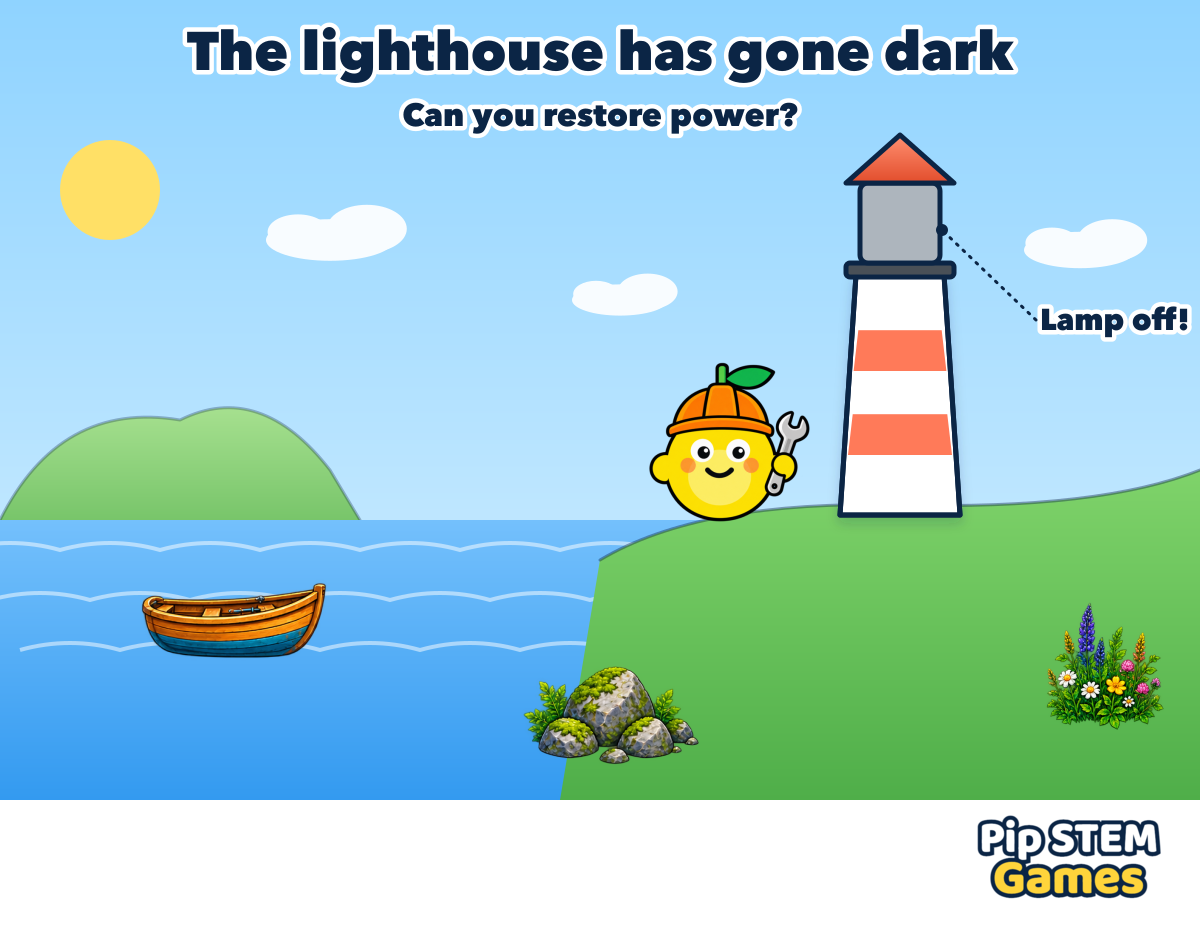
You build a model lighthouse from a card tube with a small bulb at the top. The bulb runs on two AA batteries. Then a grown-up hides one fault so the lamp stays dark. Your child looks for clues, makes a guess, tests it and brings the light back.
It is a model for learning, not a copy of a real lighthouse. Real UK lighthouses are run by Trinity House and have worked without keepers since 1998, so engineers still visit them to find and fix faults. Your child gets to do a small version of that job.
What do you need?
- A kitchen roll tube or tall card tube
- White paper, red paper, card and tape
- 2 AA batteries in a battery holder with leads
- A small bulb in a bulb holder, rated about 2.5 V to 3 V
- 3 short insulated wires, ends stripped by an adult
- A paper clip, 2 drawing pins and a scrap of thick card for the switch
- A pencil and the printable fault report
Safety first. Use only 2 AA batteries. Never use mains power, a plug socket or a charger. Batteries, bulbs and pins are small parts, so an adult should stay close, especially with younger children. Do not join the battery wires straight to each other with no bulb in the loop, because the wires can get hot.
How do you build the lighthouse circuit?
- Wrap the tube in white paper. Add two red stripes.
- Make a lantern room from card on top. Cut a window.
- Push the bulb holder up inside so the bulb sits behind the window.
- Make the switch: push 2 pins into thick card. Hook the paper clip round one pin so it can swing onto the other.
- Join one wire from the battery to the first pin.
- Join a wire from the second pin up to the bulb holder.
- Join the last wire from the bulb holder back to the battery.
- Close the switch. The lamp should light. Now open it again.
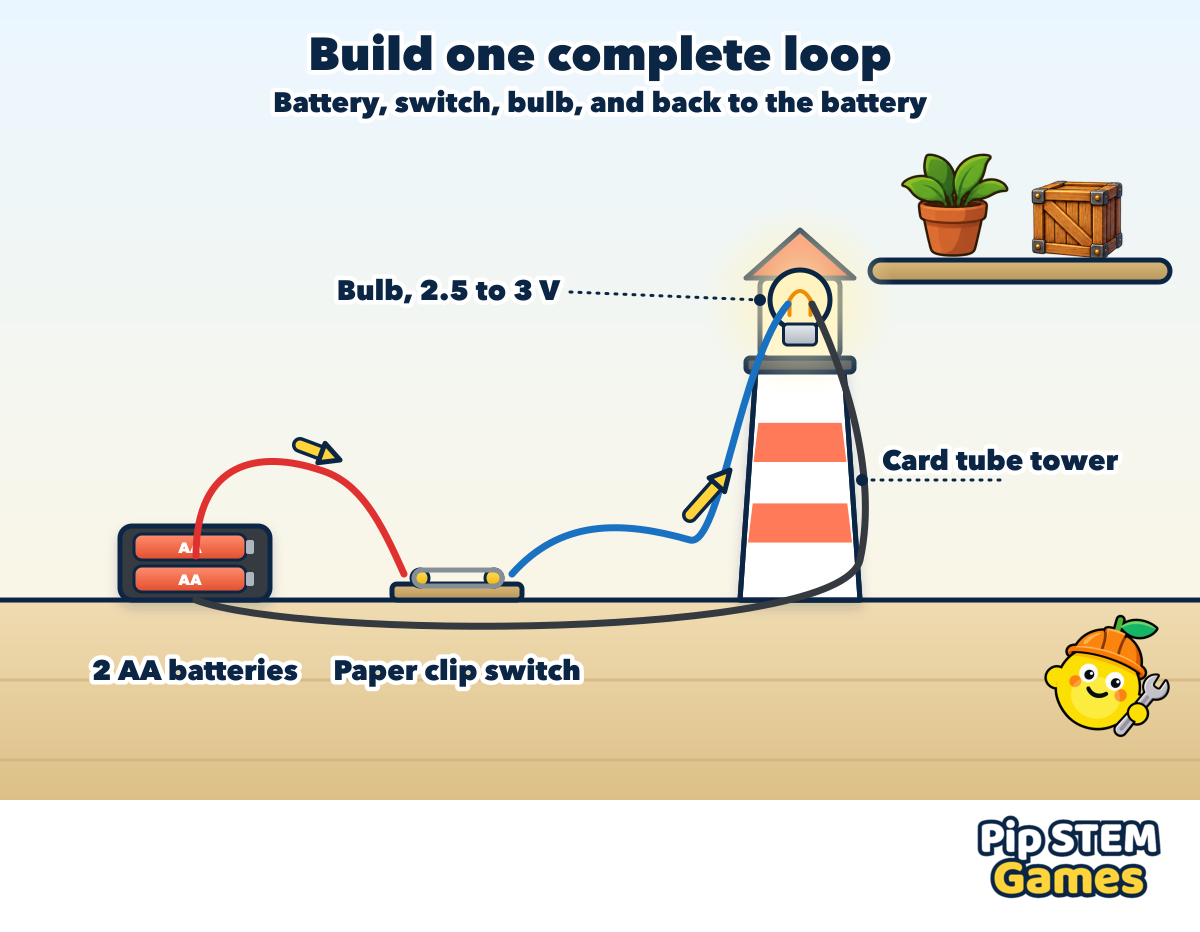
Why it works: the battery pushes electricity round the loop. It only flows when there is no gap anywhere. A bulb in the loop glows because electricity flows through a very thin wire inside it and heats it until it shines. For the basics, see circuits for kids.
How do you set the hidden fault?
While your child looks away, a grown-up picks one fault from the four below. Change only one thing at a time, so there is only one answer to find.
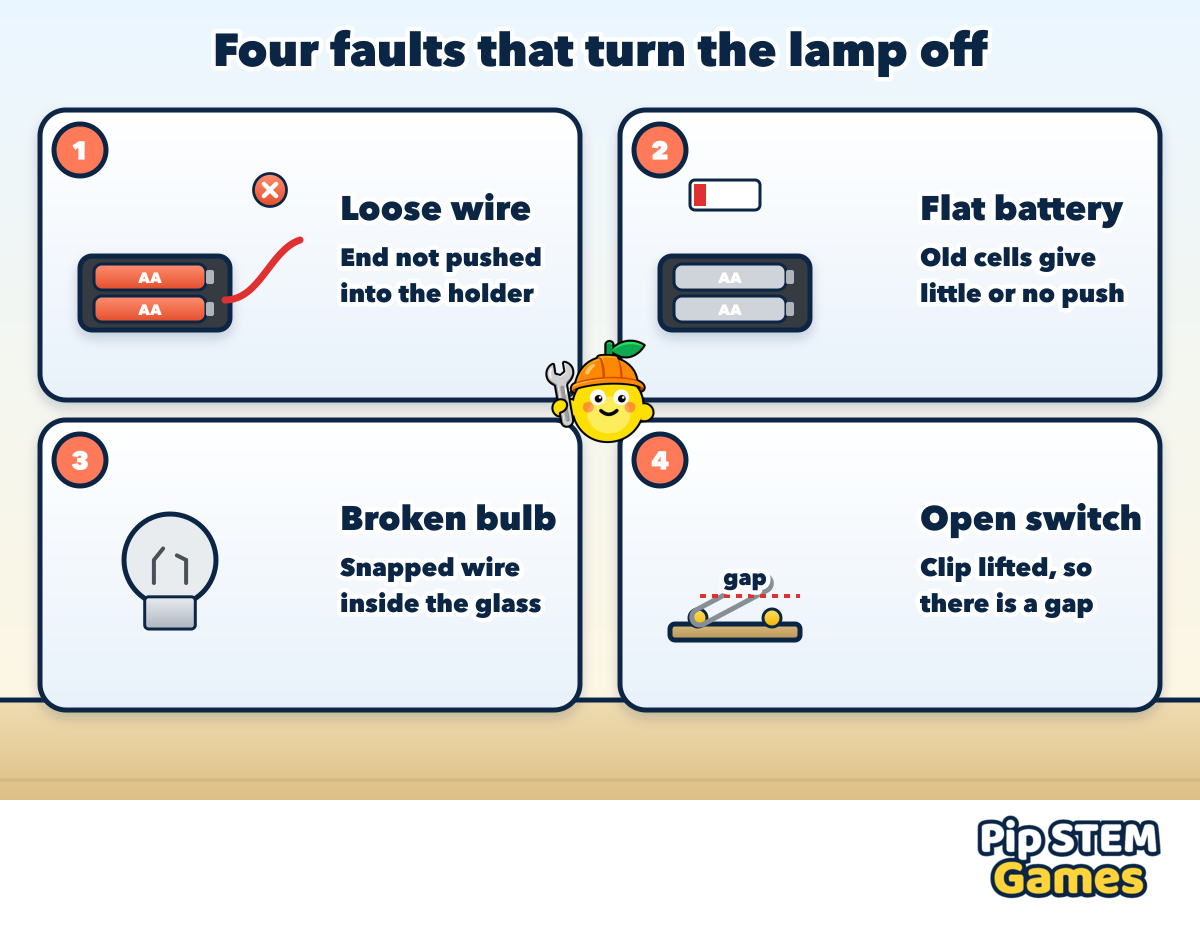
- Loose wire: pull one wire end out of its holder.
- Flat battery: swap in an old battery (keep a used one for this).
- Broken bulb: unscrew the bulb a little so it does not touch, or swap in a dead bulb.
- Open switch: leave the paper clip lifted off the second pin.
How does your child find the fault?
First, look without touching. Ask your child to say what they see. Is the clip touching both pins? Are all the wire ends tucked in? Is the bulb screwed down? Each clue becomes a guess, such as: "I think the switch is open, so there is a gap."
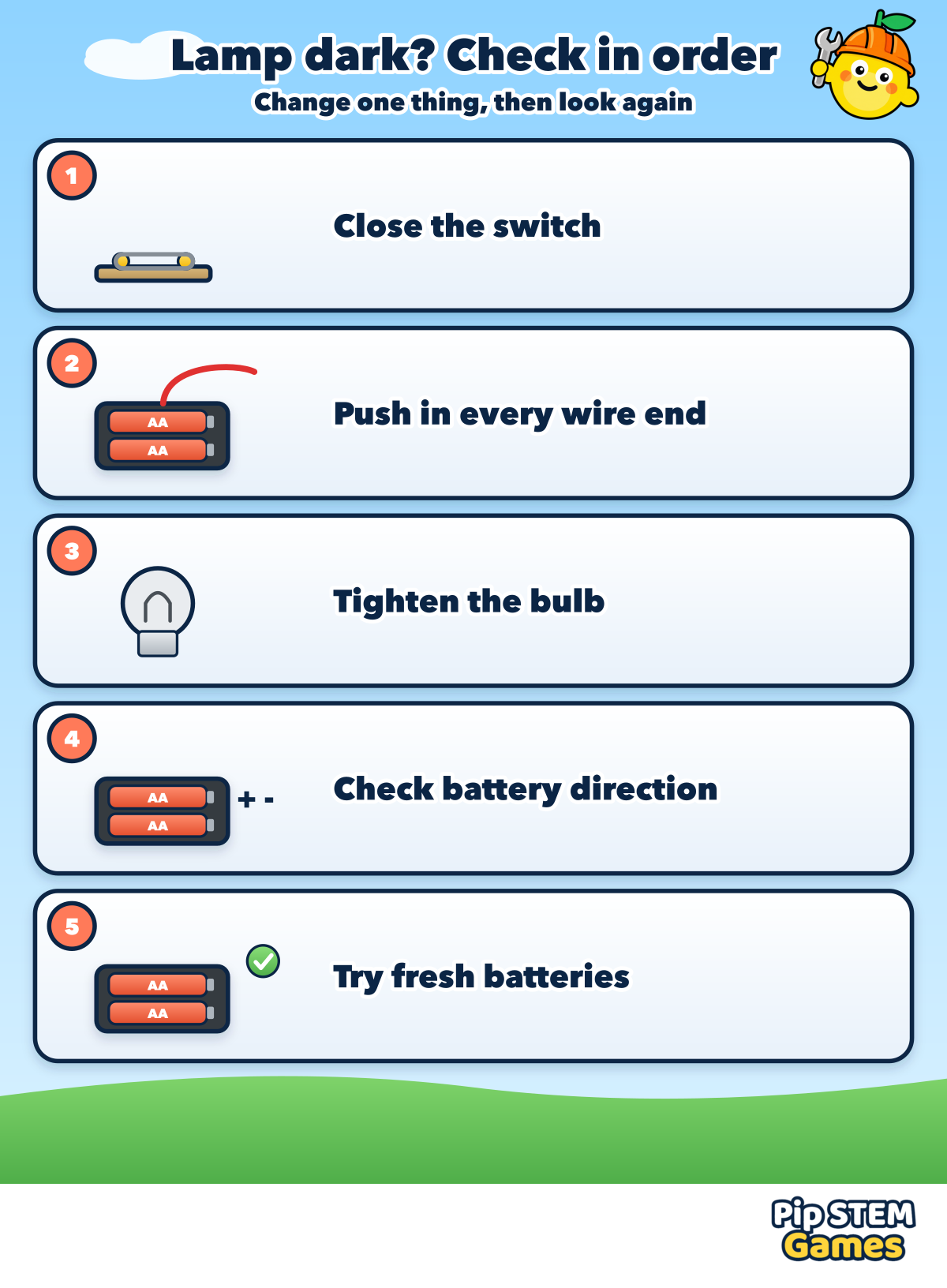
Then test in this order, one change at a time. Look at the lamp after each step.
- Close the switch firmly.
- Push each wire end into its holder.
- Gently tighten the bulb.
- Check each battery: the flat end meets the spring.
- Swap in two fresh AA batteries.
When the lamp lights, the last thing you changed was the fault. Ask your child why. A good answer: "There was a gap, and now the loop is complete." Try the online version in our circuit game, or practise with this broken circuit puzzle.
What if the lamp still will not light?
- Plastic still on the wire ends: bare metal must touch. Ask an adult to strip a little more.
- Wrong bulb: a bulb made for 6 V or more will glow faintly or not at all on 2 AA batteries. Check the number on it.
- Dim light: the batteries are probably low. Try a new pair.
- Paper clip on paint: painted or taped clips may not touch metal. Use a bare clip.
- Still nothing: the bulb may be broken. Try it in another holder.
How do you make it a fair test?
Keep everything the same except the fault. Use the same bulb, the same batteries and the same lighthouse each time. Do three runs:
- Run 1: switch open. Does it light?
- Run 2: switch closed, one wire loose. Does it light?
- Run 3: switch closed, every wire tight. Does it light?
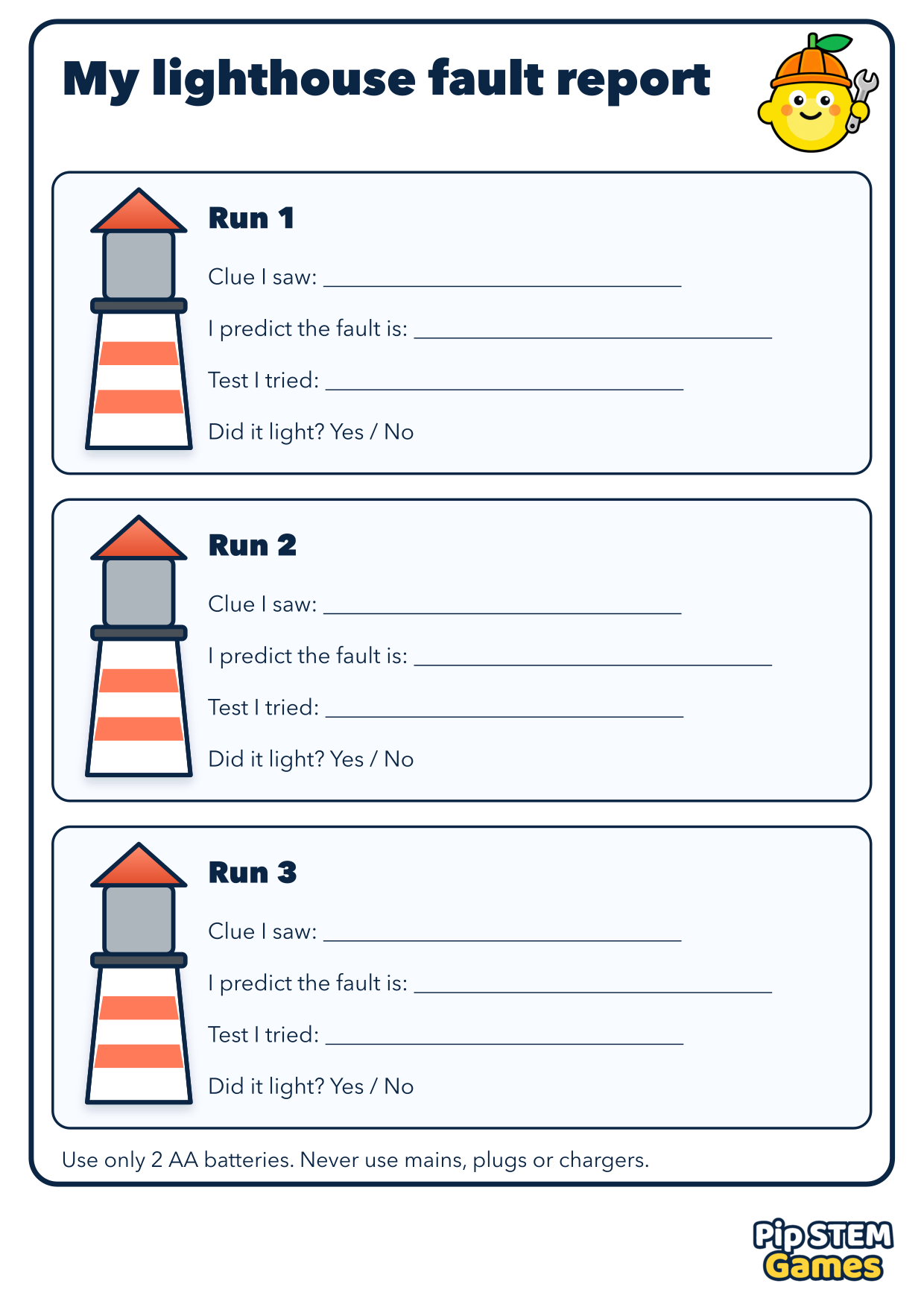
Write each result on the fault report. Only one thing changed, so you can say which fault caused which result.
What is the next test?
Add a second bulb in the same loop, one after the other. Ask your child to guess first: brighter, dimmer or the same?
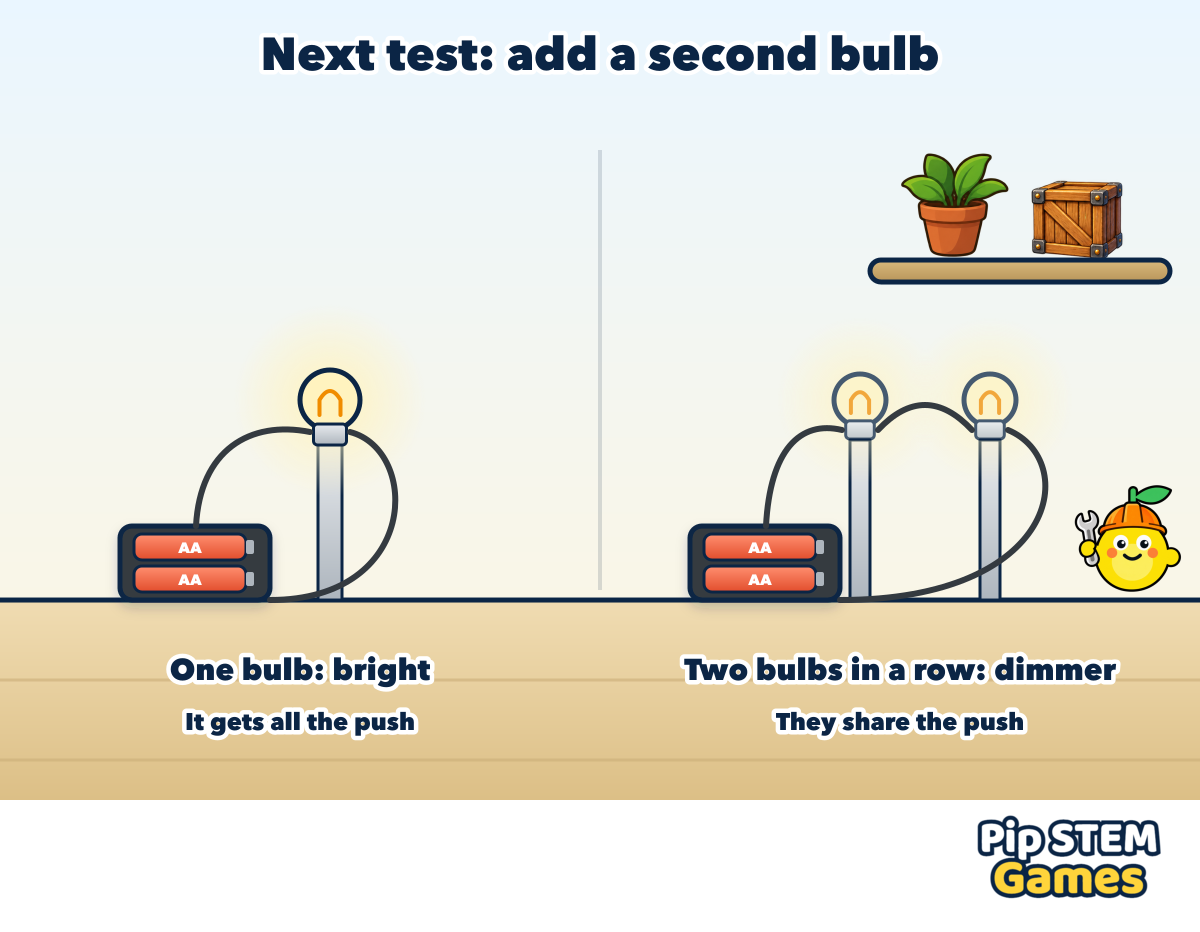
Both bulbs glow, but each one is dimmer. In a single loop the bulbs share the push from the batteries, so each gets less. Take one bulb out and the other goes dark too, because the loop now has a gap. To see how a real lamp works, read how a lighthouse lights up.
How do you change it for each age? [Printable]
- Ages 5 to 7: use a ready-made battery and bulb kit with clip leads. Skip the switch. Focus on "no gap, the light comes on".
- Ages 8 to 10: add the paper clip switch and the five-step check list.
- Ages 11 to 12: fill in the fault report for three runs, then hide a fault for a grown-up to find.
For more circuit fun, try find the missing component, or the hands-on pages in our engineering workbook for kids.
Questions parents ask
What bulb works with 2 AA batteries?
A small bulb rated about 2.5 V to 3 V. Two AA batteries give about 3 V. A bulb rated higher will glow faintly or not at all.
Why does the bulb not light when one wire is loose?
Electricity needs a complete loop. A loose wire makes a gap, so nothing flows and the bulb stays dark.
Is this activity safe for a 5-year-old?
Yes, with an adult close by. Use only 2 AA batteries, let the adult strip the wires and handle pins, and keep small parts away from younger brothers and sisters.
Why are two bulbs dimmer than one?
In one loop, the two bulbs share the push from the batteries. Each gets about half, so each glows less brightly.
Can I use an LED instead of a bulb?
You can, but an LED only works one way round. If it stays dark, flip it. That makes a good extra fault to find.
Do real lighthouses still have keepers?
Not in England and Wales. Trinity House finished making all its lighthouses automatic in 1998. Engineers visit to check and fix them.
Great STEM activities to try next...
 How Does a Lighthouse Light Up?Activity
 Can Your Child Fix This Broken Circuit?Activity
 Circuits for Kids: How a Simple Circuit Works and How to Build One [Printable]Circuits
More to try: Connect the Lighthouse Without Crossing the River · How Hydroelectric Power Works: Water Wheel Model

Pip STEM Games
We make engineering games and workbooks for kids aged 5 to 12. Every activity here is one we'd happily run at the kitchen table: test it, watch it fail, fix it, try again.




