

Key takeaways
- A lighthouse lamp stays still while a lens turns round it, so the beam sweeps past each ship as a flash.
- A Fresnel lens gathers nearly all the lamp light into a narrow beam about 1 degree wide.
- Every lighthouse has its own flash pattern, so sailors can tell which one they see.
- In our model, slots times turns equals flashes: two slots give twice as many flashes in the same time.
- Use only 2 AA batteries, never mains power, and let an adult do the cutting.
How does a lighthouse light up? A still lamp sits inside a big glass lens that turns round it. The lens squeezes the light into one narrow beam, so ships see a flash each time the beam sweeps past. You can build a small copy with a bulb, two AA batteries and a card shield, then count the flashes on the wall.
How does a lighthouse light up?
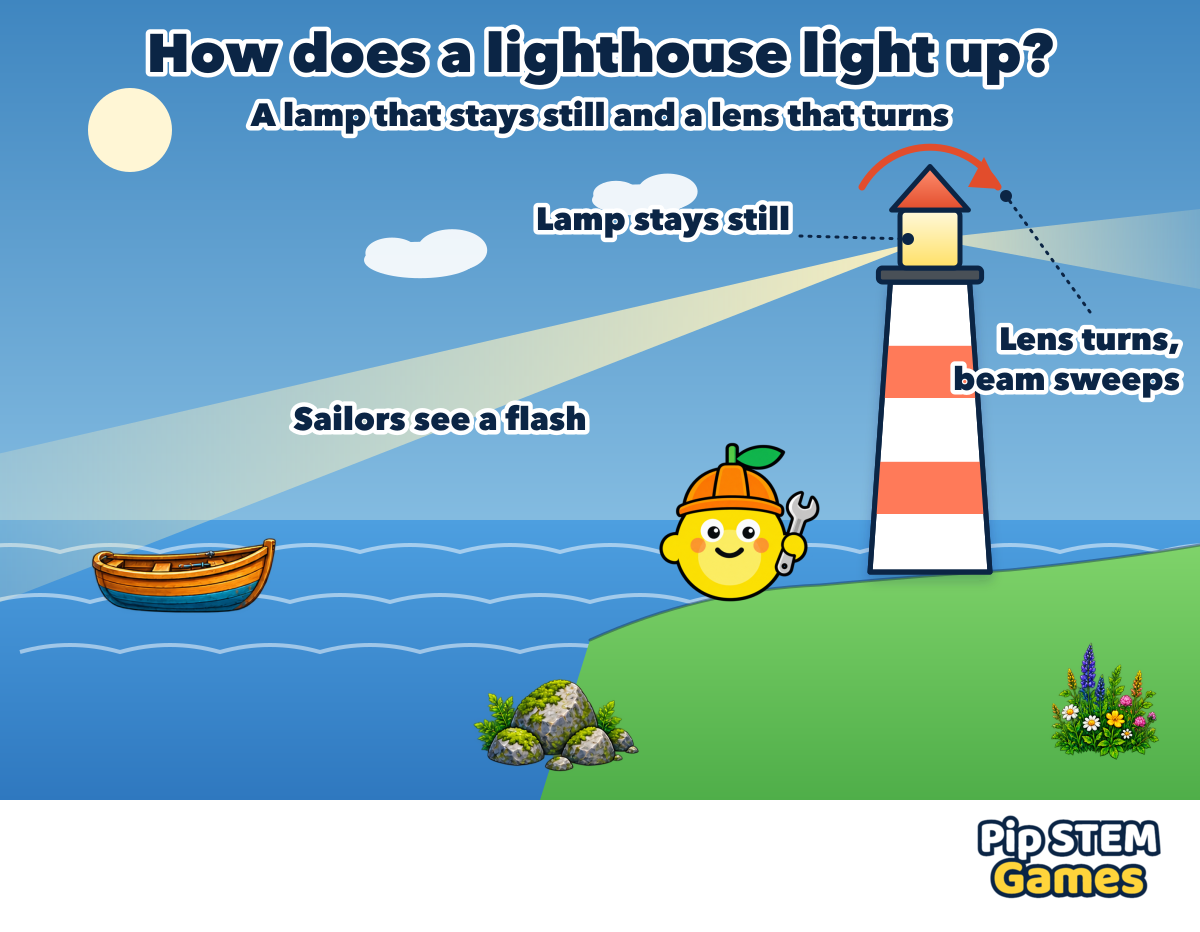
The lamp never moves. A big glass lens turns round it, and that lens squeezes the light into one narrow beam. As the beam sweeps past a ship, the sailors see a flash. Then it turns away and they see dark. Flash, dark, flash, dark: that is the lighthouse blinking.
The lens is called a Fresnel lens, and it was invented in France in the 1820s. It gathers nearly all the light from the lamp and sends it out in a beam only about 1 degree wide. In the old days, a clockwork motor with a falling weight turned the lens, and the keeper had to wind it back up every few hours. Now an electric motor does the job. Many modern lights have no moving lens at all. They use LEDs that switch on and off in a set pattern.
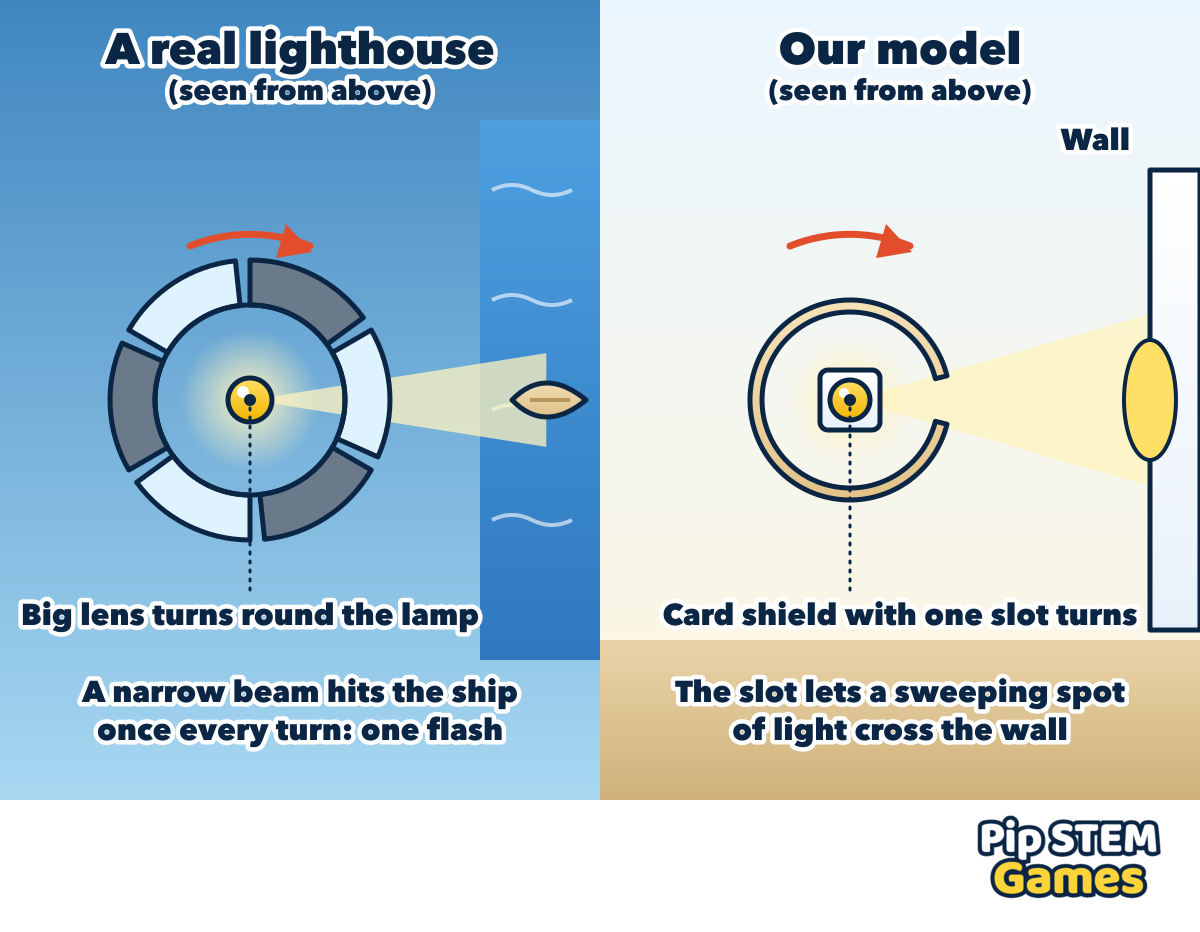
You can copy the idea at home. You will build a small lamp, put a card shield with one slot over it, and turn the shield by hand. A spot of light will sweep round the wall, just like a beam sweeping across the sea. It takes about 40 minutes and suits ages 5 to 12.
What do you need?
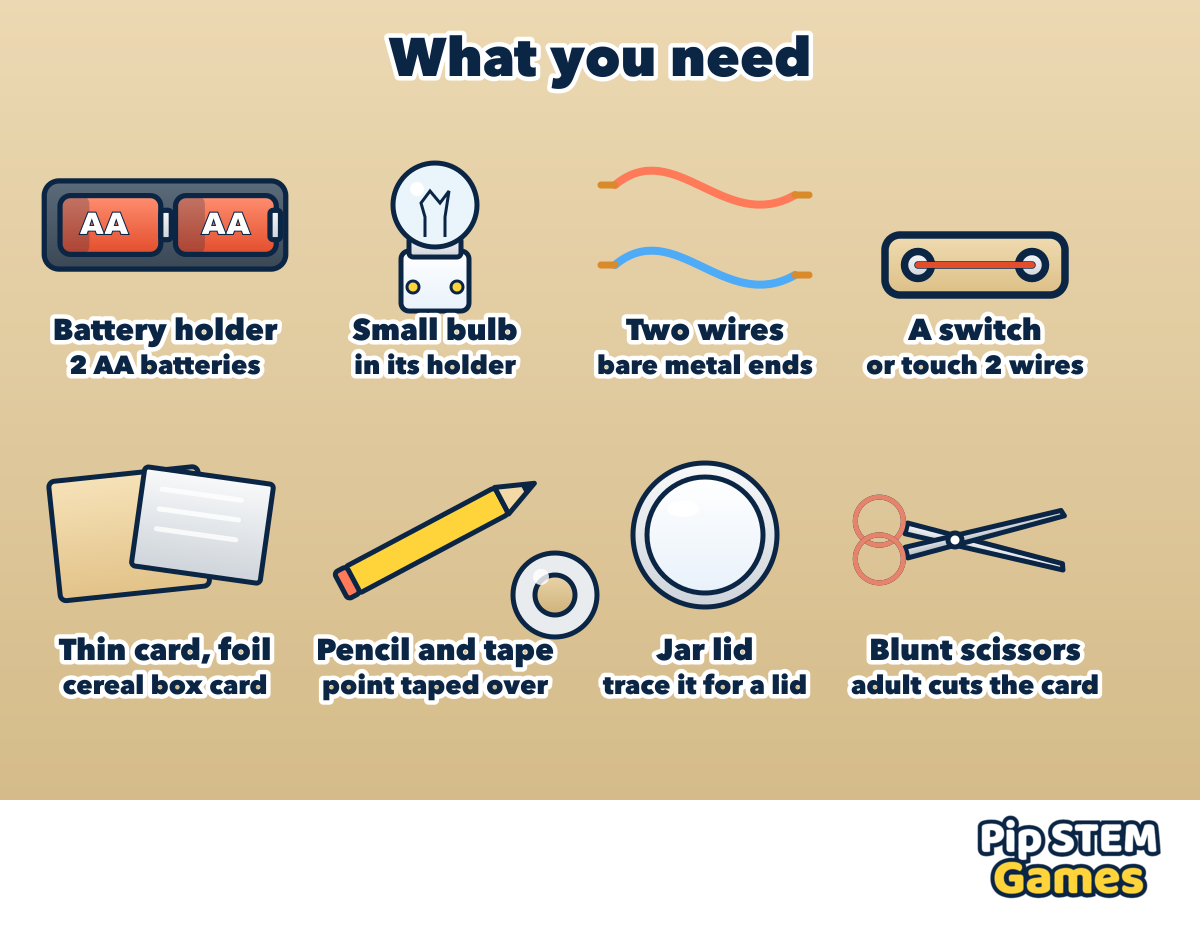
- A battery holder with 2 AA batteries
- A small bulb in a matching holder, made for about 2.5 volts
- 2 short wires with bare metal ends (an adult strips them)
- A switch, or just touch the two wires together
- Thin card, such as a cereal box, and a little kitchen foil
- A pencil with its point covered in tape, sticky tape and a jar lid
- Blunt scissors, used by an adult for the card
Safety first. Use only 2 AA batteries. Never use mains power, a plug socket, a charger or a button cell. Take the batteries out if anything feels warm. The bulb gets warm after a few minutes, so switch it off between tests and keep the card from touching it. An adult should cut the card and handle the batteries, bulbs and wire ends, especially for children under 6. Foil edges can be sharp, so fold them over. Do the experiment in a dim room, never with a torch pointed at anyone's eyes.
How do you build the lighthouse lamp and shield?
Build the lamp first. Then make the shield that turns round it.
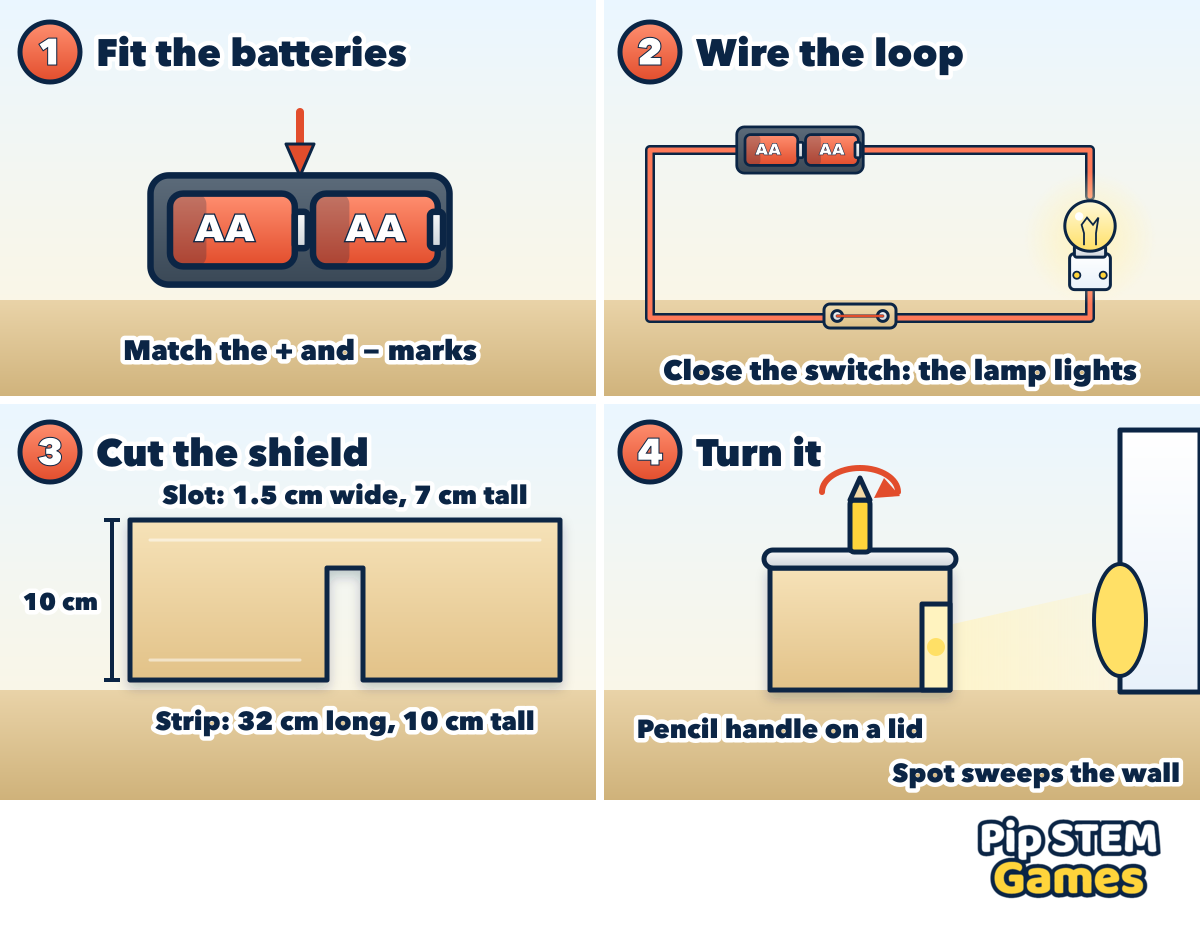
- Put 2 AA batteries in the holder. Match the + and − marks.
- Join the holder, switch and bulb in one loop, with no gaps (a grown-up checks this).
- Close the switch. The bulb should light. If it stays dark, see the checks below.
- Cut a card strip 32 cm long and 10 cm tall. Cut a slot in the bottom edge, 1.5 cm wide and 7 cm tall. An adult does the cutting.
- Line the inside with foil if you like. It bounces light back out and makes the spot brighter.
- Roll the strip into a tube so the slot stays open. Tape it closed.
- Trace the jar lid on card, cut it out and tape it on top. Tape the pencil to the lid as a handle.
- Stand the tube over the lit bulb on a table, about 1 metre from a blank wall. Turn the pencil slowly.
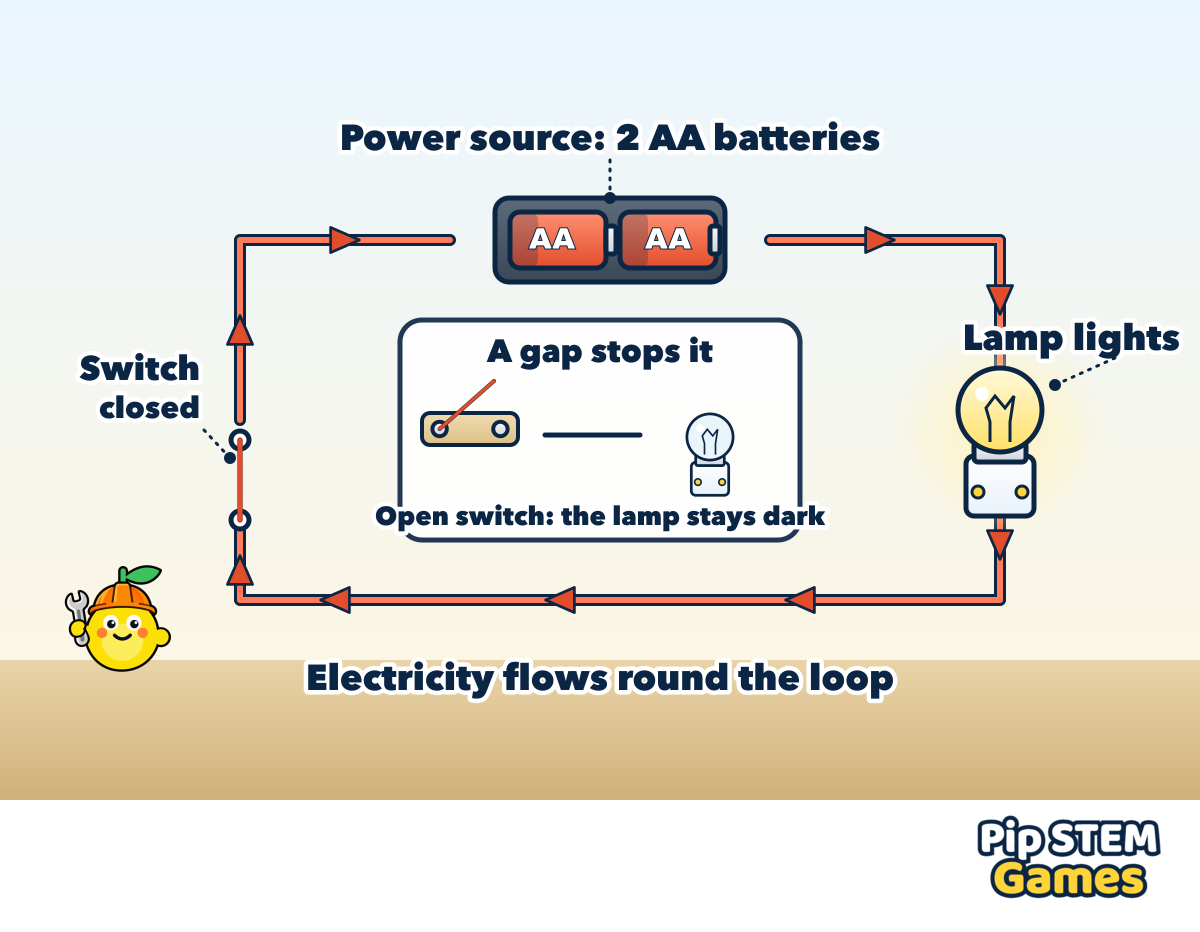
Why it works: the battery pushes electricity round the loop, but only when there is no gap. Our shield works a bit differently from a real lens. A real lens bends light into a beam. Our card just blocks the light and lets a thin slice out through the slot. The result looks alike: a spot that sweeps round the room. For the basics of loops, see circuits for kids.
How do you count flashes?
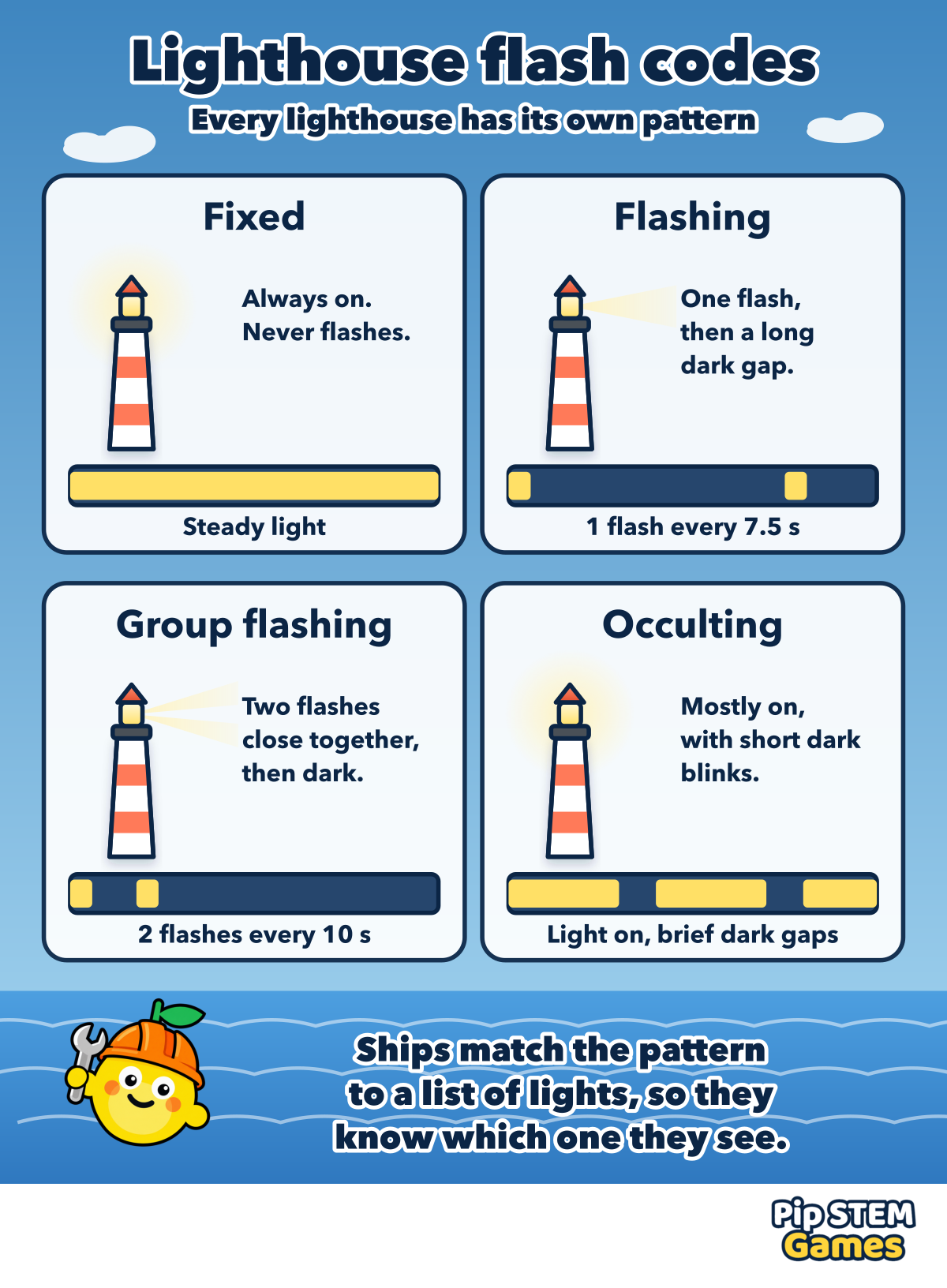
Every lighthouse is known by its flash pattern. Sailors count the flashes and match them against a published list of lights. Now you can build your own pattern.
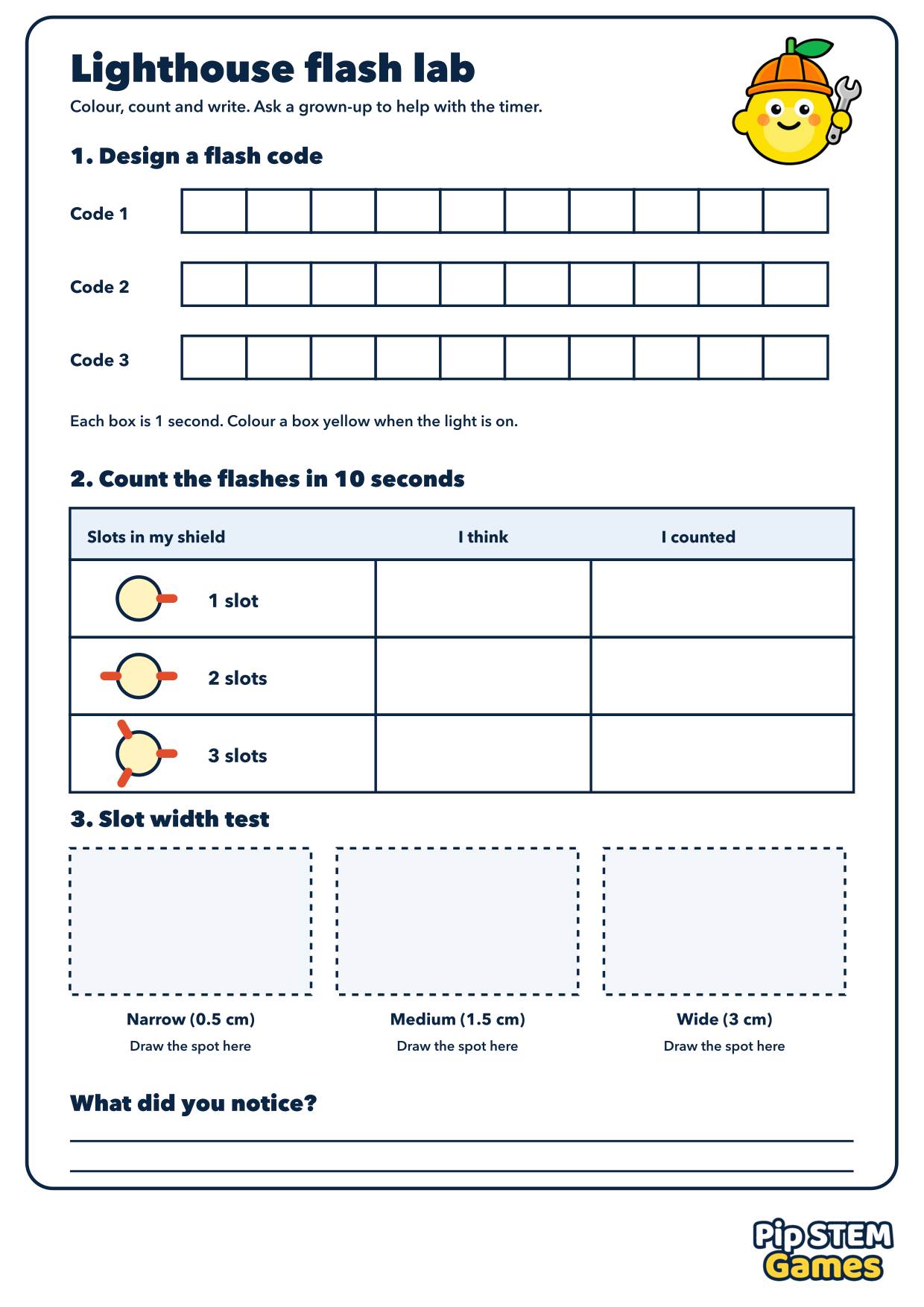
Turn the shield at a steady speed. Say one full turn takes about 2 seconds. With one slot, the spot crosses the wall once per turn. In 10 seconds you will see about 5 flashes. Add a second slot opposite the first, and you will see 10 flashes in the same time. Slots times turns equals flashes.
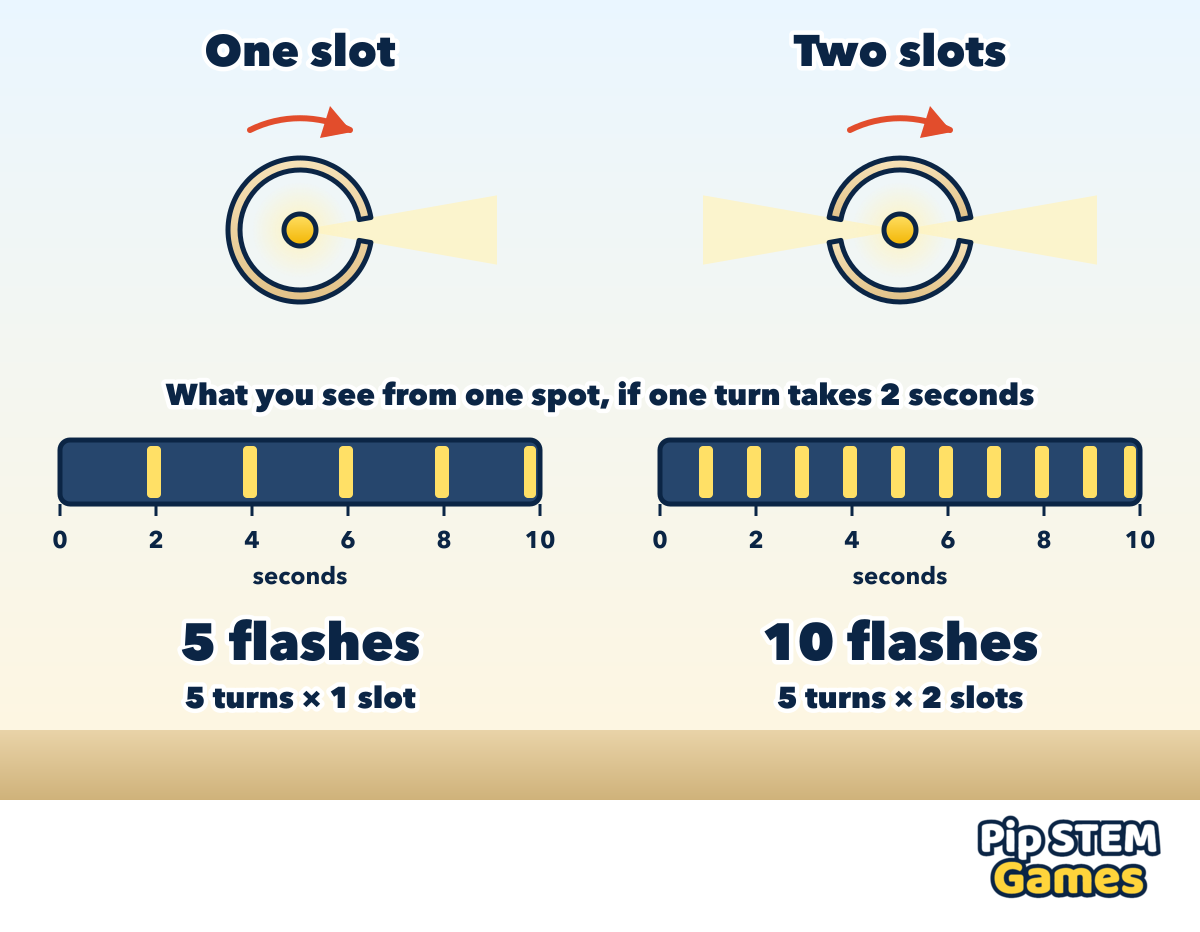
Ask your child to guess first. Will three slots give 15 flashes? Then test it. Count out loud while a grown-up watches a timer. Real lights use patterns too: one flash every 7.5 seconds, two quick flashes every 10 seconds, or four flashes every 18 seconds. Our cheat sheet shows the four main types.
Try the online version in our circuit game, which gets a bulb lit with no gaps.
How do you make it a fair test?
Change one thing at a time. Keep the same bulb, the same batteries and the same distance from the wall. Then try three slot widths: 0.5 cm, 1.5 cm and 3 cm. Make the narrow slot by taping a strip of card over part of the wide one.
- Narrow slot (0.5 cm): turn the shield. Is the spot thin and dim?
- Medium slot (1.5 cm): is the spot brighter?
- Wide slot (3 cm): is the spot wide and bright, or just wide?
Draw each spot on the printable and write down what you see. You should find that a wider slot makes a wider spot that stays on the wall for longer. A narrow slot makes a thin, quick flash. Only the slot changed, so you can say what caused each result.
What if the lamp or the spot will not work?
Go through these checks in order. Change one thing, then look again.
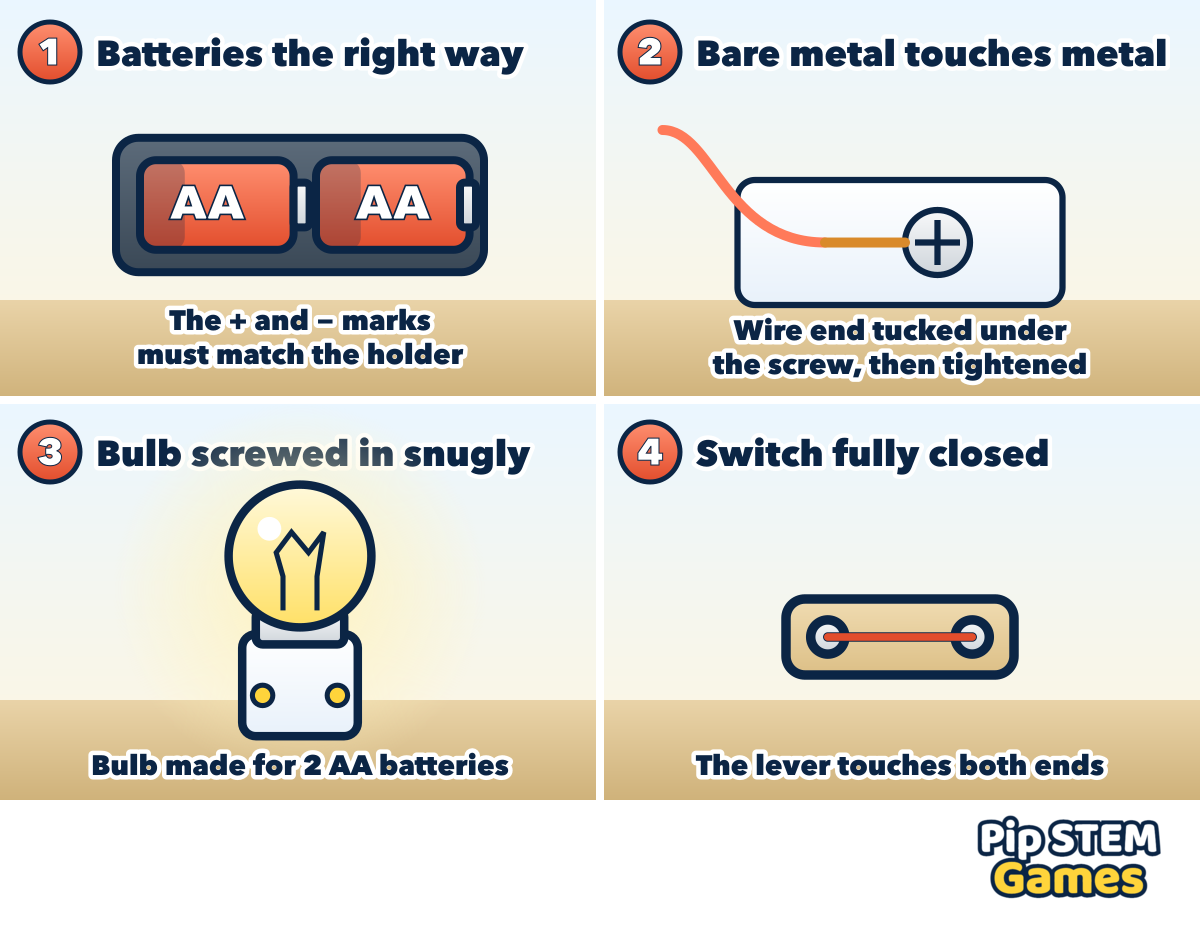
- Bulb stays dark: check the batteries, the wire ends, the bulb and the switch.
- Bulb is dim: the batteries are probably low. Try a new pair.
- No clear spot on the wall: dim the room and move the lamp closer to the slot.
- The spot is wobbly: turn slowly and hold the tube by the pencil only.
- Bulb is hot: switch off and wait. Keep the card away from it.
If it still fails, the bulb may be broken. Try it in a different holder, or try our broken circuit puzzle to practise finding faults.
How do you change it for each age?
- Ages 5 to 7: an adult builds the lamp and the shield. The child turns it and counts the flashes out loud.
- Ages 8 to 10: the child wires the loop and tapes the shield. They run the slot count test and fill in the printable.
- Ages 11 to 12: the child draws and labels the circuit, designs their own flash code on the grid, then challenges a grown-up to name it from the wall.
Next, ask them how a real light stays on during a storm or a power cut. It is a good way to talk about engineering. For more ideas, see the lighthouse fault-finding challenge and the hands-on pages in our engineering workbook for kids.
Questions parents ask
How does a lighthouse light flash?
The lamp stays on all the time. A lens turns round it and sends out a narrow beam. Each time the beam sweeps past you, you see a flash.
What is a Fresnel lens?
A lens made of many glass rings that gathers nearly all the lamp light into one beam. It was invented in France in the 1820s and is thinner and lighter than a solid glass lens.
What turned the lens in old lighthouses?
A clockwork motor driven by a falling weight. The keeper wound it back up every few hours. Today most lenses are turned by electric motors.
Why does each lighthouse flash differently?
The pattern is like a name. Sailors count the flashes and check them against a published list of lights to know which lighthouse they can see.
How far can a lighthouse light be seen?
A strong light can be seen from more than 20 nautical miles away in clear weather. Earth's curve and the weather change that.
Is the lighthouse model safe for children?
Yes, with 2 AA batteries only. Never use mains power, chargers or button cells. An adult cuts the card and handles small parts, and you switch off between tests.
Why does a wider slot give a wider spot?
More light gets out through the slot at once, so it lights a wider patch of wall. A narrow slot lets out a thin slice, so the spot is thin and brief.
Great STEM activities to try next...
 The Lighthouse Has Gone Dark. Can Your Child Restore Power? [Printable]Electricity
 Circuits for Kids: How a Simple Circuit Works and How to Build One [Printable]Circuits
 Can Your Child Fix This Broken Circuit? A Simple Circuit PuzzleBuild challenge
More to try: Connect the Lighthouse Without Crossing the River

Pip STEM Games
We make engineering games and workbooks for kids aged 5 to 12. Every activity here is one we'd happily run at the kitchen table: test it, watch it fail, fix it, try again.




