

Key takeaways
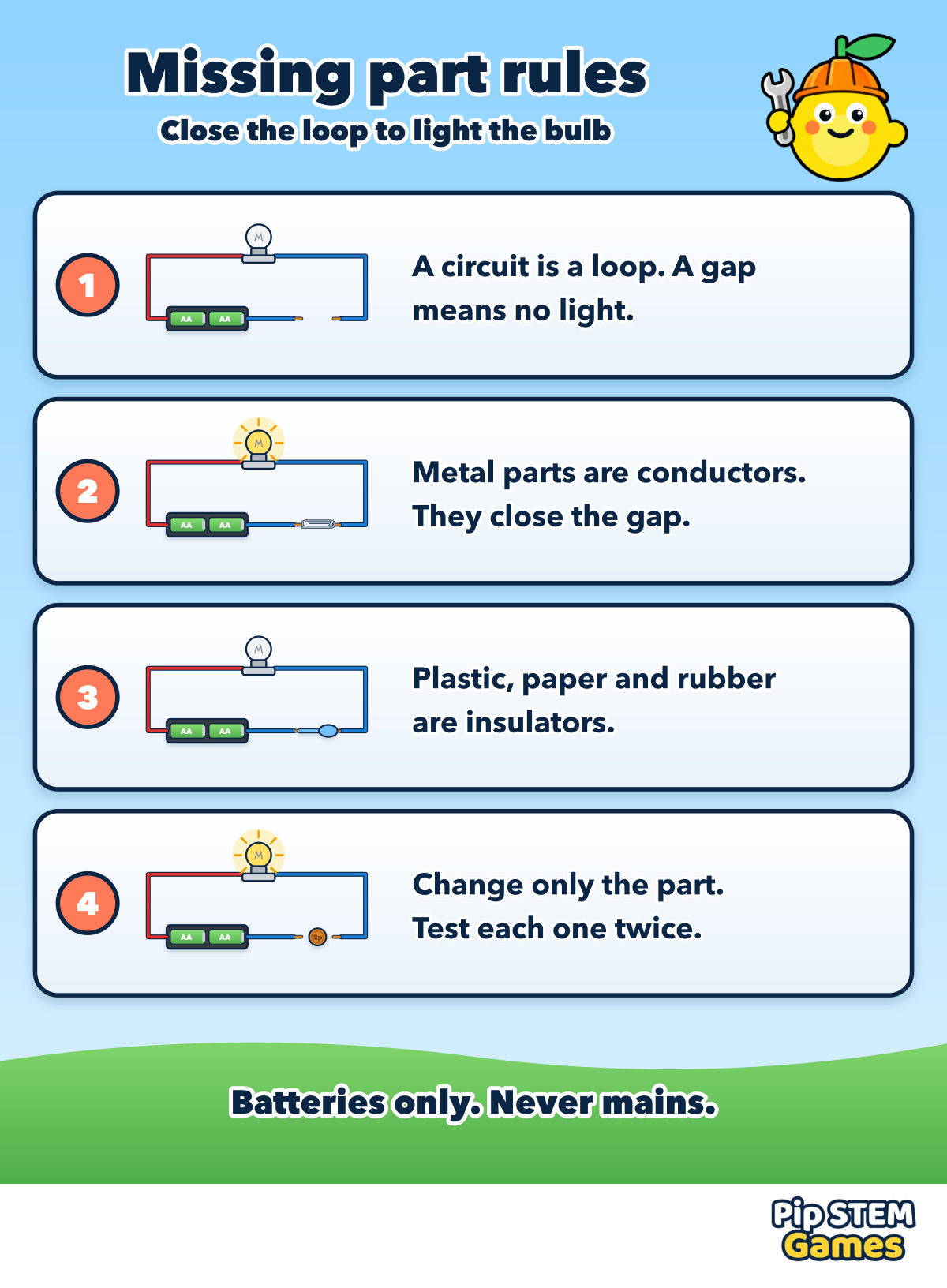
- A circuit is a loop; a gap means no light.
- Metal parts such as clips and coins are conductors and close the gap.
- Plastic, dry paper and rubber are insulators and block the current.
- Change only the part in the gap, and test each one twice.
- Use 2 AA batteries only, never mains, with an adult supervising.
Can your child find the missing component? Build a simple circuit with a gap, line up five everyday parts, and predict which ones will make the bulb light. Then test them. It takes about 20 minutes and shows the difference between conductors and insulators better than any worksheet.
What is the missing component?
The missing component is any part that closes the loop from the battery, through the bulb and back. A metal paper clip or a coin closes it and the bulb lights. A plastic spoon or a dry paper strip doesn't, so the bulb stays dark.
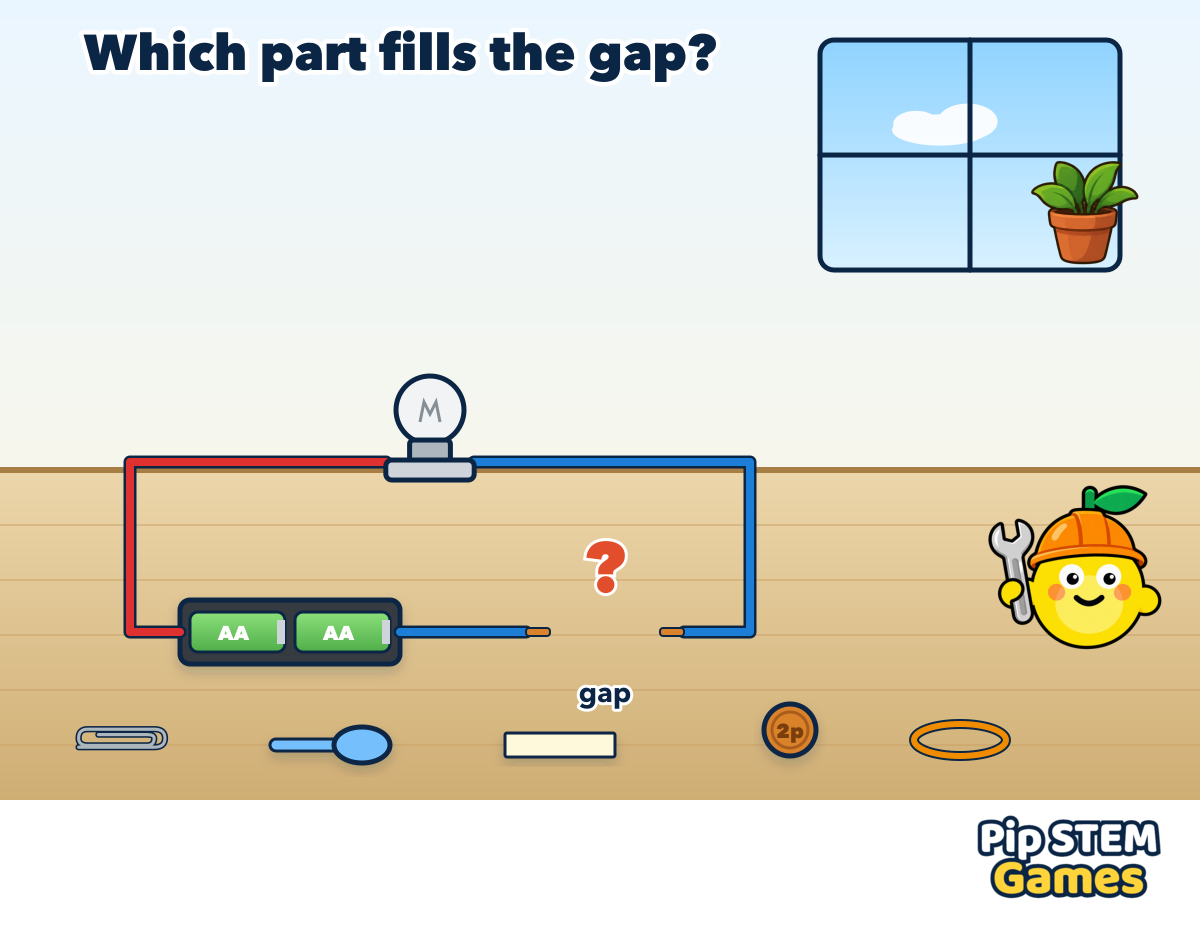
In this activity your child builds a simple circuit with one gap, predicts which parts will fill it, then tests them one by one. It's a small model for learning, not a real machine.
Why does a circuit need a closed loop?
A circuit is a loop. Electricity can only flow when the loop is closed and every part in it lets current through. If one part is missing, there's a gap, and the bulb stays dark.
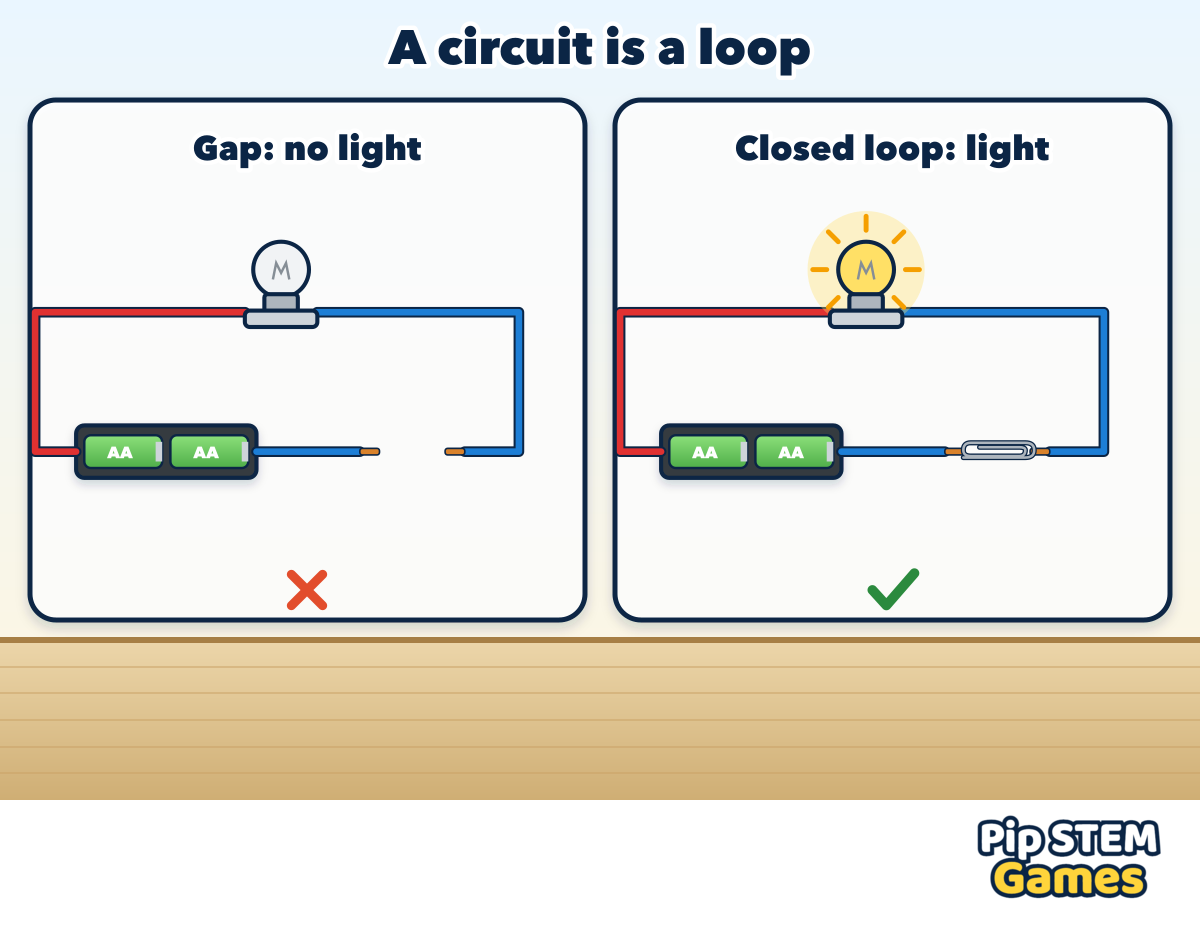
A switch works the same way. Flick it off and it opens a gap. Flick it on and it closes the loop. Our circuits for kids guide covers the basics if this is your child's first circuit.
What do you need?
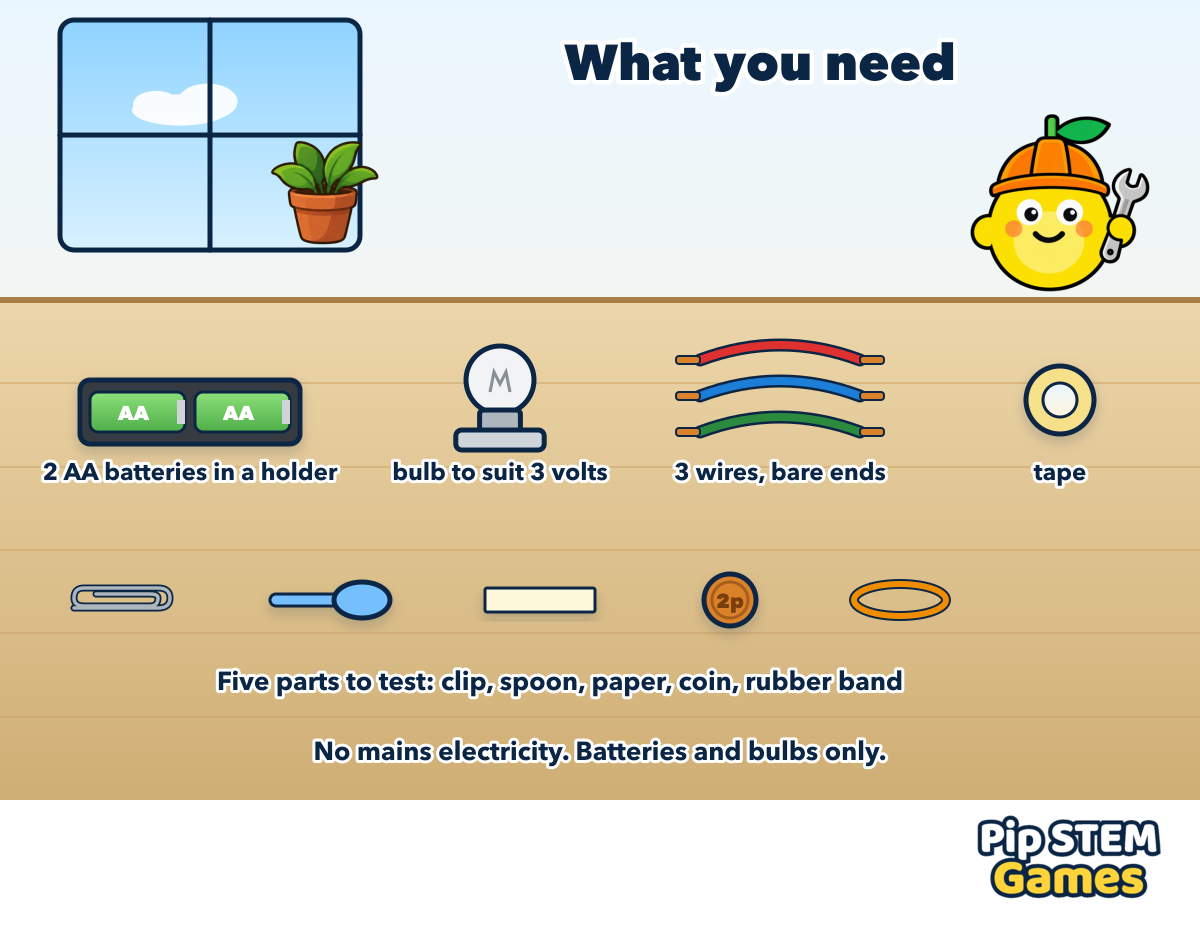
- 2 AA batteries in a battery holder
- A bulb in a bulb holder that suits 2 AA batteries (about 3 volts)
- 3 short wires with bare ends (crocodile clip leads are easiest)
- Parts to test: a metal paper clip, a plastic spoon, a strip of dry paper, a 2p coin and a rubber band
- Sticky tape and a tray or table
Safety: use only the 2 AA batteries. Never use mains electricity or a plug socket. Don't join the two battery ends with just a wire or a strip of foil, because that makes the wire hot and drains the battery. Batteries, bulbs and clips are small parts, so an adult supervises, especially with younger children nearby.
How do you set it up?
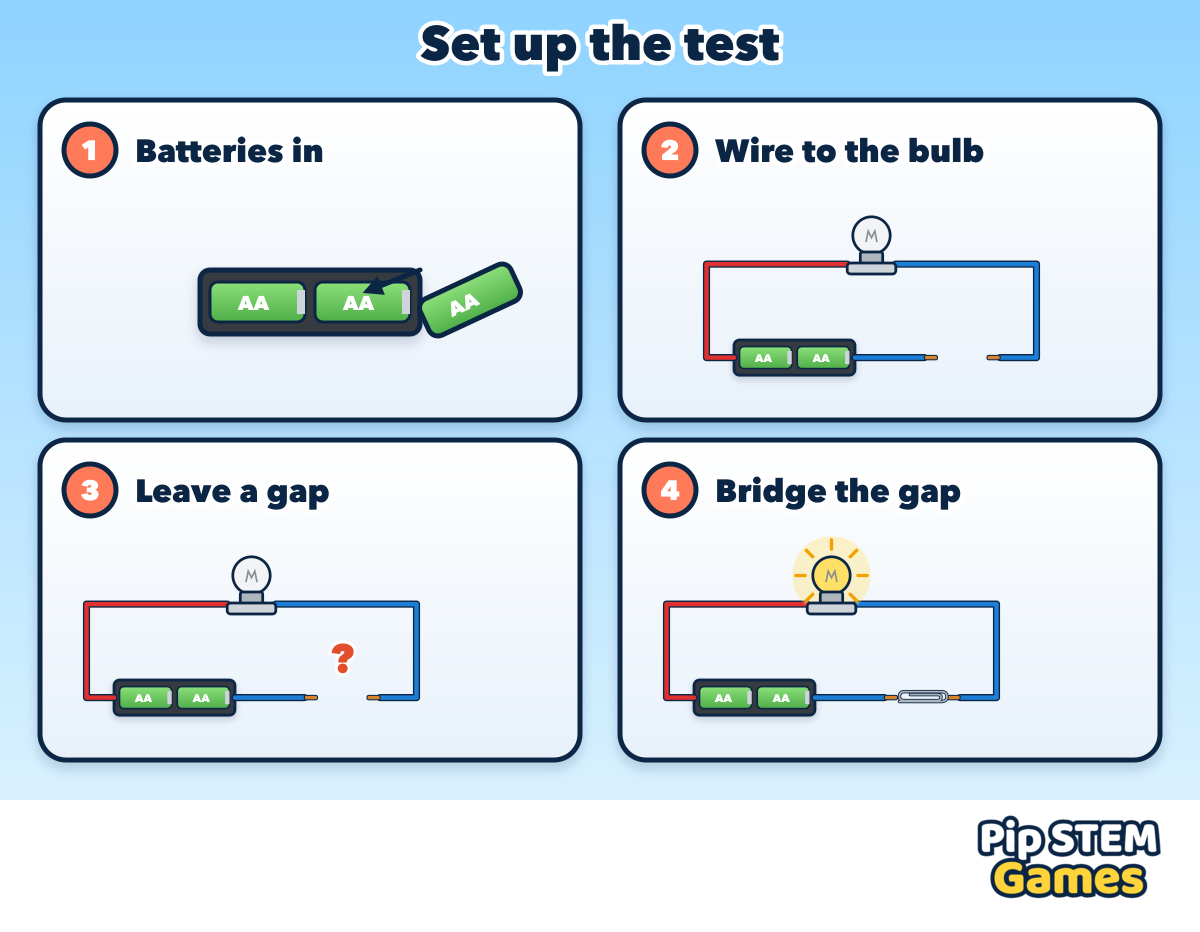
- Ask an adult to help fit the 2 AA batteries into the holder.
- Join one wire from the battery holder to one side of the bulb holder.
- Join a second wire to the other side of the bulb holder. Leave its far end loose.
- Join a third wire to the other end of the battery holder. Leave its far end loose too. Now there's a gap between the two loose ends.
- Predict. Which parts will make the bulb light? Write down or say your guess for each one.
- Touch both loose ends onto one part at a time, so the part bridges the gap. Watch the bulb.
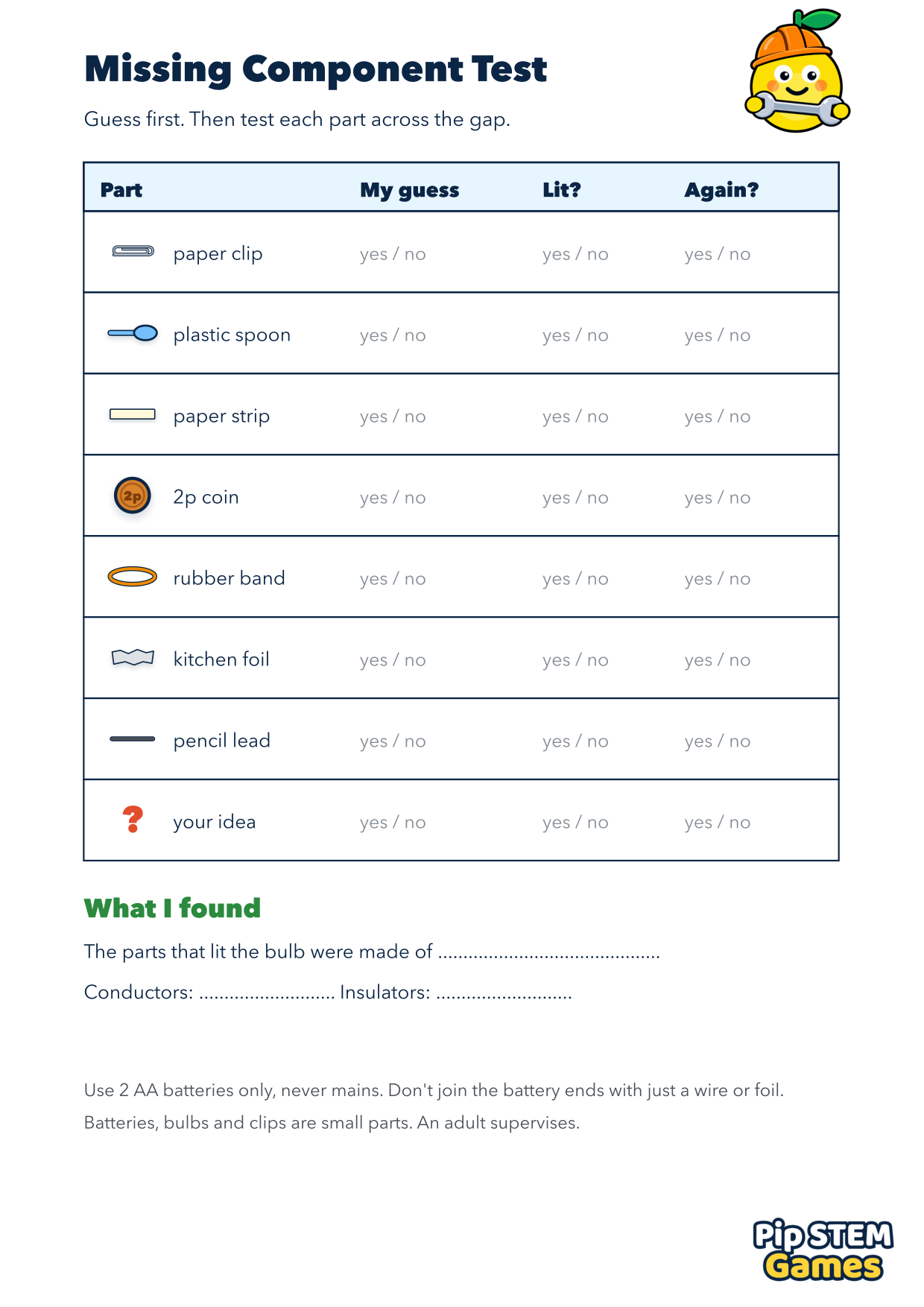
- Write each result in a table: the part, your guess, and whether the bulb lit.
Our free printable below has the results table ready to fill in.
Why does the bulb light for some parts and not others?
Metals such as the paper clip and the coin are conductors. They have tiny particles called electrons that can move easily, so current flows across the gap. Plastic, dry paper and rubber are insulators. Their electrons are held tightly, so they block the current.
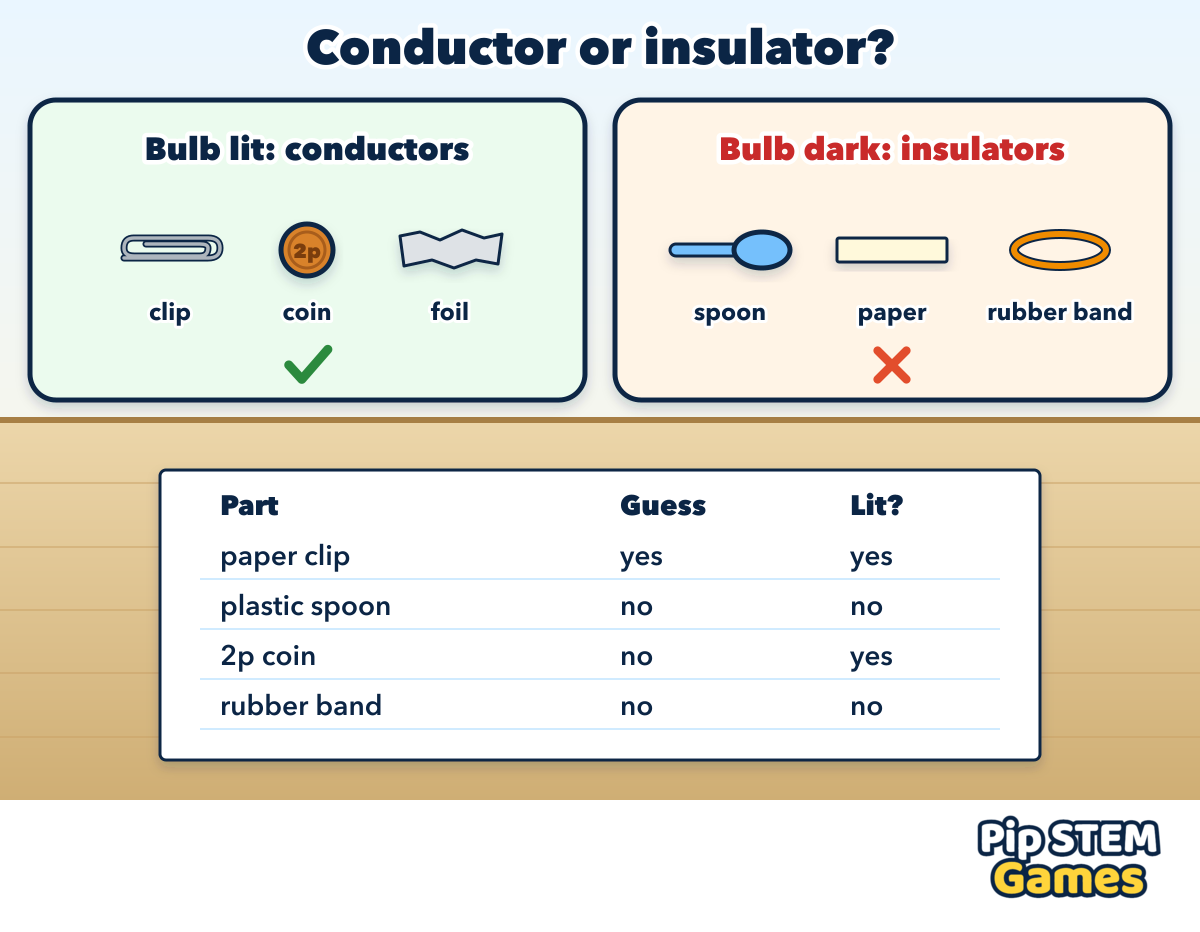
Your table should show a pattern: the parts that lit the bulb are made of metal. Write your conclusion from your own results, not from what you expected. If a result surprises you, test it again. That's how engineers check their work. For a harder fault-finding puzzle, try can your child fix this broken circuit.
What if it doesn't work?
- The bulb never lights: check the bulb suits 2 AA batteries and is screwed in firmly. Touch the two loose ends together for a second: if the bulb lights, the circuit is fine and the part is the issue.
- The wires slip: tape each bare end so it presses on the part, not on the other wire.
- The light is only dim: the batteries may be weak, so try fresh ones.
- The bulb lights with nothing in the gap: the two loose ends are touching. Move them apart.
- A metal thing doesn't work: some painted or coated metal won't conduct, because the coating is an insulator. Don't scratch it. Just try a different item.
How do you make it a fair test?
Change only one thing: the part in the gap. Keep the same batteries, bulb, wires and size of gap. Press each part against the wire ends just as firmly and for the same few seconds. Test each part twice and check the result repeats.
A result that changes between tries usually means a loose connection, not a new discovery. Tape the ends and test again.
What is the next test?
Add new parts: a pencil lead, a strip of kitchen foil and a wooden lolly stick. Predict first, then test, and sort everything into conductors and insulators. Pencil lead is made of graphite, which does conduct, but much less well than metal, so with 2 AA batteries the bulb may only glow faintly or not at all. That's a great surprise to talk about.
On screen, the Circuit game lets children build loops and find gaps without any batteries. Then try the lighthouse gone dark challenge.
Different ages: ages 5 to 7 can test three parts and talk about "lights" and "doesn't light". Ages 8 to 10 can fill in the table with a guess column. Ages 11 and 12 can add a second bulb to the loop, predict what happens to the brightness, and draw the circuit as a diagram with the gap marked.
Questions parents ask
What is the missing component in a circuit?
Any part that closes the gap so the loop is complete. A conductor, such as a metal paper clip, does this and the bulb lights.
What is a conductor?
A material that lets electricity flow through it easily. Most metals are good conductors.
What is an insulator?
A material that blocks electricity. Plastic, rubber, dry paper and wood are insulators.
Does a coin conduct electricity?
Yes. Coins are metal, so a coin across the gap closes the loop and lights the bulb.
Does pencil lead conduct electricity?
Yes, a little. Pencil lead is graphite, which conducts, but much less well than metal. With 2 AA batteries the bulb may glow faintly or not at all.
Is this circuit activity safe for children?
Yes, with 2 AA batteries and adult supervision. Never use mains electricity, and don't join the battery ends with a bare wire or foil, as it gets hot.
Great STEM activities to try next...
 Circuits for Kids: How a Simple Circuit Works and How to Build One [Printable]Circuits
 Can Your Child Fix This Broken Circuit?Activity
 The Lighthouse Has Gone Dark. Can Your Child Restore Power? [Printable]Electricity
More to try:

Pip STEM Games
We make engineering games and workbooks for kids aged 5 to 12. Every activity here is one we'd happily run at the kitchen table: test it, watch it fail, fix it, try again.




