

Key takeaways
- A Moon base needs to collect, store and budget its energy.
- Most places on the Moon get about two weeks of light, then two weeks of dark.
- A panel facing the light straight on catches the most.
- The store must last the whole night, or the base needs a bigger panel, a bigger store or to use less.
- Change one thing at a time and test twice.
This moon base energy activity for kids uses a torch, a card panel and a cup of lentils. Your child tests which way a panel should face, saves energy in the day and spends it at night on heat, lights and air. It takes about 45 minutes and suits ages 5 to 12.
Why is the Moon a hard place to run on solar power?
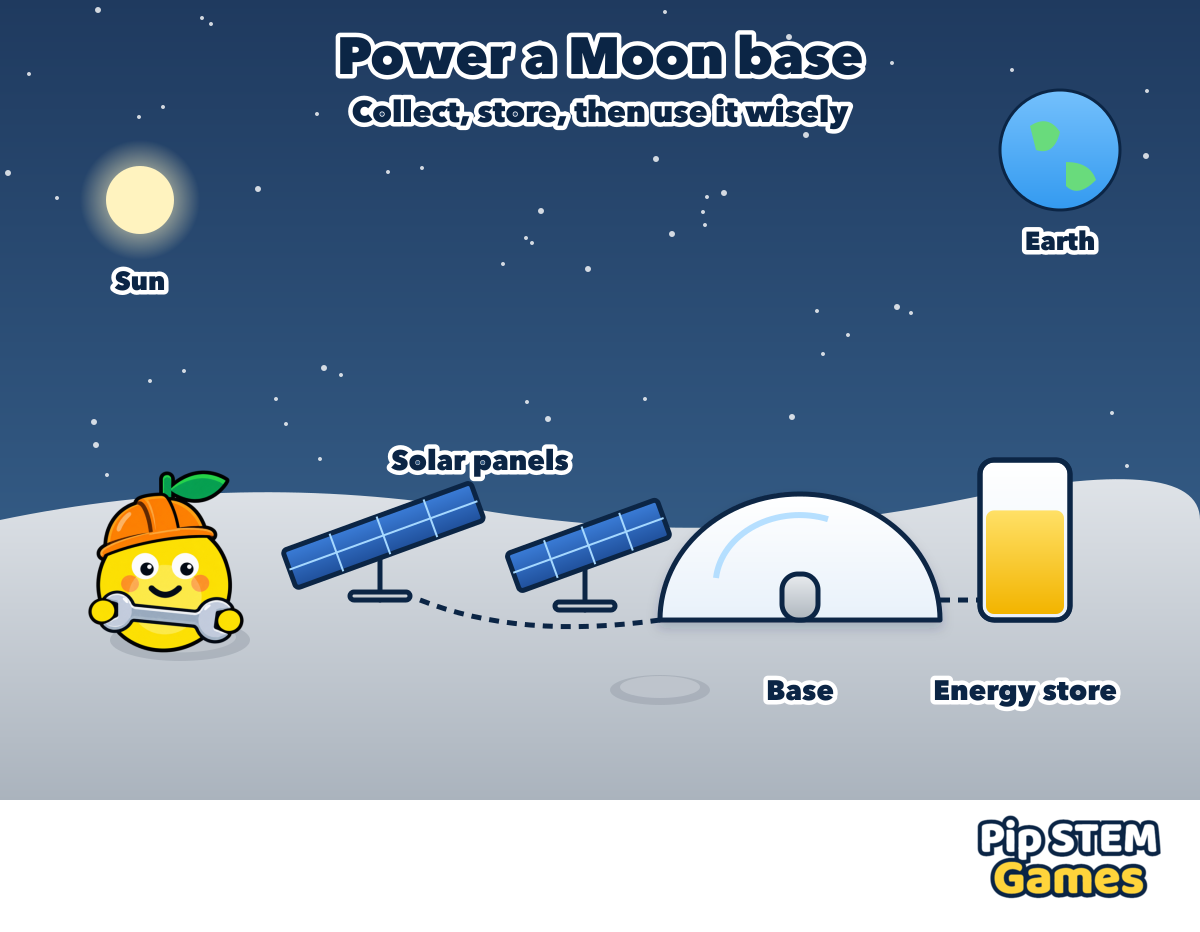
A Moon base needs three things working together. Solar panels collect energy in the light. A store holds energy for the dark. And the crew keeps a careful budget of how much the base uses.
The hard part is the night. The Moon turns very slowly, so one full day and night takes about 29 and a half Earth days. At most places that means about two weeks of sunlight, then about two weeks of dark. A panel can collect plenty for two weeks and then nothing at all for two weeks. The base has to save enough to get through, or find another source.
Near the Moon's south pole there are a few high ridges that stay lit for most of the year. Even there the Sun sits low in the sky and there are still some dark spells, so a store is still needed. The numbers change with where you are, so check them for your chosen spot.
In this activity your child builds a paper model and uses a torch as the Sun. Lentils stand in for energy. It is a model to learn from, not a real design for a Moon base.
What do you need?
- A torch (not a hot, old-style bulb)
- Stiff card, such as a cereal box
- Dark paper or kitchen foil for the panel
- A ruler and a pencil
- Small paper cups or jars for the energy store
- Dried lentils, rice or dry pasta as energy units
- Sticky notes and a marker
- A pile of books to rest the torch on
- The printable energy log
Safety first. This activity uses no mains electricity and no batteries apart from the ones sealed in the torch. Use a torch, not a hot lamp. A grown-up should cut the card. Lentils, rice and pasta are small parts, so watch younger children and keep them away from mouths and noses.
How do you build the model?
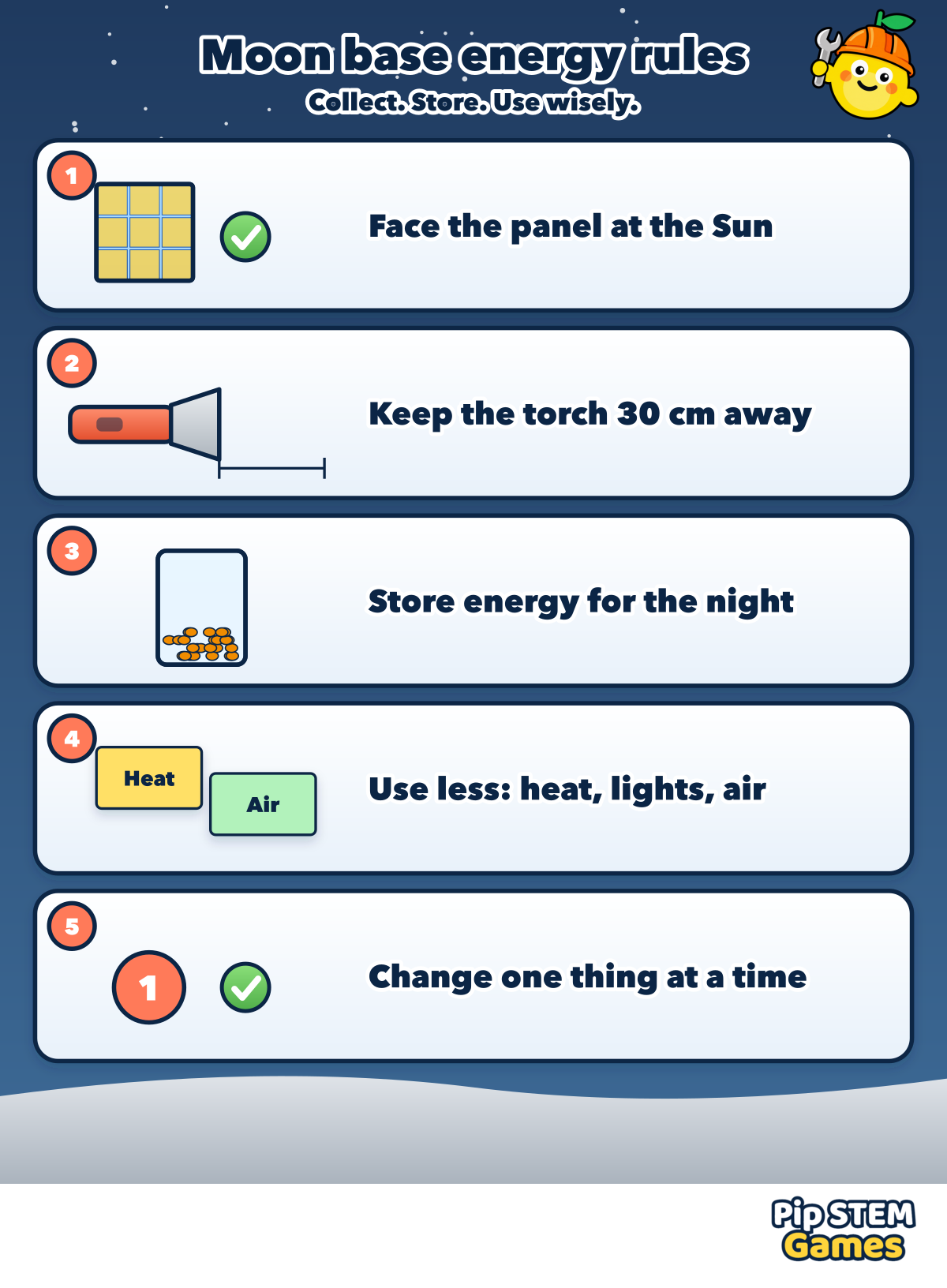
- Predict first. Will the panel collect more when it faces the torch straight on, or when it is tilted away? Write your guess.
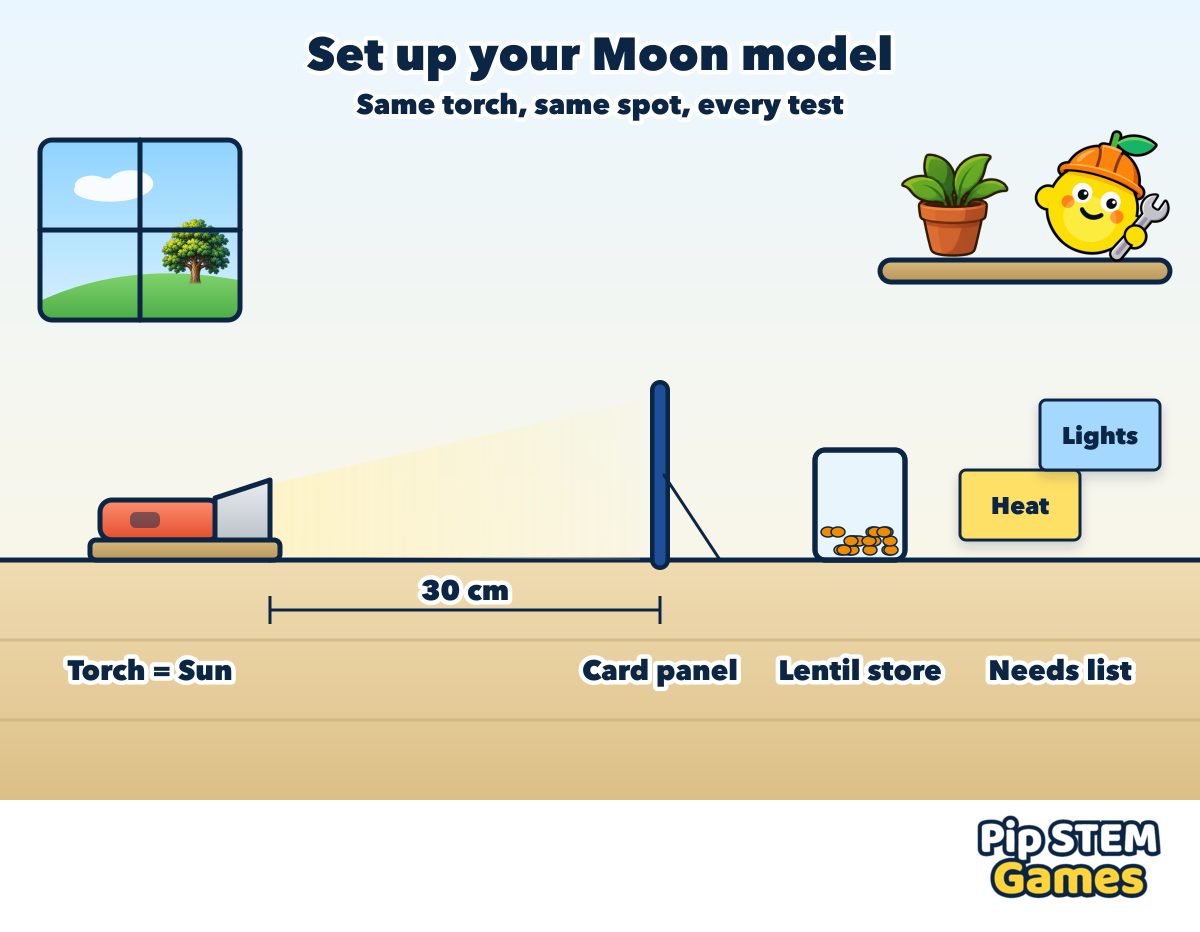
- Make the panel. A grown-up cuts a card rectangle about 10 cm by 15 cm. Cover it with dark paper. Draw a grid of squares on it, 4 across and 4 down.
- Make it stand. Fold a strip of card at the back so the panel can stand up and tilt.
- Set up the Sun. Rest the torch on some books, 30 cm from the panel. Keep it at the same height every time.
- Make a needs list. Write Heat, Lights and Air on three sticky notes. These are what the base must power at night.
How do you test the panel tilt?
- Dim the room and switch on the torch.
- Stand the panel so it faces the torch straight on. Count how many grid squares are lit.
- Tilt the panel back a bit. Count again.
- Tilt it back a lot. Count again.
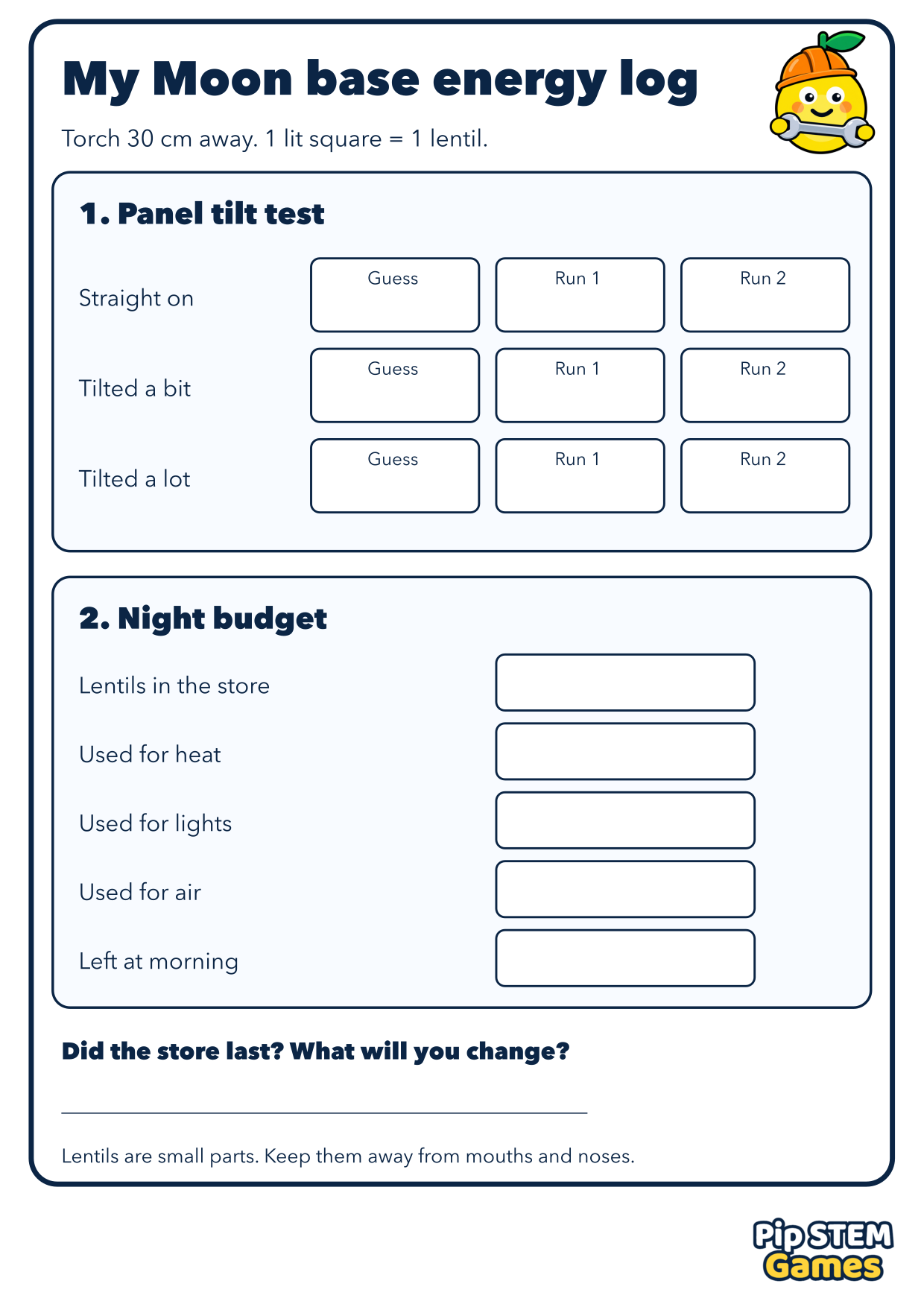
- Write each number in the log. Do each one twice.
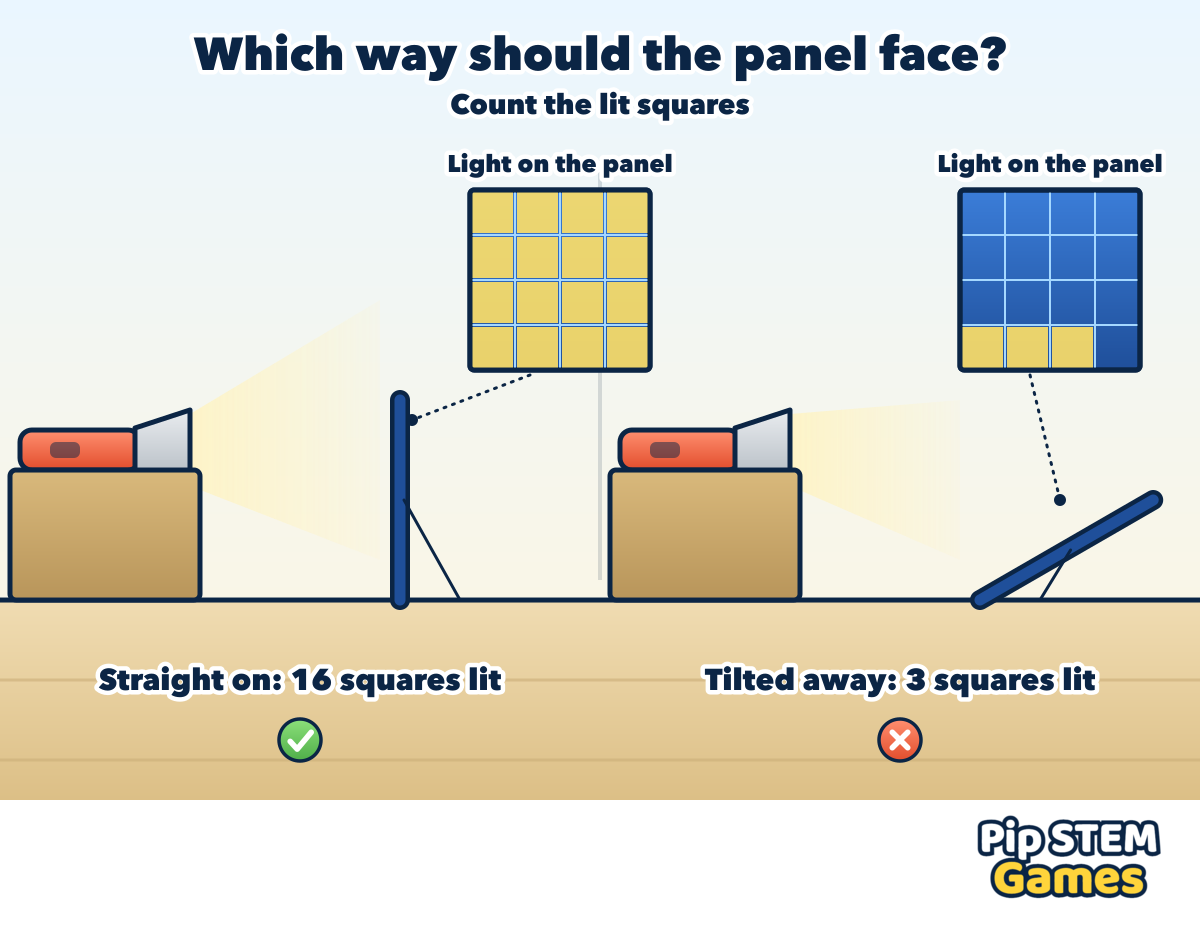
When the panel faces the torch, the beam lands on it square on and lights the whole grid. Tilt it away and the same beam spreads over a slant, so less light falls on each square. Real solar panels on Earth and in space are turned to face the Sun for the same reason. Near the Moon's poles the Sun is low, so panels there stand up tall instead of lying back. Try turning panels to follow the Sun in our solar tracker game, and see more in the solar panel placement puzzle.
How do you run a day and a night?
- Day. Pick a rule: 1 lit square = 1 lentil. With the panel straight on, that is 16 lentils. Do three days and put all the lentils in the store cup.
- Night. Switch the torch off. Now the base needs energy for each night hour.
- For each hour, take 1 lentil for Heat, 1 for Lights and 1 for Air.
- Keep going for the night you chose, for example 12 hours.
- Check. Did the cup last until morning? How many lentils were left?
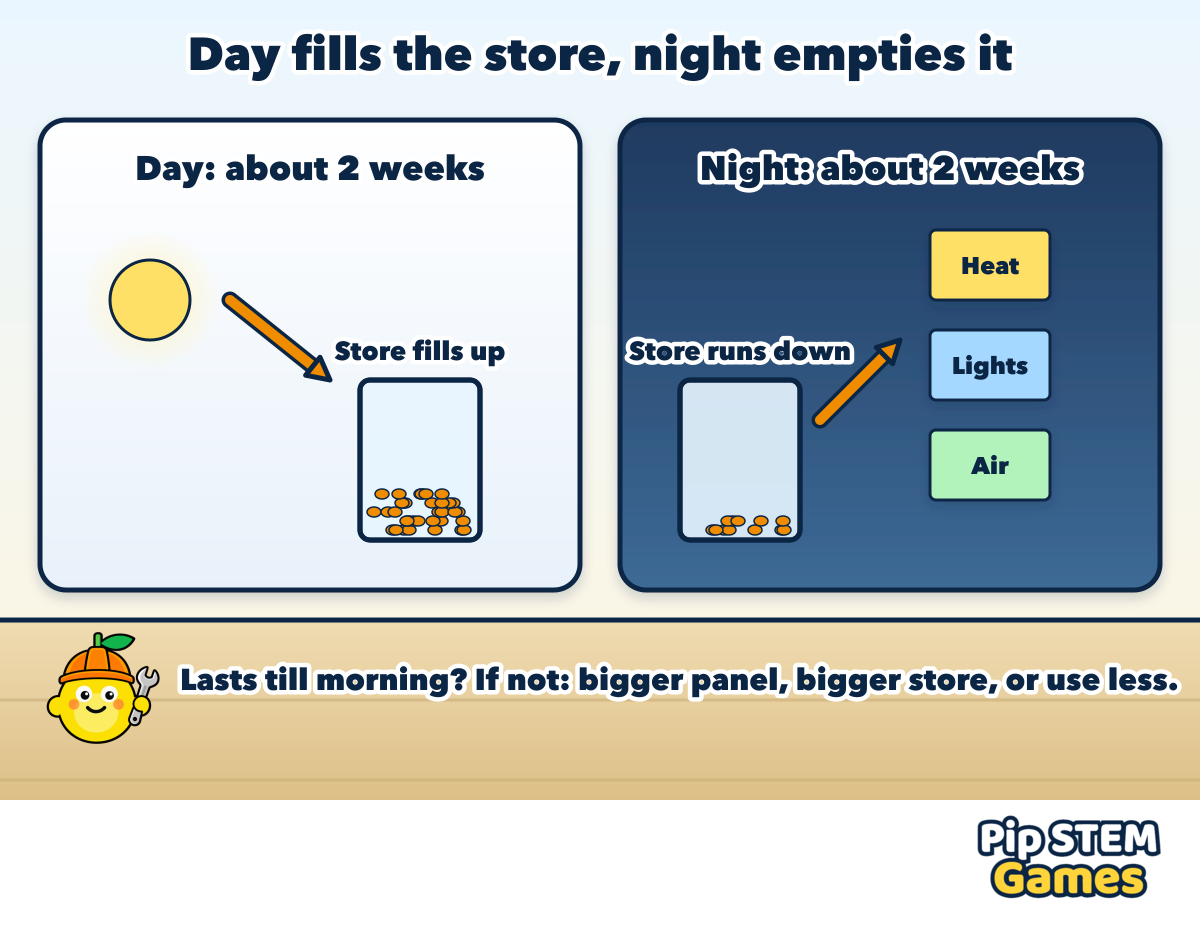
Here is a worked answer. Three days give 48 lentils. A 12-hour night uses 3 lentils an hour, so 36 lentils. That leaves 12 for morning, so the base made it. If the cup runs out early you have three choices: a bigger panel, a bigger store, or using less. Change only one thing and test again. Engineers who build real spacecraft weigh up the same choices, as you can see in how engineers build spacecraft.
What makes it a fair test?
Change one thing at a time: the panel tilt, the panel size or the store size. Keep the torch distance, the torch height and how dark the room is the same. Use the same counting rule every time. Do each test twice. If the two runs disagree, check that the panel did not slip.
What if it does not work?
- The lit patch looks the same: move the torch closer or make the room darker.
- Counting is confusing: draw the grid lines darker, or print a grid and stick it on.
- The cup always runs out: make the night shorter or take one item off the needs list, then explain why you changed it.
- The panel falls over: tape the folded strip to the table.
What is the next test?
Add a second store cup and see if splitting the store helps. Then add a new need, such as a greenhouse light, and work out how much more panel you need. Last, pretend the base is near a pole. Keep the torch low, just above the table, and see how the panel has to stand up to catch the light.
How do you change it for each age? [Printable]
- Ages 5 to 7: just compare more light and less light. Fill and empty the cup together.
- Ages 8 to 10: use the grid, count lentils and fill in the energy log.
- Ages 11 to 12: record results in a table, then draw a graph of lentils left against night length.
Short on room? Try more STEM activities for small spaces.
Questions parents ask
How long is a night on the Moon?
At most places, about two Earth weeks. A full lunar day and night takes about 29 and a half Earth days.
Why not just use solar panels on the Moon?
Panels only work in the light. A base also needs a store to get through the long night, or another energy source.
Are there places on the Moon that are always sunny?
A few high ridges near the south pole are lit for most of the year, but even they have some dark spells.
Why does the panel collect less when it is tilted?
The same beam spreads over a slant, so less light falls on each part of the panel.
Why use lentils?
They are a cheap way to count energy units you can see and hold. Rice or dry pasta work too.
Is this safe?
Yes, with a grown-up nearby. Use a cool torch, let an adult cut the card and keep lentils away from small children’s mouths and noses.
Great STEM activities to try next...
 How Do Engineers Build Spacecraft? [Printable]How it works
 The Solar Panel Placement PuzzleActivity
 STEM Activities for Small SpacesActivity guide
More to try:

Pip STEM Games
We make engineering games and workbooks for kids aged 5 to 12. Every activity here is one we'd happily run at the kitchen table: test it, watch it fail, fix it, try again.




