


Key takeaways
- Real STEM fits on a desk: a paper bridge, a straw tower and a cup ramp need one tray.
- The whole kit is paper, straws, tape, coins, a cup and a marble.
- Clear-up takes about two minutes because everything stays on the tray.
- Change one thing at a time and write every result down.
- Younger children count and predict; older children measure and explain.
STEM activities for small spaces can fit on a desk or a tray. Three challenges, a paper bridge that holds coins, a straw tower that must stand and a cup ramp for a marble, need only a few household items and clear away in about two minutes. A cheat sheet is included.
What do you need for STEM activities in a small space?
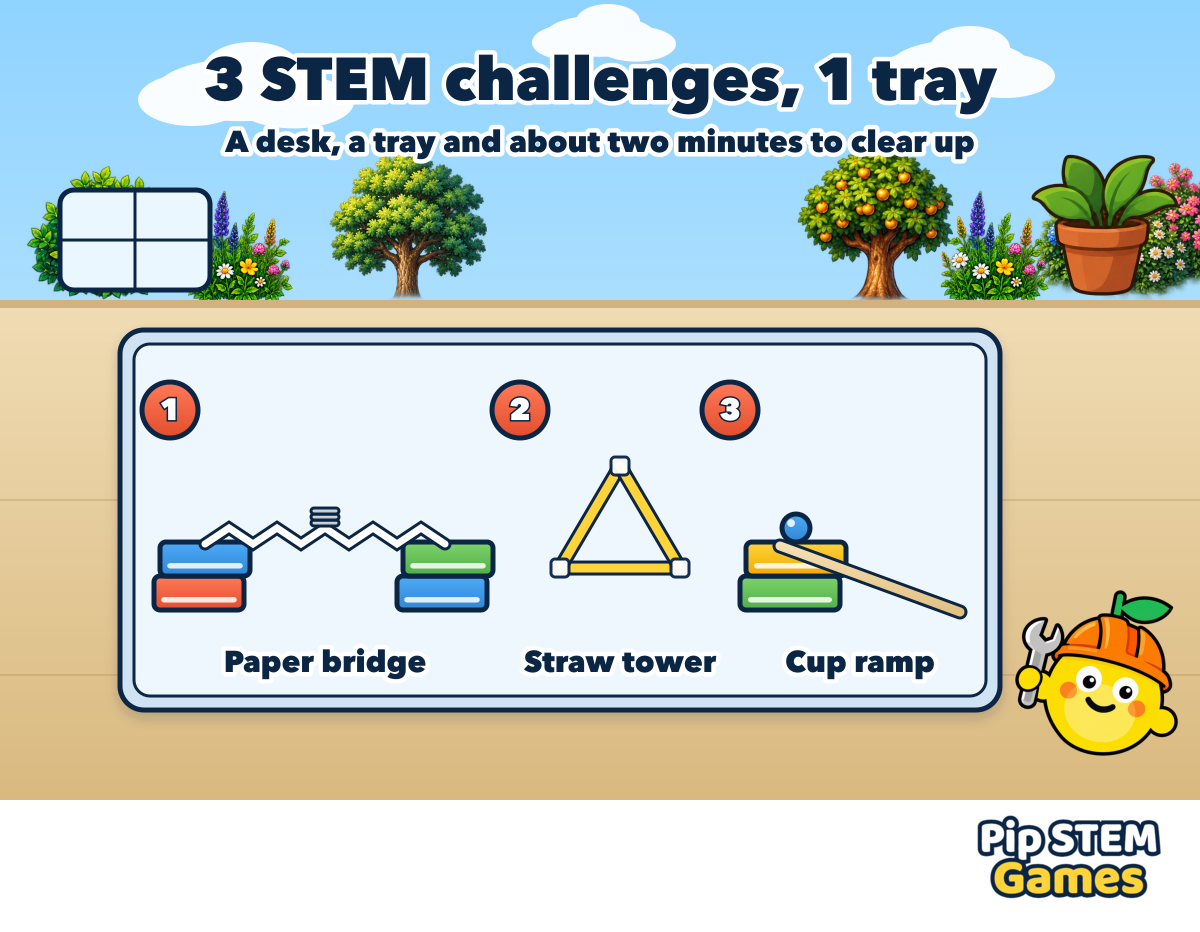
You need very little, and it all fits on one tray. Gather these before you start:
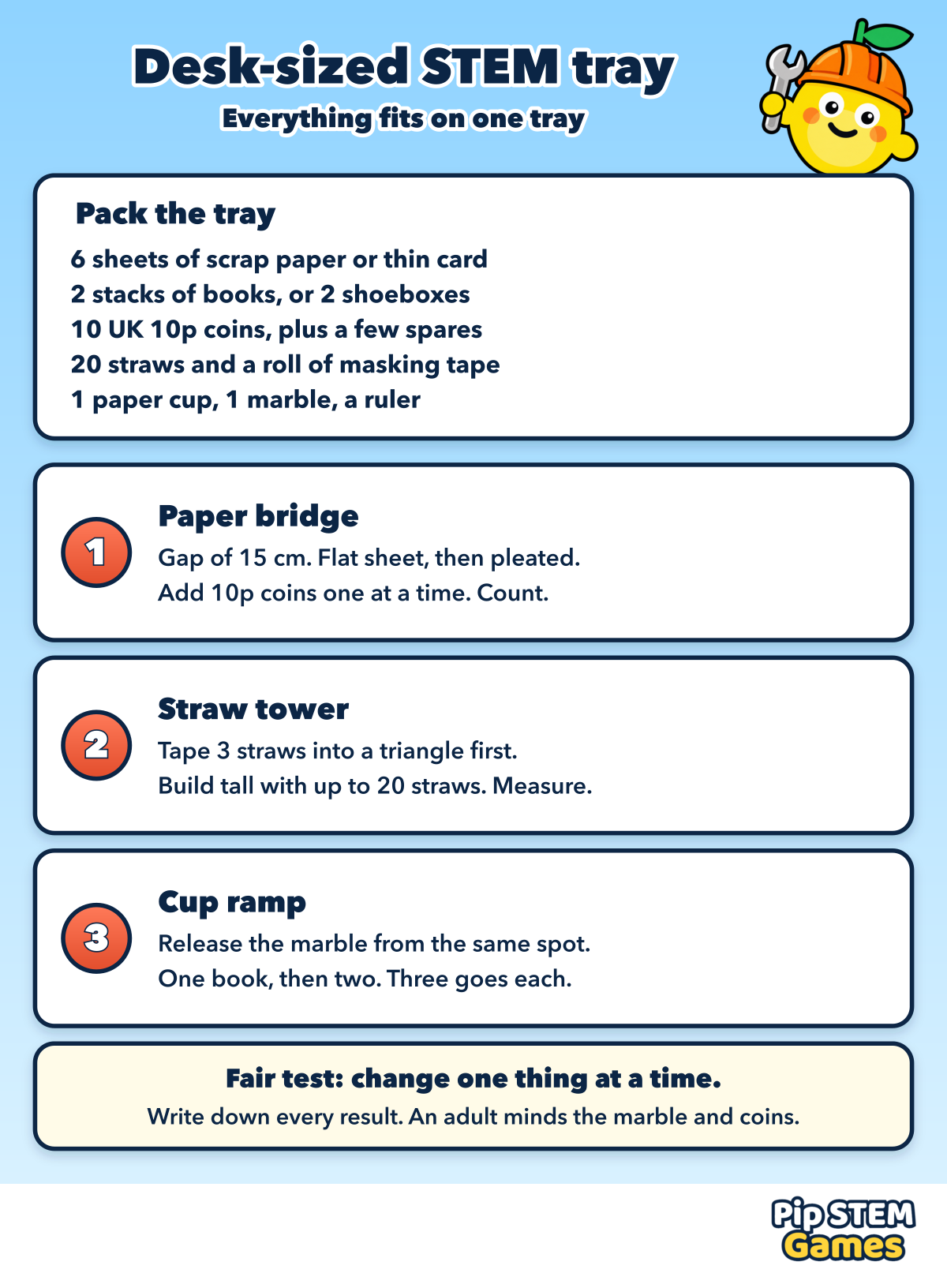
- 6 sheets of scrap paper or thin card
- 2 stacks of books, or two shoeboxes, as bridge supports
- 10 UK 10p coins, plus a few spares
- 20 drinking straws, paper or plastic
- A roll of masking tape
- 1 paper cup
- 1 marble or small ball (a small part, so an adult stays close)
- A ruler, or a paper strip marked in centimetres
- A tray or baking sheet to keep it all in one place
Put the tray on the desk. Everything you build stays on the tray, and clearing up means tipping the scraps into the recycling. That takes about two minutes.
How many coins can a paper bridge hold?
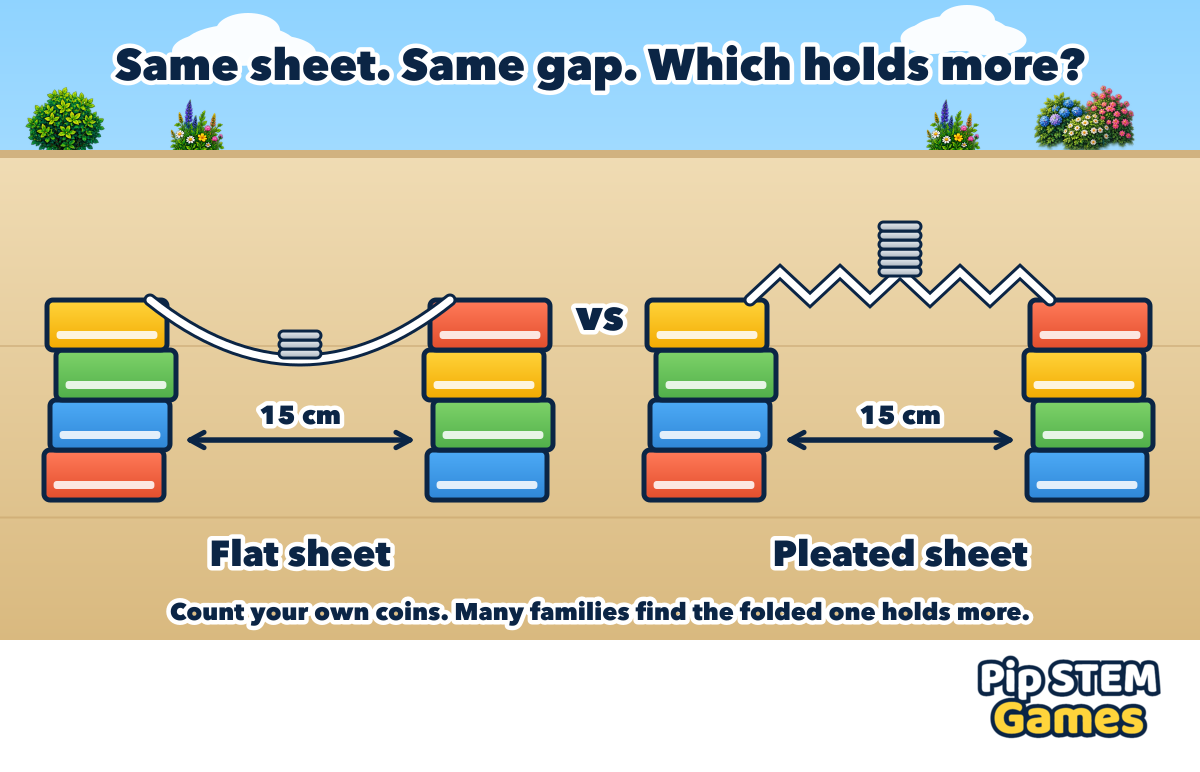
A flat sheet of paper holds very little, but a folded sheet can hold much more. Folding makes the paper stiffer, because the folds stop it bending in one smooth curve.
Predict first. Will a flat sheet or a folded sheet hold more 10p coins? Write the guess down.
- Place two stacks of books 15 cm apart. These are the supports.
- Lay one flat sheet across the gap. Add 10p coins one at a time in the middle until the sheet sags and slips.
- Count the coins and write the number down.
- Fold a new sheet back and forth like a fan. Lay it across the same gap.
- Add coins one at a time again and count.
Your numbers are your own result, so record what you see. Many families find the folded sheet holds more, but don't assume it. Trust the count on your tray. The full version of this test is in our paper bridge challenge, and your child can try the idea on screen in the Bridge game.
Can straws make a tower that stands up?
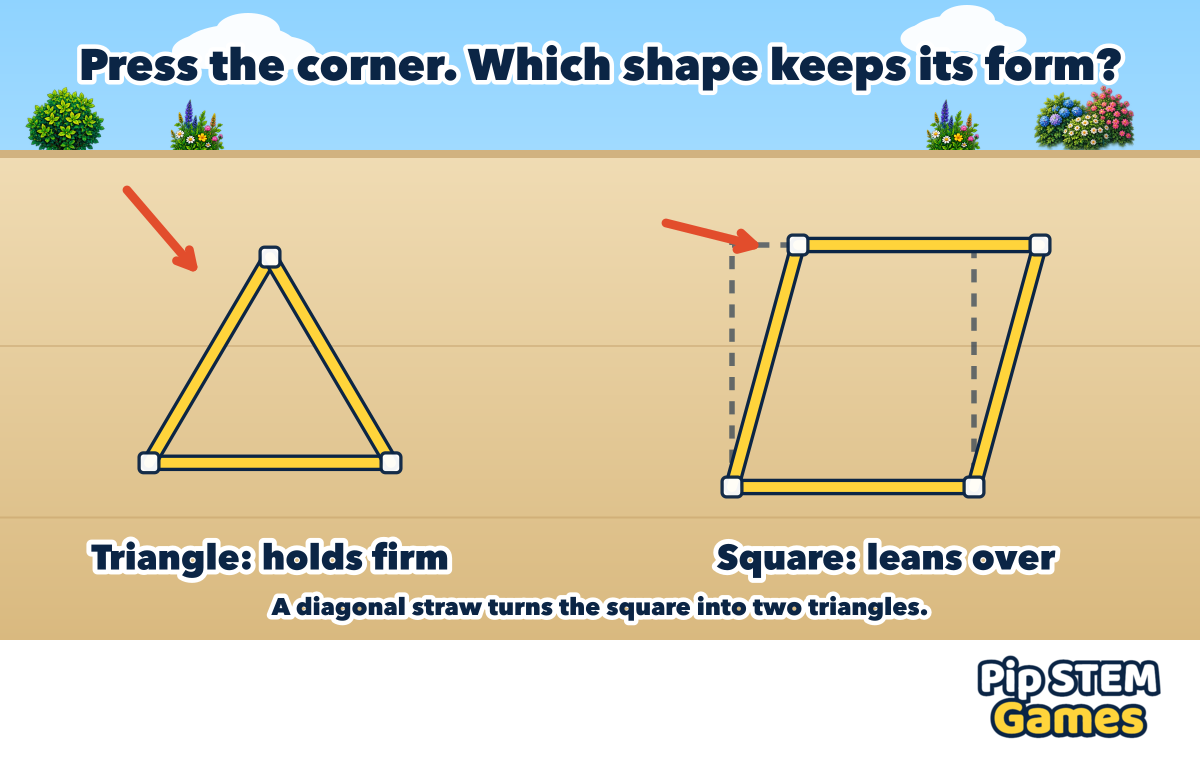
Straws are floppy alone, but a triangle is a strong shape. A square frame can lean over, while a triangle can't change shape unless a side bends or breaks.
- Tape 3 straws into a triangle. Press on a corner and notice how firm it feels.
- Tape 4 straws into a square. Press on a corner and notice how it leans.
- Build the tallest tower you can with up to 20 straws and tape.
- Measure the height to the top with your ruler.
If it falls over, widen the base. Add a diagonal straw to each square section so it becomes two triangles. If you'd like a bigger version, try the spaghetti and marshmallow tower.
How far does a marble roll from a cup ramp?
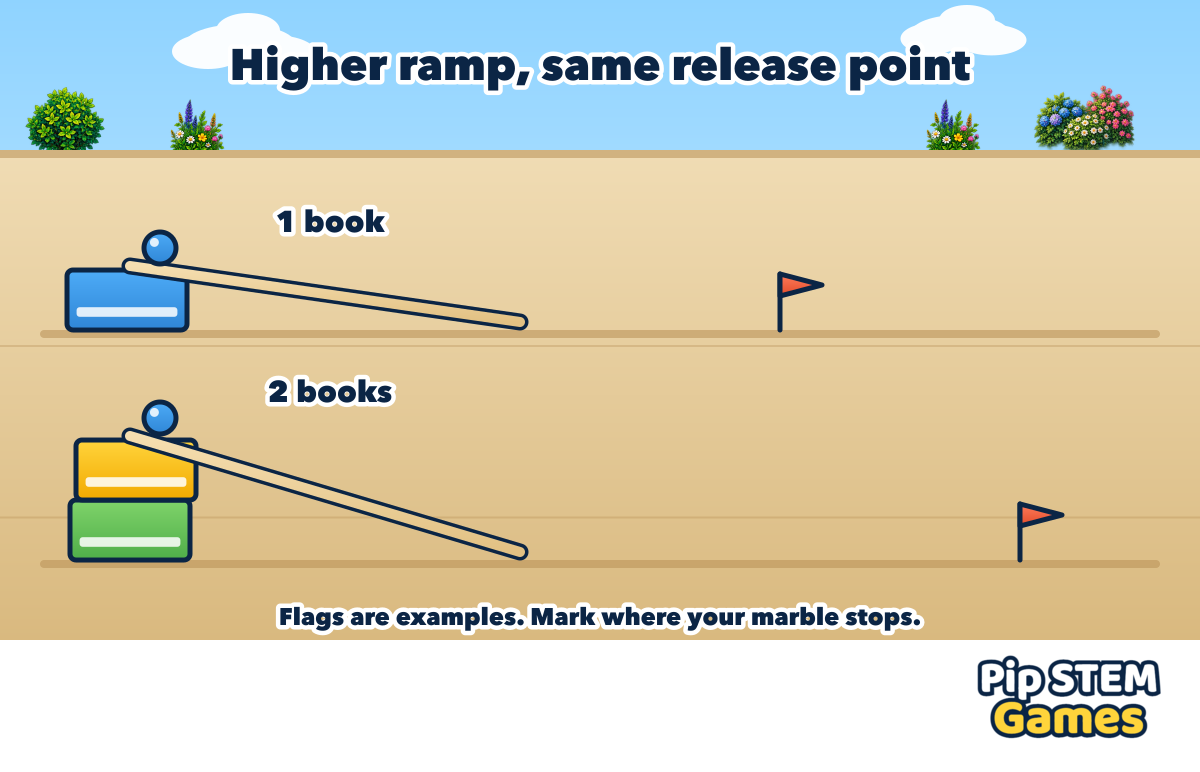
A steeper ramp usually sends a marble faster at the bottom, so it often travels further along the tray. You'll test this rather than just believe it.
- Cut a paper cup open into a curved strip, or use a folded piece of card as the ramp.
- Rest the top of the ramp on one book. Release the marble from the top without pushing it.
- Mark where it stops and measure the distance in centimetres.
- Add a second book to make the ramp steeper and repeat.
An adult should keep the marble in sight, and young children shouldn't put small parts near their mouths. For a screen version, try Ramp Runner.
How do you make it a fair test?
Change only one thing at a time. In the bridge test, use the same gap, the same paper and the same coins. In the ramp test, release the marble from the same point every time and do three runs for each height, then compare the typical distance.
A fair test means a fair comparison, so write down every run, even the odd ones.
What if it doesn't work?
- The bridge slides off: widen the support stacks so more paper rests on each end.
- Tape won't stick to the straws: press firmly and use short pieces.
- The marble rolls off the tray: stand a book on its edge as a stopper at the far end.
- The tower twists: check that the base is flat and add diagonal straws.
What should you try next?
Combine the ideas. Can a folded paper bridge hold your straw tower? Would a straw triangle under the ramp stop it sagging? Pick one question and test it. For more ideas that need no kit, see STEM activities for kids.
How do you adapt this for different ages?
For ages 5 to 6, do one challenge at a time and count coins together. For ages 7 to 9, add predictions and measuring with a ruler. For ages 10 to 12, ask for a table of results, three runs each, and an explanation of why a fold or a triangle helps. Keep an adult close by for small parts at every age. You can also print the Engineering Workbook for Junior Engineers for extra puzzles.
Questions parents ask
What are good STEM activities for small spaces?
A paper bridge, a straw tower and a cup ramp all fit on a desk or tray and need only paper, straws, tape, coins, a cup and a marble.
How long does clear-up take?
About two minutes. Everything stays on the tray, so you tip the scraps into the recycling and put the tray away.
Why are triangles strong?
A triangle can only change shape if one of its sides bends or breaks, while a square frame can lean over. Adding a diagonal to a square makes two triangles.
Is the marble safe for young children?
A marble is a small part. An adult should supervise and keep it away from children who still put things in their mouths.
Which challenge suits ages 5 to 6?
The paper bridge, with an adult helping and the family counting coins together. Do one challenge at a time.
What if I don't have 10p coins?
Any small identical objects work, as long as you use the same ones every time and add them gently one at a time.
Great STEM activities to try next...
 Paper Bridge Challenge: Build a Bridge From One Sheet of Paper [Printable]Build challenge
 Spaghetti and Marshmallow Tower: How to Build the Tallest One [Printable]Build challenge
 12 Easy STEM Activities for Kids to Try at Home (Ages 5 to 12)By age
More to try: 15 STEM Challenges for Kids (Easy, Cheap) · 8 STEM Activities for KS2 (Year 3 to Year 6) · 5 Low-Mess STEM Activities for Your Kitchen Table

Pip STEM Games
We make engineering games and workbooks for kids aged 5 to 12. Every activity here is one we'd happily run at the kitchen table: test it, watch it fail, fix it, try again.




