

Key takeaways
- You can run five real STEM challenges with paper, coins, a pencil and a bit of card.
- None of them needs glue, water or a big clear-up.
- Predict first, then test, then write the result down.
- Change one thing at a time, and repeat each test three times.
- Younger children count coins; older children make tables and explain why.
Low-mess STEM activities for your kitchen table need only paper, coins, a pencil and a bit of card. These five cover strong shapes, folding, patterns, gears and ramps, with no glue, no water and no big clear-up. Each takes about ten minutes.
1. Paper tubes: which shape holds the most coins?
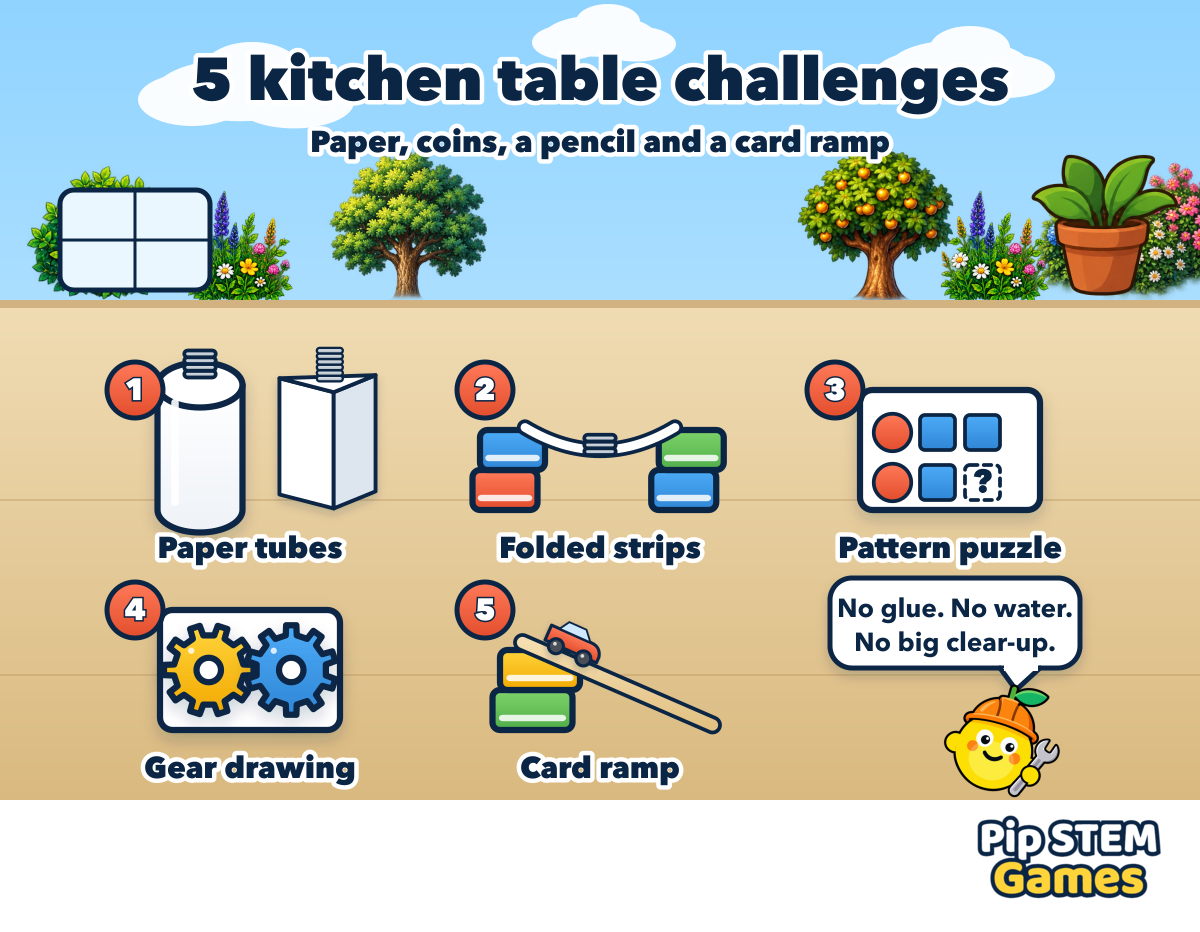
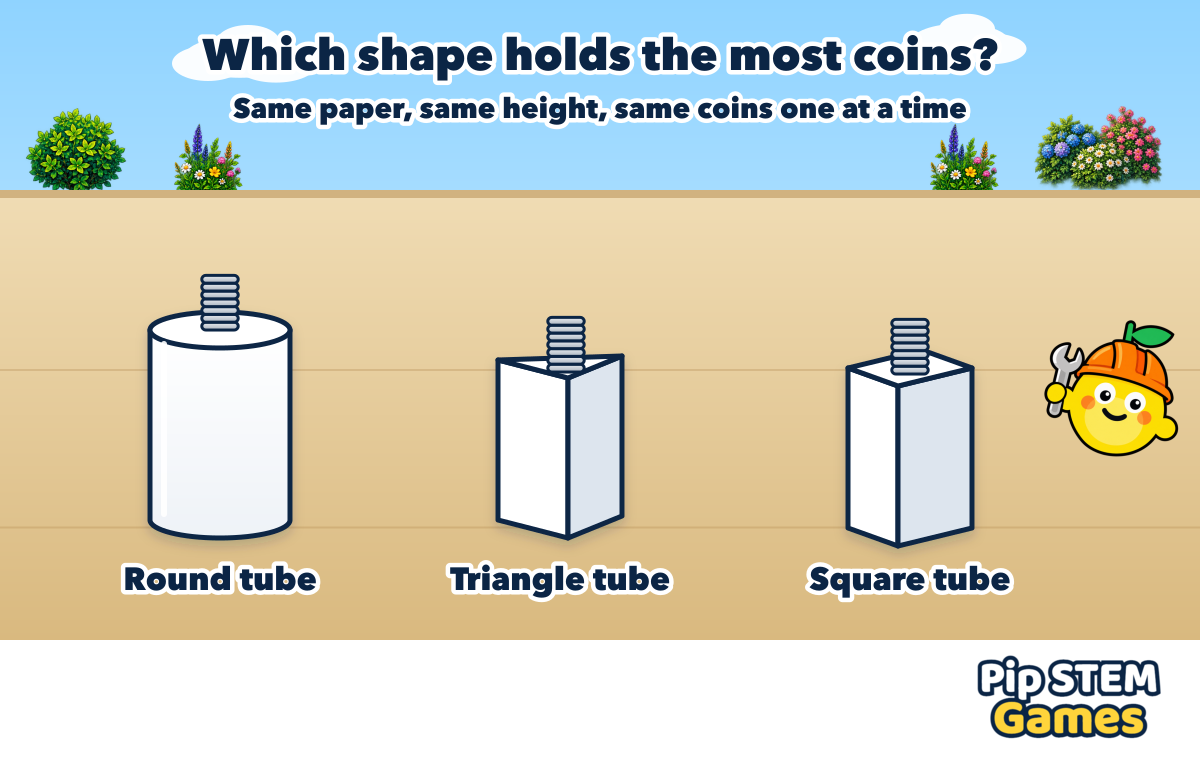
Round, triangle and square tubes can all stand up. Which one carries the most weight before it bends? Predict first, then count.
- Roll one sheet of paper into a round tube and tape the seam.
- Fold a second sheet into a triangle tube and a third into a square tube. Make all three the same height.
- Stand each tube on the table. Guess which shape will hold the most coins.
- Add UK 10p coins to the top, one at a time and gently. Count how many each tube holds before it bends.
Tubes and corners usually hold more than a flat sheet because the weight is shared around the edges. Your own count is the result that matters, so write it down.
2. Folded strips: does folding make paper stronger?
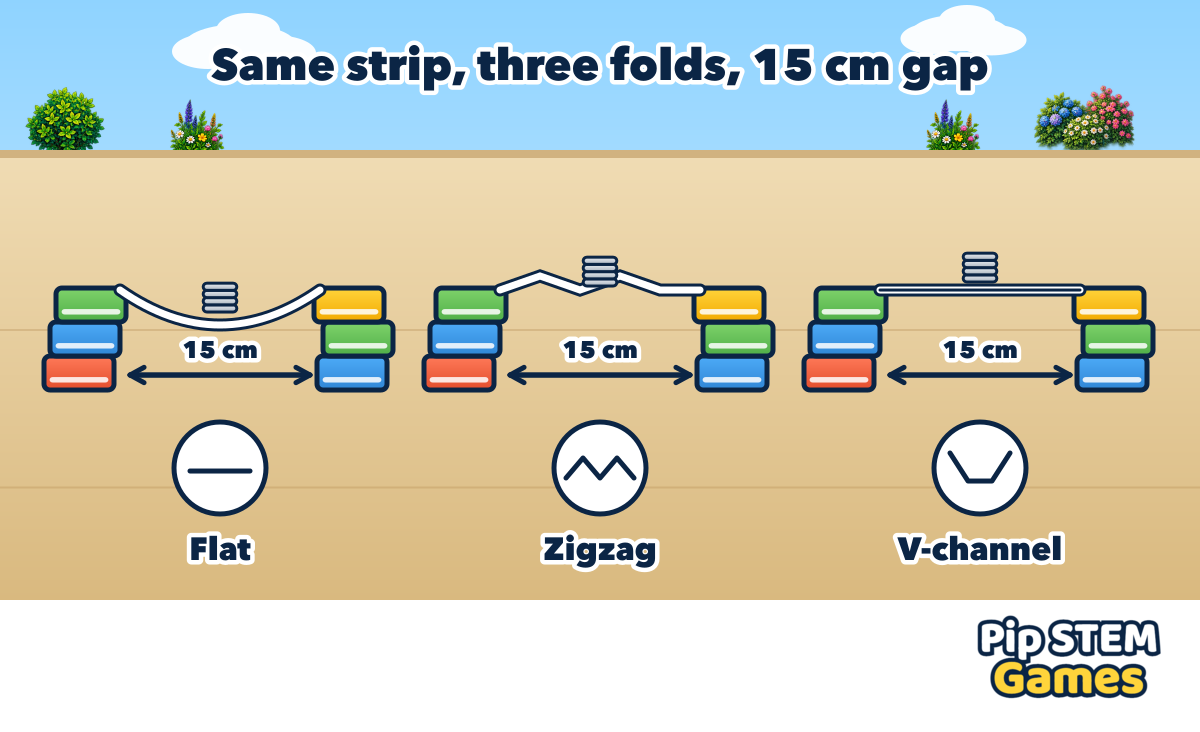
A flat strip of paper sags in the middle. A folded one often doesn't. This test shows why engineers fold, ribbed and channel their materials.
- Cut three strips of paper the same width and length.
- Leave one flat. Fold one into a zigzag. Fold one into a V-channel.
- Rest each strip between two stacks of books about 15 cm apart.
- Add 10p coins in the middle, one at a time, until the strip sags. Write down the count for each.
Folding adds depth to the strip, and depth usually makes it stiffer. Look at the end view of each strip in the picture: the folded ones have paper up high and down low, not just in one flat line. For a full version of this test, try the paper bridge challenge.
3. Pattern puzzles: what comes next?
Pattern puzzles need only a pencil. They train the habit of spotting a rule and checking it.
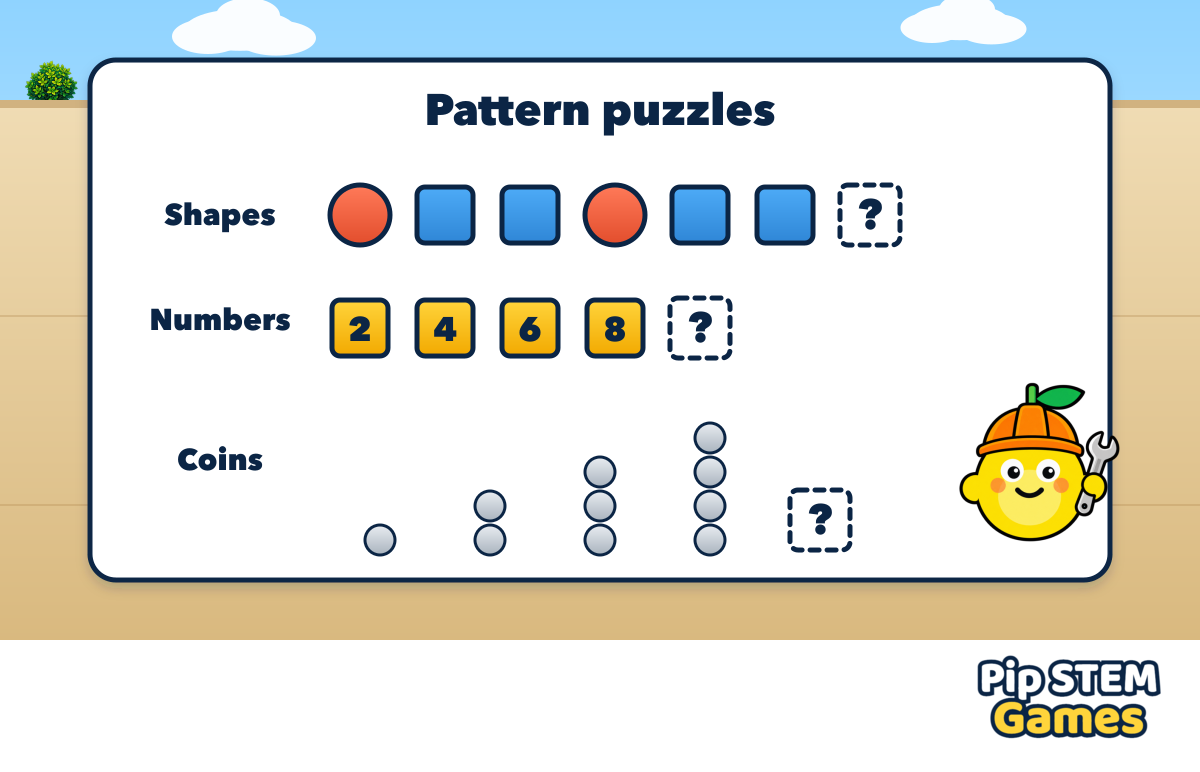
- Draw a row: circle, square, square, circle, square, square, then a gap.
- Ask what comes next, and how they know.
- Swap roles. Your child invents a pattern and you solve it.
- Try number patterns such as 2, 4, 6, 8, and a coin pattern in columns of 1, 2, 3, 4.
The next shape is a circle, because the group of three repeats. The next number is 10, and the next coin column has 5. The question "how do you know?" matters more than the answer, so ask it every time.
4. Gear drawing: which way does the last gear turn?
You don't need real gears for this one. A drawing and a pencil are enough.
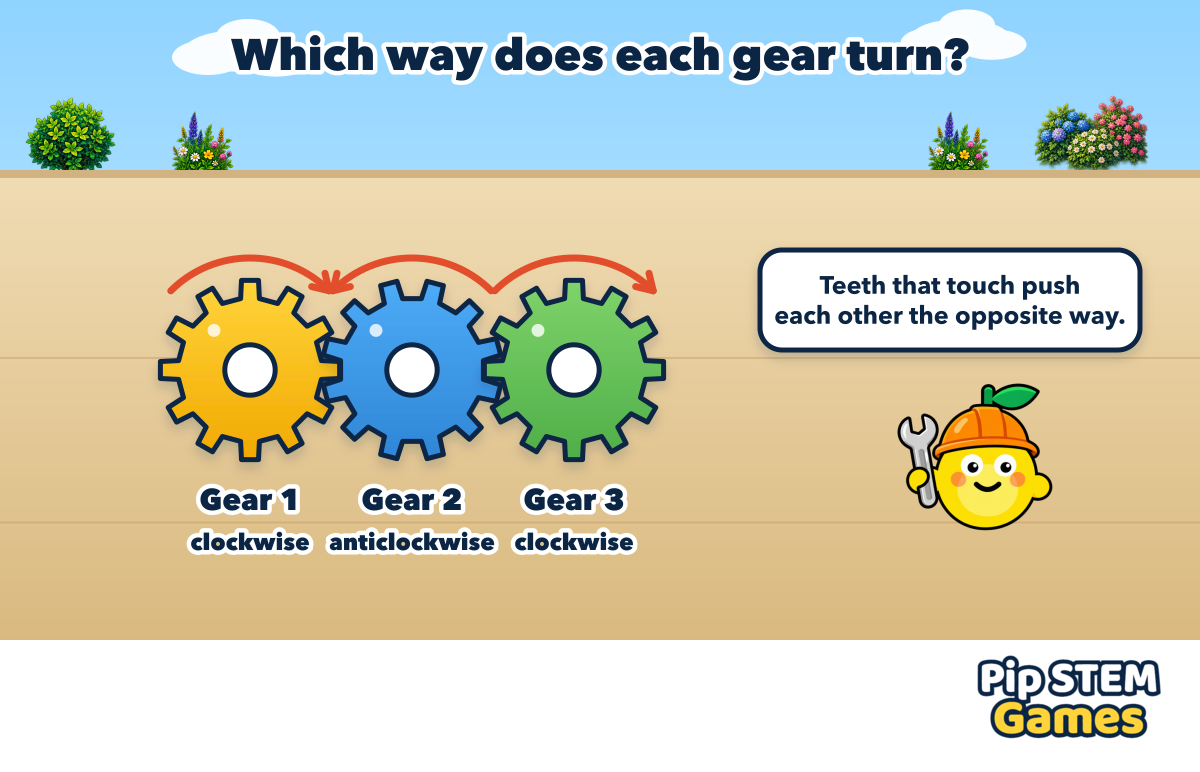
- Draw three circles in a row so each one touches the next. Add small teeth.
- Mark gear 1 with an arrow turning clockwise.
- Ask which way gear 2 turns. Then ask about gear 3.
- Trace each arrow with a finger to check.
Meshed gears turn opposite ways, so gear 2 turns anticlockwise and gear 3 turns clockwise again. This is a drawing activity, a model of how gears work and not a working machine. For more, try the four gear direction challenge or the gears game.
5. Card ramp: what does height change?
A ramp is an easy way to see how a small change gives a different result.
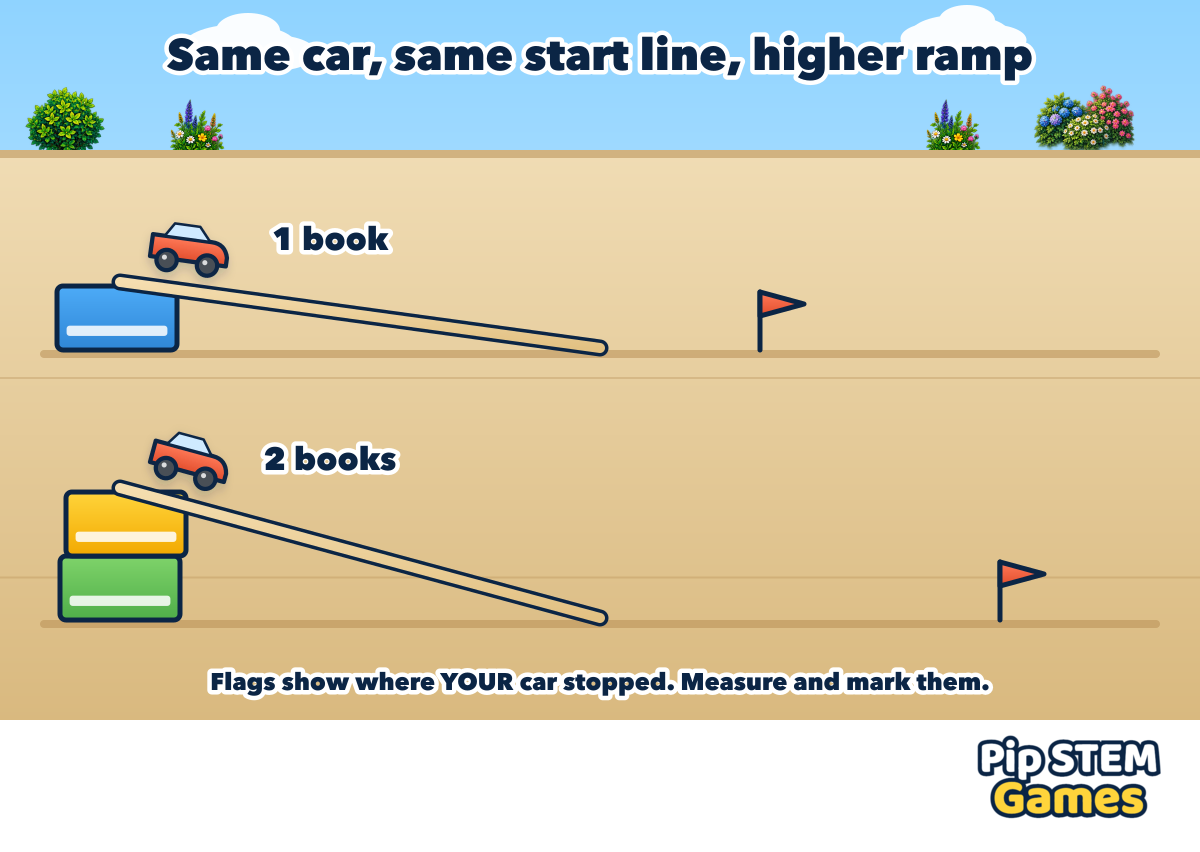
- Prop a stiff piece of card, such as the side of a cereal box, on one book to make a ramp.
- Release a small toy car from the same start line each time. Mark where it stops.
- Add a second book and repeat. Then try a third.
- Do three goes at each height and write down every result.
A steeper ramp usually sends the car further, but the surface and the start point change the result, so keep them the same. Our Ramp Runner game lets your child try the same idea on screen.
What do you need for low-mess STEM activities at the kitchen table?
You need things most homes already have: printer or scrap paper, a ruler, a pencil, sticky tape, six to ten UK 10p coins and a stiff piece of card. Add a small toy car and a few books. A timer helps. Put a tray or placemat down and you're ready.
The coins are the only small parts, so keep them away from children under six, and let an adult hand them out.
How do you make it a fair test?
Change one thing at a time. For the ramp, change only the height. For the strips, keep the width, length and gap the same. Repeat each test three times and write down every result, not just the best one.
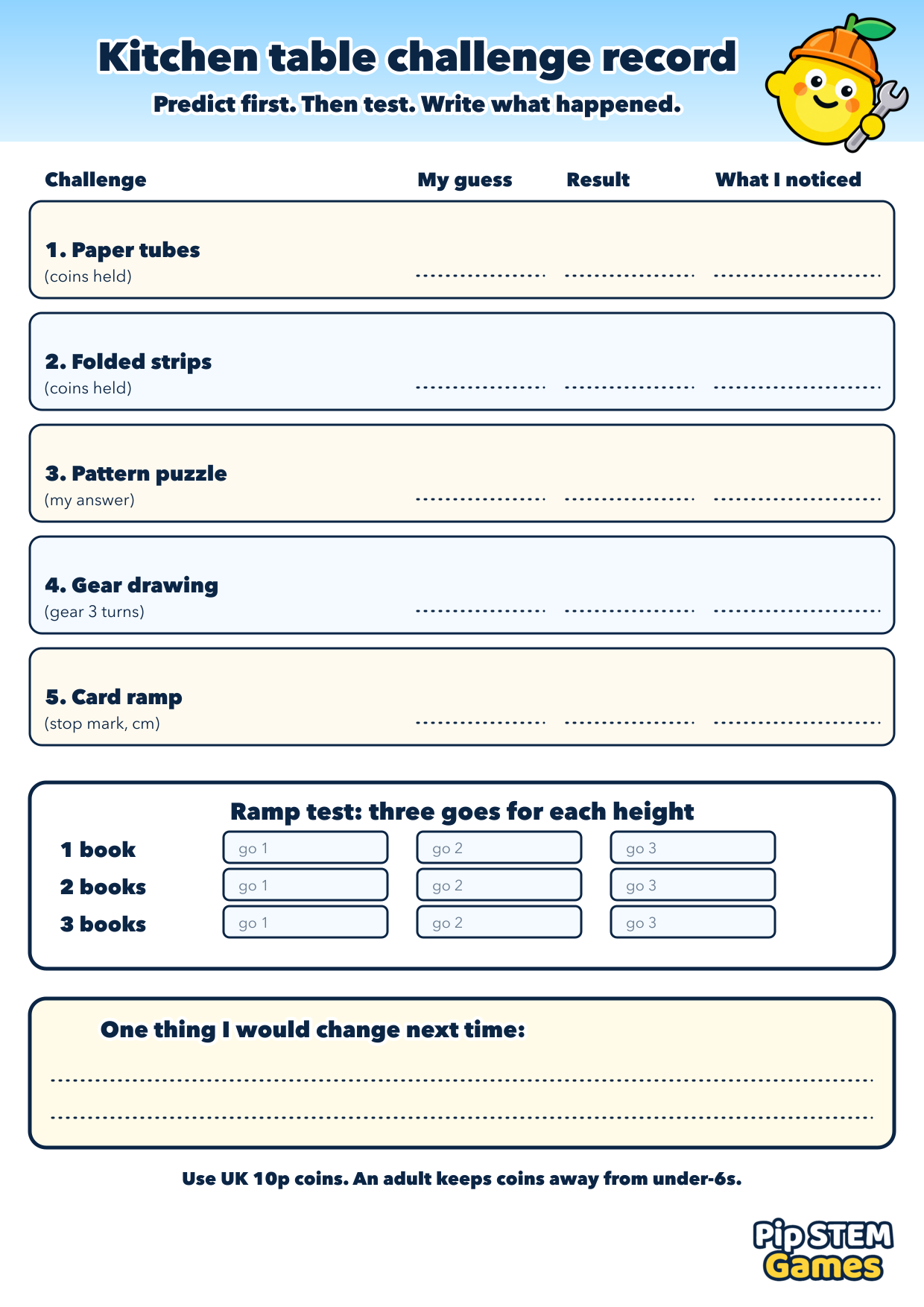
The printable record sheet below has a row for every activity and a grid for the ramp goes.
What if the results look odd?
- Towers topple: check the table is steady and place the coins in the centre.
- Strips tear: use thicker paper or add a second fold.
- The car veers: lay the ramp flat and straight.
- Results jump around: repeat more times and note the spread.
Odd results are useful. They tell you something in the test changed, and finding it is real engineering.
How do you adapt these activities for different ages?
For ages 5 to 7, focus on predicting and counting coins together. For ages 8 to 10, add a results table and averages. For ages 11 to 12, ask them to explain the results with words like load, stiffness and friction. More ideas by age are in STEM activities by age.
What should you test next?
Try a longer tube, a different weight of paper, a four-gear drawing, or a strip of carpet on the ramp. Ask your child to predict before each change. For more no-kit ideas, see 5 STEM activities for kids with no special kit, or print the Engineering Workbook for Junior Engineers.
Are these activities safe?
An adult should supervise coins and any small parts for young children, and keep scissors blunt and child-safe. Everything else here is paper and card.
Questions parents ask
What are good low-mess STEM activities for kids?
Paper tube strength tests, folded paper strips, pattern puzzles, gear drawings and card ramps all need only paper, coins, a pencil and a toy car. None needs glue or water.
How long do these activities take?
Each one takes about ten minutes, so you can do one at a time or all five over a rainy afternoon.
Do I need special equipment?
No. Paper, a ruler, tape, a few books, UK 10p coins, a stiff piece of card and a small toy car are enough.
Which activity suits younger children?
Pattern puzzles and coin counting on the paper tubes work well for ages 5 to 7. Older children can add tables and explain results.
Why does folding make paper stronger?
Folding gives a strip depth, and depth usually makes it stiffer. A flat strip sags in the middle, but a folded one keeps more paper up high and down low.
Is it a real gear machine?
No. The gear activity is a drawing that models how meshed gears turn in opposite directions. It is not a working machine.
Great STEM activities to try next...
 Paper Bridge Challenge: Build a Bridge From One Sheet of Paper [Printable]Build challenge
 Can One Sheet of Paper Hold 20 Coins?Activity
 12 Easy STEM Activities for Kids to Try at Home (Ages 5 to 12)By age
More to try:

Pip STEM Games
We make engineering games and workbooks for kids aged 5 to 12. Every activity here is one we'd happily run at the kitchen table: test it, watch it fail, fix it, try again.




