

Key takeaways
- Paper, foil, cardboard, tape and a torch are enough for five real STEM tests.
- Every activity has the same loop: guess, test, change one thing, test again.
- Folding paper into a zigzag usually makes a stronger bridge than a flat sheet.
- Repeat each test three times so one lucky try does not decide the answer.
- Coins and foil are small parts, so an adult should supervise younger children.
These are 5 STEM activities for kids that need no special kit: a paper bridge, a shadow tower, a foil boat, a paper plane and a cardboard ramp. Each one has a guess, a fair test and a next challenge, and everything comes from the recycling bin and the kitchen drawer.
1. Paper bridge
Ages 5 to 12, about 15 minutes. Fold a sheet of paper and see how many 10p coins it can carry.
- 2 sheets of A4 paper
- 2 stacks of books, set 15 cm apart
- About 10 UK 10p coins
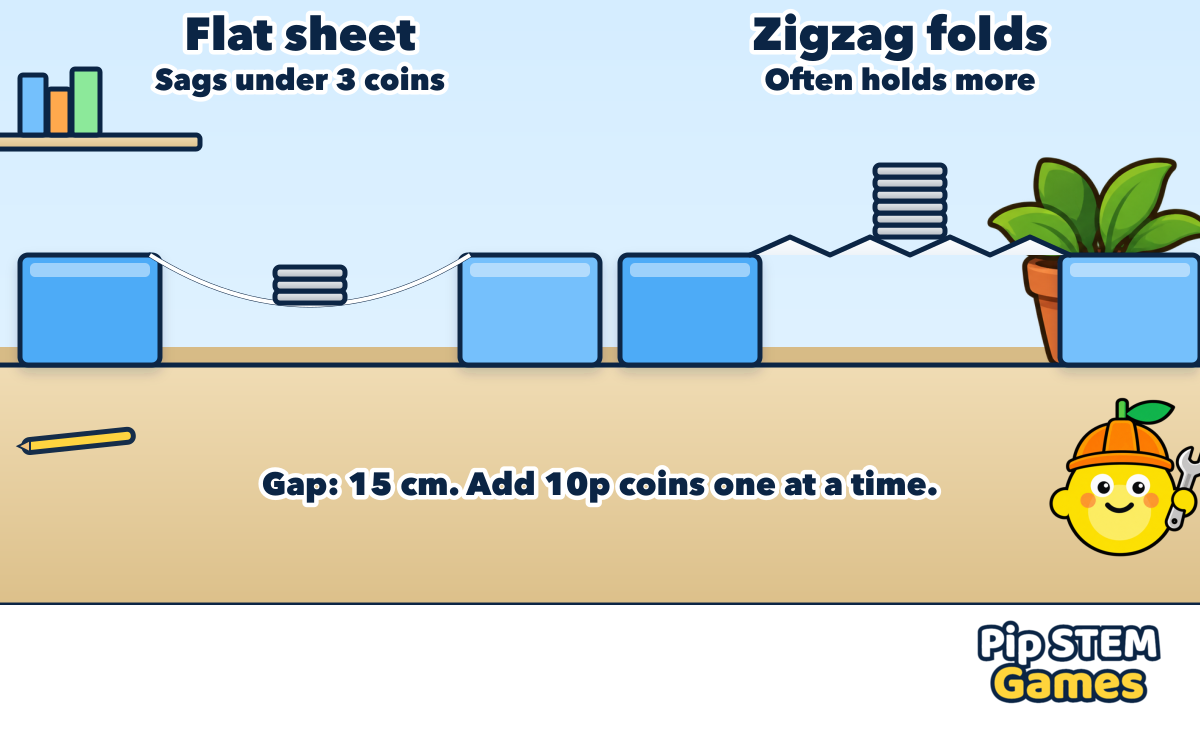
- Lay one flat sheet across the gap and guess how many coins it will hold.
- Add coins one at a time in the middle until it sags into the gap. Write down the number.
- Fold the second sheet into a zigzag, like a fan, and test it the same way.
- Compare the two numbers. Folding makes the paper stiffer, so it usually holds more, but trust your own count.
Want the full version? Read our paper bridge challenge.
2. Shadow tower
Ages 5 to 12, about 10 minutes. Build a tower of cups and change the height of the light to change the shadow.
- 4 paper cups
- A torch, or a sunny window
- A ruler
- Stack the cups on a table in a dim room.
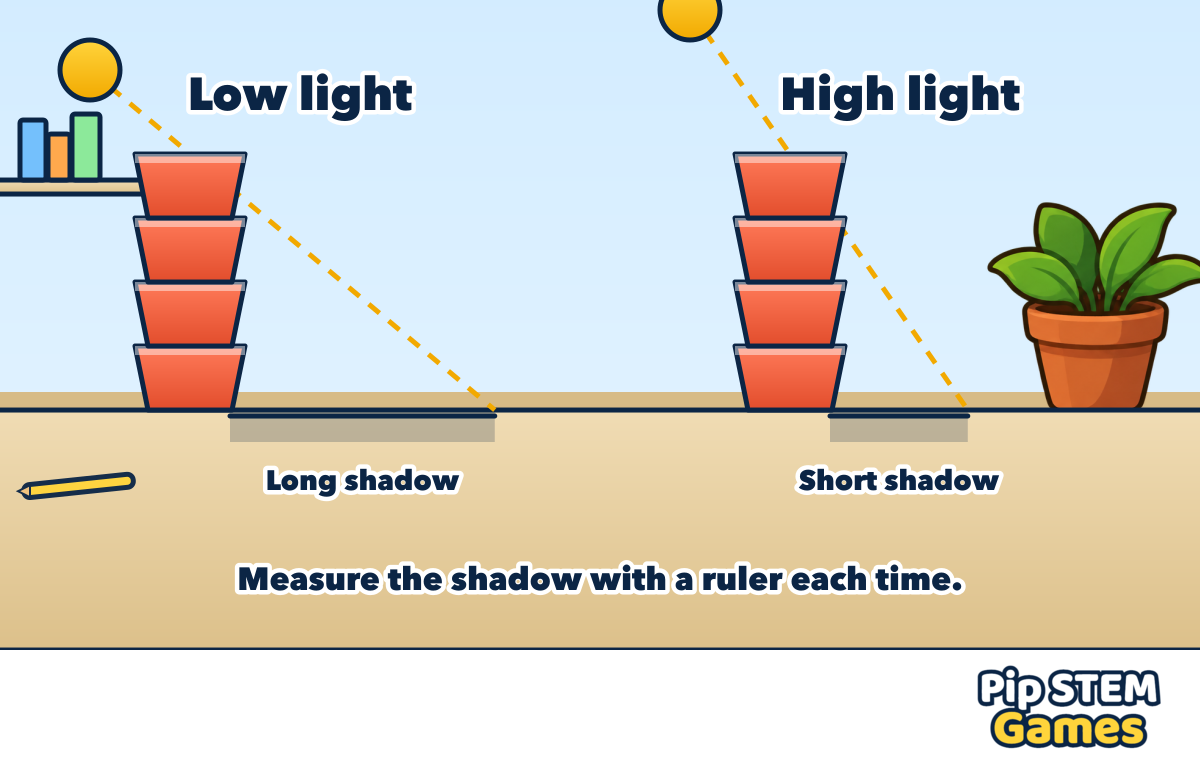
- Hold the torch low and to one side. Guess how long the shadow will be, then measure it.
- Raise the torch higher and keep it the same distance from the tower. Measure again.
- Compare. A lower light makes a longer shadow.
3. Foil boat
Ages 5 to 12, about 15 minutes. Shape a sheet of foil into a boat and see how many coins it carries before it sinks.
- Two squares of kitchen foil, about 15 cm wide
- A washing up bowl of cool tap water
- 10p coins
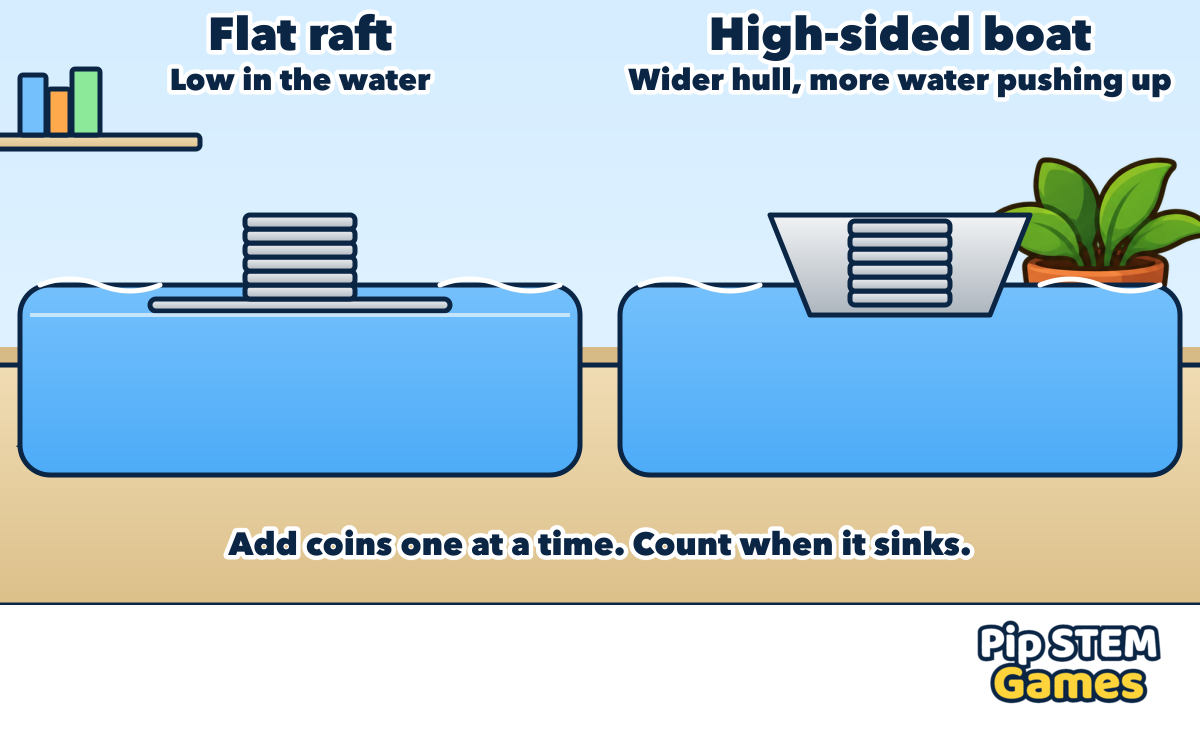
- Fold one square into a flat raft and the other into a boat with raised sides.
- Float the raft and guess how many coins it will hold.
- Add coins one at a time, spread out evenly, until it sinks. Count them.
- Test the high-sided boat the same way. A wider hull usually holds more.
Wipe up spills so nobody slips. For a bigger build, try a boat that actually floats.
4. Paper plane
Ages 5 to 12, about 15 minutes. Make two paper planes that differ by one fold and see which flies further.
- 2 sheets of A4 paper
- A ruler or tape measure
- A clear space with nothing breakable
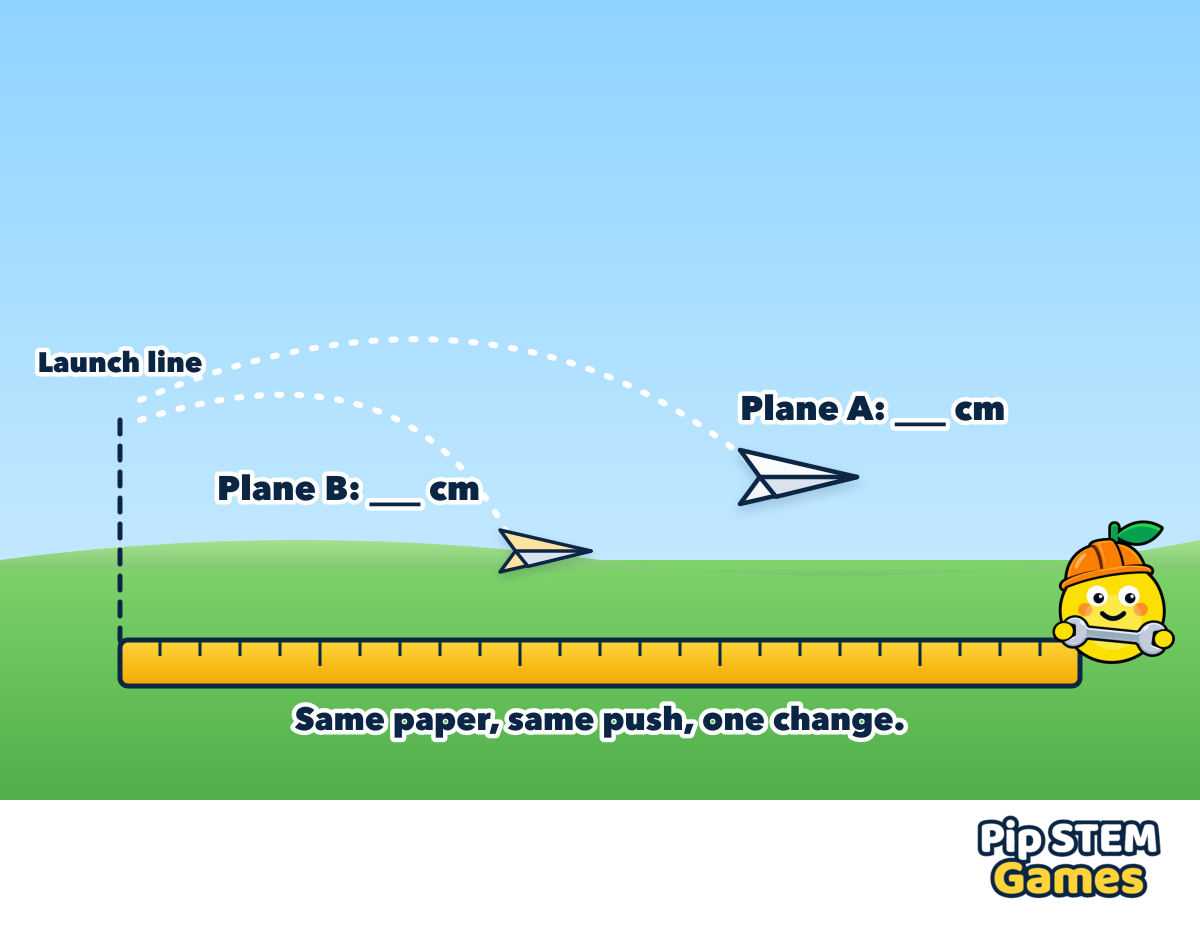
- Fold two planes the same way, but change one thing, such as the wing fold.
- Launch both from the same line with the same gentle push.
- Measure to where each lands. Throw three times and compare the middle result.
- If a plane dives, bend the back edges up a little and try again.
You can test your own designs in the Paper Plane Lab game.
5. Cardboard ramp
Ages 5 to 12, about 10 minutes. Prop up a ramp and measure how far a toy car rolls past the end.
- A flat piece of cardboard
- A stack of books
- A toy car and a ruler or tape measure
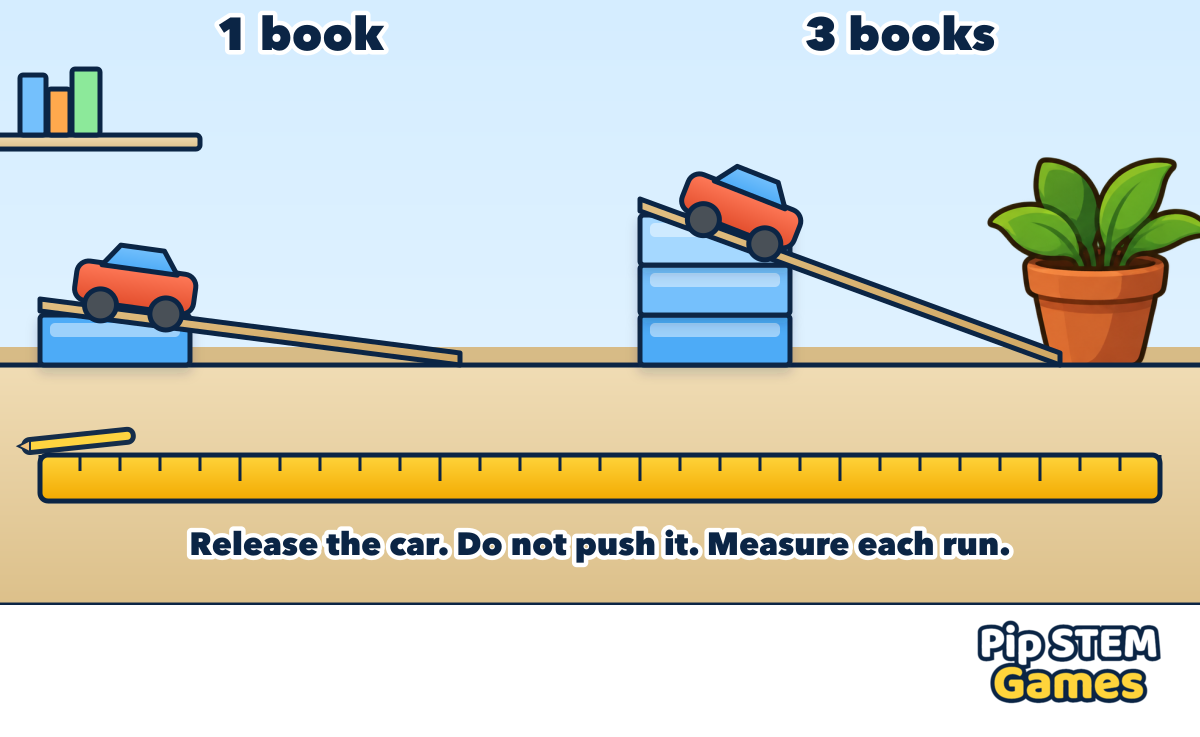
- Rest the cardboard on one book to make a ramp.
- Guess how far the car will roll past the end of the ramp.
- Let go of the car without pushing it and measure. Do this three times.
- Add a book and repeat. A steeper ramp usually gives a faster car, but check your own measurements.
How do we make these a fair test?
Change one thing at a time and keep everything else the same. That is how you know which change made the difference.
Keep the paper size, the release point and the distances the same. Repeat each test three times and write every result down. Print the results sheet and the cheat sheet, and stick them on the fridge.
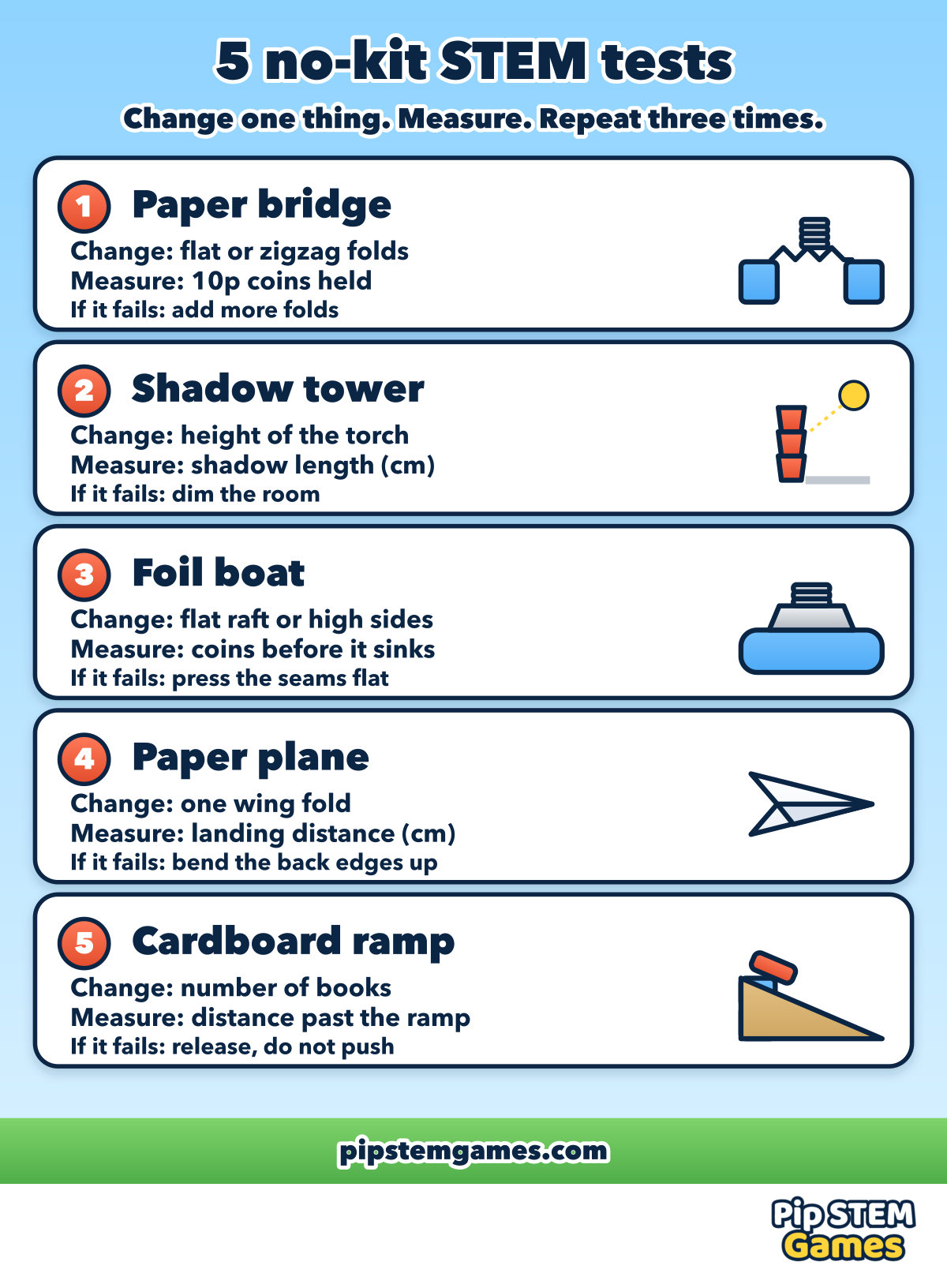
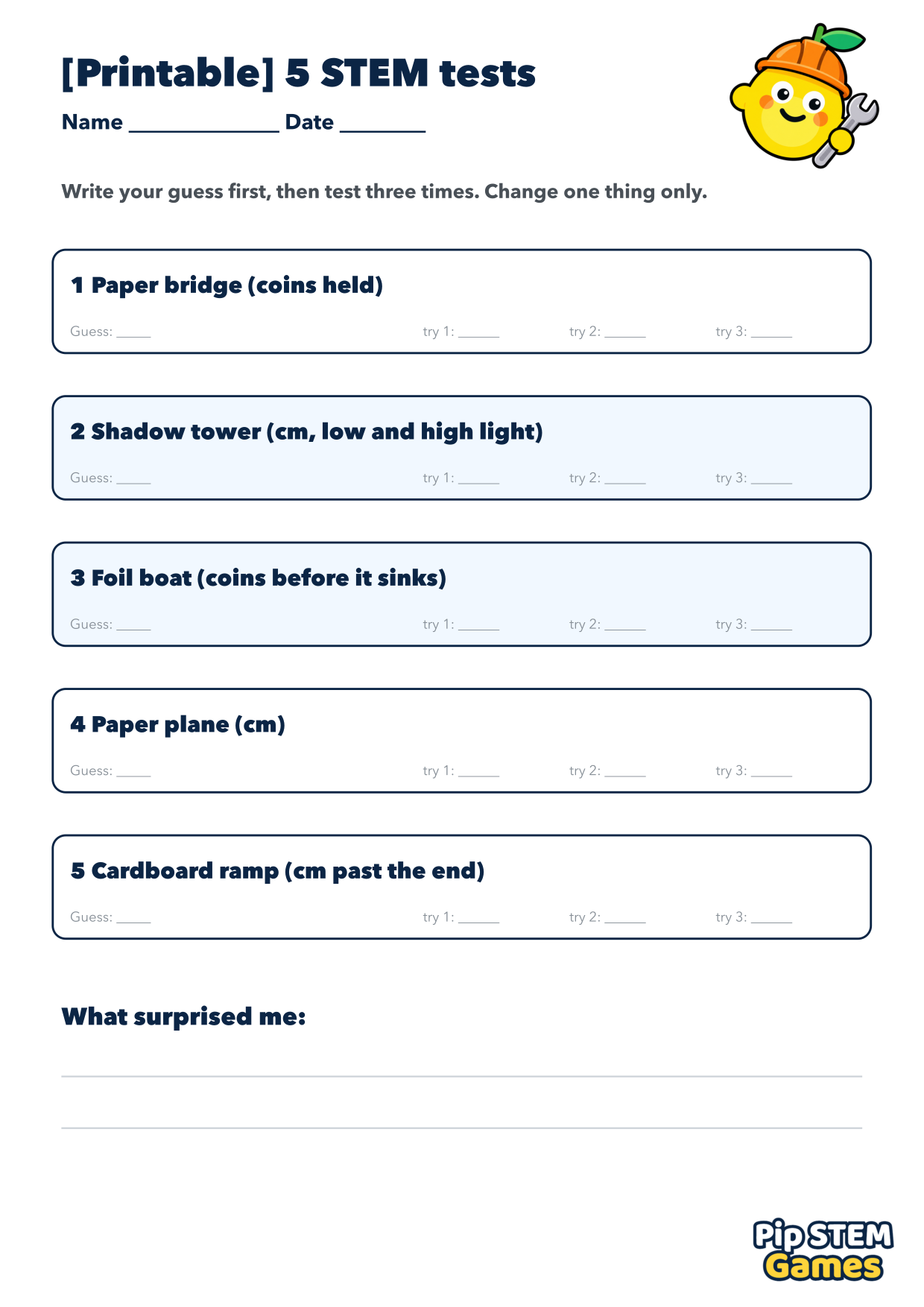
If something goes wrong, the engineer's five-step fix-it checklist helps. Younger children can count coins and say long or short. Older children can use a table and draw a chart. The Engineering Workbook for Kids has more tests for ages 8 to 12.
Safety: coins and foil scraps are small parts, so keep them away from children under 3 and supervise throughout. Scissors are for an adult or a careful child, and clear the area of breakables before launching planes.
Questions parents ask
What are good STEM activities for kids with no special kit?
A paper bridge, a shadow tower, a foil boat, a paper plane and a cardboard ramp all use things you already have. Each one is a small test with a guess and a measurement.
What age are these STEM activities for?
They suit ages 5 to 12. Younger children count coins or compare long and short, and older children measure in centimetres and record results in a table.
How long does each activity take?
Most take 10 to 15 minutes including setup. You can do one a day or run all five over a weekend.
Why do we repeat each test three times?
One try can be luck. Three tries show whether the result keeps happening, which is what engineers look for.
Why does folding paper make a bridge stronger?
Folds make the paper stiffer, so it bends less under the same load. Test it with coins and count your own result.
Are these activities safe?
Yes with an adult nearby. Coins and foil are small parts, so keep them away from children under 3, wipe up water and clear breakables before throwing planes.
Great STEM activities to try next...
 Paper Bridge Challenge: Build a Bridge From One Sheet of Paper [Printable]Build challenge
 12 Easy STEM Activities for Kids to Try at Home (Ages 5 to 12)By age
 Build a Boat That Actually FloatsActivity
More to try:

Pip STEM Games
We make engineering games and workbooks for kids aged 5 to 12. Every activity here is one we'd happily run at the kitchen table: test it, watch it fail, fix it, try again.




