


Key takeaways
- Touching gears always turn opposite ways, so the direction flips at every pair.
- If A turns clockwise, D in a row of four turns anticlockwise.
- Odd number of gears in a row: the last turns like A. Even: the opposite way.
- Equal gears turn at the same speed, and fewer teeth means faster.
- A cardboard test with brass fasteners and an adult cutting keeps it safe.
Gear D turns anticlockwise. In this gear direction challenge, four equal gears sit in a row and A turns clockwise, so the direction flips at every touch: B anticlockwise, C clockwise, D anticlockwise. This page shows why, gives the odd and even rule for longer rows, and has a safe cardboard build with a printable template.
Which way does gear D turn?
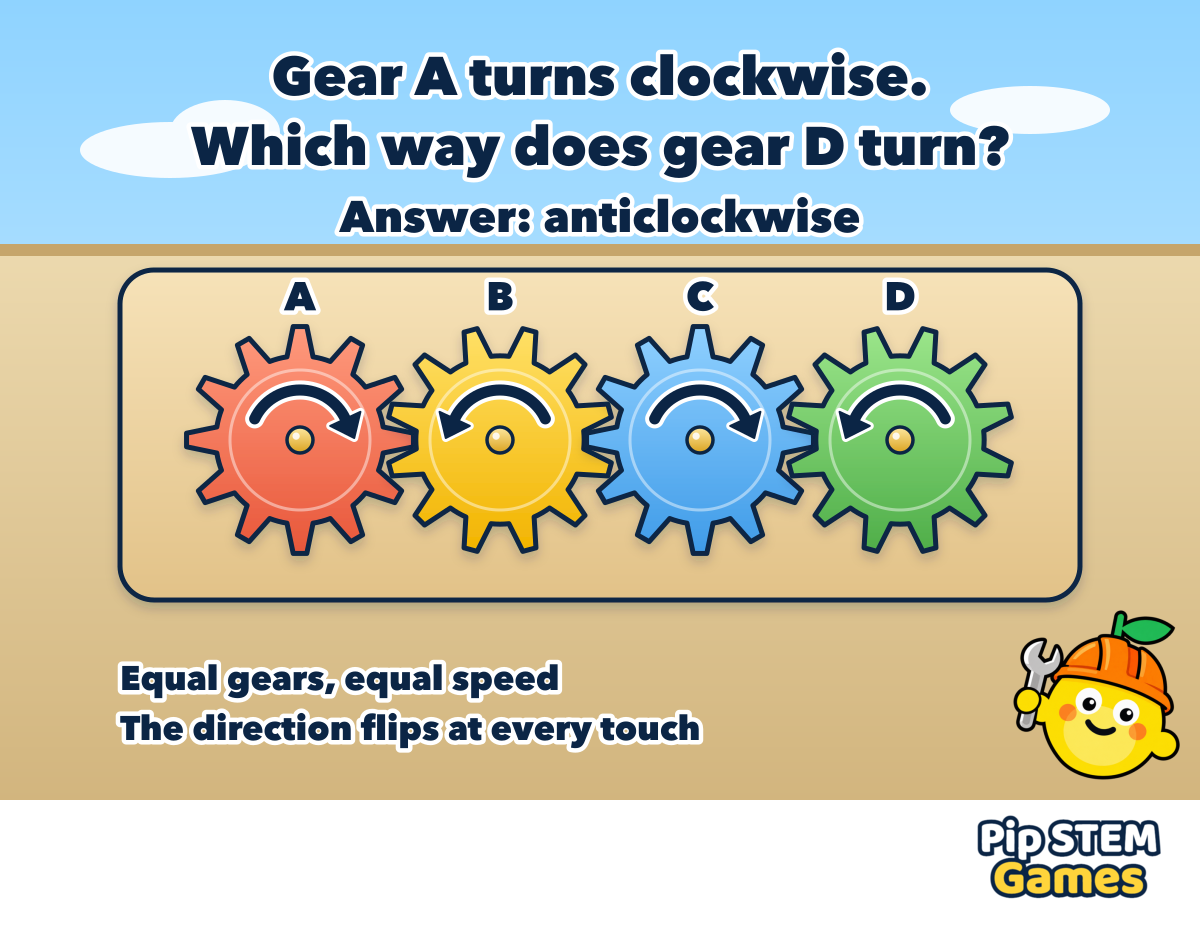
Gear D turns anticlockwise. Gear A turns clockwise, so B turns anticlockwise, C turns clockwise and D turns anticlockwise. You can check it by drawing a small arrow on each gear, one at a time.
The puzzle shows four equal gears in a row. Each gear touches only its neighbours, and gear A, on the left, turns clockwise. Your child works out which way gear D, at the far right, turns. Ages 5 to 12 can try it. Younger children do it with a finger on the picture, and older children build the real thing and test it.
If your child likes this, our post on how gear puzzles help children understand machines shows what the puzzles teach, and another gear direction puzzle uses a different row.
Why do touching gears turn opposite ways?
Gears that touch on their outsides always turn opposite ways, because the teeth that meet are pushed in the same direction at that spot. Look at the picture: at the touching point, A's teeth move down and B's teeth move down too. For A to move down on its right side, A must turn clockwise. For B to move down on its left side, B must turn anticlockwise.
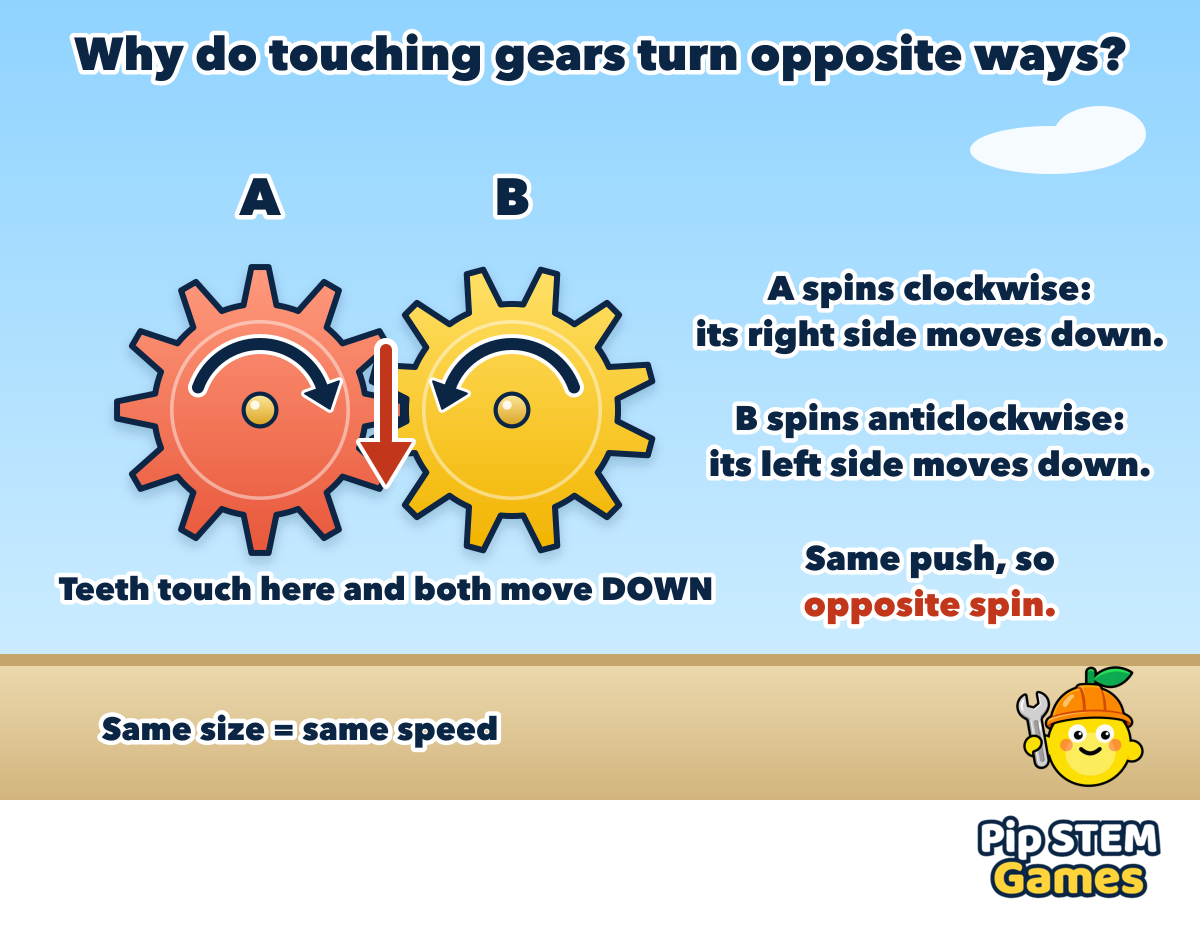
That is why the direction flips at every pair. A to B flips it. B to C flips it back. C to D flips it again. Three flips from clockwise leave you at anticlockwise.
All four gears here are the same size, so they all turn at the same speed too. Turn A one full turn and D turns one full turn as well, just the other way round.
How do you build the four-gear test safely?
You can build the four-gear test from card in about 30 minutes. An adult does all the cutting and starts every hole, and children do the tracing, the arrows and the testing.
You need:
- thin card, such as a cereal box, for the gears
- a bigger piece of thick cardboard or foam board for the base
- four brass paper fasteners (the split-pin kind with a flat round head)
- a single hole punch
- pencil, marker and glue stick
- scissors for the adult to use, with a cutting mat under the card
- the printable template below
- Print the template at actual size, glue it onto thin card, and let it dry.
- An adult cuts out each gear, including every tooth. Squared-off teeth are fine.
- An adult punches a hole in the centre of each gear. The hole should be a little wider than the fastener's shaft, so each gear spins freely.
- Lay the gears on the base using the board layout dots. An adult pushes a fastener through each hole, starts a hole in the base with a sharpened pencil point, and opens the prongs flat underneath. Leave a tiny gap under the head, so the gear isn't squashed.
- Check the teeth fit into the gaps of their neighbours. Draw a pencil arrow on each gear, then turn A slowly.
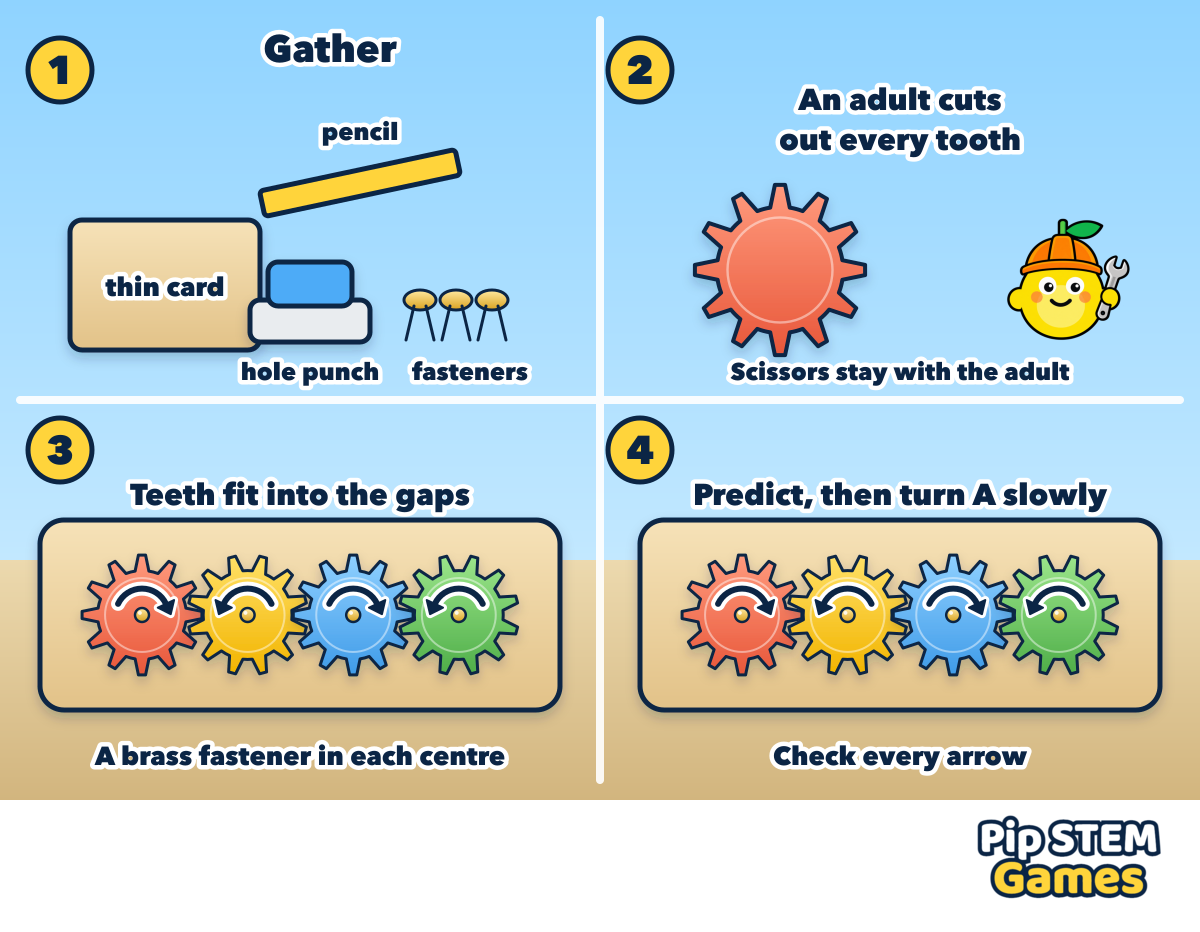
Safety: an adult does all the cutting and hole-starting. We use brass paper fasteners rather than push pins, because the flat heads are kinder to fingers and the prongs fold flat out of the way. Fasteners are small parts, so keep them away from children under 3. Put a folded towel or cutting mat under the base before anyone pushes a fastener through.
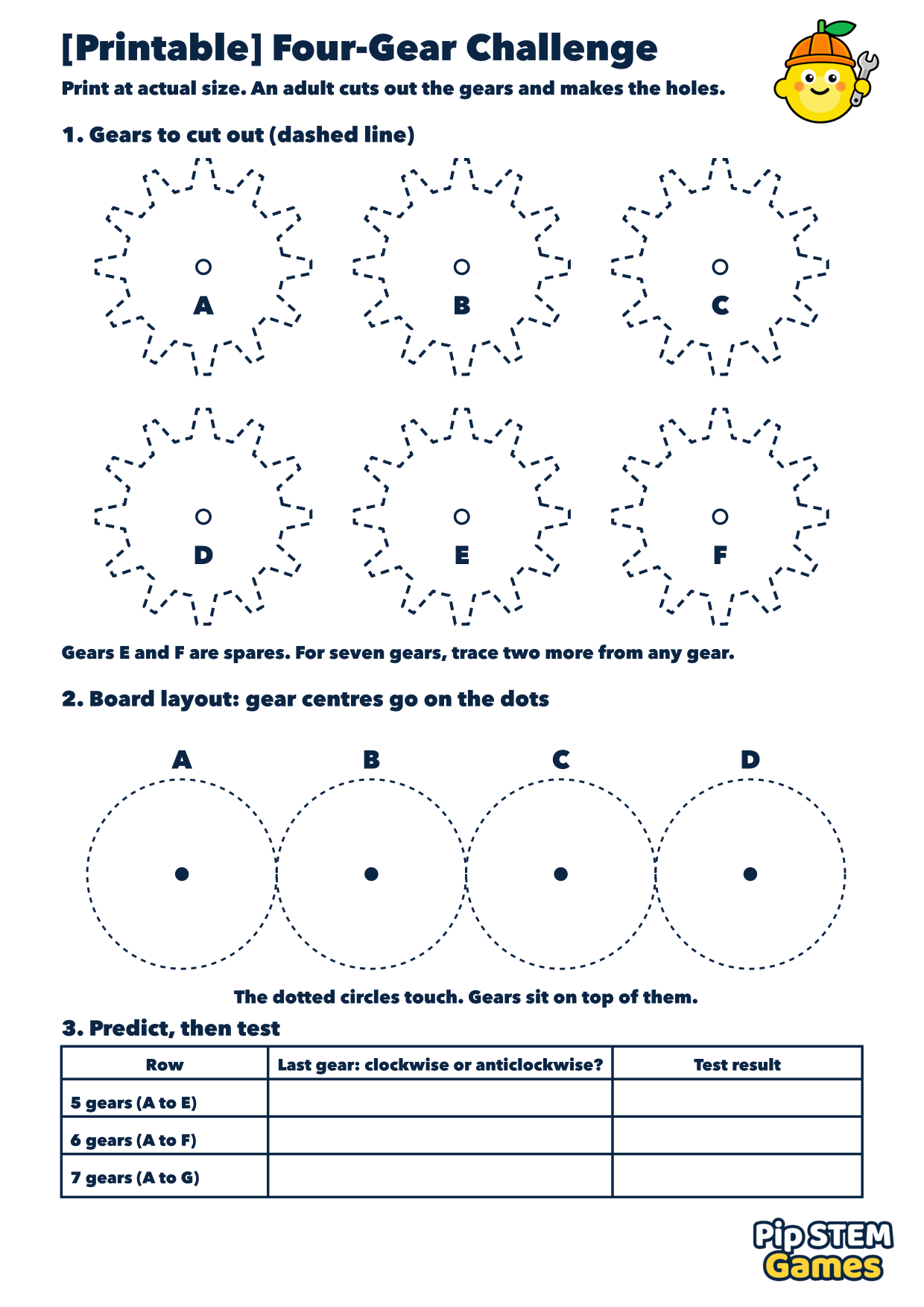
Here's the template to print and save. Gears A to D are for the challenge. E and F are spares.
Pro tip: mark one tooth on gear A with a coloured dot. Count how many teeth go past a neighbour during a quarter turn. With 12 teeth, a quarter turn is 3 teeth.
What if the gears slip or jam?
If the teeth skip, slide the gears a little closer together. If they jam, move them slightly apart, or ask the adult to trim any tooth that's too long.
- Teeth skip: the gears are too far apart. Move one a few millimetres closer and re-fasten it.
- Gears jam: they're too close, or a tooth is bent. Move apart, or trim.
- A gear wobbles or sticks: the centre hole is too tight, or the fastener is squashing the card. Open the hole a little and loosen the head.
- Card goes floppy: glue a second layer of thin card behind the gear.
Fixing is half the fun. Each fix teaches your child something about how gears have to fit together, and that's the same job real engineers do.
What happens with five or seven gears?
With five gears, the last gear turns clockwise, the same way as A. With seven gears, the last gear also turns clockwise. The rule is about odd and even: count every gear in the row, including A. If the number is odd, the last gear turns the same way as A. If it's even, the last gear turns the opposite way.
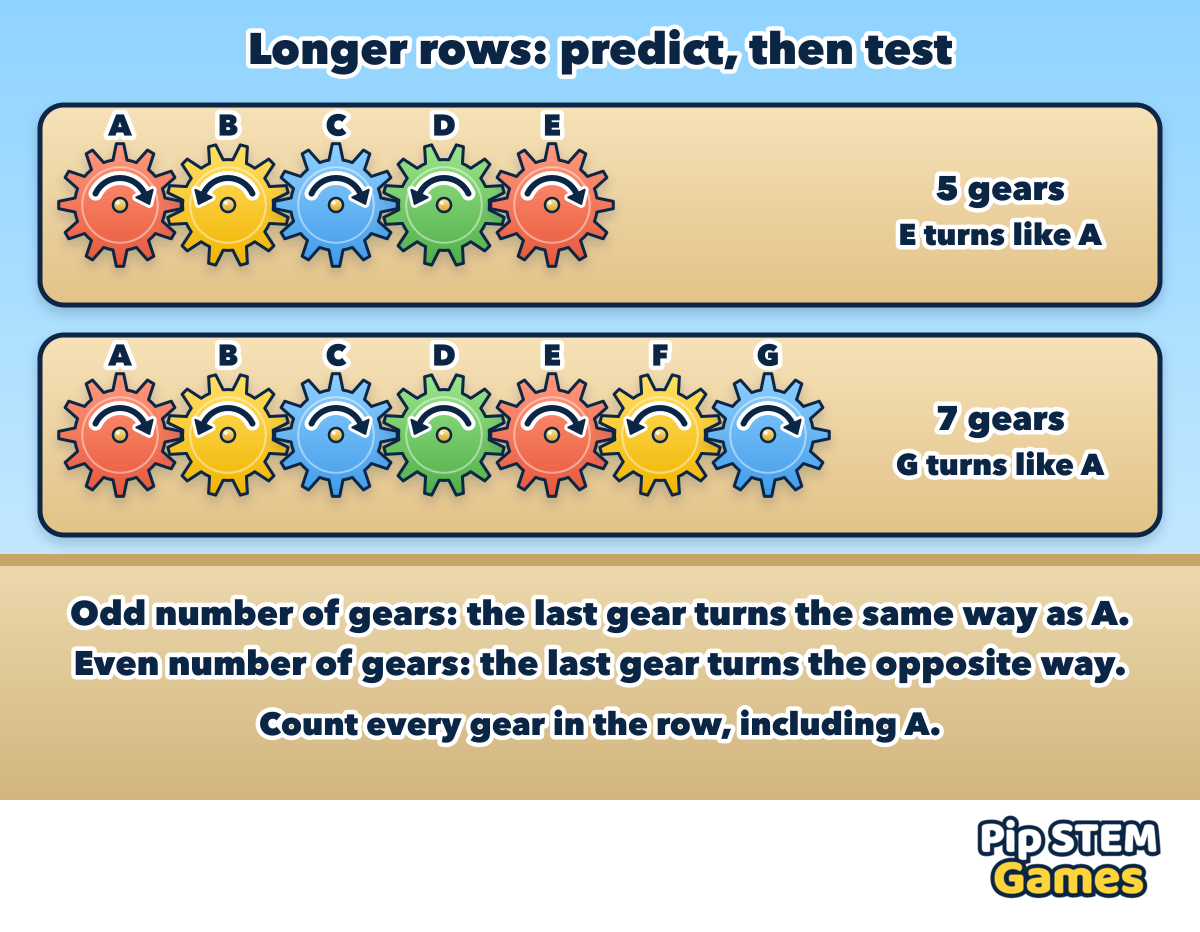
- Two gears: B turns the opposite way to A.
- Three gears: C turns the same way as A.
- Four gears: D turns the opposite way (our puzzle).
- Five gears: E turns the same way as A.
- Six gears: F turns the opposite way. Seven gears: G turns the same way.
Ask your child to predict first, write it in the table on the printable, and then build the longer rows to check. Frankly, the prediction is the point. Getting it wrong and finding out why is when the rule sticks.
The gears in the middle only pass the movement along. They flip the direction each time, but they don't change how fast the last gear turns when all the gears are the same size.
Do bigger and smaller gears turn at the same speed?
Equal gears turn at the same speed. Gears of different sizes don't. A gear with fewer teeth turns faster, and a gear with more teeth turns slower. Count the teeth to find out how much.
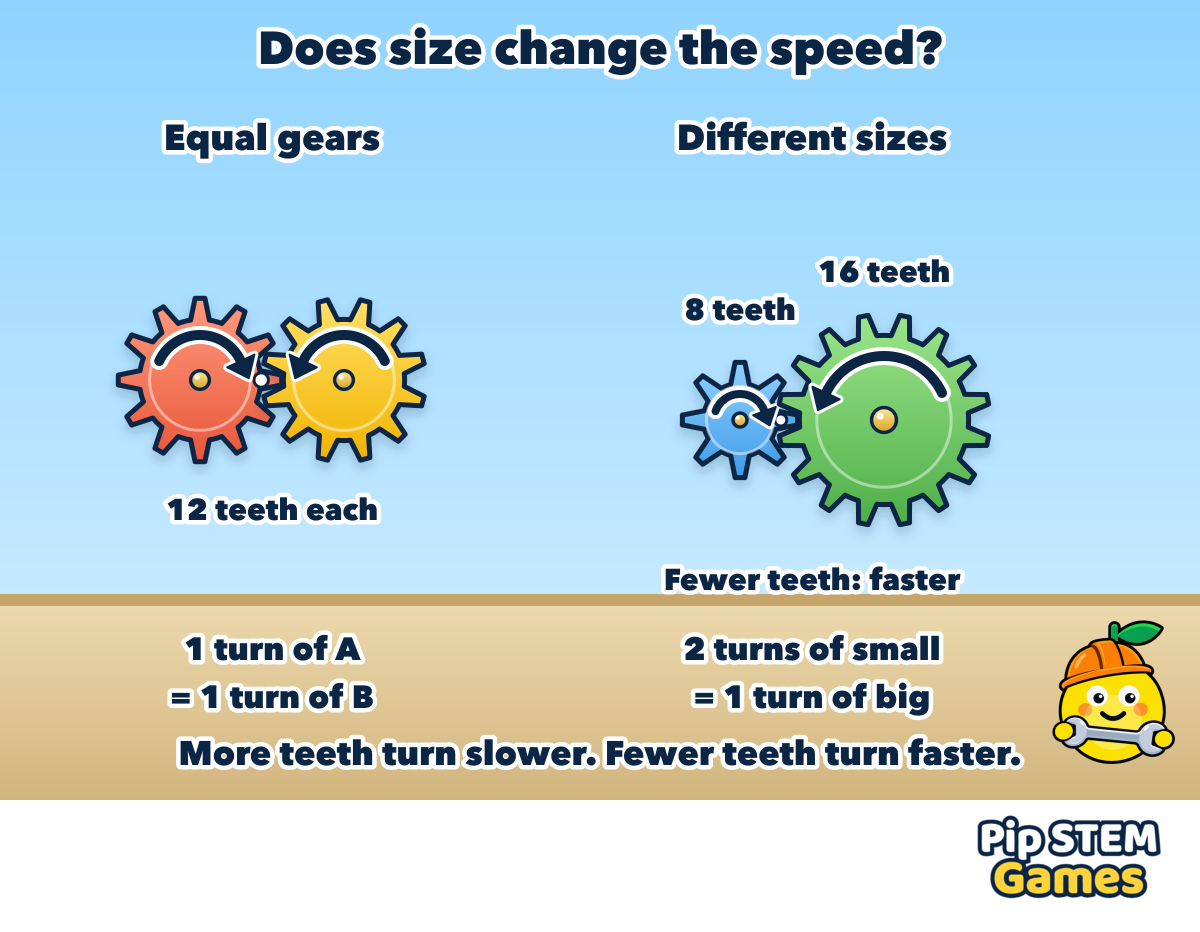
Here's a way to see it. Say a gear with 8 teeth drives a gear with 16 teeth. For every turn of the big gear, 16 teeth have to pass the meeting point, and the small gear has only 8, so it must turn twice. The big gear turns at half the speed. The direction still flips.
To try it on screen, open the Gear Factory game and watch which way each gear turns. For more machines that change speed and force, read simple machines for kids.
How do you make it a fair test?
Change one thing at a time, and always turn gear A clockwise. Turn it slowly, about a quarter turn at a time, and watch every gear. Predict first, then check.
Questions to ask your child:
- Which gears turn the same way as gear A?
- What pattern do you notice with odd and even gear numbers?
- Does gear D turn faster, slower or at the same speed as gear A?
- What would happen if one gear were bigger?
Easier (ages 5 to 7): use the picture and a finger. Say "A goes this way, so B goes that way" and draw the arrows together. Harder (ages 8 to 12): build five and seven gears, make a gear with 8 teeth, and measure the speed change by counting turns.
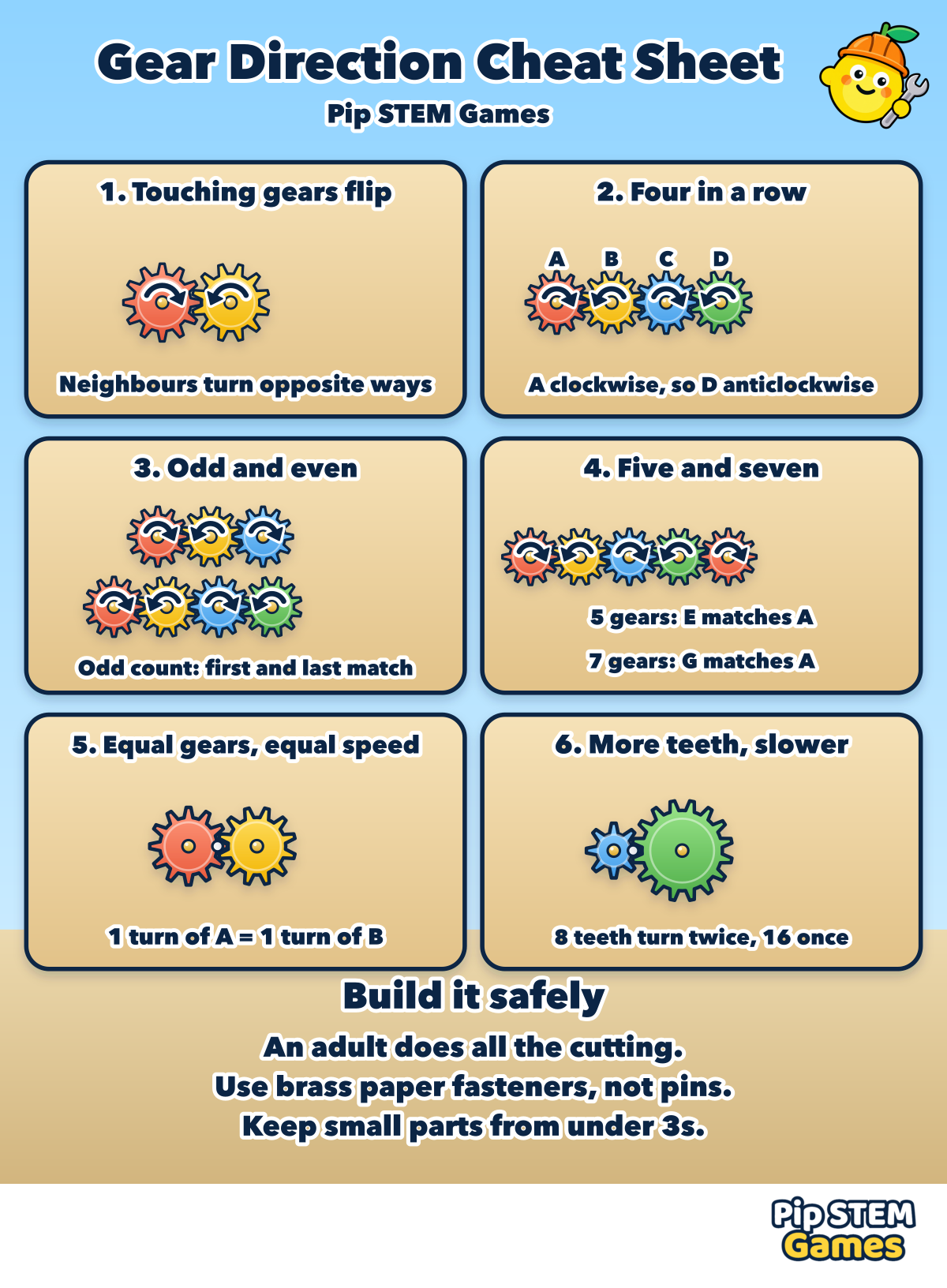
Save this cheat sheet for the fridge or the classroom wall. The Senior Engineers engineering workbook has more machine puzzles for ages 8 to 12.
Questions parents ask
Which way does gear D turn if gear A turns clockwise?
Gear D turns anticlockwise. The direction flips at every touching pair, so B is anticlockwise, C is clockwise and D is anticlockwise.
Why do touching gears turn opposite ways?
The teeth that meet at the touching point move in the same direction. For both to move the same way at that spot, one gear has to turn clockwise and the other anticlockwise.
What is the rule for odd and even numbers of gears?
Count every gear in the row. With an odd number, the last gear turns the same way as the first. With an even number, it turns the opposite way.
Do all the gears turn at the same speed?
Gears of the same size do. If the sizes differ, the gear with fewer teeth turns faster. An 8-tooth gear turns twice for each turn of a 16-tooth gear.
Do all gears flip the direction?
Gears that touch on their outsides do. A small gear running inside a ring gear turns the same way as the ring, and a bike chain makes both gears turn the same way.
What age is this challenge for?
Ages 5 to 12. Younger children trace the arrows on a picture. Older children build five and seven gear rows, and an adult always does the cutting.
Great STEM activities to try next...
 How Gear Puzzles Help Children Understand MachinesGames
 One Gear Changes the Whole Machine [Printable]How it works
 Simple Machines for Kids: The 6 Types, With Examples and Activities [Printable]How it works
More to try:

Pip STEM Games
We make engineering games and workbooks for kids aged 5 to 12. Every activity here is one we'd happily run at the kitchen table: test it, watch it fail, fix it, try again.




