

Key takeaways
- Gear C turns clockwise, the same way as gear A.
- Every touch between two gears flips the direction.
- Two flips bring you back to the start.
- Size and speed change how fast a gear turns, never which way.
- Odd number of gears in a row: last matches first. Even: opposite.
Gear C turns clockwise, the same way as gear A. Each time two gears touch, the spin flips, so A is clockwise, B is anticlockwise and C is clockwise again. This page gives the quick answer, a finger trick to check any gear puzzle and a printable sheet of six more.
Which way does the last gear turn?
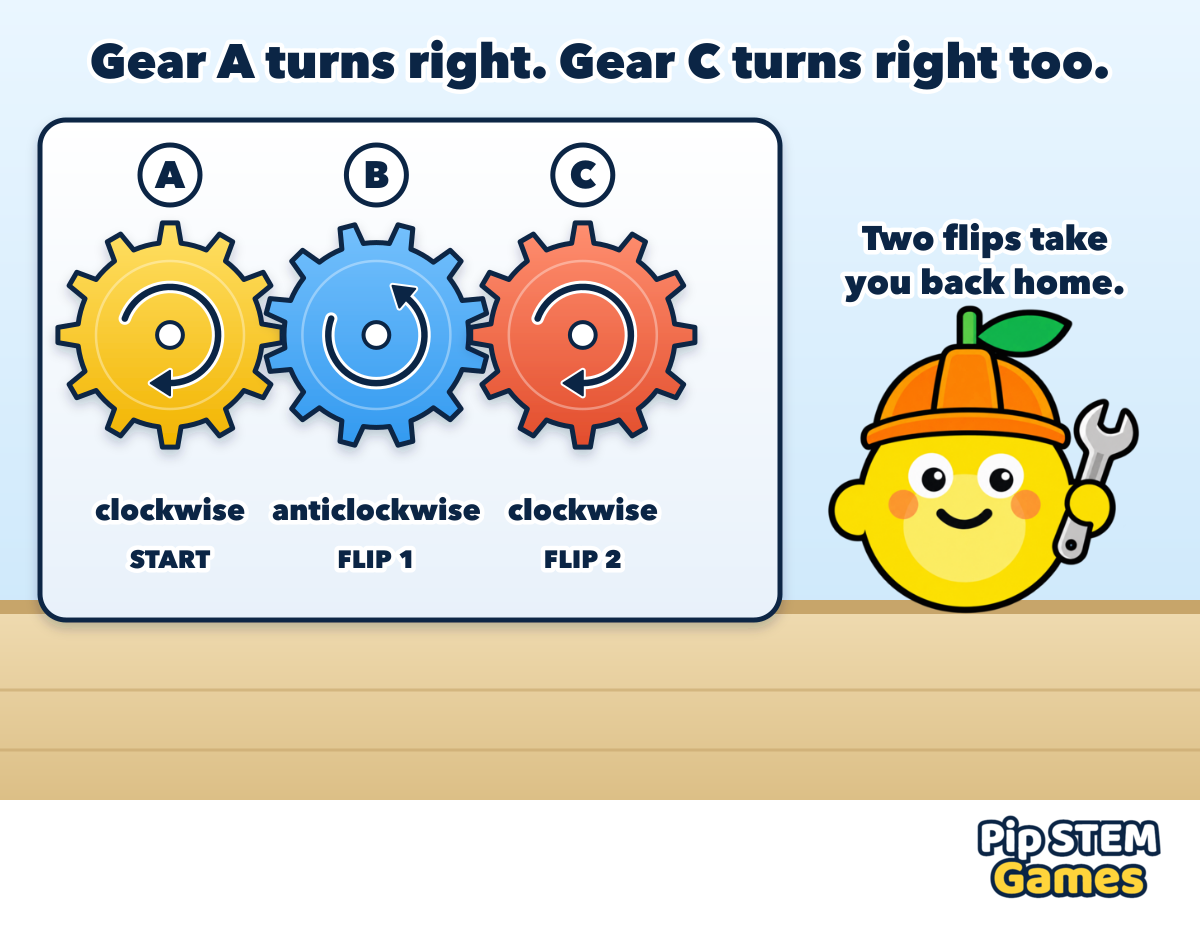
Gear C turns right (clockwise), the same way as gear A. Three equal gears sit in a row, and each gear touches only its neighbour. A turns clockwise, so B turns anticlockwise, and C turns clockwise again.
Why does the last gear match the first? Every time one gear touches the next, the spin flips. There are two touches in a row of three gears, so the spin flips twice and lands back where it started.
This page is the quick answer and the short way to check it. If you want to build the machine, our four-gear direction challenge has a cardboard template, and one gear changes the whole machine shows what an extra middle gear does.
Why does each gear flip the direction?
Meshing gears turn opposite ways because their teeth push each other round. When two gears on flat ground touch on their outsides, one turns clockwise and the other anticlockwise. Wikipedia calls this an external mesh, and it is the kind in every toy gear set.
Try it with your fists. Hold two fists side by side, touching, and roll the left one forward. The right one has to roll backwards. They can never roll the same way while they touch.
A good way to say it out loud is "A goes this way, so B goes that way, so C goes this way." Say it slowly and the answer comes out on its own.
How can you check the answer without building anything?
Use your finger and a pencil. It takes about a minute and works on any gear picture, even a tricky one in a test.
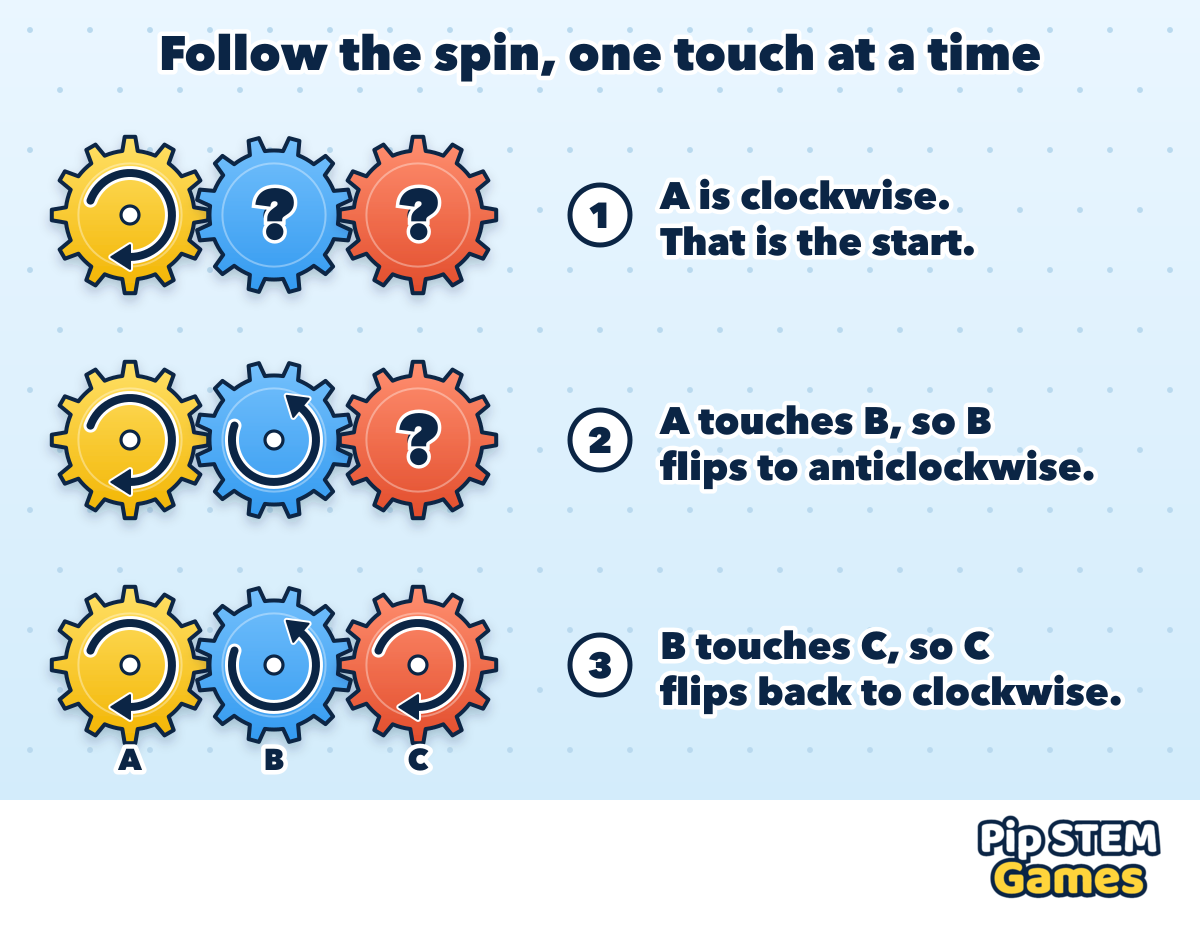
- Draw a small curved arrow on gear A to show its spin.
- Put your finger on the place where A touches B. Ask which way B has to go. It goes the opposite way, so draw the opposite arrow on B.
- Move to where B touches C. Draw the opposite of B’s arrow on C.
- Look at C. Its arrow matches A’s.
For younger children, colour a dot on one tooth of each gear instead. Mark where the dot of gear A starts, turn the picture in your head, and watch which side the next dot moves to.
Pro tip: ask "what did you notice?" before you give the rule. Children who spot the flip-flop pattern themselves remember it for much longer than children who are told.
What are the most common wrong guesses?
Most wrong answers come from three ideas that feel sensible. Knowing them helps you spot where your child is stuck.
- "They all turn the same way." This is the most common guess. Gears that touch can’t, because the teeth would jam.
- "C is opposite to B, so C is opposite to A too." Opposite of opposite is the same. Two flips cancel out.
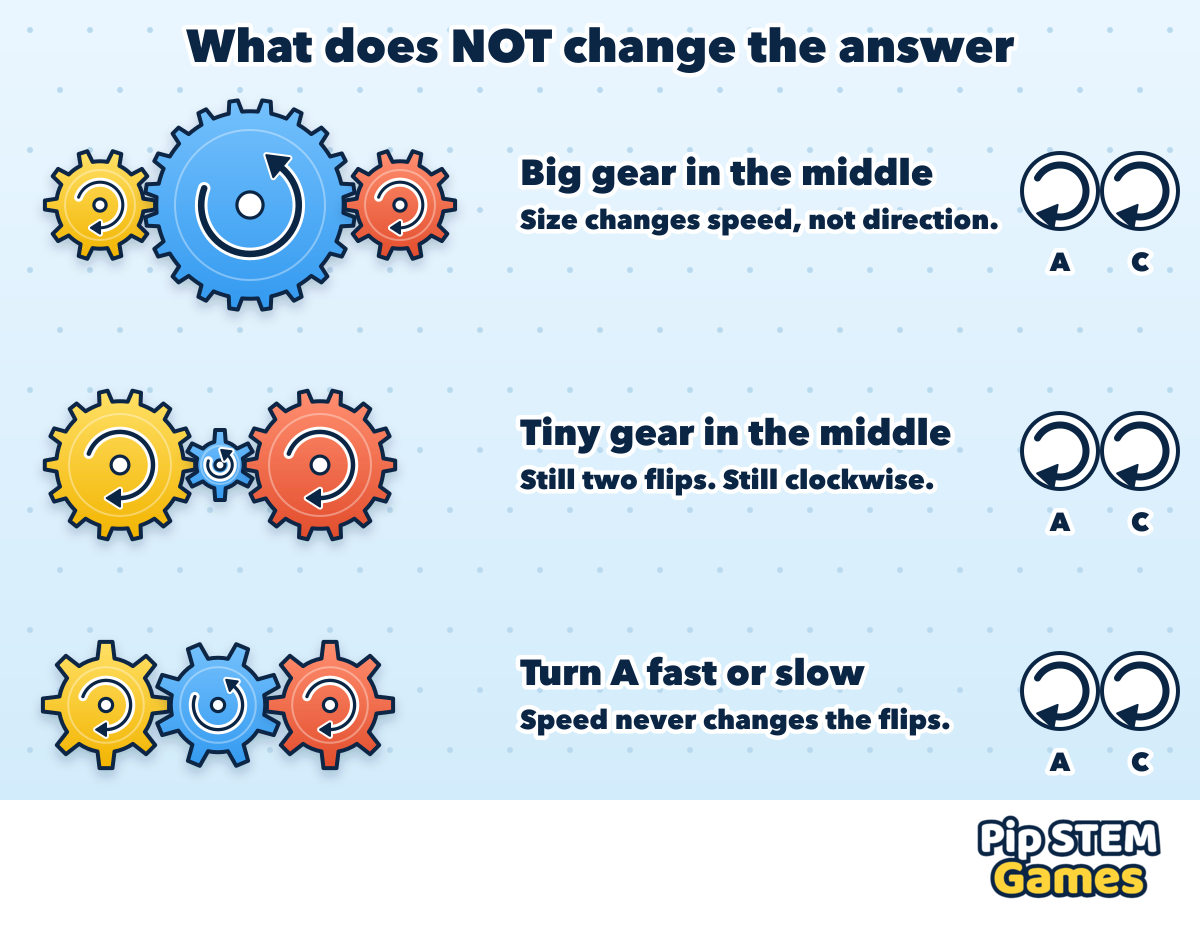
- "The big gear wins." Size changes how fast a gear turns, not which way.
Frankly, the wrong guesses are the best bit. Say "Let’s test that" and trace the flips together. Your child finds the mistake without being told off, which is how engineers fix things too.
What if there are more than three gears?
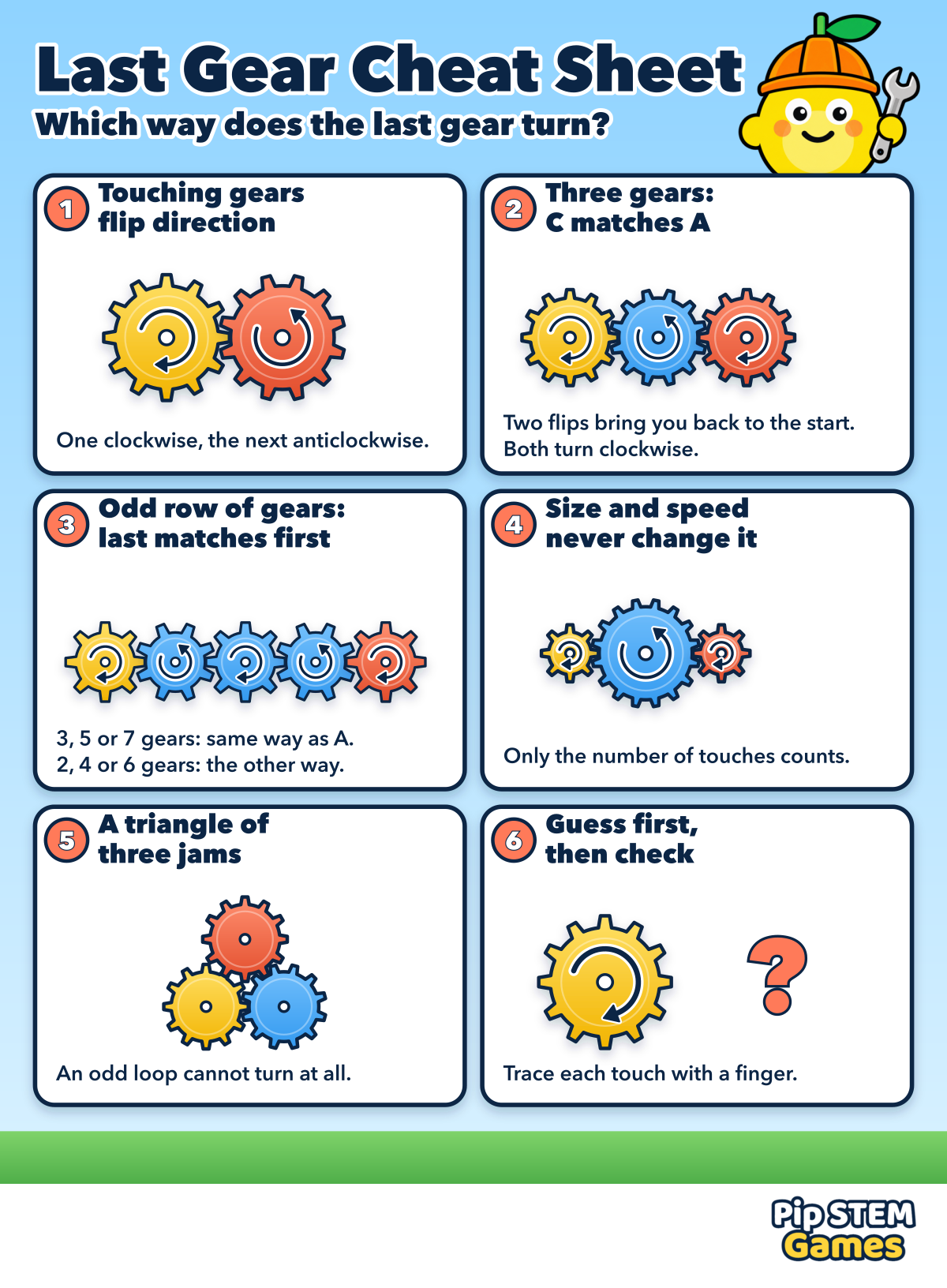
Count the gears in the row, including the first. If the number is odd, the last gear turns the same way as A. If it is even, the last gear turns the opposite way. The three-gear puzzle is the first odd case after the two-gear one.
| Gears in a row | Touches | Last gear (A is clockwise) |
|---|---|---|
| 2 | 1 | Anticlockwise |
| 3 | 2 | Clockwise |
| 4 | 3 | Anticlockwise |
| 5 | 4 | Clockwise |
| 6 | 5 | Anticlockwise |
| 7 | 6 | Clockwise |
The four-gear case is worked through in full in our four-gear direction challenge. For how teeth counts change speed, see how gear puzzles help children understand machines.
Can three gears all touch each other?
No, three gears in a triangle jam and can’t turn at all. A turns clockwise, so B has to turn anticlockwise, so C has to turn clockwise. But C also touches A, and A is clockwise, so C would have to be anticlockwise. C can’t be both.
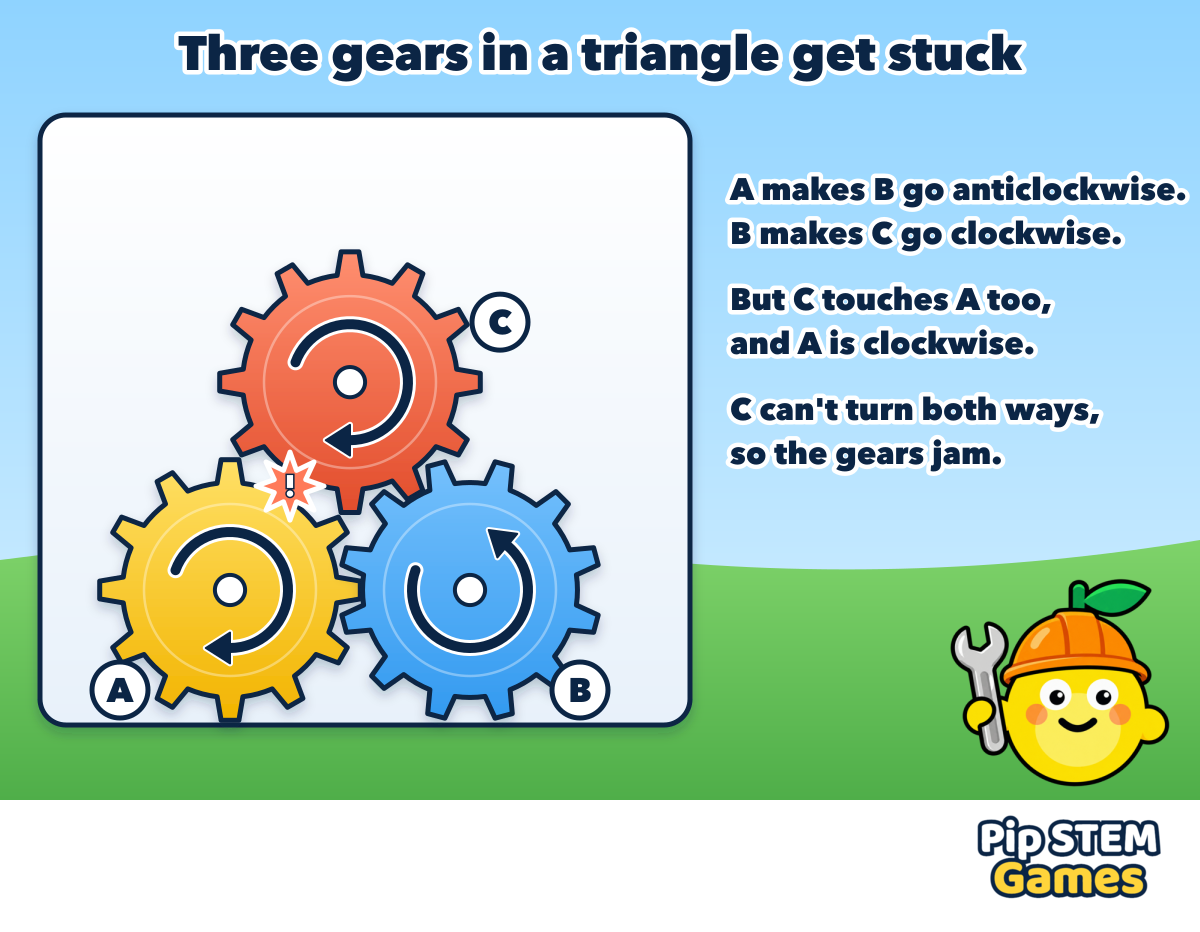
The same thing happens in any ring made of an odd number of gears. A ring with an even number, such as four gears in a square, can turn, because the flips fit round the loop. It makes a nice follow-up puzzle for ages 8 and up.
Do belts, chains and big ring gears flip the direction too?
Not always. Two gears joined by a belt or a chain turn the same way, unless the belt is crossed into a figure of eight. A bicycle is a good example: the pedals and the back wheel turn the same way, because a chain links them.
A gear that sits inside a ring gear (an internal mesh) also turns the same way as the ring. Only gears that touch on their outsides flip the spin. This puzzle is about the outside kind, so every touch counts as one flip.
How can your child test it at home?
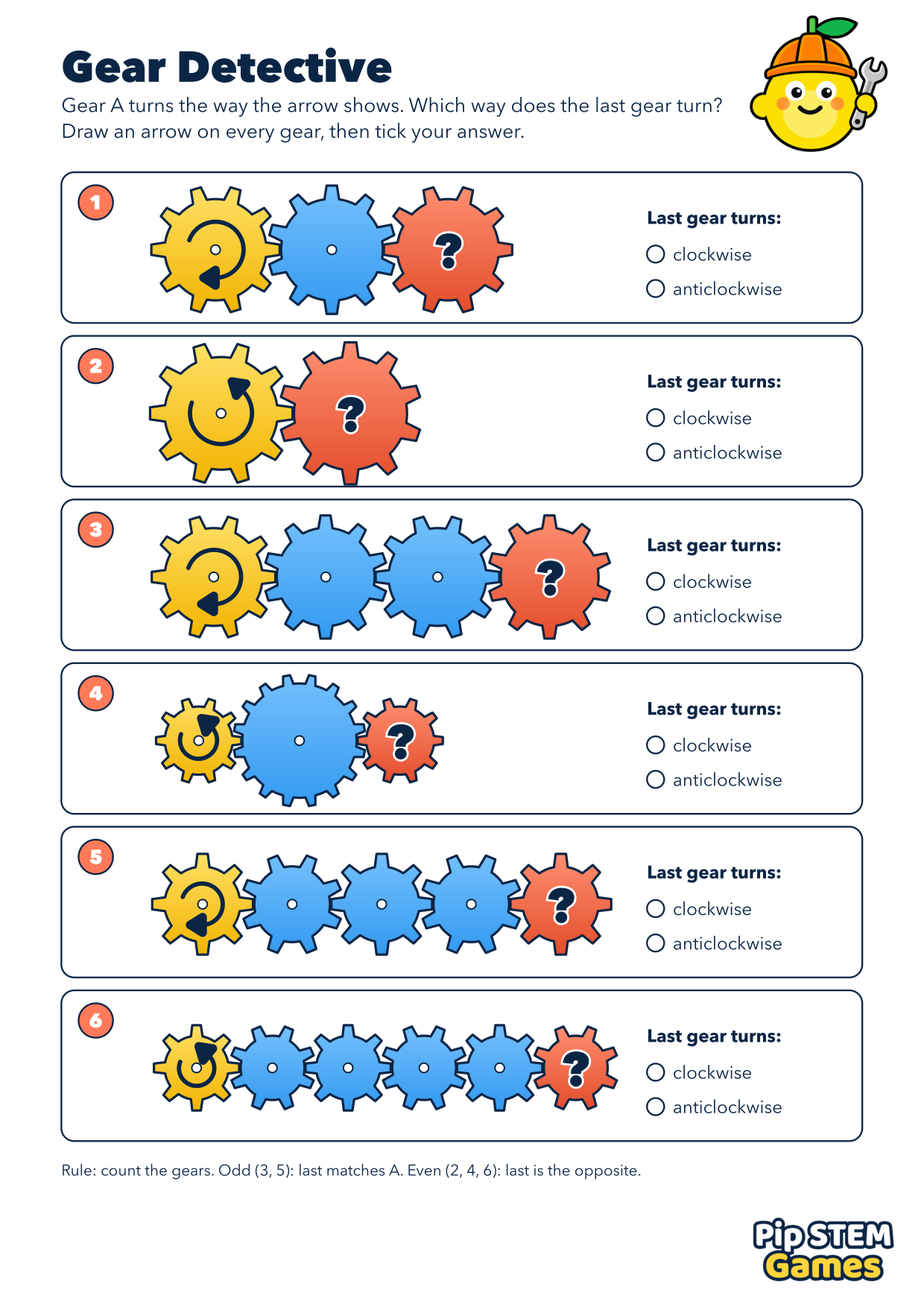
The fastest test needs a pencil and the free sheet below. It takes about 10 minutes and suits ages 5 to 12.
You need:
- the printable Gear Detective sheet below, printed on A4
- a pencil
- optional: a toy gear set or LEGO gears to check the answers
- Print the sheet and look at puzzle 1, a row of three gears.
- Guess the last gear’s direction and tick your answer.
- Trace the flips with a pencil arrow on each gear.
- Do puzzles 2 to 6. Which ones surprised you?
- Check with real gears if you have them, turning the first gear by hand.
No gears at home? Try the Gear Factory game, where your child connects gears on screen. To build your own gears from cardboard, follow the safe steps in the four-gear direction challenge. An adult does all the cutting, and fingers stay away from the meeting teeth.
What can you ask your child, and what comes next?
- Ages 5 to 7 (easier): use two and three gears and a finger. Say "this way, that way, this way" together.
- Ages 8 to 12 (harder): try puzzles 5 and 6 on the sheet, then ask for the odd and even rule in their own words.
Good questions: Which way does gear B turn, and how do you know? What if we add a fourth gear? Why can’t three gears touch each other? Pin up the cheat sheet below so the rule stays in view.
Want more? Our simple machines guide covers gears alongside levers and pulleys, and the Senior Engineers workbook (ages 8 to 12) and Junior Engineers workbook (ages 5 to 7) have more machine puzzles.
Questions parents ask
If gear A turns clockwise, which way does gear C turn?
Gear C turns clockwise too. A flips B to anticlockwise, and B flips C back to clockwise.
Why do touching gears turn in opposite directions?
Their teeth push each other round. Where the teeth meet, both surfaces move the same way, which makes one gear clockwise and the other anticlockwise.
What is the rule for the last gear in a row?
Count the gears. With an odd number, the last gear turns the same way as the first. With an even number, it turns the opposite way.
Does the size of the middle gear change the answer?
No. Size changes speed, not direction. A big or tiny middle gear still flips the spin once on each side.
Can three gears touch in a triangle?
They can touch, but they jam and can’t turn. The flips around the triangle disagree, because the last gear would need to turn both ways.
Do gears joined by a chain turn the same way?
Yes, gears linked by a belt or chain turn the same way, unless the belt is crossed. Only gears that touch on their outsides flip the direction.
What age is this gear puzzle for?
Ages 5 to 12. Younger children trace with a finger on two or three gears, and older children use the odd and even rule on longer rows.
Great STEM activities to try next...
 The Four-Gear Direction Challenge [Printable]Build challenge
 One Gear Changes the Whole Machine [Printable]How it works
 How Gear Puzzles Help Children Understand MachinesGames
More to try:

Pip STEM Games
We make engineering games and workbooks for kids aged 5 to 12. Every activity here is one we'd happily run at the kitchen table: test it, watch it fail, fix it, try again.




