

Key takeaways
- Touching gears always turn in opposite directions.
- In a row, an odd number of gears ends the same way as the first; an even number ends the other way.
- Three gears in a triangle lock, because one gear would have to turn both ways at once.
- A small gear driving a big one turns more times, and the big gear turns slower but with more force.
- You can make a working gear puzzle at home from card, pins and a cork board.
Gear puzzles help children understand machines because they turn hidden rules into things you can predict, test and fix. Two rules do most of the work: touching gears turn in opposite directions, and a small gear spins faster than a big gear it drives.
What is a gear puzzle?
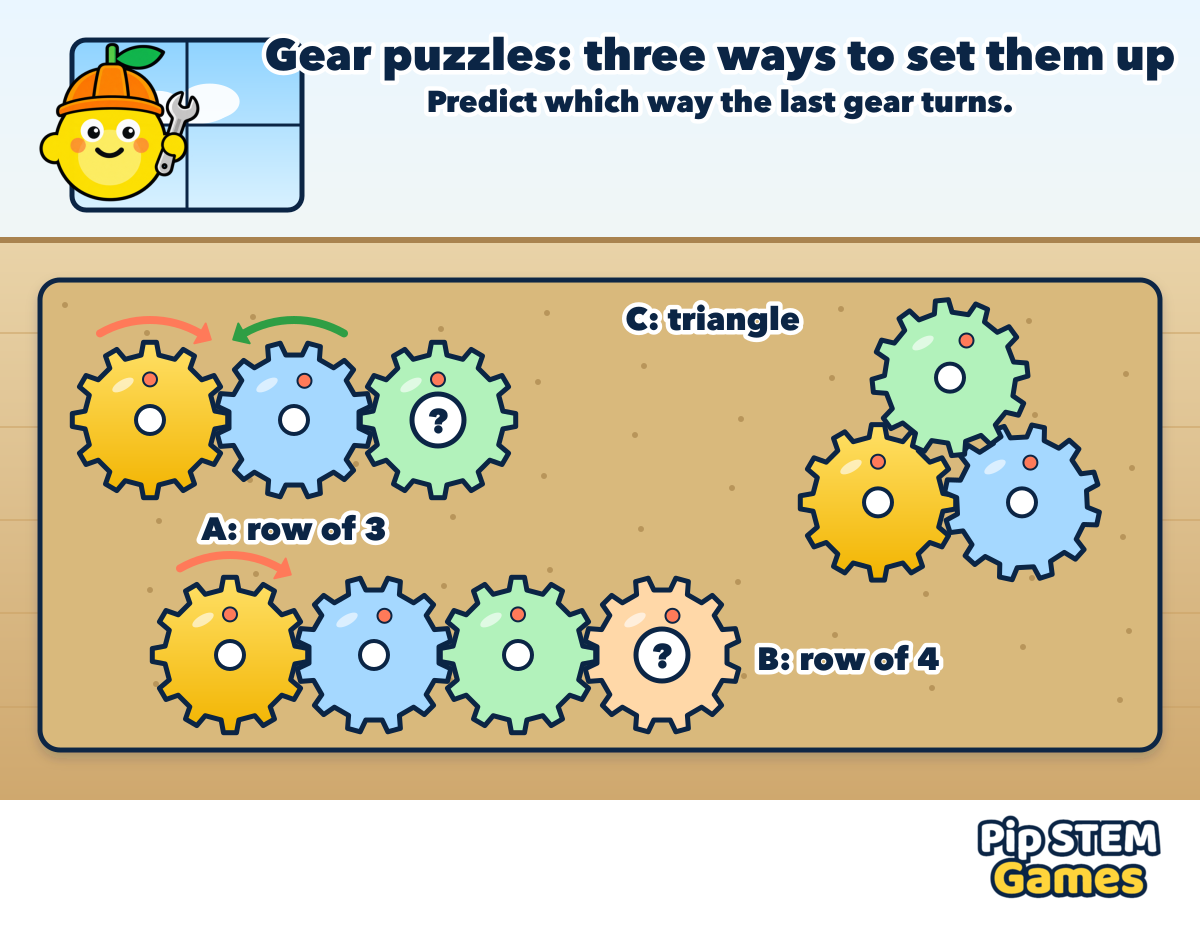
A gear puzzle shows a few gears touching and asks one question: if the first gear turns this way, what does the last one do? Sometimes the answer is a direction. Sometimes it's a speed. And sometimes the honest answer is that nothing moves at all.
The puzzle works because the answer is hidden but not random. A child can work it out before touching anything, then turn the first gear and see if they were right. That loop of guess, test and explain is the heart of how engineers think about any machine.
Why do touching gears turn opposite ways?
Where two gears meet, their teeth push each other, so the touching edges move together in the same direction. If the edge of gear 1 moves down on its right side, the edge of gear 2 moves down on its left side. That makes gear 1 turn clockwise and gear 2 turn anticlockwise.
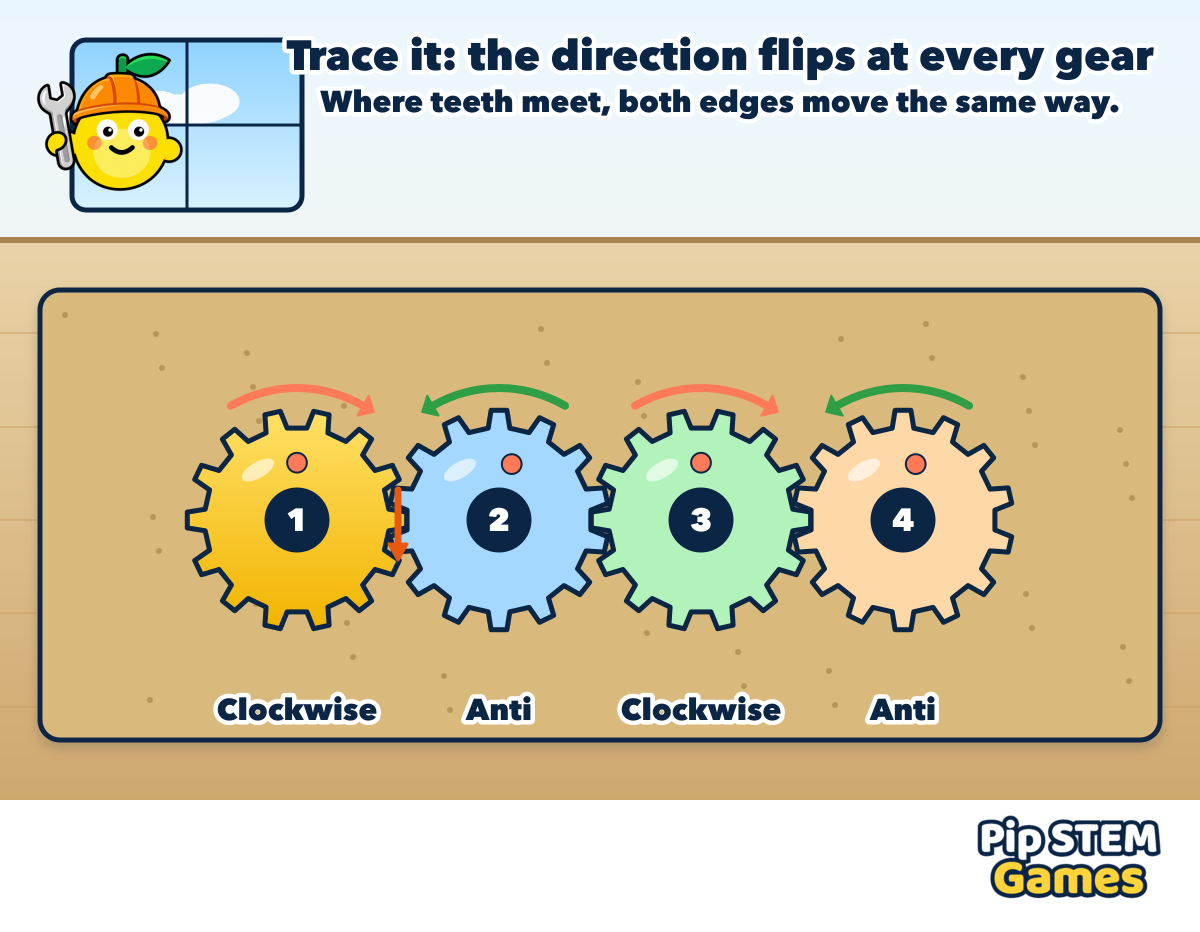
So in a row, the direction flips at every gear. That gives a neat rule. In a row with an odd number of gears, the last one turns the same way as the first. In a row with an even number, it turns the other way. Children love this because they can answer a row of 9 without building it.
Try our which way does the last gear turn? puzzle for practice, then the four gear direction challenge.
Why does a triangle of gears lock?
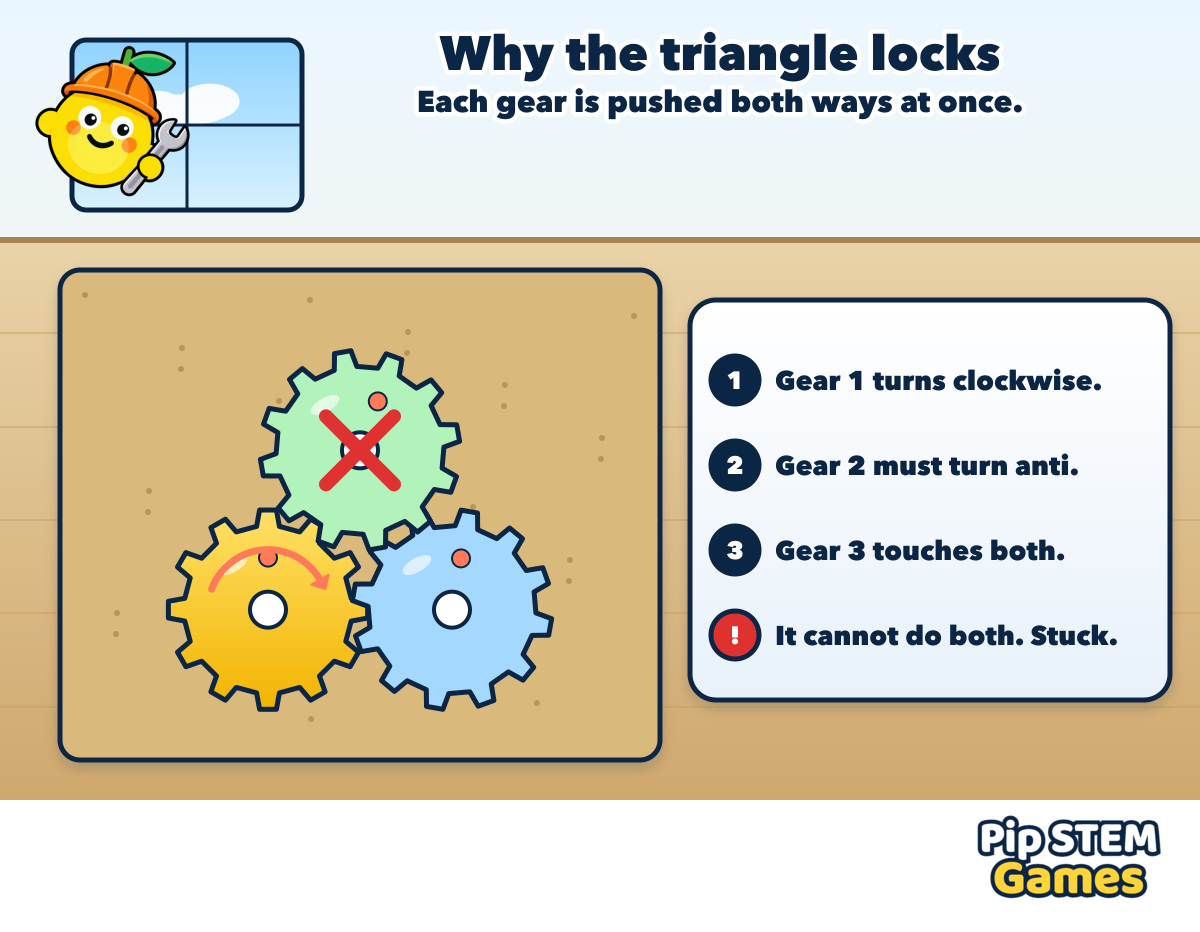
Three gears in a triangle all touch each other. Gear 1 turns clockwise, so gear 2 must turn anticlockwise. Gear 3 touches both of them, so it would have to turn anticlockwise because of gear 1 and clockwise because of gear 2. It can't do both, so the whole set jams.
This is the best moment in any gear puzzle. A child expects the gears to spin and they don't. Asking why is far more useful than being told. The same rule works for any closed loop: a loop with an even number of gears can turn, and a loop with an odd number locks.
What do gear puzzles teach about speed?
When a small gear drives a big one, the big one turns more slowly. Every tooth on the small gear pushes one tooth on the big gear along. So a 10 tooth gear must turn twice to move all 20 teeth of a 20 tooth gear round once.
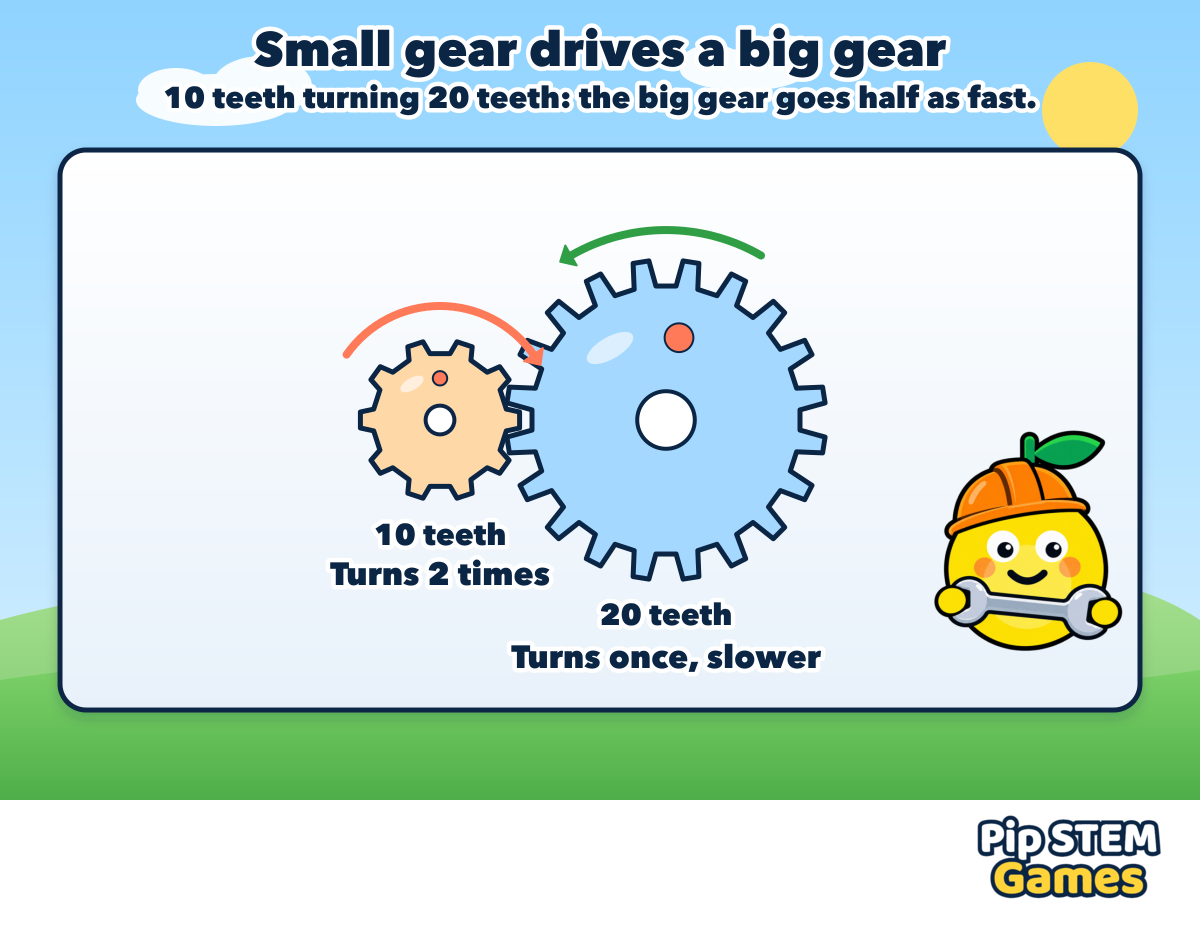
The slower gear turns with more force, which is why a bike's low gear makes hills easier. Flip it round and a big gear driving a small one makes the small one spin fast. Count the teeth, then count turns with a dot drawn on each gear. Children who do both see that the numbers match. One gear changes the whole machine shows how swapping one gear changes everything after it.
How do you make a card gear puzzle at home?
You need: the printable gear sheet below, thin card such as a cereal box, a glue stick, scissors, split pins or drawing pins, and a cork board or a thick piece of cardboard as a base.
- Print the sheet and glue it onto card.
- An adult cuts round each gear on the dashed line.
- An adult makes a small hole in the middle of each gear.
- Push a pin through the middle and into the base.
- Pin a second gear next to it so the teeth overlap by about half a tooth.
- Turn the first gear slowly and watch the dot on the second.
- Before each new set-up, write your guess on the sheet.
Start with set-up A, a row of 3. Then try B, a row of 4, and C, the triangle. The Gears game has more puzzles if you'd like to test ideas on screen too.
What if the gears don't turn?
- The gears slip: move the pins a little closer so the teeth overlap by about half a tooth.
- The gears jam: loosen the pins a bit, or move them slightly apart.
- A gear wobbles: use thicker card, or put a small card washer under it on the pin.
- Teeth bend: glue a second layer of card on the back.
- The triangle won't turn: that's not a fault. It's the answer.
What should you try next?
Make a loop of 4 gears in a square. It turns, because every gear has an even partner. Then make a loop of 5. It locks, just like the triangle. Ask your child to guess before each one and explain the rule in their own words.
After that, mix sizes. Put a small gear between two big ones and see if it changes the direction of the last gear. It doesn't. The size changes speed, not direction. Simple machines for kids shows where gears sit alongside levers and pulleys.
How do you change it for each age?
Ages 5 to 7: an adult cuts and pins the gears. Use only rows of 2 and 3 and ask which way the last gear turns.
Ages 8 and 9: add the triangle and the odd and even rule, and fill in the table on the sheet.
Ages 10 to 12: count teeth and turns, try loops of 4 and 5, and design a puzzle for someone else.
Safety: pins and split pins are small parts, so keep them away from toddlers and stay close with young children. An adult cuts thick card and makes the holes. Paper fasteners are kinder for younger hands than drawing pins. There are no batteries or motors in this activity.
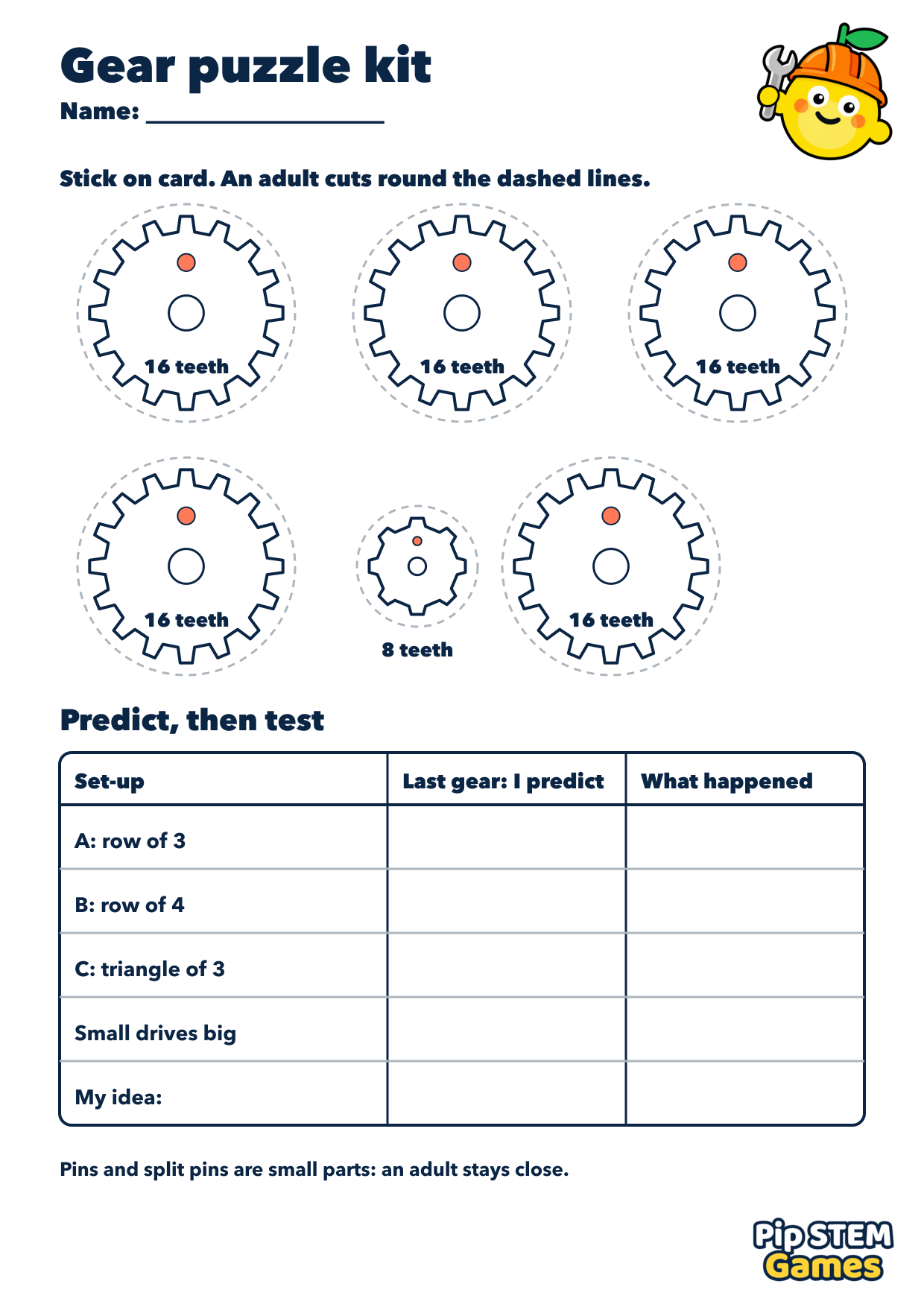
Print it on A4, or right-click and save it.
Questions parents ask
What do gear puzzles teach children?
They teach that touching gears turn opposite ways, that some layouts lock, and that gear size changes speed. They also build the habit of predicting before testing.
Which way does the last gear turn in a row?
Count the gears. With an odd number, the last one turns the same way as the first. With an even number, it turns the opposite way.
Why won't three gears in a triangle turn?
Each gear touches the other two, and they turn in opposite directions. One gear would have to turn both ways at once, so the set locks.
Does a bigger gear change the direction?
No. Size changes speed and force, not direction. Only the number of gears in the chain changes direction.
What age are gear puzzles for?
Ages 5 to 12. Younger children guess the direction in short rows; older children count teeth, test loops and design their own puzzles.
Are card gear puzzles safe?
Yes, with an adult cutting card and making holes. Pins are small parts, so keep them away from toddlers and use paper fasteners for younger children.
Great STEM activities to try next...
 If This Gear Turns Right, Which Way Does the Last Gear Turn?Activity
 The Four-Gear Direction ChallengeActivity
 One Gear Changes the Whole MachineActivity
More to try:

Pip STEM Games
We make engineering games and workbooks for kids aged 5 to 12. Every activity here is one we'd happily run at the kitchen table: test it, watch it fail, fix it, try again.




