


Key takeaways
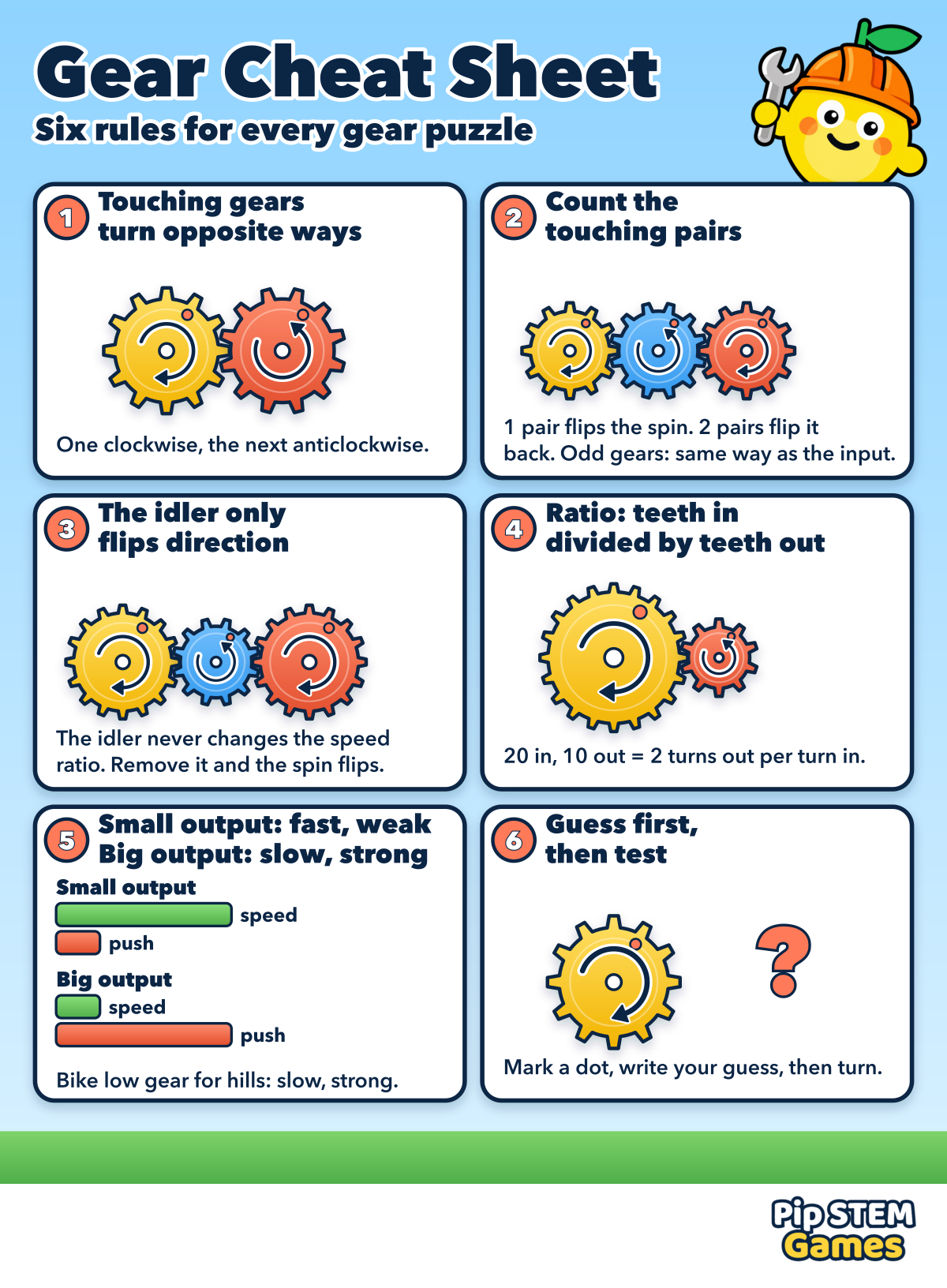
- Two gears that touch always turn opposite ways.
- Count the touching pairs: an even number keeps the spin, an odd number flips it.
- A middle idler gear changes direction but never changes speed.
- Turns out per turn in equals teeth on the input divided by teeth on the output.
- A small output gear is fast but weak, and a big output gear is slow but strong.
One extra gear in the middle flips the direction of the last gear and does nothing else to the speed. A gear that sits between the input and output is called an idler. This page shows why it works, how to predict which way the last gear turns, and how to test it at home with a printable gear sheet.
What does one extra gear do to a machine?
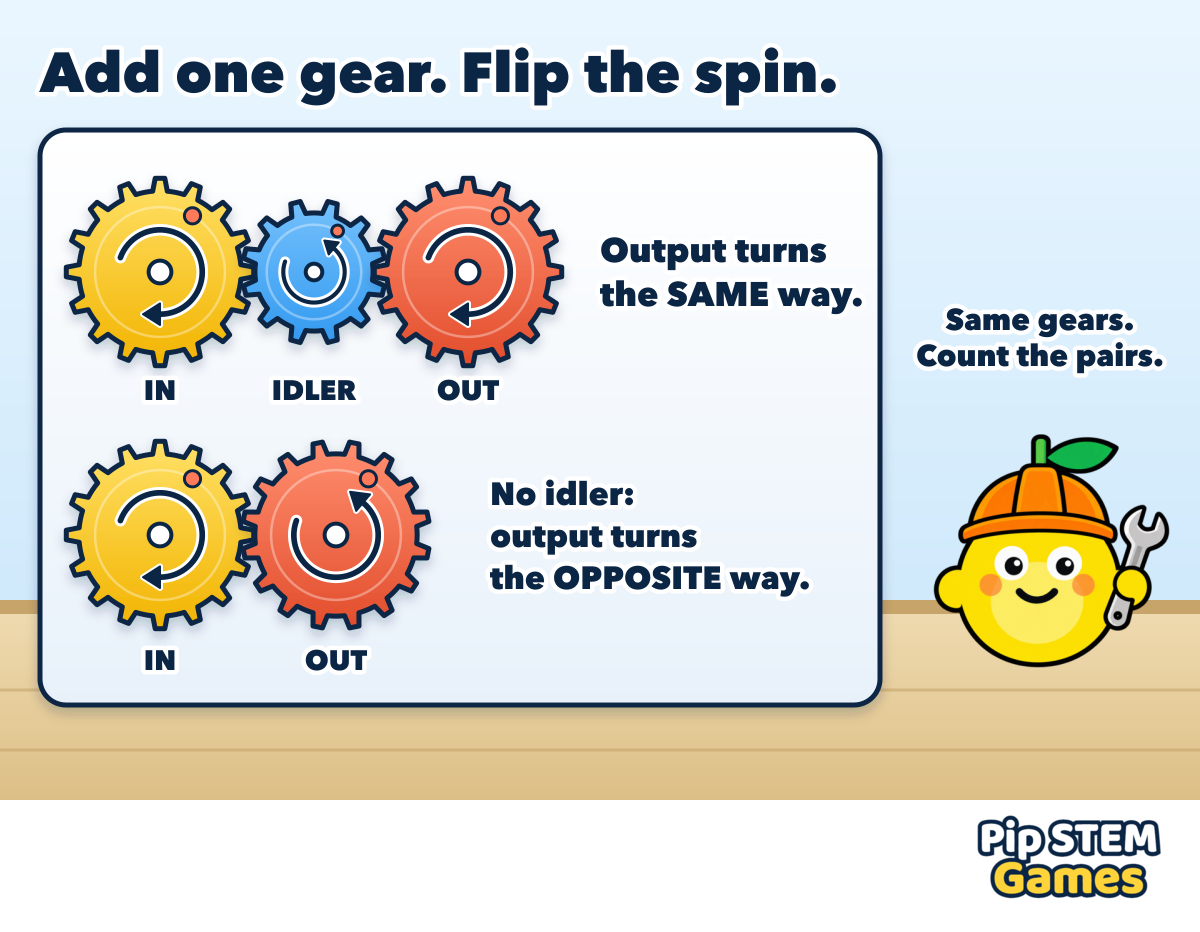
It flips the direction of the last gear and nothing else. Picture a machine with three gears in a row: an input gear, a small idler in the middle, and an output gear. Turn the input clockwise and the output turns clockwise too. Now take the idler out and slide the last two gears together. The output suddenly spins anticlockwise.
Nothing else changed. Same input, same output gear, same hand turning the handle. That one small gear in the middle decides which way the whole machine ends up spinning, which is why engineers treat it as a direction switch.
The rest of this page shows why it happens, how to predict it, and how to test it at home with cardboard. Our last-gear puzzle is a good warm-up if your child likes guessing first.
Why do touching gears turn opposite ways?
Because the teeth push on each other, and a push from one tooth drags the next surface along with it. Look at the spot where two teeth meet. On gear A, which turns clockwise, the surface at that spot is moving down. Gear B can only follow if its surface moves down there too. A surface on the left side of a wheel that moves down means the wheel is turning anticlockwise.
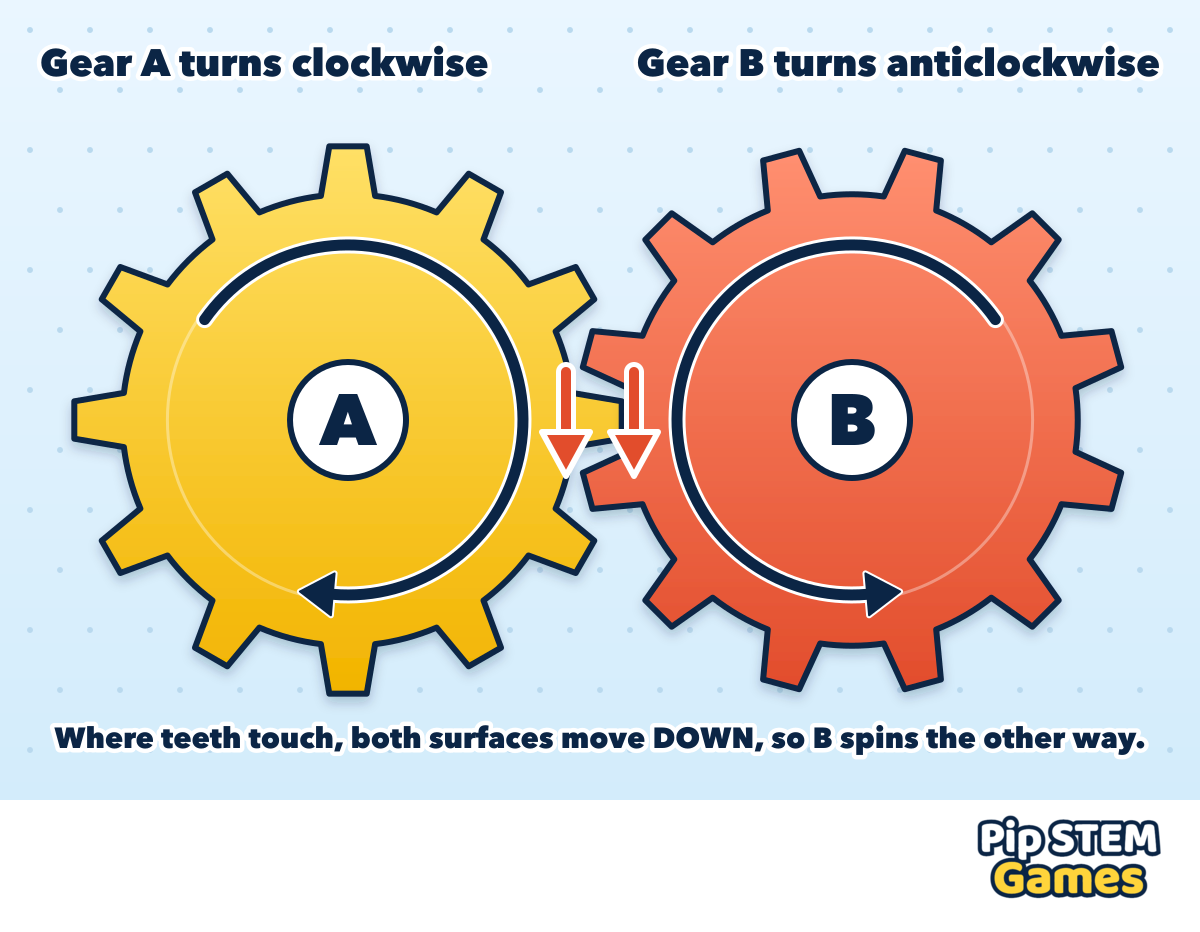
Try it with your hands. Hold your two fists side by side, touching, and roll them like gears. Your left fist rolls one way and your right fist rolls the other. They can never roll the same way while they touch.
One rule makes this work: the teeth must be the same size. A gear with big teeth won't mesh with a gear that has tiny ones, even if the sizes of the wheels match.
How do you work out which way the last gear turns?
Count the touching pairs in the chain. Each pair flips the direction once. One pair flips it, two pairs flip it back, three pairs flip it again. So an even number of pairs gives the same direction as the input, and an odd number of pairs gives the opposite.
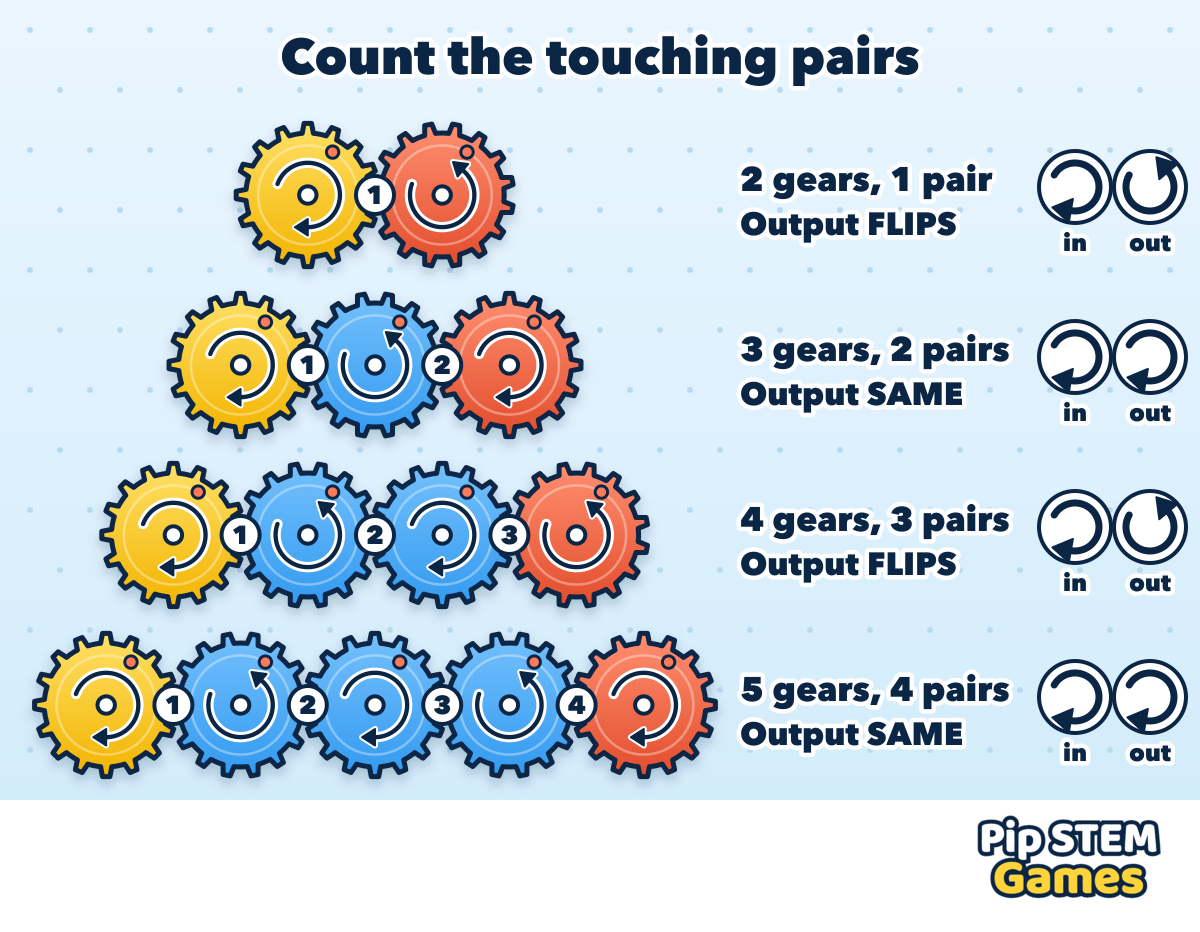
There is an even quicker shortcut. If the chain has an odd number of gears, the last gear turns the same way as the first. If it has an even number, it turns the opposite way. This works for a single line of gears, one touching the next.
Ask your child to predict before turning anything. Guessing first is the useful bit, because a wrong guess is the thing that makes the rule stick. Our four-gear direction challenge uses exactly this, and you can try it on screen in the Gear Factory game.
Does the middle gear change the speed?
No. An idler changes direction only. The speed depends on the teeth of the first gear and the last gear, and the idler's teeth cancel out.
Here is the rule: turns out for each turn in = teeth on the input gear divided by teeth on the output gear. If the input has 20 teeth and the output has 10, the output turns 20 divided by 10, which is 2 times for every single turn of the input. Add a 12-tooth idler in between and the answer is still 2. Only the direction changes.
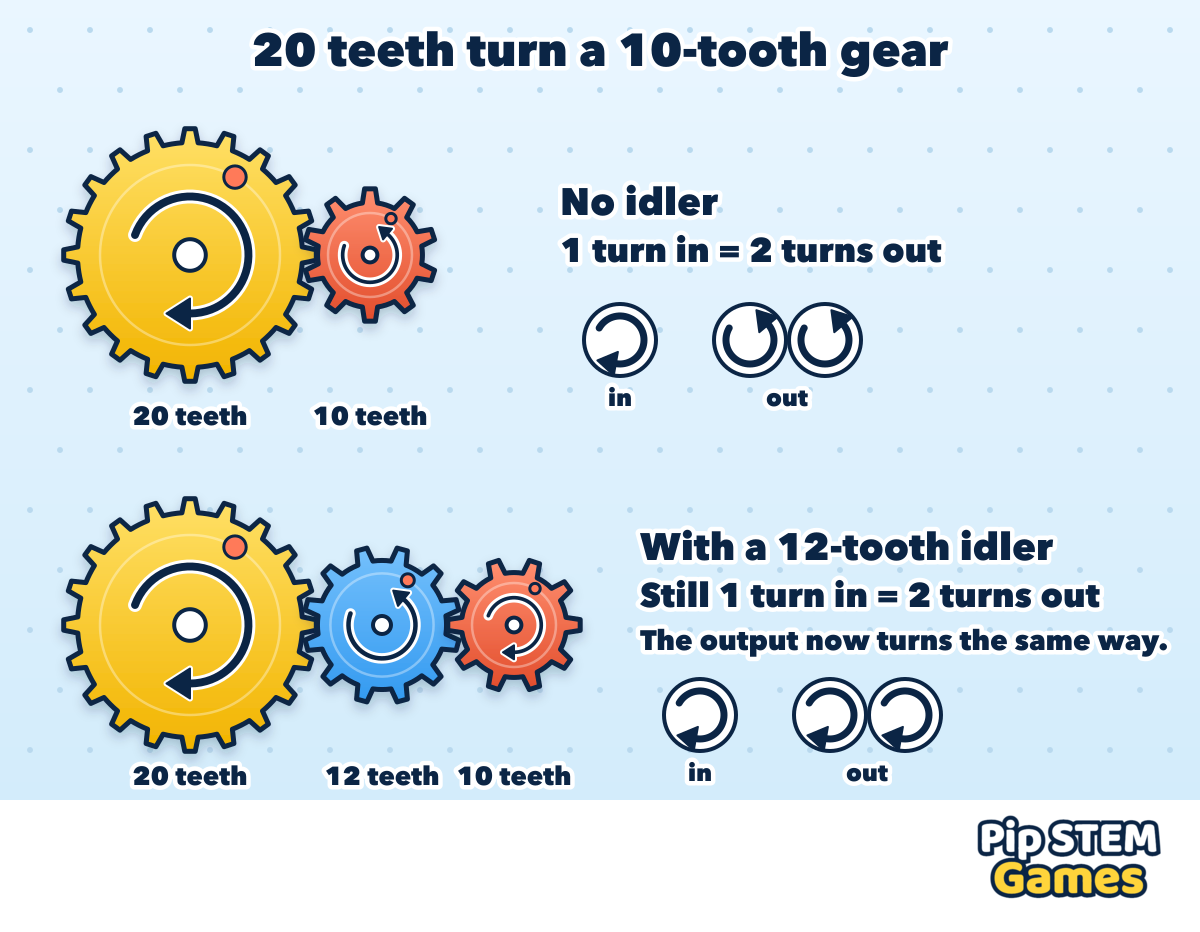
It also means you can make an idler any size you like. Engineers use that trick to bridge a gap between two gears that sit too far apart, or to make the output turn the right way without changing the speed at all.
Why do small gears spin fast but big gears push hard?
A gear trades speed for turning force. When a big gear drives a small one, the small gear spins faster but pushes more weakly. When a small gear drives a big one, the big gear spins slower but pushes harder. Engineers call that turning push torque.
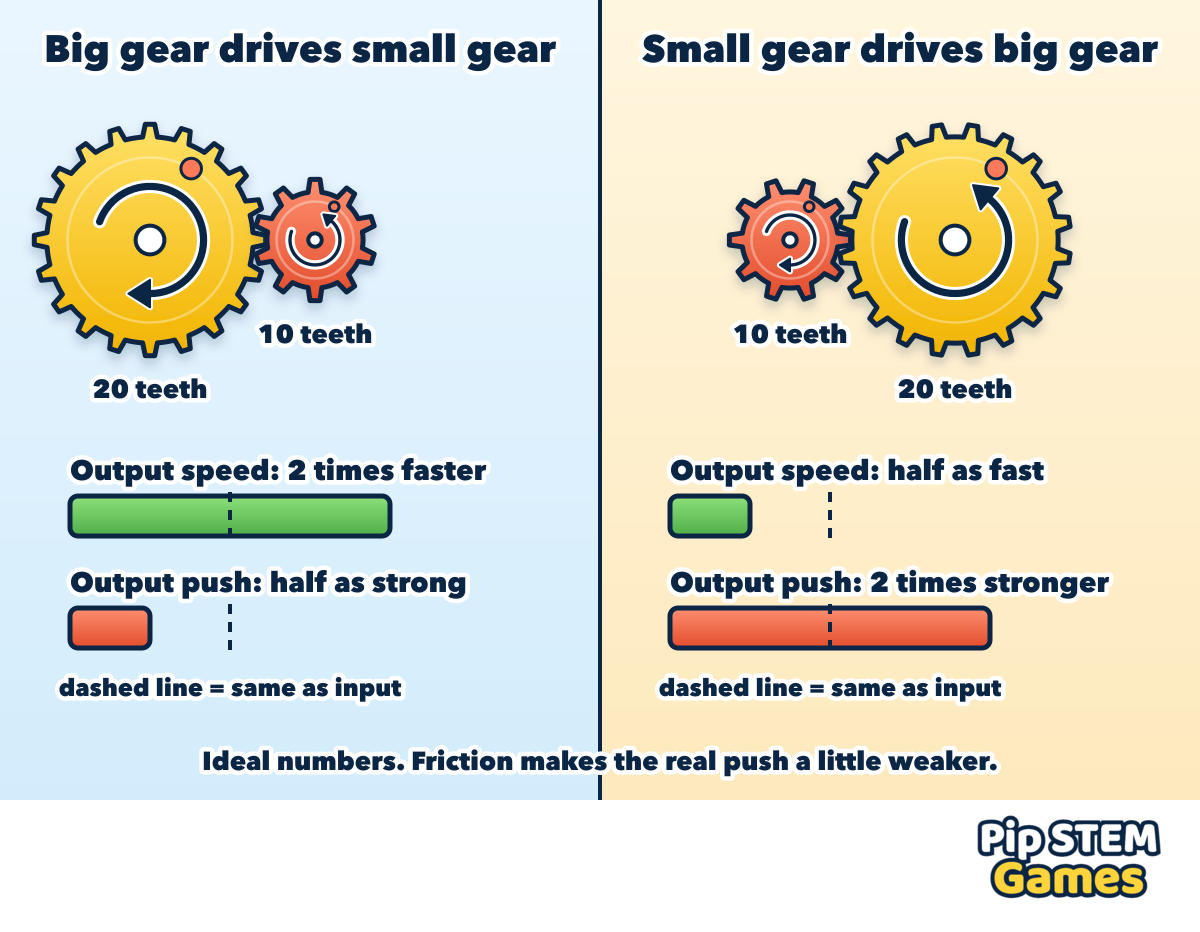
With the 20-tooth and 10-tooth pair, the 10-tooth output spins twice as fast but with half the turning push. Swap them round and the output spins at half speed with twice the push. You can't get both at once. Real gears lose a little to friction, so the true push is slightly lower than the ideal numbers.
You already use this on a bike. In a low gear the pedals move a lot while the wheel turns slowly, which is slow but strong enough for a hill. Our post on how gear puzzles help children understand machines has more everyday examples.
How can your child build and test this at home?
Build a three-gear machine from cardboard in about 20 minutes. It suits ages 6 to 12, with a grown-up doing the cutting.
You need:
- the printable gear sheet below, or thick cardboard and a cup to draw circles
- a foam board or a thick piece of corrugated cardboard
- four sharpened pencils
- a glue stick, scissors and a ruler
- a marker pen for the dots
Safety: a grown-up cuts the cardboard and pushes the pencils into the board. Put the sharp end in the board and leave the eraser end out. Keep cut gears and pencils away from children under 3. Where the teeth meet is a pinch point, so turn a gear by pushing the dot with one finger and keep fingers, sleeves and hair off the teeth.
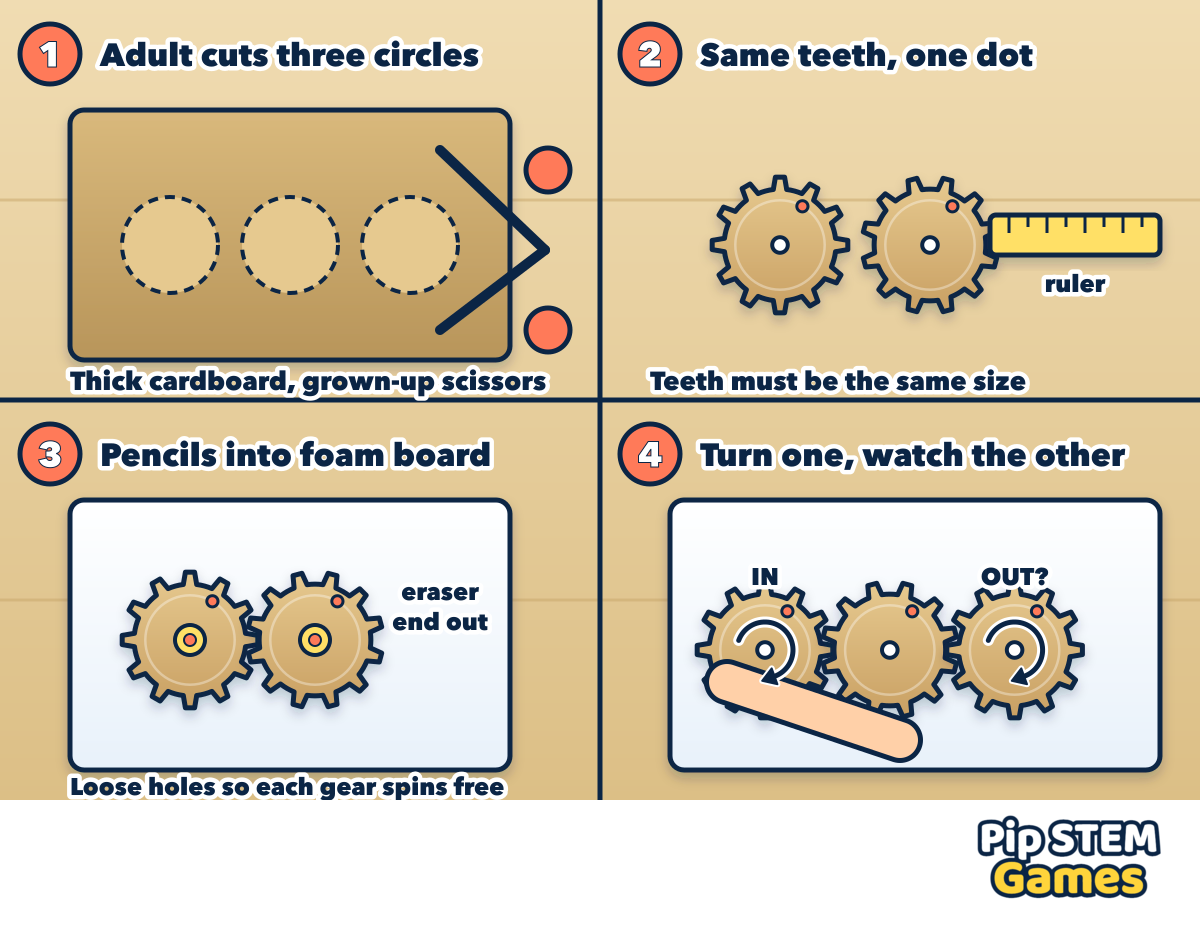
- Print the sheet, glue it to thick cardboard, and have a grown-up cut out the gears along the dashed lines.
- Colour a dot on one tooth of every gear. The dot makes the turning easy to see.
- Pin the first two gears 41 mm apart with pencil holes a little wider than the pencils. The teeth should just mesh, with a tiny bit of slack.
- Turn the first gear clockwise and watch the dot on the second. Write down which way it went.
- Add a third gear in a line and guess before you turn. Then try removing the middle one.
No cardboard? A toy gear set or a LEGO gear kit does the same job. The home-made version teaches one extra thing: you have to place the centres exactly, just like a real engineer.

What if the gears slip or jam?
If the teeth skip, the gears are too far apart. Move the pencil holes a little closer. If the gears jam or squeak, they are too close, so spread them by a millimetre or two. Make the centre holes slightly loose so each gear spins freely, and check that the cardboard teeth are the same size on every gear.
Keep the test fair. Turn the first gear clockwise every time. Change only one thing at once, such as adding or removing the middle gear. Repeat each setup three times. If you get three different answers, something is slipping, which is a great thing to fix together.
Frankly, the best bit of this activity is when the prediction is wrong. Say "Interesting, what did you not expect?" and let your child find the pair they miscounted.
How can you change it for each age, and what comes next?
- Ages 5 to 7 (easier): use two gears and a toy set. Say "clockwise" or "the other way" and count the turns of the dot.
- Ages 8 to 10: use the printable table. Predict, test and record clockwise or anticlockwise for two, three and four gears.
- Ages 11 to 12 (harder): use gear B (6 teeth) driven by gear A (12 teeth). Predict the turns out for each turn in, then count them. Then add a gear between them and see what changes.
The next challenge is a big input gear and a small output gear. Count the turns out for each turn in, then add an idler in the middle. Did the direction change? Did the count change? Write your prediction first.
For more machines like this, try the simple machines guide, and the gear and machine puzzles in the Senior Engineers workbook (ages 8 to 12) or the Junior Engineers workbook (ages 5 to 7).
Questions parents ask
Why do gears turn in opposite directions?
When two gears mesh, their touching teeth move the same way at the contact point. That makes one wheel turn clockwise and the other anticlockwise.
What is an idler gear?
An idler gear is a gear in the middle of a chain that doesn't drive anything itself. It changes the direction of the last gear and leaves the speed ratio alone.
How do I tell which way the last gear turns?
Count the touching pairs. An even number of pairs means the last gear turns the same way as the first. An odd number means it turns the opposite way.
Does an idler gear make the output faster or slower?
No. Only the teeth on the first and last gears set the speed. With 20 teeth in and 10 out, the output turns twice per input turn, with or without an idler.
What is torque in simple words?
Torque is turning push. A small output gear spins faster with less torque. A big output gear spins slower with more torque.
What age is this gear activity for?
Ages 5 to 12. Younger children can use two toy gears and a dot, and older children can work out ratios from tooth counts.
Is the cardboard gear activity safe?
Yes with an adult doing the cutting and pushing in the pencils. Keep small parts from under-3s and keep fingers off the meeting teeth.
Great STEM activities to try next...
 If This Gear Turns Right, Which Way Does the Last Gear Turn?Activity
 Simple Machines for Kids: The 6 Types, With Examples and Activities [Printable]How it works
 STEM Activities by Age: 5–7, 8–10 and 11–12Parent guide
More to try:

Pip STEM Games
We make engineering games and workbooks for kids aged 5 to 12. Every activity here is one we'd happily run at the kitchen table: test it, watch it fail, fix it, try again.




