

Key takeaways
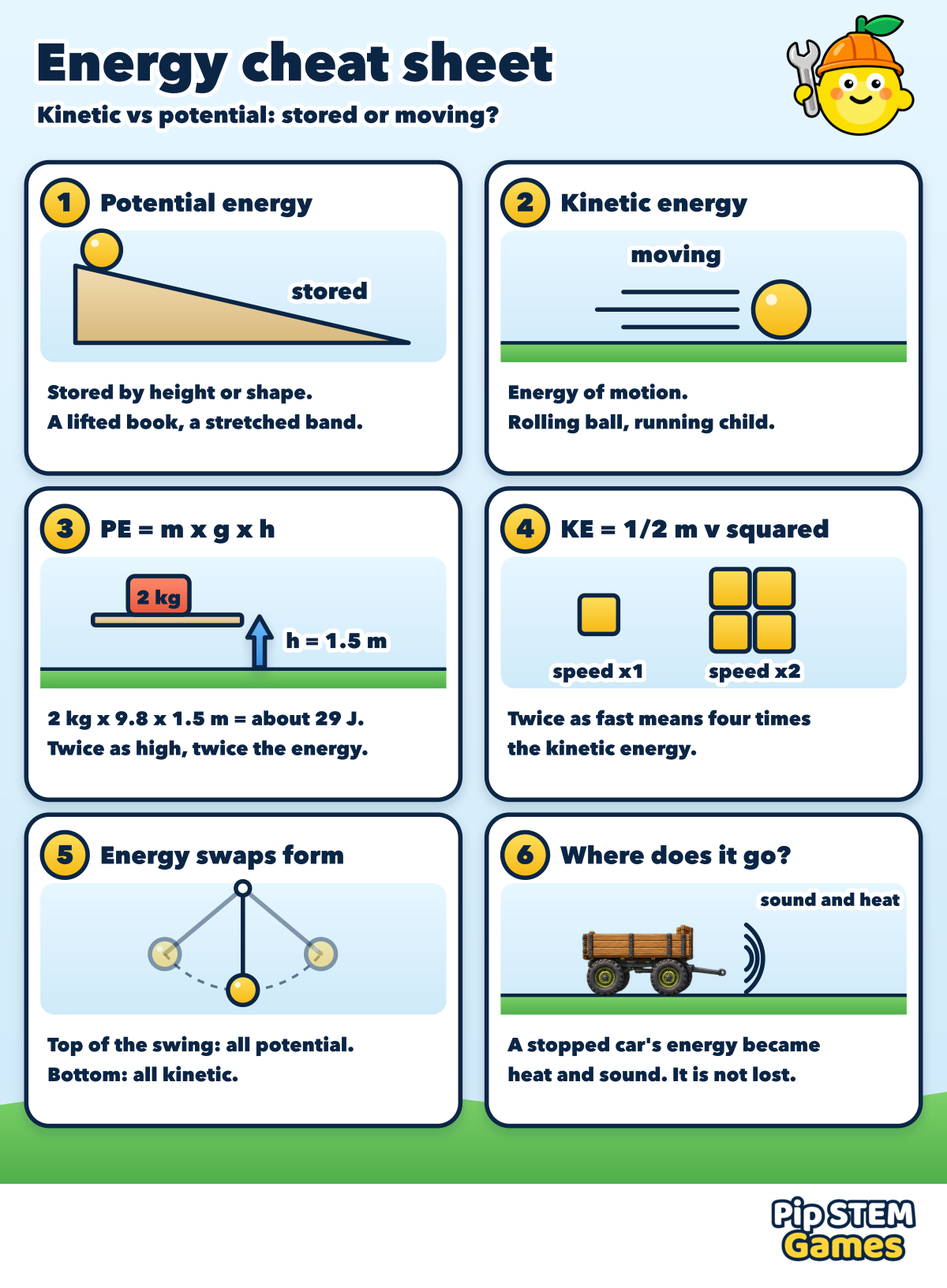
- Potential energy is stored energy waiting to be used. Kinetic energy is the energy of something moving.
- Raising an object, stretching a spring or squashing a ball all store potential energy.
- Double the height and you double the stored energy. Double the speed and you quadruple the kinetic energy.
- Energy changes form but isn't used up. Friction turns some of it into heat and sound.
- A ramp, a rubber band and a swing show the whole idea in three short experiments.
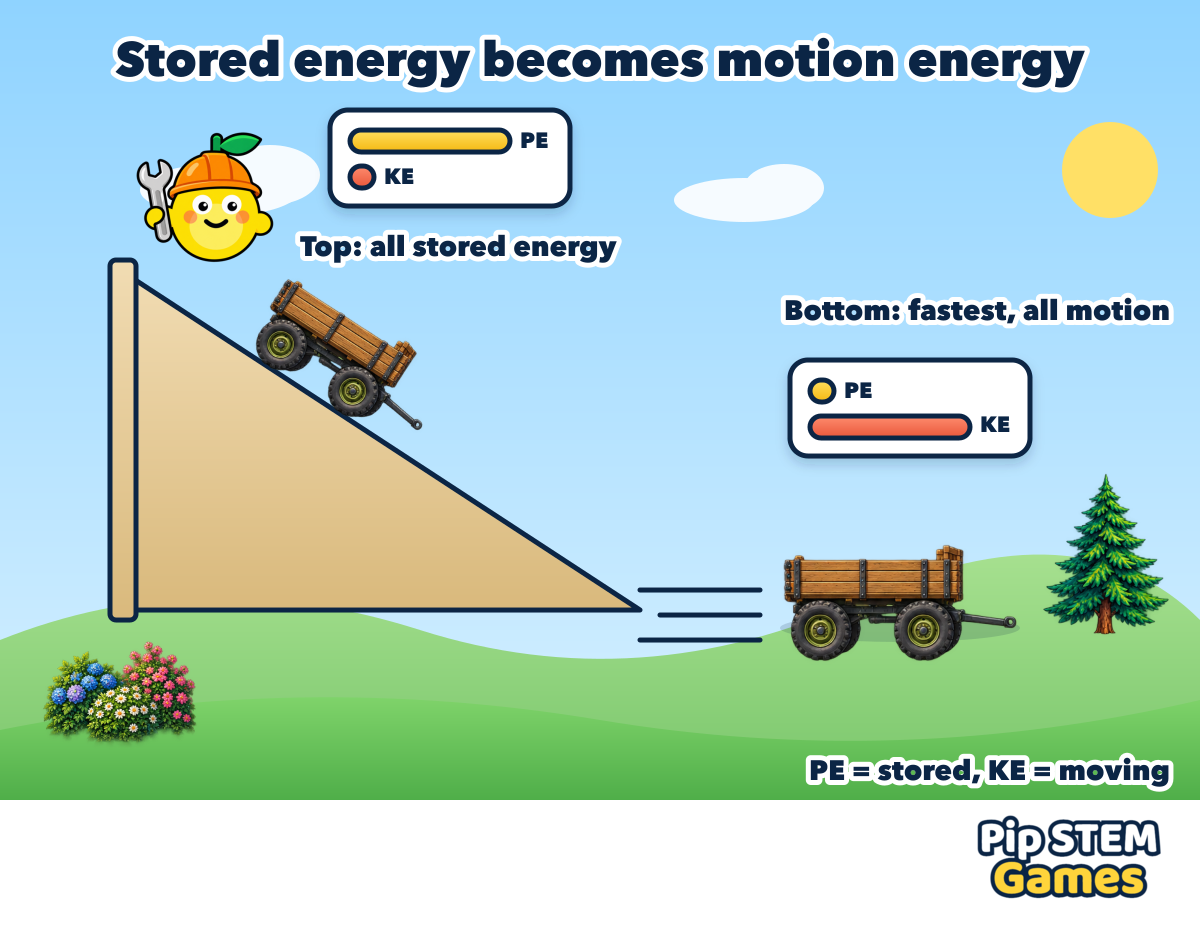
Potential energy is stored energy, and kinetic energy is the energy something has because it's moving. A ball held at the top of a slide has potential energy; as it rolls down, that stored energy turns into kinetic energy. A stretched rubber band, a lifted book and a squashed spring all store potential energy. A rolling ball, a running child and a flying paper plane all have kinetic energy. This guide gives clear examples, the simple rules for working them out, and three experiments for ages 8 to 12. There is also a printable record sheet for all three energy tests.
What is the difference between potential and kinetic energy?
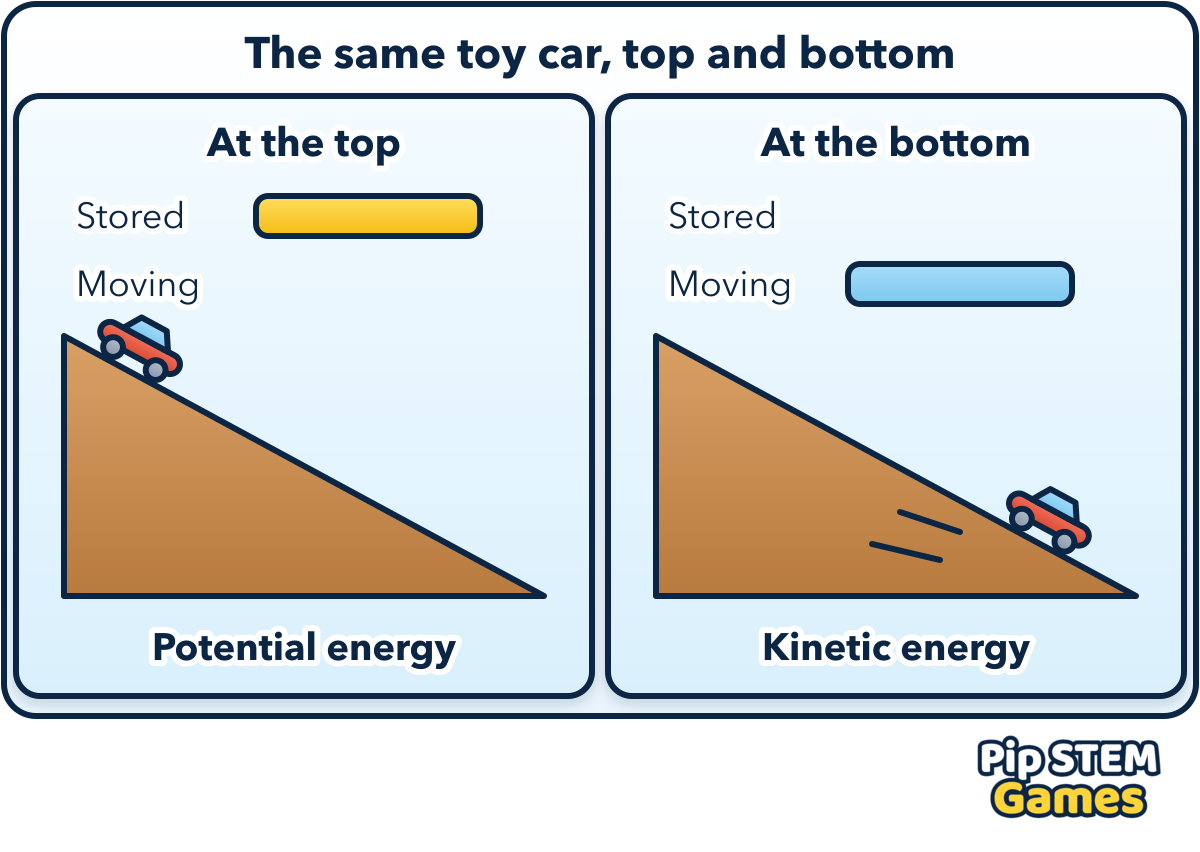
Potential energy is energy stored because of an object's position or shape. Kinetic energy is energy an object has because it is moving. The one is "ready to go" and the other is "going".
| Potential energy | Kinetic energy | |
|---|---|---|
| What it is | Stored energy | Movement energy |
| Depends on | Height and weight (gravitational), or how far something is stretched or squashed (elastic) | Weight and speed |
| Example | A skateboarder at the top of a ramp | The same skateboarder racing down it |
| Measured in | Joules (J) | Joules (J) |
Both are forms of mechanical energy, and both are measured in joules. A joule is roughly the energy needed to lift a small apple (about 100 g) one metre.
What are examples of kinetic and potential energy?
Everyday examples are easiest to learn in pairs, because the same object often swaps between the two.
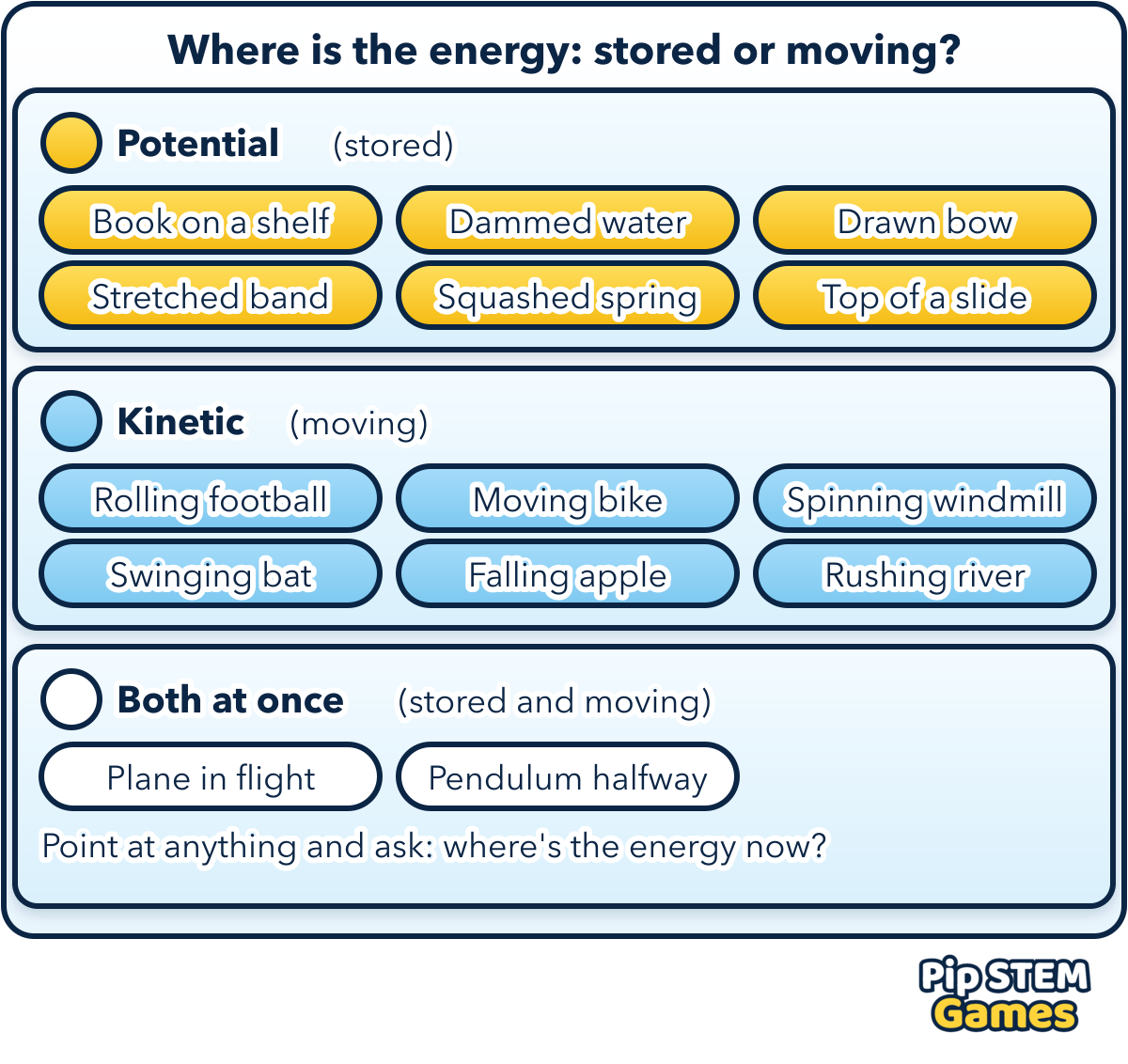
- Potential: a book on a high shelf, water behind a dam, a drawn bow, a stretched rubber band, a compressed spring, a child at the top of a slide.
- Kinetic: a rolling football, a moving bike, a spinning windmill, a swinging bat, a falling apple, water rushing down a river.
- Both at once: a plane in flight is high up (potential) and moving (kinetic). A pendulum halfway through a swing is partly each.
A useful question to ask your child is "where's the energy now?". Point at an object and ask whether it's stored or moving. Anything that can fall, spring back or unwind is storing some.
How does potential energy turn into kinetic energy?
Potential energy turns into kinetic energy whenever something stored is released, and the total stays the same. A ball at the top of a ramp loses height and gains speed in exactly equal measure, apart from small losses to friction.
Follow a swing to see it. At the highest point the swing stops for an instant: all potential, no kinetic. At the bottom it's fastest: all kinetic, least potential. Then it rises again, trading speed back for height.
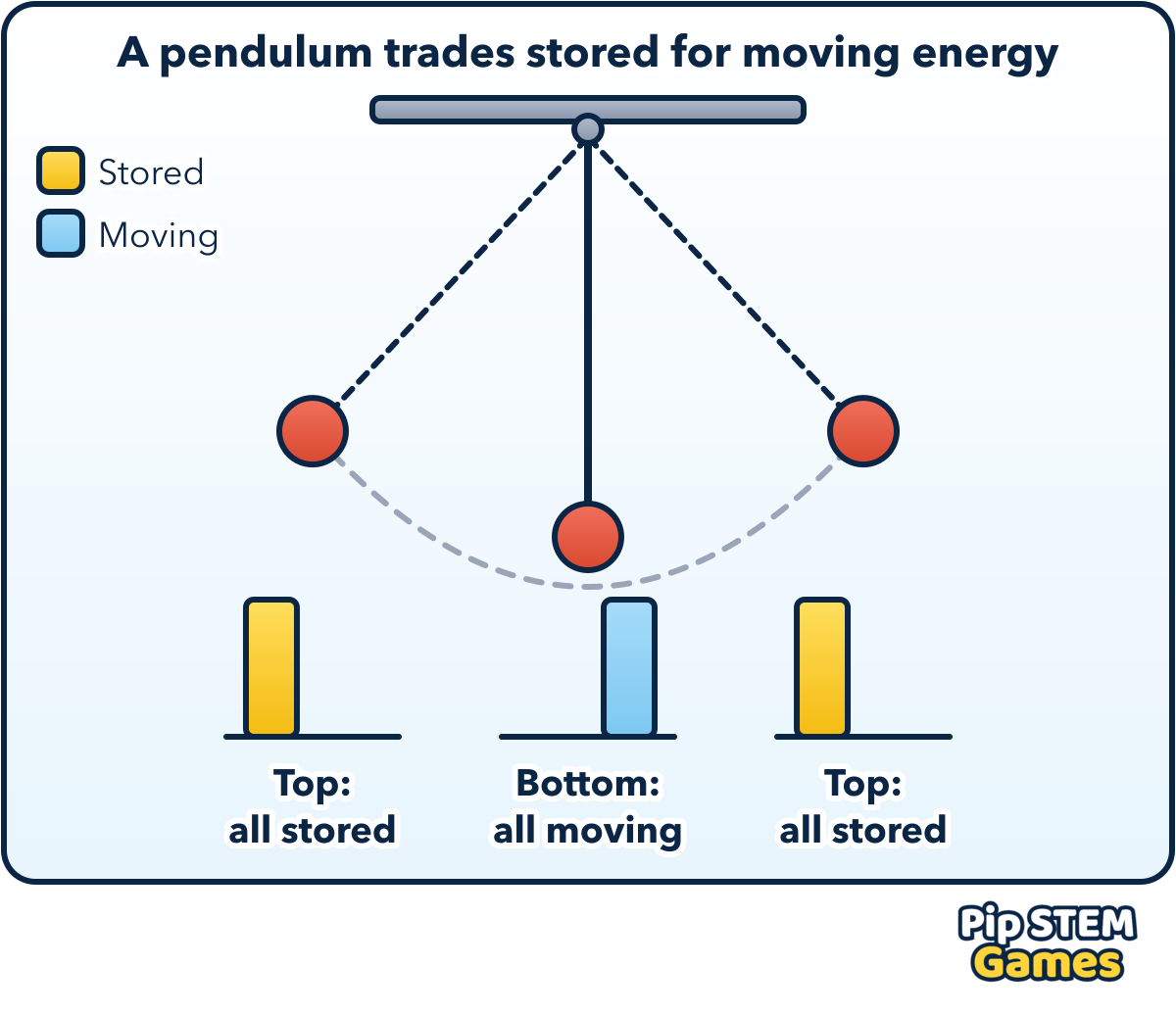
The swing never quite reaches the same height twice, because air and the chain's pivot turn a little energy into heat and sound each swing. Energy is never lost; it just changes into forms that are harder to use.
The Spring Shot game lets children feel this: pull the spring back further and the launch flies faster, because more stored energy becomes more motion.
How do you calculate potential and kinetic energy?
Gravitational potential energy equals mass times gravity times height (PE = m × g × h), and kinetic energy equals half the mass times speed squared (KE = ½ × m × v²). Gravity on Earth is about 9.8 m/s², often rounded to 10 for quick sums.
Worked example: a 2 kg bag of flour on a shelf 1.5 m up has about 2 × 9.8 × 1.5 = 29 J of potential energy.
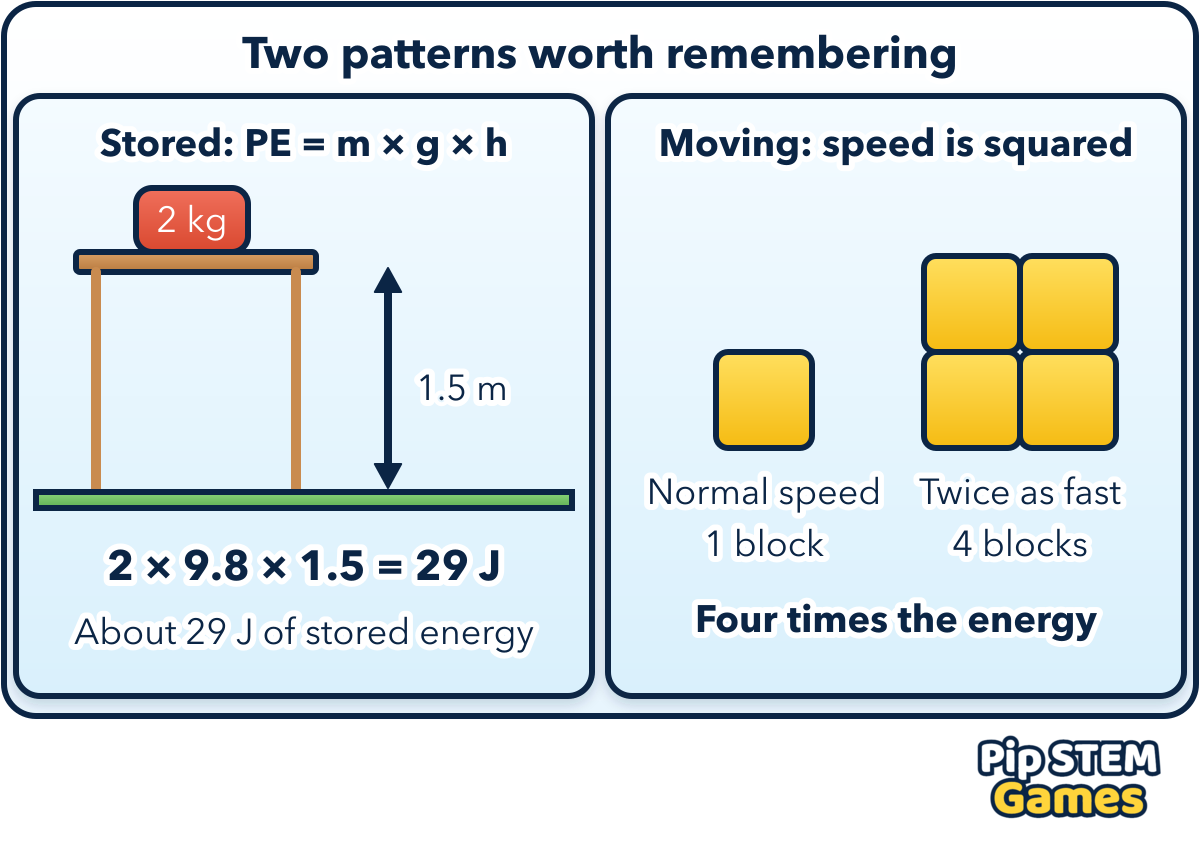
Two patterns are worth remembering, even if your child never does the algebra:
- Height is proportional. Twice as high stores twice as much energy.
- Speed is squared. Twice as fast means four times the kinetic energy. That's why a car at 60 mph is far more dangerous than at 30 mph, and why stopping distances grow so quickly.
Younger children (around 8) can skip the formulas and just rank: "which has more energy, the heavy ball or the light ball at the same speed?" Older ones (11 and up) can plug in numbers.
Which experiments show kinetic and potential energy?
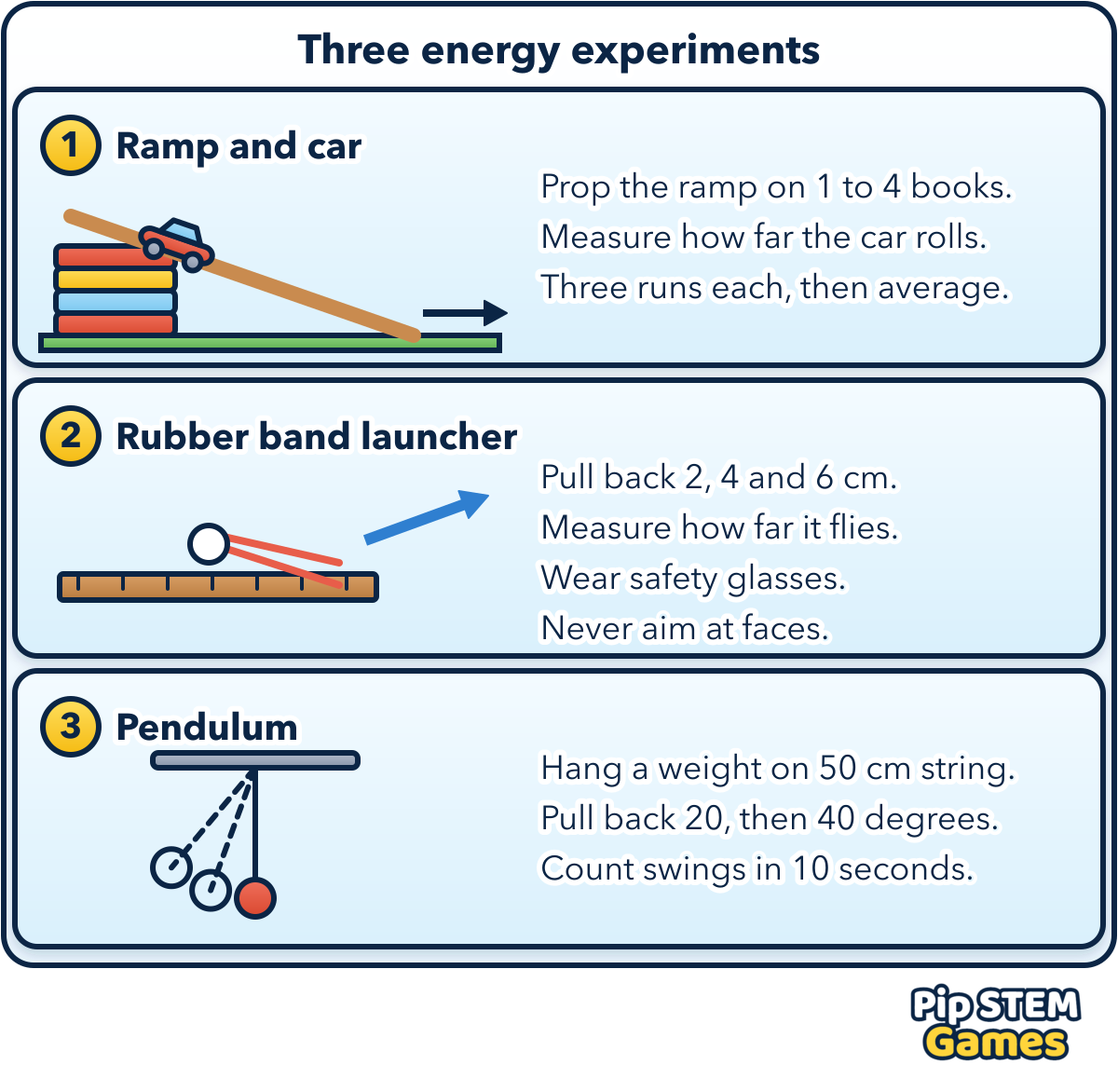
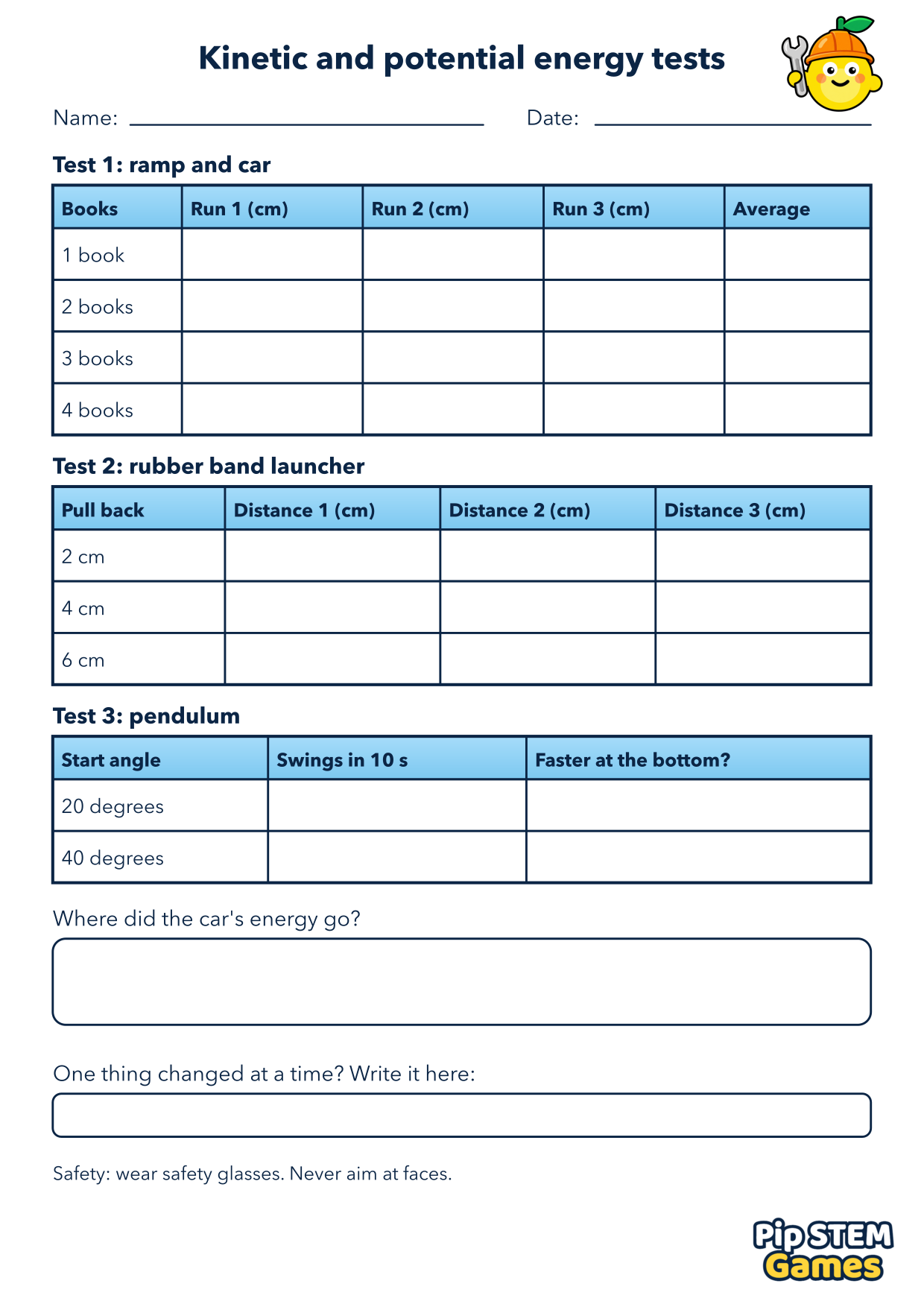
Three experiments show the whole idea: a ramp and car, a rubber band launcher and a pendulum. Each takes about 15 minutes.
1. Ramp and car
You need: a toy car, a board or book, a ruler, a few books to stack, a tape measure.
- Prop the board on 1 book. Release the car from the top and measure how far it travels along the floor after the ramp.
- Repeat with 2, 3 and 4 books. Do three runs each and average them.
- Plot height against distance. The higher ramp stores more energy, so the car goes further.
2. Rubber band launcher
Stretch a rubber band over the top of a ruler and flick a paper ball with it, pulling back 2 cm, 4 cm and 6 cm. Measure the distances. A longer stretch stores more elastic potential energy. Wear safety glasses and never aim at faces. An adult should supervise this one: use only a light paper ball, keep other people and pets out of the line of fire, and use a plain rubber band, not a hair tie with metal.
3. Pendulum
Use a light weight such as a washer or a small bag of coins, and keep the swing clear of faces and breakable things. Hang a weight from a 50 cm string. Pull it back 20 degrees and release, then 40 degrees. Count swings in 10 seconds. Surprisingly, the swing takes almost the same time at both angles (the 40 degree swing is only about 3% slower), but the bigger swing is faster at the bottom because it started higher.
Our cardboard marble run is the same experiment with a marble and a lot more fun: the first drop gives the marble all the energy it will ever get.
What goes wrong when kids test energy ideas?
The most common problem is changing two things at once. If the ramp is higher and the car is different, the results can't be compared.
- Surface changes: carpet slows the car far more than wood. Use the same floor.
- Release method: pushing the car adds energy. Let go; don't push.
- One-off results: do three runs and average them.
- Thinking energy disappears: a stopped car still had its energy. It went into heat, sound and tiny bits of warmth in the wheels.
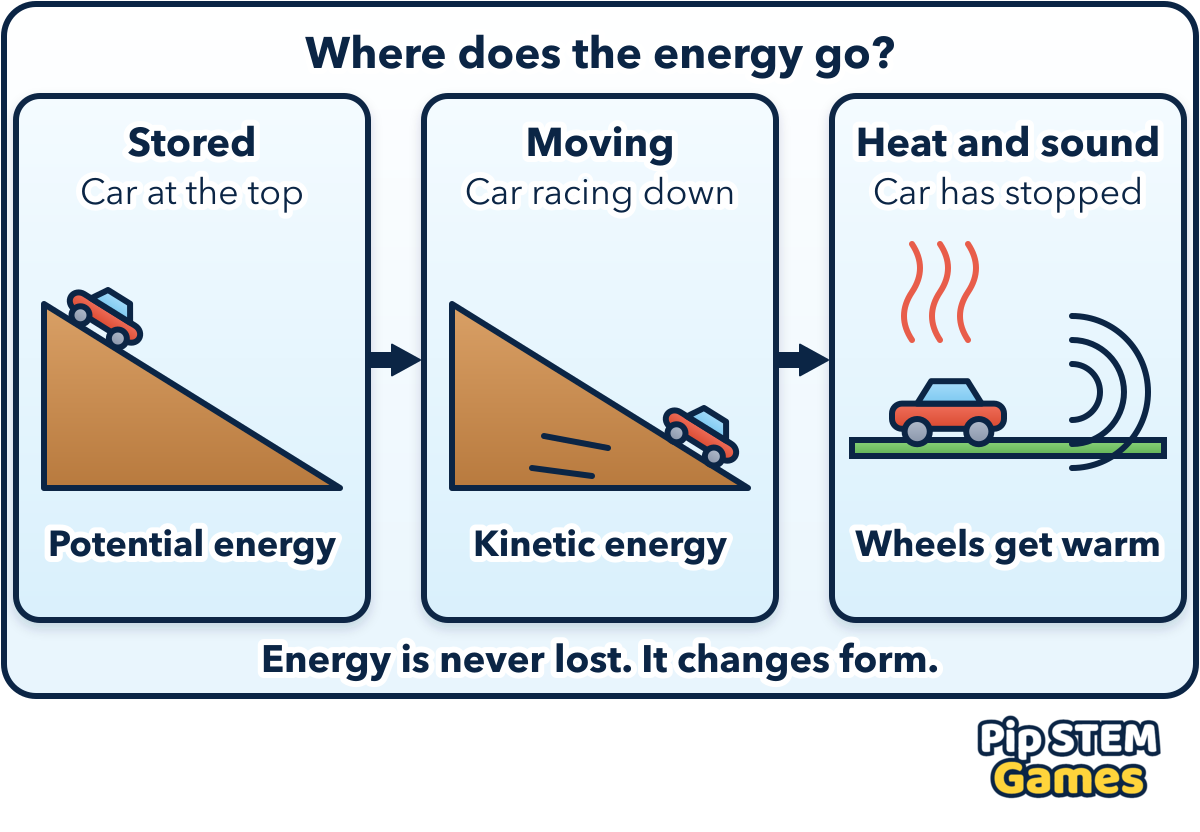
The reality is that this last point trips up adults too. Ask your child where the car's energy went and let them argue about it.
To see energy turn into motion in a different setting, our balloon-powered car turns stored air pressure into movement, and the Senior Engineers workbook has energy and force puzzles for ages 8 to 12.
Questions parents ask
What is a simple definition of potential and kinetic energy?
Potential energy is stored energy, such as a ball held high. Kinetic energy is movement energy, such as that same ball falling.
Can an object have both kinetic and potential energy?
Yes. A bird flying high has potential energy from its height and kinetic energy from its speed. A swinging pendulum has some of each except at the very top and bottom.
Is energy ever lost?
Energy isn't destroyed, but some of it becomes heat and sound through friction and air drag. That energy spreads out and is hard to use again, which is why a swing slowly stops.
What units are kinetic and potential energy measured in?
Joules, written J. One joule is about the energy to lift a 100 g apple one metre.
Is a stretched spring potential or kinetic energy?
Potential energy, called elastic potential energy. When you let go it turns into kinetic energy as the spring moves.
What age should kids learn about potential and kinetic energy?
The idea works from about age 7 with ramps and swings. The formulas suit ages 11 to 12 and are usually taught at secondary school.
Great STEM activities to try next...
 DIY Cardboard Marble Run for Kids: Build a Floor-Low Ramp Track [Printable]Build challenge
 Make a Balloon-Powered Car at Home [Printable]Build challenge
 Build a Simple Pulley With Household Items [Printable]Build challenge
More to try: Bernoulli's Principle for Kids and Flying (Printable)

Pip STEM Games
We make engineering games and workbooks for kids aged 5 to 12. Every activity here is one we'd happily run at the kitchen table: test it, watch it fail, fix it, try again.




