

Key takeaways
- Civil engineers plan, design, build and look after roads, bridges, water systems and more.
- Most projects go through four stages: plan, design, build and look after.
- The Thames Barrier, Forth Bridge and Channel Tunnel are big UK civil projects.
- Projects rarely go smoothly, so engineers adapt and keep designs safe.
- A paper bridge test and a spotter sheet let children try the ideas at home.
A civil engineer plans, designs, builds and looks after the things a whole community uses, such as roads, bridges, tunnels and water pipes. This guide explains the job in plain words, shows three giant UK projects, and gives you a paper bridge test and a printable spotter sheet to try at home.
What does a civil engineer do?
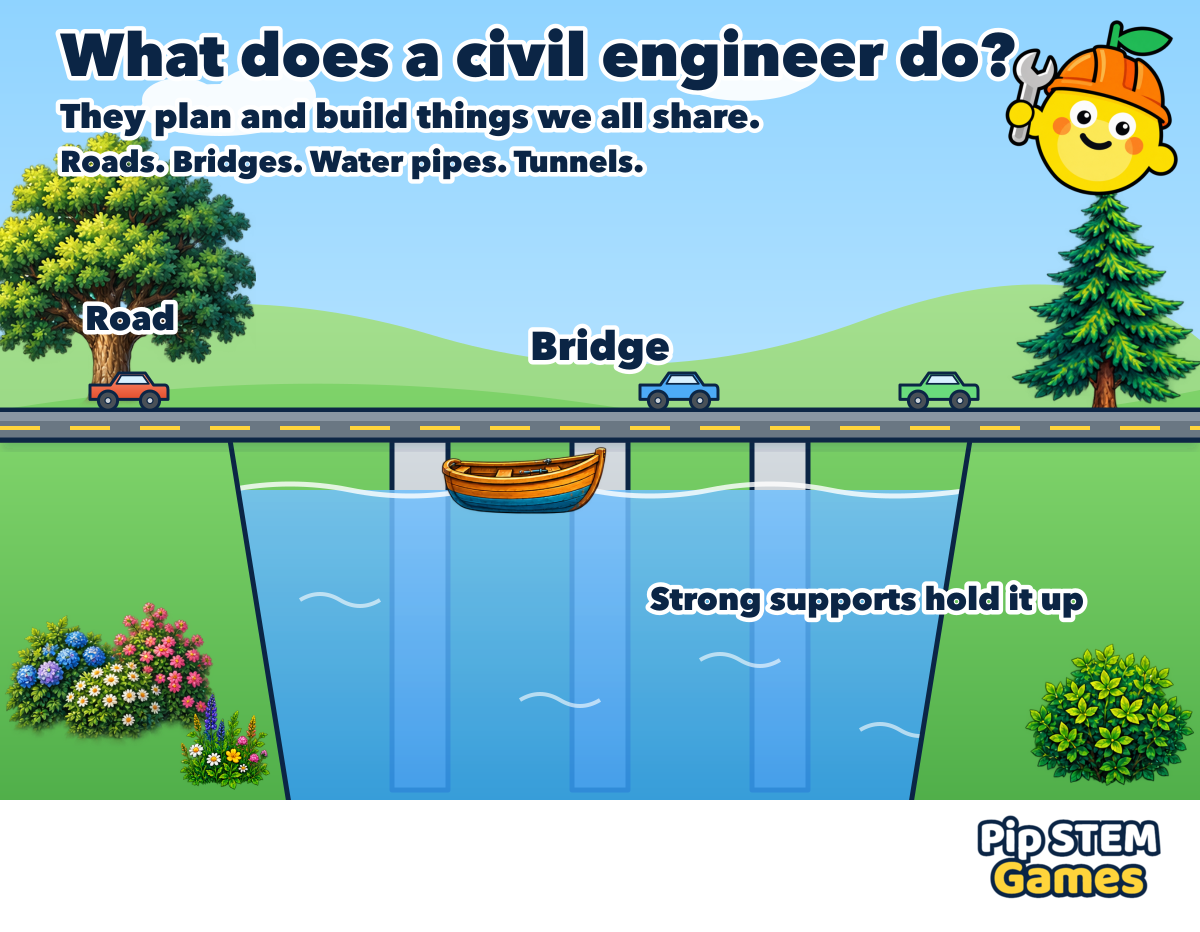
A civil engineer plans, designs, builds and looks after the things a whole community uses. Think of roads, bridges, dams, railways, tunnels, airports, harbours, and the pipes that bring clean water to your tap and carry waste water away.
You use their work before you finish breakfast. The water in your kettle, the pavement outside and the bus route to school all started as a plan on someone's desk.
This page shows what the job involves, what real projects look like, and how your child can try a little civil engineering at home. There is a printable spotter sheet too, for a walk around your own street.
What are the four jobs of a civil engineer?
Most projects go through four stages. A civil engineer can work on any of them.
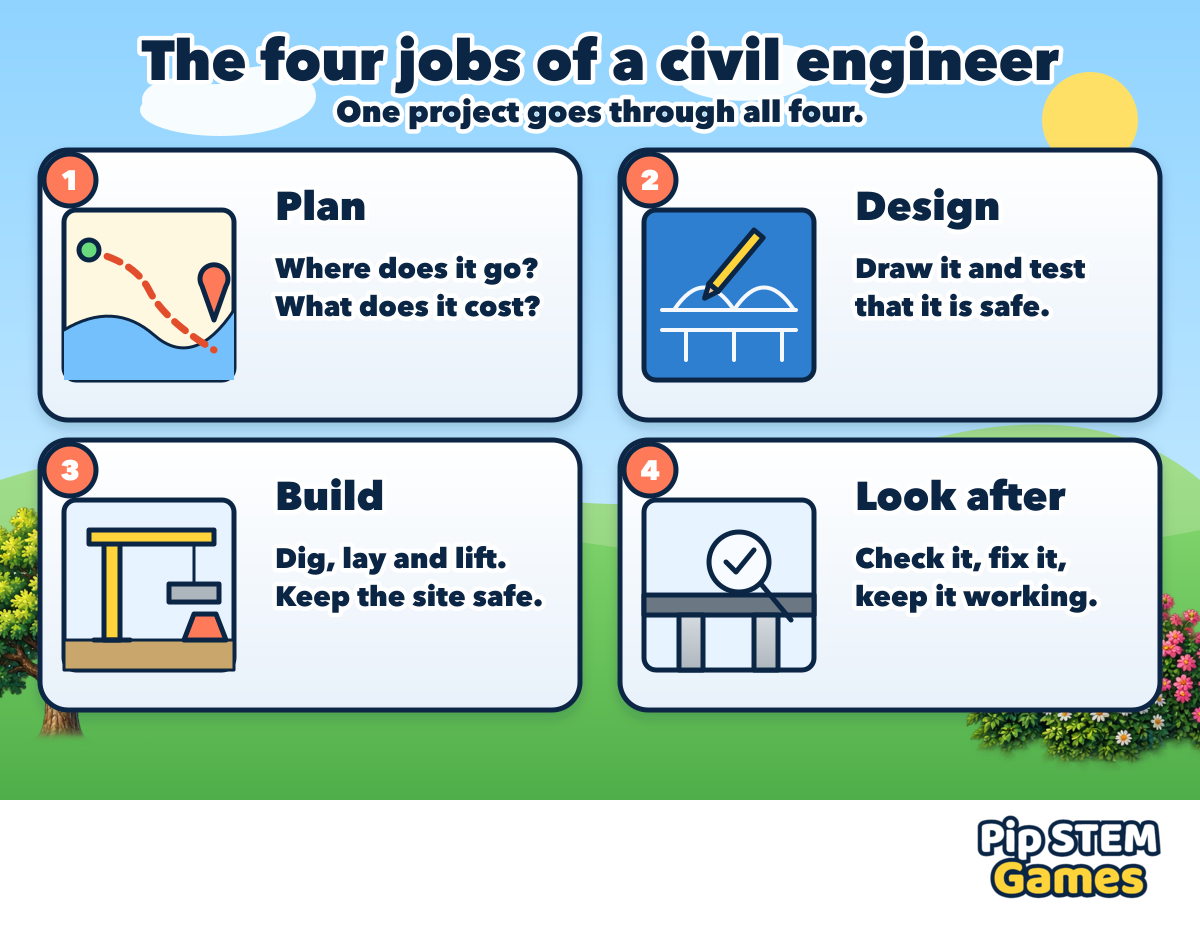
- Plan. Where should it go, and what will it cost? Engineers talk to the people who want the project, look at the land, and estimate the money, time and workers needed. They also check the risks and how the project will affect nature.
- Design. They draw the structure on computers using CAD drawings, and check that it will be safe. A cheap design is no good if it isn't safe.
- Build. They watch progress on site and make sure the work follows health and safety rules.
- Look after. Roads, bridges and water pipes wear out. Engineers inspect them and plan repairs, so they keep working.
Civil engineers also think about sustainability, which means making things that don't harm the planet more than they have to. They work in offices and on building sites, and with builders, councils, railway companies and water companies.
What kinds of civil engineer are there?
Civil engineering is a big job, so people often choose one area.
- Structural engineers work on buildings and bridges and how they carry weight.
- Water engineers work on rivers, dams, drinking water and drains.
- Transport engineers work on roads, railways and airports.
- Environmental engineers work on keeping land, air and water healthy.
Some children like the maths side, some like drawing, and some like being outdoors. Civil engineering has room for all three. To meet other kinds of engineer, read engineering careers kids might not know exist.
What have civil engineers built in the UK?
Real projects are a good way to show children how big this job can get. Here are three.
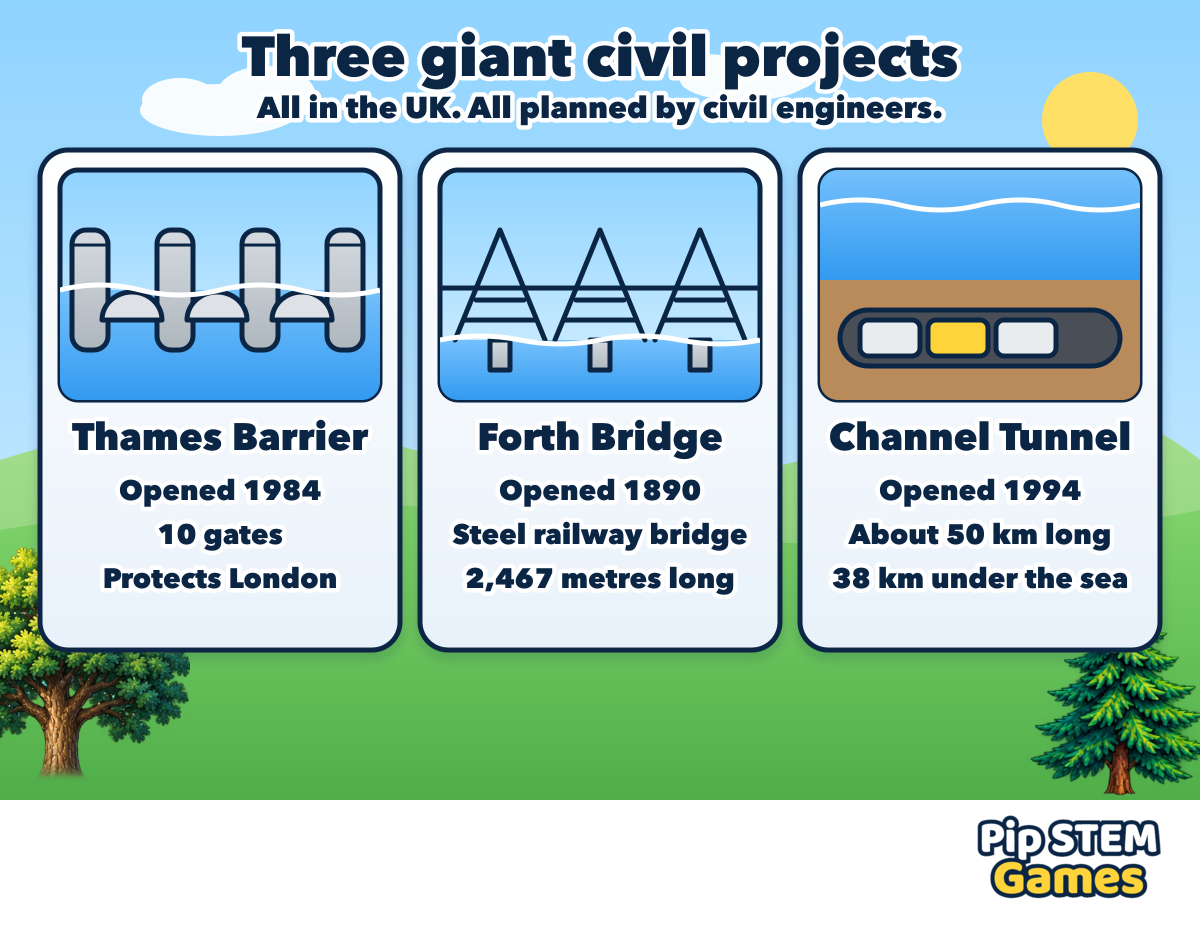
- The Thames Barrier has ten gates across the River Thames. Building began in 1974 and it opened on 8 May 1984. It protects most of Greater London from high tides and storm surges.
- The Forth Bridge in Scotland is a steel railway bridge. It opened on 4 March 1890 and is 2,467 metres long.
- The Channel Tunnel opened on 6 May 1994. It is about 50 kilometres long, and about 38 kilometres of that is under the sea. It has three tunnels: two for trains and one for workers and safety.
Ask your child: what do you think the engineers had to work out first? Many children say the ground, the water or the weight. Those are good answers.
What happens when a project goes wrong?
Projects rarely go smoothly. The weather turns bad. The people who ordered the project change their minds. A delivery of materials arrives late. Good civil engineers adapt, and they keep the design safe while they do it.
That is a useful thing to tell a child who gets cross when a tower falls over. Engineers meet problems all the time, and fixing them is the job. Our page on the engineering design process shows the loop of asking, imagining, planning, making, testing and improving.
How can your child try civil engineering at home?
Build a bridge from paper and test how much it holds. It takes about 15 minutes.
You need: two stacks of books, three sheets of A4 paper, a handful of UK 10p coins, and a ruler.
- Put the two book stacks about 20 cm apart. Check that the gap is the same each time you test.
- Lay one flat sheet of paper across the gap. Place 10p coins on the middle one at a time until it sags or falls. Count them.
- Fold a second sheet into a zigzag, like a paper fan, and lay it across. Add coins again and count.
- Try a third idea. Maybe a tube, or two sheets stuck together with tape.
- Compare your counts. Which shape held the most, and why do you think so?
Safety: coins are a choking risk for children under 3, so keep them away from little ones. Use blunt-ended scissors if you cut anything, and keep an adult nearby.
Pro tip: change only one thing between tests, and add the coins slowly. Then you can tell which change made the difference.
For more bridge ideas, try the paper bridge challenge. Children can also test shapes on screen in our Bridge game.
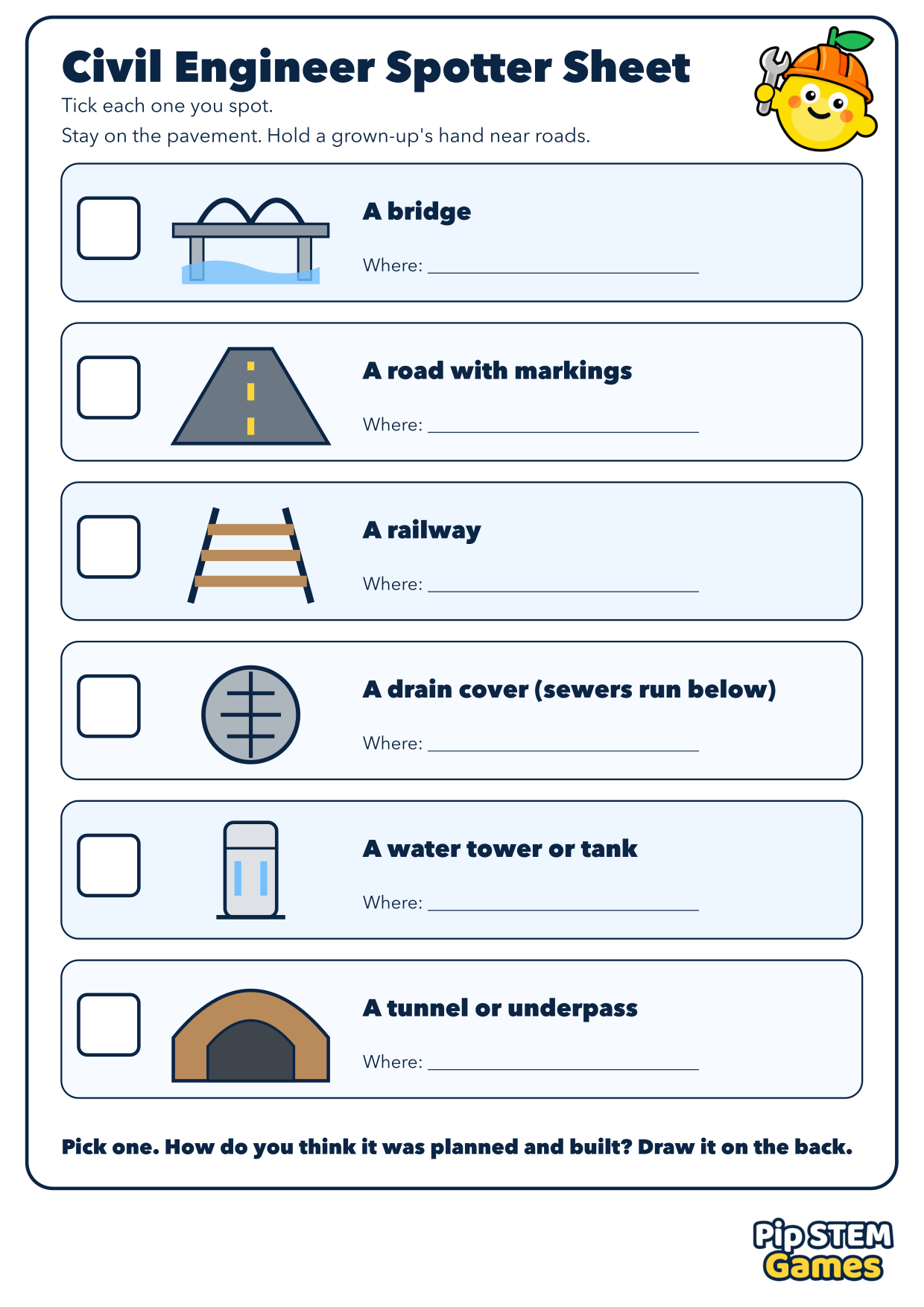
Print this spotter sheet and take it on a walk. Stay on the pavement, and hold a grown-up's hand near roads.
How do you change it for each age?
Match the task to the child.
- Ages 5 to 6 (easier): use the spotter sheet and talk about what each thing is for. Test one flat sheet and one folded sheet, and say which held more.
- Ages 7 to 9: count the coins for each design and write the numbers down. Ask which fold made the strongest bridge.
- Ages 10 to 12 (harder): make the gap wider and set a budget, such as three sheets of paper and 30 cm of tape. Draw the design before building it, like a real civil engineer.
The aim isn't to make the strongest bridge. It's to let a child see that the things around them were planned by people, and that they could plan something too.
Questions parents ask
What does a civil engineer do in simple words?
A civil engineer plans, designs, builds and looks after things people share, such as roads, bridges, railways, dams and water pipes.
What is the difference between a civil engineer and an architect?
An architect mainly designs how a building looks and works for the people inside. A civil engineer works on big shared structures and systems, such as bridges, roads and water pipes, and checks that structures are safe and strong.
Do civil engineers only work outdoors?
No. They work in offices, drawing and checking designs on computers, and on building sites, watching the work. Most do some of each.
What subjects help you become a civil engineer?
Maths and science help, and so do design and hands-on projects. Teamwork matters too, because civil engineers work with many other people.
What can my child build at home to try it?
A paper bridge between two stacks of books is a good start. Test how many 10p coins it holds, then change the shape and test again. Keep coins away from children under 3.
How long does a big civil project take?
It can take years. The Thames Barrier took about ten years from the start of building in 1974 to opening in 1984.
Great STEM activities to try next...
 Paper Bridge Challenge: Build a Bridge From One Sheet of Paper [Printable]Build challenge
 Why Are Arches So Strong?Activity
 Which Bridge Would You Build?Activity
More to try: How Does a Drawbridge Open? A Kids' Guide · What Does a Biomedical Engineer Do? Kids Guide · What Does a Sound Engineer Do? Kids Guide

Pip STEM Games
We make engineering games and workbooks for kids aged 5 to 12. Every activity here is one we'd happily run at the kitchen table: test it, watch it fail, fix it, try again.




