

Key takeaways
- A drawbridge opens by turning on a hinge while a cable lifts the free end.
- A turning effect is a force multiplied by its distance from the hinge.
- A counterweight partly cancels the deck weight, so little force is needed.
- Real bridges come as bascule, swing and lift types, each with a UK example.
- In your model, count and record your own coins, because results vary.
A drawbridge opens by turning on a hinge while a cable pulls the free end up, and a counterweight does most of the lifting. This page shows how real bridges work and how to build a cardboard drawbridge you can test at home.
How does a drawbridge open?
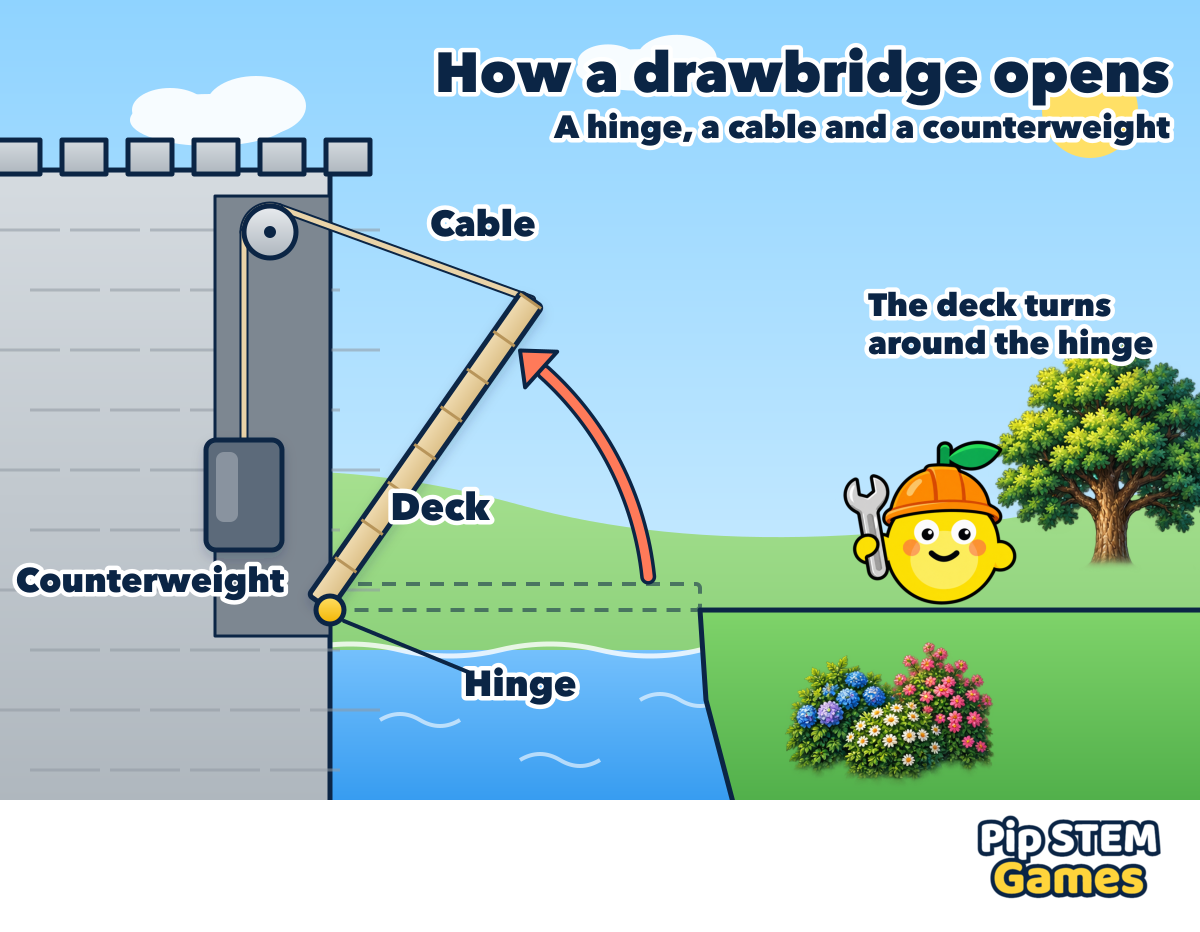
A drawbridge opens by turning on a hinge. One end of the deck is fixed to the ground, and the other end is pulled up by a cable. A heavy counterweight on the other side of the cable takes most of the work out of the lift, so the bridge can swing up with a small pull.
That is the whole idea, and it is easy to test at home. This page explains how real bridges open, what a "turning effect" is, and how to build a cardboard drawbridge that lifts when you add coins to a cup. You will count your own coins, so your results will be yours.
What are the main types of drawbridge?
Castle drawbridges were usually a wooden deck on a hinge, lifted by chains or ropes. Modern bridges that open for ships come in three main kinds, and the UK has a famous example of each.
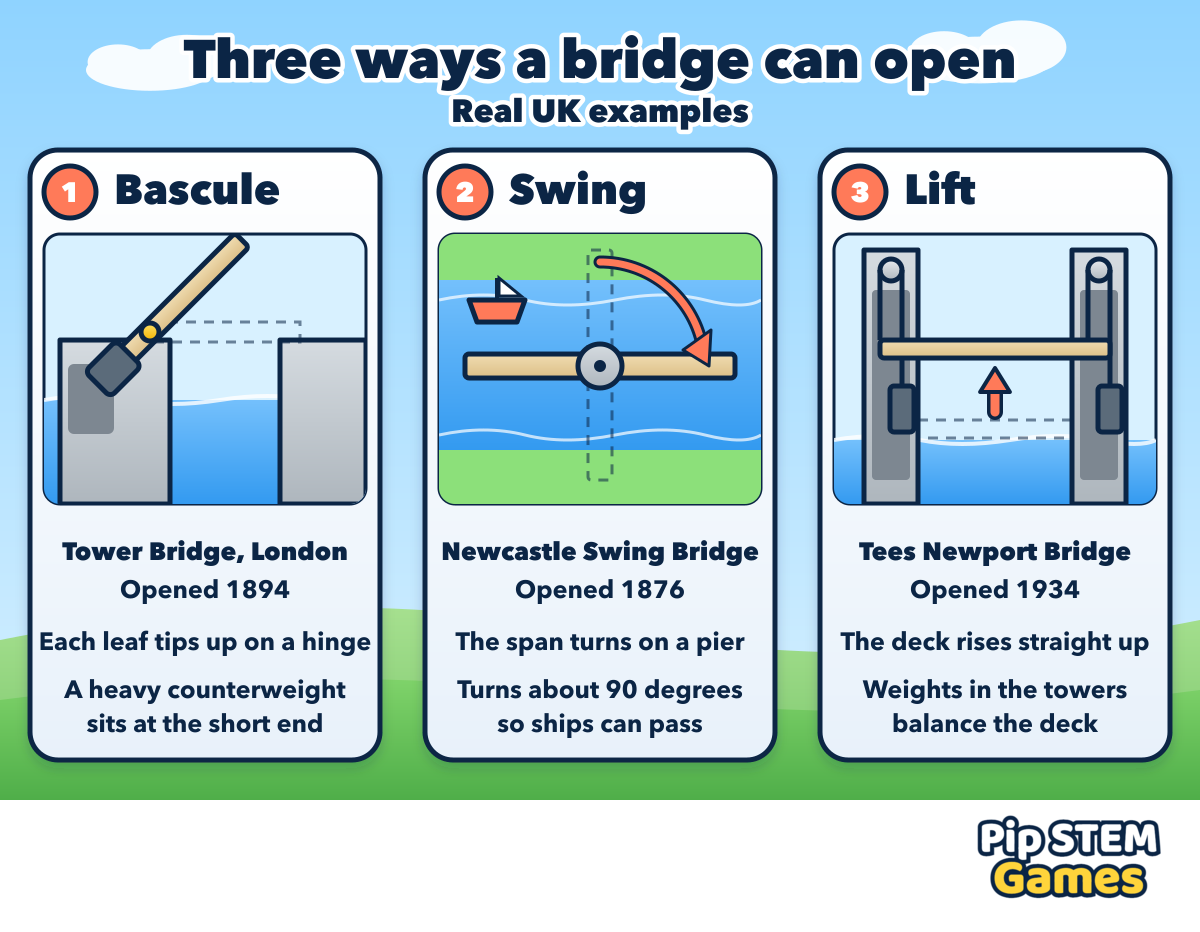
- Bascule. Each half, called a leaf, tips up on a hinge, a bit like a castle drawbridge. London's Tower Bridge, opened in 1894, is a bascule bridge. Heavy counterweights balance the leaves so they are easier to raise.
- Swing. The whole bridge turns sideways on a central pier until it lies along the river. The Swing Bridge in Newcastle, opened in 1876, turns about 90 degrees.
- Lift. The whole deck rises straight up between two towers, held on cables with counterweights inside the towers. The Tees Newport Bridge in Middlesbrough, opened in 1934, was the first large lift bridge in Britain.
Your model copies the first kind. The deck turns on a hinge, and a weight on the end of a cable does the lifting.
How does the hinge work?
A hinge is a joint that lets something turn around one line and nowhere else. A door hinge does it. So does the fold in a book cover.
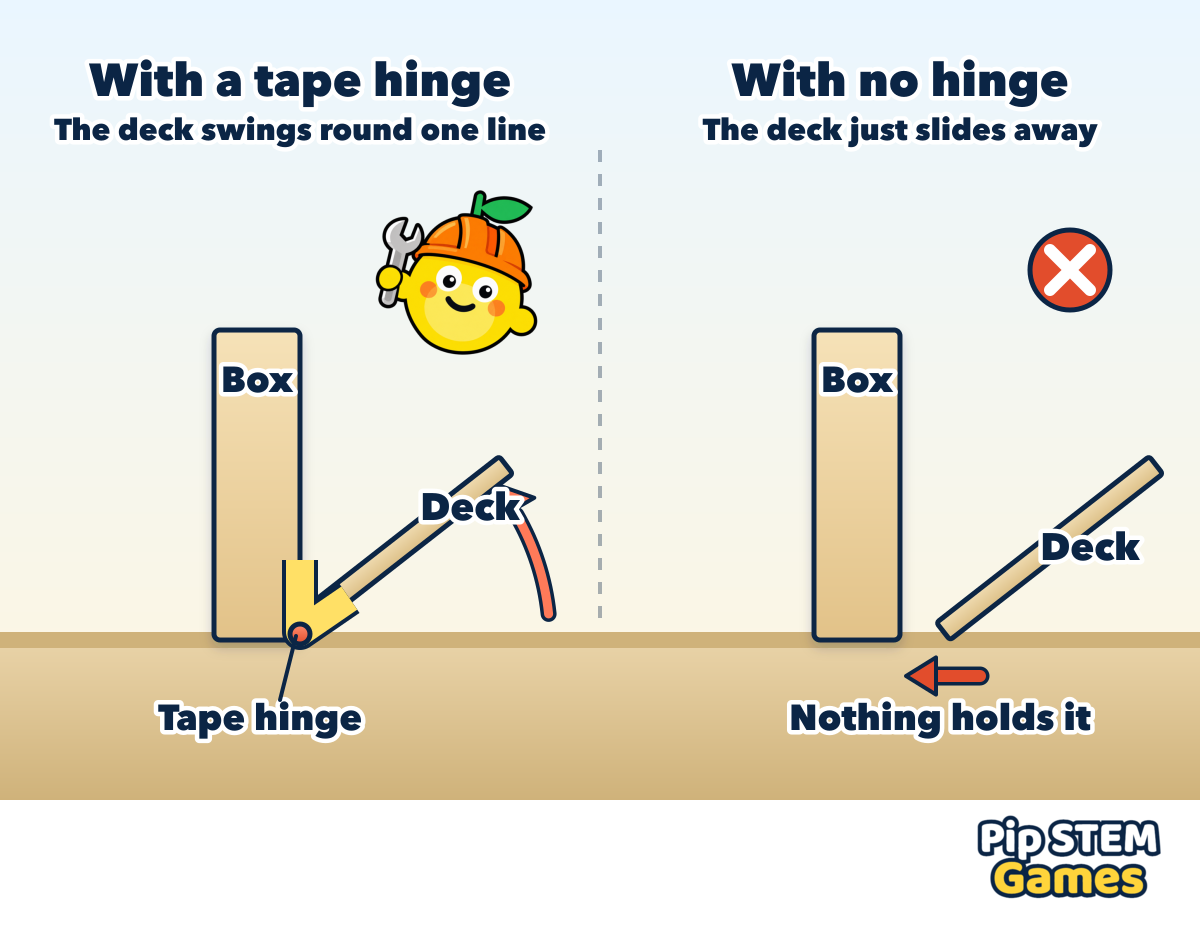
In your model, a strip of tape across the join is the hinge. The deck can only swing up and down around that line. Without it, the deck would slide about whenever you pulled the string, and the cable would drag it across the table.
Real drawbridges use strong metal pivots in place of tape, but the job is the same. The hinge keeps one end of the deck in place so the rest can swing.
What is a turning effect, and why does it matter?
Think about a see-saw. A heavy child sitting close to the middle can balance a lighter child sitting far out. What matters is not just the weight. It is the weight and how far it sits from the pivot.
Engineers call that a turning effect, or a moment. You find it by multiplying the push or pull by its distance from the hinge.
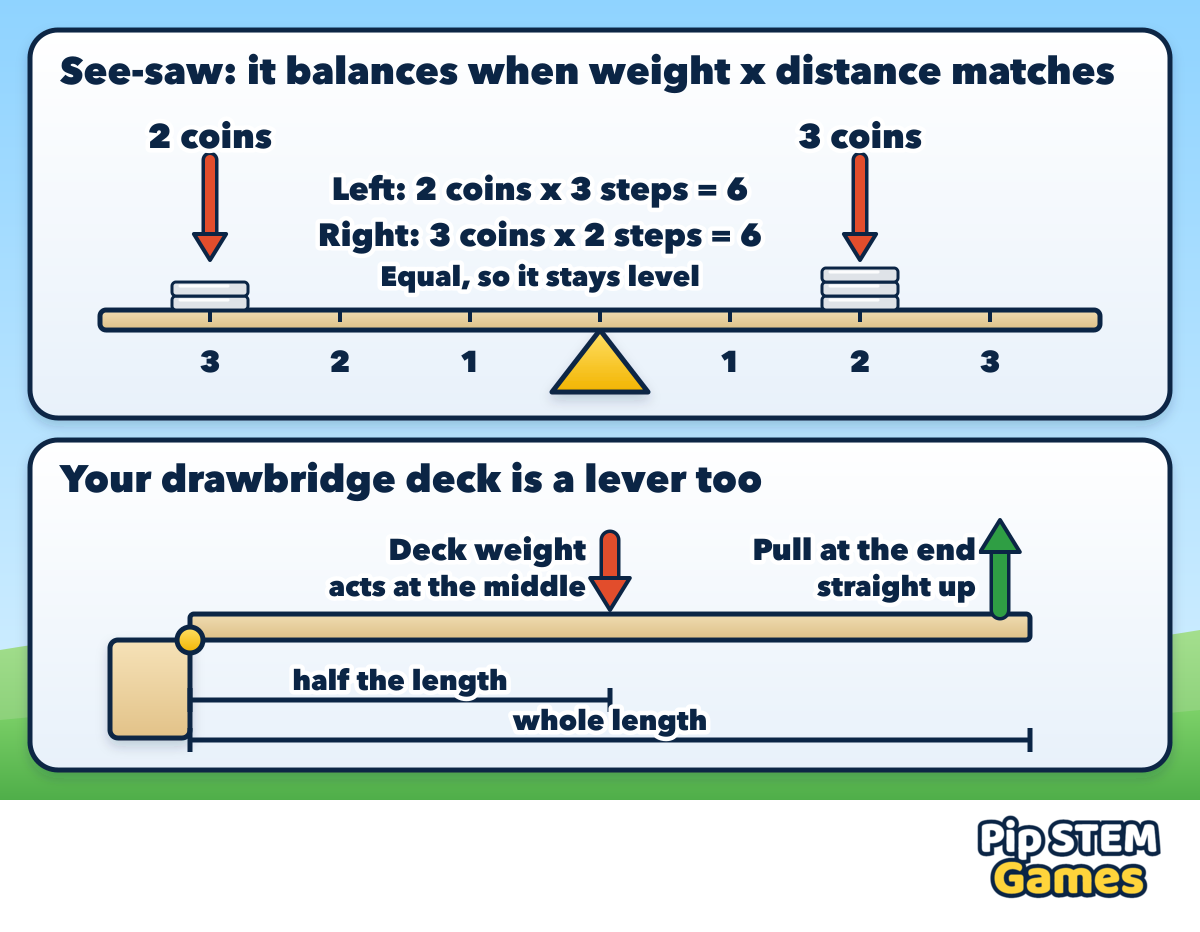
On the see-saw, 2 coins three steps out give 2 x 3 = 6. Three coins two steps out give 3 x 2 = 6. The two turning effects match, so the see-saw stays level.
A drawbridge deck is a lever too. Its weight acts at the middle, which is half the deck length from the hinge. A pull straight up at the far end acts twice as far out, so it only needs to be about half the deck weight. That is why a long, light deck is easier to lift than you might expect. You can meet the same idea in three everyday examples of levers, or try it in the Lever Lab game.
What does the counterweight do?
A counterweight pulls the opposite way to the weight you want to lift. In your model it is the cup of coins hanging behind the box. The string runs over the top of the box, so as the cup sinks, the end of the deck rises.
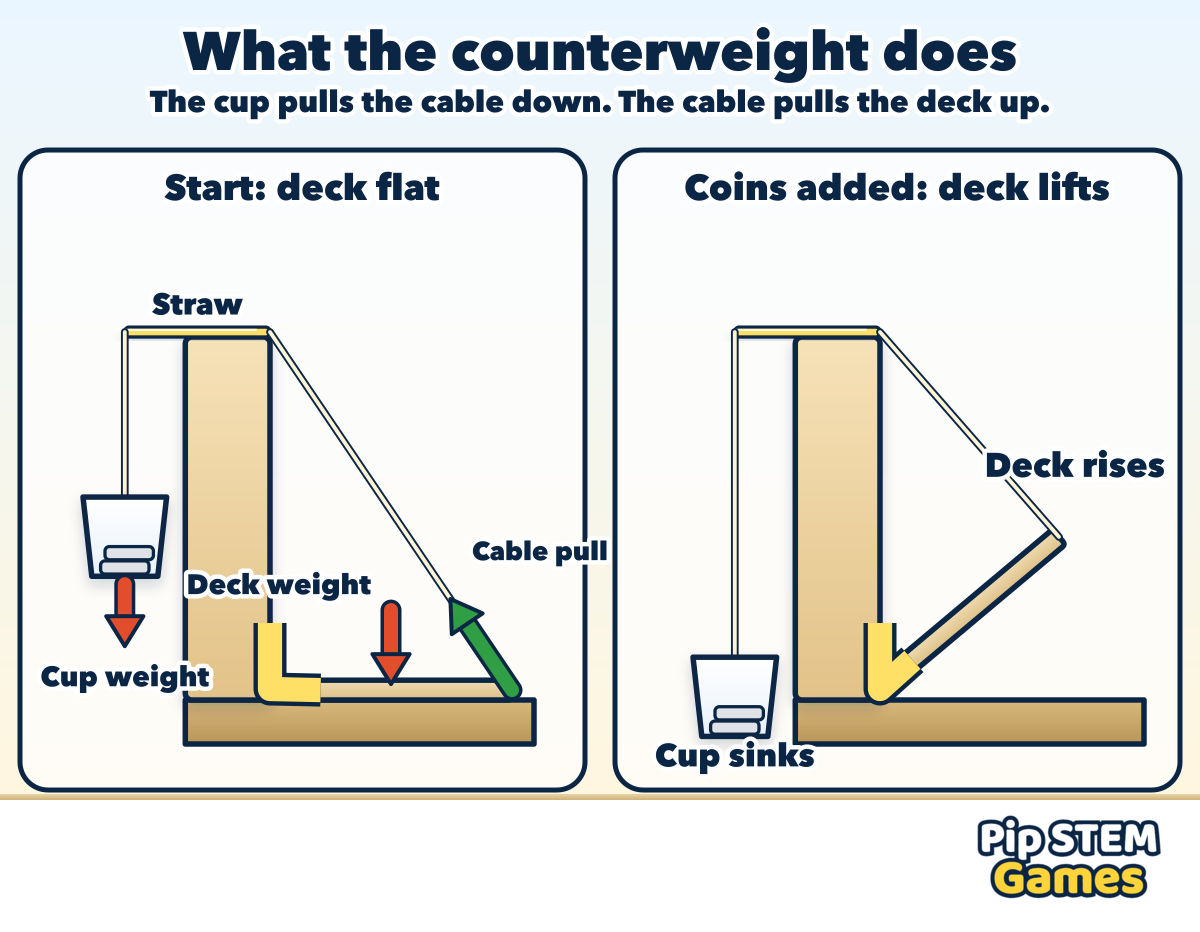
Careful here. The counterweight does not simply match the deck weight, and it is not meant to. On a real bridge, engineers balance the deck so the motors only have to add a small extra push. In your model the cup has to win by a little, because the string pulls at a slant and rubbing in the straw wastes some of the pull.
That gives you things to test. A longer deck is heavier, so it should need more coins. A taller box lifts the string higher, so the pull is steeper, and that should need fewer. Write down what you predict before you test, then see what happens.
What do you need to build a model drawbridge?
- A tall, empty cereal box, taped to the table so it cannot tip
- Stiff card or corrugated card for the deck, about 5 cm wide and 20 cm long
- A drinking straw, about 12 cm long
- Masking tape
- About 1 m of thin string
- A light paper or plastic cup
- A pile of matching UK 10p coins, or washers
- A ruler and the printable test sheet below
Safety. An adult needs to be there for the whole activity. Coins are small parts, so keep children under 3 away and keep every coin out of mouths. An adult cuts the card, and children use blunt, child-safe scissors only. Keep fingers clear of the deck, because it drops back quickly when the string goes slack.
Use matching coins every time. Coins from different years can weigh slightly different amounts, which would spoil your counts.
How do you build and test it?
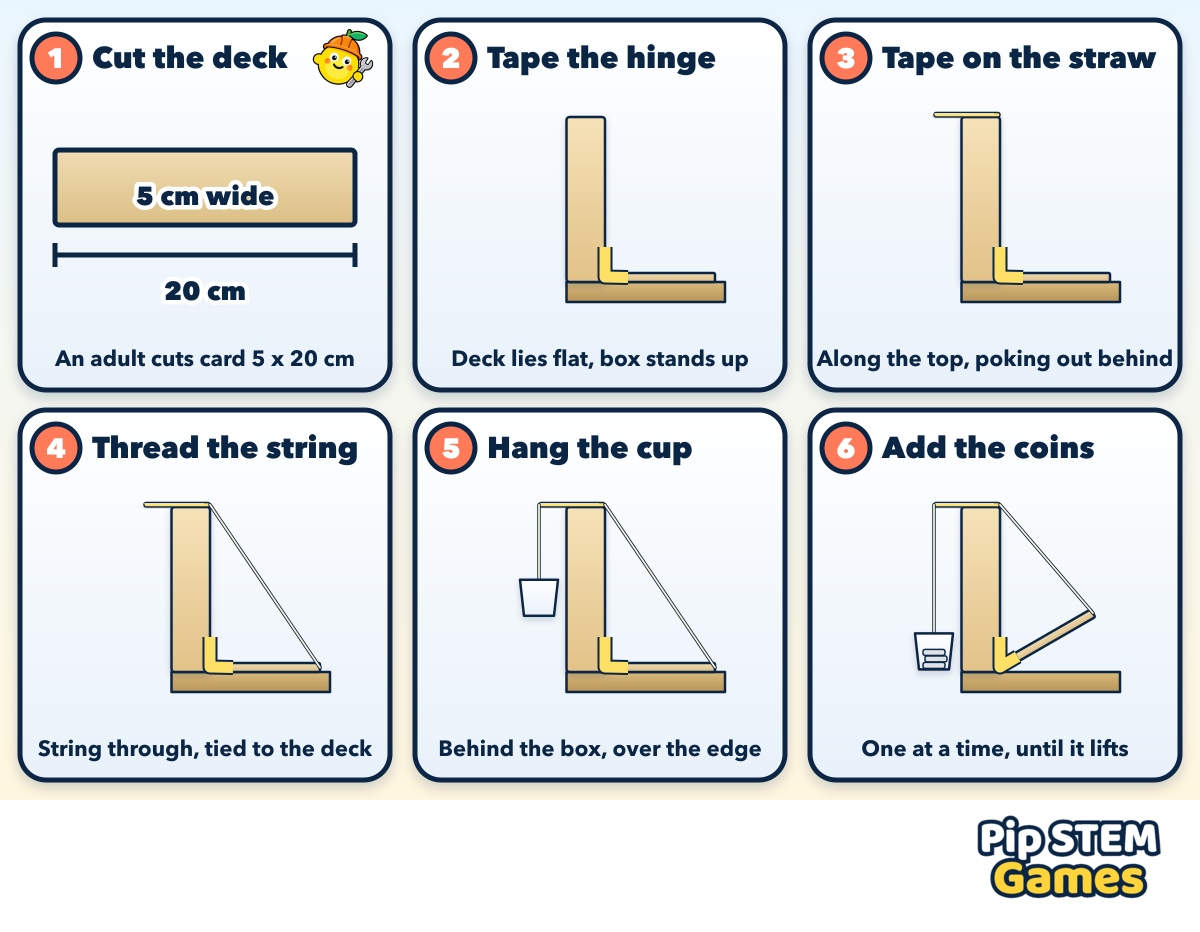
- An adult cuts the card deck, 5 cm wide and 20 cm long.
- Stand the box upright with its back flush with the table edge, and tape it down. Tape one end of the deck to the bottom front of the box, so the deck lies flat on the table. The tape is the hinge.
- Tape the straw along the top of the box. Its front end sits level with the front edge, and about 5 cm pokes out at the back.
- Thread the string through the straw. Tie one end to the free end of the deck.
- Tie the cup to the other end, so it hangs behind the box past the table edge. Leave about 25 cm of clear space under the cup, because it drops as the deck lifts.
- Add coins to the cup one at a time. Count them until the deck starts to lift. Write the number down.
Repeat three times and use the middle number. If the deck lifts with an empty cup, tape two coins to the deck as a load and start your counts again. Whatever you count is your result, and it may well be different from another family's.
Want to see the same idea in a puzzle? Have a go at the Lever Lab game afterwards.
What if your drawbridge does not work?
Fixing it is part of the fun. Engineers do it all the time.
- The deck will not lift. Add another coin, and check that the string runs freely through the straw. A kink or a sticky tape edge makes it rub.
- The deck slides about. Add a second strip of tape on the hinge and press it flat.
- The box tips. Tape it to the table, or put a heavy book against the back of it.
- The cup hits the floor too soon. Check there is 25 cm of clear space underneath, or use a slightly shorter string.
- The deck bends. Use stiffer card, or fold the sides up a little to make it stiffer.
Change one thing at a time. If you change two, you will not know which one made the difference. For more on testing and trying again, see forces for kids and the pulley you can build from household items.
How do you make it a fair test?
A fair test changes one thing and keeps everything else the same. Here the one thing is the deck length. Cut decks of 10, 15 and 20 cm from the same card, use the same coins, and test each three times.
Print the sheet at 100% so the cut guide is life-size, then fill in your own counts.
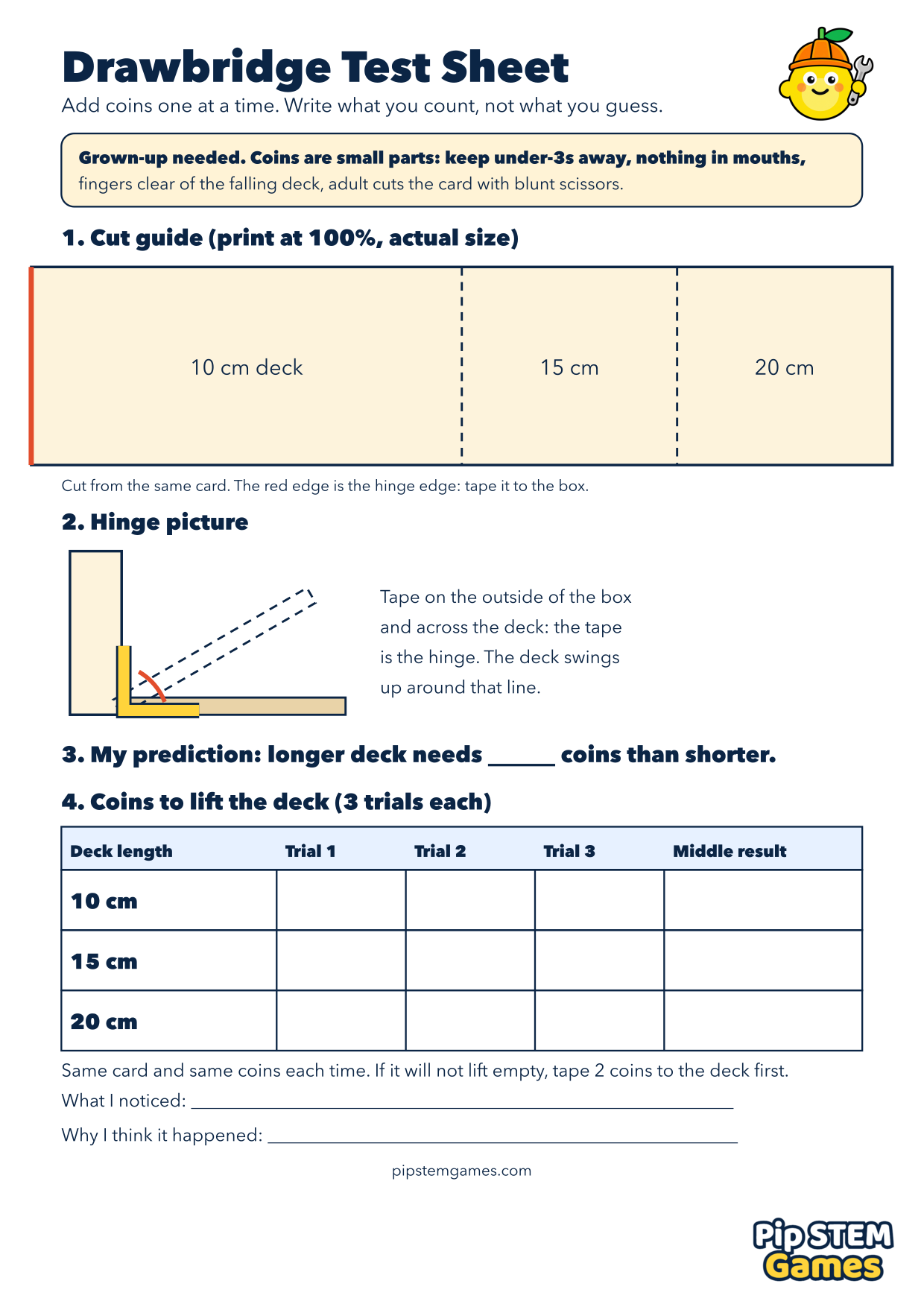
There is a cheat sheet to keep beside your build, too.
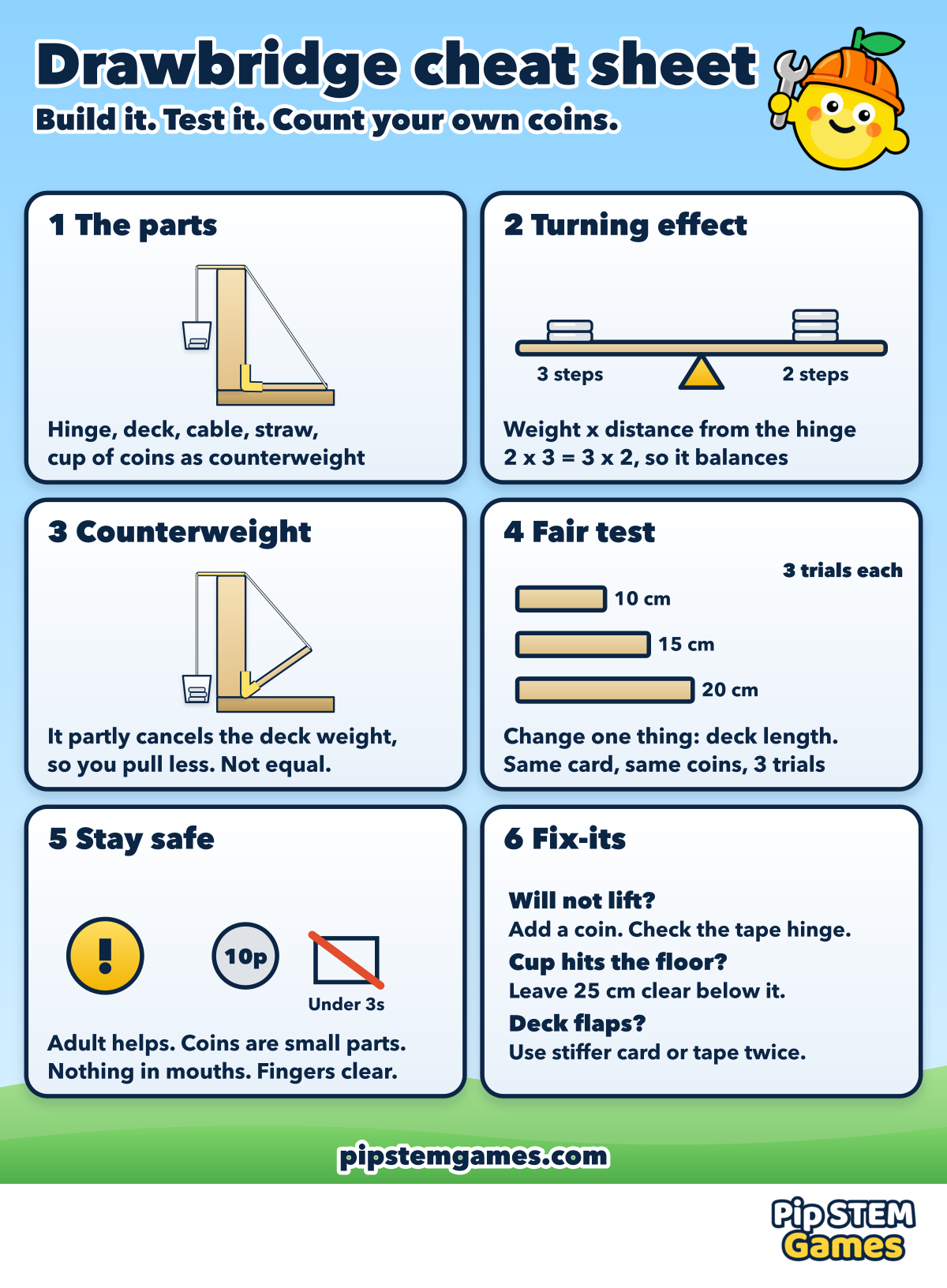
For more activities to record and compare, try the Engineering Workbook for Kids.
How can you change it for each age?
- Ages 5 to 7: an adult helps with the cutting and taping. Just count the coins and say whether the deck lifted. Ask: what happens when you add one more?
- Ages 8 to 10: test the three deck lengths and fill in the sheet. Predict first, then compare.
- Ages 11 to 12: change the height of the box or the weight of the deck, and write a sentence explaining the pattern in terms of turning effect.
Pro tip: take a photo of each setup before you test, so you can look back and see what you changed.
Pro tip: add each coin gently, and wait a few seconds before the next one, so you can see exactly when the deck lifts.
Questions parents ask
How does a drawbridge open?
A drawbridge opens by turning on a hinge. A cable or chain pulls the free end of the deck up, and a counterweight takes most of the load, so only a small extra force is needed.
Why do drawbridges have counterweights?
A deck is heavy, and lifting it all by hand or motor would take a huge force. A counterweight balances much of the deck weight, so the lift is smaller and gentler.
Does the counterweight need to weigh the same as the deck?
No. On a real bridge the deck is balanced so little force is needed. In the cardboard model the cup has to pull a little more than half the deck weight, and more if the string is slanted.
What age is this activity for?
It suits ages 5 to 12. Younger children need an adult to cut and tape. Older children can test deck lengths and explain the pattern.
Are the coins safe?
Coins are small parts, so keep children under 3 away and keep coins out of mouths. An adult should supervise the whole activity.
Which famous bridges open?
Tower Bridge in London is a bascule bridge. The Newcastle Swing Bridge turns sideways. The Tees Newport Bridge in Middlesbrough lifts its whole deck.
Great STEM activities to try next...
 What Is a Lever? Three Everyday Examples [Printable]How it works
 Paper Bridge Challenge: Build a Bridge From One Sheet of Paper [Printable]Build challenge
 STEM Activities by Age: 5–7, 8–10 and 11–12Parent guide
More to try:

Pip STEM Games
We make engineering games and workbooks for kids aged 5 to 12. Every activity here is one we'd happily run at the kitchen table: test it, watch it fail, fix it, try again.




