


Key takeaways
- Four rainy day STEM activities fit into one hour with paper, coins, a ruler and a pencil.
- Each one is a test: guess first, try three times, change one thing.
- Folding paper into a zigzag usually lets a bridge hold more coins than a flat sheet.
- A steeper slope usually makes a marble run faster, but time it to be sure.
- The four-coin puzzle has a real answer, and finding it is a logic skill.
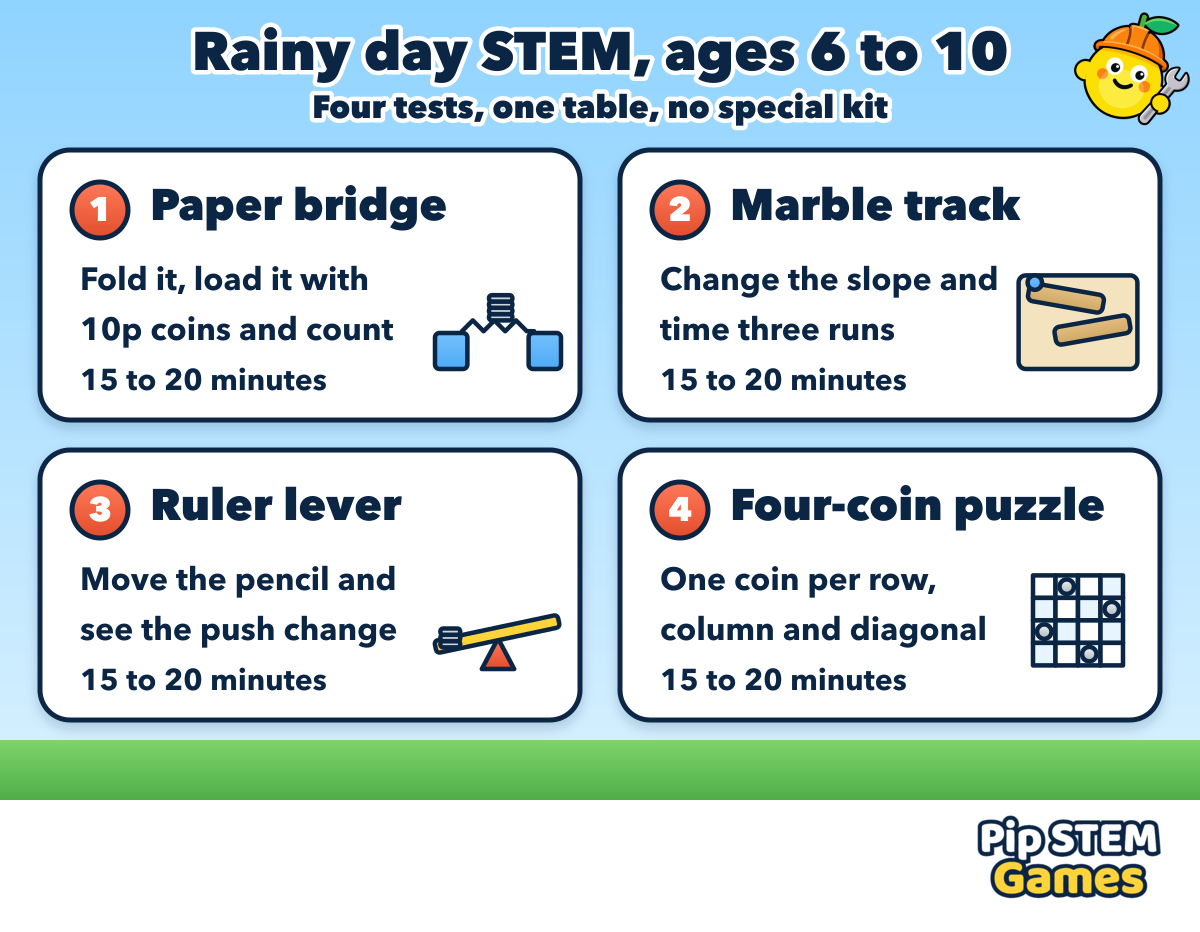
These rainy day STEM activities for ages 6 to 10 turn a wet afternoon into four small experiments: a paper bridge, a marble track, a ruler lever and a four-coin puzzle. Each takes 15 to 20 minutes and uses things you already have at home.
What do we need for a rainy day STEM afternoon?
You need very little. Gather it all before you start, so the fun does not stop halfway.
- A few sheets of A4 paper and a strip of card
- About 10 UK 10p coins
- A ruler, a pencil and a marble
- Books to prop things up, and a phone timer
Print the results sheet at the bottom of this page so each child can write down their guess and three tries. Marbles and coins are small parts, so keep them away from children under 5.
How do we build a paper bridge?
About 15 minutes. Fold a sheet of paper and count how many 10p coins it can carry across a gap.
- Rest two stacks of books 15 cm apart.
- Lay a flat sheet across the gap and guess how many coins it will hold.
- Add coins one at a time in the middle until it sags into the gap. Write down the number.
- Fold a second sheet into a zigzag, like a fan, and test it the same way.
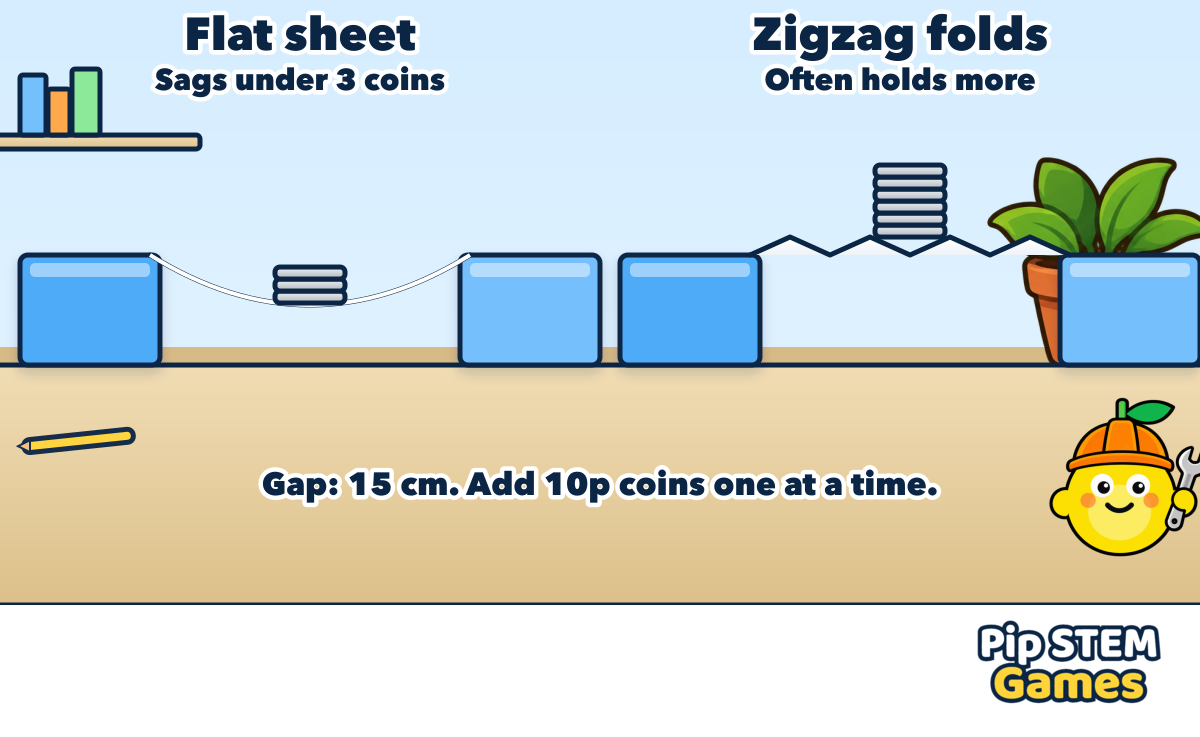
Folds make paper stiffer, so the zigzag usually holds more, but trust your own count. For the full version, read our paper bridge challenge or try the Bridge game.
How do we make a marble track?
About 15 minutes. Build two ramps with different slopes and time the marble down each one.
- Rest a strip of card on one book to make a gentle slope.
- Guess which will be quicker, then let the marble go without pushing it. Time it with the phone.
- Do it three times and write down each time.
- Prop the card on three books and test again.
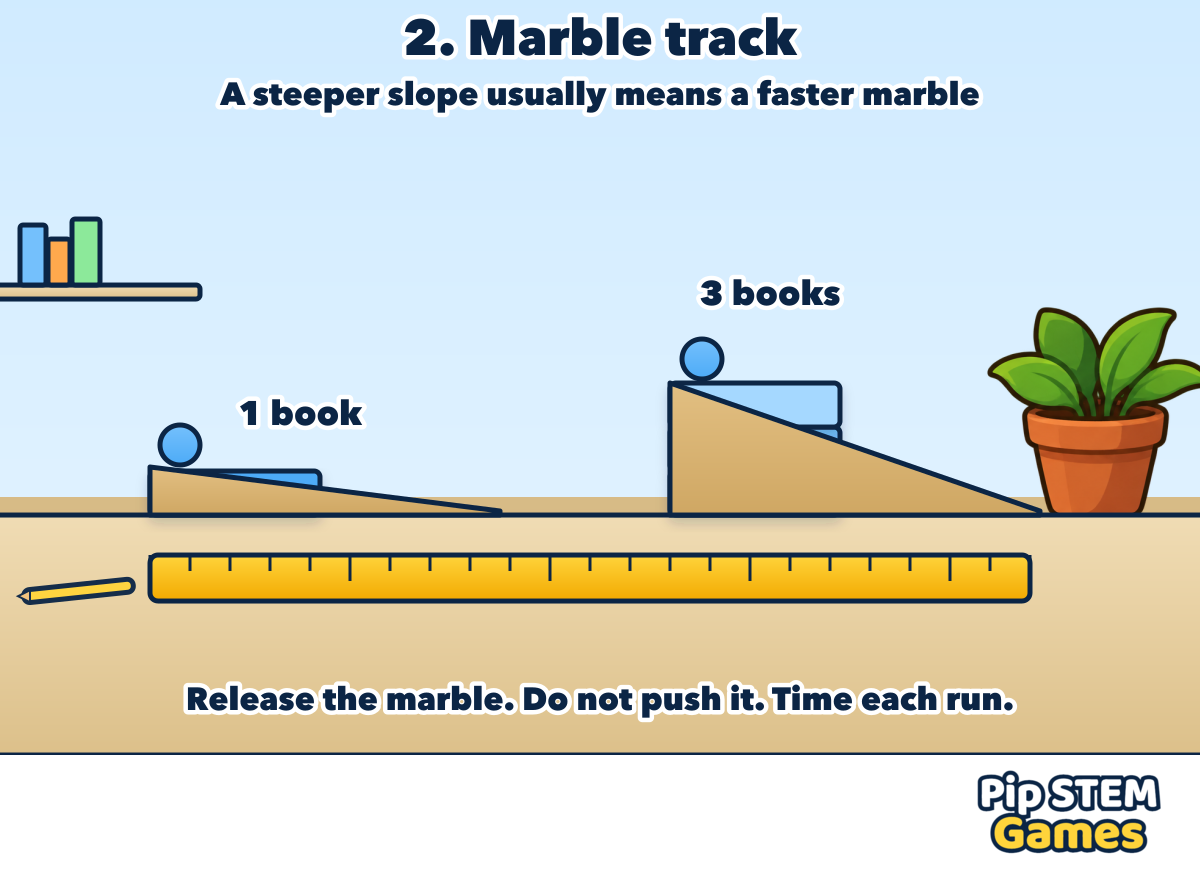
A steeper slope usually gives a faster marble, but the card and the table also matter, so keep them the same. Try a similar test in the Ramp Runner game.
How does a ruler lever work?
About 15 minutes. Balance a ruler on a pencil and use it to lift coins.
- Lay a pencil flat on the table and rest the middle of the ruler on it.
- Stack three coins on one end of the ruler.
- Press the other end down with one finger and watch the coins rise.
- Slide the pencil closer to the coins and press again. Does the push feel easier or harder?
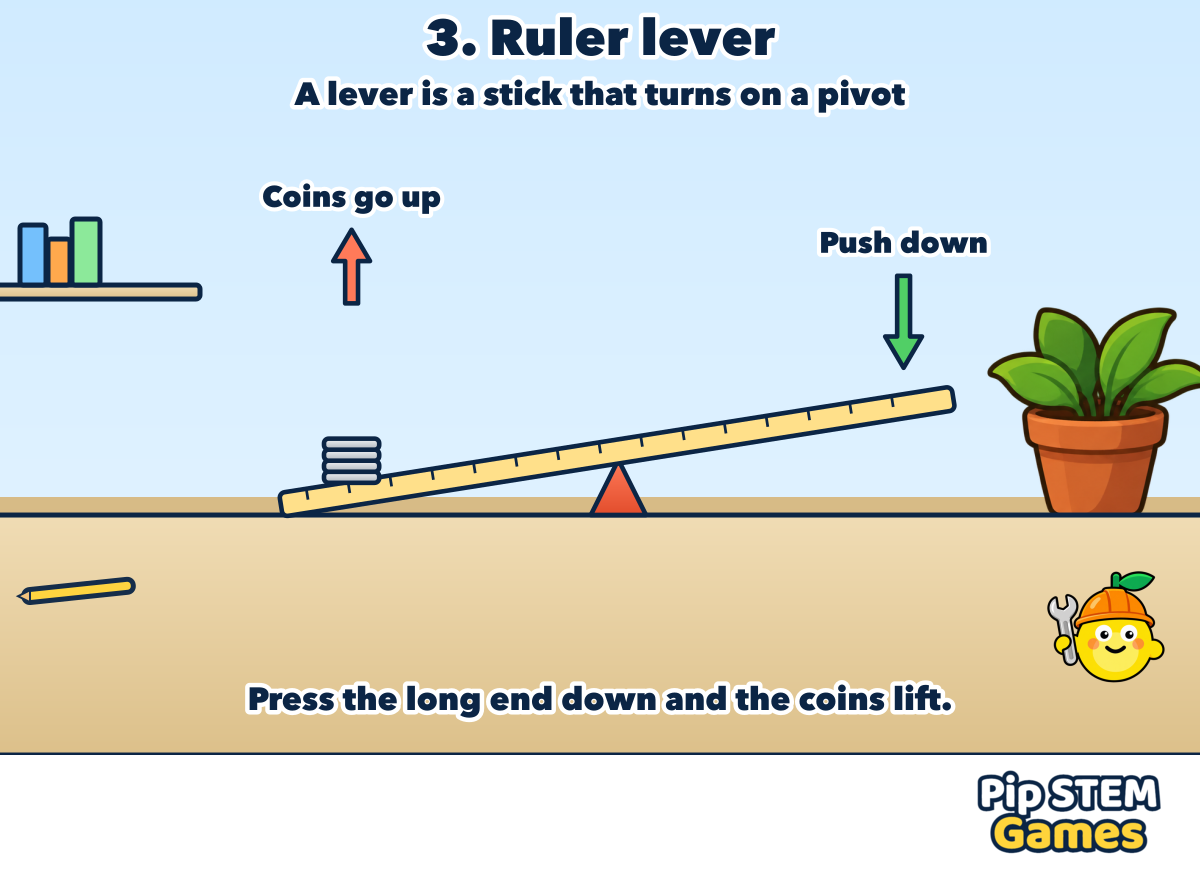
A lever is a stick that turns on a pivot. Moving the pivot changes how hard you push. Try more levers in the Lever Lab game, or read what is a lever.
Can you solve the four-coin puzzle?
About 15 minutes. Place four coins on a four by four grid so that no two coins share a row, a column or a diagonal.
- Draw a grid of 16 squares on paper, four across and four down.
- Put one coin in each row. Check the columns and then the diagonals.
- If two coins can see each other, slide one and check again.
- When you find an answer, try to find a second one.
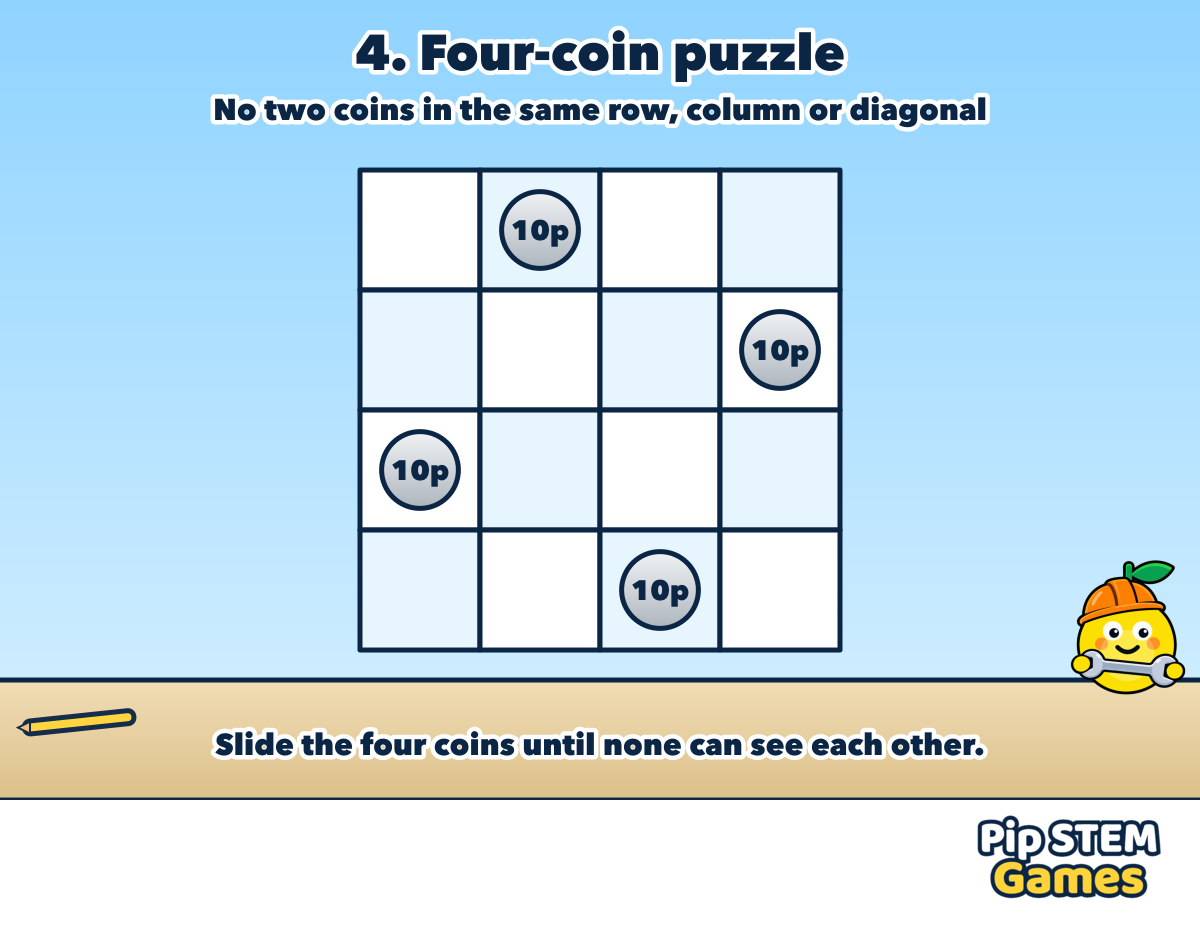
There is no single trick, so tell a grown-up how you checked. That is real logic.
How do we record and share our results?
Change one thing at a time and keep everything else the same. Write down every result, even a surprising one.
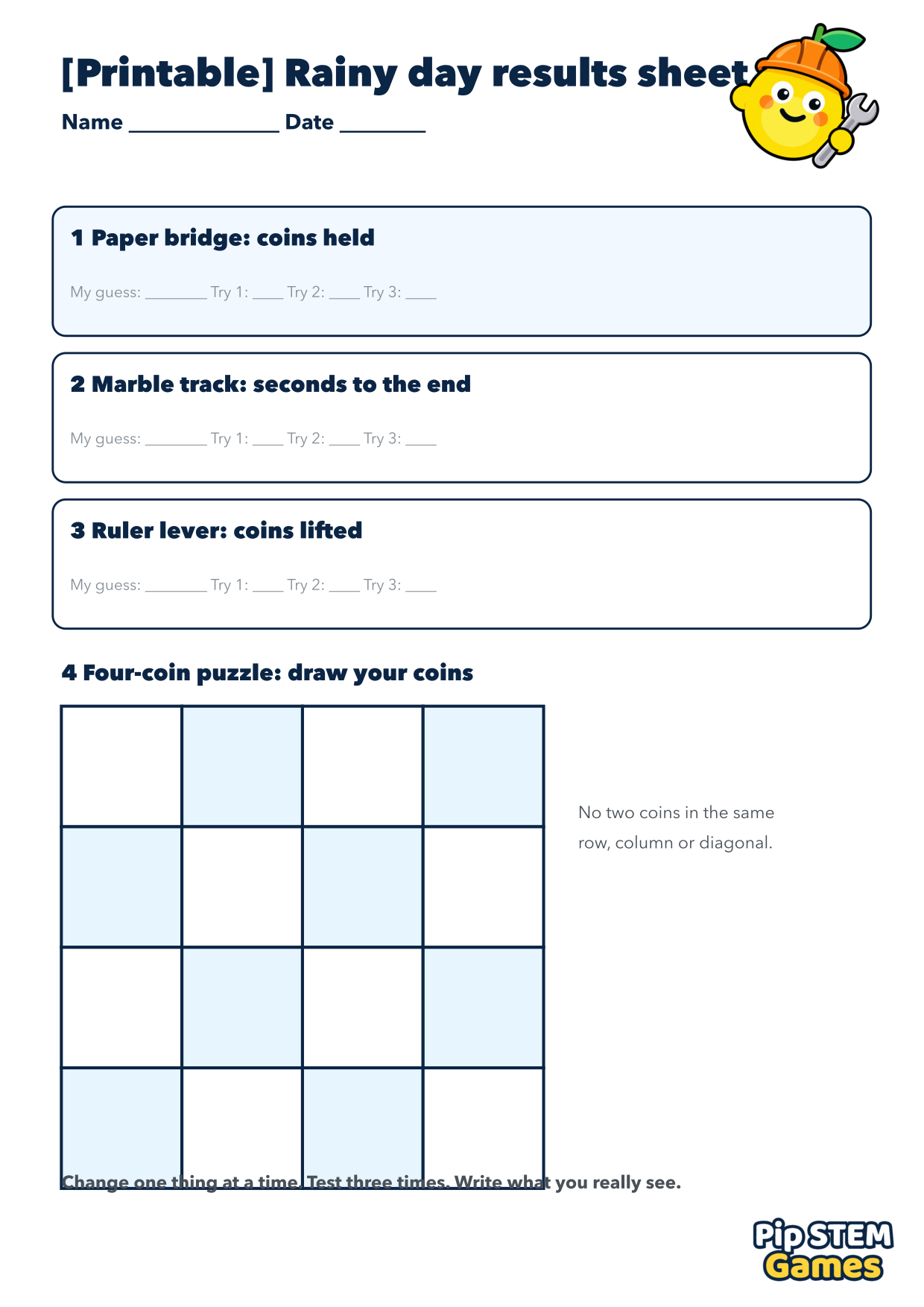
Younger children can count coins and say fast or slow. Older children can use a table and draw a chart. If something goes wrong, the engineer's five-step fix-it checklist helps. For more, see STEM activities for kids. The Engineering Workbook for Kids has more tests for ages 8 to 12.
Safety: coins and marbles are small parts, so keep them away from children under 5 and supervise throughout. Clear up dropped marbles so nobody slips.
Questions parents ask
What are good rainy day STEM activities for ages 6 to 10?
A paper bridge, a marble track, a ruler lever and a four-coin puzzle all use things at home. Each is a small test with a guess and a result.
How long does each activity take?
About 15 to 20 minutes each. You can do one now and save the others for the next rainy day.
What do we need?
Paper, a strip of card, 10p coins, a ruler, a pencil, a marble, some books and a phone timer.
Why do we repeat each test three times?
One try can be luck. Three tries show whether the result keeps happening.
Is there a right answer to the coin puzzle?
Yes, there are answers on a four by four grid. Children should check rows, columns and both diagonals for every pair.
Are these safe?
Yes with an adult nearby. Keep coins and marbles away from children under 5 and pick up any dropped marbles.
Great STEM activities to try next...
 12 Easy STEM Activities for Kids to Try at Home (Ages 5 to 12)By age
 Paper Bridge Challenge: Build a Bridge From One Sheet of Paper [Printable]Build challenge
 What Is a Lever? Three Everyday ExamplesActivity
More to try:

Pip STEM Games
We make engineering games and workbooks for kids aged 5 to 12. Every activity here is one we'd happily run at the kitchen table: test it, watch it fail, fix it, try again.




