

Key takeaways
- One short challenge a day keeps a holiday week busy without a big shop.
- Folding paper makes it deeper, so a folded bridge holds more than a flat one.
- Triangles keep their shape; squares lean over unless you add a diagonal.
- Shape matters for floating: the same foil sinks as a ball and floats as a wide boat.
- Change one thing at a time and test 3 times, then write down what happened.
These 7 days of STEM activities for the school holidays use paper, straws, foil, books and 10p coins. Each day is one short challenge for ages 5 to 12. Guess first, test it, then write down what happened. Day 7 brings it all together in a final bridge.
1. Day 1: Paper bridge
Ages 5 to 12, about 30 minutes.
- 2 sheets of A4 paper
- 2 equal piles of books
- A handful of 10p coins
- A ruler
- Set the two piles of books 15 cm apart.
- Lay a flat sheet of paper across the gap. Add 10p coins one at a time in the middle. Count how many it holds before it sags to the table.
- Fold the second sheet into a zigzag, like a paper fan, and lay it across the same gap.
- Add coins again and count. Write both numbers down.
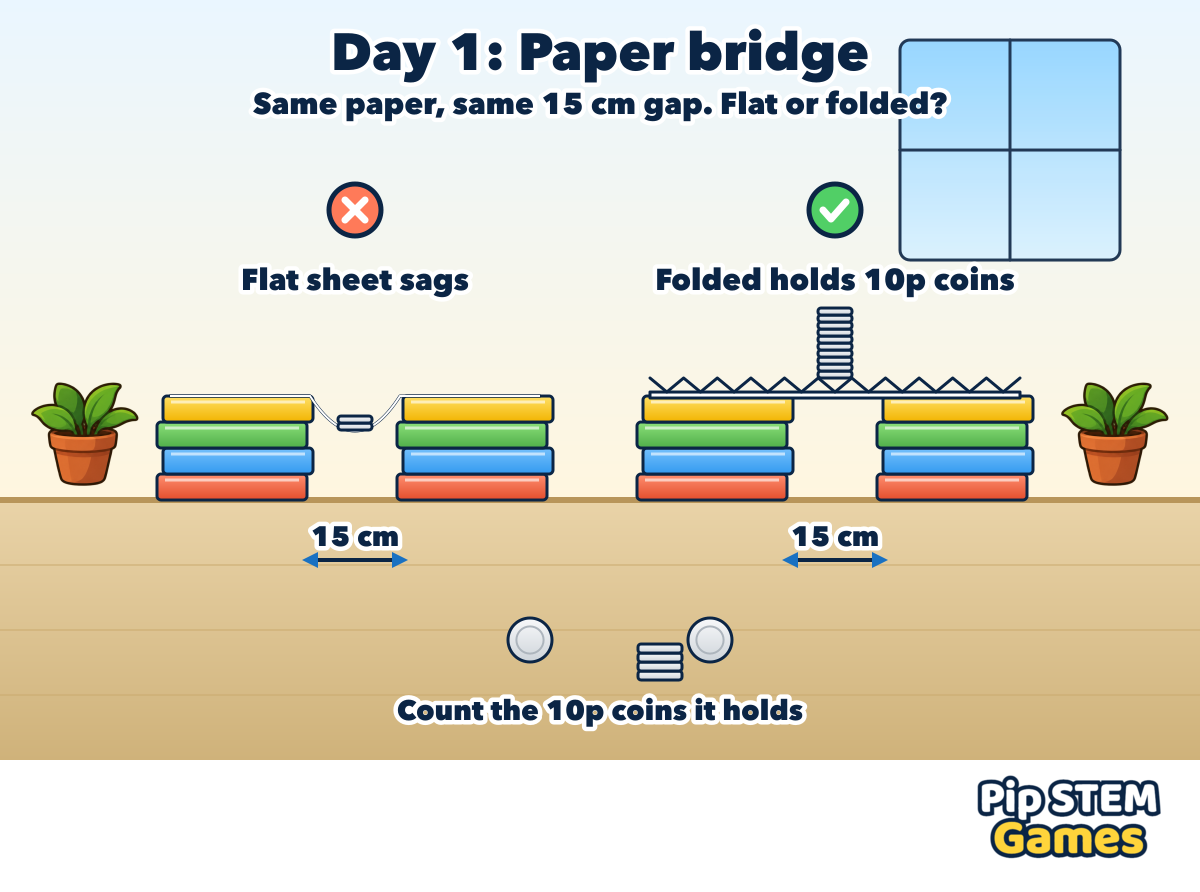
Folding makes the paper deeper, and a deeper beam bends less. Same paper, very different bridge. If your child wants more, the paper bridge challenge has more designs to try, and the bridge game lets them test spans on screen.
2. Day 2: Straw tower
Ages 5 to 12, about 40 minutes.
- About 12 paper straws
- Sticky tape or modelling clay for the joints
- A small book to rest on top
- Build a square from 4 straws, taped at the corners. Stand it up.
- Build a triangle from 3 straws the same way.
- Gently push the top of each one sideways. Which one keeps its shape?
- Now build a tower from triangles and see if it holds the book.
- Add one diagonal straw across the square and push it again.
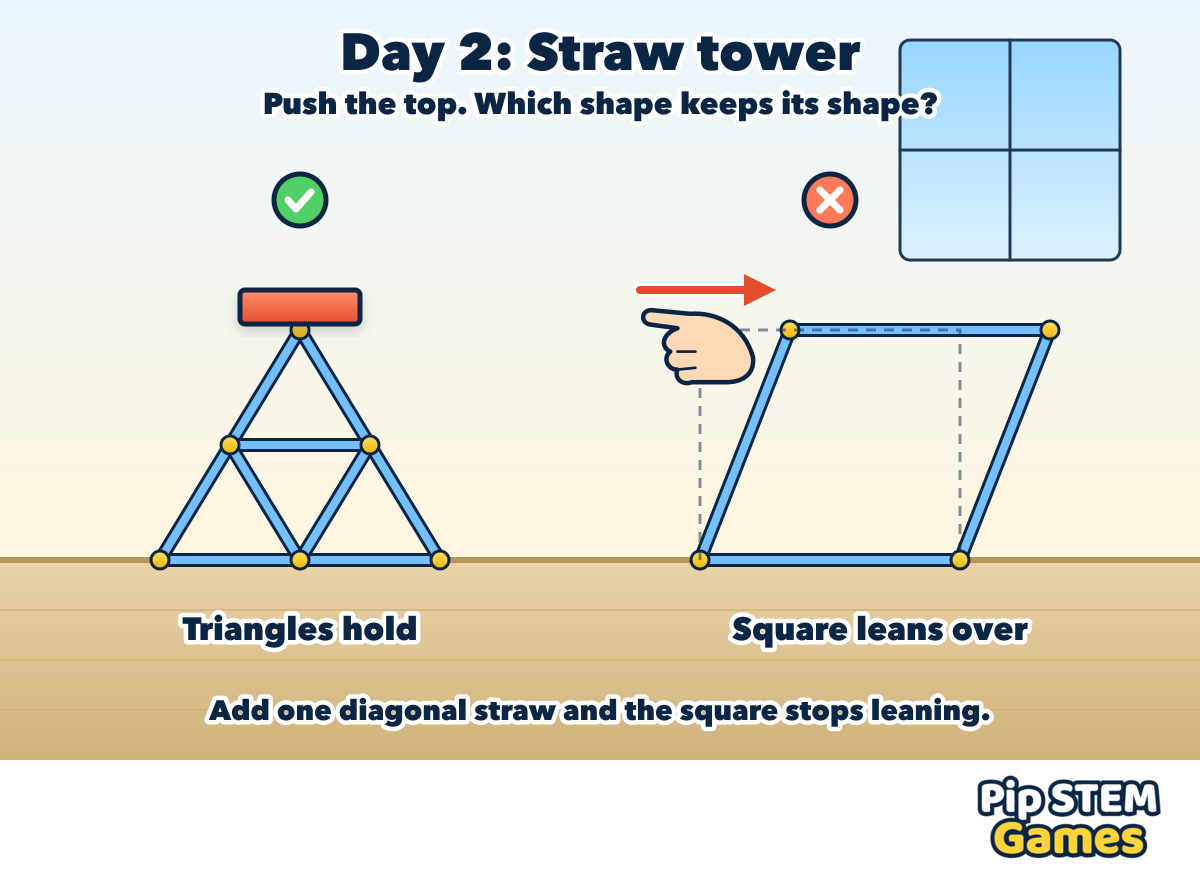
A triangle can't change shape without one of its sides changing length. A square can lean over into a squashed diamond. That's why cranes, roofs and bridges are full of triangles. Try the shape strength game next, or read which shape makes the strongest tower.
3. Day 3: Paper glider
Ages 5 to 12, about 30 minutes. Best outside or in a hallway.
- A sheet of A4 paper
- 1 paper clip
- A tape measure
- Fold a simple dart glider.
- Throw it 3 times, gently and the same way each time. Measure how far it goes.
- Slide one paper clip onto the nose.
- Throw it 3 more times and measure again. Which flew further?
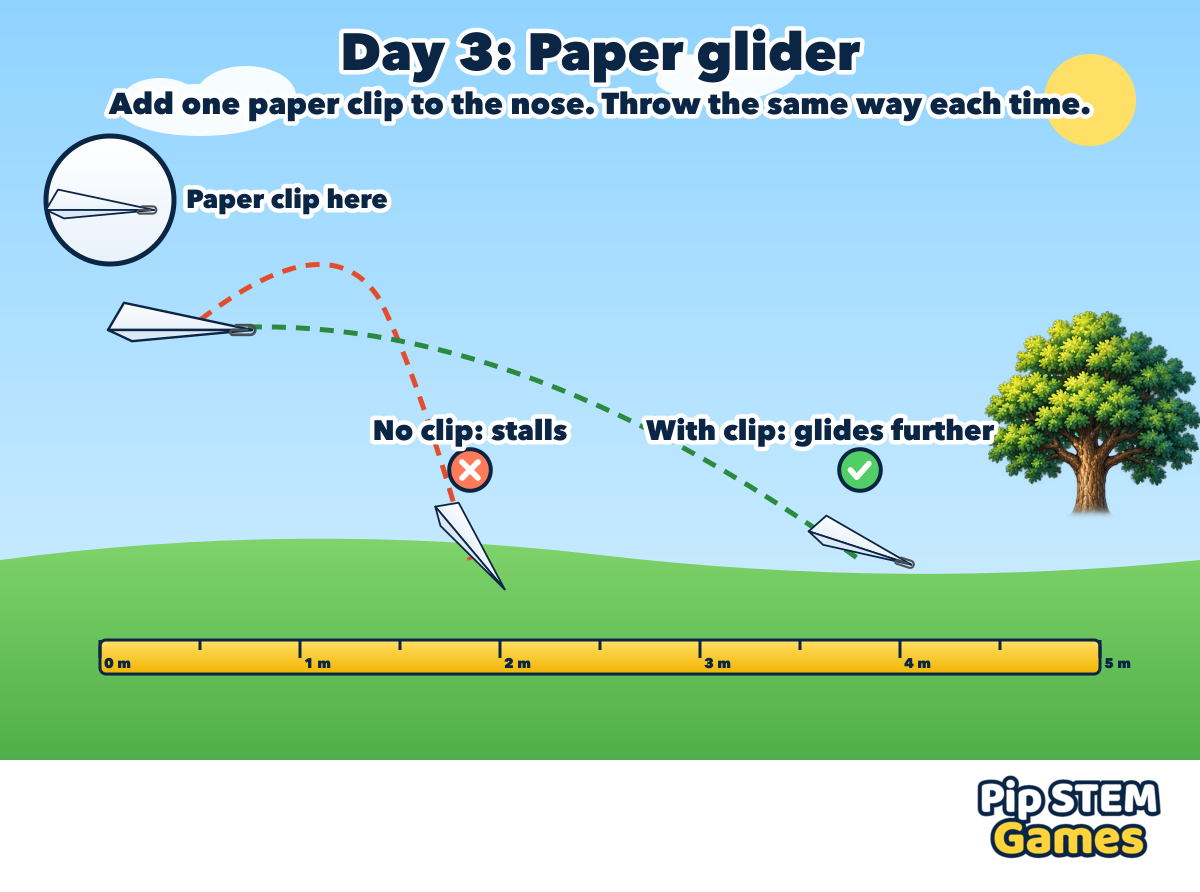
The clip moves the balance point forward, so the nose doesn't tip up and stall. Too many clips and it dives, so one is a good start. The paper plane lab lets children try wing shapes without using up all your paper.
4. Day 4: Float or sink, then a foil boat
Ages 5 to 12, about 40 minutes. Put a towel down first.
- A washing-up bowl of cool tap water
- A cork, a 10p coin and a sheet of kitchen foil
- More 10p coins for cargo
- Guess first: will each object float or sink? Write the guesses down.
- Drop them in one at a time and tick or cross each guess.
- Squash a piece of foil into a tight ball. Does it float?
- Take the same size of foil and fold it into a wide, flat boat with high sides.
- Add 10p coins one at a time. Count how many it carries before water comes in.
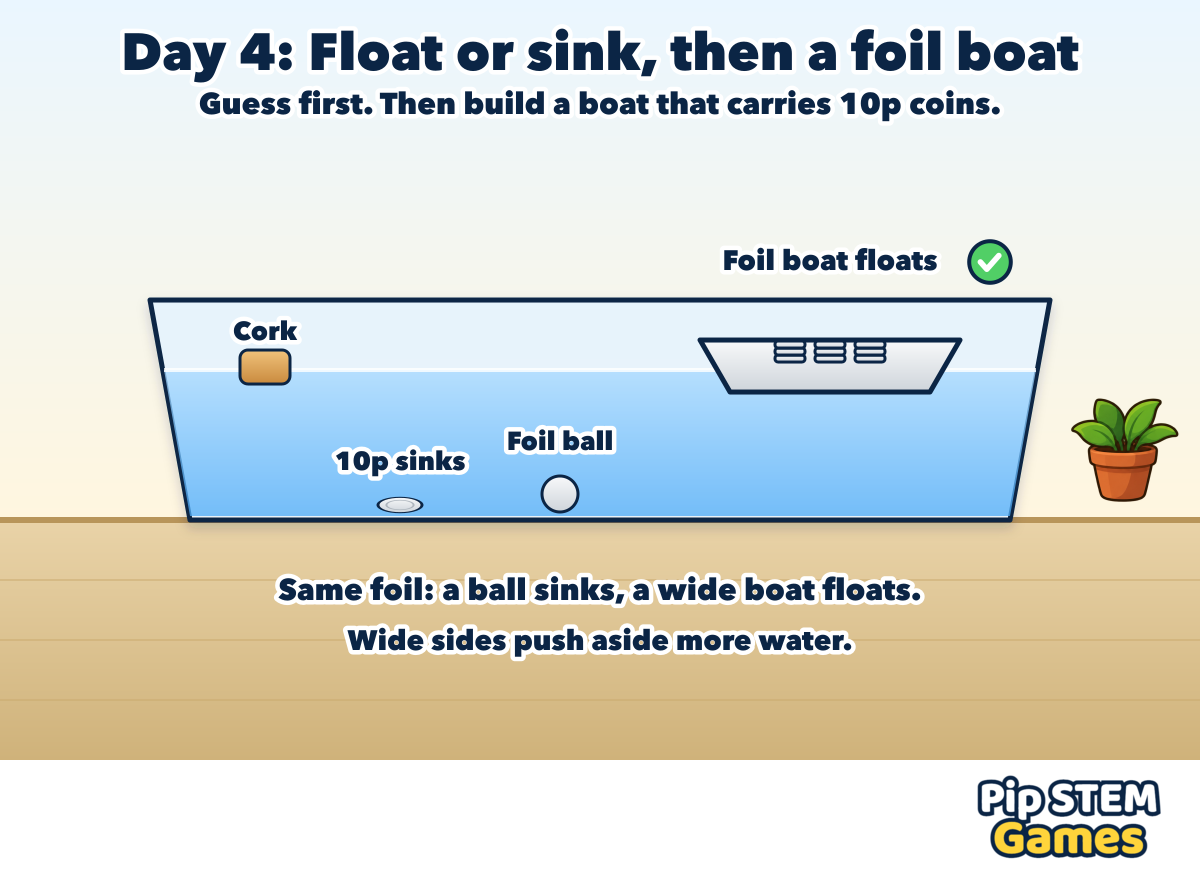
A wide boat pushes aside lots of water, and the water pushes back up. The squashed ball can't push aside enough. There are more boat designs in build a boat that actually floats.
5. Day 5: Ramp test
Ages 5 to 12, about 30 minutes.
- A long piece of stiff card or a tray
- 3 books the same size
- A small ball or marble (adults keep marbles away from under 3s)
- A tape measure and sticky notes
- Rest one end of the card on 1 book to make a ramp.
- Let the ball go from the top. Don't push it. Mark where it stops with a sticky note.
- Do it 3 times. Then try 2 books, then 3 books.
- Which height sent the ball furthest?
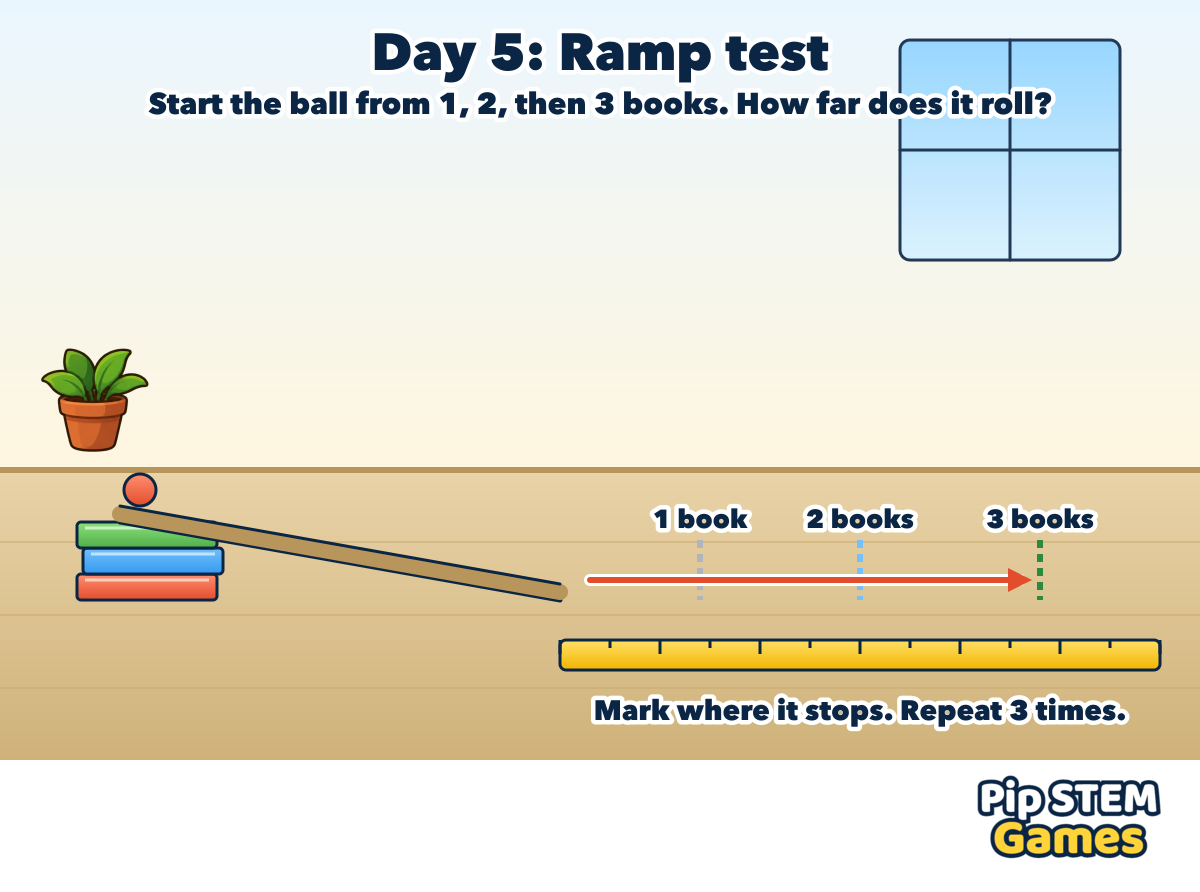
A higher start gives the ball more speed at the bottom, so it usually rolls further. Letting go without a push keeps the test fair. Ramp runner is the screen version if it rains.
6. Day 6: Pattern puzzle
Ages 5 to 12, about 20 minutes. A good quiet day.
- About 40 10p coins, buttons or counters
- Paper and a pencil
- Make stacks of 2, then 4, then 8, then 16.
- Ask: what happens each time?
- Guess the next stack, then build it to check. (It's 32.)
- Write the next one without building it. (It's 64.)
- Make up a new pattern for someone else to solve.
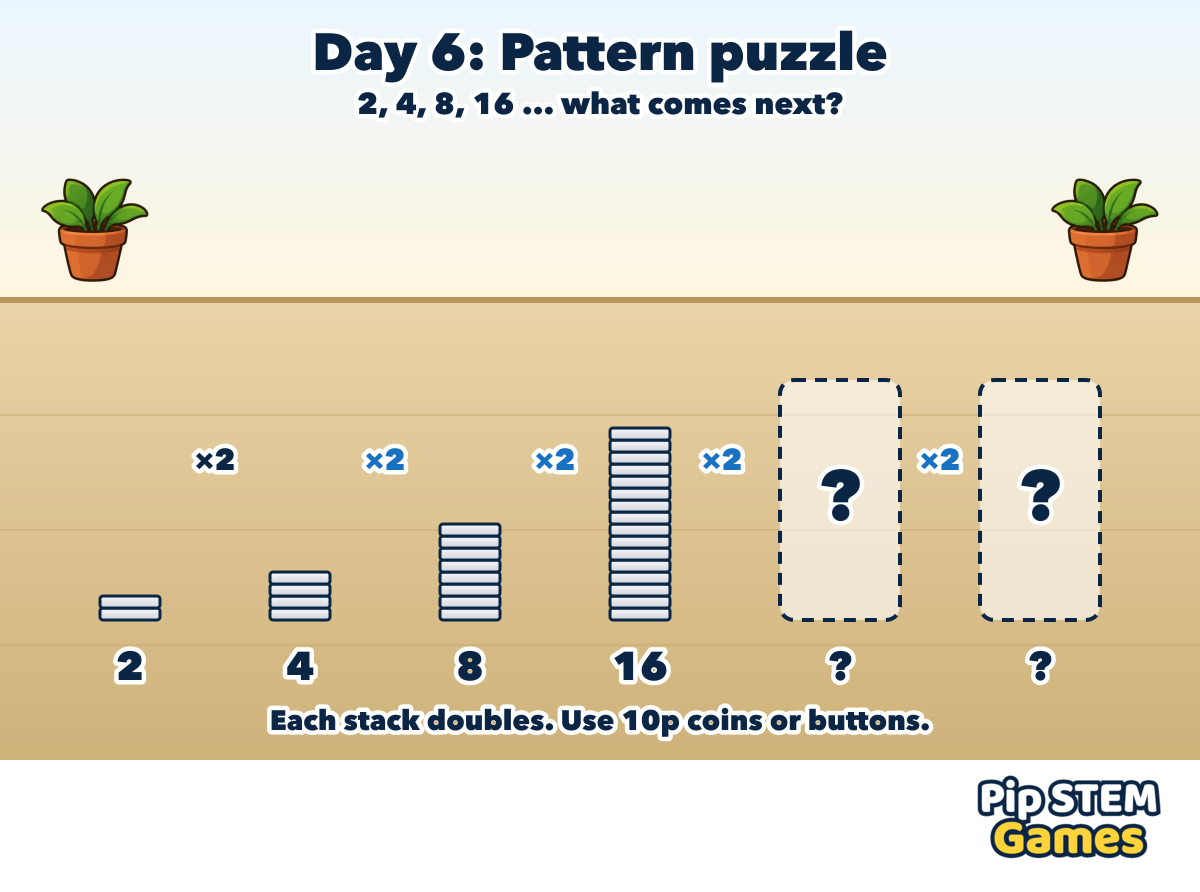
Spotting a pattern and checking it is what engineers do with test results. Younger children can try a simpler one, such as adding 2 each time.
7. Day 7: Final bridge challenge
Ages 5 to 12, about 45 minutes.
- Thin card, such as a cereal box
- Sticky tape and blunt scissors
- 2 equal piles of books and a few more for a ramp
- A small ball
- Set the piles 20 cm apart.
- Build a card bridge using what you learned: folds from Day 1, triangles from Day 2.
- Make a ramp from Day 5 that leads onto the bridge.
- Roll the ball down. Does it reach the far side?
- If not, change one thing and try again.
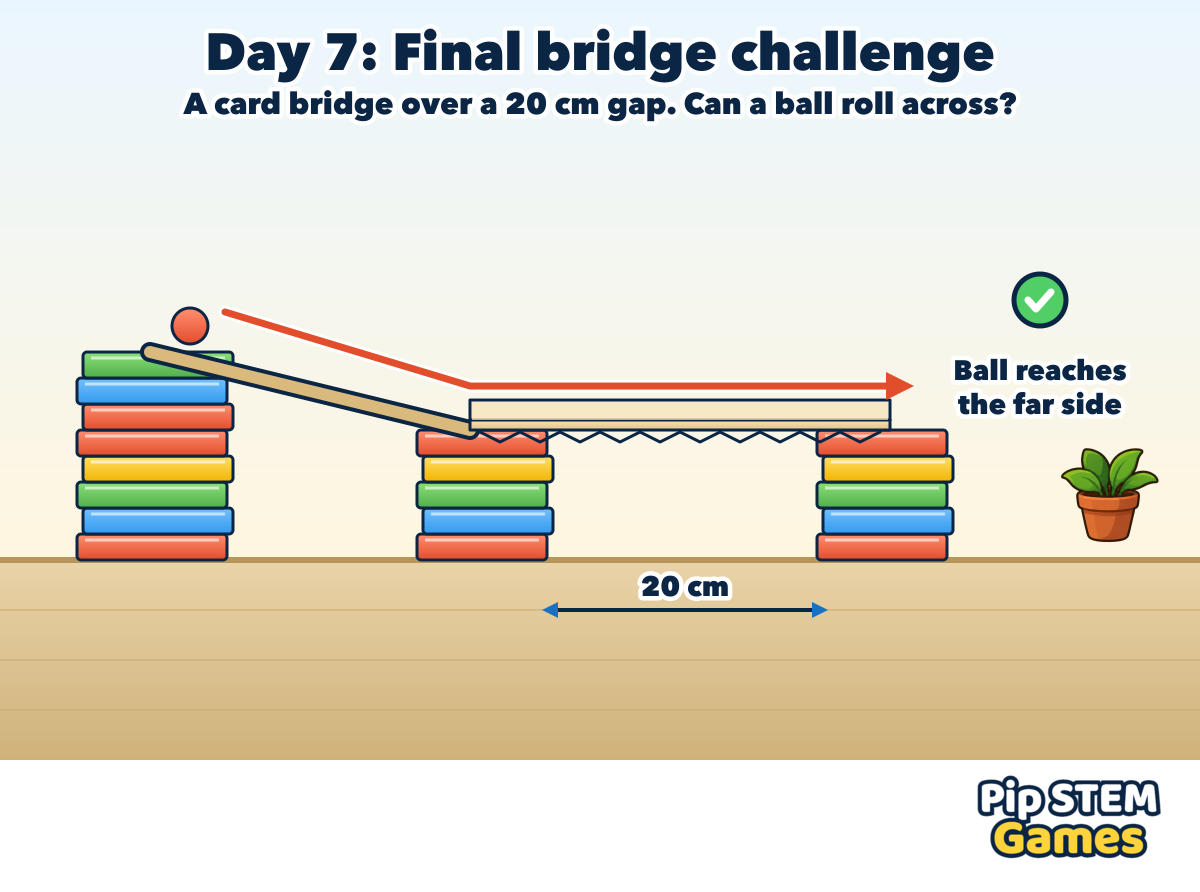
This day pulls the week together. The bridge has to be stiff, flat on top and lined up with the ramp. Most first tries fail, which is the point: find what went wrong, fix one thing, test again.
How do you keep track of the week?
Use the cheat sheet on the fridge and the printable record sheet for results. Each day has a row for the guess, the result and three stars to colour in.
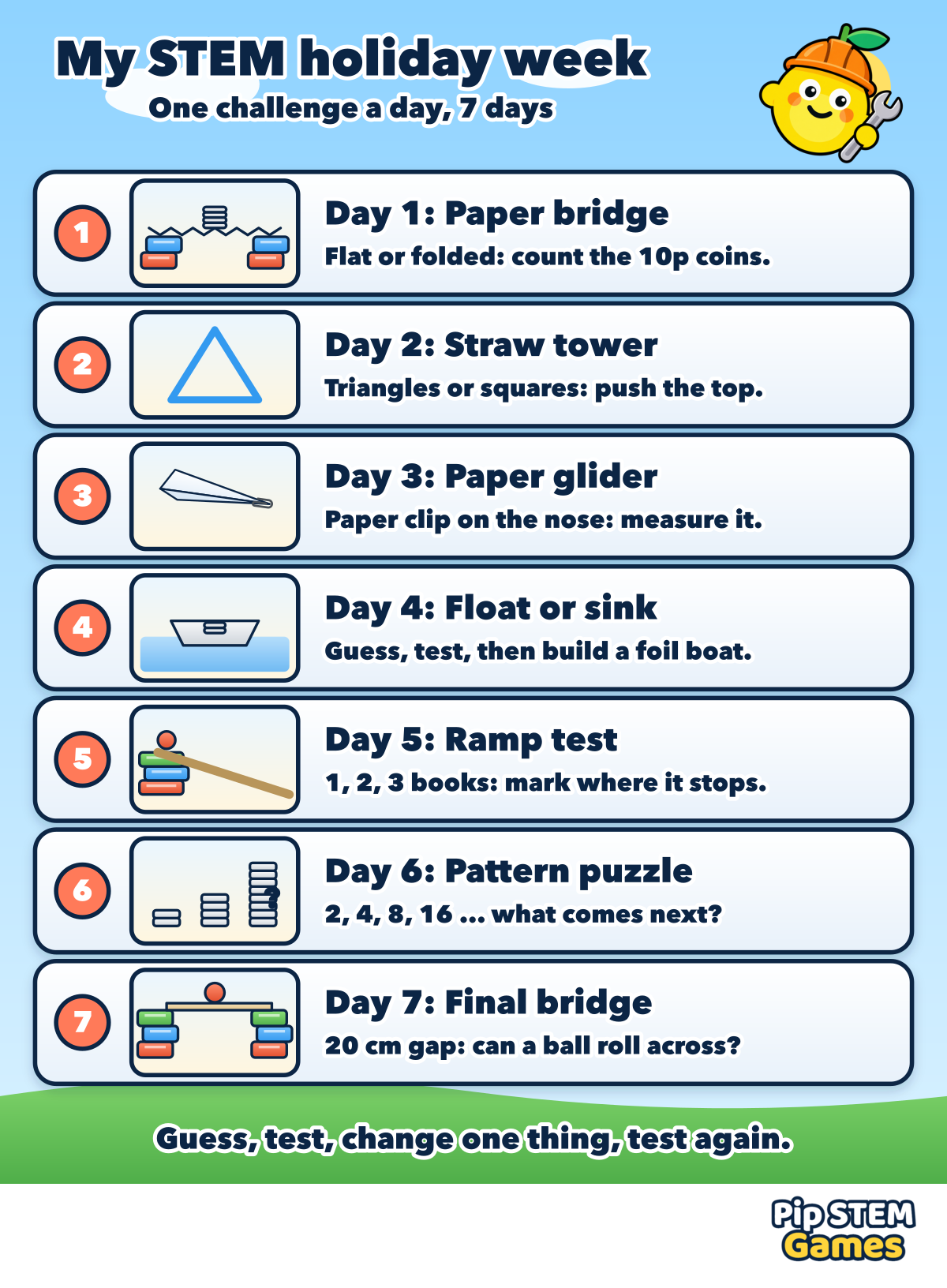
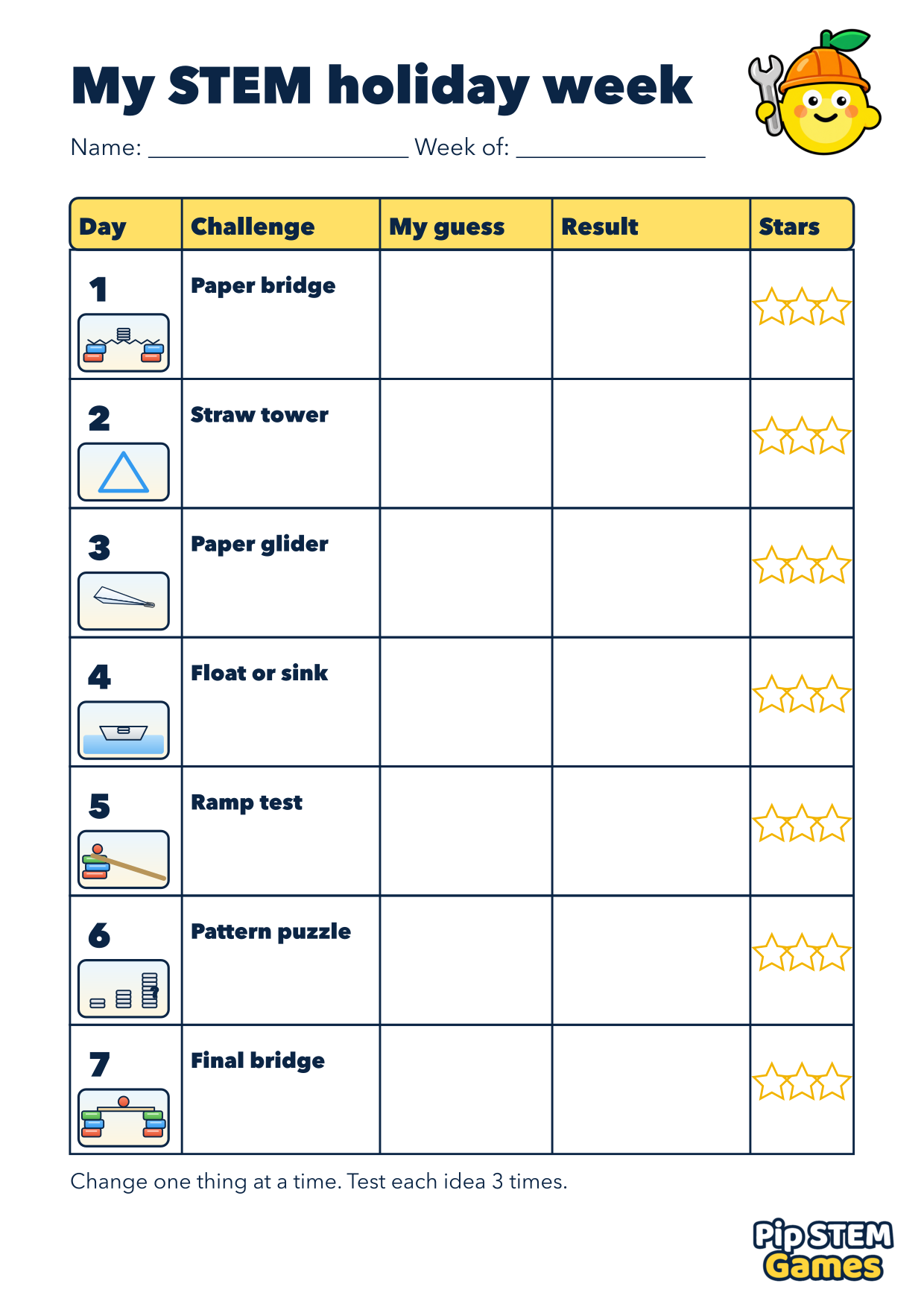
- Coins, paper clips and marbles are small parts. Keep them away from under 3s and supervise younger children.
- Use blunt scissors. An adult cuts thick card.
- Use cool tap water only and wipe up spills straight away.
- Nothing here needs mains power or hot water.
Want a longer plan after the holidays? Try the simple 4-week STEM learning plan.
Questions parents ask
What age are these STEM activities for?
Ages 5 to 12. Younger children need an adult beside them and simpler goals. Older children can measure, record and improve their designs.
Do I need to buy anything?
No. Everything is paper, straws, foil, card, books, tape, a ball and 10p coins, which most homes already have.
How long does each day take?
Between 20 and 45 minutes. You can stretch any day by letting your child try a second design.
Why does a folded paper bridge hold more?
Folding makes the paper deeper. A deeper beam bends less, so it holds more coins before it sags.
Why does the foil boat float when the foil ball sinks?
The wide boat pushes aside more water, and the water pushes back up on it. The tight ball can't push aside enough water to hold itself up.
Are the activities safe?
Yes, with supervision. Coins, clips and marbles are small parts, so keep them away from under 3s. Use blunt scissors, cool tap water and no mains power.
Great STEM activities to try next...
 Paper Bridge Challenge: Build a Bridge From One Sheet of Paper [Printable]Build challenge
 Which Shape Makes the Strongest Tower?Activity
 Build a Boat That Actually FloatsActivity
More to try:

Pip STEM Games
We make engineering games and workbooks for kids aged 5 to 12. Every activity here is one we'd happily run at the kitchen table: test it, watch it fail, fix it, try again.




