

Key takeaways
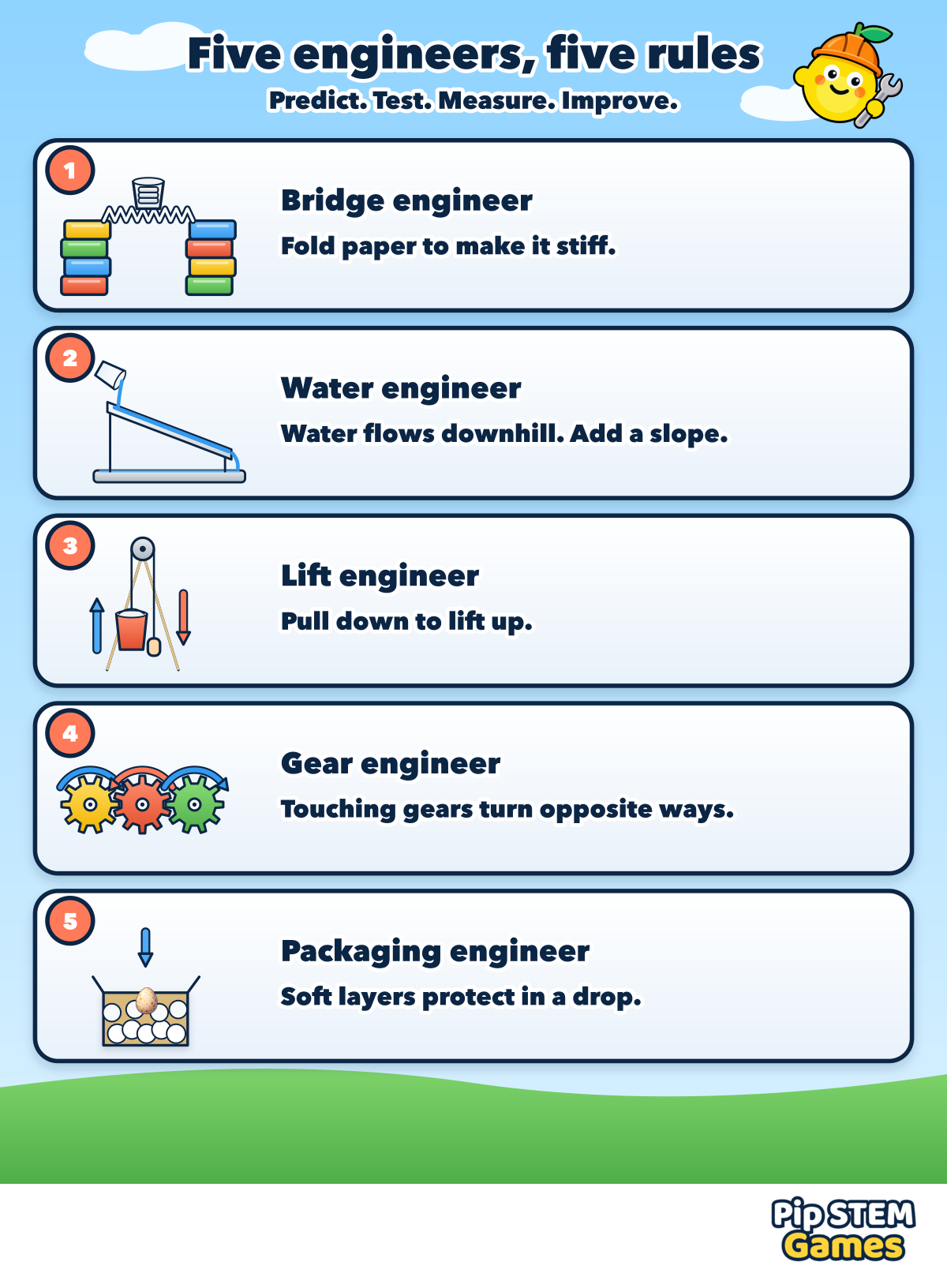
- Bridge engineers fold and shape materials so they bend less.
- Water engineers use slopes so water runs where it is needed.
- One fixed pulley changes the direction of a pull.
- Touching gears always turn opposite ways.
- Packaging engineers use soft layers to protect things in a drop.
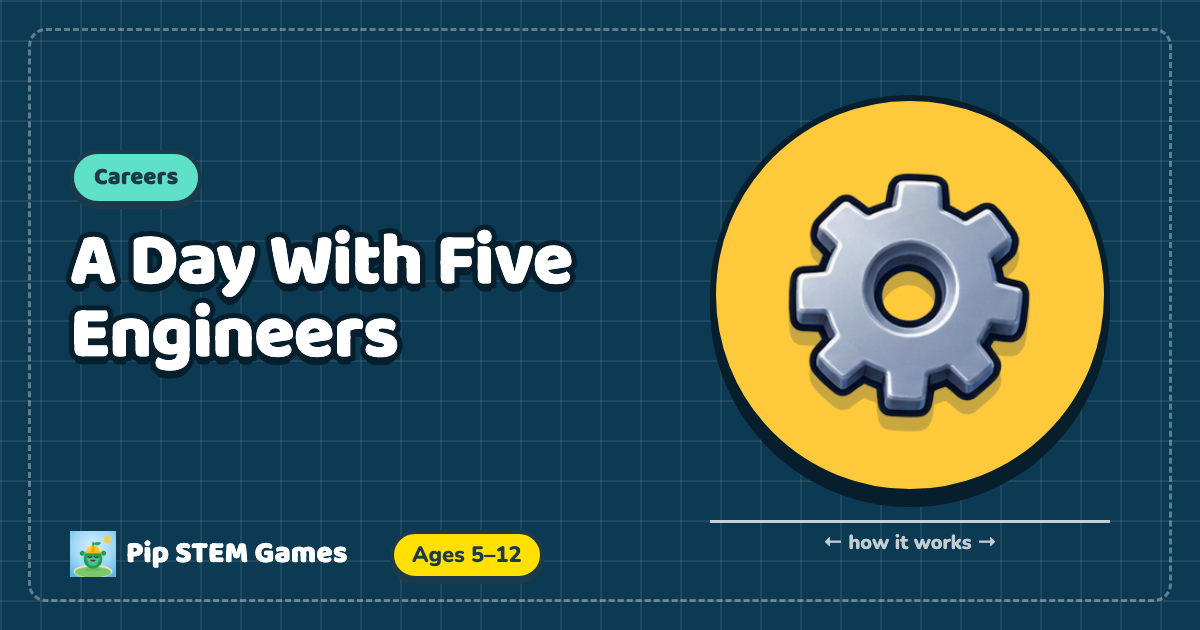
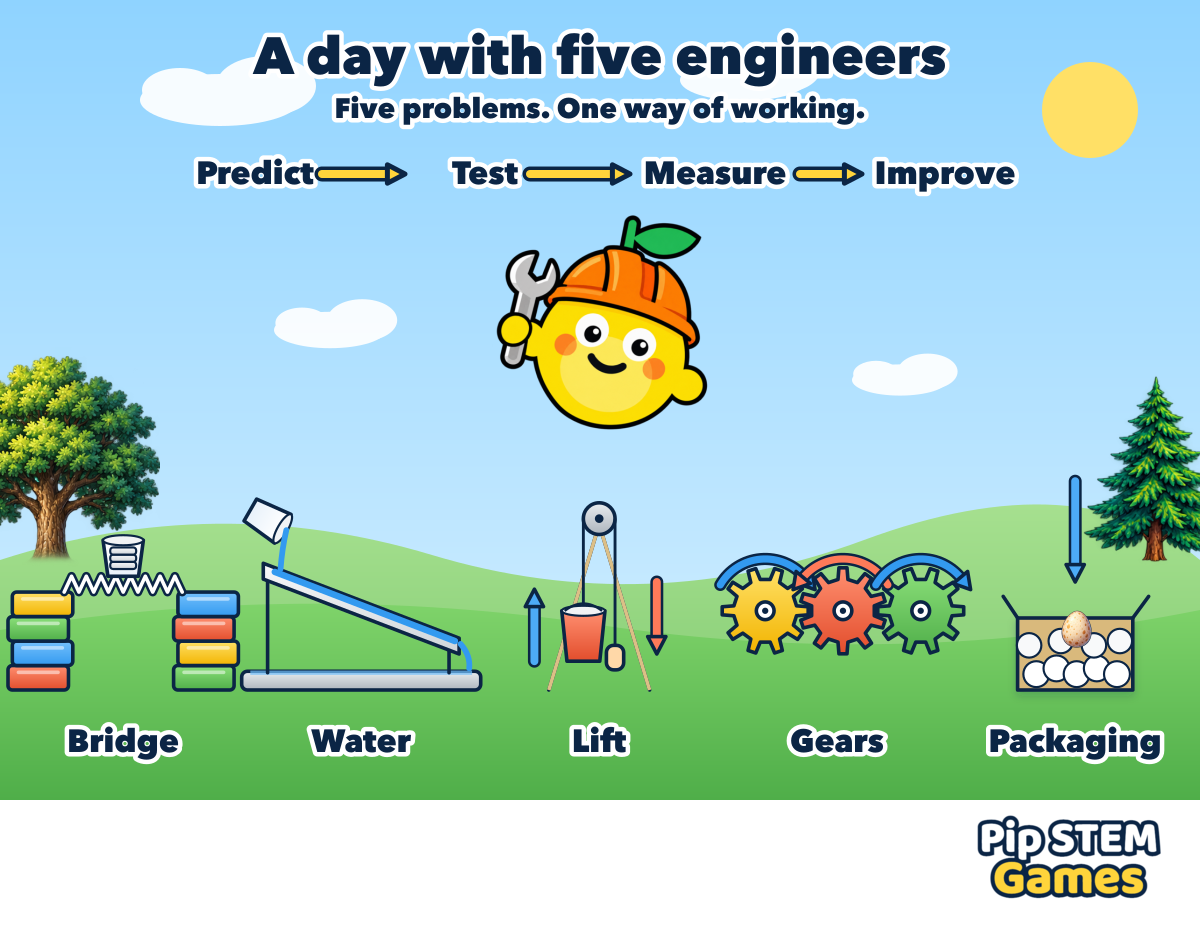
A day in the life of an engineer means asking what a problem needs, then testing ideas until one works. Here are five engineers, five problems and five quick home tests, each with a picture, plus a cheat sheet and a printable record sheet.
1. Bridge engineer
A bridge engineer's day starts with a question: how much weight can this carry before it bends too far? On a real job that means drawings, sums and checks on site. At home it means paper, books and coins. Ages 5 and up, about 10 minutes.
- Two sheets of A4 paper the same size
- Two equal stacks of books
- A paper cup
- A handful of 10p coins
- Make two stacks of books about 20 cm apart.
- Lay one flat sheet across the gap. Stand the cup in the middle.
- Add 10p coins one at a time. Count until the paper sags to the table.
- Fold the second sheet into a zigzag, like a fan. Make the folds about 1.5 cm wide.
- Test it the same way and count again.
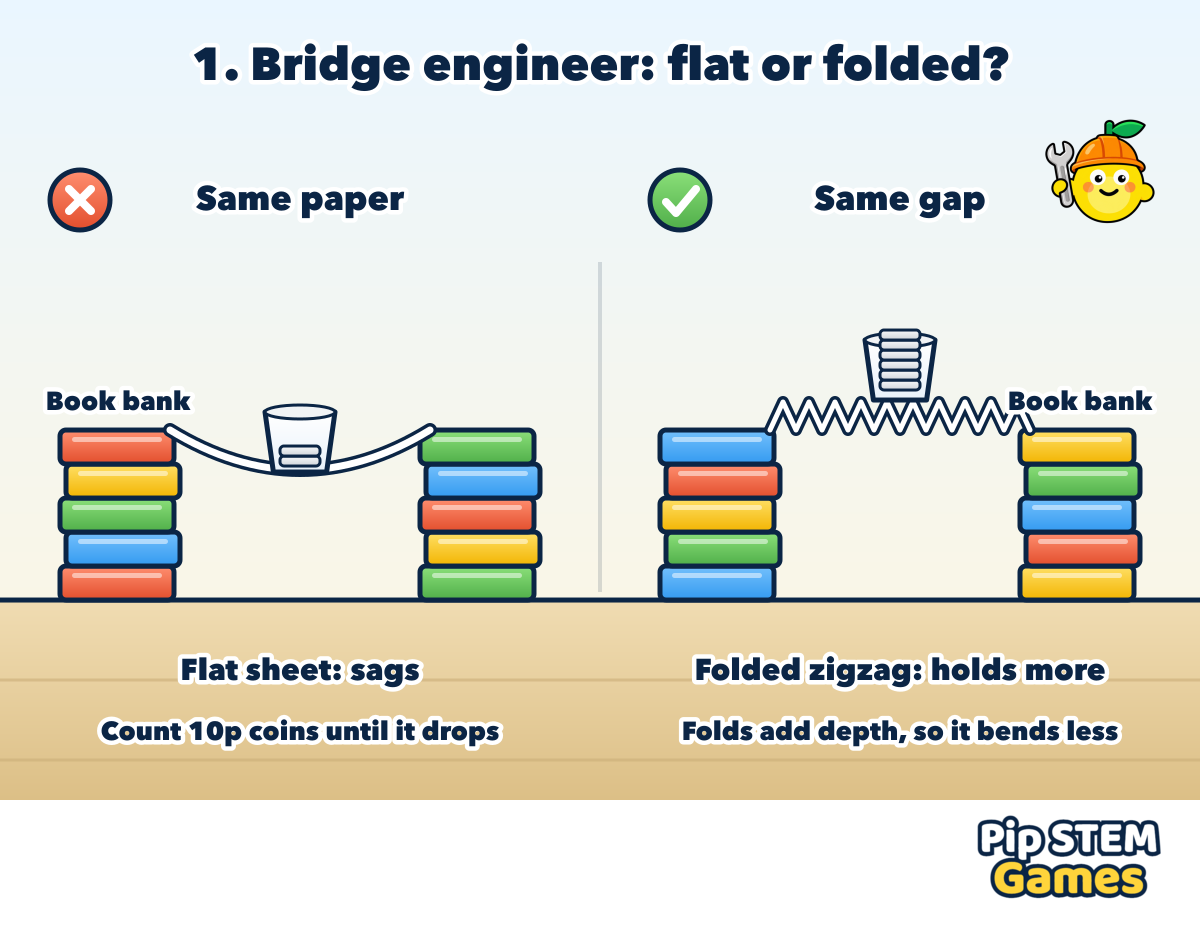
Why it works: the folds give the paper depth. A deeper beam bends less, so it can carry more. Real bridge decks use the same idea with steel and concrete. For more, try the paper bridge challenge.
2. Water engineer
Water engineers get clean water to taps and take dirty water away. Most of their pipes rely on one simple fact: water runs downhill. Ages 5 and up, about 10 minutes, on a tray.
- A strip of card folded into a U, or a cardboard tube cut in half
- Tape
- A small cup of cold water
- A tray or baking dish
- A few books to prop it up
- Put the tray on a table, away from plugs and sockets.
- Lay the channel flat inside the tray. Pour a little water in one end. Watch what it does.
- Prop the top end up on a book so the channel slopes down.
- Pour the same amount again. Where does the water go now?
- Try two books. Does it run faster?
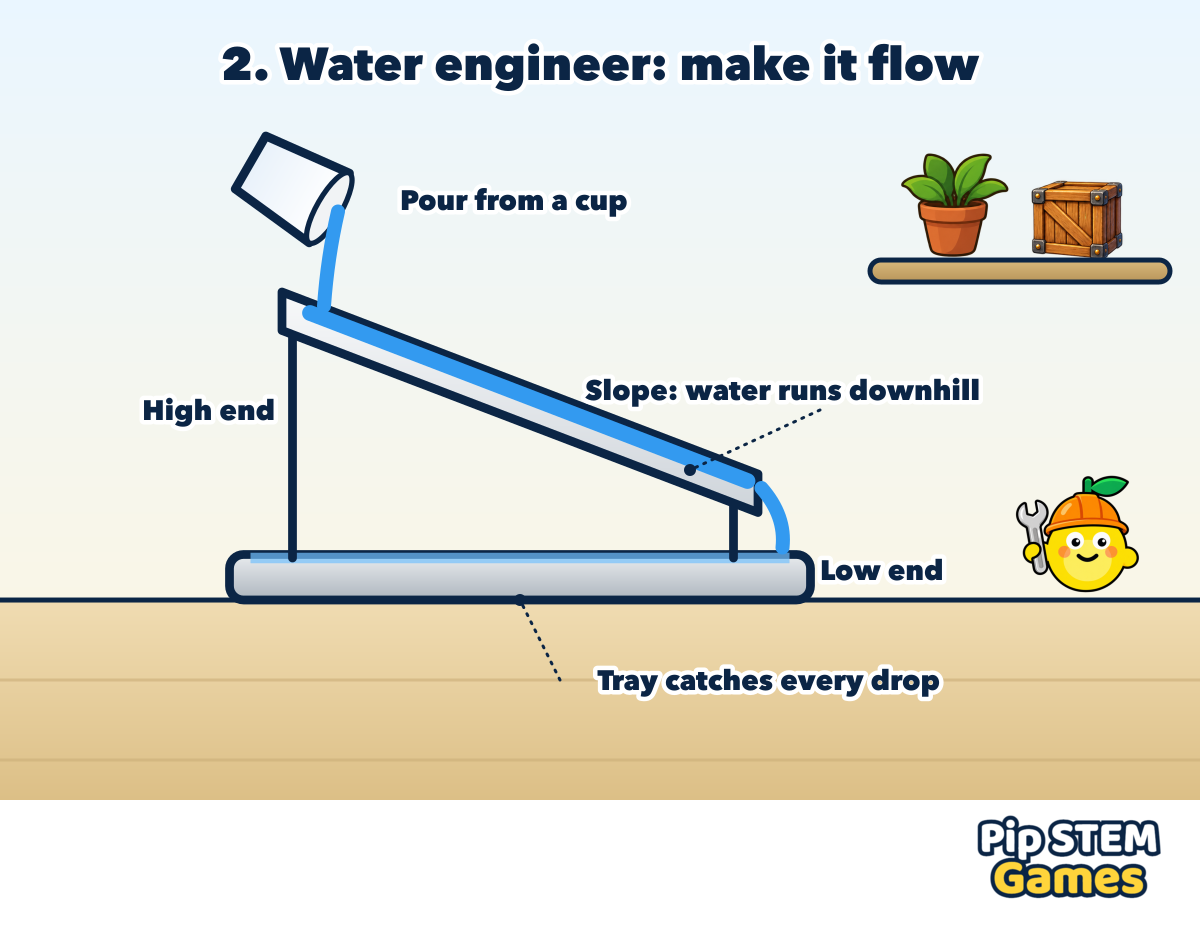
Real pipe networks use gentle slopes and pumps to move water across a town. See how water gets to your tap for the full journey.
3. Lift engineer
Lift and crane engineers work out how to raise heavy loads safely. A pulley is one of their oldest tools. Ages 6 and up, about 10 minutes, with an adult holding the rod.
- A smooth rod, broom handle or cardboard tube
- About 1 m of string
- A paper cup with a string handle
- A few 10p coins
- Ask an adult to hold the rod level, or rest it between two chair backs.
- Tie the cup to one end of the string. Put three coins in it.
- Hang the string over the rod.
- Pull the free end down. Watch the cup go up.
- Lift the same cup by hand. Does the pulley feel the same, easier or just different?
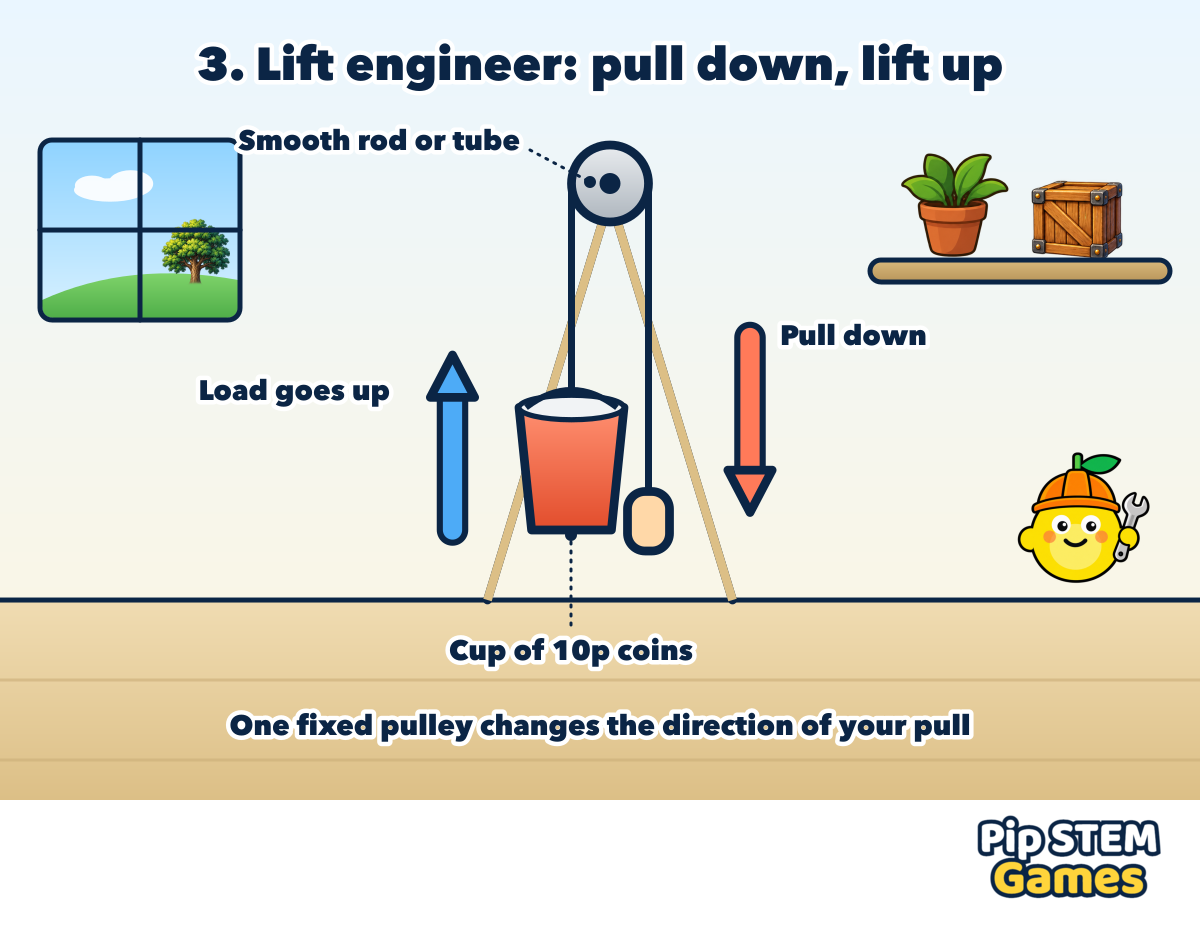
One fixed pulley does not make the load lighter. It lets you pull down, which is easier for your body. Adding more pulleys is what cuts the effort. Try it in this household pulley build.
4. Gear engineer
Gear engineers design the wheels inside clocks, bikes and wind turbines. Their first question is often simple: if I turn this one, which way does the last one go? Ages 6 and up, about 10 minutes.
- Three card gears, or three bottle tops with ridged edges
- A piece of thick card as a base
- Three drawing pins or split pins (adult job)
- A pencil
- Ask an adult to pin three gears in a row on the card. The teeth must touch.
- Draw an arrow on each gear.
- Predict: if gear 1 turns clockwise, which way will gear 3 turn?
- Turn gear 1 slowly and watch.
- Add a fourth gear. Predict again before you turn.
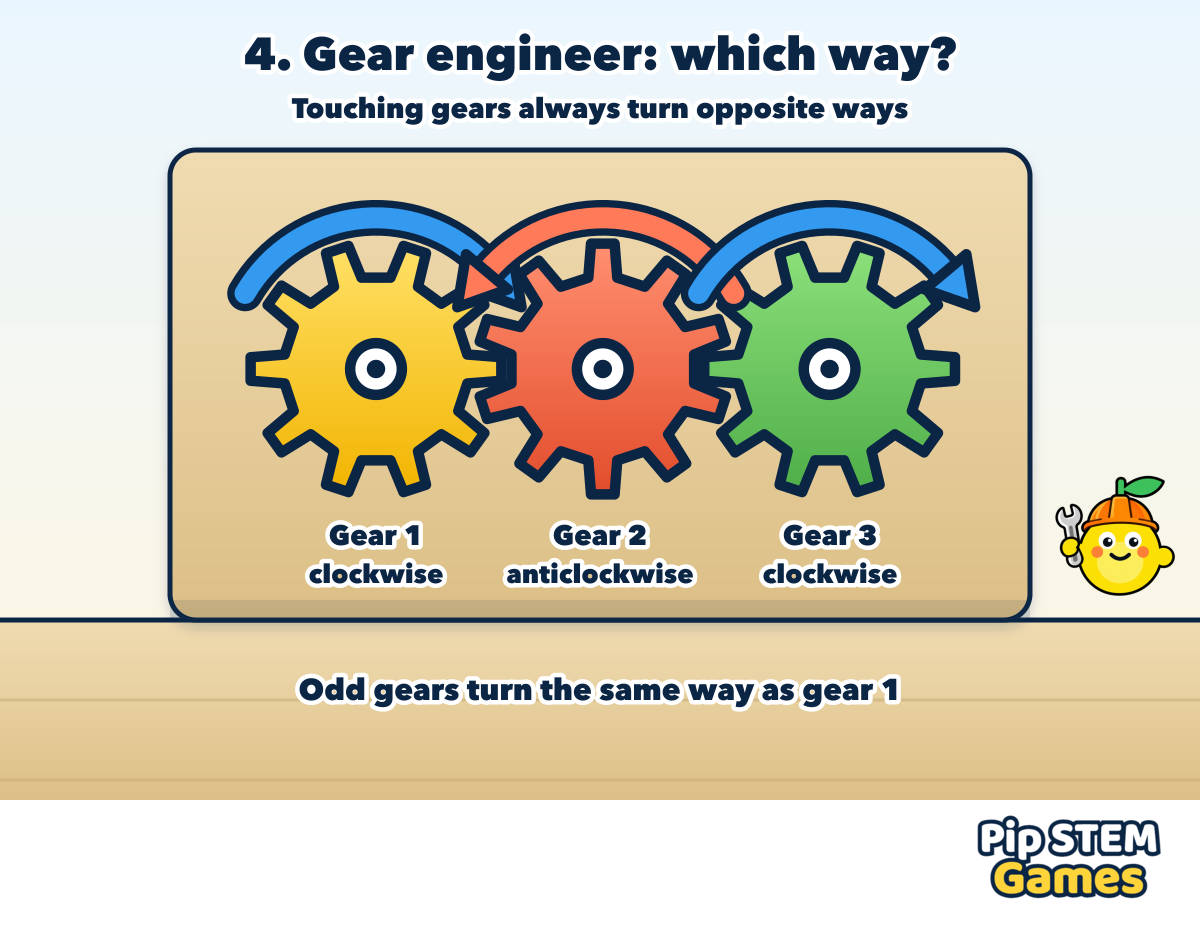
The rule: every touching pair swaps direction. So gears 1, 3 and 5 match, and gears 2 and 4 go the other way. Test your guesses with this gear puzzle or in our gears game.
5. Packaging engineer
Packaging engineers make sure things arrive in one piece. They test boxes by dropping them, again and again. Ages 5 and up, about 15 minutes.
- A small box
- Scrap paper to crumple
- A safe test object, such as a hard-boiled egg in a sandwich bag or a small soft toy
- A tape measure
- Put the test object in the empty box. Close it.
- Drop it from 50 cm onto the floor. Check the object.
- Now fill the box with crumpled paper all round the object.
- Drop it from the same 50 cm. Check again.
- Try other fillings, such as a sock or bubble wrap. Keep the height the same.
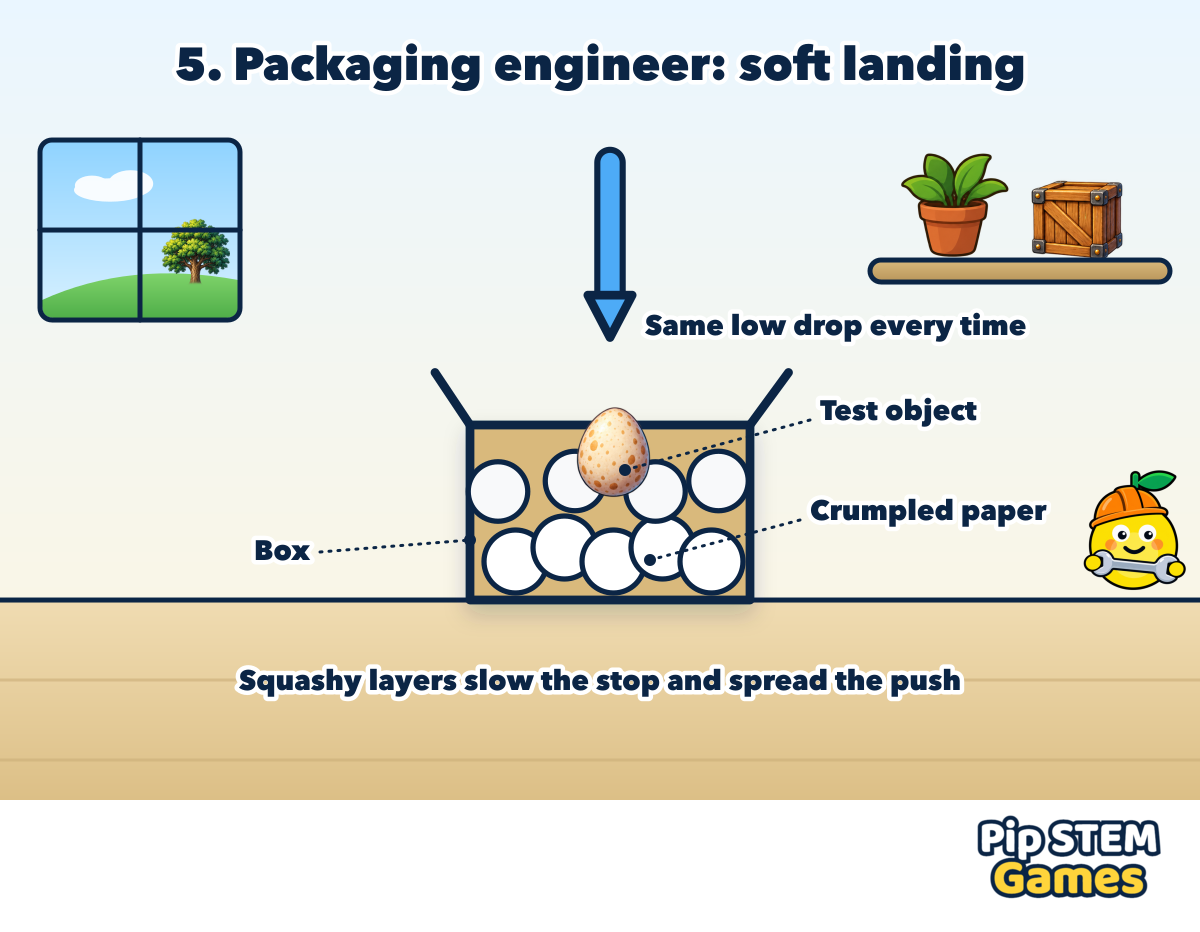
Why it works: squashy layers make the stop take a little longer, and they spread the push over more of the object. That means less force on any one spot.
How do you make each test fair?
Every engineer above works the same way: predict, test, measure, improve. The trick is to change only one thing at a time.
- Bridge: same paper, same gap. Change only the fold.
- Water: same cup of water. Change only the slope.
- Lift: same load. Compare pulley and no pulley.
- Gears: same first turn. Add one gear at a time.
- Packaging: same height, same floor. Change only the filling.
Do each test three times and take the middle result. Write down what really happened, even if it surprised you. That is how the engineering design process works on real jobs too.
What if a test does not work?
- The paper bridge falls at once: make the folds smaller and press them flat.
- Water leaks from the channel: tape along the seams, or line it with a strip of foil.
- The string sticks on the rod: use a smoother tube or thinner string.
- The gears slip: push them closer so the teeth lock together.
- Every packaging test looks the same: try a thinner filling, or compare no filling with lots.
Getting it wrong is normal. Engineers learn most from the tests that fail. There is more on that in why getting it wrong is part of engineering.
How do you change it for each age? [Printable]
- Ages 5 to 6: pick one engineer. Talk about what you think will happen, then look.
- Ages 7 to 9: try all five. Count coins, time the water and fill in the record sheet.
- Ages 10 to 12: explain why each design works, then make one better and prove it with numbers.
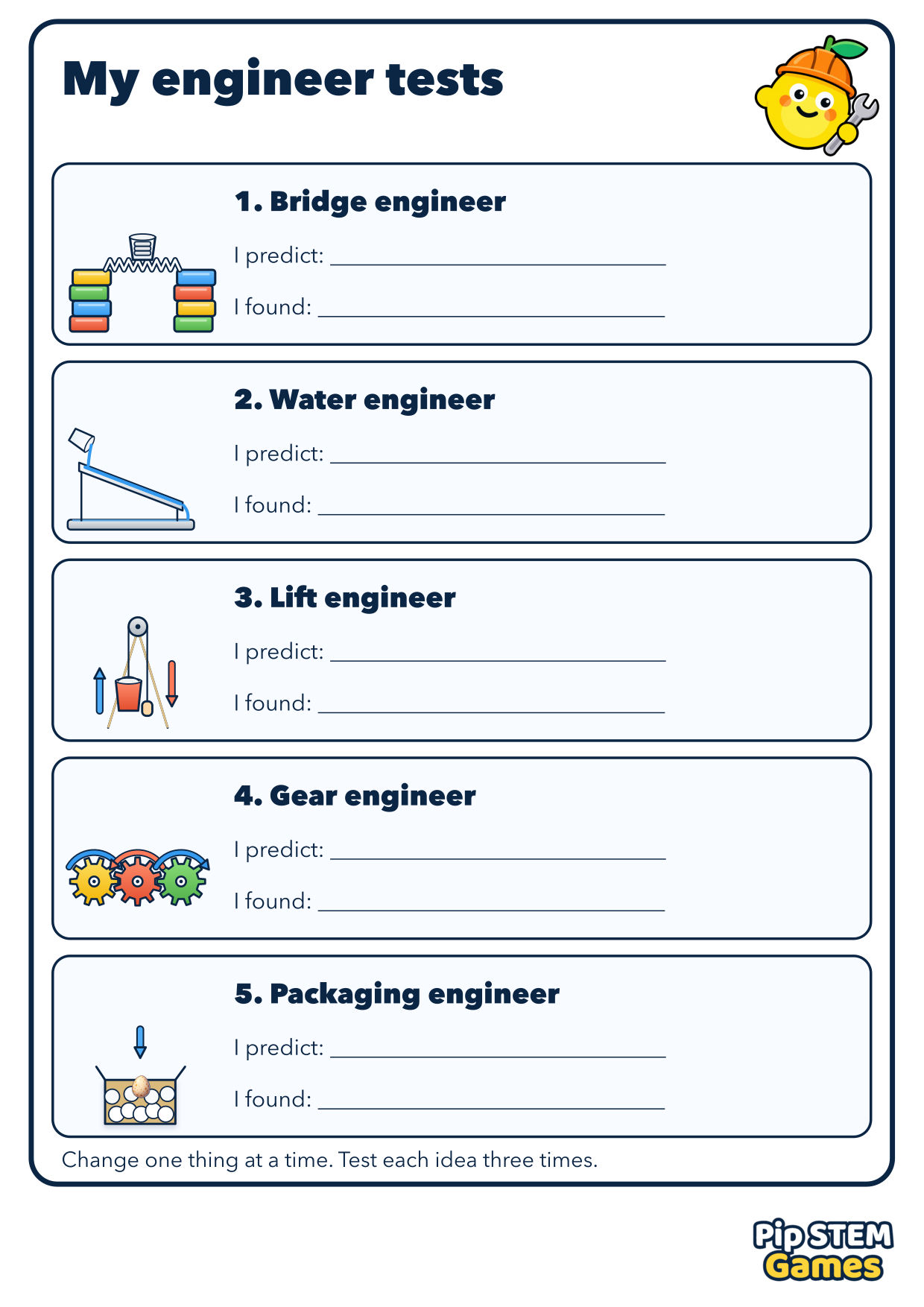
Want more? Our engineering workbook for kids has more tests like these, and these engineering careers show where each skill can lead.
Questions parents ask
What does an engineer do all day?
Most engineers split their time between planning, drawing designs, checking sums, meeting their team and testing or inspecting work. The exact mix depends on the job.
Which engineer test is easiest for a 5-year-old?
The water channel. It needs a tray, a strip of card and a cup of cold water, and the result is easy to see.
Why does folded paper hold more coins?
The folds give the paper depth. A deeper shape bends less, so it can carry more weight before it sags.
Does one pulley make things lighter?
No. One fixed pulley only changes the direction of the pull. You need more than one pulley to cut the effort.
Is it safe to use coins with young children?
Coins are a choking risk. Keep them away from children under 3 and watch younger children closely. Put them away after the test.
Can we do all five tests in one afternoon?
Yes. Each takes about 10 to 15 minutes. Do the water test last so any spills are easy to clear up.
Great STEM activities to try next...
 Engineering Careers Kids Might Not Know Exist [Printable]Careers
 Which Engineer Would Solve This Problem? [Printable]How it works
 What Does a Civil Engineer Do? [Printable]Careers
More to try: How Do Engineers Build Spacecraft? 5 Home Tests

Pip STEM Games
We make engineering games and workbooks for kids aged 5 to 12. Every activity here is one we'd happily run at the kitchen table: test it, watch it fail, fix it, try again.




