

Key takeaways
- A flooded road needs a civil engineer, who moves water away with slopes, drains and pipes.
- A cracked bridge needs a structural engineer, who finds the weak part and makes it stronger.
- A robot arm that won't grip needs a mechanical engineer, plus electrical and software engineers.
- Three kitchen tests (flood, bridge, grip) show each problem in about 30 minutes.
- Change one thing at a time so the test is fair, and write down what really happened.
A flooded road needs a civil engineer, a cracked bridge needs a structural engineer, and a robot arm that won't grip needs a mechanical engineer working with electrical and software engineers. Engineers are named after the kind of problem they solve best. Below you'll find which engineer would solve this problem for each case, three quick home tests to see the problems for real, a cheat sheet of eight engineers and a printable matching sheet. It suits ages 5 to 12 and takes about 30 minutes.
Which engineer fixes which problem?
Start with the problem, not the job title. Engineers are grouped by the kind of problem they're best at, so if you can say what's going wrong, you can usually name the engineer.
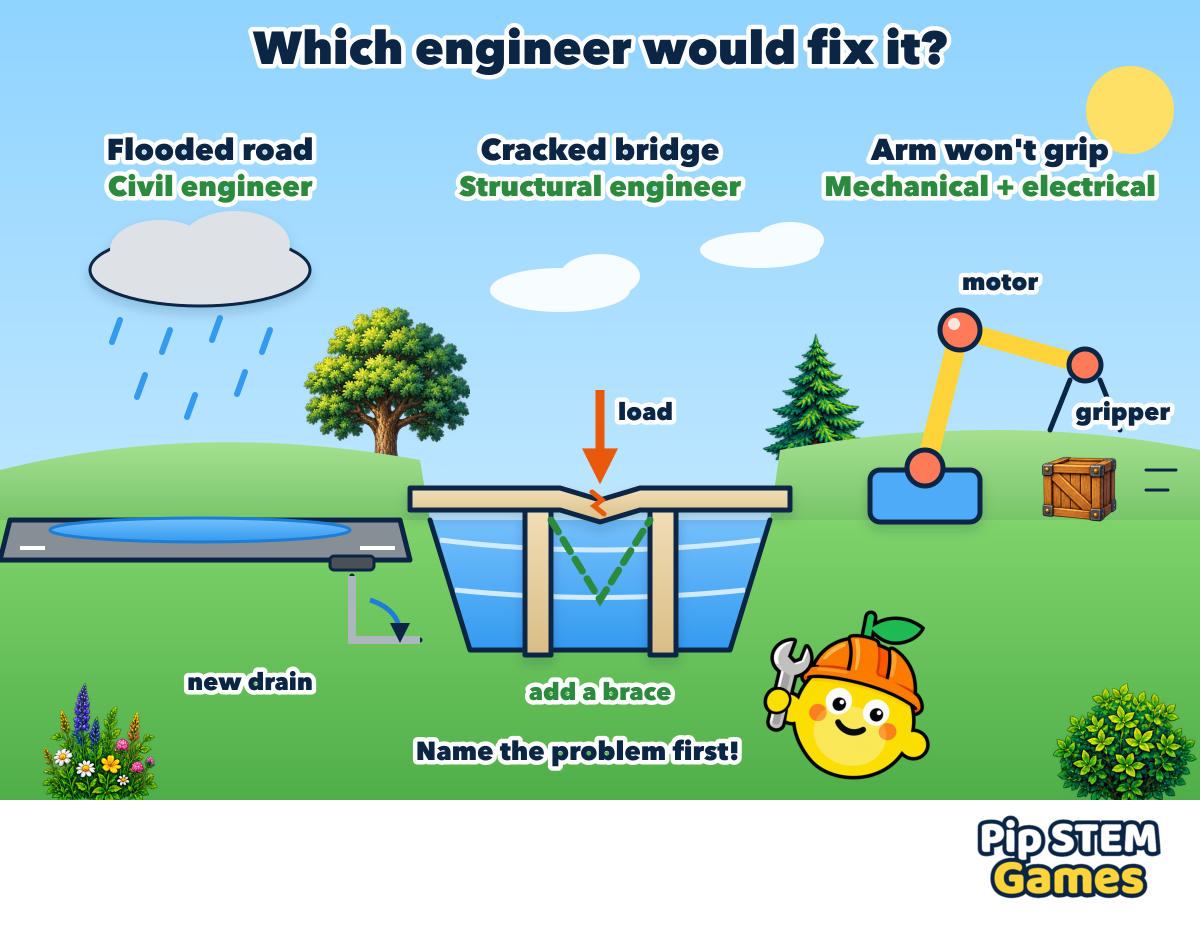
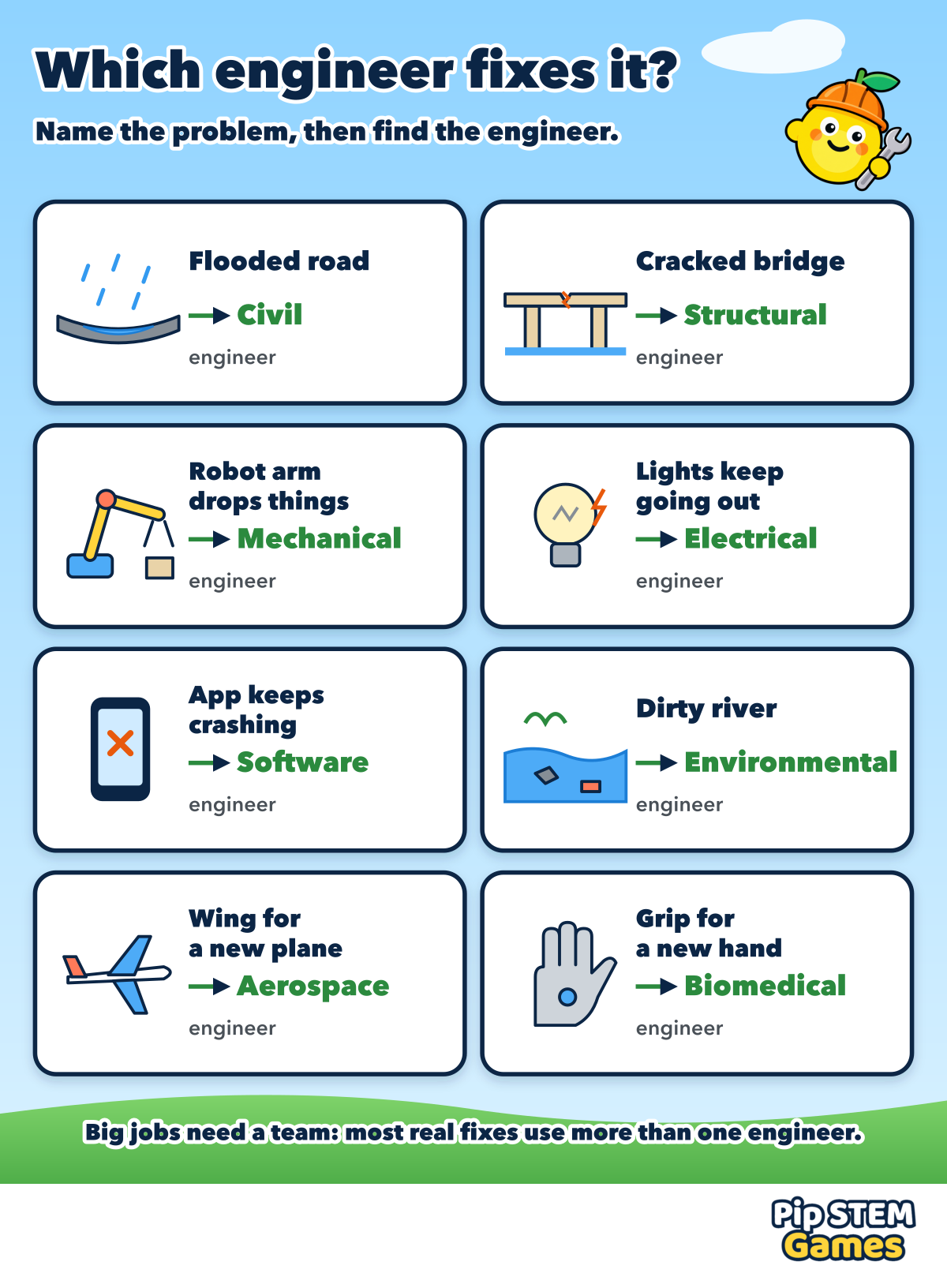
- Water in the wrong place, roads, drains: civil engineer.
- Something bending, cracking or about to fall: structural engineer.
- A machine that moves badly: mechanical engineer.
- Power, wires, motors, sensors: electrical engineer.
- Programs and apps: software engineer.
- Dirty air or water: environmental engineer.
Real fixes often need a team. A robot arm is a good example: one engineer designs the joints, another wires the motors, and another writes the code that tells it when to close. That's a lovely thing for kids to hear, because it means no one person has to know everything.
What does a civil engineer do about a flooded road?
A civil engineer works out where the water should go and builds a way to get it there. Civil engineers design the big things everyone shares: roads, drains, bridges, pipes and water systems.
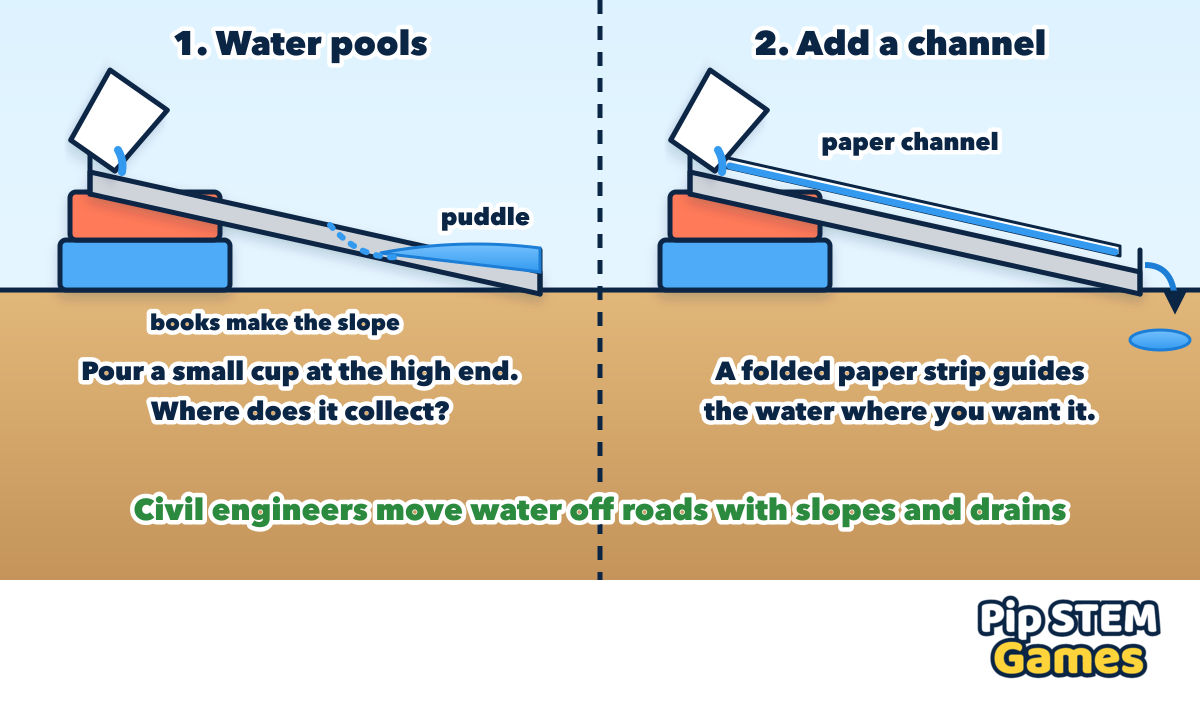
For a flooded road, the first question is simple. Where does the water collect, and why can't it leave? Water always runs downhill, so the engineer checks the slope of the road, looks for a blocked or missing drain, and plans a channel or pipe to carry the water away. Sometimes the fix is as plain as clearing leaves out of a drain. Sometimes it's a whole new pipe.
Our guide to what a civil engineer does has more examples, and design a flood defence for a small town turns this into a bigger challenge.
What does a structural engineer do about a broken bridge?
A structural engineer finds the weak part and makes it stronger. Structural engineering is a branch of civil engineering that checks how loads, which are pushes and pulls, travel through a building or bridge down to the ground.
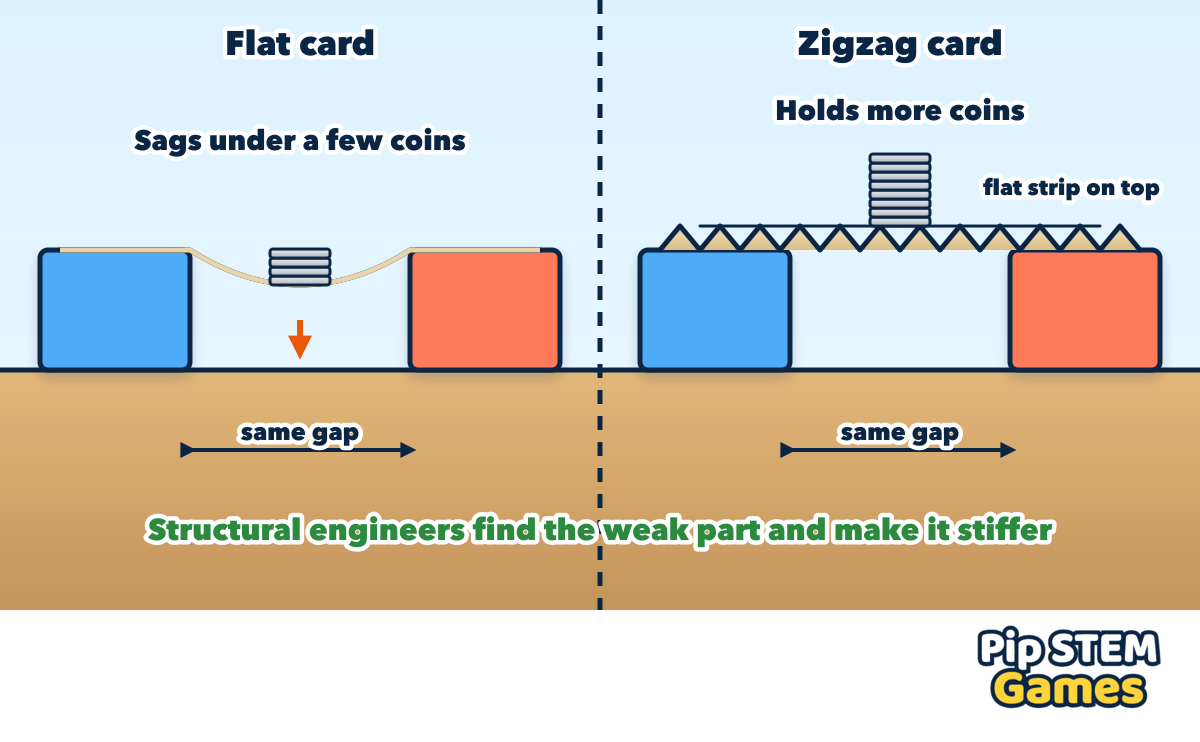
A bridge deck pushes down. The supports push back up. If one part can't carry its share, it bends, then cracks. The engineer works out which part is overloaded and fixes it, often with a brace, a thicker beam or an extra support. Shape matters as much as material, which is why a folded card holds far more than a flat one. Why arches are so strong shows another shape trick engineers use.
Want to practise? Try spotting weak spans in the Bridge Builder game.
What does a mechanical engineer do about a robot arm that won't grip?
A mechanical engineer looks at how the parts move and how hard they can squeeze. A robot arm is made of joints, levers and a gripper, and if the gripper is too weak, too slippery or in the wrong place, the box drops.
An electrical engineer adds the motors and the power. A software or control engineer writes the instructions that tell the arm when to close and when to let go. If the arm grabs too early, that's a code problem, not a gripper problem. Frankly, working out which kind of problem it is, is half the job. Our post on why the robot keeps dropping the box walks through that exact puzzle, and what software and robotics engineers do covers the code side.
What do you need for the home matching game?
You need everyday things from the kitchen and the recycling box. Plan on about 30 minutes for all three tests.
- Paper and a pen for predictions
- A shallow baking tray or plastic tub, a small cup of water and a tea towel (flood test)
- Two or three books to make a slope
- Two equal piles of books and a strip of thin card, about 25 cm by 8 cm, cut from a cereal box (bridge test)
- Ten 10p coins as the load
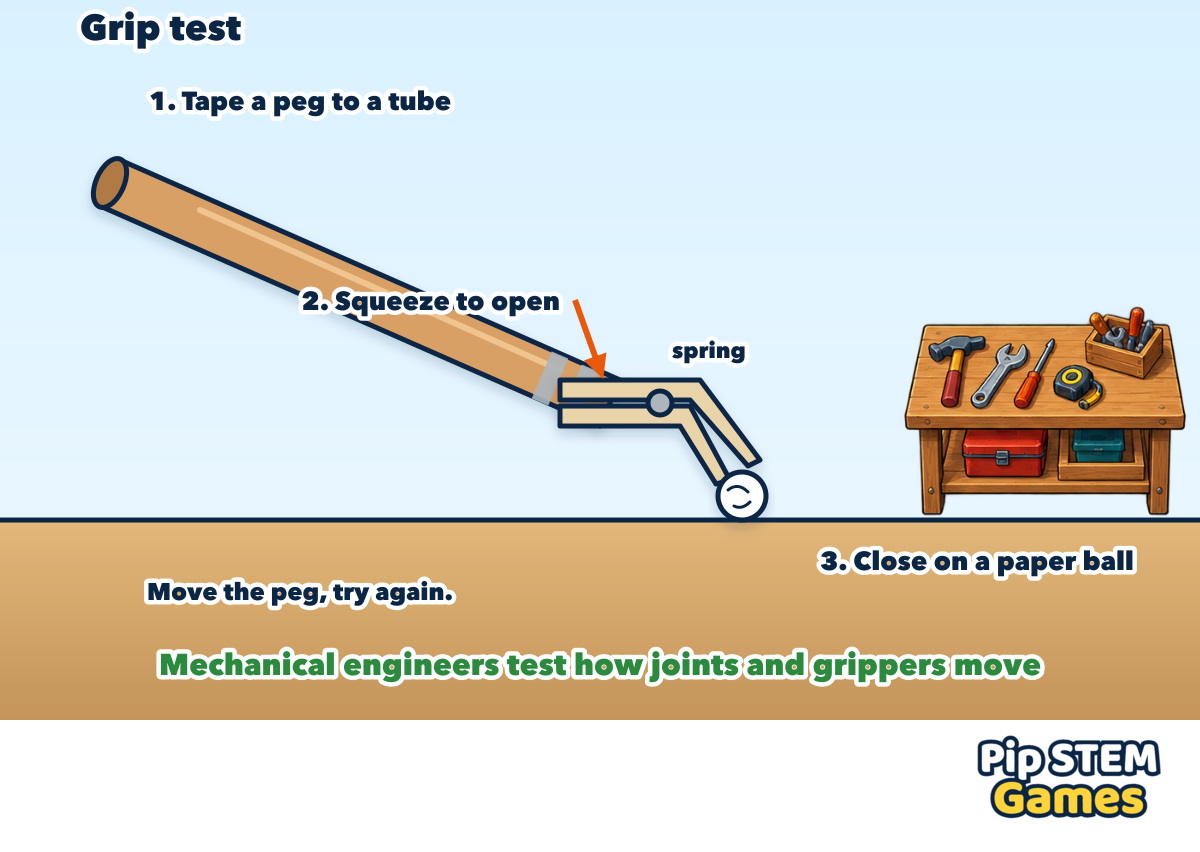
- A cardboard tube, a spring clothes peg, tape and a scrunched paper ball (grip test)
Safety: nothing here needs heat, sharp tools or mains electricity. Coins and pegs are small parts, so stay close with under-6s and count the coins back in. Mop up spills straight away so nobody slips.
How do you run the three mini tests?
Predict first, then test, then match each test to an engineer. Kids remember the job much better once they've watched the problem happen.
- Predict. Read out the three problems. Ask your child which engineer fits each one and why. Write the guesses down.
- Flood test. Rest one end of the tray on a book. Pour a small cup of water at the high end and watch where it pools. Fold a paper strip into a V-shaped channel, lay it in the tray and pour again. What changed?
- Bridge test. Lay the card strip across a gap between the two book piles. Stack 10p coins in the middle, one at a time, until it sags to the table. Then fold the card into a zigzag, lay a flat strip on top as the road, and try again.
- Grip test. Tape the peg to one end of the tube so the jaws stick out. Squeeze the peg handle to open it, then close it on the paper ball and lift. Move the peg or angle it and try again.
- Answer. Match each test to an engineer and say what you changed to fix it.
Why is it a fair test?
It's fair when you change only one thing at a time. In the bridge test, keep the same card size, the same gap and the same way of adding coins. Only the shape changes.
Write down how many coins each shape held before it touched the table. Record what you really saw, even if it surprises you. That honest number is worth more than a guess that matches the prediction. Older kids can repeat each test three times and pick the middle result.
What if it doesn't work?
Most hiccups are quick fixes, and fixing them is exactly what engineers do all day.
- Water runs straight off the tray: use a deeper tub or a smaller pour.
- The card slides off the books: tape the ends down, or make the gap a little smaller.
- The peg won't hold the ball: use a lighter ball, or wrap an elastic band round the jaws for extra grip.
- Both bridges hold the same: make a bigger change, such as deeper folds.
Ask, "Which engineer would fix that?" The answer is usually the same one as the test.
Which engineer cheat sheet and printable can we use?
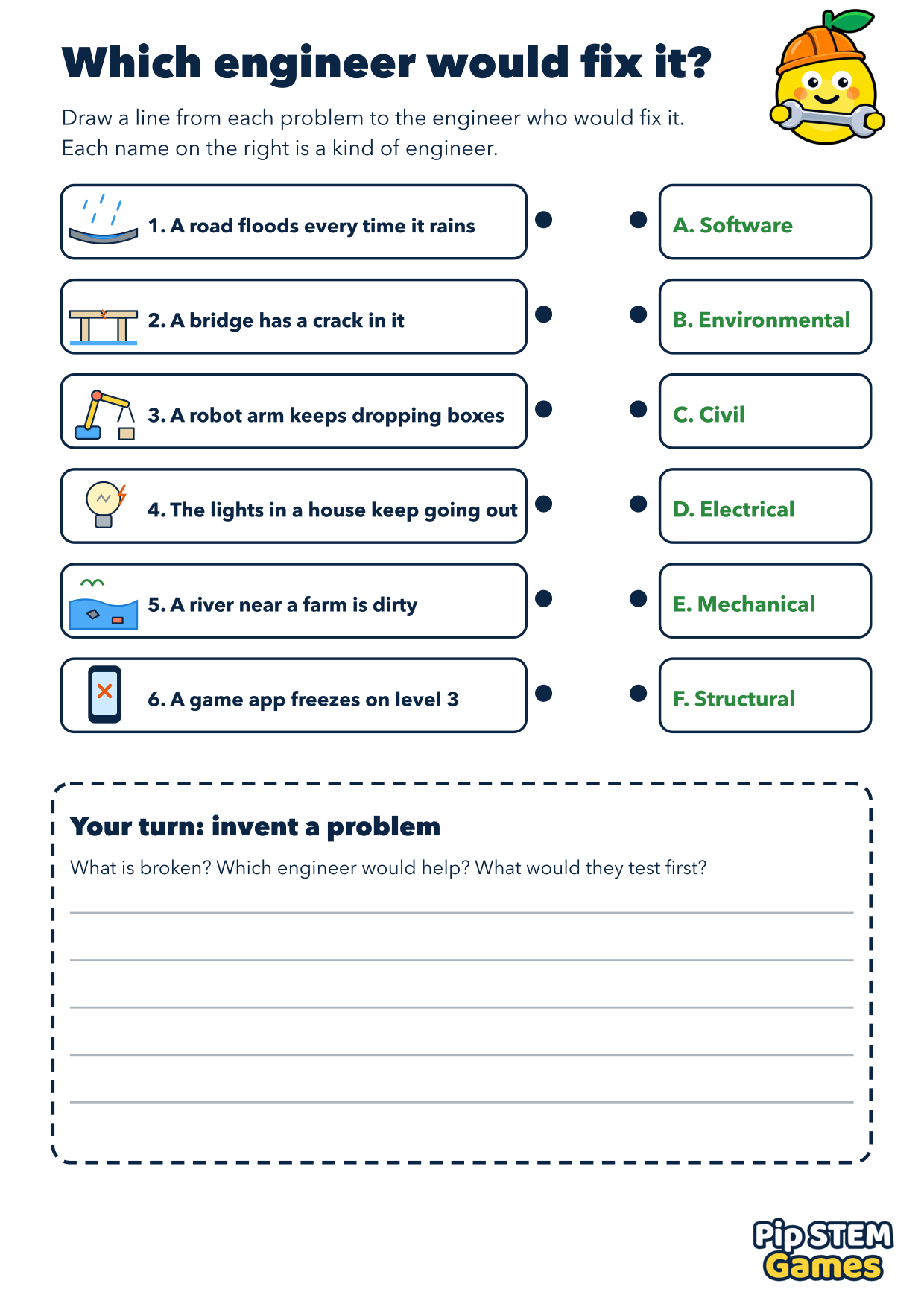
Use the cheat sheet to talk through more jobs, then the printable to test what stuck. Save either image and print it at home.
The worksheet has six problems to match by drawing lines, plus space to invent a problem of your own. Answers: 1 C, 2 F, 3 E, 4 D, 5 B, 6 A.
For 8 to 12 year olds, the Senior Engineers workbook has more problem-first challenges like this one.
How can you change it for different ages?
Younger kids sort pictures; older kids measure and compare.
- Ages 5 to 7: cut out the cheat sheet panels and sort them into "water", "breaking" and "moving" piles. Do the bridge test together and count the coins out loud.
- Ages 8 to 10: run all three tests and fill in the printable. Ask for one reason per match.
- Ages 10 to 12: measure the puddle depth with a ruler, chart the coins each bridge held, and suggest a next problem, such as a leaking roof or a squeaky wheel.
These are small models for learning, not real engineering methods. Real engineers use far more careful calculations, but the first step is the same: name the problem clearly.
Questions parents ask
What are the main types of engineer for kids to know?
Civil, structural, mechanical, electrical, software, environmental, aerospace and biomedical cover most of the problems kids notice. Each one is named after the kind of problem it solves.
Is a structural engineer the same as a civil engineer?
Structural engineering is a branch of civil engineering. Structural engineers focus on whether buildings and bridges can carry their loads safely.
Which engineer would fix a robot?
Usually a team. Mechanical engineers design the moving parts, electrical engineers add motors and sensors, and software engineers write the code.
Which engineer keeps rivers and drinking water clean?
Environmental engineers work on clean air and water. Civil engineers often build the pipes and treatment works with them.
Why does a zigzag card hold more coins than a flat one?
Folding gives the card height, so it is much harder to bend. Engineers use the same idea in corrugated cardboard and metal roofing.
What age is this matching game for?
Ages 5 to 12. Younger children sort pictures and count coins; older children run fair tests, measure and chart the results.
Great STEM activities to try next...
 What Does a Civil Engineer Do?Activity
 The Robot Keeps Dropping the Box. Why? A Gripper Test for KidsBuild challenge
 Engineering Careers Kids Might Not Know Exist [Printable]Careers
More to try: Bored 10-Year-Old? 12 Things to Build and Solve · 5 Engineering Games That Teach Problem-Solving

Pip STEM Games
We make engineering games and workbooks for kids aged 5 to 12. Every activity here is one we'd happily run at the kitchen table: test it, watch it fail, fix it, try again.




