

Key takeaways
- Gear puzzles teach that touching gears turn opposite ways, so you can predict a whole row.
- Structure puzzles show why one diagonal turns a wobbly square into two strong triangles.
- Electricity puzzles show a bulb only lights with a full loop from one battery end to the other.
- Machine puzzles show a pivot near the load means a smaller push but a longer movement.
- Resource puzzles make children plan and add up costs before they build.
The best engineering games that teach problem-solving come in five types: gears, structures, electricity, machines and resources. Each one asks a child to predict, test and improve, and each works at the kitchen table.
1. Gear puzzles
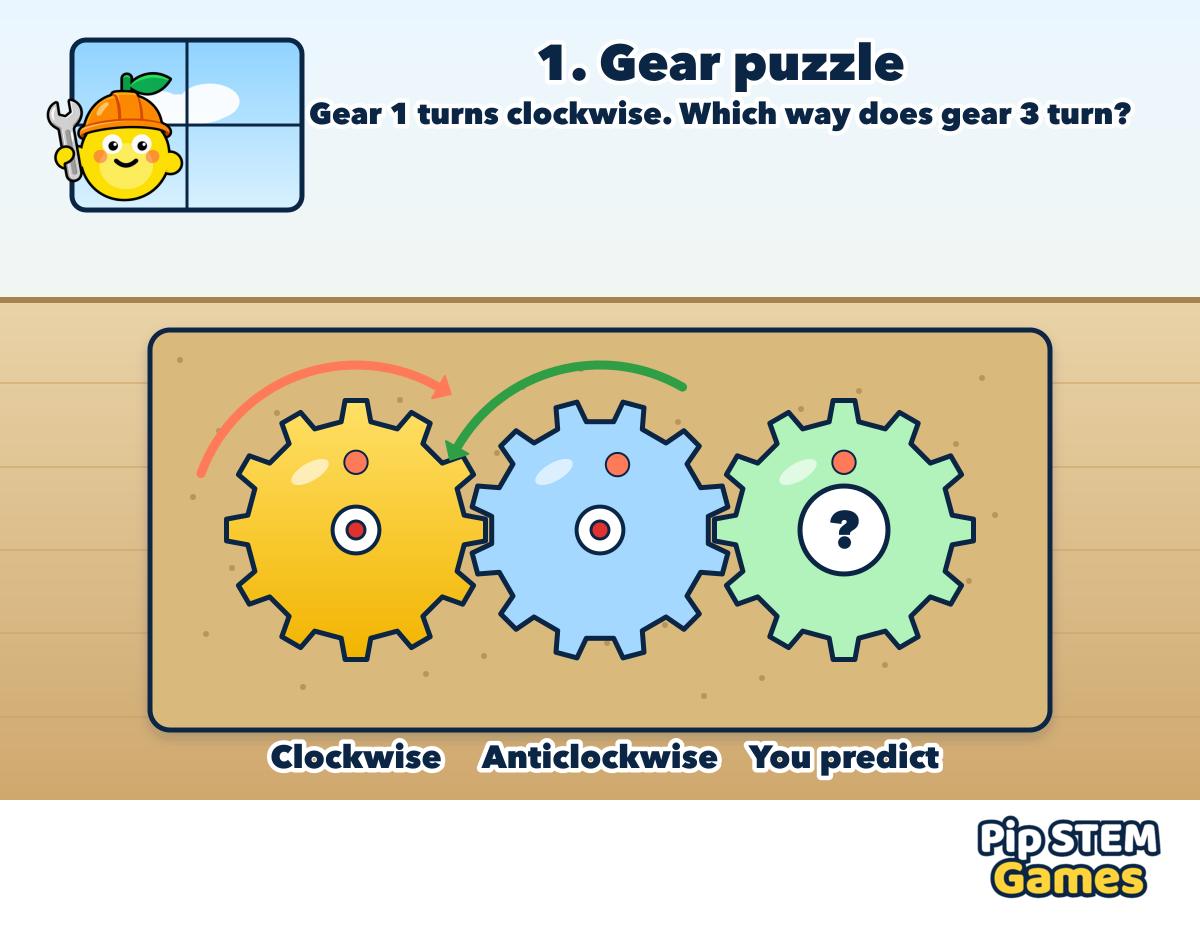
A gear puzzle asks which way each gear turns. Touching gears always turn in opposite directions, so in a row the direction flips at every gear. That one rule lets a child predict a whole machine before touching it.
You need: thick card, a pencil, round lids to trace, split pins or drawing pins, and a cork board or thick cardboard base.
- An adult traces and cuts three card circles the same size.
- Cut small notches all round each edge to make teeth.
- Pin the circles in a row on the board so the teeth overlap.
- Draw a dot on each gear so you can see it move.
- Before turning, write down which way gear 3 will turn.
- Turn gear 1 clockwise and check your guess.
Gear 3 turns clockwise, the same way as gear 1. Add a fourth gear and ask again. Our which way does the last gear turn? puzzle has more of these, and the Gears game lets children test them on screen.
2. Structure puzzles
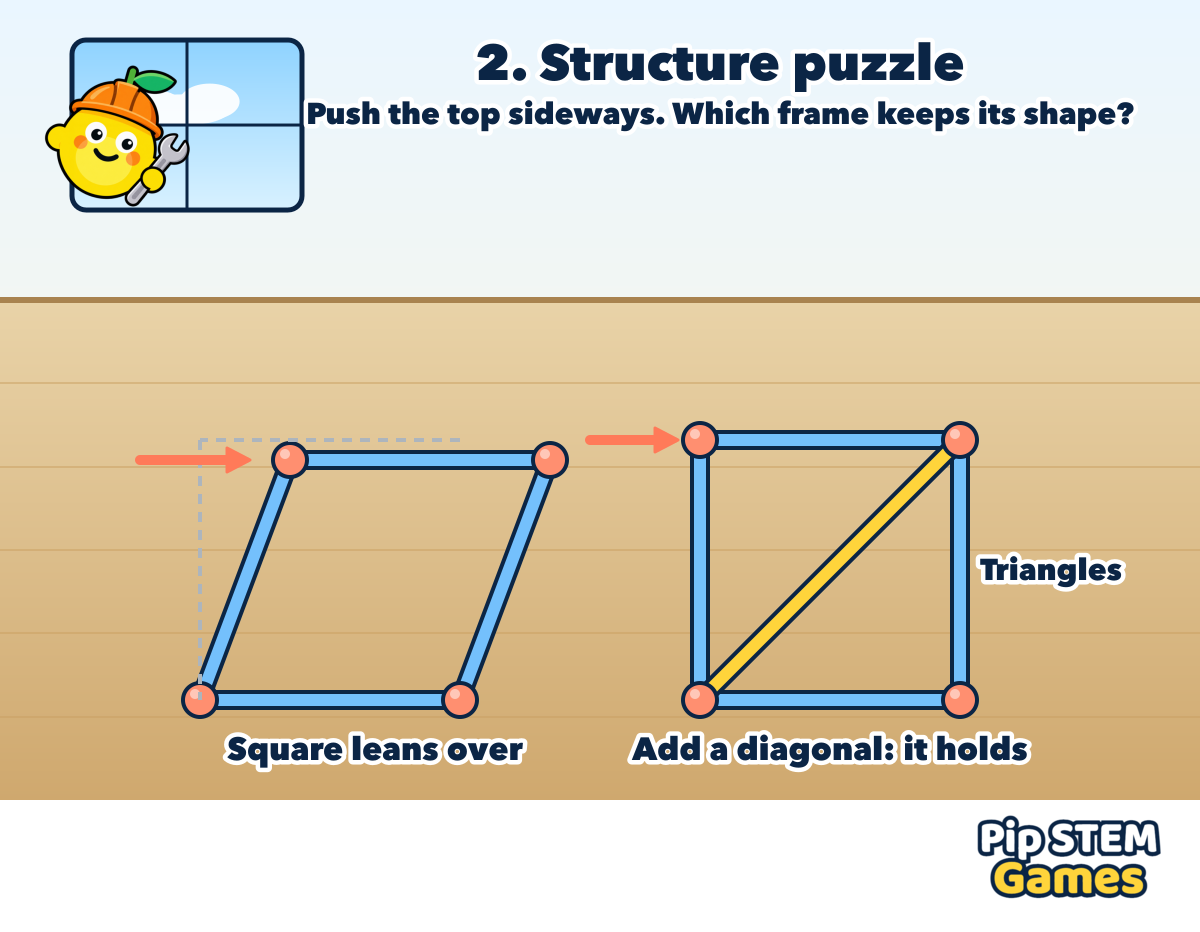
A structure puzzle asks which shape holds its form under a push. A square with loose corners can lean over into a diamond. A triangle can't change shape unless one of its sides bends or breaks, which is why bridges and pylons are full of them.
You need: drinking straws, modelling clay or mini marshmallows, and a flat table.
- Join four straws into a square with a lump of clay at each corner.
- Stand it up and press the top corner sideways. Watch it lean.
- Guess what one extra straw will do.
- Add a straw from one corner to the opposite corner.
- Press the top again and compare.
The diagonal splits the square into two triangles, and the frame stops leaning. If your child likes this one, try which shape makes the strongest tower? next.
3. Electricity puzzles
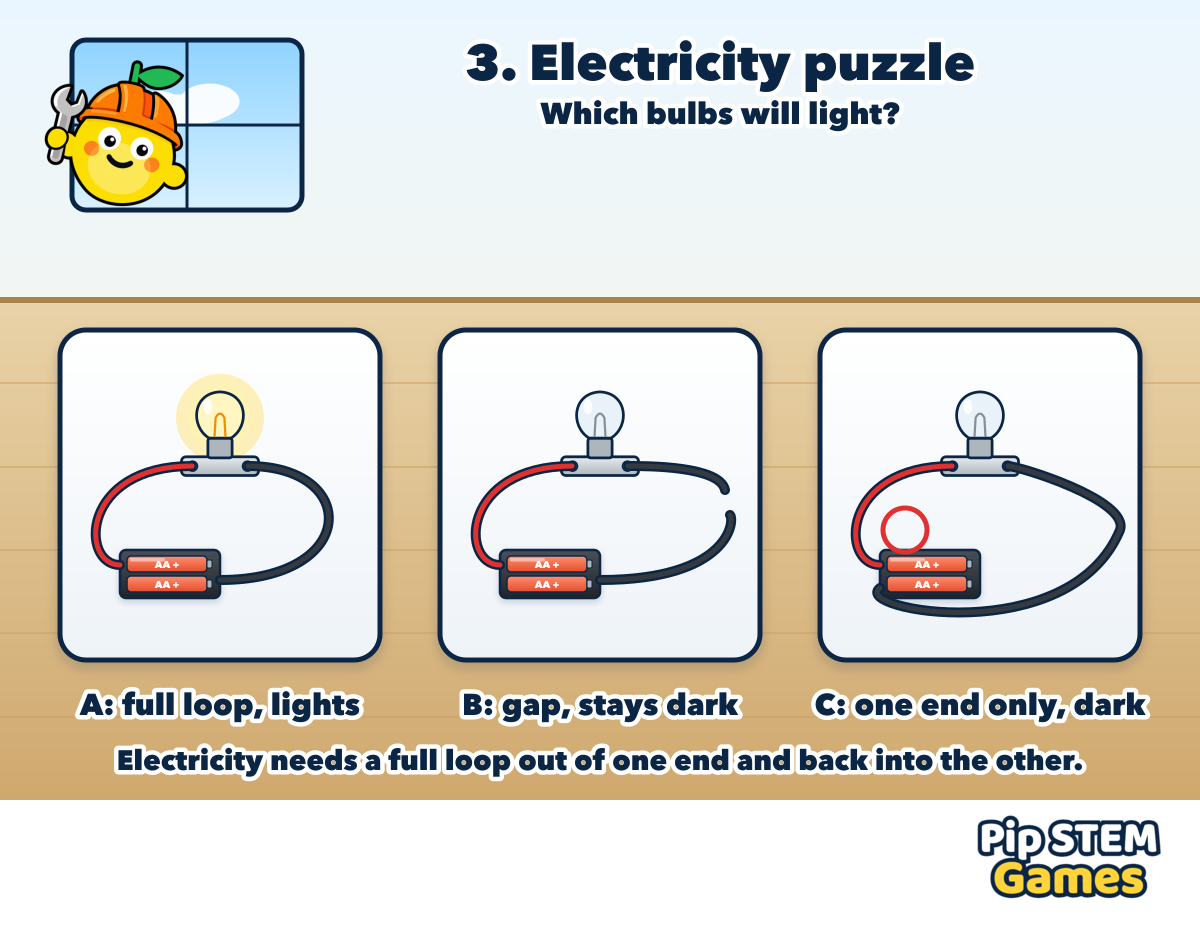
An electricity puzzle asks whether a bulb will light. It lights only when there's a complete loop from one end of the battery, through the bulb, and back into the other end. A gap anywhere, or both wires on the same end, keeps it dark.
You need: 2 AA batteries in a holder, a small bulb rated for about 3 volts in a holder, three clip leads, paper and a pencil.
- Draw the three circuits in the picture on paper.
- Ask your child to mark which bulbs will light.
- Build circuit A with the real parts and check.
- Unclip one lead to make circuit B. What happens?
- Move both leads to the same battery end for circuit C.
- Count how many guesses were right.
Never clip the two battery leads straight to each other, and unclip a lead if anything feels warm. The Circuit game has more loops to fix, and circuits for kids covers switches.
4. Machine puzzles
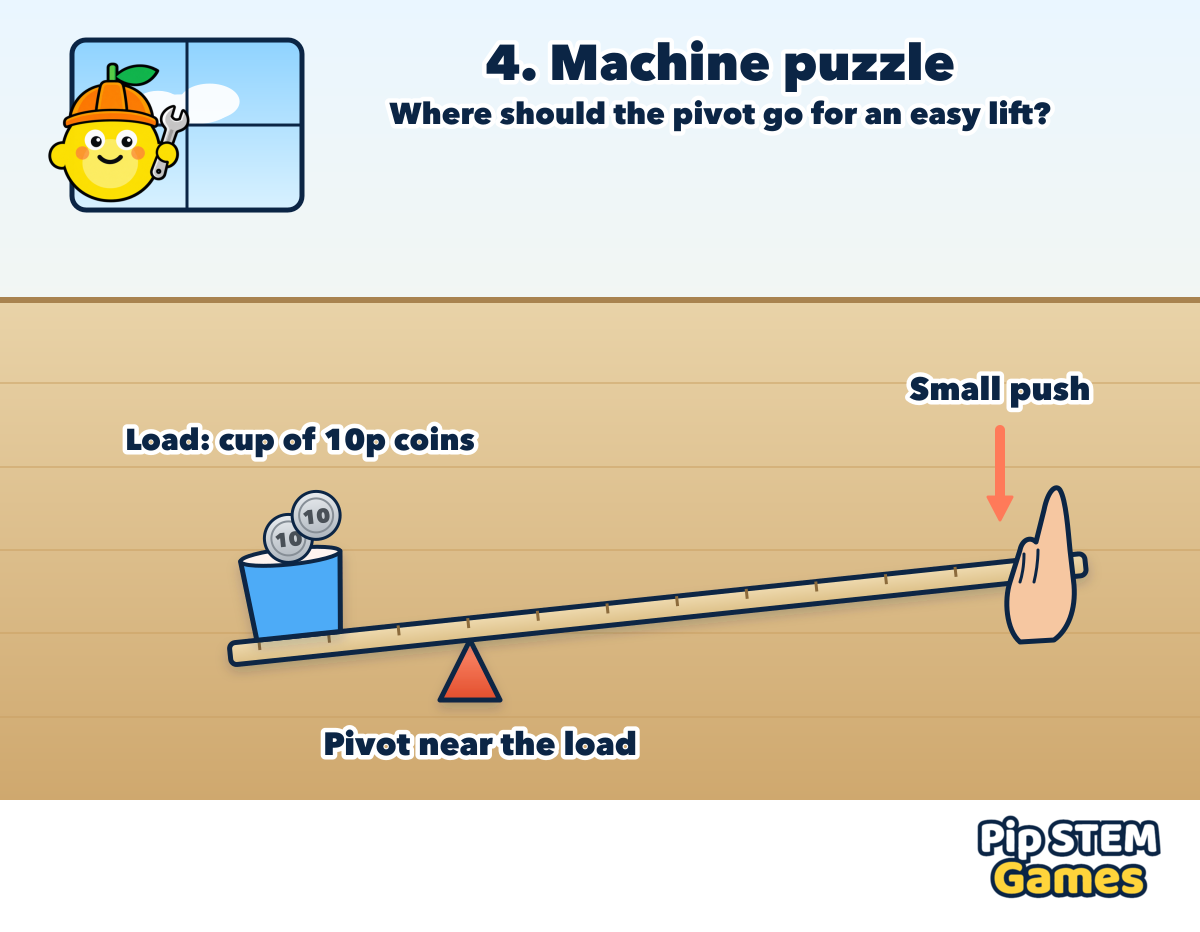
A machine puzzle asks how a simple machine changes the push you need. With a lever, moving the pivot closer to the load means a smaller push lifts it. The catch is that your end has to move further. That trade is the whole idea behind levers, ramps and pulleys.
You need: a 30 cm ruler, a thick pencil or a marker pen as the pivot, a paper cup and some 10p coins.
- Put 5 coins in the cup and stand it on one end of the ruler.
- Lay the ruler across the pencil with the pencil in the middle.
- Press the far end down with one finger and feel the push.
- Guess what happens if the pencil moves closer to the cup.
- Slide the pencil closer and press again.
- Try it with the pencil near your finger instead.
Keep the cup low over the table so coins don't land on toes. Simple machines for kids has the other five machines, and the Lever Lab game lets children move the pivot themselves.
5. Resource puzzles
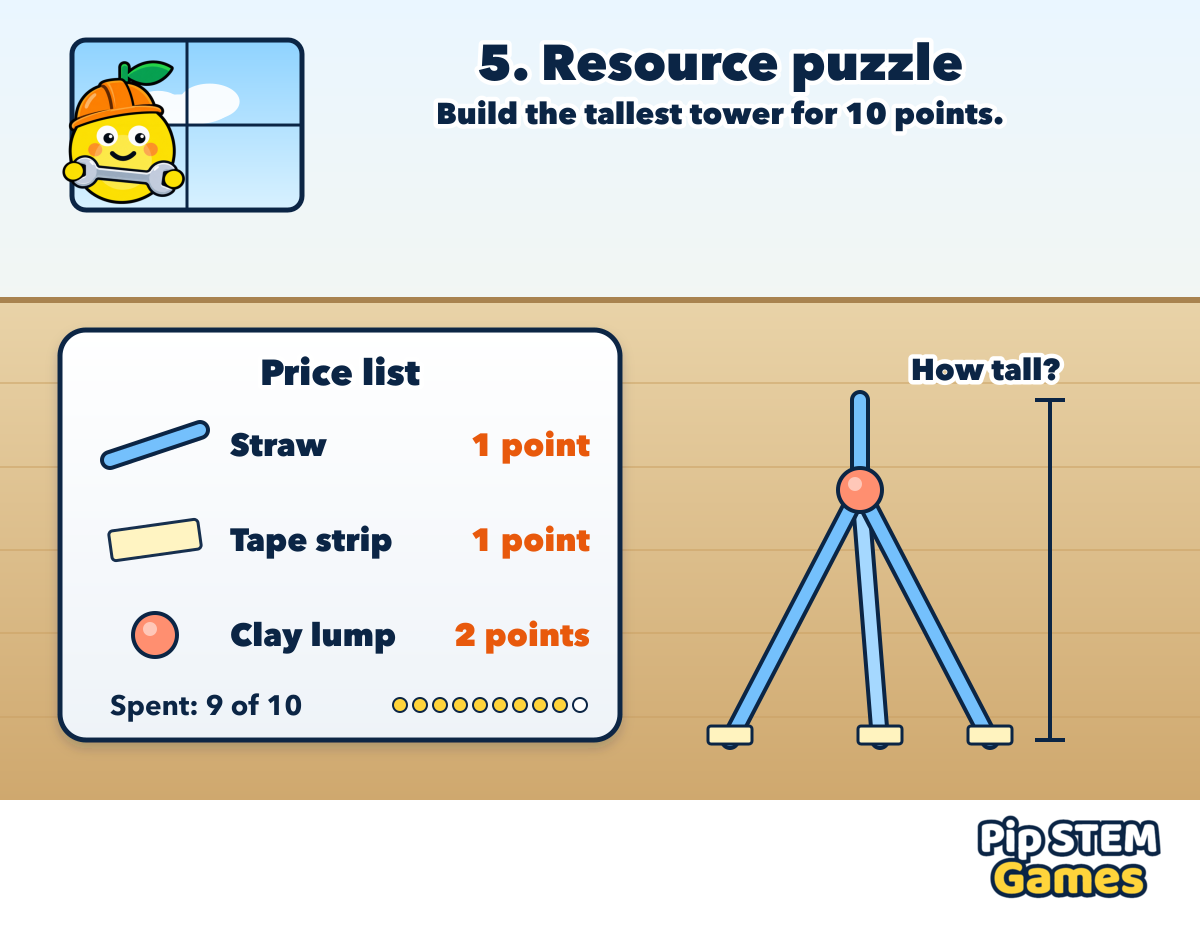
A resource puzzle asks how to reach a goal with a fixed budget. Real engineers rarely get as much as they'd like, so choosing what to spend on is part of the job. A small budget also stops children solving everything with more tape.
You need: straws, tape, modelling clay, a ruler and the price list from the picture.
- Write the price list: straw 1 point, tape strip 1 point, clay lump 2 points.
- Give your child 10 points to spend.
- Ask them to sketch a plan and add up the cost first.
- Build the tower and measure its height.
- Ask what they would buy if they had 2 more points.
The tower in the picture uses 4 straws, 1 clay lump and 3 tape strips, which is 9 points. You have 10 materials to save the island is a bigger version of the same puzzle.
How do you run a fair test with these games?
Change one thing at a time. If you compare two towers, use the same straws and load them with the same coins. Repeat each test three times and write down what happened, not what you hoped. That habit matters more than which of the five games you pick.
The order works well too. Predict, test, then change one thing and test again. Children who say their guess out loud first tend to notice far more when it turns out wrong.
What if a puzzle doesn't work?
- Gears slip: cut bigger notches or move the pins a little closer together.
- Frame keeps falling: press each clay corner firmly, then add a diagonal.
- Bulb stays dark: check the batteries face the right way, every clip touches bare metal, and the bulb suits 3 volts.
- Ruler slides off the pencil: use a hexagonal pencil or put a bit of clay under it.
- Budget runs out early: ask which part did the most work, and cut something else.
How do you change these games for each age?
Ages 5 to 7: one puzzle per session, with an adult cutting card and handling batteries. Ask only for a guess and a reason.
Ages 8 to 10: add counting and a results table, and keep the fair-test rule.
Ages 11 and 12: ask them to design a new puzzle of each type for someone else to solve. That's harder than it sounds.
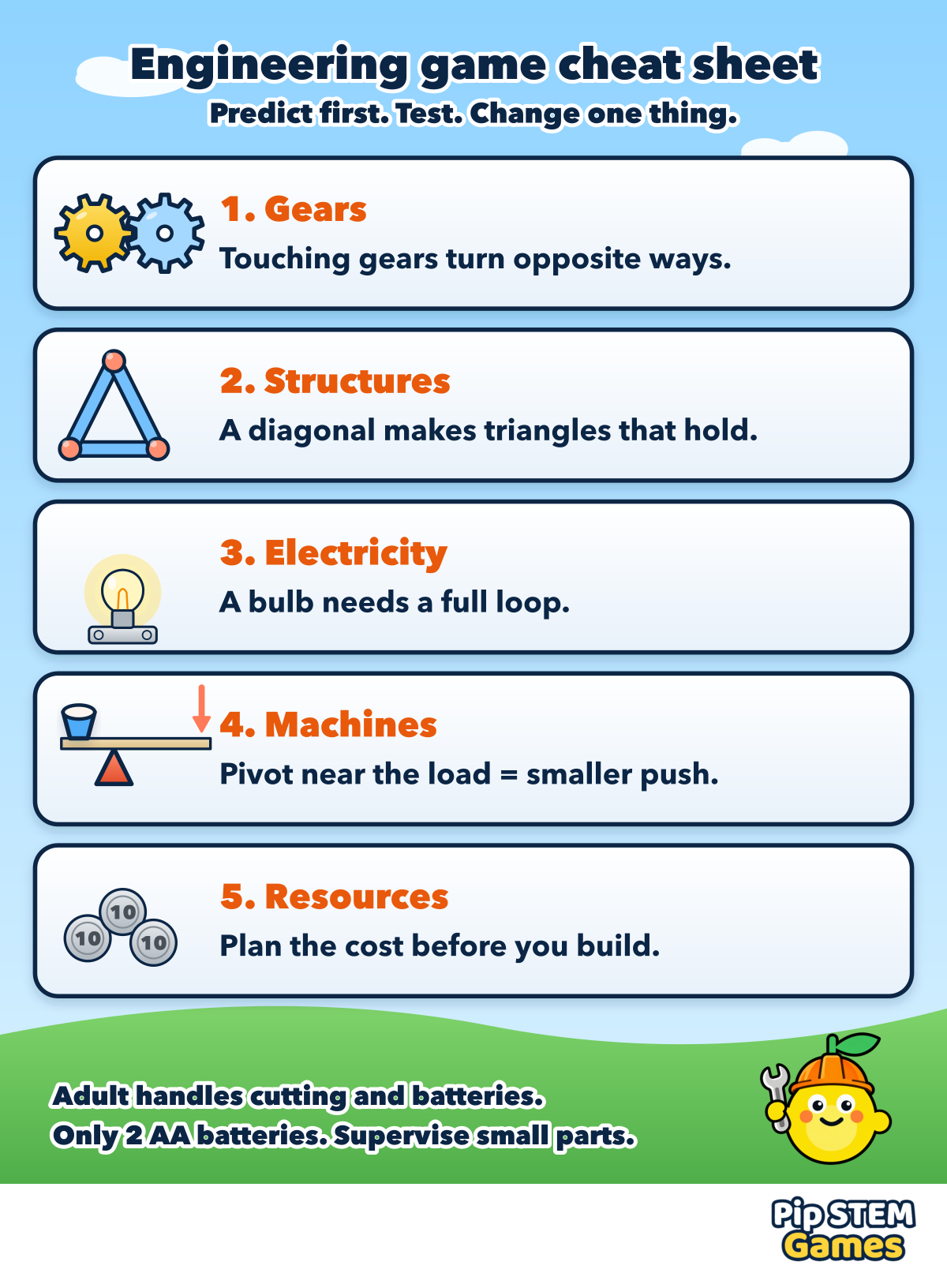
Print the cheat sheet and stick it near where you play. For game picks by age, see engineering games for ages 6 to 12.
Questions parents ask
What are engineering games for kids?
They're puzzles with a goal and a few rules, like making a bulb light or a tower stand, where children predict, test and improve their idea.
How do engineering games teach problem-solving?
Each game makes a child guess first, test the guess and then change one thing. That loop is the same one engineers use.
Which type should we start with?
Start with the gear puzzle or the structure puzzle. Both need only card or straws, and the result is quick and easy to see.
Are the electricity puzzles safe?
Yes, with 2 AA batteries, a bulb rated for about 3 volts and an adult nearby. Never use mains power and never clip the battery leads to each other.
What age are these games for?
Ages 5 to 12. Younger children make guesses while an adult handles cutting and batteries; older children record results and design their own puzzles.
Do we need a kit?
No. Card, straws, clay, a ruler, a pencil and some 10p coins cover four of the five. The electricity puzzle needs a battery holder, bulb and clip leads.
Great STEM activities to try next...
 Why the Best Engineering Puzzles Make You ThinkDesign process
 10 Best STEM Games for Kids (Apps and Board Games)Guide
 Engineering Games for Ages 6–8, 9–10 and 11–12 [Printable]By age
More to try: What Engineering Teaches Children: 5 Steps

Pip STEM Games
We make engineering games and workbooks for kids aged 5 to 12. Every activity here is one we'd happily run at the kitchen table: test it, watch it fail, fix it, try again.




